
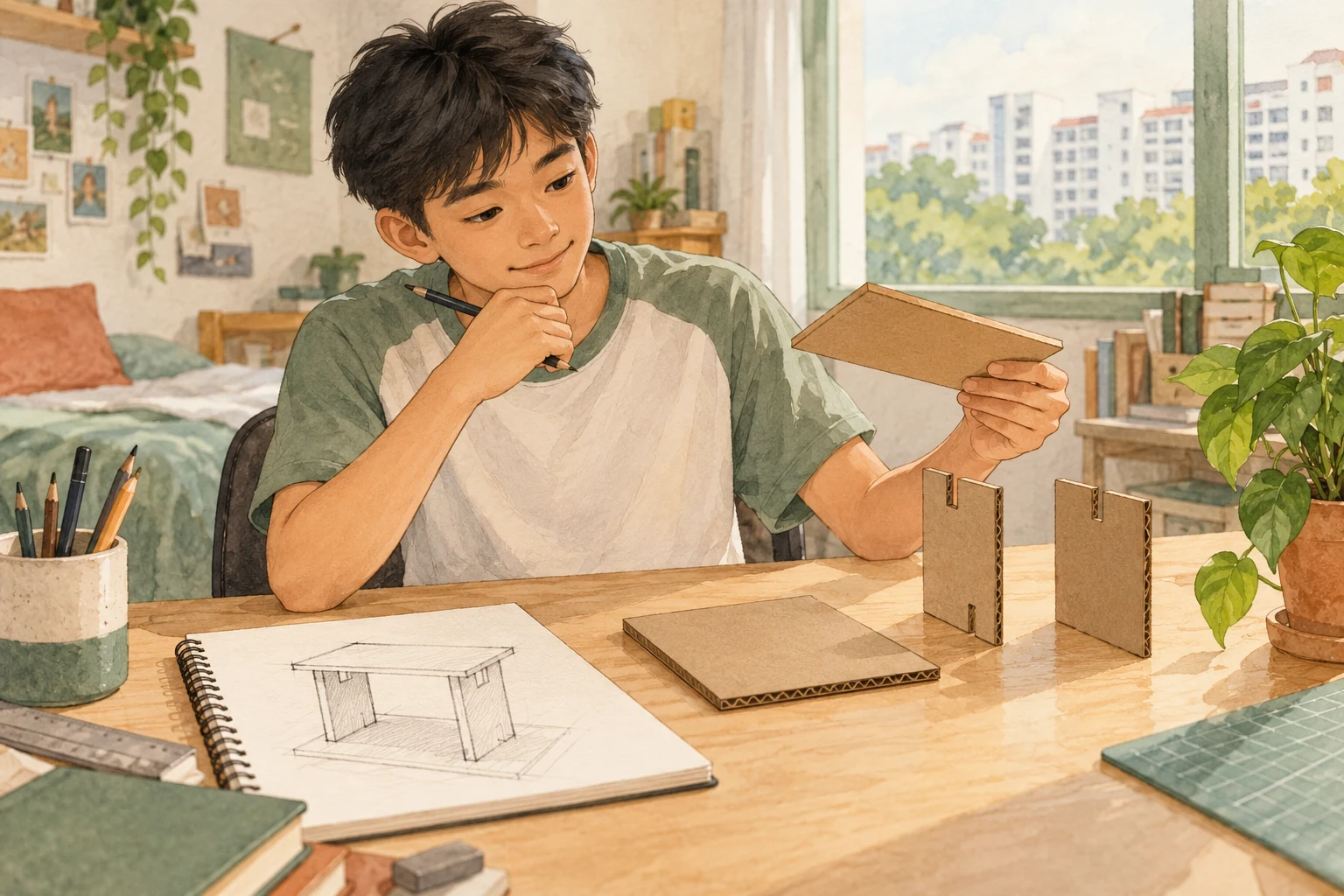
Did you know a small pencil sketch can reveal how carefully a student sees the world, even before the sketch looks like a finished artwork? A drawing of a water bottle, a bus-stop sign or a familiar doorway can help a learner observe shape, contrast, relationships and the effect of a visual decision.
Under Full Subject-Based Banding, Lower Secondary Art is part of the common curriculum students from different posting groups learn together. It is not an SEC G1 Art examination entry simply because a parent describes the child as being in PG1.
This guide explains what the shared Art experience teaches, what a good independent learning routine looks like and how a young person’s creative interests may later connect to appropriate examined subjects or education routes.
A quick Singapore parent–student guide. MOE curriculum and the 2027 SEC/2028 PSE pathways reviewed on 24 October 2026. School-specific assessments, subject availability and admissions criteria must be checked for the learner’s actual cohort.
The 60-second answer
- PG1 is the posting group used at admission. All lower-secondary students learn common Art in mixed form classes where applicable.
- MOE’s 2024 Lower Secondary Art syllabus is a common teaching and learning framework, not a separate ‘PG1 Art’ SEC examination paper.
- The syllabus has three connected learning domains: Perceive, Communicate and Appreciate.
- Students learn through observation, making, experimenting, reflecting and understanding art in contexts.
- School Art assessment or an artwork portfolio at lower secondary is distinct from a national upper-secondary SEC Art entry.
- 2027 SEC G1 Art K126 is a separate nationally examined subject; G2/G3 Art offerings have their own syllabuses and requirements.
- Art skills can support later choices, but ITE, polytechnic, JC/MI and university admission depend on the complete recognised qualification profile.
First, PG1, common curriculum and national SEC subjects are different
Did you know that the first Posting Group a child enters is not the complete story of what they will learn or where they may study later? PG1 means Posting Group 1 at Secondary 1 admission. Under Full Subject-Based Banding (Full SBB), a pupil may study other academic subjects at eligible G1, G2 or G3 levels while learning six common-curriculum subjects with classmates from different posting groups.
The six common lower-secondary curriculum subjects are Character and Citizenship Education (CCE), Physical Education (PE), Art, Music, Design and Technology (D&T), and Food and Consumer Education (FCE). They are shared within mixed form classes, and their purpose differs from the national examinations for English, Mathematics and other subjects. Schools implement the common syllabus and provide appropriate feedback and assessment.
From 2027, the Singapore-Cambridge Secondary Education Certificate (SEC) records the subjects and levels actually examined. A PG1 learner does not receive a separate PG1 certificate. The school-based common-curriculum lesson is not automatically a separate 2027 SEC result. Always check the candidate’s official subject entry, code and year.
In the case of Lower Secondary Art, this distinction is especially important: shared lower-secondary teaching has its own MOE learning aims, even when a related upper-secondary examination or separate sport/arts activity exists. Check the school’s report or examination registration rather than assuming a G1 national grade.
Why Lower Secondary Art matters in daily life
Art asks students to look before they assume. When a learner observes a cup, building or printed message, they can investigate shape, surface, space, contrast and how different viewers might interpret an image.
MOE’s 2024 Lower Secondary Art syllabus identifies three learning domains. Perceive concerns observing, analysing and recording visual information. Communicate concerns developing and expressing ideas using art materials and methods. Appreciate concerns reflection, dialogue, cultural understanding and meaning.
These domains work together. A student may first notice that a sign is difficult to read, then try alternative visual compositions, and finally explain how a choice affects the audience. The strongest result is not necessarily the most decorative design.
Art also provides a way to explore identity and culture. Students can encounter works from Singapore and elsewhere, notice different artistic approaches and learn to discuss them without dismissing unfamiliar styles as simply ‘bad’.
Creativity benefits from constraints. A limited space, small selection of materials or defined audience can encourage learners to make more deliberate choices. A portfolio or visual journal can record those choices and allow the learner to revisit an idea after feedback.
Even when a child does not pursue examination Art, the abilities to observe, interpret, design, communicate and reflect can support learning in many settings.
Eight practical skills behind Lower Secondary Art
- Perceive: identify important visual qualities in objects, images and places.
- Record: use drawing or another suitable visual method to capture an observation.
- Ask: develop a meaningful question about a visual or design situation.
- Experiment: compare materials, techniques and alternatives rather than copying one answer.
- Communicate: choose a visual form that helps another person understand an intended message.
- Appreciate: notice context and describe how another artist’s work influences an interpretation.
- Reflect: explain one change made in response to evidence or feedback.
- Collaborate ethically: respect other contributors, acknowledge references and keep assessed work authentic.
Did you know? A worked example that teaches the thinking
Imagine an unassessed classroom task: a school lost-and-found corner has a small sign that many students overlook. The class is asked to propose a clearer sign that communicates where to collect missing items. This is an original learning example, not an official examination brief.
Step one is perception. Before drawing, ask what is currently easy or difficult to notice. Is the text too small? Does the icon communicate the intended action? Are the colours legible against the background?
Step two is experiment. Make two quick sketches using different visual hierarchies. In the first, a large symbol leads the eye; in the second, a short headline and high-contrast arrow take priority. Neither needs to be beautifully finished to be useful.
Step three is audience testing. Show the two sketches to someone unfamiliar with the task and ask what the sign means. An unexpected misunderstanding may be more valuable than a compliment.
Step four is reflection. The learner chooses a revision and writes why it helps the intended viewer. ‘I increased the headline and simplified the arrow because my classmate missed the location on the first version’ is more informative than ‘I made it nicer’.
Step five is independence. Change the audience—perhaps visitors unfamiliar with the school—and ask the child to create a new solution without tracing the first model. The skill is visual reasoning that transfers to another situation.
What the official MOE syllabus and school assessments actually mean
The 2024 MOE Lower Secondary Art syllabus brings together Perceive, Communicate and Appreciate. Learners gather and record observations, generate visual ideas, experiment with materials, develop works and reflect on artistic meaning.
Schools adopt different themes, tasks, available tools and feedback approaches within the shared syllabus. Common Art may have school-based assignments, projects or assessments, but these do not automatically become a national SEC Art grade.
Under Full SBB, common Art is part of the lower-secondary six-subject set with CCE, PE, Music, D&T and FCE. Mixed form classes provide opportunities for students with varied academic subject-level combinations to learn and interact.
In upper secondary, a student may have the option of examined Art at an actual level, where the school offers it and the student meets applicable requirements. The 2027 school-candidate G1 SEC Art examination code is K126; this is different from being a Secondary 1 student in PG1 common Art.
Other creative pathways, including suitable higher-level Art offerings and arts programmes, may have school-specific prerequisites and selection arrangements. A positive visual project is worth celebrating but should not be mistaken for an automatic examination subject placement.
Parents can support by asking good questions and providing safe materials as appropriate; graded projects and portfolio work must remain the student’s own, with the teacher’s rules respected.
Six learning gaps and targeted repairs
- The child judges every drawing by realism. Repair: identify the actual task, such as observation, visual communication or exploration.
- A student copies a reference without understanding it. Repair: record what was learned from the reference, acknowledge its source and develop an independent idea.
- An elaborate final piece hides a weak concept. Repair: ask whom it is for and what the viewer should notice first.
- The learner discards all early experiments. Repair: keep a brief record of one idea, test and meaningful revision.
- Parents mistake common Art lessons for the national G1 Art exam. Repair: check the school’s upper-secondary subject entry and 2027 K126 requirements separately.
- Adults direct every creative decision. Repair: ask the child to explain two options and choose between them before offering guidance.
A simple routine that builds independent understanding
Begin with a short visual observation: choose an everyday object and ask what makes its shape or purpose recognisable.
Make two simple sketches or arrangements that answer different visual questions. Record the intention before polishing.
Ask the student to explain one element such as contrast, balance, viewpoint, spacing or colour and how it influences meaning.
Invite one relevant comment, then let the learner decide what to revise and describe the reasoning.
Return to the principle in a different context several days later. Progress appears when the child can generate and explain a new idea without the original example.
The Secondary 1 to Secondary 4 learning journey
- Secondary 1: notice visual qualities, explore media and develop confidence communicating ideas in common Art lessons.
- Secondary 2: practise more sustained inquiry, experimentation, reflection and independent choices across school tasks.
- Secondary 3: confirm whether an examined Art subject is offered at an eligible level and use the correct SEAB syllabus if selected.
- Secondary 4: complete authentic assessed work for any chosen national Art syllabus and check the full post-secondary subject-level and admissions profile.
Education pathway: ITE, Polytechnic, JC and University
Did you know ‘could my child one day earn a university degree?’ and ‘does this particular lower-secondary subject meet a course’s immediate entry requirements?’ are very different questions? The first is a possibility that depends on future recognised qualifications; the second requires checking precise academic requirements today.
MOE has announced the Post-Secondary Admissions Exercise (PSE) from 2028 for the main results-based entry routes to eligible ITE, polytechnic and JC/MI programmes. Admissions requirements remain different for each destination. A student’s participation in an important common-curriculum subject does not replace missing formal qualification, subject level or grade requirements.
A practical family plan therefore has two parallel tracks: help the child develop useful independent life skills today, and verify the complete academic qualification profile required for any future course. Both matter, but they are not the same test.
1. ITE Higher Nitec and skills-based progression
ITE: visual awareness and design reasoning can be relevant to creative media, technical communication, digital production or service fields. Entry to a chosen Higher Nitec course requires its full recognised SEC eligibility conditions; lower-secondary common Art is not an independent admissions grade.
2. Polytechnic diplomas: direct or later progression
Polytechnic: suitably qualifying students may explore diplomas in design, media, business or other fields, through direct SEC admission or recognised ITE-to-diploma progression. A programme may require certain academic grades or aptitude evidence; one school drawing does not replace those conditions.
3. Junior College and Millennia Institute
JC/MI: the announced 2028 JC L1R4 framework uses eligible G3 subject results. The child may develop Art interests within secondary school, but common Art classes are not G3 SEC aggregate subjects.
4. University: a later qualification checkpoint
University: later applications, including to creative programmes, depend on recognised pre-university or diploma qualifications and course-specific requirements, which sometimes include interviews or portfolios. The original PG1 admission grouping is not a lifelong limit or an admission guarantee.
A realistic one-week practice plan for Lower Secondary Art
- Monday: observe an everyday object and draw a few features that make it recognisable.
- Tuesday: compare two visual layouts for the same message.
- Wednesday: discuss a work of art by describing observable qualities before judging it.
- Thursday: experiment safely with an alternative material or viewpoint in an unassessed exercise.
- Friday: write two sentences about a revision and the evidence that prompted it.
- Weekend: design a small visual explanation for a different audience without copying a template.
Three parent–student conversations that help without pressure
Conversation A: ask the student which real task they can now complete more independently. Request a concrete example, not a vague label such as ‘I am better at everything’.
Conversation B: ask the teacher what feedback is available from the common curriculum, what the next suitable challenge is, and which activities must remain under school supervision or safeguarding arrangements.
Conversation C: for a named future ITE, diploma or JC course, list its actual subject-level requirements and published admissions criteria. Then compare these with the pupil’s current planned and attainable academic qualifications, not a fictional PG1 examination score.
What parents should track in a small learning notebook
Use four columns: task attempted, first point of uncertainty, student-made improvement and next date to check a changed example independently. The point is not to create another burden. A short record helps reveal whether a learner has actually understood, rather than repeating something with adult hints.
At the end of a month, ask the child to explain one changed situation without prompts. That evidence can guide a conversation about future learning, interest and appropriate support. The school’s official assessment and subject-placement procedures remain authoritative.
Frequently asked questions
Is PG1 Lower Secondary Art a national SEC subject?
No. Lower-secondary common Art is taught together under Full SBB. SEC G1 Art K126 is a distinct examined upper-secondary subject.
Does every PG1 student study common Art?
Common Art is among the six lower-secondary curriculum subjects for mixed form classes under Full SBB, subject to the school’s educational arrangements.
What are the three MOE Art learning domains?
Perceive, Communicate and Appreciate, which connect observing, creating, reflecting and cultural understanding.
Does an untidy drawing mean a student is weak at Art?
Not necessarily. Assess what the task was intended to develop: careful observation, original ideas, testing and communicating meaning.
Is a lower-secondary project portfolio the same as G1 Art K126 coursework?
No. The national examination has specific requirements and authentication procedures that differ from school common Art activities.
Can a PG1 learner later offer Art at another level?
Potentially, depending on school provision, subject combinations, eligibility and the student’s demonstrated readiness.
Can Art lead to a design diploma or university degree?
Possibly through recognised qualifications and satisfying course-specific requirements. Lower-secondary common Art does not by itself guarantee admission.
Where to verify the curriculum and education pathways
MOE provides the relevant lower-secondary syllabus and Full SBB information. SEAB publishes the actual 2027 SEC G1 school-candidate subject list. A subject may be valuable for education without appearing in that national-examination directory.
MOE’s 2028 Post-Secondary Admissions Exercise information describes how the main results-based admission routes operate. The latest rules of the selected institution and programme determine the eligibility of an individual student.
MOE school — Full SBB common curriculum and mixed form classes
MOE — official Lower Secondary Art teaching and learning syllabus (PDF)
SEAB — 2027 SEC G1 school-candidate subject list
SEAB — what the Singapore-Cambridge SEC records
MOE — Post-Secondary Admissions Exercise from 2028
MOE — 2026 announcements on education, skills and admissions
ITE — progression after Higher Nitec
Continue reading on eduKateSG
What is PG1? Posting Group versus G1, G2 and G3 subject levels
Full SBB: six lower-secondary common curriculum subjects explained
Why do PG1, PG2 and PG3 students share Art, PE and CCE lessons?
Does Full SBB common curriculum stop after Secondary 2?
Which SEAB syllabus should my child use? Complete subject directory
PG1, PG2 and PG3: ITE, JC, Polytechnic and University pathways
PG1, PG2 and PG3 common Art: visual literacy and SEC elective differences
What is PG1 Art? Understanding the actual G1 SEC Art K126 examination
What is PG1 Food and Consumer Education? Another practical common subject
One good question to ask tonight
Ask your child: ‘What did you want your artwork to communicate, and which choice helped someone understand it?’ A clear independent explanation helps parents and teachers see which practical skill is secure, which step needs support and how to preserve genuine educational choices.