
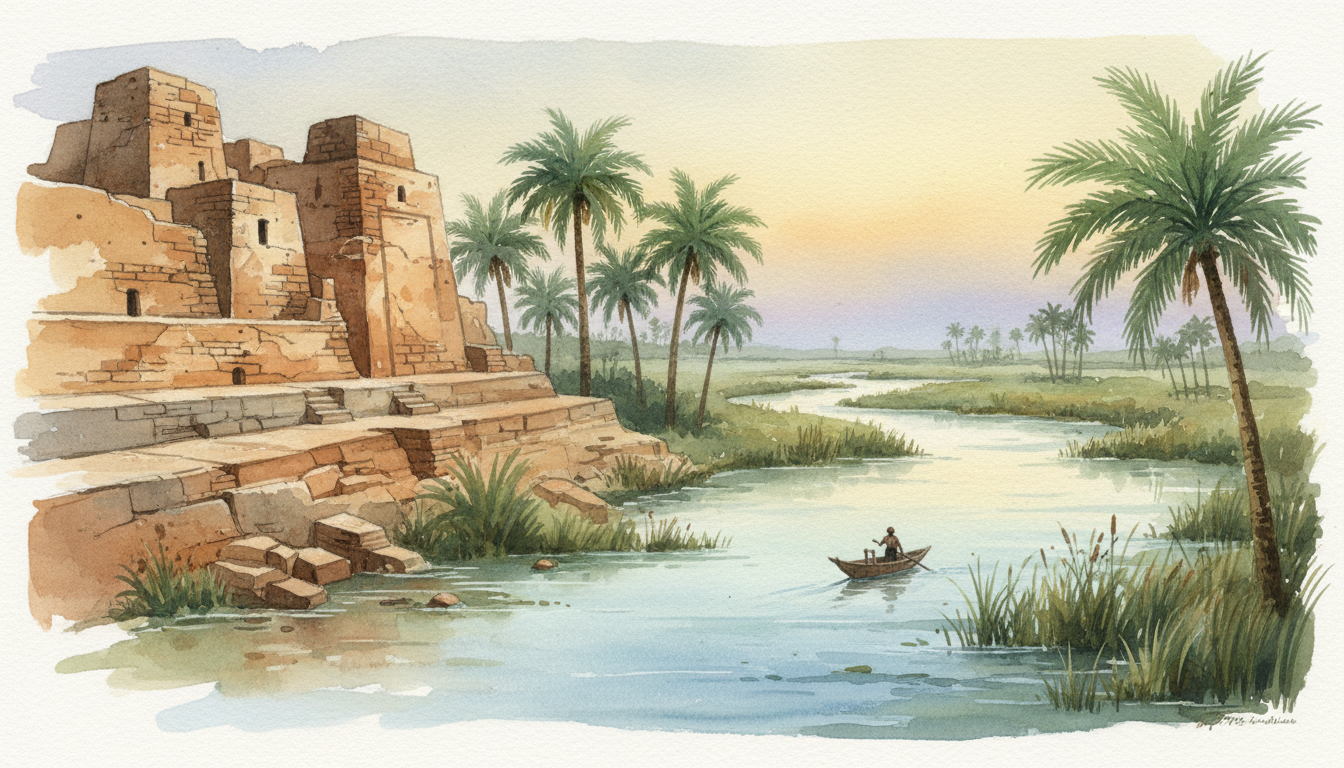
What will happen to civilisation when farmland becomes less productive year after year? The history of southern Mesopotamia—the region of early Sumerian cities in present-day Iraq—shows why a food crisis need not begin with one dramatic disaster. Sometimes the problem builds quietly in soil and water while a prosperous society is busy expanding.
Did you know? Irrigation can help a dry landscape feed thousands of people, yet poorly drained irrigated land may accumulate salts that make crops harder to grow. Farmers can try other crops, improve drainage and change how they use water. The ancient history is therefore not a simple morality tale about clever engineers destroying their own civilisation; it is a lesson in long-term maintenance and adaptation.
This guide explains Mesopotamian irrigation, soil salinity, food insecurity, urban dependence and possible future consequences through short, connected cause-and-effect explanations. Historical causes of the rise and change of Mesopotamian states remain debated. The future scenarios below are hypothetical, not predictions.
One-minute answers: What happens when food production declines?
| Question | Quick answer |
|---|---|
| Why did southern Mesopotamia need irrigation? | Rainfall was often inadequate for reliable farming, while the Tigris–Euphrates river system offered water and fertile alluvial soils. |
| What is soil salinisation? | An accumulation of soluble salts in soil, potentially interfering with plant growth. |
| Why can irrigation increase salt? | When water evaporates or is used by plants, dissolved salts can remain; drainage and water-table conditions affect the outcome. |
| Did salt alone end Sumer? | No single-cause explanation is established. Political competition, river changes, conflict and trade also shaped states and settlements. |
| What can happen to modern civilisation? | Food prices, livelihoods and migration pressures can change; outcomes depend on adaptation, markets, public support and ecology. |
| Can damaged farmland recover? | Sometimes, through suitable drainage, water management, crop choice and soil rehabilitation, depending on local conditions and resources. |
How canals helped build the first urban worlds
Mesopotamia means “between the rivers”, referring mainly to the Tigris and Euphrates. Its southern plains became home to early cities, institutions and writing traditions. Many communities depended on bringing river water to fields through canals and associated works. Water control made larger agricultural surpluses possible in places where rain alone could not reliably feed extensive settlements.
Imagine the work required. Someone must maintain the channels; farmers must receive water at useful times; labour must be organised; disputes over land and access must be resolved. Harvests require storage, processing and movement toward households and workshops. The canal is not a self-running machine—it is a continuing agreement among people, engineering and the environment.
Surplus grain can help support builders, traders, craft specialists, administrators and religious institutions. It also creates exposure: people who specialise in other work rely on farmers and the networks that carry food. If yields fall, the effects spread beyond the field.
An article from the American Society of Overseas Research’s Ancient Near East Today explains that salt played complex roles in the region. Useful in foods and production, salt could also threaten agriculture when water management allowed harmful concentrations to build in soils.
The quiet problem: how soil becomes too salty
River and groundwater can contain dissolved minerals. When irrigation water reaches a field, some enters plants or evaporates. If drainage does not remove enough salts, the remaining minerals may accumulate in the root zone. A shallow salty groundwater table can make the process worse when water rises through the soil and evaporates near the surface.
Plants do not all tolerate salinity equally. Salts can make it harder for roots to take up water, even when a field looks wet. Under some conditions, soil structure and infiltration can also deteriorate. That means a farming system may receive plenty of water but still grow weaker harvests.
The US Department of Agriculture’s salinity research unit explains how irrigation, groundwater and poor drainage can create local or regional salinity problems. This modern science clarifies the physical mechanism. It does not, by itself, establish the precise cause of any ancient political event.
There is another twist. Flushing salts out of one field may send them somewhere else. An engineering intervention that improves conditions upstream could worsen conditions downstream if water and salt disposal are not planned at the wider basin scale.
Was Mesopotamia undone by its own canals?
Scholars have long examined evidence from cuneiform records and the landscape for signs that salinity affected cultivation in southern Mesopotamia. A classic argument draws attention to changing cereal production, including the relative importance of barley, which generally tolerates salt better than wheat. Those patterns are useful clues, but crop choices have several possible causes.
A historical overview of soil salinity summarises the traditional connection between salinisation, crop changes and agricultural decline. However, converting that historical association into “salt caused Sumer to fall” would go beyond what one set of indicators can prove.
The Mesopotamian world spanned many cities, dynasties and centuries. Conflicts, shifting rivers, trade arrangements and political authority changed at different times. Irrigation required both technical and social coordination. Rather than one irreversible disaster, researchers study repeated stresses and responses in particular localities.
One Journal of Archaeological Science modelling study examined the resilience of Mesopotamian irrigation agriculture under simulated salinity pressures. A model helps explore possible mechanisms under stated assumptions; it is not a direct observation of every ancient farm.
That distinction is useful for modern readers. Archaeology shows what people built, recorded and left behind. Soil science helps explain processes. Modelling tests possible interactions. No one kind of evidence should quietly be substituted for all the others.
The cause-and-effect chain: fields, markets and government
- 1. Soil and water pressure: saline groundwater, inadequate drainage or changing river flows reduce suitable land or harvest reliability.
- 2. Production change: farmers adjust crops, inputs, labour and where they cultivate.
- 3. Household effects: food may become more expensive or difficult to access, especially for families with little savings or land.
- 4. Urban effects: traders and specialist workers experience weaker purchasing power, shortages or reduced demand.
- 5. Institutional decisions: leaders and communities choose whether to invest in drainage, help affected households, negotiate water access or fight over scarce supplies.
- 6. Long-term adaptation: land may recover, cultivation may shift or settlement patterns and institutions may change.
This is not a guaranteed domino sequence. Grain can be stored or imported. Farmers can change crops. Neighbouring communities can cooperate. Conversely, conflict or unequal control of water can make an environmental difficulty much harder to solve.
Did you know? A crop switch can be a form of intelligence
If wheat becomes less suitable for a field, a farmer may experiment with a crop that tolerates the local conditions better. That is adaptation, not automatic failure. But a crop switch can also mean lower dietary diversity, altered income or a difficult reorganisation of labour, depending on the market.
The same decision can carry different meanings in different records. A change from wheat to barley might indicate salinity pressure, price incentives, food preferences, tax policy or multiple factors. Researchers need location, chronology and supporting evidence before drawing strong conclusions.
A civilisation that learns from difficult observations may survive by changing practices. A civilisation that ignores declining productivity because its cities still look impressive may discover the problem after it has become expensive to repair.
What could happen in the future? Three conditional scenarios
Scenario A: the slow decline is detected early
Hypothetical. Farmers record rising salinity and falling yields over several seasons. Agricultural specialists test soils, improve drainage where practical and modify irrigation schedules. Authorities consider downstream salt disposal. Support helps smaller farmers adapt without losing all their land. The cost is real, but the problem remains manageable.
Watch for soil testing, water-quality records, repair budgets, farm-income trends and whether these measurements lead to action rather than reports that sit unread.
Scenario B: yields weaken while food markets remain connected
Hypothetical. Some irrigation districts lose productivity while other regions can supply grain. Imports and crop substitution prevent immediate famine, but prices rise and rural employment changes. Cities continue to function, yet poor households may face serious hardship. National food availability does not mean equitable household access.
Watch for unequal food expenditure, rural debt, market access, nutrition outcomes and the ability to move food safely without undermining future local production.
Scenario C: combined environmental and political failure
Hypothetical. Poor drainage causes salinisation while repeated drought, conflict and energy interruptions restrict water management. Credit dries up, repairs are postponed and producers leave. One productive region may enter prolonged distress. This would reflect several interacting failures—not proof that farming in every country is collapsing.
Watch for overlapping stresses and whether affected communities retain functioning channels for repair, finance, dispute resolution and support.
A modern risk is not the same as an ancient prediction
Modern agriculture uses pumps, sensors, scientific soil testing, fertilisers, crop breeding and global logistics that early Mesopotamian farmers did not have. Modern systems also depend on electricity, machinery, markets and public regulation. Technology expands choices but can introduce new dependencies.
The most useful historical comparison is the relationship between immediate benefits and delayed costs. Irrigating a new field may boost output quickly. Correcting accumulated salts can take years and require cooperation beyond one farm. Society tends to notice the easy benefit before the slow maintenance bill.
That pattern appears in other systems too: groundwater extraction, infrastructure ageing, waste management and public debt. The details differ, but all demand decisions that account for future generations.
How a reader can recognise a credible food-security warning
- Is there measured evidence of yield change, water quality or soil salinity rather than only a dramatic photograph?
- Does the claim distinguish local land degradation from regional or global food availability?
- Have alternative explanations such as weather, prices, plant disease and policy been considered?
- Which people will be affected first, and do they have meaningful options?
- Can practical intervention reduce the harm, and who pays for its implementation?
- Are claims about ancient Sumer presented as historical debate rather than a universal law?
Frequently asked questions
What did ancient Mesopotamians grow?
Important crops included barley and wheat, alongside dates, vegetables and other products. The mix varied over time and between localities.
Why is soil salinity dangerous?
High concentrations of salts can make it difficult for crops to take up water and can impair soil performance. Effects differ among crops, soils and water conditions.
Did soil salinity destroy Sumer?
It is one historically important hypothesis for part of Mesopotamia’s long agricultural history. The fate of particular Sumerian states cannot be reduced to salt alone.
Could a modern city lose access to food even if farms survive?
Yes. Transport, income, storage, conflict, processing and pricing affect whether food reaches households. Availability and accessibility are separate questions.
What is the lesson for civilisation?
Protect not just short-term production but also the soils, waterways, maintenance institutions, skills and fair access that allow food production to continue.
Read the Civilisation future series
- Do Civilisations Collapse or Transform?
- When Water Systems Fail: Lessons from Angkor
- When Trade Networks Break: The Bronze Age Lesson
- How Societies Rebuild After Empires Fall
- Everything About Iraq — historical geography and present-day context.
Sources and further reading
- The Ancient Near East Today — Salt in Mesopotamia: A Blessing and a Curse, American Society of Overseas Research.
- Assessing the resilience of irrigation agriculture, Journal of Archaeological Science (2012): modelling ancient farming pressures.
- Soil Salinity: Historical Perspectives and a World Overview (2018): historical background and modern science.
- US Department of Agriculture — Frequently Asked Questions About Salinity: modern physical processes.
Reviewed 24 October 2026. The featured illustration is a nonliteral educational impression of Mesopotamian heritage and river ecology, not a photograph of a Sumerian field. Future scenarios are illustrative; historical uncertainty is retained.