
Reading note (SC 56 audit, 25 October 2026): This accessible companion article summarises the Dust Bowl case. For the fuller historical analysis, evidence, FAQs and sources, read the primary Dust Bowl guide. The original article remains available for existing readers, while this companion is excluded from search indexing to avoid two near-identical search results.
Did you know? During the 1930s, parts of the American Great Plains became so dusty that daylight could turn almost black. Farms failed, families struggled to breathe indoors, and people left homes their parents had worked to build. This was the Dust Bowl: a warning from history about what happens when severe drought meets fragile soil and an economy already in crisis.
The United States did not collapse. Some families stayed; others moved, often facing new insecurity and discrimination. Farming methods and public institutions changed. The result is more complicated, and more useful, than the dramatic claim that a single dust storm destroyed a civilisation.
The key question for the future is this: when land stops protecting the people who depend on it, can institutions repair the relationship before livelihoods unravel? We will follow what happened, what can be established from evidence, and four possible scenarios for modern societies. This is historical explanation, not a prediction about any particular country.
Dust Bowl in one minute: what happened and why?
| Reader’s question | Evidence-based quick answer |
|---|---|
| When was the Dust Bowl? | Mainly during the drought and dust-storm years of the 1930s on the Great Plains. |
| Where was the centre of the crisis? | Especially parts of Oklahoma, Texas, Kansas, Colorado and New Mexico, though wider drought affected other areas. |
| Did one storm cause it? | No. Repeated drought, exposed soil, strong winds, farming practices and economic hardship combined. |
| What was Black Sunday? | A major dust storm on 14 April 1935 that darkened the sky across parts of the Plains. |
| What happened to the people? | Crop losses, debt, health problems, hardship and movement; experiences differed widely. |
| Did all farmers leave? | No. Many stayed and attempted to conserve and restore their land. |
| What followed? | Relief efforts and a larger federal programme of soil conservation, including the Soil Conservation Service established in 1935. |
Start with the landscape, not the disaster photograph
The Great Plains was not an empty or useless expanse waiting to be cultivated. Its grasslands, soils, communities and seasonal patterns had long histories before the 1930s. Native grasses helped hold the soil together, while Indigenous peoples had deep connections to prairie environments. Settler agriculture changed land use on a very large scale, and the mechanisation of farming made it possible to plough extensive fields.
During years when wheat was in demand, expansion appeared economically promising. Yet converting grassland to cultivated fields altered how vulnerable the land was when rain failed. The Kansas Historical Society’s Dust Bowl account highlights the combined roles of wheat demand, machinery, price pressures and the removal of native cover.
That does not mean farmers were unaware of all risk or that every farm was managed in the same way. Families were responding to markets, loans, technology and the information available to them. A historical explanation has to examine the incentive system, not merely blame individual people working difficult land.
Did you know? Drought became dangerous because the soil was exposed
Dry spells had occurred on the Plains before. What made the 1930s crisis so destructive was the interaction between prolonged lack of moisture and land whose protective vegetation had been reduced in many cultivated areas. When crops failed and soil dried, strong winds could lift fine topsoil into the air.
The US National Weather Service’s account of Black Sunday explains how removal of grasses and years of ploughing left soil poorly anchored. Once loose soil began moving, farming became still harder: young plants could be damaged, visibility dropped, homes filled with dust and transportation was interrupted.
This is a feedback loop. A failed crop leaves less cover; less cover allows more wind erosion; erosion makes future crops harder to establish. A drought is an environmental event. The scale of dust loss also depends on how land has been used and protected.
April 14, 1935: why Black Sunday matters
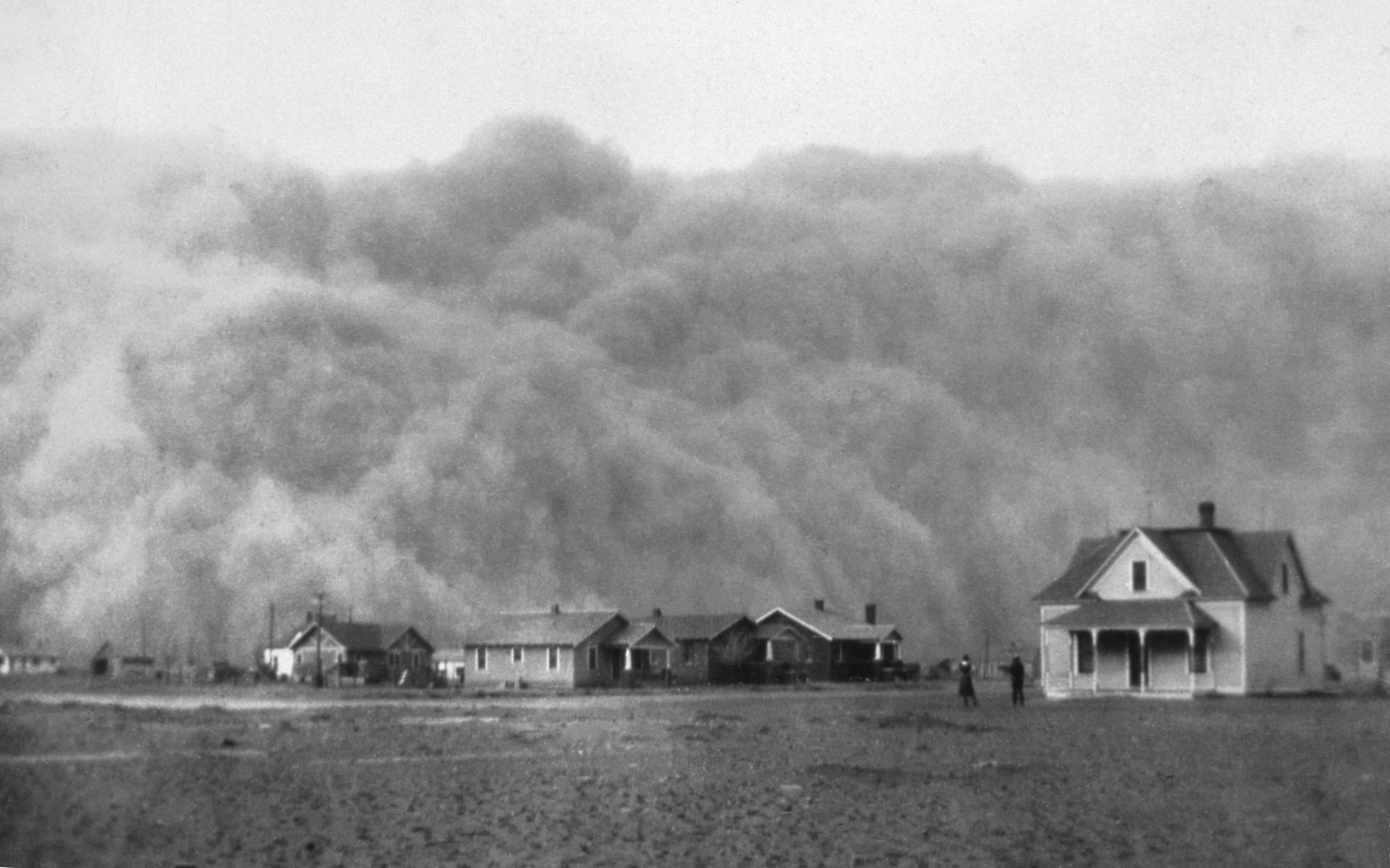
On 14 April 1935, a huge dust storm crossed parts of the central Plains, and darkness arrived in places in the middle of the day. The event became known as Black Sunday. It was not the first storm or the end of the crisis; it was a memorable moment within several years of environmental and social stress.
People sought shelter, but dust could enter buildings through small openings. For farming households and towns, the cost was not just one day’s dramatic weather. Repeated dust meant interrupted work, difficulty keeping homes and schools usable, health concerns and persistent uncertainty about whether next season would be any better.
The Library of Congress Dust Bowl timeline places Black Sunday alongside legislation, drought relief and migration. That chronology helps avoid a misleading interpretation: public responses did not begin only after a famous photograph. They were part of continuing attempts to address a widening crisis.
What did losing topsoil really mean?
Topsoil is not simply loose dirt. It contains organic matter, minerals and the soil structure required to support plants. Building fertile soil can take long periods, while severe erosion can remove valuable surface material much faster. A field may look flat and familiar after a storm but have lost productivity that is difficult to replace.
Imagine a farmer who cannot reliably harvest enough grain. Income falls. Loans become harder to pay. Repairing fences, purchasing seed or keeping machinery working becomes difficult. That weakens the next production cycle and can increase reliance on credit precisely when banks and other businesses are under stress.
The environmental problem now has an economic pathway. It moves from soil to harvest, from harvest to household accounts, from household accounts to local shops and credit, and from there to the stability of a whole agricultural community.
The Great Depression made a hard situation harder
The Dust Bowl overlapped the Great Depression. Farm households did not face drought in an otherwise thriving economy with abundant alternative jobs and easy loans. Crop losses interacted with falling income, bank distress, foreclosures and reduced purchasing power.
This is why the Dust Bowl should not be explained as a drought-only event. A household with financial savings, strong support networks and another source of income could make different choices from a tenant farmer with few assets. The same dust cloud crossed unequal situations.
For the financial side of this period, compare the SC 56 article When Banks Fail: The Great Depression. Put the two histories beside each other: financial collapse and environmental degradation can reinforce one another without being identical processes.
Did everyone become a migrant? No—and the numbers need care
The famous image of families driving west is important, but it is not the only Dust Bowl experience. Some moved to California or other places; many remained on the Plains. Some who moved came from drought-affected farming counties, while others moved for broader Depression-era economic reasons.
The Library of Congress overview of Dust Bowl migration discusses approximately 2.5 million people leaving the broader Dust Bowl states during the decade. That is not a count of people directly blown off a farm by dust, and it must not be presented as though everyone came from the central storm zone. Research at the University of Washington’s migration project adds important distinctions about migrants’ varied home counties and occupations.
Migrants sometimes found difficult working conditions and hostility in receiving communities. Movement could offer a route to survival while transferring the problem of finding secure work, housing and social acceptance somewhere else. To study resilience, count both the people who stayed and those who left—and examine their options.
Government responses: relief and the slow work of conservation
Emergency assistance mattered, but the long-term lesson was that land management needed to change. The federal government developed conservation programmes using new demonstrations, technical support and policy instruments. Under the New Deal, the Soil Erosion Service began work in 1933; the US Department of Agriculture’s NRCS history records the creation of the Soil Conservation Service after the Soil Conservation Act of 27 April 1935.
Advice and programmes encouraged farming approaches intended to keep soil in place: contour cultivation, strip cropping, crop rotations, windbreaks and other methods adapted to local conditions. No single method repairs every climate or soil type. The principle was to observe the land as a system and reduce the pathways by which a bad season could permanently damage its productivity.
Public institutions could not make rain arrive on demand. They could, however, support better decisions, distribute knowledge and alter incentives. This is why the Dust Bowl is a story of institutional learning, not merely an environmental disaster.
Soil conservation was knowledge transferred into daily practice
Technical recommendations are useful only if people can apply them. Farms differ in slope, soil, water access, vegetation and finances. A method demonstrated on one field may need adaptation elsewhere, and an owner may be more capable of adopting a change than a family renting land under a short contract.
Extension services and demonstration projects sought to bridge that gap: show what works, explain why, and make it practical. Sustainable recovery depends on repeated use, not on a one-time statement that conservation is important.
The same lesson applies to modern civilisation. A resilience policy printed in a report is not yet a resilient system. The practice has to reach the people who maintain the land, buildings, water supply, transport and public services.
Why the Dust Bowl was not the end of American civilisation
The United States continued to function as a state through the crisis, albeit amid immense social and economic suffering. Communities changed; some farms were abandoned; new approaches spread; households moved and re-established lives. Calling the entire civilisation destroyed would obscure both the losses and the continuing structures that enabled a response.
That does not make the disaster small. It means that a serious analysis separates the affected system from the larger society. For a particular family, the loss of a farm may have meant the end of a way of life. For a town, migration could weaken schools and commerce. For federal institutions, the crisis accelerated changes in land-conservation capacity.
Several levels of survival existed at once. The state endured; particular livelihoods did not. A future society can experience that same uneven pattern, and it should be judged by the protection it provides to people, not merely by whether its flag continues to fly.
Cause and effect: how a Dust Bowl develops
| Step | Historical mechanism | Question for the future |
|---|---|---|
| Expansion | Grassland converted to exposed cultivation | Are land-use incentives increasing ecological risk? |
| Hazard | Prolonged drought and strong winds | How well are drought and erosion monitored? |
| Damage | Topsoil loss and crop failure | Which soils and households are least able to recover? |
| Financial pressure | Debts, lost income, business difficulties | Are there buffers when production fails? |
| Movement | Families make unequal stay-or-leave decisions | Can people move without losing dignity and opportunity? |
| Repair | Conservation policies, practices and technical support | Do solutions reach the field rather than stay on paper? |
What could happen to future civilisation? Four conditional scenarios
These examples are possible pathways, not predictions. Modern societies have better weather data, improved agronomy and many different economic systems. Historical comparisons are useful when they help test a mechanism, not when they pretend the future will be a replay of 1935.
Scenario 1: drought arrives, but the ground stays protected
A farming region faces several dry seasons. Soil cover, suitable crop choices, conservation plans, emergency support and transparent forecasting reduce losses. Harvests are lower, yet the land remains productive enough to support recovery when conditions improve.
The success measure is not the absence of weather extremes. It is whether the combination of land management and household support prevents a temporary shock from becoming permanent productive decline. Authorities publish both the regional picture and the unequal experience of small farms.
Scenario 2: incentives reward output but ignore the soil
Farmers face strong pressure to maximise short-term production. Land without adequate protection becomes vulnerable during a dry period. Winds remove soil, and some farms struggle to restart even after rainfall improves.
The intervention would have to address more than individual technique. It would examine lease terms, credit, insurance, advice, land-restoration costs and whether public programmes reward long-term soil care. Repeating the phrase “farm more efficiently” would miss the environmental debt being accumulated.
Scenario 3: the harvest is damaged and the safety net is weak
Farm income falls while households still owe money and need food, healthcare and transport. Support reaches large operators more easily than tenants or informal workers. Some residents leave for cities where housing and work are already strained.
This is a cascading social risk. The soil event is only the starting point. Good monitoring would track household food access, debt stress, employment, school attendance and settlement conditions as well as field measurements.
Scenario 4: the crisis becomes a turning point in knowledge
A bad drought reveals overlooked failures. Researchers, land managers, local communities and public agencies jointly test conservation approaches and publish results. Practices improve, and future land-use policy incorporates the lessons.
This is not a guarantee of painless recovery. Some losses remain irreversible, and support still needs to be fair. Yet it shows that a society may learn in the wake of severe damage if evidence changes actual decisions.
A future-warning dashboard: watch more than rainfall
Rainfall departures, soil moisture and wind forecasts are essential indicators. So are ground cover, soil erosion, farm income, food prices, debt risk, migration options and maintenance of local services. A single metric can miss the changing human cost.
A dashboard should distinguish exposure from vulnerability. Two districts may experience similar drought, yet one has crop diversity and reserves while the other relies on one volatile market. Their likely economic effects may differ sharply.
Finally, check whether the monitoring changes decisions. If the erosion map is accurate but no one funds practical field support, information has not become protection. Good civilisation work connects observation, responsibility, action and verification.
A thought experiment: who is responsible for the topsoil?
Imagine three neighbouring farms. One leaves soil protected between crop cycles. Another has an owner who wants conservation but cannot afford equipment. A third is farmed under a lease that rewards immediate yield and offers little benefit for future soil health.
All three experience the same weather. Should policy impose identical obligations? Should it offer grants, technical assistance or changes to tenancy incentives? Which approach makes sense after considering ownership, resources and the broader public value of retaining soil?
The useful exercise is to avoid treating the crisis as a morality play with one foolish farmer. A good solution identifies the mechanism and the obstacles to better choices. Institutions exist partly to make individually difficult but collectively beneficial actions possible.
What students can learn from the photographs
Historical images of dust storms are powerful evidence that people witnessed extraordinary conditions. But a photograph of one approaching cloud cannot by itself tell us the decade’s total crop loss, the future of every family or whether a particular conservation programme worked.
Compare a NOAA photograph of the approaching dust at Stratford, Texas with the USDA history of soil-conservation policy. The image helps visualise the hazard. The policy history helps reconstruct response and long-term institutional change.
Then ask what evidence is still missing: maps showing which farms eroded most, household accounts, records of people who stayed, and long-term measurements after new practices were introduced. Responsible history is strongest when vivid stories are supported by slower, less dramatic records.
How this compares with earlier civilisational shocks
Compare the Dust Bowl with Mesopotamian soil salinity. Both raise questions about agricultural landscapes and the cost of damaging the productive base, although the environmental processes and historical sources are different.
Compare it also with the North China Famine of 1876–1879. That history directs attention to public relief, mortality and institutions. The Dust Bowl case highlights soil erosion, farm economics, migration and conservation. They should not be collapsed into one universal equation.
The wider idea appears in Do Civilisations Collapse or Transform?: parts of a society can fail while others maintain continuity and build new capabilities.
Frequently asked questions about the Dust Bowl
What caused the Dust Bowl?
Extended drought, strong winds and the vulnerability of extensively cultivated, exposed soils all contributed. Agricultural expansion and land-use practices increased erosion risk.
What happened on Black Sunday?
On 14 April 1935, an intense dust storm swept parts of the Plains and produced extraordinary darkness and dangerous conditions. It became a symbol of a longer crisis.
Was the Dust Bowl part of the Great Depression?
The events overlapped. Environmental damage and crop losses intensified difficulties within an already troubled economy, and financial conditions made recovery harder.
Did 2.5 million Dust Bowl farmers move to California?
No. The often-cited figure concerns migration out of a broader group of Plains states, not a census of storm-zone farmers bound specifically for California. Destinations and reasons varied.
Did the government solve the drought?
No institution could end drought by decree. Relief and soil-conservation programmes aimed to protect households and reduce avoidable erosion, while the weather eventually changed.
Did the whole American civilisation collapse?
No. The crisis devastated many communities and livelihoods but did not end the state. National institutions continued to operate and changed some of their practices.
Can another Dust Bowl happen?
Severe wind erosion remains possible wherever drought, exposed soil and strong winds coincide. Risk depends on the location’s climate, land management and ability to respond, so history is not a deterministic forecast.
What is the main lesson for the future?
A society can lose the productive base on which it depends if short-term decisions accumulate environmental risk. Protection requires ecological understanding, fair incentives, household support and sustained maintenance.
Continue exploring the Civilisation futures library
- When Banks Fail: The Great Depression
- When Food Production Falls: Mesopotamia and Soil Salinity
- When Drought Meets Weak Relief: North China Famine 1876–1879
- How Societies Rebuild After Empires Fall
- Civilisation: The Beginner’s Guide
Sources and further reading
- US National Weather Service — Black Sunday, 14 April 1935, meteorological and historical account.
- USDA Natural Resources Conservation Service — Brief History, soil conservation and the 1935 legislation.
- US Library of Congress — The Dust Bowl, documentary context.
- US Library of Congress — Climate Migrants of the 1930s Dust Bowl, historical maps and migration.
- University of Washington — Dust Bowl Migration to California, nuance about source states and destinations.
- Kansas Historical Society — Dust Bowl, farming practices, crop losses and conservation.
- National Drought Mitigation Center — The Dust Bowl, the repeated droughts and their wider effects.
- NOAA — Drought in America, historical photo attribution and contextual explanation.
Editorial review: 25 October 2026. Historical evidence and modern hypothetical scenarios are labelled separately. Featured image: the 1935 Stratford, Texas dust storm, via NOAA’s historical archive; not a photograph of every Dust Bowl location or of modern conditions.