
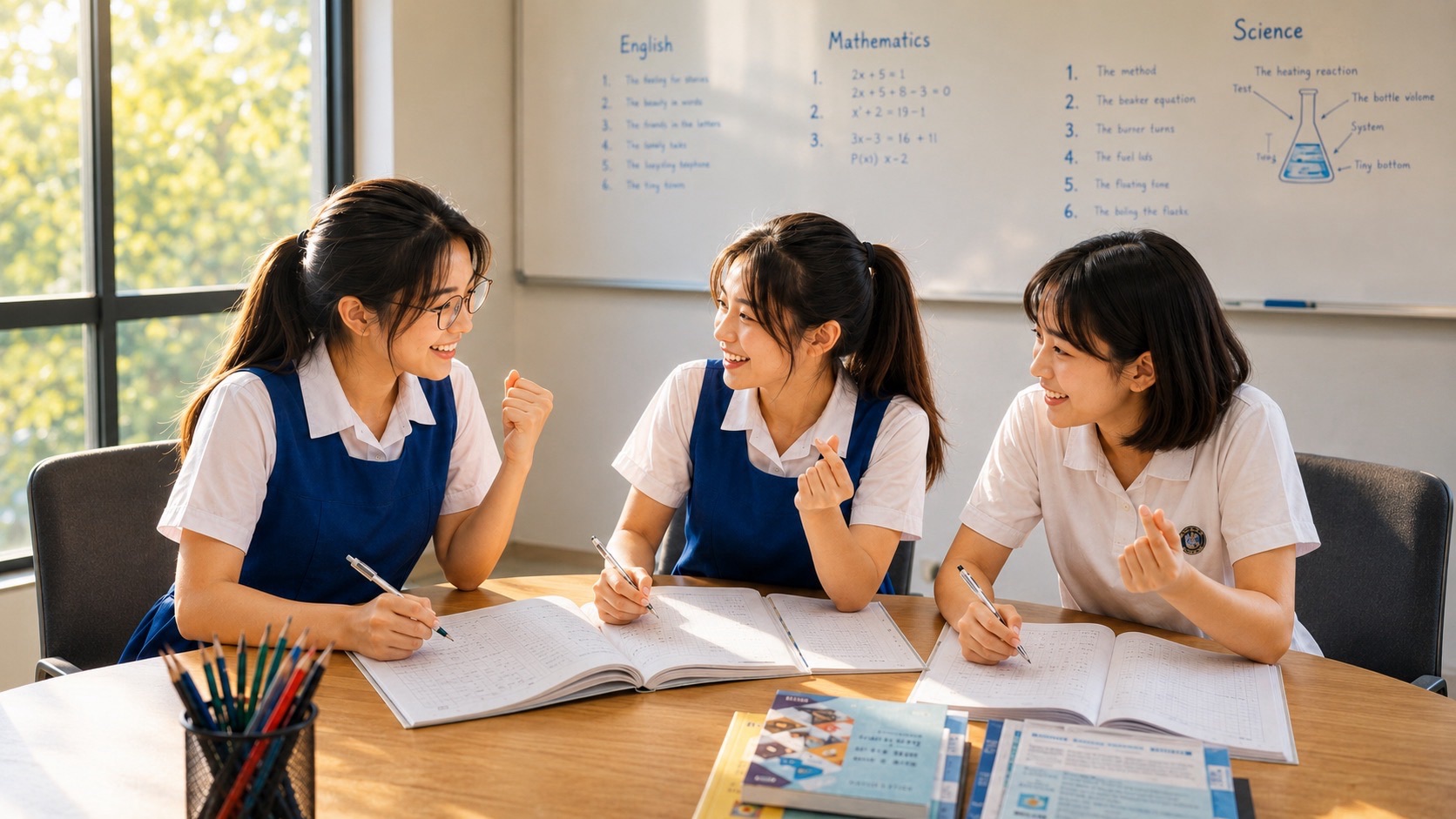
When should Clementi students begin Secondary 1 Mathematics tuition? Compare the post-PSLE, January, first-assessment and mid-year starting windows.
The best time to begin Secondary 1 Mathematics tuition is not automatically the earliest date. It is the point that gives the student enough time to bridge Primary Mathematics, learn algebra properly and stabilise school performance before gaps begin accumulating.
Discover how eduKateSG’s focused 3-pax Mathematics tuition helps Clementi students strengthen foundations, manage schoolwork and improve test performance.
eduKateSG’s 3-pax Mathematics classes help Clementi students understand school lessons, repair hidden gaps, complete work more efficiently and develop stable examination performance.
When to Start Clementi Secondary 1 Mathematics Tuition for Maximum School Performance
The best time to begin Secondary 1 Mathematics tuition is not always “as early as possible”.
It is early enough to make the transition easier, but carefully timed so that the student is ready to learn.
For one Clementi student, the right starting point may be the November or December holidays after PSLE.
For another, it may be the first few weeks of Secondary 1, once the school’s pace and Mathematics subject level are clear.
A student with strong foundations may not need tuition immediately. A student carrying unresolved difficulties with fractions, ratio, negative numbers or mathematical language may benefit greatly from a short bridging period before school begins.
The correct question is therefore not:
“What month should every Secondary 1 student start Mathematics tuition?”
It is:
“How much runway does this particular student need to enter Secondary Mathematics with control?”
That distinction matters.
Starting too late may allow small misunderstandings to accumulate.
Starting too early, too heavily or without a clear purpose can create fatigue without improving performance.
The best start is calm, deliberate and matched to the student.
Parents who are still deciding whether support is needed may first read When Does My Child Need Mathematics Tuition in Clementi?. For the wider Primary-to-Secondary route, begin with Mathematics Tuition Clementi.
The One-Sentence Answer
For maximum realistic school performance, Clementi Secondary 1 Mathematics tuition should begin before weak Primary foundations, algebra confusion or poor working habits have time to combine—but not so early or intensely that the student enters Secondary school tired, dependent or overprepared in only a superficial way.
The Best Default Starting Window
For many students, the most useful starting period is:
Late November to early January, after sufficient post-PSLE rest.
This gives the student time to:
- review essential Primary Mathematics foundations;
- become comfortable with negative numbers and algebraic notation;
- understand how Secondary Mathematics differs;
- establish orderly working habits;
- and enter school with useful prior exposure.
This is not meant to become a race through the Secondary 1 syllabus.
A good bridge should make the first school term more intelligible, not merely make the child complete chapters earlier.
Students can explore the transition itself through Parenting 101: Secondary Mathematics—The Real Transition After PSLE and Why Secondary 1 Mathematics Feels Harder Than Primary 6.
A Quick Parent Decision Table
| Student’s present condition | Sensible starting window | Main purpose |
|---|---|---|
| Weak fractions, ratio, percentage or basic number work | November or December after PSLE | Repair foundations before algebra adds further load |
| Strong PSLE Mathematics but unfamiliar with algebra | December or early January | Build a light, conceptual bridge |
| Strong, independent and confident student | Observe during January | Avoid unnecessary tuition; intervene only when a clear need appears |
| Student becomes confused in the first algebra lessons | Within the first few weeks | Correct misunderstanding before methods become habits |
| First weighted assessment is clearly below expectation | Immediately after reviewing the paper | Diagnose the failure pattern and reset before the next assessment |
| Marks are acceptable but homework takes too long | Term 1 or early Term 2 | Improve method, fluency and independence |
| Student begins drifting across several topics | June holidays | Repair the first half of the year and prepare for Semester 2 |
| Student remains unstable near year-end | As soon as a suitable programme is available | Recover the foundation before Secondary 2 |
The principle is simple:
Do not wait for a dramatic collapse when a stable pattern of difficulty is already visible.
At the same time, do not enrol a student merely because Secondary 1 is approaching. Tuition should perform a clear function.
Why Secondary 1 Timing Matters
Secondary 1 is not simply another school year.
It is a transition between two different mathematical environments.
Primary Mathematics often works with visible quantities:
- fractions of a whole;
- percentages of an amount;
- ratios between groups;
- model drawings;
- lengths, areas and volumes;
- and familiar word-problem structures.
Secondary Mathematics retains these foundations but begins expressing relationships more abstractly.
A number may become a letter.
A model may become an equation.
A repeated pattern may become an algebraic expression.
A word problem may require the student to define an unknown before any calculation can begin.
The child is therefore not only learning new content. The child is learning a new mathematical language.
Our complete guide, How Secondary 1 Mathematics Works, explains this change in greater depth.
Students now enter secondary school under Full Subject-Based Banding. They are posted through Posting Groups 1, 2 and 3 and may take subjects at G1, G2 or G3 levels according to their readiness and school arrangements. Tuition should therefore match the student’s actual Mathematics subject level rather than rely on the old stream labels.
Parents can read What Happens After PSLE: PG1, PG2, PG3 and Subject-Level Choices for the wider route.
From 2027, relevant graduating cohorts will sit the Singapore-Cambridge Secondary Education Certificate, with subjects examined at G1, G2 or G3 levels. This makes early subject-level stability useful, although Secondary 1 tuition should still focus on current learning rather than turn the first year into premature national-examination drilling.
Starting Window 1: November or December After PSLE
Best for students who need a bridge
The post-PSLE period can be an excellent time to prepare for Secondary 1 Mathematics, provided the student is first allowed to rest.
PSLE preparation is demanding. Many students reach the end of Primary 6 mentally tired. Beginning an intensive Secondary programme immediately after the examination may create resistance rather than readiness.
A better sequence is:
- allow the student to decompress;
- review the Primary Mathematics foundation;
- identify unfinished areas;
- introduce Secondary Mathematics gently;
- establish algebraic meaning before increasing difficulty.
A useful holiday bridge may include:
- integers and negative numbers;
- order of operations;
- fractions and algebraic fractions at an introductory level;
- ratio, rate and percentage review;
- algebraic symbols and vocabulary;
- simplifying expressions;
- substitution;
- simple equations;
- geometrical notation;
- and clear written working.
The goal is familiarity, not syllabus completion.
A student should arrive in January thinking:
“I have seen this language before, and I understand what it is trying to say.”
The student should not arrive thinking:
“I already finished this chapter, so I do not need to listen.”
Parents can continue with Primary 6 Mathematics Tuition: From PSLE to Secondary 1 Mathematics and Building the SEC Mathematics Corridor Early.
Who should strongly consider this window?
A November or December start is especially useful when the student:
- found PSLE Mathematics difficult;
- relied heavily on memorised model-drawing types;
- has weak fraction or percentage control;
- makes frequent arithmetic errors;
- avoids unfamiliar questions;
- struggles to explain methods;
- requires constant adult prompting;
- or loses confidence when symbols replace visible numbers.
These are not reasons to panic.
They are reasons to create more runway.
Starting Window 2: Early January
Best for students who are reasonably ready
January is often the best balanced starting point.
The student has rested after PSLE and has now entered the real Secondary-school environment. Parents and tutors can see:
- the Mathematics subject level being taken;
- the school’s pace;
- how homework is presented;
- the degree of independence expected;
- and the student’s early response to algebra and formal notation.
This makes January support more precise.
Instead of preparing for an imagined difficulty, tuition can align itself with the student’s actual school experience.
A useful January programme should help the student:
- follow school lessons more comfortably;
- clarify each new topic before confusion accumulates;
- practise independently;
- organise mathematical working;
- and retrieve earlier knowledge regularly.
January is particularly suitable for students who were relatively stable in Primary 6 but would benefit from structured support during the transition.
Parents comparing programmes can read Secondary 1 Mathematics Tuition Clementi and Secondary 1 Mathematics Tutor Clementi.
Starting Window 3: The First Two to Six Weeks of Secondary 1
Best for families who prefer to observe first
Some parents prefer to see how their child adapts before arranging tuition.
This is reasonable when the student:
- has a strong Primary foundation;
- works independently;
- is comfortable asking teachers questions;
- completes homework without prolonged struggle;
- and responds calmly to new mathematical ideas.
The observation period should still be active.
Parents can watch for:
- unusually long homework sessions;
- repeated sign and bracket errors;
- incomplete school notes;
- inability to explain what an expression represents;
- dependence on answer keys;
- avoidance of algebra;
- falling confidence;
- or a growing difference between class understanding and independent performance.
One difficult lesson is not a crisis.
A repeated pattern is more important.
The best time to act is when the pattern becomes clear, not when the student’s confidence has already collapsed.
The three-lesson rule
A simple parent guideline is to observe what happens after several lessons on the same idea.
If the student remains confused after:
- learning the topic in school;
- reviewing the notes;
- and attempting the assigned practice,
the difficulty may require more than extra time.
It may require a different explanation, foundation repair or guided correction.
That is a useful moment to consider tuition.
Starting Window 4: After the First Weighted Assessment
A useful decision point, but not the first warning
The first weighted assessment can provide valuable evidence.
It may reveal whether the student can:
- recall knowledge without prompts;
- interpret unfamiliar wording;
- select a method independently;
- work accurately under time pressure;
- and maintain control across several questions.
However, parents should avoid reading only the final mark.
A score of 65% may represent very different conditions.
One student may understand almost everything but lose marks through carelessness.
Another may obtain the same score through memorised question types while lacking conceptual control.
A third may know the methods but work too slowly to finish.
The paper should therefore be examined question by question.
Look beyond the total
Ask:
- Were the errors concentrated in one topic?
- Were questions left blank?
- Did the student know how to begin?
- Were signs, brackets or units repeatedly mishandled?
- Did the student misunderstand mathematical language?
- Was the method correct but the execution weak?
- Could the student complete the corrections independently?
- Did the same error appear several times?
An early weak result is useful when it produces an accurate repair plan.
It becomes harmful only when the family responds with panic, blame or indiscriminate drilling.
The article What Happens in Secondary 1 Mathematics Tuition? explains how a properly structured programme should turn these observations into teaching decisions.
Starting Window 5: The June Holidays
The most important recovery window
The June holidays provide a valuable midpoint.
By then, the student has completed enough Secondary 1 Mathematics for meaningful patterns to appear.
Parents can now distinguish between:
- a single weak topic;
- a broad foundation problem;
- slow calculation;
- weak algebra;
- poor method selection;
- inadequate revision;
- examination anxiety;
- and inconsistent school habits.
A June start can still meaningfully improve the year.
There is time to:
- repair Term 1 and Term 2 foundations;
- reteach algebra properly;
- strengthen negative-number control;
- review geometry and mensuration;
- improve working discipline;
- introduce upcoming topics;
- and prepare for the second semester.
June tuition should not attempt to compress half a year into a frantic stack of worksheets.
The programme should identify the few weaknesses producing the greatest amount of damage.
Repairing those first often improves several topics at once.
Starting Window 6: After Mid-Year
Still useful, but the programme must be more selective
A student beginning after June may already be carrying several layers of difficulty.
For example:
- weak fraction control affects algebraic operations;
- weak algebra affects equations;
- weak equations affect word-problem representation;
- repeated failure affects confidence;
- lower confidence reduces practice;
- reduced practice widens the gap.
At this stage, tuition must do two jobs at once:
- support the student’s current school topics;
- and repair the earlier foundations causing repeated difficulty.
This is possible, but it requires careful sequencing.
The tutor should not blindly follow the current school chapter while ignoring the prerequisite gap. Nor should the tutor spend months repairing old work while allowing the student to fall further behind in school.
A good programme creates two connected tracks:
Track A: Keep up with school
Track B: Repair the weakest prerequisite
The tracks eventually merge as the student becomes more stable.
When Starting Early Produces the Strongest Performance
An early start is most valuable when it changes the quality of the student’s learning from the beginning.
It should help the student:
- understand algebra rather than memorise movement rules;
- show clear working before messy habits become established;
- revise weekly rather than only before assessments;
- ask questions while the confusion is still small;
- correct errors before repeating them across chapters;
- and experience competence before deciding that Mathematics is “not my subject”.
This is route protection.
The student is not simply preparing for the next worksheet. The student is building the lower-secondary foundation that will later support:
- Secondary 2 Mathematics;
- G2 or G3 subject-level progression where suitable;
- upper-secondary E-Mathematics;
- Additional Mathematics;
- science subjects;
- and the eventual SEC examination route.
For a deeper look at this long corridor, read Secondary 1 Mathematics Tuition: Building the SEC Mathematics Corridor Early.
When a Student May Not Need to Start Immediately
Not every Secondary 1 student needs tuition.
A student may be ready to learn independently when the child:
- has stable Primary foundations;
- understands new school lessons;
- finishes work within a reasonable time;
- corrects mistakes independently;
- asks for help appropriately;
- retains previously taught work;
- and remains composed when questions are unfamiliar.
In this situation, parents can monitor without intervening unnecessarily.
Tuition should not replace healthy independence.
It should be considered when there is a clear learning function that school study and home routines are not currently fulfilling.
Possible alternatives before tuition include:
- a consistent weekly review period;
- corrections after every class test;
- a concise error notebook;
- consultation with the school teacher;
- short prerequisite revision;
- and asking the student to explain each method aloud.
If these measures are sufficient, tuition may not be necessary.
Early Tuition Should Not Mean Excessive Tuition
Maximum performance is not produced by maximum workload.
A Secondary 1 student is also adjusting to:
- a new school;
- a new timetable;
- new classmates;
- several subject teachers;
- co-curricular activities;
- longer travelling time;
- and greater responsibility.
A tuition schedule that consumes every available hour can reduce the attention and recovery needed for school.
Good Secondary 1 Mathematics tuition should simplify the student’s academic life.
It should reduce confusion.
It should make school lessons easier to follow.
It should teach the student how to practise more effectively.
It should not create a second full school day.
Why Algebra Determines the Timing Decision
Algebra is one of the clearest indicators of whether the Secondary 1 transition is working.
A student may cope initially with familiar number topics. The difficulty becomes more visible when the child must operate with:
- variables;
- terms;
- coefficients;
- expressions;
- substitution;
- brackets;
- equations;
- inequalities;
- and algebraic relationships.
When algebra is taught only as a collection of movement rules, students may produce answers without understanding the equality or transformation involved.
For example, the phrase “move it across and change the sign” may appear efficient.
However, it can hide the actual reason the transformation is valid: the same mathematical operation is being applied while preserving equality.
This becomes important when questions grow more complicated.
A student who understands the structure can reconstruct a method.
A student who memorises only surface rules becomes vulnerable when the question changes.
Parents can continue with Why Algebra in Secondary 1 Mathematics Is Important and the broader Secondary 1 Mathematics Syllabus and High-Performance Overview.
A 12-Week Secondary 1 Mathematics Runway
The exact programme should depend on the student, but a carefully designed first 12 weeks may follow this logic.
Weeks 1–2: Read the student
Review:
- number fluency;
- fractions and percentage;
- ratio and proportion;
- negative numbers;
- mathematical language;
- working organisation;
- recent school work;
- and independent problem-solving behaviour.
The purpose is to identify the earliest important weak link.
Weeks 3–5: Stabilise foundational operations
Strengthen:
- order of operations;
- integer arithmetic;
- fraction control;
- numerical accuracy;
- unit discipline;
- and checking routines.
Students should not carry unstable arithmetic into algebra.
Weeks 6–8: Build algebraic meaning
Teach:
- what a variable represents;
- the difference between a term and an expression;
- substitution;
- collection of like terms;
- expansion;
- factorisation foundations;
- and simple equations.
The student should explain the meaning as well as perform the method.
Weeks 9–10: Introduce variation
Questions should appear in different forms so the student learns to recognise structure rather than memorise page layouts.
This may include:
- worded algebra;
- diagram-based questions;
- mixed operations;
- geometry relationships;
- and unfamiliar applications.
Weeks 11–12: Convert learning into school performance
Introduce:
- timed sections;
- mixed-topic retrieval;
- correction routines;
- assessment-style questions;
- and strategic checking.
The student should gradually require fewer prompts.
That movement towards independence is essential.
The wider teaching architecture is explained in The eduKate Mathematics Learning System and How Mathematics Works.
What Maximum School Performance Actually Means
Maximum school performance does not mean obtaining full marks immediately.
It means helping the student perform as close as possible to their current ability while steadily increasing that ability.
A high-performing Secondary 1 Mathematics student should be developing several forms of control.
Concept control
The student understands what the mathematical objects and operations mean.
Method control
The student can select and execute an appropriate process.
Representation control
The student can move between words, numbers, expressions, equations, tables, diagrams and graphs.
Error control
The student notices and corrects mistakes rather than repeating them automatically.
Time control
The student can complete work at a suitable pace without losing accuracy.
Emotional control
The student can remain engaged when a question is unfamiliar or initially difficult.
Independence
The student can begin, continue and check work without continuous adult prompting.
A mark is the visible output.
These forms of control are the machinery beneath it.
For a more precise explanation of diagnostic teaching, see What Is High-Definition Secondary 1 Mathematics Tuition?.
How eduKateSG Uses the Starting Point
At eduKateSG, the starting date is only one part of the decision.
We also consider:
- the student’s G1, G2 or G3 Mathematics level;
- Primary Mathematics foundations;
- present school topics;
- recent assessment evidence;
- mathematical language;
- confidence;
- pace;
- repeated error patterns;
- study habits;
- and the next transition the student must manage.
Our Secondary 1 Mathematics tuition is conducted in groups of up to three students.
This allows the tutor to observe:
- how the student starts a question;
- what the student notices;
- which method is selected;
- where hesitation begins;
- how working is organised;
- and whether a correction can later be performed independently.
The class remains small enough for close correction while preserving discussion and independent thought.
For the complete service route, read:
- Secondary 1 Mathematics Tuition Clementi
- Secondary 1 Mathematics Tutor Clementi: Small-Group Tutorials
- Secondary 1 Mathematics Tuition: Parent Guide
- How eduKateSG Secondary Mathematics Tutorials Work
- Secondary 1 Mathematics Tuition: Complete Guide
A Parent Checklist Before Choosing the Start Date
Ask the following questions.
Foundation
- Are fractions, decimals, percentages and ratio reasonably stable?
- Can my child calculate accurately without excessive dependence on a calculator?
- Does my child understand negative numbers?
- Can my child explain a Primary Mathematics method?
Transition
- Is my child comfortable when letters represent numbers?
- Can my child read expressions and equations?
- Does my child understand equality?
- Can my child move from a word statement into a mathematical representation?
School performance
- Is homework taking significantly longer than expected?
- Are mistakes repeating?
- Can my child complete corrections without copying?
- Does class understanding survive into a test?
- Are marks becoming more stable or less stable?
Learning behaviour
- Does my child ask useful questions?
- Can my child begin independently?
- Does difficulty lead to thought or immediate surrender?
- Is confidence declining?
- Is avoidance increasing?
Timing
- Is there enough weekly time for tuition, schoolwork and rest?
- Is an assessment approaching?
- Would the holidays provide a cleaner repair window?
- Is the present issue small enough to correct now?
The answers usually reveal whether the student should begin before school, during Term 1, after the first assessment or during the June reset.
Frequently Asked Questions
Should every Clementi student start Secondary 1 Mathematics tuition in December?
No.
December is useful for students who need foundation repair, algebra preparation or a gentler transition. A strong and independent student may not need tuition at that point.
The decision should follow the student’s condition rather than the calendar alone.
Should tuition start immediately after PSLE?
Usually, the student should first receive a reasonable period of rest.
A short, well-designed bridge can begin afterwards. Immediate heavy acceleration is rarely necessary.
Is January too late to begin?
No.
January is an excellent starting point for many students because the real school pace, subject level and early learning response are now visible.
Should we wait for the first weighted assessment?
You may wait when the student appears stable.
However, there is no need to wait for a weak mark if repeated algebra confusion, long homework sessions or declining confidence are already visible.
Is the June holiday too late?
No.
June is one of the strongest repair windows because there is enough school evidence to diagnose the student accurately and enough of the year remains to improve Semester 2 performance.
My child scored well for PSLE Mathematics. Is tuition still useful?
Possibly, but not automatically.
PSLE success does not always transfer immediately into algebraic reasoning, symbolic notation and independent method selection.
Observe how the student responds to Secondary Mathematics before deciding.
Can tuition begin only when my child starts struggling?
Yes, provided intervention occurs while the difficulty remains manageable.
The risk is not waiting itself. The risk is ignoring a repeated pattern for too long.
How far ahead should a Secondary 1 student be taught?
Enough to create useful familiarity and confidence.
Teaching several chapters ahead is not valuable when earlier knowledge is shallow or forgotten. Strong preparation means stable preparation.
Will an early start guarantee high marks?
No responsible programme can guarantee a particular mark.
An early, well-matched start provides more time to strengthen foundations, correct habits and build performance. The eventual result also depends on attendance, effort, school demands, practice and the student’s willingness to become independent.
The Best Time Is Before Difficulty Becomes Identity
A student can recover from a weak test.
A weak chapter can be retaught.
An algebraic misunderstanding can be corrected.
The more difficult problem begins when repeated confusion becomes a personal conclusion:
“I am bad at Mathematics.”
That conclusion often reduces effort before the student’s actual ability has been properly tested.
The best starting time is therefore not defined only by the school calendar.
It is the point before temporary difficulty becomes an established learning pattern.
For some Clementi students, that point arrives during the post-PSLE holidays.
For others, it appears in the first weeks of January.
For some, the first assessment provides the necessary evidence.
For others, June offers the right reset.
The important decision is not to start earliest.
It is to start with enough runway, at the correct level, for a clear purpose.
A Calm Next Step for Clementi Families
Parents enquiring about Clementi Secondary 1 Mathematics tuition may share:
- the student’s Mathematics subject level;
- PSLE Mathematics result where relevant;
- recent school work or assessment papers;
- the current school topic;
- the main repeated difficulty;
- and any upcoming weighted assessment dates.
From there, we can examine:
- what is already stable;
- which Primary foundations remain unfinished;
- whether the student needs bridging, support or deeper extension;
- how much runway is available;
- and whether an available 3-pax class is a suitable fit.
The aim is not to make the student busier.
It is to give the student a clearer start, stronger methods and a Mathematics foundation that continues working after Secondary 1.
Start early when the student needs runway.
Start promptly when a repeated weakness appears.
Wait calmly when the student is genuinely stable.
In every case, begin from the student—not merely from the calendar.
Explore Mathematics Tuition Clementi
Read Secondary 1 Mathematics Tuition Clementi
Understand the Transition After PSLE
Enquire About a Secondary 1 Mathematics Consultation
How Our Clementi Small-Group Mathematics Tuition Makes a Difference to School Performance
The most useful Mathematics tuition does not compete with school.
It makes school work better.
A child should gradually understand lessons more quickly, complete homework with less confusion, participate with greater confidence and perform more reliably during tests.
This is the practical purpose of eduKateSG’s small-group Mathematics tuition for Clementi families.
Our classes are deliberately capped at three students. This gives the tutor enough visibility to observe how each child thinks, where the working becomes unstable and what must be repaired before the student can progress confidently.
However, class size alone does not create better results.
The difference comes from what the tutor can do inside that small group:
- identify hidden learning gaps;
- explain concepts at the correct level;
- correct mistakes while they are still visible;
- prepare students for upcoming school topics;
- reduce unproductive homework time;
- and guide each student towards independent performance.
The aim is not simply to help the child complete more Mathematics questions.
It is to make the student’s complete school Mathematics system more stable.
One-Sentence Answer
eduKateSG’s Clementi small-group Mathematics tuition improves school performance by giving each student close diagnostic attention, repairing foundations in the correct order and converting understanding into faster, more accurate and increasingly independent work.
School Performance Is More Than One Examination Mark
Parents naturally look at marks.
Marks matter because they show how a student performed under a particular set of conditions. However, one mark cannot always explain why the student performed that way or whether the result can be repeated.
A student may score well because the tested topics were familiar.
Another may understand the Mathematics but lose marks through incomplete working.
A student may obtain a pass while spending an unsustainable number of hours preparing for it.
Another may perform poorly in one test but already be building the understanding needed for a stronger recovery.
We therefore look at school performance across several connected signals:
| School-performance signal | What we look for |
|---|---|
| Lesson understanding | Can the student follow what school is teaching? |
| Homework independence | Can work be started and completed with less adult prompting? |
| Working quality | Are mathematical steps clear, valid and organised? |
| Knowledge retention | Can the student still use the method several weeks later? |
| Topic transfer | Can the method be used when the question looks different? |
| Test stability | Are marks becoming less erratic across topics? |
| Time management | Can the student complete work within reasonable time? |
| Confidence | Does the student attempt unfamiliar questions calmly? |
| Future readiness | Is the student prepared for the next topic, level or examination? |
A strong tuition programme should improve several of these signals together.
Better marks are important, but they should emerge from a stronger learning system rather than temporary dependence on memorised answers.
Why Three Students Can Make a Meaningful Difference
In a large class, a tutor may see whether an answer is correct.
In a three-student class, the tutor has a better opportunity to see how the answer was produced.
That distinction matters.
Two students can arrive at the same wrong answer for entirely different reasons.
One may have misunderstood the concept.
Another may know the concept but select the wrong method.
A third may complete the correct method before losing a negative sign in the final line.
Giving all three students the same additional worksheet would not necessarily solve any of these problems.
The tutor must be able to observe:
- how the student reads the question;
- what the student writes first;
- which information is selected;
- where hesitation begins;
- how diagrams or models are used;
- whether the student is reasoning or imitating;
- and whether the mistake is conceptual or procedural.
eduKateSG’s existing Clementi Mathematics programmes use 3-pax classes so that this close observation and correction can remain central to the lesson. The programme serves Primary and Secondary students, including students preparing for PSLE, G1–G3 Mathematics, E-Math and Additional Mathematics.
The Difference Begins Before the School Test
School performance is usually created before examination day.
It is shaped during ordinary weeks:
- when the student first encounters a concept;
- when homework is attempted;
- when an error is corrected;
- when an old topic is retrieved;
- and when several ideas are connected inside a new problem.
If these daily processes are weak, the student may arrive at the examination with a large amount of work completed but little dependable control.
Our small-group lessons intervene earlier.
Instead of waiting for a poor result to reveal that something is wrong, we look for the smaller signals that appear during learning.
These may include:
- unusual hesitation with basic operations;
- dependence on model answers;
- repeated sign errors;
- weak mathematical vocabulary;
- incomplete diagrams;
- uncertainty about which method to select;
- and excessive time spent on familiar questions.
Catching these signals early makes the repair smaller and calmer.
Difference 1: We Find the Actual Learning Break
A student may say, “I cannot do fractions.”
That description is too broad to guide useful teaching.
The real break may be:
- weak multiplication facts;
- poor understanding of equivalent fractions;
- confusion between the numerator and denominator;
- inability to identify the whole;
- weak conversion between mixed numbers and improper fractions;
- or difficulty recognising fractions inside word problems.
Similarly, a Secondary student may say, “I cannot do algebra.”
The underlying issue may be:
- negative-number control;
- expansion;
- factorisation;
- substitution;
- equation balance;
- algebraic fractions;
- or an inability to interpret symbols as relationships.
Our first task is therefore not to assign more work.
It is to locate the earliest important point at which the student’s mathematical process becomes unreliable.
Once that point is found, the lesson becomes more precise.
The student no longer has to repeat an entire chapter indiscriminately. We can repair the specific knowledge, meaning or method that is affecting everything above it.
This diagnosis-led approach follows the wider eduKate Mathematics Learning System, which treats Mathematics as a connected progression from foundations and conceptual understanding to transfer, independent control and examination performance.
Difference 2: We Repair Mathematics in the Correct Order
Mathematics is cumulative.
Later topics reuse earlier knowledge.
A child who is weak in multiplication may struggle with fractions, ratio, percentage and algebra.
A Secondary student with unstable factorisation may struggle with quadratic equations, algebraic fractions, functions and Additional Mathematics.
The visible school topic is therefore not always the correct starting point.
Suppose a student is currently learning simultaneous equations at school but cannot manipulate a simple linear equation reliably.
Repeated simultaneous-equation worksheets will create more pressure without solving the prerequisite problem.
We may first need to stabilise:
- number operations;
- negative signs;
- algebraic simplification;
- equation balance;
- substitution;
- and only then simultaneous equations.
This may appear slower at the beginning.
In practice, it is often the fastest dependable route because the student stops carrying the same weakness into every new chapter.
Difference 3: We Help Students Understand School Lessons More Quickly
A student who enters a school lesson without the necessary foundation must perform several tasks at once.
The student has to:
- understand the teacher’s explanation;
- recall an earlier topic;
- interpret new notation;
- follow the worked example;
- copy notes;
- and keep pace with the class.
When one prerequisite is missing, the cognitive load increases sharply.
The child may appear inattentive even when trying very hard.
Our tuition programme reduces this load in two ways.
First, we repair earlier weaknesses.
Second, where appropriate, we introduce upcoming concepts before the student meets them in school.
This does not mean racing far ahead.
It means giving the student a useful first encounter.
When the topic later appears in school, the vocabulary, diagrams and central method are no longer completely unfamiliar. The school lesson becomes a second exposure rather than an emergency first exposure.
The student is then more likely to:
- follow the explanation;
- answer questions;
- take meaningful notes;
- notice differences between methods;
- and retain the lesson.
School begins contributing more value because the child is ready to receive it.
Difference 4: We Convert Explanation Into Independent Ability
Students often say that they understand Mathematics when someone is explaining it.
This may be true.
However, understanding a tutor’s completed solution is different from producing a solution independently.
There are several levels of control:
- The student recognises the method when it is shown.
- The student completes the method with prompts.
- The student begins the question independently.
- The student completes the method without support.
- The student transfers the method to a less familiar question.
- The student performs under test conditions.
Many students remain between the first and second levels.
They can follow a polished example but cannot decide what to do when working alone.
A small group allows the tutor to withdraw support gradually.
We may begin with a demonstration, move to guided practice and then ask the student to produce the complete solution independently.
The tutor remains close enough to prevent the student from practising an incorrect method, but does not intervene so quickly that the child becomes dependent.
The sequence is:
Explain → Guide → Observe → Release → Test → Review
The child should leave with more than recognition.
The child should leave with usable control.
Difference 5: Mistakes Become Useful Information
In Mathematics, an incorrect answer is not simply a failure.
It is a diagnostic signal.
The tutor needs to determine what kind of mistake occurred.
| Error type | Example | Suitable response |
|---|---|---|
| Knowledge error | Formula or fact is not known | Teach and retrieve the missing knowledge |
| Meaning error | Student does not understand what the symbols represent | Rebuild the concept using examples or representations |
| Reading error | Important condition is missed | Improve question-marking and interpretation habits |
| Method error | Wrong strategy is selected | Compare question structures and method choices |
| Process error | Correct method is carried out incorrectly | Correct the exact mathematical step |
| Transfer error | Method works only in familiar examples | Introduce controlled variation |
| Checking error | Implausible answer is accepted | Build verification routines |
| Time error | Too long is spent on one question | Improve fluency and examination decisions |
Without this distinction, the standard response is often “be more careful”.
That advice is too vague.
A student cannot reliably correct an error that has not been properly identified.
In our small groups, the tutor can stop at the exact line where the process breaks, explain why it breaks and ask the student to reconstruct the step correctly.
The correction remains attached to the student’s own thinking.
This makes it more likely to survive into schoolwork and examinations.
Difference 6: Homework Becomes More Efficient
Parents often notice improvement first through homework.
Before support, the child may:
- delay beginning;
- spend a long time searching notes;
- repeatedly erase the same working;
- ask for constant help;
- copy from a worked example;
- or remain at the desk after productive learning has stopped.
This creates a difficult family routine.
Parents may feel forced to reteach the lesson after work. The child becomes tired and defensive. Other subjects receive less attention.
Our objective is not to remove all difficulty from homework.
Productive struggle is part of learning.
The objective is to reduce unproductive struggle caused by missing knowledge or an unclear method.
As the student gains control, homework should become more orderly:
- Read the question carefully.
- Identify the topic and information.
- Select a likely method.
- Show the working clearly.
- Check whether the answer is reasonable.
- Mark questions that require further clarification.
The student may still encounter challenging questions.
The difference is that the child now has a way to begin, persist and identify where help is needed.
This protects time for other subjects, rest and school responsibilities.
Difference 7: School Notes and Corrections Become More Valuable
Many students have completed school notes, marked worksheets and corrected examination papers.
Yet the learning inside these materials may remain inactive.
A student may copy a correction without understanding:
- why the original answer failed;
- why the new method works;
- how to recognise a similar question;
- or whether the question can now be completed independently.
During tuition, school materials can be used as evidence.
We look for patterns across several pieces of work:
- Is the same algebra error returning?
- Are marks being lost through incomplete working?
- Does the child avoid a particular question type?
- Are mistakes concentrated near the end of the paper?
- Does the student perform well topically but poorly in mixed tests?
- Is the problem knowledge, time or examination control?
Once these patterns are visible, corrections become more than rewritten answers.
They become part of a forward plan.
The student should be able to close the paper, return to the question later and produce the corrected reasoning without copying.
Difference 8: Students Become Better Prepared for Tests
Test preparation should not begin with full papers immediately.
A full paper tests many systems at once:
- knowledge;
- retrieval;
- method selection;
- accuracy;
- transfer;
- stamina;
- and time management.
When the student’s foundations are still unstable, repeatedly attempting full papers can generate large quantities of failure without explaining how to improve.
We build towards examination performance in stages.
Stage 1: Concept Stability
The student understands the topic and its essential relationships.
Stage 2: Method Stability
The student can perform the standard mathematical process accurately.
Stage 3: Question Variation
The student sees the concept presented through different numbers, diagrams and wording.
Stage 4: Mixed Retrieval
The topic is mixed with previous topics so the student must select the method independently.
Stage 5: Timed Sections
The student practises maintaining accuracy within a realistic time limit.
Stage 6: Full-Paper Control
The student manages sequencing, difficult questions, checking and recovery across the paper.
This progression protects confidence.
It also gives the tutor clearer information about which part of the performance system still needs work.
Difference 9: Marks Become More Stable, Not Merely Higher Once
A sudden increase in marks can be encouraging.
However, the more important outcome is stability.
A student who scores 78%, then 52%, then 73% may have ability but insufficient control. Performance may depend too heavily on the tested topics, question wording or amount of support received beforehand.
We look for a stronger pattern:
- fewer catastrophic topic failures;
- a narrower difference between strong and weak chapters;
- fewer blank questions;
- more method marks;
- better completion;
- and reduced repetition of known errors.
Stable performance does not mean every test mark will be identical.
Different papers have different demands.
It means the student’s core process remains available even when the paper is less comfortable.
This is particularly important as students approach PSLE, upper Secondary examinations and subject-level transitions.
Singapore’s Mathematics syllabuses place emphasis not only on content, but also on reasoning, communication, applications, modelling and problem-solving. These demands become increasingly connected as students move through Primary and Secondary school.
Difference 10: The Student’s Confidence Becomes Evidence-Based
Confidence is often discussed as though it can be given through encouragement alone.
Encouragement helps, but dependable mathematical confidence comes from evidence.
A student becomes genuinely more confident after experiencing that:
- a confusing concept can be understood;
- a difficult question can be broken into parts;
- a mistake can be located;
- a solution can be reconstructed;
- and an unfamiliar problem does not require immediate surrender.
Our small groups create repeated opportunities for these experiences.
Because there are only three students, each child must participate.
The student cannot disappear quietly at the back of a large room.
At the same time, the child is not placed under the intensity of constant one-to-one attention.
The group provides a measured social environment.
Students can hear another student ask a useful question, compare two valid methods and explain a step aloud. This helps them discover that uncertainty is part of learning and that mathematical reasoning can be discussed rather than hidden.
Confidence then becomes:
“I may not know the answer immediately, but I know how to begin.”
That is a useful form of confidence for school.
Difference 11: The Tutor Can Protect the Student’s Wider Academic Load
Mathematics does not exist alone inside the timetable.
A student also has English, Science, Mother Tongue, Humanities, projects, CCA commitments and rest.
When Mathematics becomes unstable, it can consume a disproportionate amount of the week.
A Primary child may spend every evening on homework.
A Secondary student may sacrifice revision for Science or Humanities because algebra takes too long.
This is why Mathematics tuition should not simply add another large collection of worksheets.
The programme should reduce disorder.
We identify the small number of weaknesses producing the greatest amount of difficulty. We then organise the repair so that the student can work more efficiently.
A good tuition lesson may lead to less wasted work outside tuition because the child knows:
- what the question is testing;
- which method is suitable;
- how to organise the solution;
- and how to identify an error.
The objective is not to make the student study Mathematics continuously.
It is to make each period of study more useful.
Difference 12: We Prepare the Student for the Next School Transition
Current marks matter, but they do not fully describe future readiness.
A Primary 4 student may be passing while remaining unprepared for the integration required in Primary 5.
A Primary 6 student may perform well through familiar model methods but remain uncertain about algebraic thinking before Secondary 1.
A Secondary 2 student may pass current work while carrying weaknesses that will become expensive in upper Secondary Mathematics.
Our lessons therefore consider two positions:
Where is the student now?
and
What will the student need next?
This is especially important at transition points:
- Primary 2 to Primary 3;
- Primary 4 to Primary 5;
- Primary 6 to Secondary 1;
- Secondary 2 to Secondary 3;
- E-Math into Additional Mathematics;
- G2 to G3 Mathematics;
- and school learning into national examination preparation.
The purpose is not to accelerate every child indiscriminately.
It is to ensure that the student arrives at the next stage with the necessary foundations intact.
What This Looks Like at Different School Levels
Primary 1 and Primary 2
School performance at this stage depends heavily on number sense, mathematical language and dependable basic operations.
Our small groups help students:
- understand quantity and place value;
- build addition and subtraction control;
- establish multiplication and division foundations;
- interpret common question phrases;
- and communicate their reasoning.
The objective is a calm, accurate start.
Primary 3 and Primary 4
Mathematics becomes more connected through multiplication, division, fractions, measurement and longer word problems.
Students learn to:
- select relevant information;
- represent problems;
- choose operations;
- organise multi-step working;
- and explain relationships.
This protects readiness for the heavier upper-Primary years.
Primary 5 and Primary 6
Fractions, decimals, percentage, ratio, measurement and problem-solving begin interacting more intensely.
We help students strengthen:
- topic connections;
- non-routine problem-solving;
- model construction;
- calculation control;
- timed performance;
- and examination review.
For PSLE students, the objective is not simply to complete more papers. Each paper should reveal what must be improved before the next one.
Secondary 1
The transition from Primary to Secondary Mathematics introduces greater abstraction, especially through algebra and formal mathematical working.
Our Secondary 1 Mathematics tuition for Clementi students focuses on repairing transition gaps, establishing algebraic meaning and preventing early confusion from becoming a multi-year problem.
Secondary 2
Secondary 2 is a consolidation and positioning year.
Students need to strengthen algebra, geometry, graphs, proportional reasoning and other connected topics before upper Secondary subject demands increase.
Our Clementi Secondary 2 programme is designed around stronger mathematical control rather than additional practice alone.
Secondary 3
Secondary 3 often introduces a sharp increase in content density, abstraction and subject combinations.
Students may be managing G1, G2 or G3 Mathematics, E-Math, Additional Mathematics or a faster school programme.
Our Clementi Secondary 3 support focuses on repairing algebra gaps while helping students manage new upper-Secondary topics in the correct sequence.
Secondary 4
By Secondary 4, students must convert accumulated understanding into examination performance.
Lessons increasingly address:
- mixed-topic recognition;
- method selection;
- timed sections;
- complete working;
- error patterns;
- paper strategy;
- and recovery under pressure.
The student should not merely know Mathematics.
The student must be able to access and apply it reliably within the paper.
Before and After: The Difference Parents May Notice
Improvement does not always arrive as one dramatic result.
It often appears through several smaller changes.
| Before structured support | As the learning system strengthens |
|---|---|
| Homework begins with avoidance | Student has a clearer starting routine |
| Notes are repeatedly searched | Important knowledge is retrieved more readily |
| Same errors appear each week | Error patterns reduce |
| Child waits for the first step | Student begins more questions independently |
| Working is scattered | Solutions become organised |
| Practice is limited to familiar forms | Student handles controlled variation |
| Tests are regularly unfinished | Completion and time allocation improve |
| One difficult question causes panic | Student attempts, marks and returns strategically |
| Marks fluctuate widely | Performance becomes more stable |
| Mathematics consumes the entire week | Study becomes more proportionate and efficient |
Not every student will move at the same speed.
The size of the gap, regularity of attendance, school timeline and quality of independent practice all matter.
The direction, however, should be visible.
Why Our Three-Pax Classes Are Not Mini-Lectures
Reducing a class to three students is useful only when the teaching model also changes.
Our small groups are not designed as lectures delivered to fewer people.
Students are expected to work, explain and respond.
The tutor circulates continually between several functions:
- direct explanation;
- observation;
- questioning;
- correction;
- guided practice;
- retrieval;
- and independent testing.
At one moment, all three students may be learning a shared concept.
At another, each student may be correcting a different underlying weakness.
This flexibility is one of the most important advantages of the format.
The students retain the energy and discussion of a group while receiving attention that remains closely connected to their own schoolwork.
What Our Small Groups Do Not Promise
Responsible tuition should not promise that every student will immediately achieve the same grade.
School performance depends on several factors, including:
- the student’s starting point;
- the depth of accumulated gaps;
- attendance;
- independent practice;
- sleep and wellbeing;
- school demands;
- and the time available before an assessment.
A tutor can provide excellent diagnosis, teaching, correction and structure.
The student must still participate in the learning.
Our promise is therefore about the quality of the process:
- we look carefully;
- teach from the necessary beginning;
- correct precisely;
- increase difficulty responsibly;
- and work towards independent performance.
The purpose is sustainable improvement rather than a temporary appearance of progress.
When a Clementi Family Should Consider Small-Group Mathematics Tuition
Parents may wish to consider support when:
- Mathematics homework regularly takes too long;
- the same mistakes return after correction;
- the child understands examples but cannot work independently;
- school marks are falling or becoming inconsistent;
- a transition to a more difficult level is approaching;
- the student is losing confidence;
- Mathematics is taking time away from other subjects;
- algebra is beginning to affect several topics;
- or the child is performing well but has stopped progressing.
One weak test does not always require tuition.
A repeated pattern deserves closer attention.
The earlier the pattern is understood, the more calmly it can usually be repaired.
Is a Three-Pax Class Suitable for Every Student?
No single class format is right for every child.
A three-pax group may suit students who:
- benefit from close tutor observation;
- can participate in a small social setting;
- need more personal correction than a large class provides;
- are ready to attempt work independently between explanations;
- and can attend a group matched reasonably to their level.
A different arrangement may be more appropriate when the child requires constant one-to-one behavioural supervision, highly specialised intervention or a pace that cannot be matched responsibly with the available group.
Class fit matters more than class size alone.
This is why eduKateSG begins with a consultation rather than assuming that every available class is suitable. The wider eduKateSG programme considers the student’s level, present concerns, school demands, confidence and learning habits before recommending a route.
What to Bring to a Mathematics Consultation
For a useful discussion, parents may bring:
- recent school examination papers;
- class tests;
- marked homework;
- unfinished questions;
- current school topics;
- the child’s subject level;
- and a short description of the weekly homework routine.
These materials allow us to look beyond the final score.
We can examine:
- where marks are being lost;
- whether the same mistake is repeating;
- whether the child understands the school method;
- which prerequisites are unstable;
- and what the student will need next.
A consultation should give the family a clearer view of the problem even before any class recommendation is made.
Frequently Asked Questions
How quickly should school performance improve?
Some students show early improvement through clearer homework, better working and fewer repeated errors.
Marks may take longer, particularly when there are accumulated foundation gaps or when the next school assessment is very close.
The first useful question is whether the learning process is becoming more stable.
Will my child receive enough attention with three students?
The class is capped at three precisely so the tutor can observe each student closely while retaining the benefits of peer discussion and participation.
Students are not left to complete worksheets silently for the entire lesson.
Do all three students complete the same work?
Students may share a central topic when their school needs overlap, but correction, questioning and supporting practice can differ according to each student’s learning position.
The class remains coherent without pretending that every student has exactly the same weakness.
Do you follow the school syllabus?
Yes. School topics, current level and assessment requirements are important.
However, when an earlier prerequisite is causing the current problem, we may need to repair that foundation before the student can use the school topic successfully.
Do you teach ahead of school?
We teach ahead when the student is sufficiently ready and when prior exposure will make the upcoming school lesson more useful.
We do not accelerate simply to claim that more chapters have been covered.
Does the programme support both Primary and Secondary Mathematics?
Yes. eduKateSG supports Primary Mathematics, PSLE Mathematics, lower-Secondary Mathematics, G1–G3 Mathematics, E-Math and Additional Mathematics through its focused small-group structure.
Where are the classes held?
The Clementi Mathematics programme serves families travelling to eduKateSG’s classes near Sixth Avenue MRT. Current availability and suitable class placement should be discussed during the consultation.
Is this only for students who are failing?
No.
Students may need support because they are falling behind, passing inconsistently, preparing for a transition or aiming to move from competent performance towards stronger distinction-level control.
A Better Relationship Between Tuition and School
Tuition should not create a second school running beside the first one.
It should strengthen the student so that the actual school day becomes more productive.
The child should be better able to:
- understand the teacher;
- participate in class;
- complete assigned work;
- interpret feedback;
- prepare for assessments;
- and recover from mistakes.
This is how our Clementi small-group Mathematics tuition makes a difference to school performance.
The difference is not created by giving three students a large volume of additional work.
It is created by seeing each student clearly enough to teach the correct thing at the correct time.
We find the earliest important weakness.
We repair it in the correct order.
We prepare the student for what school will require next.
We then reduce support carefully until the student can perform independently.
That is the movement we are looking for:
From confusion to structure.
From supported work to independent control.
From occasional good results to stable school performance.
For Clementi parents, the next step can remain simple.
Bring the child’s recent schoolwork and the concern you are seeing most often. We can examine the pattern, identify the likely starting point and discuss whether an available three-pax Mathematics class is a suitable fit.