
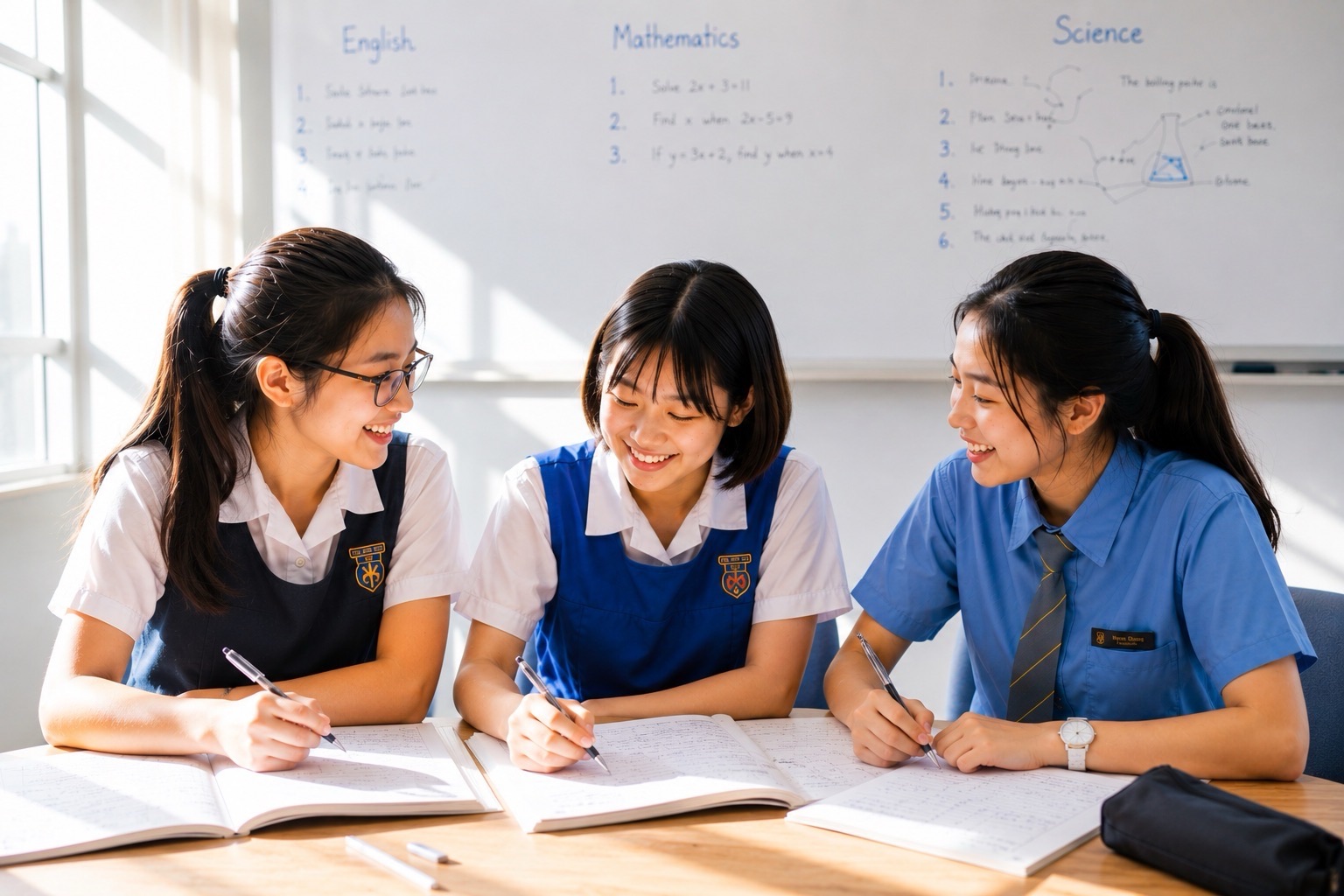
Mathematics tuition for Clementi students in focused 3-pax classes. Build foundations, repair gaps and prepare for PSLE, G1–G3, E-Math and A-Math.
Looking for Mathematics tuition in Clementi? eduKateSG helps Primary and Secondary students understand Mathematics, repair weak foundations and develop stable examination performance in carefully structured 3-pax classes.
Mathematics Tuition Clementi
Mathematics tuition should not simply give a child more questions.
It should help the child understand what Mathematics is asking, identify where the learning process has become unstable, and rebuild the subject in the right order.
For some Clementi parents, the concern begins with a disappointing examination result. For others, it is visible much earlier:
- homework is taking too long;
- word problems are becoming increasingly difficult;
- the child understands during the lesson but cannot perform independently;
- careless mistakes keep returning;
- algebra suddenly feels confusing;
- marks are acceptable but inconsistent;
- or a previously confident student has started avoiding Mathematics.
These may look like separate problems. They often come from a small number of deeper causes.
A student may be missing knowledge. The student may know the content but not understand its meaning. The method may be incomplete. The student may struggle to transfer a familiar method into an unfamiliar question. Or the entire process may collapse when speed, accuracy and examination pressure are added.
Good Mathematics tuition finds the correct break before deciding how to repair it.
The purpose of Mathematics tuition is not to make a child permanently dependent on tuition. It is to help the child think, work and verify with increasing independence.
At eduKateSG, Mathematics is taught as a connected learning system rather than a collection of isolated chapters. Students learn the meaning of each concept, the method used to operate it, the relationships between topics and the discipline required to produce reliable answers.
Families may begin with our wider guide, How Mathematics Works, before considering the most suitable tuition route.
One-Sentence Answer
Mathematics tuition in Clementi works best when it identifies whether a student is struggling with knowledge, meaning, method, transfer or execution, then repairs that weakness before building speed, confidence and examination performance.
What Clementi Parents Are Usually Trying to Solve
Parents rarely begin by asking for a learning system.
They begin with something they can see.
“My child can do the homework but not the test.”
“She keeps making careless mistakes.”
“He does not know which formula to use.”
“My child was doing well in Primary 4 but has fallen behind in Primary 5.”
“Secondary 1 Mathematics was manageable, but Secondary 2 is becoming unstable.”
“He understands E-Math but cannot cope with A-Math.”
These are useful observations, but they are not yet complete diagnoses.
| What the parent sees | What may be happening underneath |
|---|---|
| The child forgets previously taught work | Knowledge was remembered temporarily but not consolidated |
| The child knows the formula but cannot use it | Meaning or transfer is weak |
| Homework is correct but test marks remain low | The child may depend heavily on prompts, examples or extra time |
| Many careless mistakes appear | Working discipline, checking habits or cognitive load may be unstable |
| Word problems feel impossible | Language, representation or model construction may be weak |
| Algebra feels confusing | Arithmetic foundations may not have been converted into symbolic understanding |
| Marks rise and fall sharply | Performance is not yet stable across topics and question types |
| The child freezes during difficult questions | Method selection, confidence or recovery habits may be missing |
The correct tuition programme should respond to the underlying problem, not merely the visible symptom.
A student with missing multiplication fluency should not be given only advanced word problems.
A student who understands concepts but works too slowly may not need the entire syllabus retaught.
A strong student aiming for distinction needs more than additional repetition. The student needs deeper transfer, cleaner reasoning and better control under examination conditions.
This is why careful Mathematics tuition begins with diagnosis.
Mathematics Is a Connected Subject
Mathematics is cumulative.
New learning rests on earlier learning, even when the connection is not immediately obvious.
Fractions support ratio and percentage.
Arithmetic patterns support algebra.
Algebra supports graphs, functions, coordinate geometry, trigonometry and Additional Mathematics.
Measurement supports mensuration.
Visual representation supports geometry and problem-solving.
Working discipline supports almost everything.
A weakness that appears small in Primary school can become much more expensive to repair later because each new topic adds load to the same unstable foundation.
This does not mean every small mistake is a crisis.
It means that repeated mistakes should be understood rather than dismissed.
The eduKate Mathematics Learning System treats progress as a sequence:
Understand → Represent → Operate → Practise → Connect → Transfer → Perform → Review
Students should first know what a mathematical object means. They then learn how it can be represented and operated. Practice develops control. Connections allow methods to move between topics. Transfer allows the student to solve unfamiliar questions. Examination training then helps the student perform accurately within time.
You can read the wider architecture in The eduKate Mathematics Learning System.
Primary Mathematics Tuition for Clementi Students
Primary Mathematics is where the mathematical system is first assembled.
During the early years, a child may appear to be doing well because questions are short, methods are direct and adults provide considerable guidance. As the syllabus develops, the child must manage more language, more steps and more relationships independently.
The underlying foundation therefore matters.
Primary 1 and Primary 2 Mathematics
At Primary 1 and Primary 2, the priority is not advanced examination technique.
It is mathematical orientation.
Students need to become comfortable with:
- number relationships;
- place value;
- addition and subtraction;
- multiplication and division foundations;
- simple measurement;
- shapes and spatial language;
- mathematical vocabulary;
- and explaining what a question is asking.
A child who calculates correctly but misunderstands phrases such as “more than”, “fewer than”, “difference” or “altogether” may appear careless when the real difficulty is mathematical language.
At this stage, tuition should help the child form accurate meanings and dependable habits without making Mathematics feel unnecessarily heavy.
Primary 3 and Primary 4 Mathematics
Primary 3 and Primary 4 are important expansion years.
Multiplication and division become more operational. Fractions become significant. Word problems become longer. The child must hold several pieces of information in mind and select a suitable route.
This is often where parents first notice that memorised procedures are no longer enough.
A child may know how to multiply but not recognise when multiplication is required. Another may understand fractions in isolation but struggle when fractions appear inside a word problem.
Good tuition begins connecting the separate parts of Mathematics into a usable system.
Primary 5 Mathematics
Primary 5 is a major integration year.
Topics such as fractions, decimals, percentage, ratio, area, volume and multi-step problem-solving begin interacting more intensely.
The main challenge is no longer simply whether the child has encountered each topic. It is whether the child can recognise relationships and remain organised through a longer solution.
A Primary 5 student may need:
- foundation repair from earlier years;
- clearer model drawing or representation;
- stronger multiplication and fraction control;
- better question classification;
- cleaner working;
- or preparation for the increasing demands of Primary 6.
This is a year in which early repair can prevent Primary 6 from becoming an emergency year.
Primary 6 and PSLE Mathematics
Primary 6 Mathematics tuition should bring the whole Primary system together.
The student needs content knowledge, but also:
- question-reading accuracy;
- method selection;
- multi-step planning;
- non-calculator fluency;
- calculator discipline where permitted;
- checking routines;
- time allocation;
- and the ability to recover when the first method does not work.
The PSLE is taken at the end of Primary school, and SEAB publishes the current examination information and formats for each examination year.
A student preparing for PSLE should therefore not spend the entire year doing papers without understanding what the errors reveal.
Every paper should produce information.
Which topics are still unstable?
Which question forms consume too much time?
Where are method marks being lost?
Which mistakes are conceptual, and which are executional?
Which questions can the student complete independently?
This turns practice from repetition into improvement.
Secondary Mathematics Tuition for Clementi Students
Secondary Mathematics introduces a different operating environment.
Primary Mathematics often works with quantities that can be pictured directly. Secondary Mathematics increasingly asks students to work with symbols, relationships, generalisations and abstraction.
The transition can be uncomfortable even for students who performed well at PSLE.
A strong Primary student may have relied on arithmetic intuition, model drawing or familiar question patterns. Secondary Mathematics requires the student to manipulate algebraic expressions, interpret graphs, work with negative numbers and reason through general forms.
This is not necessarily a loss of ability.
It is a change in the kind of ability being required.
Secondary 1 Mathematics
Secondary 1 is the recalibration year.
Students must adapt to:
- algebraic notation;
- negative numbers;
- equations;
- ratios and rates in new forms;
- geometry and mensuration;
- graphs;
- data interpretation;
- and more formal working.
A common mistake is to treat algebra as a set of rules to memorise.
Students may learn that a term “moves across and changes sign” without understanding that the same operation is being applied to both sides of an equation.
This can produce correct answers temporarily, but the method becomes fragile when questions change.
Secondary 1 tuition should build symbolic meaning and working discipline from the beginning.
Secondary 2 Mathematics
Secondary 2 is often quieter but strategically important.
The student has passed through the initial Secondary 1 transition, but the mathematical system is now carrying more topics. Weak algebra begins affecting graphs, equations, geometry and later subject choices.
This is also when parents may need to think about the student’s developing academic route.
Singapore’s Full Subject-Based Banding framework offers subjects such as Mathematics at G1, G2 and G3 levels, allowing students to take subjects at levels suited to their strengths and readiness.
Secondary 2 tuition should therefore do more than improve the next test.
It should protect the student’s readiness for upper Secondary Mathematics.
Secondary 3 Mathematics
Secondary 3 is the upper-Secondary jump.
Topics become more connected and more demanding. Depending on the student’s school and subject route, the workload may include:
- algebraic manipulation;
- functions and graphs;
- coordinate geometry;
- geometry;
- trigonometry;
- statistics and probability;
- E-Math;
- Additional Mathematics;
- or faster IP and international-school sequences.
A student can no longer rely safely on partial understanding.
Weak algebra affects functions.
Weak manipulation affects trigonometry.
Weak graph understanding affects interpretation.
Weak working discipline makes longer solutions difficult to verify.
At this stage, tuition should protect the route into Secondary 4 rather than waiting for examination pressure to reveal every weakness at once.
Secondary 4 Mathematics
Secondary 4 is the conversion year.
The student must convert accumulated learning into marks.
That requires more than knowing the syllabus.
The student needs to:
- identify question types quickly;
- select efficient methods;
- show sufficient working;
- control signs, brackets and notation;
- manage time;
- distinguish difficult questions from time-consuming distractions;
- check strategically;
- and remain stable across an entire paper.
For students taking the existing 2026 GCE O-Level examinations, SEAB publishes the applicable subject syllabuses and examination information. From 2027, the Singapore-Cambridge Secondary Education Certificate framework will apply to the relevant Full SBB cohort.
Parents can also read our broader Secondary Mathematics Tuition guide to understand the four-year route.
E-Math and A-Math Need Different Forms of Support
Elementary Mathematics and Additional Mathematics are related, but they are not identical learning demands.
E-Math
E-Math requires broad control across practical and academic Mathematics.
Students need reliable performance in areas such as algebra, graphs, geometry, trigonometry, mensuration, statistics and probability.
The challenge is often breadth.
The student must recognise many question forms and execute standard methods accurately.
A-Math
Additional Mathematics is more symbolically dense.
It requires stronger algebraic control and greater comfort with abstraction. A small weakness in manipulation can travel through an entire solution and damage an otherwise correct method.
A-Math tuition should therefore pay close attention to:
- algebraic structure;
- identities and transformations;
- functions;
- logarithms;
- trigonometry;
- differentiation;
- integration;
- notation;
- and the validity of each intermediate step.
A-Math students do not improve simply by watching more solutions.
They need to produce the mathematics themselves, reveal where the structure becomes unstable and receive precise correction.
Why eduKateSG Uses 3-Pax Mathematics Classes
A Mathematics tutor needs to see how a student thinks.
The final answer alone is not enough.
Two students may produce the same incorrect answer for completely different reasons. One misunderstood the concept. One selected the wrong method. One made an algebraic slip. One copied inaccurately. One rushed because the previous question consumed too much time.
In a large class, these differences can remain hidden.
In a 3-pax class, the tutor has greater visibility over:
- how each student begins;
- which method the student selects;
- where hesitation appears;
- how working is organised;
- which errors repeat;
- and whether improvement is becoming independent.
The group remains small enough for personal correction while preserving useful peer learning.
A student may hear another student ask a question they had not thought to ask. Students can compare methods, explain reasoning and observe that difficulty is a normal part of learning rather than a private failure.
eduKateSG currently positions its tuition around focused 3-pax support for Primary and Secondary English, Mathematics and Science, including PSLE, G1–G3 Mathematics, E-Math and Additional Mathematics.
What 3-Pax Tuition Should Not Become
A small class is not automatically a good class.
It can still fail when:
- all students are given identical work regardless of need;
- the tutor explains continuously without checking understanding;
- stronger students dominate;
- weaker students become passive;
- questions are completed without reviewing mistakes;
- or tuition merely follows the school worksheet page by page.
The value of three students comes from visibility, correction and deliberate lesson design.
It is an instructional structure, not merely a headcount.
How eduKateSG Mathematics Tuition Works
A well-designed Mathematics lesson should move through several functions.
1. Read the Student’s Present Position
We first need to understand what is happening now.
This may include reviewing:
- recent school examination papers;
- class tests;
- homework;
- the school’s present topic;
- repeated error patterns;
- confidence;
- speed;
- study habits;
- and the student’s next academic demand.
The purpose is not to label the child.
It is to locate the most useful starting point.
2. Repair Prerequisites
Mathematics should be repaired in dependency order.
A student struggling with quadratic equations may first need better factorisation.
A student struggling with algebraic fractions may need stronger manipulation and fraction control.
A student struggling with percentage word problems may need better understanding of the whole, the part and the comparison being made.
We teach from the necessary beginning rather than pretending the beginning has already been mastered.
3. Establish Meaning
Students should understand what the symbols, diagrams and operations represent.
Meaning reduces the amount of arbitrary memorisation required.
It also helps the student reconstruct a method when memory is incomplete.
4. Teach a Dependable Method
Understanding alone is not sufficient.
The student needs a method that can be executed accurately.
This includes:
- the order of steps;
- appropriate notation;
- clean substitution;
- complete working;
- units;
- diagrams;
- and verification.
5. Practise With Variation
Repeating the same question form can create familiarity without transfer.
Students need controlled variation.
A concept may appear through different numbers, diagrams, contexts, wording and combinations. This teaches the student to recognise the underlying structure rather than memorise the surface appearance.
6. Correct Errors While They Are Visible
An error should not merely be crossed out.
The student should know what kind of error occurred.
Was it:
- a knowledge error;
- a meaning error;
- a method error;
- a transfer error;
- a reading error;
- a calculation error;
- or a checking failure?
When errors are classified properly, the repair becomes more precise.
7. Build Independent Retrieval
Students should gradually work with fewer prompts.
A child who can solve a question only after being reminded of the first step has not yet achieved independent control.
Support should therefore be reduced carefully as competence develops.
8. Prepare for School and Examinations
Once the learning system is stable, students need to perform under realistic conditions.
This includes:
- mixed-topic work;
- timed sections;
- school-style questions;
- examination papers;
- method-mark awareness;
- and review after performance.
The goal is not merely to finish more papers.
It is to make each paper improve the next one.
Teaching Ahead Without Leaving Foundations Behind
eduKateSG teaches ahead of the school schedule where it is useful and appropriate.
Learning ahead can give students an important advantage.
When a topic later appears in school, the student is not meeting it for the first time. School lessons become reinforcement rather than first exposure. This can improve participation, confidence and retention.
However, teaching ahead should not become academic acceleration without control.
There is little value in introducing an advanced chapter while essential prerequisites remain weak.
The correct sequence is:
Repair what is necessary → Introduce what is next → Practise until stable → Connect it to school learning
A student should move ahead from strength, not merely from speed.
Different Students Need Different Mathematics Routes
The Student Who Is Falling Behind
This student may have several accumulated gaps and growing anxiety.
The first priority is not to rush through the current chapter. It is to identify the smallest set of earlier weaknesses causing the present difficulty.
Early lessons may feel simpler than expected because the repair begins below the visible problem.
This is often necessary.
The Student Who Is Passing but Inconsistent
This student may understand most topics but lose marks through unstable execution.
The work may focus on:
- question reading;
- method selection;
- recurring error patterns;
- working discipline;
- checking;
- and mixed-topic practice.
The objective is to make existing ability more dependable.
The Student Who Is Doing Well but Has Plateaued
A plateau does not always mean the student needs more difficult questions immediately.
The student may need:
- greater precision;
- better explanation;
- less reliance on familiar patterns;
- improved transfer;
- stronger time control;
- or deeper connections between topics.
High performance is not simply a larger quantity of work. It is better control over increasingly unfamiliar work.
The Student Preparing for a Transition
Transitions require recalibration.
Examples include:
- Primary 2 to Primary 3;
- Primary 4 to Primary 5;
- Primary 6 to Secondary 1;
- Secondary 2 to Secondary 3;
- E-Math to A-Math;
- G2 to G3 Mathematics;
- local school to IP or IB;
- or school learning to a national examination year.
During a transition, tuition should prepare the student for the next operating environment rather than waiting for failure to appear.
What Parents Can Look for in a Mathematics Tuition Programme
Parents do not need to become Mathematics teachers to judge whether tuition is working.
Look for signs such as:
- your child can explain what a topic means;
- working becomes clearer;
- repeated mistakes reduce;
- homework requires less prompting;
- the child asks more precise questions;
- unfamiliar questions produce thought rather than immediate surrender;
- test corrections become more useful;
- and marks become more stable over time.
Progress does not always begin with a dramatic score increase.
Sometimes the first improvement is quieter.
The child starts homework without avoidance.
A previously blank question now contains a correct first step.
The student notices an error independently.
Working becomes organised.
The child can explain why a method works.
These are not cosmetic improvements. They are signs that the learning system is becoming stronger.
Mathematics Tuition Near Clementi: Location and Class Fit
eduKateSG’s Bukit Timah classes are conducted near Sixth Avenue MRT, serving students from Bukit Timah and surrounding western areas, including families travelling from Clementi.
We do not recommend choosing tuition by reputation or distance alone.
The class must also fit:
- the student’s academic level;
- present needs;
- school syllabus;
- pace;
- timetable;
- learning temperament;
- and ability to travel without excessive fatigue.
For some families, a slightly longer journey is worthwhile for a closely matched 3-pax class. For another family, the travel routine may make a different arrangement more sensible.
The purpose of a consultation is to examine the whole situation before recommending a route.
Who May Benefit From Mathematics Tuition at eduKateSG?
The programme may suit students who:
- need Mathematics taught again from first principles;
- are repeatedly losing marks despite doing substantial practice;
- need closer attention than a large class can provide;
- are preparing for PSLE Mathematics;
- are moving from Primary to Secondary Mathematics;
- need G1, G2 or G3 Mathematics support;
- are managing E-Math and A-Math together;
- need stronger algebraic foundations;
- understand topics but struggle with transfer;
- or want to progress from acceptable performance towards distinction.
When 3-Pax Tuition May Not Be the Best Fit
A careful programme should also recognise negative fit.
A 3-pax class may not be suitable when:
- the student requires constant one-to-one behavioural supervision;
- the student has highly specialised learning needs that require a different professional setting;
- the student’s timetable does not match an appropriate group;
- travel would create an unhealthy weekly burden;
- or the student is unwilling to participate in any form of guided practice.
In such cases, the responsible decision may be a different arrangement rather than forcing enrolment.
Good tuition begins with fit.
Frequently Asked Questions
Is Mathematics tuition only for weak students?
No.
A student may attend tuition for foundation repair, transition preparation, greater consistency, subject-level movement, examination readiness or distinction training.
The purpose should be clear. Tuition without a defined function can easily become additional workload without meaningful improvement.
My child understands Mathematics but still scores poorly. Why?
Understanding during an explanation is different from independent performance.
The student may struggle with retrieval, method selection, unfamiliar wording, speed, working discipline or examination pressure.
Recent school papers usually reveal where the conversion from understanding to performance is breaking.
Can eduKateSG teach Mathematics from scratch?
Yes. Where foundations are weak, we return to the necessary prerequisite and rebuild from there.
“From scratch” does not mean repeating everything indiscriminately. It means finding the true starting point and teaching forward carefully.
Does eduKateSG teach ahead of school?
We teach ahead where the student’s foundation and class route make it appropriate.
The aim is to create useful prior exposure and confidence, not to race through the syllabus.
How quickly will marks improve?
The answer depends on the size of the gap, the student’s consistency, the examination calendar and whether the problem is conceptual or executional.
Some errors can be corrected quickly. A deeply accumulated foundation may require a longer runway.
The more useful early question is whether the student’s working, understanding and independence are improving in the correct direction.
Does eduKateSG offer PSLE Mathematics tuition?
eduKateSG supports Primary Mathematics students, including those preparing for PSLE, through foundation repair, problem-solving, examination practice and structured correction.
Do you teach G1, G2 and G3 Mathematics?
Yes. Class placement should reflect the student’s actual subject level, school demands and present readiness rather than relying only on a broad Secondary-school label.
Do you teach E-Math and Additional Mathematics?
Yes. E-Math and A-Math are treated as connected but distinct mathematical systems, with different syllabus demands and error patterns.
What should we bring for a consultation?
Useful materials include:
- recent school examination papers;
- topical tests;
- homework showing repeated difficulty;
- the student’s current subject level;
- the school’s present topics;
- and a brief description of what the parent and student are noticing.
These materials help us identify a more accurate starting point.
A Calm Next Step for Clementi Families
Parents do not need to diagnose the entire Mathematics system before asking for help.
Begin with the clearest repeated concern.
Perhaps the child cannot understand word problems.
Perhaps algebra has become unstable.
Perhaps examination marks do not reflect the effort being made.
Perhaps the student is doing reasonably well but is not yet ready for the next academic jump.
Bring that concern, together with the student’s recent work.
We can then examine:
- what the student knows;
- where understanding becomes uncertain;
- which methods are dependable;
- which mistakes are repeating;
- what the school will require next;
- and whether an available 3-pax class is a suitable fit.
Mathematics can feel complicated when many small difficulties become entangled.
The correct first step is usually much simpler:
Find the earliest important break. Repair it properly. Then move forward in the right order.
Read the eduKate Mathematics Learning System