
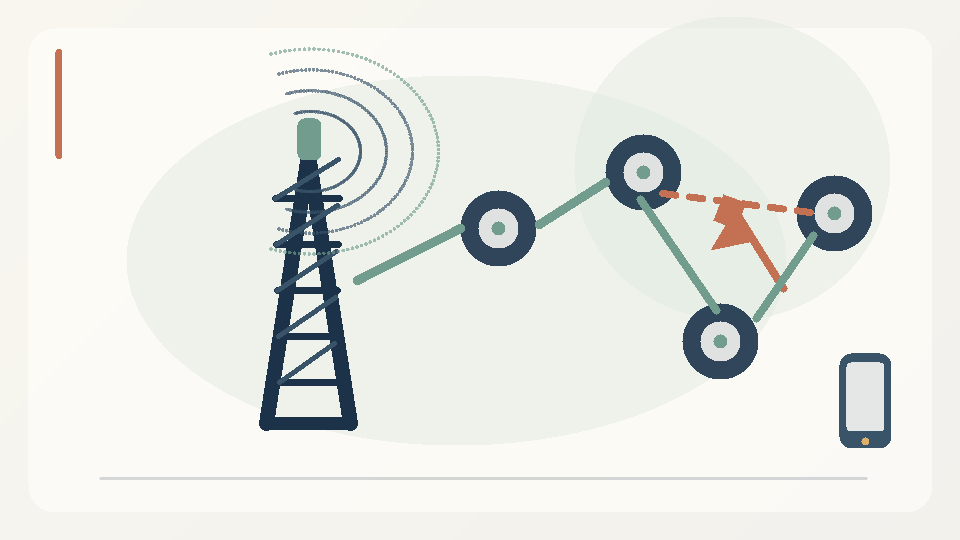
Did you know? Your phone can show full signal bars while the network that connects it to the rest of the world is unavailable. The nearest antenna is only the first handoff in a much larger system of cables, routers, software, power and shared infrastructure.
Quick answer: Communication networks fail when physical damage, overloaded connections, faulty routing, configuration errors, power interruptions or common dependencies stop calls and data reaching their destinations. A local Wi-Fi problem, operator-wide outage and application failure can look similar but require different repairs.
This plain-English guide explains why telecommunications networks fail, how routing and fibre cuts cause outages, what happened in Canada’s July 2022 Rogers disruption and the US February 2024 AT&T outage, and why the ITU is emphasising digital resilience in 2026.
Follow the chain: device → local access → operator backhaul and core → routing and interconnected networks → destination and usable service. Every link, including power and information, must work.
Choose your reading route
- The quick answer: why communication networks fail
- The route from a phone to another person
- Why full signal bars do not guarantee service
- Access networks, core networks and the internet are different layers
- The physical network underneath the digital world
- Why one fibre cut can affect many services
- Submarine cables are a critical global dependency
- Routing: why the shortest-looking path may not be available
- What happened during Canada’s July 2022 Rogers outage?
- How one configuration mistake can propagate
- Case study: AT&T’s February 2024 wireless outage
- Emergency calls turn communication reliability into public safety
- Why a network can be congested rather than broken
- Why wireless coverage maps do not tell the whole story
- The digital divide is not identical to an outage
- Power outages reveal the dependence of communication systems
- Weather and disasters can isolate communities
- Satellite connections help in some failures, not all
- Cyberattacks and operational mistakes are not the same
- How DNS problems can look like the whole internet has vanished
- Why shared cloud services can cause communication failures
- Why redundancy sometimes fails at the same moment
- An invented island: two cables, one landing station
- A second fictional scenario: the tower works, the hospital cannot call
- Monitoring needs to follow real calls and data journeys
- Why restoration can take longer than fixing the first error
- What governments and operators can do before the next disruption
- A reader’s checklist for the next outage
- The larger lesson: communication must survive more than normal days
- Frequently asked questions
The quick answer: why communication networks fail
Did you know? Your phone can show strong signal bars while messages fail to send and websites never finish loading. The radio link to a nearby tower may be working, but the larger network carrying your request may not be.
Communication networks depend on many stages: devices, local wireless connections or cables, network operators, routing equipment, authentication, shared infrastructure, software, power and links to other networks. A broken connection or incorrect configuration at one stage can interrupt the complete journey.
Quick answer: Communication networks fail when physical damage, overloaded capacity, faulty routing, software or configuration errors, power loss or a critical shared dependency prevents messages from reaching their destination. Some faults affect a single building; others spread across a mobile operator or international region. An outage is not automatically a cyberattack, and a mobile-signal icon is not a guarantee of functioning voice or data service. The useful diagnosis identifies which layer is unavailable, who is affected and whether alternative routes actually work.
The route from a phone to another person
Imagine sending a message to a family member across the city. Your phone connects to a local network, perhaps through mobile radio or Wi-Fi. The request travels across access and core infrastructure, may pass through internet routing or application servers, and eventually reaches the receiving device or service.
Each handoff has a distinct job. A mobile tower can provide a radio connection without guaranteeing the network core can route the communication. A home router can connect a laptop locally while the internet service provider remains unreachable. An application can be unavailable even though the internet itself is functioning.
This separation is the foundation of diagnosis. Ask whether the device can reach the local network, whether the provider can move traffic, whether the intended destination is reachable and whether the destination’s own software is working. Blaming the nearest visible component is tempting, but it may be the only part that is healthy.
Why full signal bars do not guarantee service
Signal bars are simplified indicators associated with received radio conditions, and the exact display depends on the device and technology. They do not directly confirm that the network’s authentication, routing, capacity and downstream services are functioning correctly.
A tower may be close enough for a handset to detect but connected to a disrupted backhaul route. The network core may be experiencing an outage, or many devices may be competing for limited resources during a crowded event. The handset can therefore report an apparent connection while calls or data sessions fail.
The right investigation uses several observations: can the device place calls, send texts and reach different internet services? Is the problem confined to one location or operator? Are official service notices available? Avoid inventing a specific technical cause merely from the display. A visible connection to one network component is not proof that the whole communication path is intact.
Access networks, core networks and the internet are different layers
A mobile access network uses radio equipment to connect devices. A core network performs other critical functions, including aspects of user authentication, session management and traffic handling under the applicable architecture. Internet routing connects networks and destinations over many operators.
A fault affecting one layer can produce a very different pattern from a fault affecting another. If an individual tower loses power, service may be degraded in a local area. If a shared core-network service is unavailable, many towers can remain powered while subscribers across a wider region struggle to make calls or use data.
A trustworthy outage explanation specifies the affected layer and the evidence supporting it. This matters to recovery because replacing a tower battery will not repair faulty routing in a core network, and restarting an app cannot fix a severed fibre connection. The user sees one failure; the engineers must locate the missing handoff.
The physical network underneath the digital world
The internet can feel like a wireless cloud, but much of the infrastructure is physical. Fibre-optic cables, routers, data centres, submarine links, antennas and power systems move and manage communications. Each requires maintenance and protection against relevant hazards.
A road excavation can cut underground fibre. A storm can damage overhead cables or transmission sites. An earthquake or underwater event can affect cable routes. Equipment can fail even when it is well maintained. The consequences depend on whether usable alternate paths exist and how quickly operators can shift traffic.
Physical resilience means mapping critical routes, maintaining suitable protection and planning repairs. A network diagram with two routes is not necessarily resilient if both cables run through the same duct or across the same exposed bridge. The question is not how many lines appear on a map, but whether they are genuinely independent under the likely disruption.
Why one fibre cut can affect many services
Imagine two telecom providers leasing capacity in the same underground corridor. Each sells service under a different name, but both rely on fibre located in one shared duct. A construction accident damages the duct and interrupts several apparently unrelated customer networks.
The incident may also affect services indirectly. A mobile tower could have working radio equipment but depend on the damaged fibre for backhaul. A payment terminal could be connected to an otherwise healthy shop network but lose the route needed to reach its transaction processor. One physical incident has crossed several business boundaries.
Strong planning identifies common infrastructure, alternative routes and what can be restored first. Redundancy must be evaluated against the actual failure scenario. Merely buying contracts from two suppliers does not guarantee their underlying cable routes, power supplies or upstream providers are independent.
Submarine cables are a critical global dependency
International digital communication depends heavily on submarine fibre-optic cables. In a 10 July 2026 announcement, the International Telecommunication Union stated that submarine telecommunication cables carry more than 99% of data traffic worldwide.
The ITU identified physical exposure, lengthy repairs and geographic concentration as important resilience concerns, particularly for places that depend on a small number of cable systems. The exact consequence of a cable fault varies according to network routes, remaining capacity and the affected location. A cut does not mean the entire planet loses internet access.
Some traffic can be rerouted if alternatives are available, but new paths may be longer or have insufficient capacity for every customer. Repair operations also face physical, logistical and regulatory constraints. The lesson is that a globally connected digital economy depends on underwater infrastructure whose vulnerabilities deserve the same seriousness as roads, power stations and ports.
Routing: why the shortest-looking path may not be available
Data moves through networks using routing information that identifies reachable destinations and available paths under relevant technical rules. Operators configure and maintain this information. The route packets take is not necessarily the line that appears shortest on a map.
Problems arise when routing information is incorrect, withdrawn unexpectedly, applied too widely or inconsistent with neighbouring systems. Traffic may fail to reach a destination, circulate through an unsuitable path or overload another part of the network. Redundant physical cables alone cannot solve incorrect logical routing.
The Border Gateway Protocol, or BGP, is one of the key mechanisms by which internet networks exchange reachability information. Understanding its broad purpose is enough for most readers: different networks need a trustworthy way to announce where traffic can go. An error in those announcements may be felt far from the equipment where it originated. Engineers must validate changes and monitor their real reach, not just check whether individual routers are switched on.
What happened during Canada’s July 2022 Rogers outage?
On 8 July 2022, Rogers Communications experienced a major disruption affecting communications across Canada. Cloudflare’s network-traffic analysis published that day observed a near-complete loss of traffic from Rogers’ autonomous system and changes in route announcements.
The analysis recorded the network gradually returning over the following hours. Cloudflare’s 2022 year-end review described impacts beyond ordinary web browsing, including communications and transaction services, and referred to Rogers’ attribution of the outage to a maintenance-related core-network problem.
The case demonstrates the difference between a local home internet problem and a provider-wide routing disruption. The provider’s customers could experience failures across many unrelated applications because they depended on the same network. It does not prove that every routing change is dangerous; it shows why major network changes require testing, visibility and rollback planning.
How one configuration mistake can propagate
Telecommunications networks are configured through software and controlled equipment settings. Operators must update routes, authentication mechanisms, capacity and security as networks grow. A mistaken configuration can affect a large number of devices when it reaches shared infrastructure.
Some faults are contained by a device or local segment. Others affect common services used by many access points. A poorly evaluated change can cause connection attempts to fail, force devices to reconnect repeatedly or change where traffic is sent. Each attempt to recover may add load to an already strained system.
The solution is not to stop network maintenance. Networks require updates to remain secure and useful. Operators need appropriate peer review, staged changes, reliable configuration records, operational monitoring and recovery plans. The essential question is how large a change’s potential impact is, and whether problems can be detected before every connected customer feels them.
Case study: AT&T’s February 2024 wireless outage
A large AT&T Mobility outage affected customers in the United States on 22 February 2024. The Federal Communications Commission’s July 2024 investigation report described a configuration error introduced during network expansion and a service interruption lasting at least twelve hours.
The FCC reported widespread problems with voice and data service, including consequences for attempts to reach emergency calling services. The finding was an operational configuration and change-control problem, not an established cyberattack. The outage demonstrated how a shared network component and inadequate safeguards can affect customers far beyond the place where an error originated.
The important lesson is not that every wireless network is always fragile. Large providers manage complicated systems successfully much of the time. It is that essential changes must be validated with their potential scope in mind, and recovery planning must protect critical communications rather than assume a routine maintenance window cannot become a public-service incident.
Emergency calls turn communication reliability into public safety
A missed entertainment stream may be frustrating. A failed emergency call can have much more serious consequences. Public-safety communications depend on suitable network paths, emergency-call routing, operational coordination and timely information about service disruptions.
Different countries and network technologies have different emergency-calling arrangements. Some devices may use another available operator under relevant conditions, but this cannot be assumed to work identically everywhere or during every outage. Official emergency authorities determine the appropriate alternatives for a real incident.
The US First Responder Network Authority’s review of the February 2024 outage emphasised the need for public-safety standards, corrective action and communications during restoration. A resilient system should protect essential users, notify affected organisations promptly and verify that actual emergency communication works—not merely report that equipment is powered on.
Why a network can be congested rather than broken
A communications network has finite radio spectrum, processing capacity, links and other resources. At a concert, transport hub or major emergency, many devices may try to use the same resources simultaneously. Even when all equipment is functioning, performance can deteriorate.
Congestion may produce slow downloads, delayed messages or failed connection attempts. The response can differ from that for a broken cable. Operators may need more usable capacity, improved scheduling, traffic engineering or priority arrangements appropriate to the service and applicable rules.
Demand also varies by time and location. A network sized only for quiet-hour averages may not cope well with peak crowds. Resilience planning therefore includes realistic load testing, monitoring and procedures for protecting essential services. The goal is to prevent a predictable surge from becoming a complete loss of communication when information is needed most.
Why wireless coverage maps do not tell the whole story
Coverage maps estimate where a signal may be available under specified assumptions. They do not fully describe indoor reception, network congestion, device compatibility or the complete end-to-end service. Hills, buildings and radio interference can affect real conditions.
A household might appear to be inside a covered area but experience unreliable service in a basement or densely built location. A rural community might have a signal on a main road but not inside homes farther away. Even where a tower exists, backhaul and power reliability can limit performance.
Meaningful connectivity means more than a coloured coverage region. It includes usable speeds, quality, affordability, devices and skills. Regulators and operators need both network measurements and feedback from users. A coverage promise should be assessed under realistic receiving conditions rather than only the technical existence of an access signal.
The digital divide is not identical to an outage
An outage is a disruption of a service that would otherwise be available. A digital divide can exist when people cannot obtain affordable, suitable connectivity even under normal conditions. Both prevent participation, but their causes and remedies differ.
The ITU’s Facts and Figures 2025 estimated that 2.2 billion people remained offline in 2025 despite nearly three-quarters of the world’s population being connected. The publication identified gaps in affordability, quality and use alongside differences among regions and income groups.
A country can have highly reliable networks for connected users while leaving parts of its population without meaningful access. Building a new cable may help, but some households also need affordable services, suitable devices and digital skills. Success means dependable connection that people can actually use, not solely that new infrastructure has been installed.
Power outages reveal the dependence of communication systems
Mobile sites, fibre-network equipment, data centres and routers need electricity. Batteries and other backup arrangements can maintain selected functions during interruptions, but their duration and capacity vary. Prolonged power loss can therefore turn a stable communications network into an unavailable one.
The vulnerability can spread in both directions. A utility may need communications to coordinate power restoration, while the network needs electricity to carry those coordination messages. If both systems are affected at once, repairs become harder. Critical facilities must understand these shared dependencies.
Resilience requires realistic backup capacity, tested maintenance and arrangements for coordinating with power operators. A generator is not a universal solution if fuel, safe access or network backhaul are missing. For the companion mechanism, read Why Power Grids Collapse. Protection is measured by the ability of essential users to communicate under stress.
Weather and disasters can isolate communities
Floods can damage equipment shelters or prevent access to towers. Wildfires and severe storms can affect exposed routes. Earthquakes may damage multiple pieces of infrastructure over a wide area. Restoration can be delayed when roads, electricity or fuel supplies are also disrupted.
The ITU Disaster Connectivity Map helps assess connectivity disruption after disasters. According to the ITU’s January 2026 description, it had been activated for more than eighty country or disaster situations, using available information about network infrastructure, coverage and connectivity performance.
Such information helps response agencies understand where communications are missing. It does not automatically restore damaged equipment. Effective emergency plans combine monitoring, alternate communications, trained staff, repair supplies and safe access. Communities need options matched to their actual hazards, not a generic assurance that networks always have backups.
Satellite connections help in some failures, not all
Satellites can provide communication where terrestrial infrastructure is limited or damaged, and some emergency arrangements use satellite services as an alternative path. Their usefulness depends on the equipment, service, capacity, power supply, coverage and conditions under which they operate.
A satellite link is not automatically interchangeable with the throughput or latency of a working fibre network. It may be essential for basic coordination but unable to carry every normal application or every user’s demand. A backup that requires equipment stored far away may not be usable when disaster strikes.
The ITU’s February 2026 recommendation on disaster communications also discusses the role of amateur and amateur-satellite networks when ordinary services are unavailable. The broader lesson is to select and rehearse appropriate alternatives before an emergency, with explicit limits on what each option can support.
Cyberattacks and operational mistakes are not the same
A network may fail because of hardware, software, configuration, weather or malicious interference. These causes can sometimes produce similar symptoms for the customer. It is therefore unsafe to label an unexplained outage a cyberattack simply because it is widespread.
A security incident may involve unauthorised access, disruption or data exposure. Operational failure may result from an incorrect change or unexpected dependency interaction without malicious action. Each requires a suitable investigation and communication response.
Good organisations prepare for both. They use appropriate network security, controlled access, change management, incident detection and recovery arrangements. Public statements should distinguish confirmed causes from possibilities still being examined. False certainty can mislead users and hinder trust; unjustified blame can also distract from the engineering weakness that actually needs repair.
How DNS problems can look like the whole internet has vanished
The Domain Name System helps translate human-friendly names into information computers use to locate internet services. If name resolution is unavailable or incorrect, a device may struggle to reach websites by their usual names even when parts of the underlying network can still carry packets.
A DNS-related issue can therefore make many unrelated applications appear broken, particularly if they rely on the same resolver or authoritative service. The problem is different from a complete loss of internet connectivity. Engineers need to test the relevant name-resolution path along with routing and the intended destination.
For ordinary readers, the lesson is diagnostic rather than procedural. If several websites fail simultaneously, the cause may be a common service rather than independent failure of every site. Safe recovery depends on trustworthy configuration and security; indiscriminately changing device or network settings based on unverified social-media instructions is not always appropriate.
Why shared cloud services can cause communication failures
Messaging apps and communication platforms often rely on cloud infrastructure for authentication, message processing, storage or media delivery. A telecom network can be functioning while one application is unavailable because its software or provider has failed.
Conversely, many apps can fail at once when they use the same shared identity service, content delivery layer or network provider. Users may experience this as “the internet is down” even though other services remain reachable. The correct diagnosis distinguishes transport connectivity from the applications delivered over it.
See Why Software Systems Fail for the related software-level mechanisms. Resilience needs independent monitoring of the network and the user-facing service, because restoring one does not automatically restore the other.
Why redundancy sometimes fails at the same moment
A company may purchase two internet connections, maintain backup equipment or configure several network routes. Redundancy can reduce interruption risk, but only when the alternatives are sufficiently independent and their capacity is realistic.
Two connections from different vendors may share a physical fibre corridor. Two cellular providers may rely on the same regional power supply. A backup router may carry the same faulty configuration as the primary. A disaster affecting the shared dependency can then disable every nominal alternative.
Resilience planners should therefore test concrete scenarios. What happens if the local power grid is unavailable for a day? What if one internet exchange or cable corridor fails? Which essential services still work, and for how long? The existence of multiple logos on invoices does not establish genuine fault tolerance. The test is whether the service survives the particular disturbance being planned for.
An invented island: two cables, one landing station
Imagine a fictional island connected to the mainland by two submarine cables. Residents feel secure because there are two routes. A detailed review, however, finds that both cables terminate at one low-lying landing facility with the same electrical and control systems.
A coastal flood damages that facility. Both cables remain physically intact offshore, but the essential termination equipment is unavailable. The island experiences serious disruption despite owning two international connections.
The right repair may be to protect or diversify landing facilities, provide suitable power resilience or arrange an independent alternative service. Buying a third cable into the same vulnerable building might not solve the shared failure. This thought experiment shows why geographic and operational diversity matter as much as the count of transmission paths. Resilience is about removing common bottlenecks, not simply adding more items to an inventory.
A second fictional scenario: the tower works, the hospital cannot call
Imagine a hospital near a mobile tower. A maintenance change interrupts a shared service inside the network core. The tower remains powered, and staff see signal icons on their phones. Yet attempts to reach certain destinations fail because connection management is disrupted.
The hospital has functioning electrical power and medical equipment, but communications used for coordination are impaired. A local technician cannot solve the problem by replacing the tower battery. The relevant operator must restore the core service and verify that emergency communication is functioning.
This invented example is intentionally simple. Actual networks have multiple layers and emergency calling architectures. Its lesson is that apparent local equipment health is insufficient to confirm a critical end-to-end function. Organisations whose work depends on communications should develop appropriate, rehearsed continuity plans rather than assuming the nearest antenna provides the whole service.
Monitoring needs to follow real calls and data journeys
Telecom operators monitor signal quality, equipment status, routing, traffic, call completion and other indicators. Different measures reveal different weaknesses. A tower’s online status may look healthy while many customer sessions are failing. A network might carry large amounts of traffic while emergency calls are still affected.
Useful monitoring therefore connects technical signals to user outcomes. Did the call complete? Could the message be delivered? Can an essential site be reached from multiple regions? How many customers are affected, and which failures are persistent rather than transient?
Reporting should also show uncertainty. A low volume of complaints can reflect a network that is working—or users who have lost the means to complain. Independent measurements, network data and customer reports help fill these gaps. The goal is not to produce the most dashboards; it is to detect a meaningful problem early enough for qualified operators to contain it.
Why restoration can take longer than fixing the first error
After a major network outage, an operator may correct the configuration or replace damaged equipment yet still face heavy demand from devices reconnecting. Pending messages, registration attempts and overloaded services can delay full recovery. The visible change that caused the incident may not be the only problem remaining.
Restoration also requires checking that voice, data, emergency calling and other relevant functions work under realistic conditions. A single successful test call cannot prove the service has returned for every customer. Some regions or device types may recover earlier than others.
A responsible incident update separates the root cause being corrected from service fully restored. It identifies verified progress and outstanding effects without inventing certainty about every customer. After restoration, operators should review change controls, shared dependencies, safeguards and communications so the same weakness is less likely to recur.
What governments and operators can do before the next disruption
Reliable communications require continuous work. Maintain critical physical routes, secure sites and power supplies, manage software changes carefully, test alternate paths and coordinate emergency planning with hospitals, utilities and public safety organisations. These actions should reflect the geography and risk profile of the network.
The ITU’s May 2026 report announcement on critical digital risks emphasises shared vulnerabilities across terrestrial, submarine and space-related digital systems and the need for coordinated resilience. The message is not that all global communications are about to fail. It is that interconnected infrastructure needs preparation across organisations.
Oversight should measure service and recovery outcomes, not merely the number of facilities built. Operators need the ability to detect faults, contain changes and communicate honestly. Public agencies need suitable contingency arrangements where essential services depend on commercial networks.
A reader’s checklist for the next outage
When communications stop working, begin with the scope. Is one application unavailable, or are calls and several unrelated services affected? Is the problem limited to one device, building, provider or wider region? Look for official service-status information rather than treating unverified screenshots as proof of a particular cause.
If the situation involves public safety or a medical emergency, follow the relevant local emergency authority’s instructions and established continuity arrangements. Do not assume another network, Wi-Fi calling or an internet messaging app is always available or equivalent to an emergency calling service.
For students, draw a route from a phone through a tower, backhaul, network core and distant application. Then remove one connection and ask which observations could locate the missing handoff. This exercise explains the larger principle: networks are only as reliable as the path required by the task people are trying to complete.
The larger lesson: communication must survive more than normal days
On a normal day, many networks perform so smoothly that people barely notice the infrastructure behind a call or message. That convenience is a remarkable engineering achievement, but it can hide shared vulnerabilities and maintenance dependencies.
A communications system does not become resilient merely because it works at average demand or because spare equipment has been purchased. It needs honest capacity models, genuinely independent routes, safe change management, trained operators, credible recovery and a practical plan for essential users when normal services fail.
The final measure is the receiver’s outcome. Can a family contact someone, a hospital coordinate care, a shop take payment or a rescue team send a message under the conditions that matter? When engineers and policymakers plan around those real tasks, the network can be judged by what it reliably enables, not simply by signal icons and equipment counts.
Frequently asked questions
Why does my phone show signal but the internet not work?
The radio connection to the tower can be available while the network core, backhaul, routing, authentication or downstream internet service is failing. Signal bars do not verify the whole path.
What is the difference between Wi-Fi and the internet?
Wi-Fi connects a device to a local wireless network. Internet access requires additional functioning connections and services beyond that local network. A Wi-Fi icon alone does not prove external connectivity.
Can one cable cut disconnect an entire country?
It can severely affect countries or regions with concentrated connections, but the actual impact depends on alternate routes and capacities. Some traffic may be rerouted, while other services can remain disrupted.
Why are submarine cables so important?
The ITU’s July 2026 guidance says submarine cables carry more than 99% of global data traffic. Their location, physical exposure, available alternatives and repair times make them important resilience infrastructure.
What is BGP in simple language?
The Border Gateway Protocol is a major mechanism internet networks use to exchange information about reachable destinations. Incorrect or withdrawn route information can prevent traffic from finding the intended path.
Was the February 2024 AT&T outage a cyberattack?
The FCC’s 2024 investigation described an operational configuration error during network expansion, not an established cyberattack. The outage affected widespread voice and data services for many hours.
What happened to Rogers Communications in July 2022?
A major Canadian network outage coincided with significant route withdrawals and interrupted a range of services. Cloudflare’s contemporaneous observations and year-end review documented the network loss and gradual recovery.
Why can communications fail during a power outage?
Towers, fibre equipment, routers and other components require electricity. Backup power may be limited by capacity, fuel, maintenance and dependencies elsewhere on the route.
Does satellite internet always solve a terrestrial outage?
No. Satellite alternatives depend on equipment, power, availability, capacity and service rules. They can be valuable for particular emergency functions but do not necessarily replace all ordinary traffic.
What is a shared point of failure?
It is a dependency used by multiple otherwise separate services, such as a common cable corridor, power source or network core. One event can disable all services using that shared component.
Is every major network outage caused by hackers?
No. Physical damage, software updates, configuration errors, overload, weather and power loss can all cause outages. Security attribution requires evidence rather than speculation.
Why do networks take time to recover after repairs?
Devices may need to reconnect, routing may need to stabilise and remaining services may be overloaded. Operators must also verify that essential end-to-end functions are actually restored.
What do official connectivity statistics measure?
Different indicators describe usage, coverage, speed, affordability and quality. The ITU’s 2025 estimate of 2.2 billion people offline concerns connectivity access and use, not people experiencing one temporary network outage.
Primary sources and related reading
The ITU’s May 2026 digital-risk report announcement and July 2026 submarine cable recommendations describe global resilience concerns. Its Facts and Figures 2025 provides dated connectivity estimates. Historical primary-source accounts include Cloudflare’s July 2022 Rogers observations, the US FCC’s July 2024 AT&T investigation report and the First Responder Network Authority’s review. Each source concerns specific networks and reporting dates.
Explore connected system failures: Why Software Systems Fail | Outages, Dependencies and Bad Deployments; Why Power Grids Collapse | Cascading Failures, Blackouts and Recovery; Why Transport Networks Fail | Congestion, Maintenance and Disruption; Why Healthcare Systems Fail | Capacity, Access and Patient Safety.
Final thought: Communication reliability is not the strength of one signal bar. It is the reliability of the entire path that lets people coordinate, learn, work and call for help when normal conditions change.