
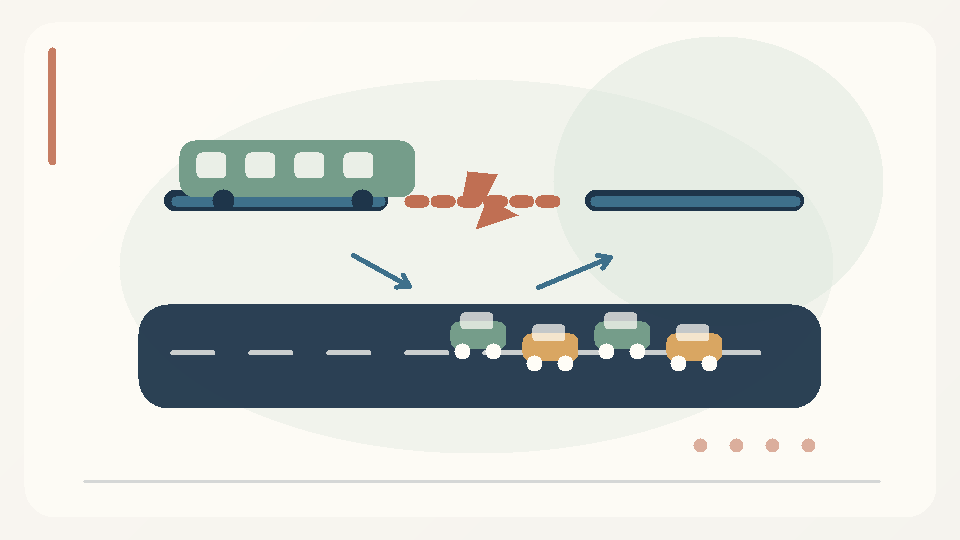
Did you know? One defective component on a train can affect hundreds of thousands of journeys even though most of the tracks and trains in a city remain in service. Transport is a network: when a critical handoff fails, delays and disruptions can spread far beyond the original problem.
Quick answer: Transport networks fail when congestion, damaged assets, unsafe operating conditions, signalling errors, severe weather or poorly coordinated alternatives prevent people and goods moving reliably. The visible jam or closure is often the outcome of a much earlier capacity, maintenance or information problem.
This readable guide explains why roads and railways fail, how bottlenecks spread congestion, what Singapore’s September 2024 East-West Line disruption teaches and why safe restoration matters more than a rushed reopening.
The journey chain is origin → accessible route → available vehicle → safe network capacity → transfer or interchange → final destination. Power, information, asset maintenance and safety support every link.
Choose your reading route
- The quick answer: why transport networks fail
- Transport is a network of connections, not a collection of roads
- Congestion is a capacity and behaviour problem
- Why extra road capacity may not fix congestion forever
- Why one junction can delay an entire district
- What reliability means beyond average journey time
- Maintenance failures accumulate long before a dramatic closure
- Rail signalling and the role of information
- Passenger crowding can magnify a minor timetable problem
- Case study: Singapore’s September 2024 East-West Line disruption
- Why the 2024 East-West Line case is a systems lesson
- Why reopening a rail line requires more than repairing one part
- Alternative buses and network redundancy
- Road safety is not separate from transport performance
- Weather can disable several modes at once
- Why bridges and tunnels are critical nodes
- Power and digital systems are hidden transport dependencies
- Housing location determines transport stress
- Why price is not the only barrier to mobility
- Freight transport failure differs from passenger disruption
- How to judge the real cost of a transport breakdown
- A fictional town with two roads and one hidden weakness
- A second scenario: more trains, a slow station
- What a credible recovery and prevention plan includes
- A student’s six-question transport diagnosis
- Frequently asked questions
The quick answer: why transport networks fail
Did you know? A busy highway can still be a failing transport system if people cannot reach work or medical care reliably. High traffic volume may indicate strong demand, but it says little about whether the network gives users safe, predictable and affordable journeys.
Transport connects homes, schools, businesses, stations, hospitals, ports and other destinations. It depends on vehicles, roads or tracks, operating staff, power, signalling, maintenance, information and the ability to transfer between different services. A failure occurs when this chain cannot provide the needed mobility at the relevant place and time.
Quick answer: Transport networks break when essential routes or operating capacities cannot handle demand, withstand disruption or recover safely. Congestion, damaged infrastructure, signalling failures, severe weather, accidents and poor coordination can amplify one another. A slow commute is not the same event as a line closure, and a crowded station is not automatically proof that an entire rail system has collapsed. Diagnose the specific service, location, cause and user impact before choosing a remedy.
Transport is a network of connections, not a collection of roads
Imagine a student leaving home, walking to a bus stop, changing to a train and walking from the station to school. The journey involves sidewalks, traffic crossings, vehicle availability, timetables, payment systems, station access and a safe connection at the transfer point. A problem at any of those stages can make the entire trip fail.
A single high-capacity rail line may serve thousands of people, but not everyone can use it if the first or last part of their journey is inaccessible. A bridge may be well maintained, but an approach road could become the bottleneck during peak hours. A port may unload containers while trucks queue for hours at a nearby gate.
The transport system therefore has to be measured end to end. Infrastructure volume, train-kilometres or vehicle counts describe activity. The receiver’s outcome is whether a person or shipment reaches the right place safely and within an acceptable, predictable time. A good network serves complete journeys rather than optimising one attractive-looking component in isolation.
Congestion is a capacity and behaviour problem
Congestion develops when many vehicles or passengers attempt to use limited network capacity, especially when demand is concentrated in particular places and periods. When traffic approaches the practical capacity of a road, junction or platform, small disturbances can create disproportionate delays.
A road junction might be capable of serving a steady flow under ordinary conditions but become unstable when turning vehicles block an intersection, a bus stop is obstructed or an incident closes one lane. The downstream queue can prevent upstream vehicles from clearing, spreading delay into nearby streets. A public transport platform can likewise become crowded when trains arrive less frequently than passengers.
The correct repair depends on the constraint. It might involve better junction management, safer boarding, more reliable public transport, freight scheduling or demand management. Widening a road is not the universal answer. A network can become overloaded again when travel behaviour changes or a downstream intersection remains the true bottleneck.
Why extra road capacity may not fix congestion forever
Adding road capacity can improve movement in some locations and circumstances. But over time, lower travel costs may encourage some people to change routes, make more trips, travel at different times or choose locations requiring longer drives. This is one reason road widening does not always deliver permanent relief at the original scale expected.
Transport economists study these responses under ideas such as induced demand, but the size of the effect varies by setting. It is incorrect to claim that every new road is useless, just as it is incorrect to assume every new lane permanently eliminates congestion. Road investment may also have essential safety or connectivity benefits that cannot be judged through speed alone.
Useful planning examines realistic alternative routes, transit availability, land use, future development and travel behaviour. The objective should be dependable access, not a guarantee that every driver can travel at free-flow speed at every moment. Sometimes a more attractive rail, bus or walking option creates more useful capacity than another lane on a corridor already surrounded by bottlenecks.
Why one junction can delay an entire district
Traffic flow is a chain of junctions, road segments, crossings and vehicle movements. If one busy intersection cannot discharge vehicles quickly enough, a queue forms. When the queue grows long enough to block the previous junction, new streams of traffic are also delayed. This is sometimes called spillback.
Imagine a fictional business district where delivery vans and buses share a narrow access road. Construction removes one loading space. Vans begin stopping in a traffic lane, reducing effective capacity. Buses arrive late, more people choose alternative routes, and the queue extends back to a major road. The original issue was one missing loading arrangement, not a sudden national shortage of road space.
Effective solutions follow the actual path of the queue. They may involve protected loading areas, signal management, safer pedestrian movements or better service access. A highway expansion kilometres away will not necessarily help if the last junction remains blocked. The lesson is to find the bottleneck that controls throughput before prescribing a large and expensive project.
What reliability means beyond average journey time
A commuter who takes 35 minutes most days may be able to plan work and childcare. Another commuter may average the same journey time but experiences 20 minutes one day and 70 minutes the next. For many activities, uncertainty is as damaging as the average delay.
Transport agencies therefore examine travel-time reliability, service regularity, missed trips and incident recovery, in addition to speed. The experience of the longest or most unpredictable journeys can be important for passengers who cannot afford to arrive late at work, school or healthcare appointments.
The International Transport Forum’s 2024 report on transport system resilience describes resilience as the ability to deal with, adapt to and recover from disruptions. That framework shifts attention from a smooth trip under ideal conditions to how the network behaves under realistic stress. Measuring only the average may conceal the very failure people most need a transport system to prevent.
Maintenance failures accumulate long before a dramatic closure
Roads, rails, bridges, tunnels, vehicles and stations need ongoing inspection and maintenance. Parts wear, water enters structures, equipment ages and repeated loads contribute to deterioration. The work is often invisible to customers because successful maintenance prevents an incident that never becomes a headline.
Deferred maintenance can leave an operator with an increasing backlog and fewer safe alternatives when a component fails. The result may be speed restrictions, recurring delays or a sudden closure requiring extensive repairs. Not every fault is caused by neglect; even properly maintained systems can encounter unexpected defects.
Asset management should combine inspections, condition records, engineering judgement, appropriately funded renewal and clear escalation of anomalies. A kilometre of newly built rail is not inherently more valuable than a kilometre of existing rail kept safe and dependable. A transport system succeeds over its entire lifecycle, not just during its opening ceremony.
Rail signalling and the role of information
Train movements depend on safe coordination. Signalling, train protection, communications, track equipment and operations control support safe spacing and route management. The precise technical arrangements differ among systems and should not be treated as interchangeable.
A communications interruption or equipment fault may require service restrictions or stopping some operations while safety is confirmed. To a passenger, this can feel like an excessive response to a small technical problem. In a safety-critical network, however, an uncertain or inconsistent system state cannot simply be ignored to protect a timetable.
Reliability improvements may involve better monitoring, testing, maintenance, redundant equipment where appropriate and carefully rehearsed operating procedures. The aim is not only to reduce technical faults but also to limit their effect on passengers. A system that detects danger and stops safely is different from a system that fails to recognise a hazard. Both can create delays, but their safety significance is not the same.
Passenger crowding can magnify a minor timetable problem
A train arriving two minutes late may seem insignificant. But at a busy interchange, the delay can cause more passengers to accumulate on the platform. The next service takes longer to board, creating additional delay. A series of closely scheduled services can then become uneven, with crowded vehicles following one another.
This feedback explains why transport performance is not just the sum of individual vehicle speeds. Platform design, dwell times, crowd management and the distribution of demand across stations influence the service as a whole. Bus systems can encounter similar patterns when late buses collect more passengers and fall further behind the schedule.
Solutions depend on operating context: reliable dispatching, suitable capacity, effective passenger information and designs that support safe movement. It is also important to manage expectations. During a serious incident, adding passengers to an already constrained system may worsen conditions. Clear, timely directions are part of a transport network’s ability to recover.
Case study: Singapore’s September 2024 East-West Line disruption
Between 25 and 30 September 2024, services on Singapore’s East-West MRT Line were disrupted between Jurong East and Buona Vista. Following repairs and extensive testing, full services resumed on 1 October 2024. The dates and affected section matter; the event was not a permanent shutdown of Singapore’s entire MRT network.
In a 3 June 2025 news release, the Land Transport Authority stated that a dislodged axle box caused a train bogie to come off the running rail, damaging the tracks and trackside equipment. The event required prolonged repair work, inspection and safe restoration.
The case illustrates why one defective component can have effects beyond the vehicle itself. A train’s condition, maintenance processes, fault detection, track safety, passenger movement and alternative transport arrangements all became part of the wider response. The official investigation—not a viral image of damaged rails—should guide conclusions about the specific causes and responsibilities.
Why the 2024 East-West Line case is a systems lesson
The immediate physical event damaged rail infrastructure, but a complete investigation also needed to understand maintenance, inspection and operational decisions. LTA’s June 2025 findings addressed these additional issues and recorded a financial penalty of S$3 million imposed on SMRT in relation to the incident.
It would be misleading to summarise the disruption as though every train was defective or the full network became unsafe. The failure was particular, serious and extensively documented. The response included repair of damaged assets, operational adjustments and the eventual resumption of service after safety checks.
The lesson for a general reader is to distinguish initiating fault, contributing conditions, spread of damage and recovery. A broken component may explain how the incident began. Preventive maintenance, fault detection and decision-making explain whether warning signs were managed and how consequences were limited. These are different questions and all deserve evidence-based answers.
Why reopening a rail line requires more than repairing one part
During the September 2024 incident, Singapore’s authorities reported that replacement rail segments and other equipment needed inspection and testing before passengers could safely return. On 30 September 2024, LTA and SMRT described functional checks, load tests, ultrasonic checks and endurance runs conducted as part of the restoration process.
The important distinction is between completing visible repair work and verifying that the repaired system is safe. If another problem emerges during testing, delaying reopening may protect passengers even though it creates inconvenience.
This principle applies to bridges, tunnels and other infrastructure. Reopening prematurely may create further damage or harm. A credible restoration plan communicates what remains to be tested, what has been confirmed and any temporary operating restrictions. A timetable can be a useful planning target, but safety must remain a condition of declaring a service ready to carry people.
Alternative buses and network redundancy
When a rail section closes, alternative buses or rail routes can preserve some access. They are not automatically equivalent replacements. A single train may carry many more passengers than one bus, and bus routes are affected by road conditions, stop capacity and travel time. Transferring thousands of people introduces new demand at alternative stations and stops.
During the 2024 East-West Line event, authorities activated bridging shuttle buses and arrangements for passengers to use other public services. The benefit was partial continuity of mobility while essential rail repairs continued. The experience shows why contingency plans must be designed around realistic passenger volumes and locations.
A good alternative has usable capacity, accessible stops, clear instructions and operational coordination. Providing a route on a map is only the first step. Operators should measure whether travellers can actually complete their journeys, how much extra time they face and whether vulnerable passengers can use the fallback. Redundancy is valuable when it works under the same conditions that disabled the original service.
Road safety is not separate from transport performance
A network that moves traffic rapidly but exposes people to severe preventable injury cannot be considered successful simply because congestion is low. Safety includes road design, speed management, vehicle standards, enforcement and provisions for pedestrians, cyclists and other users.
The WHO Global Status Report on Road Safety 2023 estimated about 1.19 million annual road-traffic deaths using the data available for that report. It identified road traffic injuries as a leading cause of death among children and young people aged 5–29. The estimate has a defined period and methodology; it is not the current fatality count for any particular country.
A safe-system approach recognises that people make errors and designs transport so ordinary mistakes are less likely to lead to death or serious injury. Faster flow is not worth a hidden increase in danger. Capacity, accessibility and safety must be evaluated together.
Weather can disable several modes at once
Heavy rain can flood low-lying roads, affect stations and delay buses. Heat can stress infrastructure and people using it. Extreme storms may close bridges or airports, while landslides or flooding may cut off railway corridors. The damage is magnified when several transport modes share the same exposed location.
A plan that routes trains onto buses may perform poorly if the alternative roads are also flooded. A nominally separate bridge is not a resilient detour if it crosses the same hazardous river reach. Transport planners need hazard maps, drainage information, inspection capabilities and realistic alternate arrangements.
Resilience does not mean the network can operate normally through every conceivable extreme event. It means known risks are reduced where practical, the most important services have protective plans, and recovery can be coordinated with public safety and other agencies. The useful metric is safe access restored, not merely how fast a traffic signal returns to operation.
Why bridges and tunnels are critical nodes
Some routes depend on a small number of bridges, tunnels or mountain passes. These are chokepoints because the surrounding terrain or built environment provides few practical alternatives. Closing one route can force large detours and add strain to roads or services designed for much lower demand.
The correct response depends on the physical condition and function of the structure. Engineers may need to inspect it, restrict loads, carry out repair work or keep it closed if safety cannot be confirmed. Temporary crossings may be appropriate in some settings, but they also need design and supervision.
Long-term transport planning can reduce exposure by maintaining critical assets, improving alternate connectivity and considering the consequences of losing a route. The cheapest network on a map may not be the most economical over decades if one vulnerable bridge creates repeated region-wide disruption. The consequences for emergency access and essential freight should be part of the appraisal.
Power and digital systems are hidden transport dependencies
Railways, metro stations, tunnel ventilation, signals, ticketing and traffic management often depend on electricity and digital communications. A transport system can suffer an interruption even when tracks and roads remain physically intact. Software and power faults may affect control, information or the safe operation of particular services.
The degree of dependence varies. Some essential functions have appropriate backups, but those backups need testing, maintenance and clear operating limits. A mobile-app outage may inconvenience passengers without stopping vehicles; a safety-critical signalling problem can require restriction of movement. The consequences should not be confused.
For the related failure mechanisms, see Why Power Grids Collapse and Why Software Systems Fail. Interdependence becomes manageable only when operators understand which services depend on one another and which degraded modes remain safe.
Housing location determines transport stress
A road can become congested because land use concentrates journeys through one corridor. If jobs, schools or commercial areas grow while transport capacity and alternatives remain unchanged, pressure accumulates in predictable periods.
Housing policies therefore influence mobility even though they are administered by different institutions. Affordable homes located far from dependable transport may reduce rent but impose substantial commuting time and cost. When many households make the same long journey, the resulting network becomes more crowded and less predictable.
Integrating land use and transport means considering where people live and work, which modes they can actually use and how demand will change over time. New transit capacity may enable a housing district, while thoughtful housing distribution can reduce unnecessary travel. Compare Why Housing Markets Break for the other side of this relationship.
Why price is not the only barrier to mobility
A bus fare may be low while the route is impractical because service is too infrequent, connections are unreliable or vehicles are not accessible to the people who need them. Similarly, an excellent train network may remain difficult for some users if stations or surrounding walking routes contain physical barriers.
Transport accessibility has several dimensions: cost, travel time, reliability, safety, physical access and service availability. The best measures reflect real journeys rather than only distances from a transport stop. Households have different needs, including school schedules, disabilities, shift work and caregiving.
Investment decisions should examine who benefits and who remains isolated. Rural communities may require different service models from dense city centres, while accessible station design can be vital to inclusive urban mobility. A transport network fails socially when it looks impressive on a map but excludes the people it was intended to serve.
Freight transport failure differs from passenger disruption
People and goods share some infrastructure but have different operational requirements. A commuter cares about the time, comfort and safety of a journey. A manufacturer needs specific materials to arrive at the correct production window. A perishable shipment also needs suitable storage conditions and product quality.
An airport or seaport may be operating while a cargo owner still faces failure because customs paperwork, warehouse access or onward trucking is delayed. A highway incident might affect commuter buses and essential medical deliveries differently. Different receivers require different priorities.
Transport reliability should therefore be measured through end-to-end service, not only vehicles moved. For goods, use the companion explanation Why Supply Chains Break. Transport is one part of the wider supply chain, and restoring a route does not automatically restore a factory’s production schedule.
How to judge the real cost of a transport breakdown
Direct costs can include repair work, overtime and replacement services. Indirect costs may involve missed work, reduced business activity, delayed freight, disrupted appointments and the burden placed on families. These consequences depend on the event’s scale and timing, not simply the number of kilometres of track or road affected.
A disruption during a school examination morning can matter greatly to a smaller group even if average network travel time looks modest. A rural bridge closure may isolate a hospital or produce market while affecting fewer vehicles than an urban traffic jam. Counts of affected journeys are useful but incomplete.
Serious evaluation includes safety, access to essential services, equity, duration and the quality of recovery. Claims about economic loss should explain the method and not automatically equate every hour of delay with the same monetary amount. A transport authority needs to know which harms are most serious and which actions can reduce them.
A fictional town with two roads and one hidden weakness
Imagine a town served by two roads to its only hospital. On a map the design looks redundant. In practice, both roads cross the same floodplain. When intense rain closes both crossings, ambulances need a much longer route even though the hospital remains open.
A project to resurface one road might improve daily comfort, but it would not address this shared flood exposure. A more relevant plan could investigate higher-level crossing options, flood resilience, alternative emergency access or service arrangements for affected communities. The correct design would need engineering and financial assessment.
This is a fictional illustration of common-mode failure: multiple alternatives depend on the same vulnerable condition. A good network map should show not only where the routes are, but whether the routes actually remain independent under the hazards that matter. Reliability is a property of the entire journey.
A second scenario: more trains, a slow station
Suppose another fictional city purchases additional trains because carriages are regularly crowded. But one central station has limited platform access and long boarding times during the busiest period. Running trains closer together may not achieve the planned benefit if station dwell times and signalling constraints prevent the schedule from being maintained.
The new trains might still be useful elsewhere, but the bottleneck needs its own diagnosis. A response could involve better passenger circulation, timetable changes, safe access improvements or other capacity work appropriate to the system. Each intervention should be tested for passenger safety and actual throughput.
This example shows why service frequency is not only a fleet-size question. Transport systems behave as networks of dependencies. A manager can optimise the number of vehicles and still fail to deliver more dependable journeys if the slowest handoff remains unchanged.
What a credible recovery and prevention plan includes
First, identify the disruption and stabilise safety-critical operations. Communicate which routes are affected and which verified alternatives can be used. Allocate personnel and equipment for inspection and repair, and ensure vulnerable passengers are not overlooked.
Second, protect essential access. Alternative services should be evaluated against real passenger or cargo demand, not only announced. Transport operators may need to coordinate with road authorities, other carriers, emergency agencies and employers or schools where appropriate.
Third, learn from the incident. Review maintenance, inspections, information flow, spare capacity, fault response and decisions made during restoration. Measure whether the corrective actions reduce recurring delays or improve safe recovery. The International Transport Forum’s resilience work emphasises prevention, response and adaptation. A transport system becomes more robust when those three activities are routine instead of improvised after each headline.
A student’s six-question transport diagnosis
For any traffic jam or service disruption, ask: What journey failed? Which users or goods were affected? Where was the bottleneck? Was it a vehicle, route, station, signalling system or transfer? When? Was this peak demand, a temporary fault or a persistent pattern?
Next ask what changed? Did capacity fall, demand rise or information become unreliable? What alternatives genuinely worked? A line on the map may lack enough capacity or accessibility. Finally ask what would count as recovery? A cleared lane, an inspected track and passengers safely reaching their destinations are different stages of success.
This method works for rural bus services, national rail networks, shipping corridors and city streets. It encourages careful cause-and-effect reasoning. A transport network is successful not because it is always busy, but because it gets people and goods where they need to go safely, predictably and fairly.
Frequently asked questions
Why do traffic jams form suddenly?
When demand approaches a bottleneck’s practical capacity, a small incident, slow manoeuvre or queue can create disproportionate delay. Backed-up vehicles may block upstream intersections and spread congestion.
Is a slower commute the same as a transport-system collapse?
No. Congestion is reduced performance under demand, while an infrastructure or service outage may interrupt access. They can reinforce one another but should be measured and diagnosed separately.
Why do trains stop for signalling problems?
Railway signalling and protection systems support safe movements. When critical information or equipment is unreliable, operators may need to restrict service until conditions are verified. The specific response depends on the system.
What caused Singapore’s September 2024 East-West Line disruption?
LTA’s June 2025 investigation described a dislodged axle box and associated derailment damage to track and equipment, alongside findings about operations and maintenance. Services between Jurong East and Buona Vista were disrupted from 25 to 30 September 2024 and resumed on 1 October.
Why can’t buses replace a train immediately?
Trains and buses have different capacities and routes. Thousands of displaced passengers can overwhelm stops and roads. Bridging buses help, but effective alternatives need planning, enough vehicles, safe access and accurate information.
Does widening roads always fix congestion?
Not always. It may reduce some delays, but demand patterns, downstream junctions and changes in travel behaviour affect long-run results. The useful question is which constraint actually determines the journey’s reliability.
What is transport resilience?
It is the ability of a transport system to reduce vulnerability to disruptions, respond when they occur and adapt or recover while preserving important mobility functions. The ITF uses this broader approach in its 2024 research.
Why must repairs be tested before service returns?
Infrastructure and safety systems may need inspections, functional checks or other suitable tests after damage. Completion of visible repair work does not itself prove the route is ready for safe passenger use.
Can one bridge closure affect an entire region?
Yes, especially if it is a chokepoint with few practical substitutes. Detours may be long or have insufficient capacity, and essential emergency or freight journeys may be affected.
Why is public transport important to housing?
Reliable transit changes which homes people can reach from work and essential services. A cheaper apartment far from mobility options may carry large time and travel costs. Coordinated planning improves real choice.
Are road traffic deaths part of transport-system failure?
Safety is a core performance goal. A road network that moves vehicles efficiently while exposing people to avoidable serious harm is not fully successful. Relevant road design, enforcement and safe-system policies matter.
How do we know a transport disruption is genuinely over?
Check safe restoration, actual service frequency, travel times, remaining restrictions and whether passengers and goods can reach their destinations. An announced reopening is one step; sustained user access is the outcome.
Primary sources and further reading
See the International Transport Forum’s 2024 resilience report, LTA’s June 2025 East-West Line findings, LTA’s September 2024 restoration statement and the WHO’s Global Status Report on Road Safety 2023. The numbers describe specific dated studies and events, not all transport systems today.
Explore connected systems: Why Supply Chains Break | Bottlenecks, Dependencies and Delays; Why Housing Markets Break | Affordability, Supply and Credit; Why Power Grids Collapse | Cascading Failures, Blackouts and Recovery; Why Software Systems Fail | Outages, Dependencies and Bad Deployments.
Final thought: The measure of a transport network is not simply the length of its tracks or roads. It is whether real journeys remain safe, accessible and dependable—and whether the system can contain one fault before it becomes everyone’s disruption.