
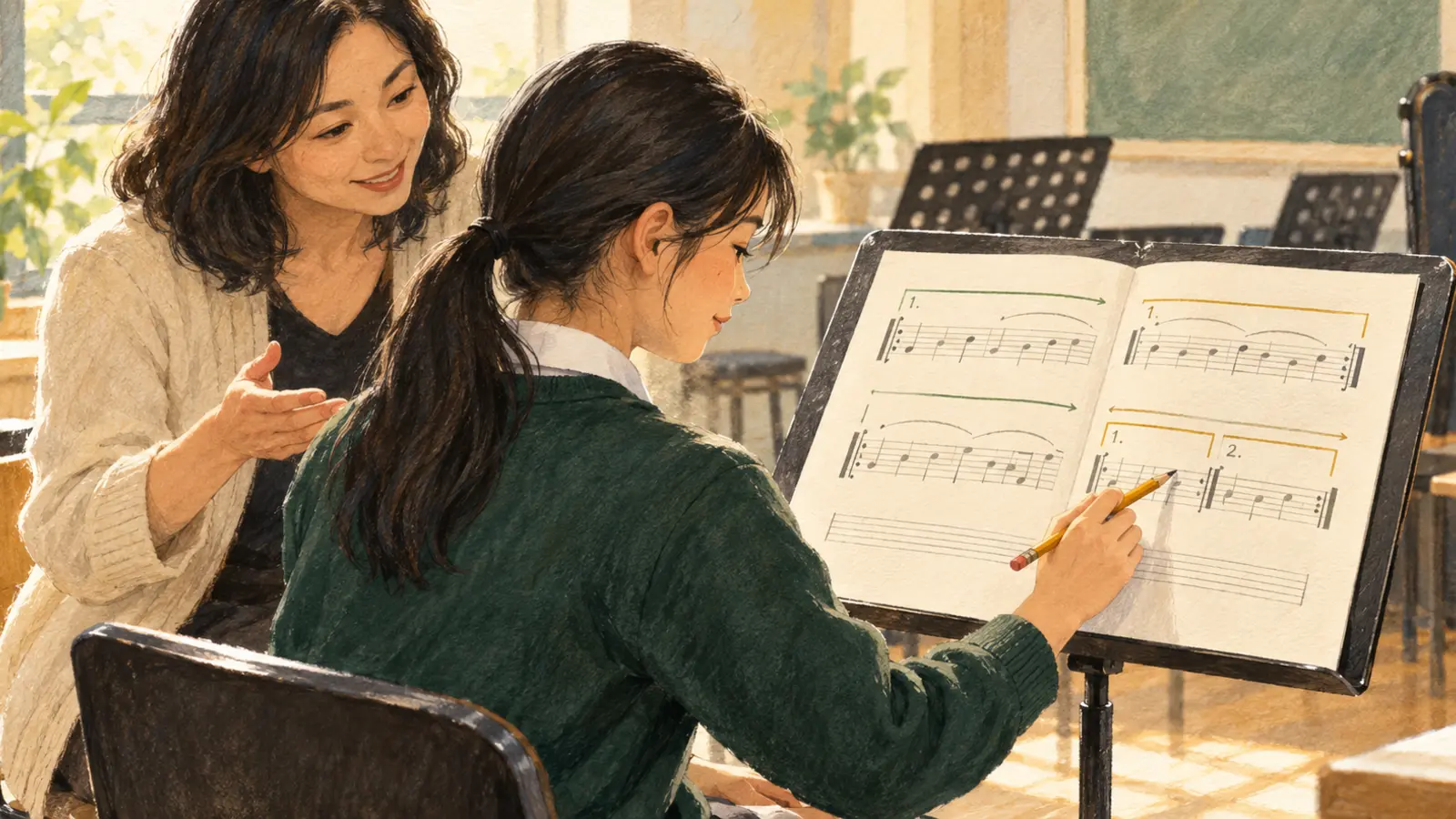
Did you know that the moment a song becomes exciting is often created by a very small musical change? A new rhythm, a stronger bass line or a sudden silence can change what listeners feel. Once a student can hear and explain that effect, the subject becomes much more than remembering notes or performing a familiar tune.
For Singapore parents searching ‘PG1 Music’, there are two separate ideas to unpack. PG1 is a Secondary 1 posting group. G1 Music is an examinable subject with the 2027 SEC code K128 where it is offered. Ordinary shared lower-secondary Music lessons do not automatically mean a child is registered for this examination.
Music is a practical and creative discipline. The 2027 syllabus combines listening with creation and live performance, including music technology. It can reveal interests and strengthen independent decision-making, while later admission to a course still depends on formal qualifications.
A practical reader guide for Singapore families. The relevant 2027 SEC syllabuses and announced 2028 post-secondary entry framework were checked on 24 October 2026. Always verify the school offering, examination year and intended admissions intake.
The 60-second answer
- PG1 is a posting group; the 2027 school-candidate G1 Music syllabus is K128.
- Paper 1 listening is worth 40% of the result and lasts one hour.
- Paper 2 coursework contributes 60%: creating and performing (40%) plus creating and evaluating (20%).
- Areas of study include popular music, Western classical programme music, music for film/television and music from Singapore’s local cultures.
- The coursework involves a live-recorded performance part and an original short film/television music cue under teacher supervision.
- ITE, diploma, JC/MI and university pathways depend on later qualifications, not the original posting group.
First, PG1 is not the same as G1
Posting Group 1 (PG1) describes a student’s admission into Secondary 1. General 1 (G1) is the subject level. Full Subject-Based Banding allows eligible learners to offer a mixture of G1, G2 and G3 subjects, subject to school offerings, readiness and placement rules. A pupil’s posting group is not itself the name of an examination.
The Singapore-Cambridge Secondary Education Certificate (SEC) replaces the previous N(T), N(A) and O-Level examinations from the 2027 examination year. It records the actual subject and level taken. A parent should therefore check the student’s official school subject record rather than assuming every subject is automatically at the initial posting-group level.
MOE’s new Post-Secondary Admissions Exercise (PSE) starts for the 2028 intake, using SEC results across eligible JC/MI, polytechnic and ITE routes. The shared admissions exercise does not eliminate programme-specific grades, subject-level requirements, prerequisites or vacancies. Earlier rules should not be casually copied forward.
What does Music actually help your child learn?
Musical listening builds careful attention. Students learn to notice a beat, tempo, phrase, instrumental colour, texture, form and change. These observations let them explain why music sounds energetic, tense, calm or reflective without assuming everyone must share their personal taste.
Performing trains another layer of thinking. A part must fit the timing and expression of the group. Playing faster is not always better; steady pulse and intentional phrasing can communicate more clearly than rushing through difficult notes.
Creating music asks a child to solve a communication problem using sound. If the goal is to build suspense for a scene, which choices help and which distract? Good creative decisions depend on listening, comparing possibilities and evaluating what the audience actually hears.
Music technology becomes useful when the student understands the purpose of the tools. Digital audio workstations, MIDI, microphones and simple editing can support an arrangement, but software cannot replace musical judgment or authentic performance.
Parents who are not musicians can still help: ask ‘What changed in the music?’ or ‘Which part creates the feeling you described?’ Specific observations matter more than deciding whether a genre is fashionable.
The core learning skills in Music
- Listen: recognise pitch movement, rhythm, tempo, timbre, texture and structure in a short recorded extract.
- Compare styles: hear features of pop, rock, R&B, electronic dance remix and other prescribed genres.
- Understand context: appreciate Western programme music, film and television cues and Malay, Chinese and Indian ensemble traditions in Singapore.
- Arrange: choose parts that fit a musical idea, balance the melody and supporting layers, and produce a coherent introduction and ending.
- Perform: practise a live part with appropriate timing, accuracy, coordination and expression.
- Create: design an original short cue that supports a specified visual narrative or dramatic purpose.
- Evaluate: explain why a particular musical or technical choice suits the context, and revise it after listening.
- Use technology ethically: save working files, follow teacher instructions, use source materials responsibly and avoid unauthorised edits of assessed performances.
Inside the 2027 SEC G1 Music K128 assessment
For the 2027 SEC G1 Music K128 syllabus, Paper 1 Listening is 40% and Paper 2 Creating and Performing coursework is 60%. The listening examination lasts one hour, with multiple-choice and short-answer questions based on short recorded musical extracts.
SEAB identifies four areas of study. Popular Music from 2000 onwards includes pop, rock, R&B and electronic dance remix. Other areas are Western Classical programme music, music for film and television, and Singapore’s Malay, Chinese and Indian ensemble traditions.
Coursework lasts five months with 30 hours of prescribed supervision. In Task 1, the learner produces an arrangement of a song or instrumental work and records a live performance of one distinct part. It contributes 40% of the overall assessment.
Task 2 contributes 20% and involves producing an original approximately 30-second instrumental music cue for a given film or television context, accompanied by an explanation or evaluation of musical decisions. Merely selecting an existing film soundtrack is not the task.
Creating work with a Digital Audio Workstation does not eliminate authenticity rules. The syllabus includes specific restrictions on live performance recording, the parts students may sequence and the handling of recorded takes. Candidates are supervised by their own school’s G1 Music teacher.
The exact 2027 requirements belong to K128 and should not be casually transferred to G3 Music or Higher Music. The 2027 SEC school-candidate list does not list a G2 Music paper, even though students may experience common Music lessons at lower secondary.
School staff should clarify which recording software, instruments, submission procedures and practice arrangements are provided. A student’s separate private music lessons or CCA work is valuable but not a substitute for the authenticated national coursework.
Did you know? A worked example worth discussing
Imagine a fictional 30-second film scene. A student searches for a missing library book, notices the library is about to close and finally finds it. This is an invented practice exercise, not an SEC coursework question.
First listen to the emotional sequence in the story: calm searching, growing urgency and relief. Ask the learner to describe what could change musically across these three moments before touching any software.
Try one short idea in which a repeated rhythm speeds up as time runs out. Make a second attempt that keeps the speed steady but changes the instrument colour or density. Play both and ask which version makes the change in urgency clearer.
Then make an original gentle ending. The learner might remove layers, change the rhythm or soften the attack of notes. Choose one change and explain what a viewer is meant to feel.
A useful reflection is: ‘I repeated the short notes during the search, then spaced them farther apart when the book was found. That helped the ending sound calmer.’ This connects audible evidence with purpose.
This simple practice can be done with voice, clapping or school-approved tools. Official coursework has detailed composition, arrangement, duration, performance and authenticity requirements that must be followed separately.
Common learning gaps, with a practical repair
- The learner can label the genre but not describe any audible evidence. Repair: focus on two contrasting features and cite the extract.
- An arrangement has too many competing parts. Repair: identify the principal melody and remove or rebalance one unnecessary layer.
- A student performs at speed but loses the pulse. Repair: practise a short phrase slowly until timing is reliable before increasing tempo.
- The pupil chooses a sound preset without knowing why. Repair: compare what happens to mood or clarity with a different timbre.
- A film cue imitates a familiar copyrighted soundtrack. Repair: create a fresh motif and explain how it fits the specified scene.
- A recording is edited in a way that misrepresents the assessed live part. Repair: follow the teacher’s authentication rules and the K128 syllabus.
- A reflection says only ‘this is nice’. Repair: name one audible feature, its intended effect and the reason for keeping or revising it.
From guided practice to independent understanding
Start with one short task at the learner’s current level. Ask what successful work would look or sound like before giving the first instruction.
Demonstrate one small decision, guide a similar attempt and remove hints for a changed problem. Independent explanation is more revealing than repeatedly copying a polished model.
Record the first uncertain point rather than correcting every possible weakness at once. Try that same underlying skill after a day or two in a different context to see whether the learner can transfer it.
Invite precise feedback from the subject teacher. A school programme, assessed task and national-examination syllabus are not interchangeable; the learner’s actual offering determines the next useful practice.
The learning journey from Secondary 1 to Secondary 4
- Secondary 1: explore attentive listening, pulse, short performance and vocabulary to describe how sound communicates.
- Secondary 2: compare musical styles, arrange simple parts and experiment with original short motifs and respectful feedback.
- Secondary 3: confirm the actual school-offered Music subject level, practice facilities and relevant K128 coursework rules.
- Secondary 4: practise listening independently, authenticate creative and performance submissions and check post-secondary prerequisites.
Interests and the opportunities this subject can help a learner explore
Music may encourage interest in performance, education, sound production, film or game audio, live events, instrument work and cultural activities. Different paths demand different technical preparation and formal qualifications.
Some later arts or music programmes may request auditions, interviews, creative portfolios or prior theory and performance evidence. Their official criteria matter more than a broad claim that taking secondary Music opens every music course.
Teamwork, listening and responsible project completion can transfer across many courses. That does not mean music alone makes a pupil academically eligible for every technology or arts programme.
Education Pathway: ITE, Polytechnic, Junior College and University
Did you know that the question ‘Could my child study at university someday?’ is different from ‘Can my child enter this specific diploma straight after SEC?’ One asks about a long-term possibility; the other asks whether the student meets current admission criteria. The sequence of legitimate qualifications matters.
1. ITE and Higher Nitec
An eligible ITE Higher Nitec programme can provide a practical pathway for a student whose SEC grades and subject profile satisfy its entry requirements. The three-year route may be relevant for G1-focused profiles. Programme offerings and selection rules must be checked for the intended intake.
After Higher Nitec, recognised progression into relevant diplomas or further qualifications may be possible for eligible students. Success at the previous stage is important but never makes the next offer automatic.
At ITE, eligible media, event, digital or related technical courses may suit a student interested in the practical side of music, depending on the current programme catalogue and full SEC results.
2. Polytechnic diploma pathways
A polytechnic diploma may be reached later through an eligible ITE Higher Nitec progression route, or directly after SEC if the student’s full G3/G2 subject-level aggregate, grades and programme prerequisites meet the published criteria.
From the 2028 diploma intake, one eligible G2 result can count in the specified fifth subject of the direct diploma aggregate. This does not mean a set of G1 subjects or an isolated G1 elective automatically grants direct diploma admission.
Relevant polytechnic diplomas can be pursued after an eligible Higher Nitec progression route or directly with the required G3/G2 aggregate, grades and programme-specific selection. Some courses may ask for auditions or aptitude evidence.
3. Junior College and Millennia Institute
For JC and MI, check the appropriate pre-university entry rules. Under the announced 2028 JC L1R4 framework, the five counted subject results are at G3 level. PG1 is an initial posting arrangement, not a lifelong restriction, but actual G3 preparation and qualifying examination grades remain essential.
Families considering this route should ask schools what subject-level progression is realistic, what evidence is needed and which prerequisites the student must meet. An elective studied at G1 cannot be treated as a substitute for a required G3 result.
JC and MI admission requires the formal pre-university subject levels and grades. An original PG1 label does not decide the final outcome, but a G1 Music result cannot substitute for necessary G3 results.
4. University as a later qualification checkpoint
University study is a later qualification and selection checkpoint. An eligible applicant may progress after recognised diploma study or qualifying pre-university education, depending on the institution’s entry conditions. Courses can require additional skills, assessments, interviews, auditions, portfolios or particular academic subjects.
A promising interest today can help guide exploration without guaranteeing the final destination. Choosing the next realistic qualification based on good evidence is more useful than promising a university place while the child is still in lower secondary.
At university or a specialised arts institution, entry can involve a qualifying diploma or pre-university route plus auditions, portfolios or other selection conditions. There is no automatic degree place from SEC G1 Music.
A realistic one-week Music practice plan
- Monday: listen to a brief excerpt and identify a change in tempo or texture.
- Tuesday: compare two genres and justify the comparison with audible features.
- Wednesday: practise an eight-bar rhythm or melodic phrase with steady pulse.
- Thursday: create two original musical versions of the same imagined mood.
- Friday: listen back and describe a specific change that made the intention clearer.
- Weekend: explore a prescribed Singapore ensemble tradition and respectfully identify instrument roles.
Three parent–student conversations that make pathways clearer
- Conversation one: Ask the child to show one piece of genuine work they can now do without prompts, and to explain the improvement.
- Conversation two: Ask the school to confirm the exact G-level and examination-year syllabus code. Discuss whether future subject-level changes are appropriate for demonstrated readiness.
- Conversation three: Identify one post-secondary programme the child may enjoy, read its full admission criteria and compare those with the student’s actual subject plans, not simply the words PG1, G1 or ‘good at this subject’.
What to track in a simple learning notebook
Keep a compact record with four columns: task attempted, first uncertain point, student’s own correction and next review date. This makes it easier to distinguish recognition during practice from independent understanding.
At the end of each month, choose an unfamiliar task at a manageable level and ask the learner to explain a method or decision. Then decide whether the next step is more accuracy, greater independence, new content or an appropriate subject-level discussion with the school.
Frequently asked questions
Is PG1 Music a separate examination?
No. PG1 is a posting group. For 2027 school candidates, G1 Music is syllabus K128.
Does everyone study examinable G1 Music?
No. Common lower-secondary Music lessons are different from an elective SEC examination entry, and subject offerings vary by school.
What is the 2027 G1 Music assessment split?
Paper 1 Listening is 40% and Paper 2 Creating and Performing coursework is 60%.
Do pupils have to record a live musical performance?
The 2027 K128 Task 1 requires an authenticated live-recorded part in an arrangement, with precise school-supervised conditions.
What is the short film cue task?
Task 2 requires an original short instrumental cue fitting a film or TV context and a supporting explanation or evaluation.
Is G2 Music a 2027 SEC subject?
The 2027 SEAB school-candidate list names G1 Music and G3 Music/Higher Music, but no G2 Music examination.
Can a PG1 child eventually study Music at university?
Potentially through qualifying further education and selection. Auditions or other prerequisites may also apply.
Where to verify the official syllabus and admissions criteria
SEAB lists 2027 SEC G1 Music with syllabus code K128. Use the exact official paper and school instructions for examination practice, especially if project work or practical arrangements are involved.
For the next stage, compare current MOE PSE information with the institution’s programme-specific entry criteria. The published rules may change for future cohorts, so confirm them when an application is actually due.
SEAB — 2027 SEC G1 school-candidate syllabus list
SEAB — official 2027 G1 Music K128 syllabus PDF
SEAB — Secondary Education Certificate overview
MOE — 2026 announcement of post-secondary admissions from 2028
MOE — Post-Secondary Admissions Exercise
ITE — progression following Higher Nitec
Continue reading on eduKateSG
What is PG1? Posting and subject levels explained
PG1–PG3: education routes from SEC through PSE
2027 SEC subject directory and syllabus codes
Learn Everything about Music in the MOE and SEAB syllabuses
G1 Music: syllabus details and practical assessment
PG1 Art: creative decisions and authentic portfolios
Our foundation-first approach to small-group tutorials
One good question to ask tonight
Ask your child: ‘Which particular sound changed the emotion in this piece, and how can you describe the change?’
A learner who can explain one choice independently is building a stronger foundation than one who simply repeats the correct answer. Help them understand, practise, and then explore the next stage with real evidence.