
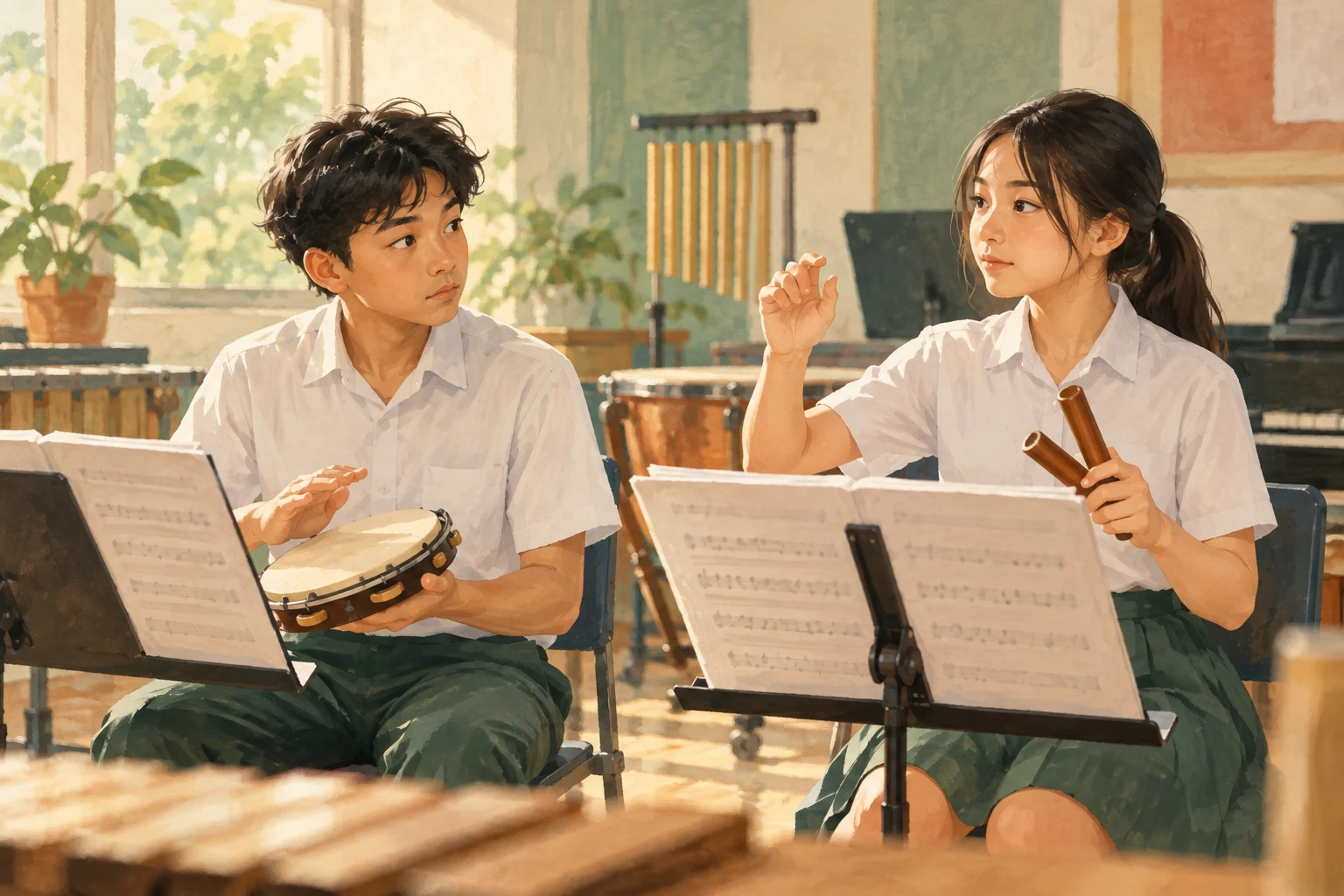
Did you know? A listener can recognise the same melody when a song changes instrument, tempo or arrangement. What stays recognisable, and what changes emotionally, are questions that teach a teenager to listen attentively and make creative decisions rather than merely hear background sound.
G1 Music in Singapore joins listening, performing, arranging, producing and reflecting. Students encounter popular music, Western classical music, film and television cues, and traditions practised within Singapore’s communities. The subject makes music technology a practical part of creating, rather than treating software as a substitute for musicianship.
This guide follows the 2027 Singapore–Cambridge Secondary Education Certificate (SEC) G1 Music syllabus K128. It explains the 40% listening paper and 60% Creating and Performing coursework, the two exact coursework tasks, and how parents can help a child become a more independent and thoughtful music maker.
The quick answer for parents
Studying G1 Music teaches students to identify musical features, understand why they matter in a particular style, arrange a piece, perform a live part and create an original cue for a visual scene. They learn to relate a musical choice to the audience’s experience.
The enduring ability is hear → analyse → decide → create → evaluate. Technical tools help students express the decision, but the student remains responsible for its meaning.
G1 identifies a subject level, not a limit on talent
Full Subject-Based Banding organises G1, G2 and G3 subjects according to learning levels and school arrangements. It does not measure the worth of a teenager or forecast all future creative accomplishments.
The 2027 SEC has the separately named G1 Music K128 subject. Parents should not confuse its assessment with G3 Music K350, Higher Music K351 or informal performance examinations.
The official 2027 paper split
Paper 1: Listening is a 1-hour written examination worth 40 marks and 40%. Paper 2: Creating and Performing is coursework worth 60 marks and 60%, developed over approximately five months with 30 hours of supervision time.
Both parts matter. A student who performs fluently but has weak listening analysis can lose marks; a student who recognises genres but does not make and perform convincing music also has a significant gap.
Paper 1 is a listening examination, not a recital
Part A of Paper 1 has 20 one-mark multiple-choice questions using 8–10 recorded extracts. Part B has 12–16 one-word or short-answer questions, using another 4–6 extracts, for 20 marks.
Each extract is about 20–40 seconds. Students listen via individual headphones in the school music room or computer laboratory, can replay recordings during the examination, and have no internet access.
Why active listening needs a method
An effective listener identifies first the broad genre and mood, then focuses on a musical feature: rhythm, timbre, melodic pattern, texture or arrangement. Only after identifying the feature should they explain what that feature does.
Writing ‘the music sounds happy’ is a subjective starting point. A stronger answer might describe a fast tempo, a prominent backbeat or an ascending melodic phrase, while recognising that musical meanings depend on context.
The four official areas of study
The syllabus covers Popular Music from 2000 onwards; Western Classical Music; Music for Film and Television; and Music from Local Cultures. These are not four unrelated playlists; each provides techniques and examples for listening and creating.
Parents can invite a comparison between two excerpts without insisting that one genre is superior. The useful question is which musical elements make each excerpt distinctive.
Area 1: Popular Music after 2000
Students examine pop, rock, R&B and electronic dance remix music. They learn about characteristic instrumentation, grooves, phrase patterns, structures and effects that help a listener recognise stylistic choices.
A playlist can be educational when each selection has a purpose: notice a backbeat, identify a bass line, compare a chorus with a verse, or hear how a build-up changes the energy before a drop.
Pop music is organised, not random
A song often contains structural sections such as an introduction, verse, pre-chorus, chorus and bridge. Those sections can repeat with small variations to maintain familiarity and interest.
Ask a child to write a simple map of a chosen excerpt. They need not transcribe every note; hearing when a section returns already develops structural listening.
Rock involves distinct instrumental roles
Rock commonly uses guitars, bass and drums in characteristic arrangements, with guitar riffs, distortion and contrasting textures among the possible features. The exact sound differs among artists and songs.
Students should describe what they actually hear, not classify every loud electric guitar as the same genre. Listening for the relationship among instruments makes explanations more defensible.
R&B asks students to hear groove and phrasing
Syncopation, rhythmic detail, vocal ornamentation and layered accompaniment can be relevant features of R&B. Musical identity comes from how several elements work together rather than a single magic sign.
A child can tap a steady pulse while noticing an unexpected accent or a vocal phrase that stretches over it. The exercise develops precision without requiring expensive equipment.
Electronic dance remix: arrangement as transformation
An electronic remix can work with rhythmic loops, synthesised timbres, builds, breakdowns and drops. Technology creates possibilities, but musical decisions still determine coherence.
Ask the learner to identify what remains recognisable from a source piece and what changes through the arrangement. This also creates an opening for discussing legitimate rights and attribution.
Understand the difference between pulse and rhythm
Pulse is the underlying regular beat a listener might tap; rhythm describes the timing pattern of musical sounds relative to that pulse. Confusing them makes performance coordination difficult.
Try keeping a steady tap while clapping different short patterns. The physical exercise exposes the difference more directly than a memorised definition.
Tempo and BPM are meaningful quantities
Tempo describes the overall speed, while beats per minute offers a numerical representation of that speed. Changing tempo can alter energy or character without changing the identity of every note.
Students can use a metronome in teacher-approved practice to compare versions. A faster version is not automatically a better interpretation.
Melody, interval and contour
Melody is a sequence of pitches organised through time. Its intervals and contour influence what a listener recognises; a rising line, repeated note or leap can create a distinctive shape.
Invite the child to trace the movement of a short phrase with their hand, then match that shape to a simple sketch. The goal is hearing accurately, not guessing a composer’s emotion.
Harmony and bass lines do different jobs
A bass line often supports movement and grounding, while harmonic parts shape relationships among pitches. In an arrangement, melody, harmony and bass should be coordinated rather than competing for attention.
Ask what happens when one layer is muted in an educational example. This can reveal which musical function the layer served.
Timbre: why instruments sound distinct
Timbre describes qualities that help distinguish sound sources, even when they produce similar pitches. A piano phrase and a violin phrase can play the same notes while creating different textures and associations.
Students can recognise sound sources, but should avoid claiming that every sound comes from the instrument it resembles; modern production can mimic timbres.
Dynamics and articulation change expression
Loud and soft passages, changes in intensity, accents, smooth phrasing and short detached sounds alter a musical phrase’s effect. These are deliberate choices that can be named and evaluated.
Encourage two performances of a simple motif with different articulation. Ask which version suits a hypothetical scene and why.
Area 2: Western Classical and programme music
The syllabus focuses on programme music and related works, where musical ideas may represent or suggest scenes, characters or narrative events. Sergei Prokofiev’s Peter and the Wolf is among the indicative repertoire.
Listening carefully to recurring themes and orchestral colour helps students connect musical features with expressive intent while still recognising that associations are shaped by the programme.
Motifs help audiences recognise ideas
A short musical motif can recur in different instruments or forms. The listener may notice continuity even as harmony, tempo or orchestration changes.
Children can design a small original motif of a few notes, repeat it in two contrasting ways and explain which features remained constant.
Orchestral families have different colours
Strings, woodwinds, brass and percussion offer contrasting sound qualities and expressive possibilities. The syllabus names representative instruments and relevant playing techniques.
Instead of memorising a table only, listen to a short excerpt and ask which family is prominent and what musical evidence supports the identification.
Area 3: Music for Film and Television
Students study emotive and action music cues. A cue may guide attention, establish atmosphere, connect scenes or support dramatic movement. The same visual image can feel different when paired with different musical choices.
An invented, non-copyrighted short scene can illustrate the effect. Compare sparse, slow music with tightly rhythmic textures without assuming that every viewer experiences the same emotion.
What makes an emotive cue?
Emotive cues may use melodic expressiveness, sustained or gentle textures, suitable harmony, pauses and instrumental colour. These are possible conventions, not an absolute formula for generating one feeling.
Ask which part of the music supports the scene’s intended mood and whether silence might be more effective at a particular moment.
What makes an action cue?
Action cues may involve energetic rhythms, faster movement, dense textures and strategically timed accents. Sound effects and musical punctuations can help draw attention to changes on screen.
The student should explain how timing, instrumentation and pacing align with the scene rather than adding noise everywhere.
Area 4: Malay, Chinese and Indian music in Singapore
The syllabus includes Malay ensemble music, Chinese ensemble music and Indian ensemble music. It invites students to understand musical features as well as the cultural contexts and functions of the traditions.
Teach respectful comparison: which instruments, rhythmic patterns, melodic practices or performance settings are present? Avoid reducing whole communities to one instrument or song.
Listening to a Malay ensemble
Rebana, gambus and accordion are among the named instruments; Rentak Inang and Rentak Zapin appear in the syllabus. The sound of an ensemble reflects the relationships among rhythm, melodic material and performance practice.
Parents need not own these instruments to support study. A well-chosen teacher-approved recording and careful identification exercise can provide the foundation.
Listening to a Chinese ensemble
Examples include pipa, erhu and dizi, with attention to timbre and techniques such as plucking or bowing. Students also encounter pentatonic melodic ideas and distinctive ornamentation.
Ask the child to identify one audible feature and explain why it matters rather than supply a long list of cultural claims unsupported by the excerpt.
Listening to an Indian ensemble
Sitar, tabla and violin are among the instruments named, and melodic ornamentation can be central to expression. The syllabus gives indicative repertoire including Raga Yaman and Raga Mohanam.
Invite focused listening to a melodic phrase and the relationship between melody and rhythm. Different traditions should be understood on their own terms.
Paper 2 Task 1: Create and perform an arrangement
Task 1 is worth 40 marks or 40% of the total qualification. The candidate arranges a song or instrumental work from the permitted areas of study, then performs one distinct part live and records that performance as part of the arrangement.
The produced arrangement should run one to two minutes, include a melody, harmony and bass line, and where appropriate drum or percussion. The work also needs a clear introduction, ending and stylistic identity.
The student’s live part cannot simply double another layer
The syllabus requires the candidate to play one part live and record it into the digital audio workstation, without simply duplicating another part. This preserves genuine evidence of performing skill.
Parents can help organise ordinary practice time but should not record or play the assessed part on behalf of the candidate.
Paper 2 Task 2: Create an original film or television cue
Task 2 is worth 20 marks or 20% overall. Students produce an original instrumental cue of about 30 seconds for a given film or television context and provide a supporting explanation of their musical decisions.
The supporting note must not exceed 100 words. That requires concise explanation: which musical choices match the particular scene and what effect they intend.
Digital audio workstations are musical tools
A digital audio workstation, or DAW, allows students to sequence, record, edit, mix and render audio or MIDI. The skill is using these operations to express musical ideas, not clicking every available effect.
Ask what problem a tool solves. For example, a change in balance between two parts may improve clarity more than adding another track.
MIDI and recorded audio are not the same
MIDI can represent performance instructions such as note events, while recorded audio captures a sound waveform. They can work together in a production but serve different functions.
A student who understands that distinction can choose whether to correct a note event, re-record an audio part or adjust the mixing of the finished track.
Make arrangements readable to the listener
Layering many parts can create clutter. Effective production requires space for the melody, coordination of rhythm and attention to how the instruments interact.
Try muting one track and asking whether clarity improves. The choice should be driven by listening evidence, not an arbitrary demand for more layers.
Recording quality is part of communication
Unwanted clipping, excessive noise or unstable levels can obscure musical decisions. A student should learn the basic signal chain from source to recording device and how to check the resulting audio.
Parents need not buy professional recording gear without school guidance. Correct microphone placement, calm preparation and repeated checking can matter more than expensive equipment.
A performance is more than playing the right notes
Accuracy of notes and rhythms matters, but the coursework also evaluates coordination with the arrangement and expression. A mechanically correct part can still be poorly integrated.
Rehearsal should combine technical control with the musical intention. Ask the child what listeners should notice about the performance.
Why a short arrangement needs editing
One to two minutes is a small canvas. The student must choose a recognisable structure, develop it sufficiently and end deliberately.
A clear plan of introduction, contrasting section and ending can make limited material coherent. A longer, overcrowded arrangement is not automatically stronger.
Credit musical sources correctly
The syllabus specifies documentation of the original source material and third-party loops, samples or plugins where applicable. Unattributed copying can jeopardise the authenticity of coursework.
Teach students to keep a simple source log from the beginning. Claims of ‘free online’ do not by themselves establish permission for unrestricted reuse.
Coursework must be the candidate’s own work
The school’s supervising teacher and principal authenticate submissions. External help that effectively creates the arrangement, performance or cue for the student is inconsistent with the assessment’s purpose.
Parents can encourage practice and time planning while keeping decisions, production and final recorded work attributable to the learner.
A listening log that builds vocabulary
After a brief excerpt, write a four-part note: genre or context, one precisely heard feature, its musical function and one uncertainty. Return to the excerpt and check the observation.
This trains both recognition and explanation. It also reduces vague responses such as ‘nice music’ without evidence.
A small original composition exercise
Using a school-approved instrument or application, invent a four-bar motif. Repeat it with one change to tempo, articulation or timbre and explain which effect was intended.
The activity is for learning, not a substitute for the assessed coursework. It helps a student link an audible change with a decision they made.
Comparing two arrangements of one melody
Use a simple original tune, perform one version with sparse accompaniment and another with a denser texture. Ask which is clearer for a fictional calm or energetic context.
The student’s response should name musical features rather than declare that more instruments always make better music.
What if the child cannot play an instrument confidently?
Technical performance develops through consistent practice at an appropriate level. The 2027 requirements include a live part and the syllabus describes basic technical competence rather than assuming only advanced performers can participate.
Ask the school how students with different musical backgrounds are supported, and develop a feasible part that remains authentically performed by the candidate.
How to balance listening and creation each week
Combine one focused listening exercise, one short instrument or voice rehearsal and one DAW practice task. Finish by describing a decision and a correction.
Small, well-reviewed sessions are more useful than accumulating hours of undirected audio editing. Match the routine to school coursework supervision and the child’s wellbeing.
A four-week foundational practice sequence
Week one: identify common instruments, timbres and rhythmic vocabulary. Week two: map structures in popular and local music. Week three: practise recording and editing a short original phrase. Week four: compare performances, improve accuracy and justify a change in musical expression.
This is a voluntary learning routine, not an official coursework calendar. The teacher’s brief and authentic coursework deadlines take precedence.
Questions parents can ask after class
Try What did you hear? What did you change? Why did you choose that sound? A teenager can answer using a bass line, vocal phrase, local ensemble rhythm or film cue.
Listen without insisting that the music match your own taste. The relevant question is whether the student can connect musical evidence to a reasoned decision.
The difference between enjoyment and assessment
Music can be deeply enjoyable, but assessed work still requires musical understanding, technical accuracy, production skill and appropriate documentation. Enjoyment and rigour can strengthen one another.
A child can love a song while also explaining why its rhythm, harmonic shape or instrumentation suits the intended audience.
How musical thinking transfers
Arranging teaches planning across layers; performance requires coordination and feedback; listening develops selective attention; production involves technical troubleshooting and revision.
These are reasonable transferable habits, not a promise that a single subject causes dramatic improvements in intelligence or exam performance in unrelated areas.
What an effective Music teacher or tutor does
A knowledgeable teacher can hear and diagnose errors in musical structure, timing, expression, recording or style. The student should make the important creative decisions and understand the feedback.
Parents can ask how coursework authenticity, live practice, listening analysis and technology are supported within the school’s actual arrangements.
Thinking about post-secondary pathways
Music can contribute to interest in performance, audio production, creative media, education or arts-related study. However, specific institutions may require auditions, portfolios, different subject qualifications or other criteria.
Treat subject choice as a way to develop capability and explore interest. Always check current entry requirements rather than promising a particular career outcome.
Frequently asked questions: Is K128 only a written theory subject?
No. Listening is 40%, while Creating and Performing coursework is 60%. The candidate must complete the stated creative tasks under the school’s supervision.
Frequently asked questions: Does coursework involve film music?
Yes. Task 2 requires an original approximately 30-second instrumental cue for a given film or television context, together with a short supporting note.
Frequently asked questions: Must the student perform live?
Yes. Task 1 requires a live part recorded into the arrangement. The student’s own performance forms assessable evidence; it is not enough to program all sounds and submit an entirely automated result.
Frequently asked questions: Is K128 the same as G3 Music?
No. K128 is the specific G1 2027 syllabus. G3 Music K350 and Higher Music K351 have their own requirements and should not be treated as replacements.
The lasting reason to study G1 Music
Music helps a teenager become both an attentive listener and a responsible creator. The learner can recognise how sound affects meaning, practise a real skill, collaborate with technology and explain a creative choice rather than depend on taste alone.
Read the official 2027 SEAB G1 Music K128 syllabus and SEAB G1 school-candidate list. Related eduKateSG guides include Why Study G3 Music, Why Study Primary Music and the unchanged Clementi Secondary 1 Mathematics small-group tutorials reference for a separate example of diagnostic teaching. It should not be construed as a promise of Music-course availability.