
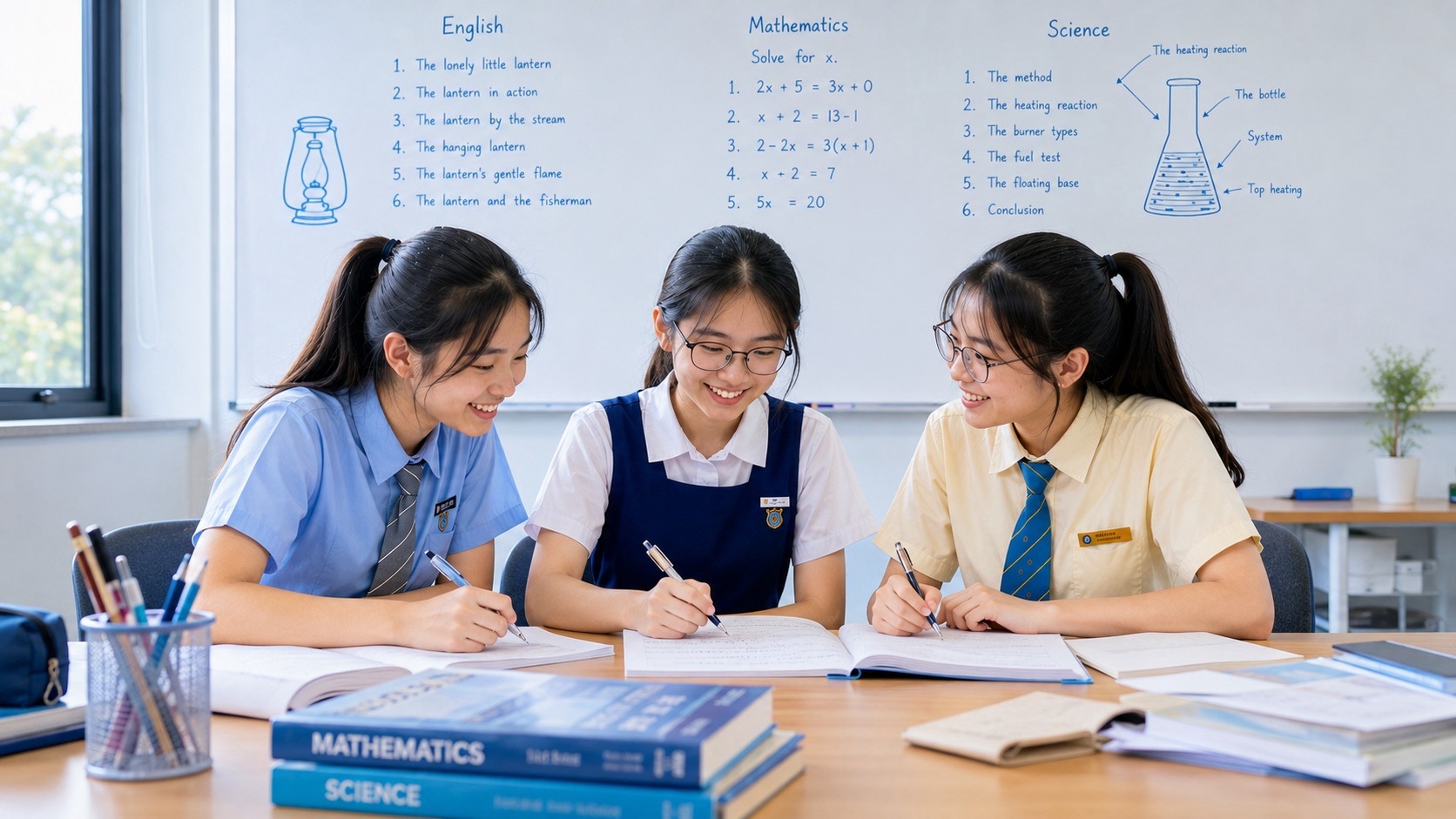
A parent usually arrives at Mathematics tuition with a visible problem.
The school paper is 58. Algebra is becoming difficult. Fractions never seem to stay repaired. Word problems take too long. The child understands during homework but loses the method during a test.
Those are useful observations.
They are not yet a diagnosis.
The real advantage of a small Mathematics group is not simply that there are fewer students. It is that the tutor can see enough of each student’s thinking to work out what is actually breaking.
That distinction matters in Punggol Mathematics tuition because the wrong intervention can look busy while leaving the real weakness untouched. A student who needs fraction repair can be given harder problem sums. A student who needs transfer can be sent back to basic worksheets. A fast but inaccurate student can be pushed to work even faster. A strong student can be kept permanently inside comfortable practice.
Small-group tuition becomes valuable when visibility changes the decision.
This article sits beneath Punggol Mathematics Tuition | From Representation to Method Selection and Transfer, which remains the main Punggol Mathematics owner. This page answers one narrower question: when does a three-student small group make a meaningful difference, and what should the tutor be doing with that visibility?
The 50-second answer for parents
- Three students is not the product by itself. The product is visibility → diagnosis → intervention → checked transfer.
- A mark is compressed information. Two students with the same score can need completely different teaching.
- The first useful weak link matters more than the loudest symptom. Repeated percentage mistakes may actually begin with fractions, place value or interpretation.
- Good tuition changes state. Diagnose → prioritise → repair → practise → connect → perform → review.
- The tutor should work at the child’s centre and edge. The centre is what is stable; the edge is the next productive challenge.
- More work is not always the answer. Sometimes the job is foundation repair, sometimes school stability, exam performance, stretch or transition.
- The end goal is independence. Tuition is working when the student increasingly knows what to do without waiting for rescue.
Why “small group” can mean almost nothing
A class of three can still be taught like a class of thirty.
The tutor can stand at the front, explain one method, assign one worksheet and mark three copies of the same work.
That is a small class numerically. It is not necessarily diagnostic tuition.
The advantage appears only when the tutor uses the smaller group to observe things that would otherwise be easy to miss:
- where the student hesitates;
- which representation the student chooses;
- whether the operation was understood or guessed;
- which line introduced the first error;
- whether a correction survives when the question changes;
- how much prompting is still required;
- whether speed is helping or damaging reliability.
Small-group tuition should therefore create a different information environment.
Fewer students → more visible thinking → better diagnosis → more precise teaching.
If the chain stops after “fewer students”, much of the potential advantage has been wasted.
The mark is a dashboard light, not the broken part
Imagine a car dashboard warning light.
The light tells you something needs attention. It does not tell you which component failed.
A Mathematics score works similarly.
A 65 can come from:
- strong concepts but slow execution;
- excellent routine procedures but poor transfer;
- weak fractions contaminating several topics;
- good reasoning with unreliable arithmetic;
- poor reading of mathematical language;
- strong understanding but weak examination control;
- several small unrelated gaps rather than one large weakness.
The same score can therefore produce several different tuition plans.
This is one reason eduKateSG uses the idea of the first weak link. We are not searching for a permanent label for the child. We are searching for the earliest useful repair that changes the largest amount of later work.
Three students. Same mark. Three different jobs.
Alicia, Tricia and Kai Kai each score 68 on a Mathematics assessment.
Their parents could reasonably say the same thing: “We want the marks to improve.”
The tutor sees something else.
Alicia: the foundation-repair student
Alicia loses marks in percentage, ratio and a multi-step word problem. The topics look separate. Her working shows the same instability underneath them: she does not reliably identify the whole before reasoning about the part.
Her tuition job is not “do more percentage”. It is to rebuild the part-whole relationship, then reconnect it to fractions, ratio and percentage.
Tricia: the transfer student
Tricia can do almost every familiar exercise. She becomes uncertain when the same Mathematics is presented through a different diagram, wording or unknown.
Her content knowledge is better than the mark suggests. Her weak link is method selection under changed surfaces.
Her tuition job is transfer: same structure, different skin.
Kai Kai: the performance-control student
Kai Kai understands quickly and works quickly. Her errors come from skipped lines, missing units, premature calculation and weak checking.
Giving her easier work would be the wrong response. Giving her harder work without changing the operating behaviour could make the error leakage worse.
Her tuition job is reliability under load.
Same score. Three different systems.
The five common Mathematics tuition jobs
A useful diagnostic often places the student into one dominant job for the current phase. The job can change as the student changes.
| Current job | What the tutor sees | What tuition should do |
|---|---|---|
| Foundation Repair | Earlier concepts repeatedly fail inside current work | Trace backwards, rebuild the dependency, reconnect forward |
| School Stability | Student understands but cannot keep pace or retain consistently | Consolidate school learning, retrieval and working routines |
| Exam Performance | Capability exists but marks leak under timing and paper conditions | Train pacing, selection, checking and mixed-paper execution |
| Stretch | Current work is stable and under-challenging | Increase transfer, depth, unfamiliarity and reasoning demand |
| Transition | A new school stage changes representation and expectations | Build the handoff: P6→Sec 1, lower→upper secondary, G-level changes |
These are not permanent categories. They are operating states.
A Foundation Repair student can become a School Stability student. A School Stability student can become a Stretch student. A high-performing Stretch student can temporarily return to Repair if one hidden weakness is exposed by harder Mathematics.
Good tuition follows the state rather than defending the original programme description.
The small-group control loop
For a three-student class, the core loop can be stated simply:
Read → Diagnose → Prioritise → Repair → Practise → Connect → Perform → Review.
Read
Read the question, the student’s working, the marked paper and the behaviour around the error. A cross does not tell the whole story.
Diagnose
Identify whether the problem is conceptual, representational, procedural, strategic, computational or related to checking and performance.
Prioritise
Not every mistake deserves equal lesson time. Fix the bottleneck that blocks the greatest amount of useful later work.
Repair
Rebuild the mechanism. Do not merely demonstrate the correct answer.
Practise
Make the new process more stable through purposeful repetition.
Connect
Link the repair to neighbouring topics. Fraction understanding should travel into ratio and percentage. Equality should travel into algebra.
Perform
Reduce prompts and ask the child to operate independently under increasing constraints.
Review
Check whether the same error returns in a different form. If it does, the repair is not finished yet.
This loop is more important than the number of worksheets completed.
A marked paper is telemetry
One of the most useful things a parent can bring to Mathematics tuition is not a new assessment book.
It is a recent marked paper with the student’s original working still visible.
That paper is telemetry from a period when the tutor was absent.
It shows:
- what the child remembered independently;
- which methods were selected without prompting;
- where working became compressed;
- whether units and answer forms were controlled;
- which errors survived previous corrections;
- where time pressure may have changed behaviour.
In control-system language, the paper is a sensor return.
The tutor should use that return to decide the next intervention, not simply file the score and proceed to the next chapter.
Centre and edge: where the lesson should live
Every student has a centre and an edge.
The centre is the Mathematics the child can already perform with reasonable reliability.
The edge is the next productive challenge: difficult enough to require growth, but not so far beyond the current floor that every line needs rescue.
Too much time inside the centre produces comfort without growth.
Too much time beyond the edge produces noise without ownership.
A good small-group tutor keeps moving between the two:
- retrieve something stable;
- introduce or repair the next edge;
- practise until form is reliable;
- increase the load;
- return independently.
This is similar to progressive overload in performance training. The goal is not maximum difficulty on every repetition. The goal is sustainable adaptation.
Why three students can create useful peer information
One-to-one teaching has obvious advantages when a student needs concentrated support. Larger groups can create strong classroom energy and efficient common instruction.
A three-student group occupies a useful middle position when it is managed well.
Students can see another method. They can hear another explanation. They can discover that a peer made a different error. They can compare representations without the lesson becoming anonymous.
That creates information.
For example, Tricia may explain a ratio problem using a bar model while Kai Kai uses an equation. Alicia can see that two surface methods preserve the same relationship.
The tutor’s job is not to declare one student’s method the winner. It is to make the invariant visible: what mathematical structure stayed the same?
When small-group tuition makes the biggest difference
Small-group diagnosis is especially useful when the student’s problem is not obvious from the chapter heading.
- Repeated errors across several topics: suggests a shared dependency may be failing.
- Understands with help, fails alone: points towards transfer or independence.
- Strong homework, weaker tests: may indicate performance control, retrieval or method selection under pressure.
- Fast but inconsistent: working and checking may be compressed.
- Slow but accurate: fluency or retrieval may be limiting the usable performance.
- High marks but little stretch: the student may need deeper or less familiar Mathematics rather than more of the same.
These are situations where observation can change what happens next.
When a small group may not be the right tool
No class format is automatically best for every child.
A student may temporarily need one-to-one attention if the learning state is highly specific, if school absence has created a large discontinuity, or if the student cannot yet participate productively in a group setting.
Another student may thrive in a larger, highly structured class because the curriculum fit is already strong and the main need is systematic coverage and practice.
The correct decision should follow the job.
Choose the teaching configuration that solves the current problem; do not invent a problem to justify the configuration.
The 90-minute lesson as a controlled sequence
At eduKateSG, a useful 90-minute Mathematics lesson is not simply 90 minutes of maximum question volume.
| Lesson state | Purpose | What the tutor watches |
|---|---|---|
| Signal check | Find the current state | Marked work, retrieval, previous repair |
| Mechanism | Teach or rebuild the relationship | Can the student explain the idea? |
| Stabilise | Make execution reliable | Is the procedure becoming fluent? |
| Transfer | Change representation or surface | Can the student still identify the structure? |
| Performance | Reduce support and add constraint | Does the Mathematics survive independence? |
| Return | Review the evidence | What should the next lesson prioritise? |
The proportions change by student and season.
A foundation-repair student may spend more time on mechanism and stabilisation. A Primary 6 or Secondary 4 student near examinations may spend more time on performance and review. A strong student may move quickly through retrieval and spend most of the lesson at the edge.
Same class length. Different job mix.
The logistics layer parents often underestimate
Teaching quality matters. So does whether the learning system can run consistently.
A class that is theoretically perfect but repeatedly missed because the weekly schedule is unworkable has a delivery problem.
For Punggol families, the practical questions belong inside the educational decision:
- Can the student attend consistently?
- Is the lesson time compatible with school load and sleep?
- Is there enough time after class to consolidate rather than rush to the next obligation?
- Can marked school work reach the tutor while it is still useful?
- Does the class schedule support continuity with the same tutor?
This is not administrative trivia. It is part of the learning machine.
Consistency allows the tutor to observe change across weeks. Without continuity, diagnosis keeps restarting.
Primary, PSLE and Secondary students need different versions of the same mechanism
Primary Mathematics
The emphasis is building the mathematical floor: number sense, operations, fractions, measurement, representation and increasingly structured problem solving.
See Punggol Primary Mathematics Tuition: How Primary Math Really Works from P1 to PSLE.
PSLE Mathematics
The system now has to integrate years of learning and perform under examination constraint. Diagnosis should separate missing Mathematics from transfer, pacing, strategy selection and exam reliability.
See Punggol PSLE Mathematics Tuition | The Examination Engine and Finding the First Weak Link Before PSLE.
Secondary Mathematics
Representation becomes more symbolic, algebra becomes central, Full SBB subject levels matter, and the student increasingly has to select methods independently.
See Secondary Mathematics Tuition | Punggol — 3 Pax Small Groups and Secondary Mathematics G1, G2 and G3 | Teaching the Student at the Right Level.
The mechanism remains recognisable. The load changes.
The independence test
There is a simple test for whether tuition is transferring capability.
If the tutor becomes quieter, does the student’s Mathematics collapse?
At the beginning of a repair, substantial guidance may be necessary. That is normal.
Over time, prompts should reduce.
- The student reads before calculating.
- The student chooses a representation without being told.
- The student notices when units do not match.
- The student can explain why a method fits.
- The student detects implausible answers.
- The student knows when to persist and when to change strategy.
That is the return path we want: capability moving from tutor to learner.
How parents can tell whether diagnosis is real
A useful diagnosis should become specific enough to change what happens next.
Compare these statements:
| Weak diagnosis | More useful diagnosis |
|---|---|
| Weak in problem solving | Understands operations but does not represent relationships before choosing a method |
| Careless | Compresses working during multi-step algebra and loses negative signs |
| Weak in fractions | Can calculate familiar forms but does not preserve the whole when representation changes |
| Too slow | Concepts are secure but multiplication retrieval consumes too much working memory |
| Needs more challenge | Current work is stable; transfer remains strong when representation and unknown change |
The right-hand column gives the tutor something to teach.
A parent checklist before choosing Punggol Mathematics tuition
- Will the tutor inspect the child’s working, not just the final answer?
- Can the tutor explain the current bottleneck precisely?
- Will earlier weak links be repaired when current topics depend on them?
- Does practice change representation so transfer can be checked?
- Can stronger students receive stretch without simply racing ahead?
- Can students preparing for exams practise under appropriate timing and mixed-paper conditions?
- Is progress reviewed in terms of independence as well as marks?
- Is the weekly schedule realistic enough for continuity?
- Does the class size allow the tutor to notice when the method is going wrong, not only after the worksheet is marked?
These questions are more revealing than asking only how many worksheets will be completed each term.
Where this article connects inside eduKateSG
- Punggol Mathematics Tuition | From Representation to Method Selection and Transfer — the main local Mathematics owner.
- Punggol Mathematics Tuition | The Full MathematicsOS from Primary to Secondary — the full local pathway.
- Punggol Mathematics Tuition | Rescue, Maintain or Distinction? — different current jobs for different students.
- Not Just More Worksheets | Punggol Primary Mathematics Tuition — why volume is not diagnosis.
- Diagnostics & Recovery Hub — the estate-wide weak-link system.
- Mathematics Learning Hub — Primary, PSLE, Secondary, A-Math and JC Mathematics.
- Tuition | Strategies for Excellence in Education — the wider tuition and teaching architecture.
Frequently asked questions
Why does eduKateSG use three-student Mathematics groups?
The intended advantage is visibility. A group of three can allow the tutor to observe individual working closely while retaining peer comparison, discussion and independent work. The class size only matters if that visibility is actually used diagnostically.
Is small-group tuition better than one-to-one tuition?
Not universally. One-to-one teaching may be more appropriate for some highly specific repair states. A small group can be useful when a student benefits from close tutor visibility plus peer methods and discussion. The teaching configuration should match the current learning job.
What should I bring for a first Mathematics diagnosis?
A recent marked school paper with the child’s original working is particularly useful. School worksheets, corrections and a short explanation of what has been difficult can provide additional context.
What if my child is already doing well?
Then the job may be stretch rather than repair. The tutor can test transfer, depth, unfamiliar representations and greater independence instead of automatically assigning more routine questions.
How quickly should marks improve?
There is no responsible universal timeline. Some repairs affect marks quickly; others require rebuilding, practice and transfer before results move reliably. Earlier signals include clearer working, fewer repeated errors, stronger transfer and less dependence on prompting.
Can Mathematics tuition guarantee a particular grade?
No. Tuition can improve diagnosis, teaching, practice, feedback and preparation. Future examination performance still depends on the student, starting point, time available, school demands and performance on the day.
The idea to keep
The reason to choose a small Mathematics group should not be that three is a fashionable number.
The reason is that three students can create enough visibility for teaching to become more precise.
See the working. Find the first useful weak link. Decide the current job. Repair what limits the system. Practise until it is stable. Connect it to the rest of Mathematics. Increase the load. Then reduce the tutor’s help and see whether the student can carry the Mathematics alone.
That is when small-group diagnosis makes the difference.
For Punggol Mathematics class enquiries, use Contact eduKateSG. For the full local subject route, begin at Punggol Mathematics Tuition.
Primary 4 to PSLE Mathematics Tuition in Punggol
Use the existing canonical Punggol Mathematics owners for upper-primary and PSLE preparation. These routes preserve the established URLs rather than creating competing duplicates.
- Primary 4 Mathematics Tuition | Punggol
- Primary 5 Mathematics Tuition | Punggol
- Primary 6 Mathematics Tuition | Punggol
- PSLE Mathematics Tuition | Punggol
For the full Primary, PSLE, Secondary, Additional Mathematics and JC route map, continue through the Mathematics Learning Hub.