
eduKateSG · SEC G3 SCIENCE · K323–K328 · 2027 · PHASE 4
G3 Science Is Not One Route. It Splits into Combined Science and Pure Sciences—and the Difference Changes How a Student Should Learn.
The 2027 Singapore-Cambridge Secondary Education Certificate lists six major G3 Science entries: three combined Science combinations—K326 Physics–Chemistry, K327 Physics–Biology and K328 Chemistry–Biology—and three pure sciences—K323 Physics, K324 Chemistry and K325 Biology.
The distinction matters. Combined Science requires the student to carry two disciplines inside one combined assessment architecture, including a common practical paper. Pure Science gives a single discipline more syllabus resolution and its own assessment structure. Neither should be taught as a prestige label. They are different operating envelopes.
At eduKateSG, G3 Science tuition begins by identifying the student’s exact code and route. Only then do we decide what content depth, practical work, quantitative load and examination training are required.
What This Page Owns
This is the national eduKateSG owner for generic SEC G3 Science. It explains the combined-vs-pure split, the K323–K328 map, the combined Science assessment architecture, practical reasoning and the learning consequences of taking G3 at higher resolution.
It does not replace SEC G3 Chemistry, which owns Chemistry-specific K324/K326/K328 detail. For the full comparison among levels, use SEC Science Pathways.
The Official 2027 G3 Science Map
| Route | SEC code | Reference code |
|---|---|---|
| Science (Physics, Chemistry) | K326 | 5086 |
| Science (Physics, Biology) | K327 | 5087 |
| Science (Chemistry, Biology) | K328 | 5088 |
| Physics | K323 | 6091 |
| Chemistry | K324 | 6092 |
| Biology | K325 | 6093 |
Official reference: SEAB 2027 G3 syllabus list.
The reference codes show continuity with the pre-SEC subject families, but the public-facing 2027 route should use the new K-codes so the cohort is not confused with the 2026 GCE framework.
The 2027 G3 Combined Science Assessment
Candidates taking K326, K327 or K328 enter for Paper 1, Paper 5 and the two discipline-specific papers corresponding to their combination.
| Paper | Type | Duration | Marks | Weight |
|---|---|---|---|---|
| 1 | Multiple Choice across both chosen disciplines | 1 h | 40 | 20% |
| 2 / 3 / 4 | Structured & Free Response — Physics / Chemistry / Biology | 1 h 15 min each | 65 each | 32.5% each chosen discipline |
| 5 | Practical Test across the two chosen disciplines | 1 h 30 min | 30 | 15% |
Thus a K326 candidate takes Papers 1, 2, 3 and 5; K327 takes 1, 2, 4 and 5; K328 takes 1, 3, 4 and 5.
Official syllabus: K326/K327/K328 G3 Science 2027.
Combined G3: Two Disciplines, But More Resolution Than G2
It is tempting to think of G3 combined Science as simply “G2 but harder”. That misses the structural difference.
G3 combined Science increases depth, generated-response demand and practical assessment. The student must keep two discipline models distinct while integrating them under one MCQ paper and one common practical paper.
That creates four simultaneous competencies:
- discipline knowledge at G3 resolution;
- MCQ discrimination across two content sets;
- free-response generation inside each discipline;
- practical transfer across both disciplines.
One strong discipline can still hide a weak one in day-to-day schoolwork, so we track the components separately even though they converge into one combined subject result.
Pure G3: A Single Discipline at Higher Resolution
K323 Physics, K324 Chemistry and K325 Biology are not “the same combined discipline with extra chapters”. The pure route gives one science greater conceptual, quantitative and practical resolution.
That means the student must build a more complete internal model:
- Physics: quantities, equations, graphical relationships, models and experimental measurement must stay connected.
- Chemistry: macroscopic observation, particle model, symbolic equations, quantitative ratios and practical evidence must translate cleanly.
- Biology: structures, functions, processes, systems, data and experimental reasoning must remain organised rather than memorised as independent lists.
The pure route therefore rewards students who can sustain detail without losing the larger mechanism.
For Chemistry-specific detail, see SEC G3 Chemistry Tuition Singapore.
Paper 1: Mixed MCQ Requires Fast Discipline Switching
In G3 combined Science, Paper 1 mixes the two chosen disciplines. The student cannot stay mentally inside Chemistry for an hour and then switch to Biology later. The paper itself requires fast mode switching.
We train a short reset:
- Identify the discipline.
- Identify the model family—quantity, particles, system, mechanism, graph.
- Read the constraint carefully.
- Reject distractors by discipline-specific reason.
The first step prevents cross-discipline contamination: using an everyday biological explanation in a Chemistry question, or treating a chemical observation as if it were only a general energy statement.
Structured & Free Response: 65 Marks Means the Model Must Be Generative
Each chosen G3 combined discipline has a 65-mark structured and free-response paper. This is where recognition stops being enough.
The student may need to calculate, explain, interpret data, construct a mechanism, evaluate evidence or integrate several subtopics in one question.
We use a four-layer answer check:
- Task: what is the command word asking?
- Model: which scientific relationship applies?
- Evidence/working: what data, equation or diagram supports it?
- Conclusion: what exact outcome answers the question?
Long answers are allowed only when the Science demands them. Extra sentences should not substitute for missing causal structure.
Paper 5 Practical: The Common Evidence Layer
The 90-minute practical paper is especially important because it tests the shared scientific operating layer across the chosen disciplines.
The apparatus may be Physics-like, Chemistry-like or Biology-like, but the evidence questions recur:
- What is measured or observed?
- Which variable is deliberately changed?
- What should be controlled?
- Is the measuring instrument appropriate?
- How should readings be recorded?
- What graph or table best represents the evidence?
- Which conclusion follows?
- What source of error or limitation matters?
- Which improvement specifically addresses it?
- What safety condition is relevant?
Practical skill is not memorising a list of classic experiments. It is being able to reconstruct a valid evidence process when the apparatus changes.
The G3 Error Map
| Visible problem | Likely cause | Repair |
|---|---|---|
| Combined MCQ swings between disciplines | Mode switching is unstable | Identify discipline/model before options |
| 65-mark papers feel exhausting | Generation/retrieval is too slow | Short timed structured sets before full papers |
| Pure Science feels memory-heavy | Detail is not organised by mechanism | Structure/function or quantity/model maps |
| Practical results are inconsistent | Procedure followed without evidence purpose | Variable → measurement → data → conclusion |
| Graphs/calculations are correct but explanation weak | Representation not translated back to Science | Working → physical/chemical/biological meaning |
| One combined discipline hides another | Aggregate score masks component weakness | Separate discipline error ledgers |
A Typical 90-Minute G3 Science Tutorial
Combined and pure students do not need the same weekly mix.
Combined G3 example
- 10 min mixed retrieval across both disciplines;
- 20 min Discipline A model/structured work;
- 20 min Discipline B model/structured work;
- 15 min practical/data reasoning;
- 15 min mixed MCQ or free-response transfer;
- 10 min error closure by discipline.
Pure G3 example
- 10 min cumulative retrieval;
- 25 min current high-resolution concept;
- 15 min quantitative/diagram/mechanism translation;
- 15 min practical/data;
- 15 min free-response transfer;
- 10 min error closure and retest plan.
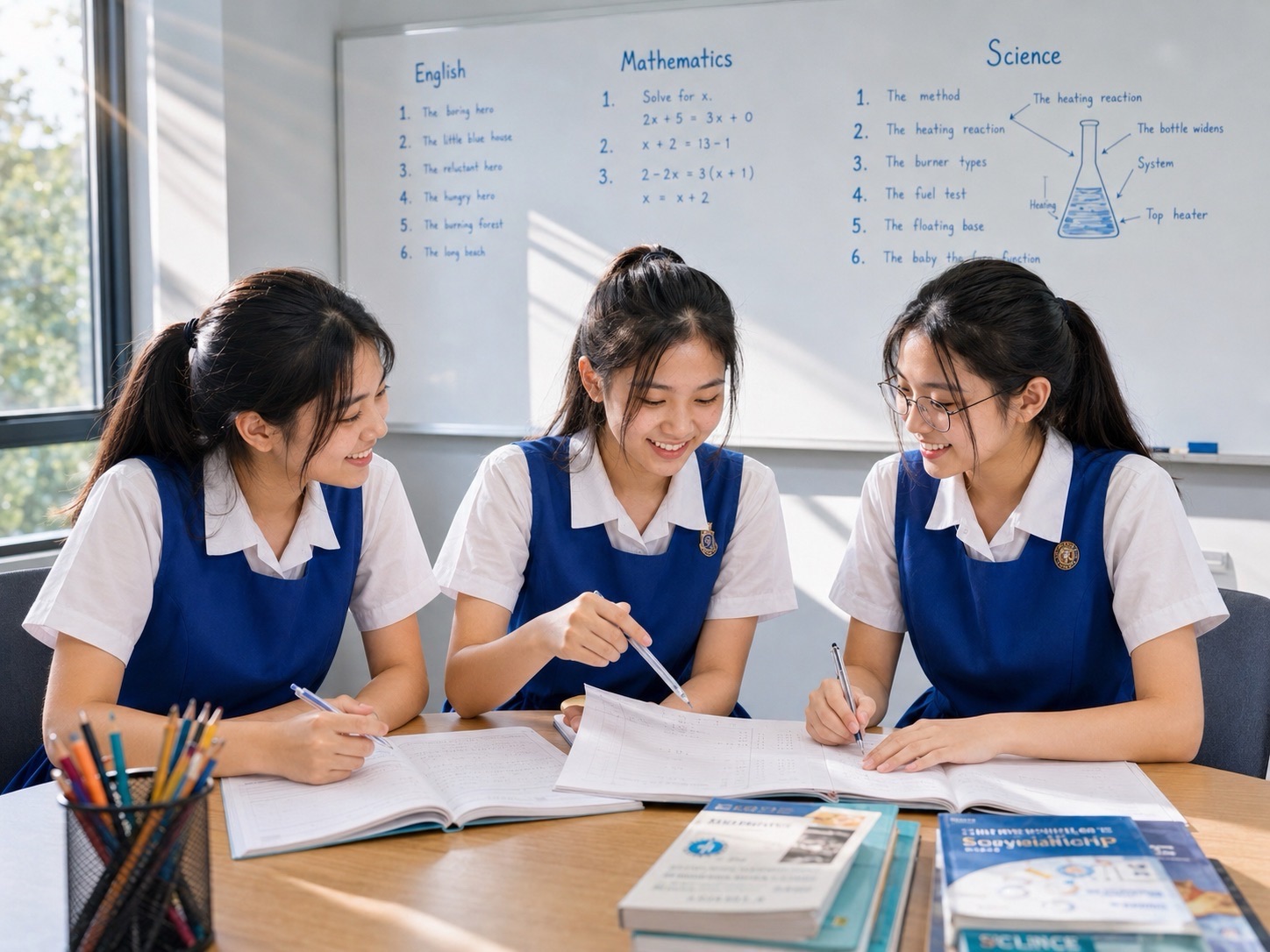
In both cases, the 3-pax format gives enough visibility to distinguish a content gap from a representation, practical or examination-execution gap.
What Progress Looks Like in G3 Science
- the student knows the exact K323–K328 route;
- combined students can switch disciplines without mixing reasoning rules;
- pure students can carry detail without losing the central mechanism;
- MCQ distractors reveal fewer basic model errors;
- structured/free responses are generated from models rather than recalled templates;
- practical work is solved through evidence architecture;
- graphs, equations and diagrams are translated back into scientific meaning;
- component weaknesses are visible before they distort the final result;
- timed performance grows after reasoning stabilises;
- the student can transfer to an unfamiliar wrapper without needing the chapter title.
Frequently Asked Questions
What are the G3 combined Science codes in 2027?
K326 Physics–Chemistry, K327 Physics–Biology and K328 Chemistry–Biology.
What are the pure G3 Science codes?
K323 Physics, K324 Chemistry and K325 Biology.
Does G3 combined Science have practical assessment?
Yes. The published 2027 combined Science scheme includes a 1 hour 30 minute Paper 5 Practical Test worth 15%.
How much is each combined discipline’s written paper worth?
Each chosen discipline has a 65-mark structured and free-response paper worth 32.5%.
Is pure Science automatically better than combined Science?
No. The routes have different resolution and workload. The useful question is whether the student’s readiness and future pathway justify the additional depth.
Continue Through SEC Science
SEC G3 Science Tuition at eduKateSG
G3 Science rewards resolution, but resolution is useful only when the model remains coherent. More equations, more mechanisms and more biological detail should make the explanation sharper—not more fragile.
We teach combined and pure routes differently, preserve discipline-specific reasoning and make practical evidence part of the subject rather than an examination afterthought.
Higher resolution should reveal more Science, not merely create more notes.
eduKateSG · 8 Fourth Avenue · Singapore 268674 · Near Sixth Avenue MRT · Premium 3-pax small-group tutorials · typically 1.5 hours weekly.