
Guide 23 · Civilisation Building
Previous guide: Food, Provisioning and Shared Meals · Full series index
A piece of clothing connects a person’s choices with materials, patterns, making and care. In Riverbend’s fictional Cloth House, children explore those connections through paper garment outlines, grid layouts and story displays. The guide asks what it takes to turn a promising design into a complete, understandable object within a stated model.
Choose a short activity from these forty chapters. Children can arrange pattern pieces, reconcile a component kit, trace a making sequence or explain how a design invites different interpretations. Parents and tutors can begin with a drawing and a concrete question, then use the worked example to check the reasoning together. The final project supplies its own rules and quantities so another group can try it without guessing missing conditions.
All dimensions, capacities, material properties and transformations assigned to Riverbend are invented paper-model assumptions. Drawn garment shapes are not real tailoring patterns or clothing sizes. These activities use diagrams and counters; they do not instruct readers in sewing, tool handling or treatments for actual materials. Read each chapter’s setup before using its rules, and distinguish a result about a paper design from a claim about real clothing or its wearer.
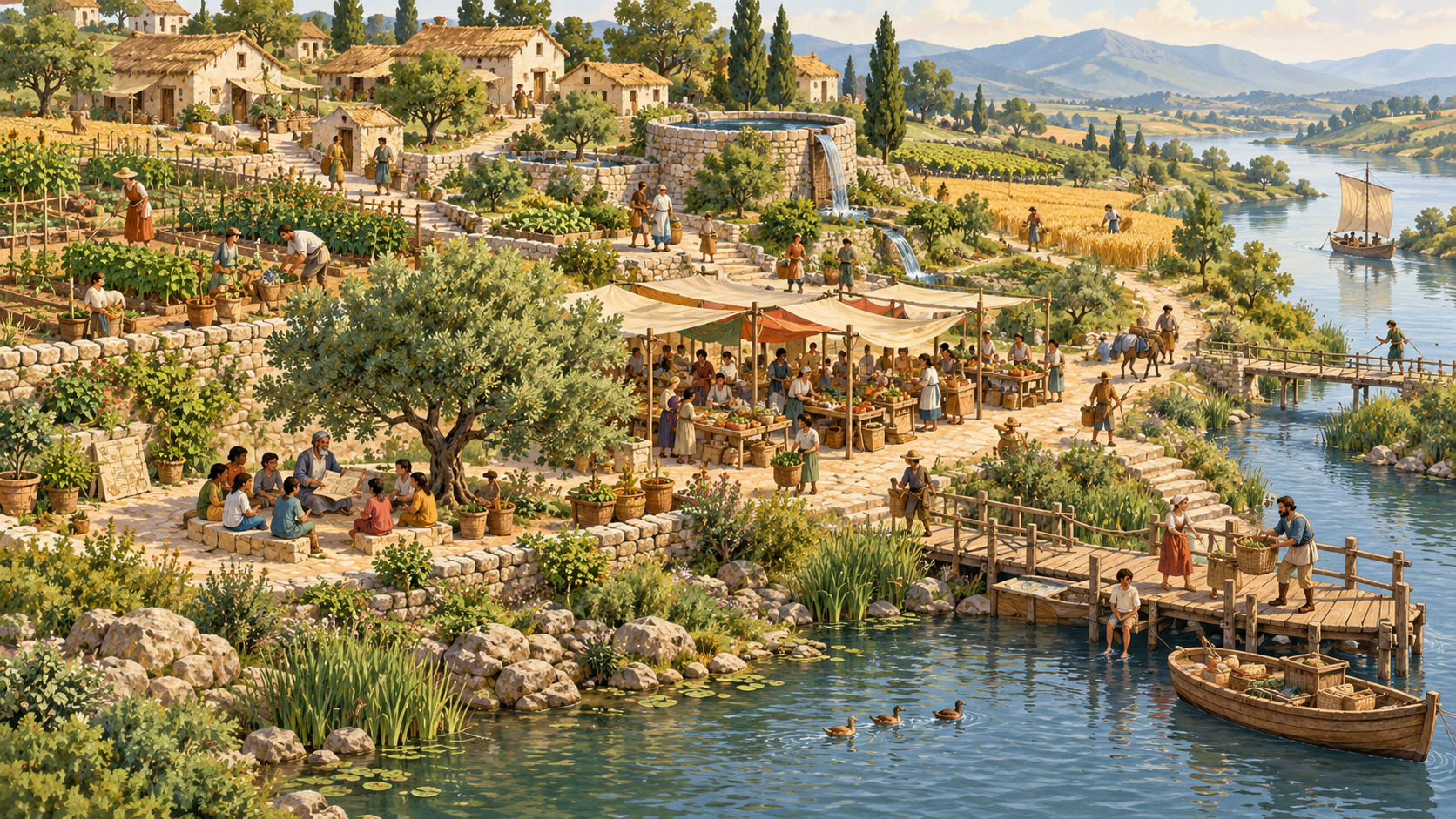
Series cover: AI-generated conceptual illustration of Riverbend, the starting community in these guides. It is not a literal depiction of every scenario, a historical reconstruction or an engineering plan.
Choose your next learning question
Follow a route into the expanded chapters, or choose a specific activity from the index.
Full chapter index
Chapters 1–8: Begin with purpose and choice
- 1. See clothing through the everyday tasks around it
- 2. Define a purpose without deciding the design in advance
- 3. Describe a material token without inventing its performance
- 4. Read a pattern as a representation with a stated scale
- 5. Define a complete making kit before counting it
- 6. Distinguish usable area from a pile of separate pieces
- 7. Show a layout that another maker can reconstruct
- 8. Let rotation change the layout only when the pattern permits it
Chapters 9–16: Read patterns and materials
- 9. Use a connection diagram to explain how pieces belong together
- 10. Write an instruction another maker can interpret
- 11. Give clothing symbols a context rather than a universal dictionary
- 12. Let a character choose an appearance without making it a stereotype
- 13. Revise a design through a specific reader question
- 14. Bring a small paper collection together through purpose and pattern
- 15. Test a pattern layout by showing where every outline goes
- 16. Arrange different pattern pieces without losing the sheet boundary
Chapters 17–24: Plan the making work
- 17. Define a complete costume through its components and meaning
- 18. Break the making sequence into tasks with visible results
- 19. Represent a paper station by the work it can actually do
- 20. Choose a batch size that makes an intelligible making activity
- 21. Count unfinished work by its current state
- 22. Model a repair as a defined change to a paper representation
- 23. Reuse a remaining region through a new constructive pattern
- 24. Compare material cards through the fictional choices they permit
Chapters 25–32: Repair and express meaning
- 25. Convert units only through a stated relationship
- 26. Revise a pattern while tracking what the change affects
- 27. Run a family pattern studio with several ways to contribute
- 28. Hand over a making project with its design relationships intact
- 29. Read a garment outline as an invitation to imagine a character
- 30. Offer more than one way to join the making
- 31. Give a fictional garment without silently changing the agreement
- 32. Exhibit garment stories without turning the display into a ranking of people
Chapters 33–40: Review and make together
- 33. Give material tokens a story without inventing real performance
- 34. Revise a design while preserving a choice the maker values
- 35. Check a pattern layout through area and a visible construction
- 36. Read making evidence without treating completion as the whole story
- 37. Teach expression and collaboration in the first two sessions
- 38. Teach layout, revision and evidence in two further sessions
- 39. Construct the complete Three Travelling Cloaks project
- 40. Repair a changed cloak choice and a missed decoration period
CHAPTER 1 OF 40 · Begin with purpose and choice
1. See clothing through the everyday tasks around it
Riverbend's Cloth House opens with a row of paper garment outlines: a short jacket, a long wrap, a pocketed apron shape and an invented festival cape. A child chooses the cape because it looks spectacular. Another asks where a story card could be carried. A third wants a garment outline that changes its picture when the character turns. Clothing gives the class a way to connect everyday making with purpose, imagination and the meanings people choose to express.
The Cloth House uses paper outlines, preprinted pattern pieces and invented material tokens. Children do not follow real sewing, cutting, heating or chemical instructions. The model makes no claim about actual fabric performance, safety, fit or suitability. Parents and tutors can supply ready-made paper shapes and let learners arrange, draw and annotate them. Quantities refer only to the defined classroom pieces, while fictional characters provide circumstances without requiring personal measurements or information about real clothing needs.
Begin with one character and one ordinary task. Neri carries questions between Riverbend's story tables. The character wants a visible place for a question symbol and a drawn pocket that represents where a postcard belongs. These are purposes inside a story design. The child can choose how to represent them, but should not assume that a decorative pocket shape demonstrates a functional real pocket. A diagram can communicate an intention without establishing a real object's performance.
Give learners three design cards. One concerns carrying a paper message, one concerns being recognised in a fictional procession and one concerns telling a changing story through a repeated pattern. Ask which garment feature serves each purpose. A badge might identify the messenger; a sequence of panels might carry the story. The same feature may serve more than one purpose, but its relationship should be explained rather than inferred from an impressive appearance.
Explore the example
Parents can invite a younger child to point to the feature they most want another reader to notice. An older learner can describe a trade-off between two choices. A very large story panel may leave little space for the message symbol on the supplied outline. The child can move, resize or simplify a drawn feature within the paper brief. The discussion concerns the actual design choice, not which garment type every real person should prefer.
Now give Neri a second fictional activity: joining an evening story scene in the model. The messenger badge may remain useful, become irrelevant or acquire a playful new meaning. A character can use different designs for different purposes without one design becoming their permanent identity. The class should avoid treating an outfit as proof of personality, social value or belonging. Its meanings depend on the scene and supplied context.
A first design page can contain the character's task, the outline and three labelled choices. One label explains a practical intention, another an expressive detail and a third a question still open. This keeps the work manageable. The child does not need a complete account of every stage of real clothing production to make a thoughtful contribution to this tabletop enquiry.
The opening display celebrates a design and the reasoning that gives it shape. Riverbend's learners begin to see everyday making as more than producing identical objects. A civilisation's clothing can be explored through activities, choices, communication and stories, provided the class remains clear about what its paper representation actually establishes and what it only imagines.
CHAPTER 2 OF 40 · Begin with purpose and choice
2. Define a purpose without deciding the design in advance
The Cloth House receives a request to make the best messenger jacket. Learners quickly disagree about the best colour, length and number of drawn pockets. The request has hidden several questions inside a superlative. Children now turn it into a brief that names what the fictional character needs to do while leaving room for different designs. A useful purpose can guide invention without prescribing every artistic choice before the maker begins.
Use a fresh character card. Sol carries two identified message cards during a paper parade and must display the current route symbol. The model brief asks the design to show two distinct message spaces and one clearly labelled symbol area. These are graphic requirements for a garment outline, not claims about actual storage or visibility. The child can meet them through several arrangements and explain why the chosen layout suits the story.
Give three sample designs. Design A has two labelled spaces and a symbol area. B has three spaces but no route symbol. C has one large space containing two named subdivisions and a route symbol. Under the supplied graphic rule, A and C meet the brief because C's subdivisions count as two distinct spaces. B does not meet the symbol requirement despite having more pocket-like shapes. The class should not reward a larger feature count as automatically better provision.
Parents can ask which parts are requirements and which are preferences. Sol's card prefers a curved line along the edge but accepts a straight one. The two message spaces are required; the curve is optional within this model. A child can preserve an unmet preference in the design note without claiming the entire design fails. Equally, an attractive curve cannot compensate for a missing required symbol area.
Explore the example
A practical activity gives each learner the same outline and three movable feature cards. They arrange the cards, then write a brief before drawing a final version. A partner checks whether the arrangement serves the stated purpose rather than whether it resembles the adult's example. Two designs can both meet the brief while making different expressive choices. That comparison gives children something substantive to discuss beyond liking one more.
Now change the purpose openly. The parade becomes a scene about a lost route, and the symbol area must show a question rather than a confirmed direction. The earlier design remains a valid response to the earlier brief. It should not be called wrong because the story changed. A revision note can identify the new purpose and the feature altered, preserving the relationship between request and response.
Older learners can inspect a brief that names its solution too early: add four pockets so the messenger can keep two messages apart. The child can rewrite it as a separation requirement and explore whether two labelled panels or another supplied representation achieves it. A design question becomes more interesting when it leaves room for a simpler or unexpected response, while keeping the relevant function recognisable.
Finish with a purpose sentence, a drawing and an explanation of one choice the brief deliberately left open. Riverbend's learners can now appreciate variety without losing a common question. A clear brief makes it possible to recognise several adequate designs, discuss their differences and notice where an attractive proposal has changed the problem instead of meeting the purpose it was asked to serve.
CHAPTER 3 OF 40 · Begin with purpose and choice
3. Describe a material token without inventing its performance
The Cloth House displays three paper swatches with names such as Reed, Cloud and Night Map. One child assumes Cloud must be soft and another assumes Reed must be strong. The names belong to an invented collection; they establish neither actual material composition nor performance. Learners now describe what the model supplies and separate those descriptors from qualities a real object would need evidence to establish.
Begin with visible features: a token may have stripes, dots, a smooth drawn border or a repeated triangle pattern. The exercise can also supply model attributes on a card, such as accepts a printed symbol or may be rotated. Those are rules for paper pieces, not findings about real cloth. A child should identify whether a description comes from looking at the token or reading its supplied specification.
Give three fresh material cards. Token M1 has horizontal stripes and a rule permitting rotation. M2 has dots and permits either orientation. M3 has an arrow pattern that must point upwards in the final design. The tokens have the same rectangular dimensions in this model. Their visual descriptions differ from the orientation rules. A dotted appearance does not itself establish rotational freedom; that permission comes from the card.
Parents can ask learners to sort sentences into observed feature, supplied model rule and unsupported inference. This token has five dots is an observation if five are drawn. This token must keep its arrow upward is a rule if the specification says so. This pattern will keep a real wearer comfortable is outside the evidence. The child can still discuss how the pattern looks or what story it suggests without pretending to have tested actual comfort.
Explore the example
A practical comparison uses a descriptor grid rather than a ranking. Children record shape, pattern, identifier and permitted orientation for each token. Then they choose one for a fictional character's story panel. The choice can be expressive: the arrow pattern might connect with a journey scene. The explanation should say that the maker wants to suggest direction, rather than claim that every reader will interpret arrows or stripes in the same way.
Now introduce two tokens with the same appearance but different supplied status. M4 and M5 both show dots, but only M4 has been assigned to the current paper kit. A picture alone cannot establish which is available to use. Conversely, a status label does not change the visible pattern. Children can preserve these separate fields without turning every property into one vague judgement that the token is good or bad.
Older learners can rewrite an exaggerated catalogue description. The world's best material for every messenger becomes a specific account of this token's pattern and model permissions. The new description can remain lively through an invented name and a short story line. Honest description does not require stripping all imagination from the page; it requires making clear which statements invite a reading and which establish a usable classroom condition.
End with a swatch page carrying descriptions another group can check. A reader should identify one feature directly, one rule through its reference and one question the page does not answer. Riverbend's learners have made material language more precise while retaining expressive choice. Their paper collection now supports discussion through evidence and context, rather than letting an evocative name silently become a claim about actual fabric behaviour.
CHAPTER 4 OF 40 · Begin with purpose and choice
4. Read a pattern as a representation with a stated scale
A garment outline in the Cloth House has a tiny sleeve shape beside a large front panel. A child assumes the sleeve is meant to be that small in the finished fictional design. The page may instead use different drawing scales or show only an identifying icon. Learners now ask what a pattern represents, how its sizes are expressed and which relationships the paper brief expects them to preserve.
For this chapter, a pattern piece is a supplied flat shape used in a tabletop layout. It is not a real garment pattern or instruction for making wearable clothing. The first set uses a common scale: one drawn grid square represents one model area unit. A rectangular body panel measures four grid units across and three high, giving twelve model square units under the rectangle rule. A smaller badge measures two by one, giving two.
Parents can provide preprinted grid shapes so children arrange rather than cut anything. Ask a younger learner to count the squares inside each shape. An older learner can multiply side lengths and explain why the answer uses square units. Four plus three gives a perimeter-related sum only after further operations; it does not give the panel's area. Naming the quantity prevents a familiar calculation from answering the wrong question.
Now enlarge the body panel drawing by a factor of two in each direction. Its drawing becomes eight by six grid units, occupying forty-eight drawn squares. If it still represents the same model panel, the scale note must change accordingly. The represented panel has not acquired four times as much material merely because its illustration is larger. The class should distinguish drawn area from represented area through the supplied scale relationship.
Explore the example
A practical matching task gives three kinds of record: an outline icon, a dimensioned rectangle and a decorative sketch. Only the dimensioned rectangle establishes the exact model dimensions under this brief. The icon can identify a piece and the sketch can suggest a visual effect. Neither becomes useless because it answers a different question. The child links each representation to the purpose it can actually serve.
A second pattern set deliberately uses a detail window. The badge is enlarged so its tiny symbol can be read, while the body panel remains at the original scale. The page should label the detail view instead of implying that the two can be compared by measuring their paper sizes directly. Children can make their own enlarged detail and ask a partner to explain which dimensions belong to the model and which belong to the display.
Older learners can inspect missing dimensions. A panel's area alone does not establish its shape or ability to fit a layout. Twelve square units could form a three-by-four rectangle or a two-by-six rectangle under the supplied grid. Those pieces have equal area but different spans. A future arrangement question needs the actual dimensions, not just a total that appears large enough.
Finish with a pattern page containing identifier, representation type, dimensions and any scale note. Add one expressive sketch separately so the design remains more than arithmetic. Riverbend's learners can now move between imagination and specified paper shapes without confusing their roles. A pattern becomes shareable when another person can tell what it represents and which comparisons its drawing actually supports.
| Design feature | Question |
|---|---|
| Purpose | What does the fictional request ask this object to do? |
| Description | Which visible feature or supplied rule supports the wording? |
| Choice | What has the fictional requester actually selected? |
| Limit | What remains outside this paper model? |
CHAPTER 5 OF 40 · Begin with purpose and choice
5. Define a complete making kit before counting it
The Cloth House's festival display needs paper costume kits for fictional characters. One maker counts every front panel and announces that twelve kits are ready. Another points out that several badge cards are missing. The group needs a complete-kit definition before using a component count as a promise. Learners now connect a whole design with the distinct pieces the classroom brief says it requires.
Use a fresh kit rule: one front panel, one back panel, two matching sleeve tokens and one badge card form a complete kit. These are paper representations, not real assembly or clothing instructions. Opening stock contains twelve fronts, ten backs, twenty-two sleeve tokens arranged in eleven accepted matching pairs and nine badges. Fronts support twelve kits, backs ten, sleeves eleven and badges nine. The maximum confirmed complete-kit count is nine.
Building nine kits uses nine fronts, nine backs, eighteen sleeves and nine badges. Remaining stock is three fronts, one back, four sleeves and no badges. The four remaining sleeves belong to two accepted matching pairs under the supplied inventory. That pairing condition matters. Four loose sleeve tokens do not establish two suitable pairs if the brief requires a match and the relationship is unknown.
Parents can provide component outlines and ask the learner to fill one kit mat at a time. The badge tray empties first. Ask why a nearly complete tenth arrangement should be labelled incomplete rather than quietly included in the ready count. The child can still preserve its useful components for a later activity. Complete under this definition does not mean more valuable in every artistic sense; it means the required combination is present.
Explore the example
Now supply two additional badges. Badge capacity rises to eleven while back panels still support ten. Ten kits can now be completed in total, not eleven. Relative to the opening stock, ten use ten fronts, ten backs, twenty sleeves and ten of the eleven available badges. Two fronts, no backs, two sleeves and one badge remain. The limiting component changes after the new supply, so the child should recalculate rather than add two automatically to the earlier nine.
A practical choice extension offers two badge designs with no difference in kit validity. Fictional characters choose a bird or doorway emblem. A complete-kit count does not establish that every named character's badge preference can be met. The class can inspect a supplied choice list, preserve accepted alternatives and distinguish an unmet preference from a missing required component. It should not infer a character's personality or social role from the emblem they choose.
Older learners can examine a kit label saying sleeves included when the tokens are actually held in a separate shared tray. The arrangement can work if the handover explicitly connects the tray to each kit and prevents double allocation. A neat label does not create extra sleeve pairs. The reviewer should trace the actual components rather than assume that every box carrying the word complete satisfies the definition.
End with a kit account naming the definition, maximum supported count and specific remainders. Keep one character's illustrated design beside the numbers so the making purpose remains visible. Riverbend's learners can now describe a finished paper provision without inflating it from the most abundant component. Their kits become more useful to another group because the promise and its pieces remain connected through an inspectable rule.
CHAPTER 6 OF 40 · Begin with purpose and choice
6. Distinguish usable area from a pile of separate pieces
The Cloth House receives two sheets whose areas add to twenty-four model square units. A design needs one uninterrupted rectangle of that area. A child adds the numbers and assumes the requirement is met. Separate areas do not automatically form a continuous piece of the required shape under the model's rules. Learners now examine both quantity and arrangement, using ready-made paper rectangles rather than real cutting or joining instructions.
Begin with one supplied sheet six grid units wide and four high. It contains twenty-four unit squares. A four-by-three panel has area twelve and fits when placed with its lower-left corner at the sheet's lower-left corner. A second identical panel does not fit beside it in that orientation because two widths of four require eight against six. However, rotation may change the arrangement if the piece's rule permits it.
For this first comparison, allow quarter-turn rotations. Rotate each four-by-three panel into a three-by-four orientation. Place one across horizontal coordinates zero to three and the other three to six, both from vertical zero to four. They cover the six-by-four sheet exactly. Two panels of twelve square units use all twenty-four, with no gaps or overlaps. The constructive placement establishes fit; the matching area total alone would not have proved it.
Parents can use a six-by-four grid mat and two preprinted rectangles. A younger child can place them, while an older learner names coordinates or spans. The group should not allow a piece to hang outside the boundary or overlap another merely because the final photograph looks tidy. Whole-piece placement is the rule for this paper activity, and no subdividing or joining is permitted unless a separate scenario explicitly allows it.
Explore the example
Now replace the sheet with two three-by-four sheets. They still total twenty-four square units, and each accepts one rotated panel. That supports two separate panels. It does not support a single six-by-four continuous piece under the no-joining rule. The class can identify which design request the stock meets. An area sum remains useful while its limit is made explicit.
A further comparison gives one two-by-six sheet and one three-by-four sheet, again twelve units each. The four-by-three panel fits the three-by-four sheet through rotation, but cannot fit within the two-unit narrow span of the other sheet in either permitted orientation. Equal area does not guarantee equivalent usefulness. The child can explore another pattern for the narrow sheet without pretending it serves the original request unchanged.
Older learners can label a quantity as total area, largest sheet area or number of complete panels supported. These are different measures. A pile with a large total can still lack a suitable continuous span. The class should preserve dimensions and placement rules when the question concerns layout, rather than report only the area number most flattering to the supply.
Finish with a comparison drawing showing valid placement on one sheet and an explanation of an equal-area case that does not meet the same purpose. Riverbend's paper making becomes more interesting when children discover a rotation that works and explain why a tempting sum is insufficient. Geometry supports the creative design by keeping its material promise connected to shapes another learner can actually arrange.
CHAPTER 7 OF 40 · Begin with purpose and choice
7. Show a layout that another maker can reconstruct
The Cloth House wants four identical story panels for a paper cape display. Each panel is a rectangle three model grid units wide and two high. The supplied sheet is six by four. A learner says four will fit because their total area matches the sheet. That calculation is a useful first check, but the class now supplies an actual non-overlapping layout so another group can verify the claim rather than trust a total alone.
The sheet's lower-left corner is coordinate (0,0), horizontal values increase to the right and vertical values upward. Pieces must stay inside the boundary, remain whole and have edges along the grid. In this chapter rotations are not permitted, so every panel retains width three and height two. There are no margins or spacing requirements beyond the piece boundaries in this simplified paper model.
Place the first panel with its lower-left corner at (0,0), the second at (3,0), the third at (0,2) and the fourth at (3,2). The bottom pair fills horizontal zero to six from vertical zero to two. The top pair fills the same width from vertical two to four. Their interiors do not overlap, and their edges meet. Four panels use four times six square units, or twenty-four, exactly the sheet area.
Parents can give a younger learner four ready-made pieces and the grid mat. An older learner can write a placement list and ask another group to reconstruct it without seeing the original. If a reader places the third panel at (0,1), it overlaps the first through a one-unit-high strip. The coordinate is a lower-left reference, not a loose indication of neighbourhood. The group should clarify that convention before interpreting a mismatch as careless work.
Explore the example
Now add a supplied requirement for one grid unit of horizontal space between neighbouring panels in a row. Two widths of three plus the gap require seven units, exceeding the six-unit sheet. The original layout no longer meets the revised rule. This does not prove that no arrangement of four panels could fit under every possible interpretation; the learner must inspect the full condition. Under the unchanged six-by-four sheet, fixed orientation and required between-piece separation, the exact-cover layout has no spare area for any positive gap.
The child can draw a larger proposed sheet, but should label it a proposal. A seven-by-four sheet accommodates the two rows at horizontal zero to three and four to seven, with the specified gap between columns and no vertical gap requirement in this scenario. Its area is twenty-eight, four more than the original. Adding a gap between rows too would require a separate revised height; it should not appear silently in the calculation.
Older learners can compare three claims: area permits, this placement fits and no permitted placement exists. Each requires a different explanation. A constructive arrangement establishes that at least one layout works. A failed attempt establishes only that this attempt fails. A claim of impossibility needs reasoning about the allowed dimensions and rules, rather than a report that the child stopped trying after two pictures.
End with the verified layout and one labelled change scenario. The story panels can carry four connected images chosen by the maker, so geometric precision remains attached to an expressive purpose. Riverbend's learners have made a layout portable: another person can reconstruct its positions, inspect its assumptions and understand exactly which new requirement would require a different sheet or plan.
| Panel | Lower-left coordinate | Horizontal span | Vertical span |
|---|---|---|---|
| 1 | (0,0) | 0 to 3 | 0 to 2 |
| 2 | (3,0) | 3 to 6 | 0 to 2 |
| 3 | (0,2) | 0 to 3 | 2 to 4 |
| 4 | (3,2) | 3 to 6 | 2 to 4 |
CHAPTER 8 OF 40 · Begin with purpose and choice
8. Let rotation change the layout only when the pattern permits it
The Cloth House receives a five-by-four grid sheet and three rectangular pieces, each three units wide and two high. Their combined area is eighteen, below the sheet's twenty. A learner expects an easy fit, then struggles when every piece must keep the same orientation. This chapter makes rotation a meaningful model permission. The child will compare two precisely stated versions instead of turning a piece whenever it solves a difficult moment.
In the first version, pieces remain three units wide and two high, with edges along the grid. They cannot overlap, extend outside the sheet, bend or divide. Any two three-unit-wide pieces placed within a five-unit width must overlap in horizontal span because three plus three exceeds five. To avoid overlapping interiors, their vertical spans must therefore be separate. Three pieces of height two would need six vertical units, exceeding four. At most two can fit under these rules.
A parent can demonstrate two valid placements at lower-left coordinates (0,0) and (0,2). Together they cover a three-by-four region, leaving a two-by-four strip. A third fixed-orientation piece cannot use that strip because it needs width three. The blank area is large enough in total for another piece, but has the wrong span. Children can see a concrete reason rather than accept the adult's statement that the puzzle simply does not work.
The second version permits quarter-turn rotations while retaining every other rule. Keep the first two pieces at (0,0) and (0,2), each three by two. Rotate the third into a two-by-three rectangle and place its lower-left corner at (3,0). It occupies horizontal three to five and vertical zero to three, entirely in the unused strip. All three fit. A two-by-one region remains at the top right, with area two, matching twenty minus eighteen.
Explore the example
Parents can ask younger learners to reconstruct that placement using preprinted pieces. Older learners can explain why rotation changes width and height but not area. Turning the third piece does not create additional material or reduce its eighteen-unit total with the other two. It changes the shape of the span available to the arrangement. The child should distinguish that mechanism from a hidden permission to trim or overlap pieces.
Now give the pieces an upward-pointing story arrow and explicitly require the arrow to stay upward. The third piece's quarter-turn would violate that orientation condition. The two-piece result applies again unless another permitted solution is supplied. The rule is an artistic pattern choice in this model; a stripe or arrow appearance does not establish real material behaviour. The child can decide whether preserving the arrow matters to this design's story.
Older learners can distinguish rotation from reflection. A quarter-turn changes where an arrow points without producing its mirror image. The current activity does not permit flipping a piece to its reverse face, and its marks appear on one defined face only. If a later design allows reflection, that is a separate rule change. A layout note should not use the vague word turn when different actions would change what another maker is allowed to do.
Finish with the two versions side by side: fixed orientation supports two, permitted rotation supports three through the listed placement. Riverbend's learners have made an impossibility claim and a constructive fit claim for their proper conditions. The discovery can be satisfying precisely because the shared rules are visible: the larger result comes from one explained permission rather than a silent change to the piece or sheet.
CHAPTER 9 OF 40 · Read patterns and materials
9. Use a connection diagram to explain how pieces belong together
A paper character's design contains a body panel, two sleeve shapes and a badge. The Cloth House lays them in a row, then asks which relationships make them one intended outfit representation. A component inventory names what exists. A connection diagram shows which piece relates to which. Learners now use diagrams to communicate a design while keeping the distinction between paper relationships and real methods of joining clothing clear.
Begin with four identified pieces: body B, sleeves L and R, and badge D. The model diagram draws one line from B to each of the other three. Each line means belongs at this labelled area in the paper design. It is not an instruction for fastening or sewing. The three lines make a star-shaped relationship with B at the centre, showing which locations a reader should inspect when arranging the pieces.
Parents can hide the finished picture and give a learner only the diagram and labelled outline. The child places L at the left reference, R at the right and D in the badge area. If the two sleeve shapes are intentionally different, their identifiers matter. A drawing that says sleeve twice may not tell another maker which one carries the story pattern. Clear naming supports the expressive difference rather than forcing both pieces to become identical.
For a worked area example, B is a four-by-three rectangle, each sleeve a two-by-two square and D a one-by-one square. The sum of individual piece areas is twelve plus four plus four plus one, or twenty-one square units. In the composition picture, both sleeves sit beside B without interior overlap, while D lies entirely within B's outline. The distinct covered area is twenty, because the badge's one-unit area already lies inside the body region. Material-piece area and picture coverage are different quantities.
Explore the example
A younger learner can use transparent paper for the badge to see the overlap. An older learner can write the two questions separately: how much area is contained in all pieces, and how much distinct area does this arrangement cover? The answers do not contradict each other. Nor does the visual overlap mean a real material layer has vanished. The exercise concerns a supplied flat composition and its counting conventions.
Now change the diagram so the badge appears connected to sleeve L rather than B. The inventory remains four pieces, and their individual areas remain twenty-one. The design relationship changes. Another reader needs the updated diagram to reconstruct the intended placement. The class can compare which location best serves the character's story, rather than assume a diagram's first version was a permanent truth.
Older learners can inspect a diagram containing lines between every pair of pieces. Four pieces produce six pair connections if every distinct pair is joined once. That is different from the three body-centred relationships required here. More lines do not automatically make the design clearer. The child can remove unnecessary connections while preserving the relations the reader actually needs, using labels where an unexplained line could be mistaken for a sequence or a direction.
Finish with a composition drawing and a matching connection diagram. Ask a partner to point to a relationship that appears in both and one aspect the diagram does not show, such as a colour association or a character's reason for choosing the badge. Riverbend's learners have gained another representational tool. It makes a design's structure shareable while leaving room for artistic meaning beyond the inventory and without pretending to supply a real construction method.
CHAPTER 10 OF 40 · Read patterns and materials
10. Write an instruction another maker can interpret
The Cloth House's instruction card says add the bright piece beside the other one. Its author knows that bright piece means badge D and other one means panel B. A newcomer cannot recover either reference. Children now revise instructions for arranging ready-made paper pieces, focusing on meaning, sequence and examples. The exercise teaches communication through a model design rather than offering directions for real sewing or material treatment.
Give the learner a complete arrangement task with labelled parts B, L, R and D. The supplied outline has matching areas marked body, left sleeve, right sleeve and badge. A clear instruction can say place D within the marked badge area on B. The sentence identifies the object, action and location. It still depends on a usable key linking D with the badge piece; letters do not explain themselves to a reader who lacks that key.
Parents can ask a child to produce a picture instruction and a short written version for the same arrangement. The forms can complement one another. A picture may show location clearly while words explain that orientation must be preserved. A sentence may name the correct piece while a drawing distinguishes its two possible sides. The child should inspect which information each form carries rather than declare one universally better for every reader.
A practical test uses six prepared reader cards. Four arrange all pieces as intended, one swaps L and R and one places D outside the body outline. Four out of six, or two thirds, meet the full arrangement criterion under this supplied check. The two difficulties suggest different revisions. Distinguishing the sleeve identifiers may address the swap; clarifying the badge area may address the outside placement. Counting two nonmatching outcomes does not establish that both readers misunderstood the entire task.
Explore the example
Now introduce an ordering condition. In this paper scene, the badge location remains visible only before a supplied overlay card is placed. The instruction should therefore locate the badge first or supply an equivalent reference after the overlay. The group should not demand one universal sequence for every arrangement. Sequence matters here because the scenario explicitly changes what information is visible. Another model with permanently visible labels could permit a different order.
Parents can observe a newcomer using the card without verbal rescue. If the maker immediately points to the missing location, the task may succeed with assistance while the written instruction remains incomplete. Record that help honestly. Then revise the card and ask what the new test actually demonstrates. A successful supplied arrangement check supports this task under these conditions, not every future maker's understanding of an entire craft.
Older learners can compare a description, an instruction and a reason. D is a doorway badge describes a piece. Place D in the marked area directs an action. The badge connects the character with the story table explains an intended relationship. All three can appear in a useful design page, but they do different work. A reason alone may not tell the reader how to arrange the pieces, while an instruction alone may omit the expressive purpose.
Finish with one tested instruction card carrying its current identifier and a clear example. Keep the character's story nearby so the task remains an act of making rather than a language puzzle detached from purpose. Riverbend's learners have made their design more portable by identifying the references another person needs, allowing imagination to travel through an explanation that can actually be followed within the paper activity.
CHAPTER 11 OF 40 · Read patterns and materials
11. Give clothing symbols a context rather than a universal dictionary
Riverbend's festival cape carries a drawn doorway. One fictional reader sees an invitation, another thinks of a journey and a third asks whether the doorway is open or closed. The mark does not possess one meaning every person must repeat. The Cloth House now explores clothing as an expressive surface, using invented stories and symbols while avoiding claims about the identities, beliefs or values of real people based on what they wear.
Begin with three supplied scenes for the same badge. In the first, a messenger uses the doorway mark to identify a story table. In the second, a character draws it after imagining a place beyond the river. In the third, a group chooses it as an emblem for an unfinished tale. The visible form remains similar while its story relationships differ. The child should connect an interpretation to the relevant scene instead of treating the badge as a fixed cultural fact.
Parents can give learners a plain garment outline and one simple symbol. Ask them to create two contexts in which the symbol suggests different things. A circle might be a moon in one scene and a meeting place in another. These meanings are invented locally. The child can write a short caption explaining what the maker hopes to invite, then let a reader offer another possibility grounded in the drawing.
A practical activity compares an identification key with an artistic association. The game key explicitly says that a doorway badge marks the current story messenger. The character's personal drawing uses a doorway to explore curiosity. One is a supplied role convention for this scene; the other is an expressive choice. Wearing the paper badge within the model does not prove a person's authority or character outside that convention, and the class should not infer that every doorway drawing identifies a messenger.
Explore the example
Now change a contextual feature. Close the drawn doorway, add a path towards it or place a question within its frame. Readers explain which interpretation becomes easier to support and which loses its direct visual basis. The changes do not guarantee a particular emotion. A closed door might suggest waiting, privacy, a puzzle or another possibility under different scenes. The maker can guide a reading without claiming to determine every reader's response.
Older learners can examine a group pattern. Three fictional characters choose the same repeated bird shape for different reasons: one likes its geometry, one connects it with a supplied story and one simply accepts the available design. The pattern does not establish a shared identity beyond any explicit classroom agreement. The child can preserve these different reasons rather than write a description that turns matching surfaces into identical lives.
An imagined exhibition label can say that the cape uses a doorway motif to connect three scenes about arrival. That is more informative than saying doorways always mean welcome. The label can also state that the motif's interpretation remains open. If a reader notices exclusion because one character has no doorway, the maker can examine the actual drawing and decide whether that difference belongs in the work or needs revision.
Finish with a symbol scene, a short context note and one alternative supported reading. Riverbend's learners can use clothing imagery as a rich part of storytelling without reducing people to signs. The surface becomes meaningful through relationships, choices and responses. Its openness invites discussion, while its supplied context prevents an imaginative classroom convention from being mistaken for a universal explanation of what real clothing says about its wearer.
CHAPTER 12 OF 40 · Read patterns and materials
12. Let a character choose an appearance without making it a stereotype
The Cloth House prepares three drawings of the same fictional character, Tavi. One shows a map-pattern wrap, another a plain jacket with a tiny bird emblem and the third an extravagant paper collar shaped like a cloud. A child wants to decide which one is the true Tavi. The story can instead show Tavi choosing different appearances for different moments. A design choice may express something important without containing the whole character.
Give Tavi a supplied day with three scenes: delivering a question, arranging a quiet display and joining an invented parade. The character's intentions differ across the scenes. Learners choose an outline for each and explain how a visual feature connects with the intention. They should not assume that quiet work requires a plain appearance or that a dramatic collar proves a loud personality. The connection comes from the scene and the character's stated choice, not from a universal code.
Parents can ask the child to write two kinds of statement. Tavi chooses the cloud collar because it recalls a story from the previous scene names a supplied fictional reason. People with cloud collars are always imaginative generalises beyond the model. The first can enrich a character; the second turns an appearance into a stereotype. A useful revision keeps the particular story without claiming that it explains everyone who makes a similar choice.
A practical exercise offers three reader assumptions beside the same drawing. One reader guesses that the map pattern identifies a route expert. Another thinks it shows a recent journey. A third treats it as decoration. The child then receives Tavi's context card saying the pattern is a gift from the fictional map group. That information supports a relationship but does not establish expertise, a completed journey or the character's opinion of every map. The class can revise assumptions without demanding that the drawing reveal everything itself.
Explore the example
Now let the character decline an expected symbol. A story organiser proposes the doorway badge, but Tavi prefers the bird for this scene. Under the supplied agreement, either badge meets the display requirement. The maker should not invent a moral fault or a hidden personal reason. The choice can remain a preference. A character can also explain it through an invented line if the story benefits, without being forced to defend every ordinary design decision.
Older learners can compare a role marker with personal expression. The current messenger key requires a small identifier at one named location on the outline, while the rest of the pattern is open. Tavi can preserve that function and choose a cloud motif elsewhere. The class should state the limited rule clearly rather than infer that the whole outfit must match every other messenger. A common task can coexist with visible variation under the model's defined conditions.
The child can create a short scene in which another character misreads Tavi's appearance and asks a respectful question. Tavi's answer may clarify one detail while keeping another private or simply unexplained. Nobody needs to supply a real family practice or personal identity for the scene. The prepared fictional context provides enough substance to explore recognition, assumption and choice.
Finish with the three drawings and a sentence about continuity: the same character makes these different choices for these supplied moments. Riverbend's learners have explored clothing as part of everyday identity without making appearance a complete explanation of a person. Their designs can carry memories, jokes and purposes, while the story leaves characters room to remain more complex than the symbols another reader first notices.
| Check | What it can establish |
|---|---|
| Area total | A necessary quantity comparison |
| Dimensions | The span of a proposed piece or sheet |
| Allowed orientation | Which rotations or reflections this example permits |
| Constructive placement | A complete layout without overlap or gaps in the claimed pieces |
Extend this learning question through How Education Works.
CHAPTER 13 OF 40 · Read patterns and materials
13. Revise a design through a specific reader question
The Cloth House's paper cape display receives three responses. One reader cannot tell which panel comes first. Another likes the repeated bird but interprets it differently from the maker. A third wants a brighter border. These comments call for different kinds of artistic judgement. Children now revise through a specific question rather than treat every response as either an instruction to obey or criticism to reject.
Use a fresh three-panel design telling a fictional journey from the square to an unnamed doorway. The maker intends readers to follow left to right, but has supplied no sequence cue. A reader starts with the largest panel in the centre. The group can test a discreet numbering mark or an arrow key, while preserving an alternative reading as an artistic option if the maker prefers a less fixed sequence. The question is what this work wants to make recoverable.
Parents can model feedback that identifies a feature and an encounter. I noticed the central bird first and then did not know where to go next gives the maker something to examine. Make it better does not identify a relationship. The child can choose one useful question for the next draft, leaving unrelated preferences for another time. Revision should not become an endless attempt to satisfy every possible reader simultaneously.
A supplied comparison gives six reader cards the original display. Four recover the intended sequence and two choose another order. A revised version adds the current sequence convention, after which five of six prepared readers recover it in a separate check. The observed difference is one reader card, or about 16.7 percentage points. It concerns sequence recognition under the supplied conditions. It does not establish that the revised design is artistically superior in every respect or that the wording alone caused the difference between groups.
Explore the example
Now inspect an interpretation difference. The maker thinks the bird suggests departure, while a reader sees return because its repeated shape leads back towards the first panel. The child can identify the evidence and decide whether to strengthen one reading or preserve both. Unlike a missing sequence key, a thoughtful different interpretation is not automatically a design error. It may reveal a relationship worth keeping even if it was not planned initially.
Older learners can compare two revisions. Version A adds explanatory captions to every panel. Version B adds only a beginning marker and retains the imagery. A may guide the story more firmly while reducing its openness; B may preserve ambiguity while leaving some questions unresolved. The class should compare the actual drafts and maker's purpose. Neither more explanation nor less explanation is a universal measure of better art.
A practical revision note can state what changed, which response informed it and what remained deliberately unchanged. Keep the original beside the selected draft. If the child changes a pattern token's orientation, the current layout rule must still permit that turn. Artistic revision can create a new geometry question, which the maker should examine rather than assume the earlier layout remains valid after a piece changes size or direction.
Finish with a reader looking at the revised work before hearing the maker's account. Record one supported observation and one open interpretation. Riverbend's learners have made revision a conversation between purpose, form and response. The resulting garment display remains an expressive work, while its necessary instructions and layout conditions become clear enough for another group to use without being required to repeat a single authorised meaning.
CHAPTER 14 OF 40 · Read patterns and materials
14. Bring a small paper collection together through purpose and pattern
The opening Cloth House project ends with a collection for three fictional characters taking part in Riverbend's story procession. Each receives a paper outfit representation with a front, a back, one accepted sleeve pair and a badge. The characters choose different story motifs, while the collection shares a repeated line connecting the panels. The task combines expressive design with an explicit kit and layout, rather than asking children to make anything wearable.
Use a fresh component inventory: four front panels, three backs, eight sleeve tokens in four accepted pairs and two badges. The initial complete-kit maximum is two because badges are limiting. The exercise then supplies one additional accepted badge design, and the third character's card explicitly accepts it. There are now three badges. Three kits use three fronts, three backs, six sleeves and three badges, leaving one front and two sleeves in one matching pair. No back or badge remains unassigned.
Each selected front and back is a rectangle three grid units wide and two high. Arrange those six pieces on a six-by-six grid mat. They remain whole, grid-aligned and unrotated, with no overlaps, margins or gaps required. Use lower-left coordinates (0,0), (3,0), (0,2), (3,2), (0,4) and (3,4). Two pieces fill each row of height two, and three rows fill the height six. Their total area is thirty-six square units, equal to the mat, and the listed placement establishes actual fit.
The sleeve and badge tokens belong to separate supplied trays and are not being fitted onto that body-panel mat. The extra unused front also remains outside the selected layout. A reviewer should not silently add those pieces and still claim the six-by-six exact cover. Children can draw the full outfit composition on another page, where a badge may visually overlap a body panel under that page's own rules. Layout of whole pieces and final pictorial arrangement answer different questions.
Explore the example
Parents can offer each character a purpose card. Neri wants a visible question emblem, Sol wants a sequence about an imagined river and Tavi wants a quiet pattern with one unexpected detail. None of these choices establishes a real personality type. The learner can make the motifs distinct while using the shared line to connect the procession. A repeated feature can create a relationship without requiring all three designs to look identical or mean the same thing.
For a communication check, another group receives the kit definitions, coordinate list and motif notes. It should identify one complete kit, reconstruct the six-piece layout and explain which visual choice belongs to which character's supplied intention. Any missing reference becomes a specific revision question. The maker can use drawings, short labels or dictated explanations rather than produce a large administrative folder for a small creative project.
Now introduce one deliberate display choice: the three character drawings appear in an order different from their panel positions on the mat. The pattern layout is an arrangement for accounting and fit, not necessarily the narrative sequence. Label the display order if the story depends on it. The child should not infer that the top-right pattern piece must appear last simply because it occupied that coordinate during the layout exercise.
Finish with the collection, one constructive layout and a short note about a meaningful choice. Riverbend's learners have connected everyday clothing with materials, geometry, communication and expression through finite paper forms. Their project can be handed to another group without losing its conditions or closing its meanings. Another learner can see what pieces are present, how the layout works and why a character chose a symbol, while remaining free to offer a thoughtful reading the original maker had not expected.
CHAPTER 15 OF 40 · Read patterns and materials
15. Test a pattern layout by showing where every outline goes
Riverbend's fictional Cloth House designs paper costumes for characters in a neighbourhood story. The workshop uses drawn outlines, grid sheets and component tokens. Its dimensions belong to that representation, with no claim about actual bodies, fabrics or garment-making methods. A learner counts the area of a sheet and announces how many panels it can provide. Another asks where those panels would go. The class begins with a constructive layout: an arrangement that another learner can draw and check.
The supplied sheet is twelve grid units wide and eight high, giving ninety-six square grid units. Each rectangular costume panel is four units wide and three high, with area twelve. Dividing ninety-six by twelve gives eight as an area-based upper bound. It does not alone prove that eight panels fit. A layout also needs nonoverlapping positions inside the stated boundary, together with a rule about whether rotating an outline is permitted.
First prohibit rotation. Three four-unit widths fit across twelve, and two three-unit heights fit within eight. This particular row layout holds six panels in a twelve-by-six rectangle, leaving a twelve-by-two strip. The unused area is twenty-four square grid units. Do not claim that the six-panel construction establishes a general maximum without another argument. It establishes a valid arrangement of six under the present orientation rule.
Now allow each panel to rotate by a quarter turn, making it three units wide and four high. Four such widths fit across twelve and two heights fill eight. Draw vertical boundaries at zero, three, six, nine and twelve, and horizontal boundaries at zero, four and eight. The resulting eight rectangles are all inside the sheet and share only their edges. Their total area is ninety-six, so this construction reaches the area upper bound and establishes a maximum of eight in the rotated model.
Explore the example
A parent can ask the child to explain why rotation matters here. The shape's area remains twelve, but its width and height exchange roles. The sheet has not become larger. The improved fit comes from the relationship between dimensions and orientation. This is a property of the supplied paper rectangles, not a statement that any real material or printed pattern may be rotated without other consequences.
Add an explicit design mark that must point upward in a separate version. If the tutor says the mark's direction forbids rotation, the eight-panel construction is no longer accepted for that version. Children should retain both records with their conditions. A mathematically fitting arrangement may fail a stated design requirement, just as an attractive pattern may fail to fit the available sheet. The useful account connects geometry with the rule the current costume actually follows.
For a tutor activity, give a learner a sheet outline and ask them to mark every panel boundary, then have another learner reconstruct the arrangement from its dimensions. No actual cutting is needed. The result can be a clear drawing and a note naming sheet size, panel size, rotation permission and proven count. Riverbend's makers learn to distinguish a plausible quantity from a demonstrated layout, allowing an imaginative costume idea to rest on a pattern another person can genuinely inspect.
Ask a learner to check the eight-panel drawing by two methods. The dimension check confirms four widths of three and two heights of four. The area check confirms eight panels of twelve square units. Agreement between these methods supports this construction, but either alone could miss a different error. A total of ninety-six could still describe overlapping outlines, while a tidy grid could contain panels of the wrong dimensions.
| Orientation | Panel width | Panel height | Columns | Rows | Panels in construction | Unused square grid units |
|---|---|---|---|---|---|---|
| Unrotated | 4 | 3 | 3 | 2 | 6 | 24 |
| Quarter-turn permitted | 3 | 4 | 4 | 2 | 8 | 0 |
CHAPTER 16 OF 40 · Read patterns and materials
16. Arrange different pattern pieces without losing the sheet boundary
The next Cloth House costume uses more than repeated rectangles. A fictional messenger wears a front panel, a back panel and two decorative bands in the story display. The class models those pieces with rectangles of different sizes. The question is whether the entire set fits the paper sheet, not whether each piece could fit there on its own. Different shapes can compete for the same space even when their separate drawings look comfortable.
The supplied sheet is ten grid units wide and eight high. The front is four by five, the back six by five, and each band two by three. Their areas are twenty, thirty and six each, making sixty-two square grid units for one complete set. The sheet area is eighty. An eighteen-square-unit remainder is possible in area terms, but the class still needs a placement to show that the particular combination fits.
Place the front in the upper-left four-by-five rectangle and the back immediately to its right in the upper-right six-by-five rectangle. Together they occupy the full ten-unit width across the top five units. The lower strip is ten wide and three high. Place the two two-by-three bands side by side at its left, using four of that width. A six-by-three rectangle remains at the lower right, with area eighteen. Every piece has a location and none overlaps another. For this placement table, (0,0) is the upper-left corner and vertical coordinates increase downward.
A parent can ask the child to reconstruct the layout from the description without seeing the maker's drawing. If the child places a band partly above the five-unit boundary, the pieces may overlap the front or back. The correction should point to the defined rectangles rather than rely on the picture looking wrong. A labelled grid lets learners check the common boundary directly and provides language for explaining a successful placement.
Explore the example
Now propose a second complete costume on the same sheet. Two sets need one hundred and twenty-four square units, exceeding eighty by forty-four. No rearrangement can fit both unchanged sets within that sheet because their combined area already exceeds its area. This area argument establishes impossibility under the stated nonoverlapping-outline model. It is stronger than failing to find a layout after one attempt, which by itself would not prove that no arrangement exists.
The remaining six-by-three rectangle can support a separate story accessory defined as three by three. Two such accessory outlines fit side by side and use all eighteen remaining square units. The sheet can therefore contain one complete costume set plus two of those accessories under this construction. The accessories are a new defined use of the remainder, not extra complete costumes. Naming the outputs prevents a useful reuse of space from becoming an inflated count of garments.
For a tutor activity, let the learner invent another accessory that fits the remainder and provide a constructive drawing. A proposed two-by-four rectangle needs checking because its four-unit side exceeds the strip's three-unit height unless rotation places four across and two high. If that rotation is permitted, one fits within the six-by-three remainder, leaving space whose shape should be drawn rather than described only by area. The Cloth House keeps design and geometry in conversation, making the leftover region an invitation to imagine within explicit boundaries.
| Piece | Left coordinate | Top coordinate | Width | Height |
|---|---|---|---|---|
| Front | 0 | 0 | 4 | 5 |
| Back | 4 | 0 | 6 | 5 |
| Band1 | 0 | 5 | 2 | 3 |
| Band2 | 2 | 5 | 2 | 3 |
CHAPTER 17 OF 40 · Plan the making work
17. Define a complete costume through its components and meaning
A paper costume can look finished while lacking a component the fictional performance relies on. Riverbend's character carries a message under a marked flap, so the costume needs that flap as well as the main outline. Another character's story depends on a reversible name card. Children define the complete model through its intended use, keeping component counts connected to the scene rather than treating every decorative token as equally necessary.
For a supplied costume kit, one front outline, one back outline, two band tokens and three fastening symbols are required. The symbols are paper markers with an invented role in the model; they are not instructions for attaching real clothing. A kit therefore contains seven pieces under this counting convention. The number seven does not mean seven garments. It describes the different objects that together represent one specified costume.
The stock contains twelve fronts, ten backs, twenty-six bands and twenty-seven fastening symbols. Fronts support twelve kits, backs ten, bands thirteen and fastening symbols nine. Nine complete kits can be assembled. They use nine fronts, nine backs, eighteen bands and twenty-seven fastening symbols. Remaining stock is three fronts, one back, eight bands and no fastening symbols. The twelve loose pieces do not form another complete unchanged kit.
Ask what happens if the fastening-symbol requirement changes from three to two. This is a different model description, perhaps for a character with a different story role. The twenty-seven symbols could then support thirteen complete kits by symbol count, but the ten backs would limit the full stock to ten kits. The class should recalculate all components instead of adding the apparent symbol saving directly to nine and assuming that every other requirement is unlimited.
Explore the example
A parent can give the learner a component list and a finished example that deliberately omits the story flap. Ask whether the example meets the supplied definition, then whether the definition itself captures the scene's purpose. Sometimes the list is incomplete rather than the maker careless. The class can revise the list openly and check the stock again. A complete count should follow the agreed description, while the description remains open to a reasoned design question.
Distinguish a kit type from the role assigned to an individual costume. Two kits may have the same component structure but carry different character names or symbols. Exchanging them could preserve the piece count while changing the story. The inventory should identify both type and current character assignment when that relationship matters. A tally of nine kits cannot by itself establish that every role in a nine-character scene has its correctly marked costume.
For a tutor exercise, ask another learner to assemble a represented kit using tokens and identify the scene it supports. They should explain which component carries the message relationship and which is optional decoration. This makes completeness both practical and expressive. Riverbend's Cloth House can preserve imaginative character choices while providing enough component structure for a later group to recreate the intended work without guessing what the original maker meant by finished.
A missing optional border differs from a missing fastening symbol under the current kit definition. Let the child write a caption for each case, naming what the record establishes rather than assigning a general quality grade. The border may matter artistically even when it is outside the completion rule. Separating the formal kit check from the maker's creative judgement lets both questions receive attention without making one answer stand for the other.
CHAPTER 18 OF 40 · Plan the making work
18. Break the making sequence into tasks with visible results
The Cloth House's first instruction says make the messenger costume. That phrase hides several different tasks: choose the character's identifying mark, draw the pattern outlines, add the mark and compare the result with the scene card. Children make a workflow from defined paper activities. They are not being taught sewing, tool handling or actual clothing production. The sequence concerns drawings and tokens whose state another learner can observe.
The tutor supplies four tasks. Choosing the mark takes three model minutes, drawing the outlines takes eight, adding the chosen mark takes four and checking the complete representation takes five. Drawing can begin without the mark decision, but adding the mark requires both the decision and the completed outlines. Checking follows the marked representation. A dependency drawing should show those two inputs meeting at the marking task instead of placing every task in one line automatically.
With one fictional maker doing selection and drawing sequentially, then marking and checking, elapsed time is twenty minutes. Total task work is also twenty worker-minutes if every task uses one role at a time. With two independent roles and the supplied separate paper references, selection and drawing can start together. Both inputs are ready at minute eight, marking ends at twelve and checking at seventeen. The complete elapsed time becomes seventeen while work remains twenty worker-minutes.
Ask whether the three-minute selection can be omitted because drawing takes longer anyway. It cannot disappear from the work account merely because it fits inside another task's elapsed interval. The mark still needs to be chosen. A parent can use two coloured role tokens on parallel timeline strips, showing that simultaneous work occupies fewer clock minutes than its combined worker-minutes. The mathematical distinction serves the making activity rather than replacing it with a general race for speed.
Explore the example
Now change the character card so the mark's size determines the front outline. Drawing then needs the mark decision before it starts. The parallel arrangement is no longer supported by the supplied dependency. Selection from zero to three, drawing to eleven, marking to fifteen and checking to twenty restore the twenty-minute elapsed sequence. The difference comes from an information relationship, not from one group working less efficiently.
For a tutor activity, give the child the same four task cards with two different character briefs. Ask them to draw arrows and explain one arrow's reason in each case. A changed brief may change the workflow even when durations remain the same. Children can discover that planning begins with the actual relationships in a design, rather than with a memorised rule that every project should be either sequential or parallel.
The completed workflow record names the current brief, task outputs and conditions for starting the next step. Another learner should be able to identify whether an unmarked outline is ready for checking or still awaits a decision. Riverbend's paper making becomes easier to share when progress is visible as a series of defined results, preserving the creative choices that shape the costume while giving later makers a reliable account of what remains unfinished.
CHAPTER 19 OF 40 · Plan the making work
19. Represent a paper station by the work it can actually do
Riverbend's fictional studio has a Layout Station and a Symbol Station. Their names are cards on the table, not instructions for operating real tools. The Layout Station checks whether an outline arrangement meets the supplied grid rule. The Symbol Station checks whether the character mark matches the story brief. Children examine how station capacities shape a making plan, avoiding the assumption that the presence of a table makes every task immediately available.
The tutor supplies a batch of six costume records. A layout check takes two model minutes per record and uses the one Layout Station continuously during that check. A symbol check takes one minute per record at the separate Symbol Station and follows that record's layout check. Different fictional roles staff the stations. Starting at minute zero, layout results become available at two, four, six, eight, ten and twelve.
The Symbol Station can check each record when its layout result arrives. Its corresponding finish marks are three, five, seven, nine, eleven and thirteen. All six records therefore complete both checks by minute thirteen. Total checking work is six times two plus six times one, or eighteen worker-minutes. Thirteen is the elapsed batch finish, not the sum of the station workloads. The example specifies the finite six-record sequence and does not require a queue model.
A parent can place numbered record cards on two timeline rows, keeping each card's two checks connected. Ask which record is complete at minute seven. Records one, two and three have finished both checks; record four has not yet finished layout until eight. The class can inspect a particular moment instead of treating every record as ready because the batch's total work has been allocated.
Explore the example
Now use one fictional checker who cannot operate both station roles simultaneously. A simple valid arrangement completes all six layout checks in twelve minutes, then all six symbol checks in six, ending at eighteen. Another valid order alternates a record's two-minute layout and one-minute symbol check, also totaling eighteen. The station names alone do not support the thirteen-minute arrangement without the separate-role condition supplied earlier.
Ask whether adding a second Symbol Station shortens the original thirteen-minute sequence. Under the current two-role arrangement and unchanged arrival times from layout, the single one-minute symbol check already finishes before the next layout result arrives. A second equivalent symbol position is not shown to improve the finish. This is a useful design observation: additional capacity at one task need not change a plan limited by another relationship.
For a tutor exercise, let the learner change one supplied duration and rebuild the finite schedule. If the symbol check takes three minutes instead of one, its placement needs a new explicit timeline rather than the old finish marks. The child can report the revised sequence without inventing faster work or unlimited people. Riverbend's making station model connects each claimed capacity with a defined task, duration and role, allowing children to see how individual paper records progress through the workshop.
A checked record can return for a revised story mark without invalidating its earlier result. The earlier symbol check described the earlier brief. The new version needs the stated new comparison. Ask the learner to label the two records and explain which observation supports the current performance. This keeps a making history useful while preventing a completed stamp from becoming evidence for a pattern that was altered afterwards.
| Record | Layout finish minute | Symbol start minute | Both checks finish minute |
|---|---|---|---|
| 1 | 2 | 2 | 3 |
| 2 | 4 | 4 | 5 |
| 3 | 6 | 6 | 7 |
| 4 | 8 | 8 | 9 |
| 5 | 10 | 10 | 11 |
| 6 | 12 | 12 | 13 |
CHAPTER 20 OF 40 · Plan the making work
20. Choose a batch size that makes an intelligible making activity
The Cloth House prepares drawing guides for a fictional costume parade. Making several at once may share a preparation task, while very large batches may postpone the first complete result. Children compare finite batch arrangements using supplied setup and making times. The point is not that larger or smaller batches are always better. It is to see how a stated arrangement changes work and when outputs become available.
Each batch requires a three-minute reference setup. After setup, drawing each guide takes two minutes and checking each takes one. One fictional maker does all tasks sequentially. Six guides in one batch require three plus twelve plus six, or twenty-one model minutes. If the rule is to finish all drawings before checking, the first checked guide is ready at minute sixteen and the last at twenty-one. The batch end and first-output time answer different questions.
Two batches of three each repeat the setup. One batch takes three plus six plus three, or twelve minutes, so two take twenty-four. The first checked guide in the first batch is ready at minute ten: setup ends at three, drawing at nine and its one-minute check at ten. The final guide is ready at twenty-four. This arrangement uses three more setup minutes overall but produces its first checked output six minutes earlier than the one-batch version.
A parent can place six guide tokens behind a batch boundary and ask when one becomes available for the story activity. Under the supplied all-drawings-before-check rule, a drawn but unchecked guide cannot be counted as ready. If the class wants to interleave drawing and checking, it can propose another arrangement. The comparison should then state that changed order and calculate its output times rather than borrowing a favourable result from the earlier version.
Explore the example
The fictional parade organiser needs two checked guides by minute twelve and all six by minute twenty-five. The one-batch version cannot meet the first requirement because no guide is checked before sixteen. The two-batch version has all three of its first batch ready by twelve and all six by twenty-four, so it meets both. Under this particular brief, an earlier partial result matters more than the lower total time of the single batch.
For a tutor activity, change the early requirement to none and the final deadline to minute twenty-two. Now the single batch fits while the two-batch arrangement ends two minutes late. The preferred arrangement can change because the required output timing changes, even though all task durations remain the same. Children should name the brief when recommending a batch size, instead of turning one successful example into a permanent studio rule.
The batch note should record setup repetitions, complete output times and the chosen making order. It can also preserve an artistic reason for a small batch, such as reviewing a character mark before repeating it across all guides, if the tutor supplies that review as a separate task. Riverbend's learners see a batch as an arrangement of making and learning, with consequences for both effort and the moment at which a usable part of the work becomes available.
A small batch can also expose a copied mistake before every guide repeats it. That is a possible purpose, not a guaranteed benefit of the smaller arrangement. Supply a fictional first-batch observation that the emblem identifier is wrong, then ask which later tasks would change. The child can record the already completed work, revise the remaining reference and state the new durations only if the exercise provides them.
| State | What to record |
|---|---|
| Unassigned components | Pieces still available for a supported task |
| Work in progress | Started objects and their completed steps |
| Checked object | An item meeting this version’s completion rule |
| Handover | The named item and information supplied to its next user |
CHAPTER 21 OF 40 · Plan the making work
21. Count unfinished work by its current state
Several paper costumes sit on Riverbend's studio wall. Some have outlines, others have character marks and a few have passed the defined check. The display looks busy, but activity is not the same as completed work. Children describe a finite collection by state, connecting each incomplete piece with the task it still requires. This helps the fictional parade use ready costumes without pretending that every attractive draft is finished.
The supplied collection contains twelve records in distinct categories. Four are checked and ready, three have outlines but no mark, two have marks but await a check, and three remain blank under the current brief. The categories total twelve. Eight records need some work. Counting the nine nonblank records as nine ready costumes would be incorrect: the four ready, three outline-only and two marked records make nine nonblank records, while three are blank. A caption should identify what it counts.
The remaining tasks have stated work costs. Adding a mark takes two tokens per outline-only record. Checking a marked record takes one token. A blank record needs three for its outline, two for its mark and one for checking, six altogether. To finish the entire collection requires three times three for the outline-only records, two times one for the marked records and three times six for blanks. The total is twenty-nine work tokens.
Ask why each outline-only record requires three rather than two. Marking uses two, but the final check still follows. The state does not jump directly from outlined to ready because the mark has been added. A parent can make task cards that move with each record, crossing off a defined task when it occurs. The count becomes a practical explanation of what remains, not a judgement that a maker has done too little.
Explore the example
The next fictional scene needs seven ready costumes. Four are ready now, so three more are needed. Checking the two already marked records costs two tokens and brings ready stock to six. Completing one outline-only record costs three more, giving seven ready at a total of five tokens. This is one feasible minimum-cost choice under the supplied costs, because no other incomplete category can add a ready record for less than a marked record's one-token check or an outline-only record's three-token completion.
The remaining work after that five-token plan is twenty-four tokens, assuming no task or brief changes. Meeting the immediate seven-costume scene has not completed all twelve. The state record now contains seven ready, two outline-only and three blank. Their remaining costs are six plus eighteen, which reconcile to twenty-four. Children can compare the before and after records and trace exactly which three pieces changed.
For a tutor exercise, ask the child to choose three outputs for the next scene and explain both their creative assignment and completion work. A particular character might need a blank record because no existing mark fits its brief; that requirement would change the cheapest feasible plan. The class should not substitute any ready costume for a named character without checking the role relationship. Riverbend's work-in-progress account preserves quantities, states and artistic purpose together.
CHAPTER 22 OF 40 · Plan the making work
22. Model a repair as a defined change to a paper representation
A character's paper coat has a missing story patch and an unclear name marker. Riverbend's Cloth House calls the next activity a repair, but the word alone does not specify what changes. Children define a before state, a transformation and an acceptable result for the paper model. No real garment, seam, tool or material performance is assessed. The repair is a recorded alteration to the fictional representation.
For this exercise, a costume record is ready when it has two identified patch symbols and one readable character-name card under the supplied key. A record with only one patch needs a second matching symbol. A record with an earlier name needs the current name card. These conditions are chosen for the scene. A real clothing repair would raise different questions that the paper model neither supplies nor answers.
Eight records arrive in four distinct categories: three meet the current description, two lack one patch each, one needs a name replacement and two need both changes. Four patch symbols and three name cards are required. Five records need some alteration, while the seven replacement components count pieces, not seven separate costumes. The class can draw a component-demand table or place tokens beside each record to preserve the overlap.
Adding a patch symbol costs one work token, replacing a name card costs two and checking each altered record costs one. Patch work totals four, name work six and final checks five, giving fifteen tokens for the complete defined repair. A twelve-token allowance is short by three. Reporting ten would include only alterations and omit the checks that establish the required ready state in this model.
Explore the example
A parent can ask whether a visibly different patch is acceptable. The answer depends on the scene brief. If the story requires two matching guild symbols, an unrelated mark does not meet that condition. If a revised brief deliberately gives the character two different affiliations, the new mark may serve a different costume design. The class should name the revision rather than claim the old description has been restored unchanged.
For a tutor activity, supply one record with an unresolved patch identifier. The learner should mark the required replacement as unknown until the current key is provided. Choosing whichever token happens to be available could produce a neat result that misrepresents the character. This makes repair a relationship between purpose, reference and alteration rather than an instruction to make every visible gap disappear as quickly as possible.
The final repair note identifies which records changed, which components were used and which checks occurred. If one check remains incomplete, the corresponding record remains awaiting that check even when its appearance matches the example. Riverbend's makers learn that restoring a defined function involves more than attaching a positive label. It requires a stated transformation and evidence about the result, while leaving room to choose a clearly marked redesign when that better serves the fictional work.
The paper transformation can preserve an older mark in the learning record even when the active costume changes. A before-and-after drawing helps a later group understand why the character name differs across versions. This is especially useful when the scene itself has changed. The class should distinguish restoring the earlier accepted description from updating to a newly accepted one, since both may look like replacing a card but serve different purposes.
CHAPTER 23 OF 40 · Plan the making work
23. Reuse a remaining region through a new constructive pattern
After arranging a costume, Riverbend's studio has a drawn remainder that is six grid units wide and four high. A learner writes twenty-four spare square units and proposes three accessories of area eight each. The area totals agree, but the shapes may not fit. The Cloth House returns to constructive placement, asking children to show a new use of the region rather than assume that equal areas make every pattern interchangeable.
The first accessory is a four-by-two rectangle. With rotation allowed, each can become two wide and four high. Three such rotated outlines fit side by side across the six-by-four remainder, filling its twenty-four square units. Draw vertical boundaries at zero, two, four and six within the remainder, and the full four-unit height for each. This construction establishes three accessories under the supplied orientation rule.
Now prohibit rotation because the accessory's drawn arrow must remain upward in this separate version. A simple layout places one four-by-two rectangle above another, using a four-by-four region and leaving a two-by-four strip. It provides two accessories. The class should not claim that the area division alone proves a third unrotated one fits. Under an axis-aligned placement rule, a four-unit-wide rectangle cannot share a horizontal line with another in a six-unit width, and three two-unit heights require at least six of height if their vertical spans cannot overlap.
The tutor can keep that impossibility reasoning optional for younger learners, who may compare the two supplied constructions directly. Older learners can explain why any two unrotated four-unit-wide rectangles with overlapping vertical spans would require eight units of combined width. Since six is insufficient, the three rectangles must occupy nonoverlapping vertical spans, needing six height against four. This argument depends on the axis-aligned, nonoverlapping rule explicitly given for the model.
Explore the example
A parent can invite a different accessory with a two-by-two outline. Six of those fit in the same six-by-four remainder, using three columns and two rows. Six accessories is a larger count than three, but the outputs are different types. It would be misleading to call it twice the same provision without comparing what the fictional scene needs. A character may require the longer banner form rather than several small badges.
Ask what reuse means in this activity. A region left outside one pattern becomes input to another drawn design. The model establishes a layout and a new output count. It does not establish actual material recovery, environmental benefit or the performance of a remade object. The class can value the imaginative exercise while preserving the evidence needed for any wider claim outside the paper representation.
For a tutor activity, give the child the remainder outline, two accessory descriptions and a character scene. They choose a supported layout and explain why its outputs serve that scene. Another learner checks dimensions and orientation. Riverbend's makers can turn leftovers into new possibilities without making the remainder magically shapeless. Reuse becomes a concrete design question in which geometry, purpose and a clearly described transformation meet.
CHAPTER 24 OF 40 · Plan the making work
24. Compare material cards through the fictional choices they permit
The Cloth House offers three invented material cards for a paper cloak design. Each card states its own model rules about drawing space, permitted marks and work cost. These are not claims about actual cloth, paper strength, warmth, durability or comfort. Children compare the choices a card makes available for the imagined character, keeping the supplied properties attached to the fictional model rather than importing real material expectations.
Material Card A provides one twelve-square-unit design field and accepts two story symbols. Card B provides an eighteen-square-unit field and accepts three. Card C provides a twelve-square-unit field but accepts four smaller symbols under its own template. The larger field does not automatically carry more narrative meaning. A single central mark may serve the character's question more effectively than four unrelated marks. The maker should first say what relationship the cloak is intended to show.
The supplied work costs are two tokens for A, four for B and three for C per completed drawn field, including the template's own defined check. Five characters using A require ten work tokens and sixty square units of field area. Five using B require twenty tokens and ninety square units. Five using C require fifteen tokens and sixty square units. These are separate work and area accounts. Subtracting ten work tokens from ninety square units would have no meaning in this model.
A parent can give each character a specific story requirement. Two need one visible emblem, two need three separate marks and one needs four. Under the stated capacities, A can support the first two, B or C the next two, and C the last. Choosing A for two, B for two and C for one uses four plus eight plus three, or fifteen work tokens. Its field areas total twenty-four plus thirty-six plus twelve, or seventy-two square units.
Explore the example
An alternative uses A for the first two and C for all three remaining characters. Work becomes four plus nine, or thirteen, while area becomes twenty-four plus thirty-six, or sixty. Under the supplied rules, both combinations meet the symbol-count requirements. They may still produce different visual experiences because B and C use different templates. The class can compare those actual drawings instead of assuming the lower work count makes one artistically superior for every scene.
For a tutor activity, ask a learner to recommend a combination under a fourteen-token work allowance. The fifteen-token combination is unsupported by one, while the thirteen-token combination fits and leaves one. Then supply a character who requires the particular wide layout only B provides. That extra condition may change the feasible choice. The learner should revise the model openly rather than ignore the new requirement or silently increase the budget.
The material-choice note names the relevant fictional properties, complete costs and artistic reason for the decision. It can preserve a question about an unexamined template. Riverbend's makers learn to compare materials as part of a designed representation, with room for expression and constraints that remain measurable in their own units. A useful choice connects the available model properties with the character's purpose rather than relying on a vague claim that one material is best.
Offer a fourth material proposal with no completed property card. It has a beautiful invented name but no stated field dimensions or symbol capacity. The child can use the name as inspiration for a future design while marking the present comparison unresolved. Imagination does not need to stop, yet an unexamined proposal should not quietly inherit whichever dimensions and costs would make the current allocation easiest.
Extend this learning question through How Teamwork Works.
CHAPTER 25 OF 40 · Repair and express meaning
25. Convert units only through a stated relationship
Riverbend's pattern catalogue uses grid units, while the studio inventory records sheet area in patch units. A learner treats the two names as interchangeable and overstates the available design space. The Cloth House supplies an explicit conversion for this chapter. One patch unit of area equals four square grid units. This is a convention of the paper model, not a real length conversion or a description of fabric measurement.
A rectangular sheet is eight grid units wide and six high. Its area is forty-eight square grid units, which equals twelve patch units under the stated relationship. A panel four by three has area twelve square grid units, or three patch units. Area division suggests at most four such panels by area. A constructive layout with two four-unit widths across eight and two three-unit heights across six shows that four unrotated panels do fit exactly.
The class should not convert the eight-unit width directly into two patch units, because patch units measure area in this convention. The width is a length. Dividing a length by an area conversion produces no supported length statement. A parent can label the rectangle's edges with grid units and shade four-square groups inside it to show which quantity the conversion actually describes. This keeps the mathematical relationship visible rather than relying on similar-sounding unit names.
Now add a work rule: drawing one complete panel requires two work tokens, and checking a four-panel layout requires three more. The four-panel plan costs eleven work tokens while occupying twelve patch units. With ten work tokens available, the plan is short by one. The perfect area fit does not resolve the work requirement. A spare patch unit on another sheet would not automatically supply the missing work token without another explicitly defined task relationship.
Explore the example
A tutor can give three captions for correction. The sheet is twelve grid units confuses area with length and uses the wrong unit. Each panel is three patch units is correct when the unit has been defined as area. The plan uses eleven patches of work mixes the work and area accounts. Ask learners to rewrite the captions so another maker can identify both the geometric space and the effort requirement without guessing.
For an extension, suppose the inventory records eighteen patch units across several sheets. That represents seventy-two square grid units in total, but does not establish a single sheet of a particular shape. Six area-sized panel equivalents may exist in aggregate without a constructive six-panel layout on the actual sheets. The class needs dimensions and orientation permissions for each region before promising those outputs. An area conversion preserves quantity, not the missing information about shape.
End with a unit key beside the pattern record. It names length, area and work separately, with only the supplied conversion between the two area measures. Riverbend's learners can now use different catalogues without letting a convenient arithmetic operation erase meaning. Accurate conversion helps a creative plan travel between records, while the constructive layout and work account remain necessary to establish what the paper workshop can actually make.
CHAPTER 26 OF 40 · Repair and express meaning
26. Revise a pattern while tracking what the change affects
The fictional messenger's costume needs a larger space for its story emblem. Riverbend's maker revises one front outline but initially leaves the back, bands and kit description unchanged. Children explore a pattern change through the relationships it affects. A new outline is a proposal until its geometry and component description have been checked against the current scene. The activity remains a drawing exercise with no real fitting or garment-making instructions.
The original front is four by three grid units, area twelve. The revision is five by three, area fifteen, adding three square units or twenty-five per cent of the original area. The height is unchanged while the width grows by one, also twenty-five per cent of the original width. These equal percentages happen because the unchanged height makes area proportional to width here. They should not become a general rule that every dimension change produces the same area percentage.
The supplied sheet is ten wide and six high. Four original fronts fit as two columns of width four and two rows of height three, occupying forty-eight of sixty square units. Four revised fronts fit as two columns of width five and two rows of height three, filling all sixty. The count remains four, while the remainder changes from twelve to zero. A larger individual pattern does not always reduce the output count, but this result depends on the exact dimensions and construction.
Now ask about the scene's complete kit. Its back outline remains four by three, and the tutor supplies a model matching rule requiring front and back to have the same width. The revised five-wide front therefore requires a revised back under that separate condition. Area fit for the front alone does not establish that a complete changed costume meets the kit definition. The class should identify the new back task and its layout before claiming the revision is ready.
Explore the example
A parent can give the child a change map with boxes for front, back, bands, emblem and instruction card. Draw an arrow only where the supplied relationship requires it. The matching-width rule connects front and back. The band requirement may remain unchanged if the tutor says it is independent. This prevents both underreaction, where linked pieces are forgotten, and overreaction, where every component is remade without a reason.
The revised instruction card costs four work tokens to prepare and two to check. Updating six individual kit labels costs one each. The supporting update work totals twelve tokens. Those tasks are additional to drawing the revised outlines if the drawing work is not included in the supplied costs. The class should preserve that boundary, reporting twelve for instructions and labels rather than calling it the complete redesign effort when the pattern-making task remains uncosted.
For a tutor activity, ask another learner to select the active pattern from an old and revised set using the instruction card alone. If both are labelled current, the handover has a version problem. A clear change note can preserve the old drawing as a record while pointing to the accepted new description. Riverbend's makers learn to improve an expressive feature without losing the relationships that make the whole costume coherent and reproducible within the paper model.
CHAPTER 27 OF 40 · Repair and express meaning
27. Run a family pattern studio with several ways to contribute
Parents and tutors can turn the Cloth House models into a small family studio using drawn grids, character cards and component tokens. The aim is to create a costume representation with a visible design reason and a layout another learner can check. Nobody needs to cut materials, handle real making tools or demonstrate a particular bodily skill. A child can contribute through drawing, pointing, arranging tokens, explaining a scene or checking a supplied relationship.
Begin with a fictional character who carries a message between two story places. Ask what the costume should let a reader notice: the character's changing allegiance, the place they left or a question they have not yet asked. The answer can guide a mark or repeated shape. It need not become a moral about how actual people should dress. The character belongs to the invented scene, and different makers may choose different expressive possibilities.
The supplied session has five model minutes for discussing the character, twelve for exploring layouts, eight for making the represented kit and five for sharing and reflection. Total elapsed length is thirty minutes if the activities are sequential. Layout exploration and kit making contribute twenty minutes of those stated activities, while discussion and reflection remain distinct parts of the studio encounter. These are chosen intervals, not a prescription for every learner's attention or creative pace.
Offer one finished example and one deliberately incomplete example. The child identifies a choice they want to borrow and a question the incomplete example raises. An adult can record the child's words without redesigning the character on their behalf. If a learner asks someone else to draw a line or read a description, the decision about its meaning can remain theirs. Participation need not be identical physical performance to be genuinely connected to the work.
Explore the example
For a complete material task, prepare three fictional character kits requiring one front, one back and two band tokens each. The activity needs three fronts, three backs and six bands. Stock of four fronts, three backs and seven bands meets the requirement and leaves one front and one band. If one back is absent, only two unchanged complete kits can be assembled, even though several loose pieces remain. The child can propose another supported character design rather than pretend the third kit is complete.
A tutor can introduce a review conversation between maker and reader. The reader describes what the costume seems to tell them, pointing to a mark or arrangement. The maker can explain the intended relationship and decide whether to revise. Different interpretations do not automatically establish a layout error, just as a perfect geometric fit does not guarantee that the scene's idea is communicated. Keeping those questions separate enriches both the mathematical and imaginative parts of the activity.
End with a small portfolio containing the character scene, current pattern, constructive layout and one revision note. Another learner should be able to identify what was chosen, what was checked and what remains open. Riverbend's family studio supports everyday making as a meeting of imagination, materials and shared explanation, leaving room for a child to make something particular while giving their choices a form others can recognise and discuss.
CHAPTER 28 OF 40 · Repair and express meaning
28. Hand over a making project with its design relationships intact
Riverbend's fictional Cloth House passes its messenger costumes to a new paper-theatre group. The handover includes finished representations, patterns, component records and notes about the characters. The next group needs to know what is active, what is unfinished and which changes would alter the work. A successful transfer preserves enough particular detail for the costumes to remain meaningful without preventing another group from proposing a clearly labelled new version.
The fresh handover stock contains ten costume records in distinct states: six checked and ready, two needing a band-symbol replacement, one needing a name-card replacement and one needing both. Three bands and two names are required to alter the four incomplete records. The component demand of five does not mean five different costumes need attention. A parent can lay replacement tokens beside each identified record to make the overlap visible.
Replacing a band costs one work token, replacing a name costs two and checking an altered record costs one. Total completion work is three plus four plus four, or eleven tokens. The next scene needs eight ready costumes. Completing the two band-only records costs two tokens each, including their checks, and raises ready stock from six to eight for four tokens. The name-only and combined-change records remain unfinished, with three and four tokens of work respectively, totaling the remaining seven.
Ask whether the eight ready records serve the eight named characters. If the next scene specifically requires the record with both changes, the four-token cheapest-count plan may not satisfy the brief. The class must identify the character assignments and choose the appropriate completion work. This preserves a central making distinction: interchangeable component types do not make every finished creative object interchangeable in its role within a story.
Explore the example
The handover should name each pattern's sheet dimensions and rotation condition. A later maker cannot reproduce the eight-panel layout from Chapter 15 if the upward-mark version is active and rotation is forbidden. The record can retain both versions, but the active instruction must identify the current one. An earlier successful construction remains evidence for its own conditions, not a universal permission to rotate every future costume panel.
For a tutor activity, give the incoming learner the current kit description and one deliberately misplaced earlier pattern. Ask them to identify the mismatch before beginning a new represented kit. The original maker watches without supplying a private hint. Any missing reference becomes a practical revision to the handover, while a genuinely open artistic question remains available for discussion rather than being disguised as an overlooked instruction.
The closing note explains one design relationship worth preserving and one possibility the next group might explore. A story emblem could remain central while a border changes, or a new character could use a clearly marked alternative template. Riverbend's everyday making can travel across people and time because its materials, layouts, transformations and meanings are legible together. The new group inherits both something it can use and an invitation to continue creating, with enough clarity to know when it is reproducing, repairing or inventing a different work.
Invite the incoming group to write one question before changing a pattern. It could ask why a mark must point upward or why the character has two different bands. The answer may reveal an essential scene relationship, a local convention or a choice nobody has yet examined. A thoughtful successor can preserve the work's particularity while recognising that not every inherited detail is equally fixed or equally understood.
| Question | Keep visible |
|---|---|
| Starting state | The actual item and available components |
| Permitted action | The transformation this model supplies |
| Result | The new state and remaining material |
| Claim boundary | What the paper result does and does not establish |
CHAPTER 29 OF 40 · Repair and express meaning
29. Read a garment outline as an invitation to imagine a character
Riverbend Cloth House begins with three paper garment outlines. One has a long rectangular panel, another a short repeated border and a third two deliberately different sides. The outlines are story objects, not patterns for actual clothes. Children can arrange supplied shapes and marks without cutting, sewing or testing real materials. A fictional character may choose a garment for a parade, a quiet visit or an imagined journey. The class explores how clothing can contribute to expression without assuming that a style reveals a real person’s identity, beliefs, capabilities or membership of a group. A drawn feature provides material for a story, not a reliable label for its wearer.
Give the first outline a row of tiny doorway marks. A prepared character calls them places it hopes to visit. Another interprets them as places it remembers. The same marks can support different stories when the supplied context changes. Ask learners to point to what is visible and identify what the character card adds. “There are five doorway marks” describes the outline. “The wearer has travelled widely” is an interpretation that requires more context. A child can invent such a traveller, but should label the story as an invention rather than claim that the pattern proves the character’s past.
Now offer three optional character cards: a cloud messenger, a keeper of unfinished maps and a visitor who collects imaginary greetings. Learners may pair any card with any outline or create another fictional role. They should explain one relationship between the selected feature and the story. The map keeper might use the two different sides to represent routes not yet connected. The messenger might use a repeated border as a sequence of stops. Neither pairing is compulsory or culturally authentic. The exercise deliberately avoids assigning a look to an actual profession, nation, faith, gender or community. Its interest comes from the particular invented relationship.
A maker can also choose a garment that resists an obvious story. The visitor might select the plain outline and keep its greetings in an accompanying speech bubble. That choice can show how expression extends beyond decoration. Ask whether the outline needs to carry every aspect of the character or whether one feature is enough. A crowded design may serve a lively parade, while a sparse one may leave more room for a story object elsewhere in the scene. These are possible artistic decisions. The tutor should not translate them into universal claims about how every viewer experiences simplicity, colour or repetition.
Explore the example
For a comparison activity, make two paper versions with the same outline and different mark placements. In one, all five doorway marks sit on the border. In the other, four sit together and one stands apart. Ask a prepared visitor what relationship it notices. The separated mark could suggest an unfinished route, a new destination or a deliberate variation. A maker may prefer one reading while acknowledging another supported response. Changing placement is not automatically an improvement. Children should say what the change makes available in this particular fictional design, and which meaning remains uncertain.
Keep the design title separate from an identity label. “The Cloak of Unvisited Doors” names a work and opens a question. “This is what newcomers wear” assigns a style to people without support. Ask learners to rewrite the latter as an invitation, such as “Our fictional newcomer chose this outline because its empty doorway space suggested another possible story.” The rewrite adds an individual choice and supplied reason rather than a group stereotype. A parent or tutor can use prepared names and roles so no actual child is asked to stand for the character or explain personal clothing choices.
The finished display contains an outline, a maker’s story and a visitor’s alternative reading. Vocabulary such as silhouette, motif, placement, expression and interpretation can be explained through those objects. A learner can contribute by arranging shapes, dictating a character line or identifying an unsupported claim about the wearer. The Cloth House treats clothing expression as a creative relationship between a form, a choice and a story. It gives children room to imagine who might wear a paper garment while preserving the important difference between an invented character and assumptions about the real people they meet.
CHAPTER 30 OF 40 · Repair and express meaning
30. Offer more than one way to join the making
The Cloth House’s fictional parade includes designers, arrangers, storytellers and visitors. Not every role wants to handle the garment outline or display a personal-looking design. Children explore participation through supplied choices rather than a demand that everyone make the same object in the same way. The materials are paper representations prepared for a classroom task. A learner may point, dictate, arrange cards or ask another person to place a chosen shape. The activity makes no claim about an actual child’s needs or skill. Its question is whether the offered route lets a participant make a meaningful decision within the project.
Prepare four contribution cards. One chooses the outline, one chooses the motif arrangement, one writes the character’s invitation and one checks the current pattern labels. A fifth card permits observing and asking a question without taking a making task. These are possible routes, not permanent roles. The observer may later choose to arrange a motif, and the pattern checker may prefer storytelling in another round. The host should describe what each contribution affects. A title such as assistant is less useful than a clear action, especially if it hides whether the learner can actually choose or merely follow another maker’s instructions.
A group of twelve fictional participants receives supplied preferences: four want to arrange motifs, three want to tell a character story, two want to examine pattern cards, two want to choose outlines and one wants to observe. The categories total twelve. They do not rank the contributions or predict future choices. If the teacher prepares only motif stations, four roles have their preferred route while eight do not. Offering the other routes requires a task arrangement, not just a statement that everyone is included. The observer needs a visible place in the encounter without being forced to create an output as proof of participation.
Try a collaborative design where the storyteller chooses a question before the motif arranger begins. The question is “Which doorway has not yet been visited?” The arranger can respond with four clustered marks and one empty space. The outline chooser supplies a shape that keeps the space visible. The checker confirms which printed region the pattern card identifies. These contributions connect, but none has to become subordinate to the person physically placing the final mark. Ask learners to identify what each role changed. A count of shapes handled would miss the contribution of the question that gave those shapes their relation.
Explore the example
A role may also decline to have its fictional name on the exhibition label. The classroom agreement can permit a role title or agreed display name instead. No explanation is required by this exercise. A contribution can remain acknowledged without making the learner disclose a real name or present the work as a personal statement. Use supplied fictional preferences when discussing this choice. The teacher should not infer that anonymity means embarrassment or lack of pride. The label’s task is to describe the contribution accurately under the agreement, not interpret the contributor’s motives.
For a practical role-play, give the host a making invitation that says “Everyone must design a cloak for themselves.” A prepared visitor wants to invent a cloak for a paper moon messenger instead. Another prefers to write the messenger’s greeting without making a cloak. Learners rewrite the invitation to offer those routes while preserving the project’s shared purpose. The task can still have boundaries: it is an exhibition of fictional garment stories, so an unrelated counting activity may need another setting. A usable option connects to the project rather than simply filling time beside it.
End with a contribution map showing where a role can choose, where it can ask and where it can remain an observer. Useful words include participation, contribution, choice, assistance and display name. Ask another learner to trace one route without assuming a task the role did not accept. The making remains joyful when a paper cloud can have an extravagant cloak and another participant can give it a ridiculous greeting. Clear options support that play by allowing different ways into the shared world, rather than treating one kind of making or public display as the price of belonging to the Cloth House.
CHAPTER 31 OF 40 · Repair and express meaning
31. Give a fictional garment without silently changing the agreement
Riverbend’s paper map keeper wants to give its doorway cloak to a visiting character after the exhibition. Children explore gifting and continued use through an explicit classroom agreement. The garment is a labelled paper model, and the recipient is a fictional role. This is not guidance about real ownership, contracts or legal permission. The task is to make the characters’ expectations understandable: what is offered, what can be changed, which contribution remains credited and whether the original display will continue to use an image of the work. A gift can carry a warm story without requiring the class to leave every practical condition unstated.
Supply an offer card from the maker: “The visitor may keep the model after the exhibition and may rearrange its loose motif tokens. Please keep the maker’s original title on the accompanying story card.” The receiving role accepts those conditions. Ask learners to identify the object, timing and permitted change. The model cannot be handed away before the exhibition if the offer starts afterwards. The recipient may rearrange loose motifs, but the card does not supply permission to rewrite the original title while claiming it remains the maker’s unchanged title. A future adaptation can be proposed and clearly labelled under the fictional agreement.
Now compare a loan card. It permits the visitor to display the model for one classroom round and return it with all six numbered tokens. Keeping a gift and borrowing a loan are different story arrangements. A host should not use the word gift when the record requires return. The class can write two dialogue lines that reveal the difference without a lecture. “I have left a place for it in my travelling collection” fits the accepted gift. “I will bring the six tokens back after the cloud parade” fits the loan. The imaginative context makes the agreement memorable while the wording makes the next event clear.
A component check can support the loan. The model contains two panel cards, one band card, two closure-symbol circles and one title card, totaling six pieces. If the recipient returns five pieces, the count alone does not identify what is absent. The supplied return record says both panels, band and title are present, with only one closure circle. The missing component is one circle. Learners should name it instead of asking for one unspecified piece. A different paper object might bring the total to six without restoring the defined model. The token composition matters to the agreed return state.
Explore the example
The story can include a request to change the cloak. The visiting character wants a wave motif in place of one doorway. The original maker’s role says the model may be adapted if the display note distinguishes the new arrangement from the exhibition version. Children prepare a before-and-after title strip, preserving the original as a record while naming the changed work. This is one supplied classroom convention. It does not establish how actual artworks or garments may be reused outside the exercise. Its purpose is to prevent a revised model from being presented as though the original maker selected every later detail.
For a role-play, give pairs an ambiguous note: “This is yours for the parade.” One character reads it as a gift; another expects it back. The note alone leaves the duration unclear. Learners should ask for clarification before inventing a confident answer. A revised note might say keep after the parade or return at the end of the parade, with the required component list. A gentle story disagreement can be resolved through clearer expectations. The recipient should not be portrayed as ungrateful for asking whether the model may be kept or changed; that question makes the offered relationship usable.
The final gift or loan envelope contains the offer, accepted conditions, component list and chosen story note. Vocabulary such as gift, loan, adaptation, attribution and return state can be taught through the contrasting records. Ask learners what warm meaning the gesture carries and what the record still needs to state. Those questions support rather than cancel each other. A fictional cloak can become a sign of friendship between imagined characters while the class remains clear about which model moves, when it moves and how later changes are represented. The agreement lets the story continue beyond the original exhibition without relying on private assumptions.
CHAPTER 32 OF 40 · Repair and express meaning
32. Exhibit garment stories without turning the display into a ranking of people
The Cloth House prepares a paper procession of three garment stories: The Cloak of Unvisited Doors, The Band That Became a River and The Two-Sided Greeting. The exhibition invites visitors to compare choices of outline, motif and narrative. It is not a contest to decide which fictional wearer or real maker has greater worth. Children can express preferences and discuss craft while keeping the subject of criticism specific. A visitor might find one arrangement clearer for its stated question, while another prefers an ambiguity the maker deliberately retained. The work and its purpose remain available for another look rather than being replaced by a single popularity label.
Begin by choosing an exhibition question: “How can a garment outline hold a story that is still changing?” Arrange the three works so that visitors can notice the doorway motif, a river-like band and contrasting sides. The title River belongs to the invented story; it makes no claim about actual fabric behaviour. Ask learners to write a short opening label that poses the question without supplying the answer to every work. A label saying all these cloaks mean welcome may erase differences the makers want to explore. An open question can connect the display while leaving each piece its own relationships.
Give each work a maker’s note with three parts: a visible choice, a supplied intention and an unresolved interpretation. The doorway maker may say that one empty motif space holds an unvisited place. The band maker may say a continuous line links separate scenes. The greeting maker may want the two sides to hold different voices. These notes join the visitor’s encounter as context. They do not make every different reading a failure. Ask a prepared visitor to identify what the note helps it see and what remains different from its own interpretation. A shared exhibition can support that difference without requiring the maker to redesign immediately.
For placement, use a display strip of twenty-four invented grid spaces. The three model cards occupy six, seven and five spaces, totaling eighteen. Two gaps of two add four, leaving two for an opening marker. The arrangement fits this one-line template. That calculation does not establish readability for every visitor or artistic quality. The tutor supplies a role that approaches from the other end and asks which work begins the intended sequence. Learners can add a direction marker, permit a second reading order or choose a circular layout under a new supplied template. They should explain the chosen encounter rather than assume every viewer enters where the maker started.
Explore the example
Visitor responses can compare features. “The separated doorway makes me wonder where the character has not been” refers to the arrangement. “This wearer must be lonely” assigns an unshown condition to the character. The latter can be explored as a possible story, but should not be treated as a fact established by clothing. A real-person version would be even less appropriate to infer from an outline. Ask children to qualify the claim and name its evidence. The exhibition teaches a habit of discussing expression without treating style as a transparent code for someone’s private life or identity.
A playful alternative to ranking is a route card asking visitors to find a repeated mark, an unexpected contrast and a detail that changes after reading the story note. A visitor can choose a favourite without converting the choice into a total score of artistic value. The class might also invite an imagined character to select a garment for a particular scene, such as the cloud parade. Its choice needs a supplied reason: perhaps a long border supports the procession’s unfolding story. Another scene could favour a different work. Purpose makes comparison richer than announcing one universal best design.
Finish with an exhibition sketch, three notes and one retained visitor question per work. Useful words include curation, sequence, feature, intention and preference. Ask a new learner to describe the connection among the works without repeating a fixed conclusion. A child can contribute through a funny character commentary, careful label checking or an alternative arrangement of the strip. The exhibition becomes a shared imaginative encounter when it preserves the particular choices that made each work, while allowing another person to notice a relationship the original maker had not yet named. Clear presentation supports that conversation without turning it into a judgement about the people represented or making it.
CHAPTER 33 OF 40 · Review and make together
33. Give material tokens a story without inventing real performance
Riverbend’s material cards have names such as Moon Paper, Doorway Cloth and River Strip. They are invented categories in a tabletop making model. A name does not establish how an actual substance stretches, lasts, feels or responds to weather. Children can give a paper garment a rich material story while keeping the model’s rules explicit. One card may allow two motif spaces, another four. A third may carry a repeated line in the fiction. Those properties exist because the task supplies them. The lesson asks learners to reason from the given representation, not to infer real textile knowledge from an appealing name or surface description.
Prepare two material-token types. Type M supports a panel with two story marks under the exercise rule. Type R supports a panel with three. Each token can be assigned to one panel only. A garment needs two panels, so two M tokens support four story marks and two R tokens six. An M-and-R pair supports five. These numbers concern the permitted marks in this paper game. They do not measure strength, quality, comfort or environmental value. Ask learners to design a story using exactly the allowed spaces. A limit can invite a deliberate choice about which doorway or greeting matters most to the character.
Give a cloud messenger a six-stop journey but only four mark spaces. The maker can choose four stops, combine two stops into a supplied shared symbol or use an accompanying story card. Each response changes how the journey is represented. Omitting two marks does not necessarily mean the fictional messenger forgot those places. The note should explain whether the garment is a selection, a summary or one part of a larger story. Children can discover that expression often involves choosing what the visible object carries and what another form supplies. More marks are not automatically a better account of the character.
Now introduce a token allocation with five M and three R tokens. Four two-panel garments need eight material tokens, so the overall stock is sufficient. If three makers each request two R panels, demand for R is six and stock is short by three, despite the total of eight. The group can offer an M-and-R alternative, change its story plan with confirmation or leave the request unresolved. It cannot silently relabel M as R. A story preference and a component category are connected by the project’s rules. The class should preserve both the available stock and the maker’s actual choice rather than claim that any material token serves every design equally.
Explore the example
For an activity, learners invent a material card with one precise model property and one imaginative description. “This token permits a three-mark border” is a rule. “It was traded by the moon messenger for a story about rain” is fiction. Both can enrich the encounter, but they answer different questions. A visitor should be able to identify the permitted layout without treating the fictional origin as evidence of real material behaviour. The teacher can challenge a claim such as Moon Paper never tears by asking whether that statement is a supplied game rule, an imagined story or an unsupported assertion about something outside the model.
A second comparison separates appearance from category. Two tokens can look different but carry the same M rule; two visually similar tokens can carry different M and R labels. The receiving maker should inspect the identifier relevant to the task. A pretty surface cannot substitute for the required information. Conversely, the surface can remain artistically meaningful even when it does not change the numeric rule. Ask learners to choose a texture-like pattern for a story reason and state that reason as a possibility, such as making a border resemble the character’s imagined map, without claiming how every viewer will respond.
The finished material sheet holds a rule, a story and an actual allocation. Vocabulary such as category, property, representation, allocation and selection can be taught through those three layers. The imaginative description gives the garment a place in Riverbend’s world, while the explicit rule gives another learner a playable making task. Children can enjoy inventing impossible cloth for a paper cloud without confusing that invention with advice about actual fabrics. Their reasoning becomes stronger when they can say which part is a model condition, which part is expressive storytelling and which question the available information does not answer.
CHAPTER 34 OF 40 · Review and make together
34. Revise a design while preserving a choice the maker values
The doorway cloak receives two comments. One visitor wants the unmarked space filled so the border becomes regular. Another finds that space the most interesting feature because it suggests a place still unknown. The maker’s supplied intention is to leave one destination open. Children explore revision as an artistic decision rather than obedience to every suggestion. The garment remains a paper outline with movable tokens. No actual alteration technique is taught. The question is what a change would do to the visible relationship and whether that consequence serves the story the maker wants to continue.
Begin by separating observations, interpretations and recommendations. “One border position is empty” is an observation. “It may represent an unvisited place” is an interpretation. “Add another doorway” is a recommendation. A visitor may combine all three in a comment, but the maker can respond to them separately. The empty position is real within the drawing, the proposed meaning is traceable but not compulsory, and the suggested action is one possible next choice. This separation protects the maker’s ability to listen carefully without accepting the visitor as the final authority over the work.
Prepare three revisions. Version A fills the gap with a doorway. Version B outlines the gap with a faint frame. Version C moves the empty position to the centre of the border. Learners predict how each might affect the story, then read supplied visitor cards. The cards are particular encounters, not universal colour or composition rules. A faint frame may make the gap more noticeable to one prepared role and leave another uncertain about whether it is unfinished. The maker can decide that uncertainty is useful, but should distinguish a deliberate opening from a missing piece that accidentally prevents the pattern from meeting its own stated requirement.
A model requirement can coexist with an expressive choice. Suppose the pattern card requires five marked regions but permits one region to contain an empty-frame symbol. The frame counts as a supplied mark under that convention. The maker need not fill it with a doorway to meet the count. If the card instead requires five doorway tokens specifically, substituting an empty-frame symbol changes the pattern brief. Children should identify which condition applies before treating the design as complete. The task is not to let arithmetic overrule art; it is to make clear whether the maker is working within an agreed form or proposing another one.
Explore the example
Give six prepared responses to Version B. Three connect the framed gap to a future destination, two read it as a lost destination and one cannot identify whether it is intentional. The primary topic counts total six. They do not tell the maker to choose the majority interpretation. The lost-destination reading might be a valuable complication of the story. The uncertain response might prompt a clearer maker’s note or another visible cue. Ask learners to read the exact wording and identify a feature before deciding what change, if any, follows. A topic tally alone cannot explain why the response matters.
For a practical exercise, the maker writes a short reply to one visitor. It names the observation heard, the change accepted or declined and the reason. “I kept the space because the character has not chosen the last destination, but I added a frame to show that the space belongs to the design” is a deliberate response. Another maker may fill the space and rewrite the story as a completed journey. Both choices should preserve the earlier version in the learning record. A changed intention is allowed; it should not be described as though the first design always meant the new story.
The revision pair becomes a small exhibition of thinking. Useful words include intention, recommendation, constraint, revision and ambiguity. Ask a new learner to identify what changed and what remained important to the maker. The playful character can comment too: the cloud messenger might complain that a new destination has appeared before it has packed an imaginary map. Such dialogue enriches the story without changing the pattern rule silently. Revision succeeds when the choice becomes more deliberate and explainable, not when all visitors finally agree or when every empty space has been filled simply because it was available.
CHAPTER 35 OF 40 · Review and make together
35. Check a pattern layout through area and a visible construction
The Cloth House’s geometry laboratory uses printed rectangular regions rather than real garment patterns. A grid unit is a unit on the supplied paper diagram, with no conversion to actual clothing dimensions. The pieces do not represent seam allowances, fit or material performance. Children check whether the specified rectangles can occupy a larger rectangle without overlap and within its boundary. Area is useful, but it does not establish a layout by itself. A constructive answer should show where each piece goes, with orientation and boundary conventions clear enough for another learner to reproduce.
Supply a board eight grid units wide and six high. It contains forty-eight unit cells. The project needs four panel rectangles, each three units wide and two high, plus two band rectangles, each four wide and one high. Orientation is fixed: the stated width runs left to right and height bottom to top. No rotation, overlap or crossing the board edge is allowed. Shared boundary lines are permitted and have no area in this model. The four panels use twenty-four cells and the two bands eight, for thirty-two cells of required area. Sixteen cells would remain if a valid arrangement exists.
A complete construction places the first panel from horizontal coordinate zero to three and vertical zero to two. The second uses horizontal three to six and the same vertical interval. The third uses horizontal zero to three and vertical two to four. The fourth uses horizontal three to six and vertical two to four. Together the panels fill a six-by-four rectangle in the lower left. Put one band from horizontal zero to four and vertical four to five, and the other from zero to four and vertical five to six. Every stated rectangle has its required dimensions, stays inside the board and meets another only along a boundary.
The unused region consists of a two-by-four strip at horizontal six to eight, vertical zero to four, and a four-by-two region at horizontal four to eight, vertical four to six. Their areas are eight and eight, totaling sixteen. This agrees with forty-eight minus thirty-two. Ask learners to check the regions visually, not only through subtraction. If a panel had been placed across a band, the total area arithmetic might still look tidy while the construction failed. A reconciliation of used and unused cells helps reveal a gap or overlap, but the actual coordinates are what establish this particular arrangement.
Explore the example
Now offer a misleading claim: a six-by-one band fits on a five-by-five board because six is less than twenty-five. Under fixed horizontal orientation, the band’s width exceeds the board’s width by one, so it does not fit. Even if ninety-degree rotation were allowed, its height would become six and exceed the board’s five. The area inequality is necessary but not sufficient for that placement. The example is deliberately simple so children can point to the failed dimension. It should not become a vague slogan that area never helps. Area rules out some impossible totals and supports a check, while a construction or another argument is needed to establish fit.
For an activity, give pairs a board template and labelled rectangle cards. One learner describes coordinates while another identifies the regions on the sheet. Then introduce a proposed change to a band’s width. Ask which measurements and unused regions must be reconsidered. A smaller band may release cells but change the symbolic project requirement. A larger band may need another layout. The tutor should supply a new brief before learners treat either change as permitted. No claim of a minimum board size is needed here; the class has demonstrated one valid arrangement on the given board, which is a precise and useful result.
The final layout record includes dimensions, orientation, coordinates, used area and remaining regions. Vocabulary such as rectangle, area, orientation, overlap and construction can be learned through the board. Children may turn the four panels into fictional travelling banners after the geometry is checked, giving each its own story. The imaginative names do not change the grid dimensions. A clear model lets play and mathematical reasoning coexist: the panel can belong to a cloud messenger while its six cells still occupy exactly the region the record claims. Another learner should be able to verify both what was made possible and what the geometry does not establish about real garments.
CHAPTER 36 OF 40 · Review and make together
36. Read making evidence without treating completion as the whole story
The Cloth House’s report says that every model was finished. A visitor asks what finished means: were the required components present, did the motif match the maker’s current choice, was the story label accurate or did the exhibition simply occur? Children examine evidence from a finite paper project. The report does not assess actual tailoring, materials or children’s general abilities. It records particular models under supplied conditions. A complete component count can be useful while leaving an expressive question unresolved. A thoughtful visitor response can reveal a new story without proving that the maker’s intended meaning has been communicated to everyone.
The tutor supplies twelve model records. Eight contain all required pieces and match the active choice card. Two contain every piece but use an earlier motif choice. One lacks a band card and one has no final check record. The categories total twelve. Ten contain all pieces according to their recorded inspections, because the two outdated-choice models still have complete component sets. Eight of twelve, or two thirds, are confirmed current-choice completions. The unchecked model is not automatically complete or incomplete. Learners should preserve its unknown status rather than choose the category that makes the overall report more attractive.
A different sheet contains nine exhibition comments. Four connect a motif to an imagined journey, three describe the outline without interpreting it, one asks who contributed the title and one refers to a colour not in the current model. These topic counts total nine under the supplied primary-topic convention. Four of nine is approximately 44.4%, but that percentage is not a score of artistic success. The outline descriptions may be valuable observations, and the title question can identify a missing attribution. The colour mismatch suggests a version check. Read a full comment before deciding what it supports or what the maker should change.
Give learners the contribution record for the title. It shows that a visiting fictional role suggested the phrase and requested the display label visiting storyteller. The current label credits only the panel arranger. Correcting the label addresses an information gap without changing the garment outline. The task should not be confused with making the visitors’ interpretations agree. Evidence can lead to different kinds of response: component replacement, choice update, credit correction or an artistic revision. A generic instruction to improve the model hides those distinctions. Ask the learner to identify the specific relation that needs attention and the evidence describing it.
Explore the example
A small source comparison adds two apparently independent comments that repeat the maker’s note word for word. They show that the wording appeared in the response record, but do not by themselves establish two separately developed interpretations. The class can label them as quotations or ask for the feature each role noticed. Repetition is not evidence of dishonesty, and a quotation can still be meaningful. The point is to avoid inflating the claim from two records into two independent confirmations of a theme without checking their relation. The model needs no investigation of actual people to illustrate that distinction.
For a diagnosis exercise, prepare four possible next actions: check the unrecorded model, compare the two earlier motif cards with current requests, replace the absent band and correct the title credit. Ask which record each action addresses. None automatically changes the journey interpretations, and none supplies information about real garment performance. A learner can then choose one artistic question from the comments, such as whether the outline description makes a repeated border easier to notice. The question remains a proposal for another encounter. It should not be written as a result before the class has supplied a relevant observation.
End with a report divided into making state, choice match, contribution record and visitor encounter. Useful words include inspection, active choice, confirmation, attribution and reception. The categories let the Cloth House celebrate a completed exhibition while acknowledging a missing piece, an outdated choice and an interesting unresolved reading. Children can appreciate both the finished object and the thinking around it. A clear account does not reduce creativity to checked boxes; it stops a checked box from standing in for every question, leaving the maker free to explore expression while another learner can still understand what the project actually contains.
| Prompt | Useful next step |
|---|---|
| Maker’s intention | Name the feature intended to carry meaning |
| Reader’s response | Listen for the detail supporting the interpretation |
| Participation | Offer the ways this fictional activity permits |
| Revision | Identify what changed and what another reader should examine |
CHAPTER 37 OF 40 · Review and make together
37. Teach expression and collaboration in the first two sessions
Parents and tutors can organise the Cloth House enquiry into four linked paper-making sessions. Prepare garment outlines, labelled shape cards, fictional character prompts and a folder for current and earlier versions. The work remains a classroom representation, with no actual garment construction or material testing. Children may arrange, draw, dictate, observe or ask for assistance while retaining a choice that affects the shared project. The first two sessions focus on expression and participation. The later two test geometry, evidence and revision. The aim is to combine an imaginative garment story with enough clarity that another learner can understand the choices and continue the making.
Session one begins with the three outlines and their doorway motifs. Ask learners what is visible before asking who might wear the model. Five doorway marks are an observation; a widely travelled wearer is an invented possibility. Give the cloud messenger, map keeper and greeting collector cards, then permit any pairing that a learner can explain. The tutor should listen for an unsupported assignment of style to a real group and help rewrite it as a specific fictional choice. A character may choose an empty doorway because its next destination is unknown. That is a story relationship, not evidence that newcomers as a category dress in a particular way.
Try the two versions with five clustered marks or four together and one apart. A visitor proposes a reading before hearing the maker’s intention. Then the maker explains the selected question. Ask what the visitor noticed that the maker did not expect and which reading has a visible basis. A younger learner can point and dictate; another can write a qualified interpretation. The goal is not to make all descriptions identical. Keep one agreement and one difference beside the outline. The garment’s expression becomes discussable through features and context rather than a demand to identify the single hidden meaning the teacher approves.
Finish the first session by choosing a title and a short character line. The title can open a question without labelling a kind of person. The line might come from a cloud messenger worried that its last doorway has not been drawn yet. It can be comic, curious or unresolved. Learners should distinguish the maker’s invention from a claim about what the visible outline proves. Preserve one original and one revised sentence in the folder. The teacher can celebrate a precise revision, such as adding the character’s supplied reason, as a contribution equal in value to placing another decorative mark on the model.
Explore the example
Session two uses contribution routes. Give twelve fictional roles their supplied preferences: four motif arrangers, three storytellers, two pattern examiners, two outline choosers and one observer. Ask the host to make each route usable without requiring every role to produce an identical cloak. In a shared design, the storyteller supplies the unvisited-doorway question, the arranger creates a visible gap and the checker identifies the relevant region. A learner should be able to name what each role changed. A count of pieces handled alone would overlook the question that shaped the arrangement and the check that prevented an unintended mismatch.
Continue with the gift and loan cards. The six-piece model contains two panels, a band, two closure symbols and a title card. A loan returning both panels, band, title and one closure is short of one circle, not one unspecified piece. Compare an offer beginning after the exhibition with a request to take the model earlier. The host needs a clarification or changed agreement. Keep the discussion fictional and practical. Children can write warm dialogue while stating when the model moves and whether it returns. A gift’s story meaning does not remove the need for the characters to understand what they have accepted.
The first two sessions end with an outline, a contribution map and a clear offer card. Ask one learner to trace an observer’s place in the exhibition and another to explain a permitted adaptation. Vocabulary such as motif, contribution, display name, gift and loan should refer to those objects. The next session will examine how the project’s geometric pieces fit the supplied board. That mathematical question will support the making without replacing the imaginative one. A model can belong to a paper moon messenger while the class still needs to show where its panels are represented and which agreement accompanies its journey to another character.
CHAPTER 38 OF 40 · Review and make together
38. Teach layout, revision and evidence in two further sessions
The third session starts with a printed eight-by-six grid and the geometry laboratory’s four three-by-two panels and two four-by-one bands. State the fixed orientation and boundary rule before arranging pieces. Learners calculate forty-eight available cells, twenty-four panel cells and eight band cells. The area remainder is sixteen, but the class must also supply a construction. Place the panels in the six-by-four lower-left block and the two bands above it from horizontal zero to four. Another learner checks each interval. The teacher should ask where a piece goes, not accept the total area alone as proof that the layout works.
Inspect the two unused regions: a two-by-four strip on the right below height four and a four-by-two region on the right above it. Each has area eight. The combined sixteen matches subtraction. Then show the six-by-one band and five-by-five board. The band’s area is small enough, but neither its original nor ninety-degree orientation fits the board’s five-unit dimensions. This example helps learners distinguish an area bound from an actual placement. The lesson does not need a claim about the smallest possible sheet. It has established a valid layout for one brief and an impossibility for a different supplied rectangle.
Add the material-token story. M permits two marks per panel and R three. Two M panels permit four marks, two R six and a mixed pair five. With five M and three R tokens, four two-panel garments fit by overall token count, while three requests for two R panels each exceed the R stock by three. Ask learners to name the precise gap and preserve the maker’s confirmed preference. A new material choice can be proposed, not presumed. The imaginative origin of Moon Paper can remain in the story note while the numeric property stays on the rule card, avoiding unsupported claims about actual fabrics.
Session four returns to the doorway gap and its three revisions. Learners compare filling the gap, framing it and moving it to the centre. Read the six Version B responses: three future destinations, two lost destinations and one uncertain intentionality. Ask the maker which response matters to the current question. It need not be the most common theme. A framed empty symbol can satisfy a five-mark rule only if the supplied pattern convention permits it. If the requirement says five doorways specifically, it changes the brief. The teacher should keep expressive judgement and stated completion conditions connected without treating either as a substitute for the other.
Explore the example
Write a response to one fictional visitor, accepting or declining a suggestion with a reason. The maker can preserve an unresolved destination while clarifying that the gap is deliberate. Then inspect the twelve-model evidence pack. Eight match all current choices, two have complete pieces but earlier motifs, one lacks a band and one is unchecked. Ten are confirmed component-complete, but only eight are confirmed current-choice completions. The unchecked model remains unknown. A child who identifies that distinction has made a useful contribution even without drawing another shape. The record describes particular states, not a general judgement of the makers’ ability.
Finish with the missing title credit and the absent-colour visitor response. The first needs the supplied visiting-storyteller label. The second needs a version question before a new artistic change is selected. Ask learners to match observation to next action. A label correction should not be reported as proof that every visitor now understands the motif. A complete layout should not be reported as evidence of actual garment fit. Keep the claim matched to the task. The class can still celebrate a lively exhibition whose cloud messenger complains that its cloak contains more imagined journeys than its map can hold.
Before the capstone, assemble a concise folder containing the current outline, story, contribution agreement, layout and unresolved question. Ask an incoming learner to identify what is settled and what can still change. The capstone supplies its own rectangle sizes, component quantities, station rules and choice cards. Earlier dimensions or permissions do not carry over automatically. A parent or tutor can offer a role in checking, narrating or arranging, preserving the participation routes practised earlier. The making project is ready to combine imagination with a constructive plan: a fictional garment whose story is chosen, whose paper regions actually fit and whose later revision can be explained from the state reached.
Extend this learning question through How Vocabulary Works.
CHAPTER 39 OF 40 · Review and make together
39. Construct the complete Three Travelling Cloaks project
This capstone supplies every quantity and rule for a fictional paper project called Three Travelling Cloaks. The models belong to three invented characters, Aster, Brin and Coda, referred to as A, B and C in the records. Aster’s story concerns distant stars used as imagined doorway signs. Brin’s story follows a line resembling a river. Coda’s story joins a star and a wave as two possible greetings. These are individual fictional choices, not styles assigned to real groups. The project uses garment outlines, printed rectangular regions and loose material tokens. It teaches no actual tailoring, tools, joining method or fabric performance.
Each cloak requires two panel cards, one band card, two circle closure symbols, one title card and exactly two decorative tokens. A panel is two grid units wide and three high. A band is four wide and one high. Panel and band orientation is fixed as stated; rotation is not permitted. The printed material board is ten units wide and six high. Pieces may share boundary lines but cannot overlap or extend outside it. The activity marks and labels these regions on a supplied diagram, then uses matching component cards. No cutting or other real construction process is part of the model.
A complete constructive layout places three panels across the lower half: horizontal zero to two, two to four and four to six, each with vertical zero to three. The other three panels use those same horizontal intervals with vertical three to six. The six panels fill a six-by-six block and use thirty-six unit cells. Place the three bands from horizontal six to ten with vertical intervals zero to one, one to two and two to three. They use twelve cells. The unused region is horizontal six to ten, vertical three to six, a four-by-three rectangle of twelve cells. Thirty-six plus twelve plus twelve reconciles the board’s sixty cells, and the coordinates establish a non-overlapping fit.
Label two panels and one band for each character before preparation period zero. This pattern-marking stage is supplied as completed and checked for the capstone’s station plan. The matching stock contains exactly six panel cards, three band cards, six closure circles and three blank title cards, plus four star and four wave decorative tokens. A requests two stars; B requests two waves; C requests one star and one wave. Thus the base decoration demand is three stars and three waves, leaving one of each. No decorative token can be assigned to two cloaks. Unused board cells do not automatically become additional component cards under these rules.
Explore the example
The project has preparation periods zero, one, two and three, followed by exhibition period four. One assembly station can assemble one cloak per period. Its single action assigns the two labelled panels, band, two circles and title card, with the stated component check. An assembled cloak is available at that period’s end. A separate decoration station can decorate one previously assembled cloak per period, placing both requested tokens and checking the active choice card as one action. Decoration cannot begin in the same period that the cloak is assembled. Separate fictional workers operate the stations, so they may work concurrently on different cloaks. Each station’s capacity is a maximum, not permission to omit required components.
A valid base plan assembles A in period zero. Period one assembles B and decorates A with two stars. Period two assembles C and decorates B with two waves. Period three decorates C with one star and one wave. All three are ready before exhibition period four. Each assembly and decoration action stays within its station’s one-cloak capacity, and every decoration follows an earlier completed assembly. The final models use all six panels, all three bands, all six closure circles, all three title cards, three stars and three waves. One star and one wave remain unassigned. The board’s twelve unused cells remain unused diagram space.
The exhibition offers each character a story note and three optional participant roles: narrator, motif arranger and observer. A role need not claim the cloak as personal clothing or perform publicly. The classroom agreement permits these three fictional models to be shown during period four and returned to the shared story folder afterwards; no gifting or private ownership is assumed. Ask learners to produce the labelled layout, component account, station plan and one character line. A reviewer should be able to locate every required rectangle and trace one cloak from assembly through decoration. The project succeeds when its imaginative choices and constructive record describe the same complete models, with no hidden piece, rotation or simultaneous task needed to make the story appear finished.
CHAPTER 40 OF 40 · Review and make together
40. Repair a changed cloak choice and a missed decoration period
Continue Three Travelling Cloaks from an explicit state at the end of period one. A is assembled and decorated with two stars. B is assembled but undecorated. C is not yet assembled. The component cards assigned to A and B are no longer free stock, while C’s two panels, band, two closure circles and title card remain assigned to its future assembly. There are two unassigned stars and four waves, because only A’s two stars have been used. The patterned board and its constructive regions do not change. This is a new branch from the project’s period-one state, not a claim that B’s base-plan period-two decoration has already occurred.
Two change cards arrive before period two. First, the normal decoration station is unavailable throughout period two and returns in period three. Second, Brin confirms a new choice of two stars instead of two waves. Aster’s two stars remain unchanged. If Coda still requests one star and one wave, total star demand would become five: two for A, two for B and one for C. Stock contains only four. The changed request cannot be met merely by moving a star between records or pointing to twelve unused board cells. Those cells are not supplied star tokens. A choice change has created a specific one-star shortage under the current confirmed list.
The host offers Coda the available options without inferring agreement. A supplied reply card says Coda chooses two waves and changes its story from two possible greetings to a river of repeated greetings. This is an individual new fictional choice, not an obligation to rescue Brin’s request. Under the revised list, A needs two stars, B two stars and C two waves. Four stars and two waves fit the original stock exactly in stars, leaving two unused waves. If Coda’s reply were absent or declined, the five-star requirement would remain unsupported. Children should preserve the confirmed response as the event that changes the demand, rather than assume a convenient preference on the character’s behalf.
Choice correction has a defined task cost in this branch. A review station may update and check one character’s active choice and story card per slot. It has two slots available during period two, with a separate worker and no need for the assembly or decoration station. Brin’s update uses one slot and Coda’s one, filling both. The original title cards remain with their cloaks; the update changes the supplied choice-and-story reference, not the number of title components. No decorative tokens are removed or returned, because B and C have not yet been decorated. Treating an unperformed base-plan decoration as actual work would create an incorrect stock history.
Explore the example
The station disruption creates another limit. C can still be assembled in period two, but neither B nor C can be decorated there because the normal decoration station is absent. In period three, the returning station can complete only one cloak. Both need decoration before period four, so the original capacity is short by one decoration action. The tutor supplies a temporary second decoration station for period three, with its own worker, the same one-cloak action rule and access to the shared component stock. This is an explicit additional resource. It is not created merely by drawing B and C beside one another on the timeline.
A complete repaired plan assembles C in period two while the review station checks both new choice cards. In period three, the normal decoration station places two stars on B and the temporary station places two waves on C. Both cloaks were assembled in earlier periods, both choice references are current and each station performs one permitted action. At period three’s end, A, B and C are ready for exhibition. All panel, band, closure and title components are used exactly as in the base plan. Decoration uses four stars and two waves, leaving no stars and two waves. The change has not created extra panel cards or altered the sixty-cell board account.
The failed-plan example is a proposed record saying that B received two waves during period two and C was decorated at the normal station in period three. It fails twice: period two has no decoration station, and B’s current confirmed request is stars. The repair must start from the actual period-one state, not claim those impossible waves were placed and then recovered. Finish the portfolio with the base and changed plans separated, Coda’s reply, both review slots, the temporary-station condition and the final stock. Ask learners what would remain unresolved without either the reply or the extra station. The project is complete when a new learner can reconstruct the layout and revised making sequence while also hearing how the characters’ stories changed. Paper geometry, component truth and imaginative choice then support one coherent exhibition rather than three unrelated claims of completion.
Continue through the civilisation learning routes
Choose another Civilisation Building guide · What is Civilisation? · Civilisation, Society and Culture
For related vocabulary practice, read Choosing Rainwear That Is Waterproof, Water-Resistant and Breathable. That separate eduKate article examines words used in real clothing descriptions. Use it to discuss why a precise description needs context; Riverbend’s invented material rules do not establish those real performance properties.