
Guide 22 · Civilisation Building
Previous guide: Play, Games and Learning Together · Full series index
A shared meal connects a table to a much wider set of decisions. Someone asks what is wanted, counts what is available, brings items to the right place and makes room for different ways to participate. In this Civilisation Building guide, Riverbend becomes a paper learning world for exploring those connections together.
Use these forty chapters in short sessions. A child can match a request card, trace a delivery, check a store record or explain a seating choice. Parents and tutors can select one worked example, invite a drawing or a spoken explanation and return to another question later. The final two chapters provide a complete fictional gathering project with a worked plan and a disruption to examine.
All meal tokens, quantities, routes, schedules and seasonal conditions are invented classroom assumptions. A meal token is a piece in the stated paper exercise; it does not specify a real portion, diet or nutritional requirement. The guide offers reasoning activities rather than instructions for cooking, farming, food storage or food safety. Different chapters introduce different models, so read each setup before carrying a rule or quantity into another exercise.
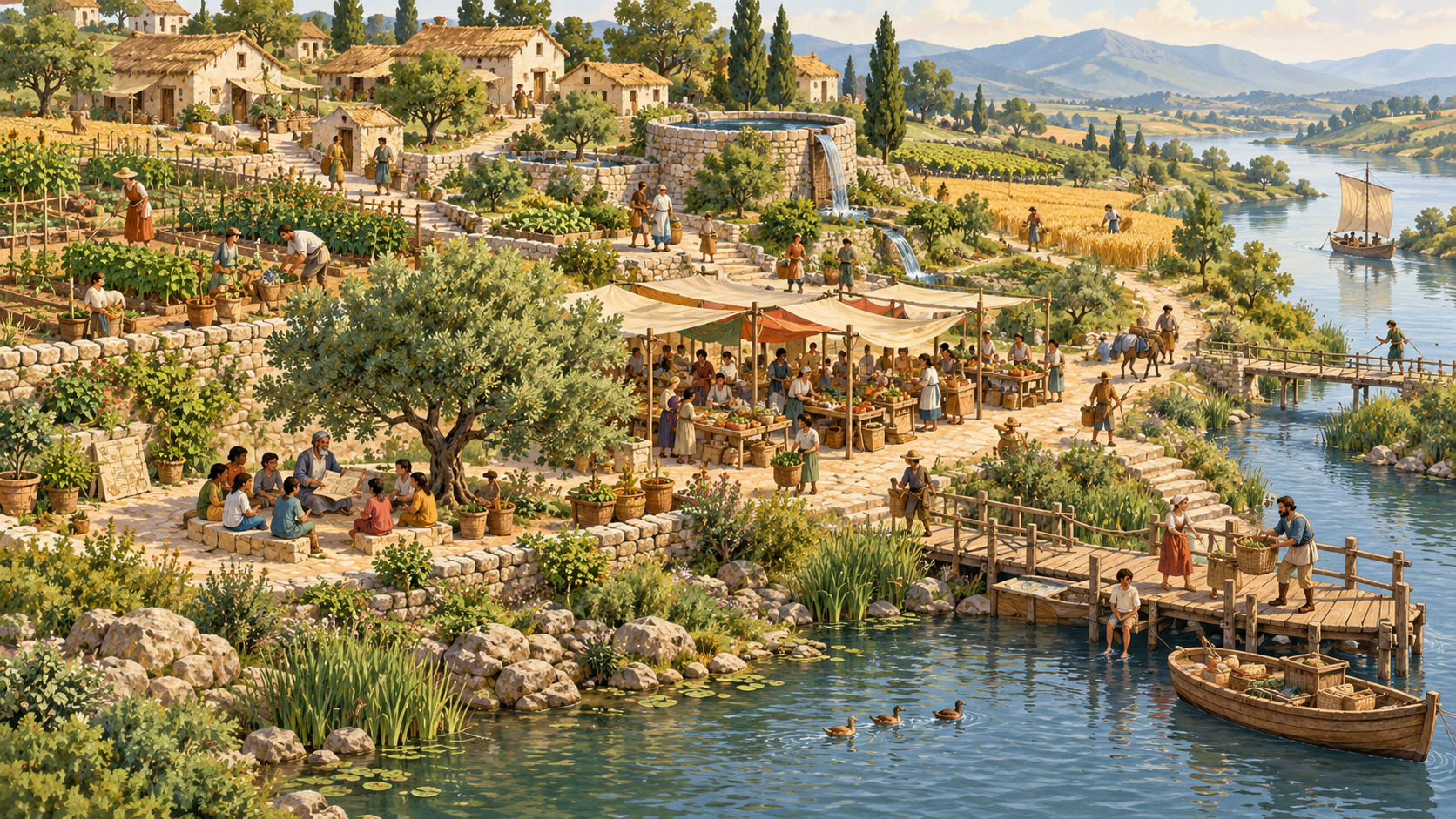
Series cover: AI-generated conceptual illustration of Riverbend, the starting community in these guides. It is not a literal depiction of every scenario, a historical reconstruction or an engineering plan.
Choose your next learning question
Follow a route into the expanded chapters, or choose a specific activity from the index.
Full chapter index
Chapters 1–8: Start with people and requests
- 1. See provisioning as a connection between plans and people
- 2. Separate a stated requirement from a preferred option
- 3. Count guests, visits and meal sets with different labels
- 4. Make a menu an invitation another reader can understand
- 5. Plan complete sets instead of counting attractive components
- 6. Keep invented seasons separate from claims about the world
- 7. Notice when a total hides the timing of provision
- 8. Trace whether a guest can use the offered arrangement
Chapters 9–16: Read patterns and connections
- 9. Follow a provision from request to a place at the table
- 10. Invent shared-meal customs without speaking for real cultures
- 11. Let menu stories create variety without hiding the actual option
- 12. Account for leftovers through defined next uses
- 13. Read provision outcomes without confusing issue with experience
- 14. Compose a complete paper meal with a clear fictional promise
- 15. Follow a meal token through the provisioning network
- 16. Keep an inventory that distinguishes stock from commitments
Chapters 17–24: Plan stores and deliveries
- 17. Match a delivery plan with the capacity of its carrier cards
- 18. Find the requirement that limits a complete provision set
- 19. Treat storage as an abstract rule with an explicit time order
- 20. Schedule arrival, preparation and the shared-table activity
- 21. Allocate a limited symbolic supply through a stated rule
- 22. Respond to a shortage without changing the promise silently
- 23. Compare provisioning alternatives on the same task boundary
- 24. Account for unused portions without assuming why they remain
Chapters 25–32: Make sharing welcoming
- 25. Model renewal as a supplied transformation with a delay
- 26. Make the provisioning model usable with simple materials and formats
- 27. Hand over a provision plan with its present state and next event
- 28. Let provision become a shared occasion with room for different meanings
- 29. Make a shared meal an invitation rather than a requirement
- 30. Ask about a preference without inventing its cause
- 31. Let a gathering carry stories without assigning one tradition to everyone
- 32. Arrange the shared occasion around encounters people can choose
Chapters 33–40: Review and host together
- 33. Connect preparation, arrival and the moment of welcome
- 34. Recover a disrupted gathering without pretending nothing changed
- 35. Read a gathering report without turning symbols into personal conclusions
- 36. Solve a provisioning puzzle with components, readiness and choice
- 37. Teach hospitality and shared stories in the first two sessions
- 38. Teach preparation, recovery and evidence in two further sessions
- 39. Provision the complete Riverbend Lantern Gathering on paper
- 40. Repair a changed gathering from the state actually reached
CHAPTER 1 OF 40 · Start with people and requests
1. See provisioning as a connection between plans and people
Riverbend's paper Meal House begins with a colourful drawing of a shared table. There are plates, banners and a menu, but no explanation of how the fictional guests receive what the activity promises. One child says provisioning means filling the table. Another asks whether a guest who arrives later can understand the menu. Learners begin with provisioning as a connection between stated needs, available resources and actual opportunities to take part, rather than a picture of abundance alone.
This guide uses invented meal tokens, household cards, model periods and story ingredients. None represents a recommended diet, a real portion, farming practice or a food-safety instruction. Children arrange paper pieces and inspect supplied records. Parents and tutors should keep the activity within that fictional frame. A model meal can have exactly the components the exercise defines without making any claim that those components form a suitable real meal for anyone.
For the opening model, one complete meal set means one round token, one square token and one invitation card. These shapes have no nutritional meaning. The invitation identifies the session and explains the next action in the paper activity. A complete set therefore combines objects and information. Children can create another definition for another game, but must name the change before comparing results.
Give a group twelve round tokens, ten square tokens and eleven invitations. The rounds could support twelve sets, the squares ten and the invitations eleven. Only ten complete sets can be formed under the supplied definition. Assembling them uses ten of each component, leaving two rounds, no squares and one invitation. A display of all thirty-three pieces does not establish thirty-three meals, and twelve plate-shaped tokens do not establish twelve complete sets.
Explore the example
Parents can invite the child to lay out the sets before calculating. Ask which component ends first and why the leftover pieces cannot finish another set. An older learner can write a short explanation linking the limiting component to the final count. The purpose is to connect a promise with its actual requirements. There is no reward for selecting the largest available number if that number describes only part of the promise.
Now add eleven fictional guest requests. Ten complete sets leave one request unmet in the current scenario. The class can propose obtaining another square, revising the model set through an explicitly supplied alternative or changing the commitment. It should not solve the arithmetic by deleting the eleventh guest from the record. Nor should it label the request unreasonable merely because the first plan cannot meet it.
A shared-table story can give the quantities meaning. Perhaps the invitation cards contain a question each guest will bring to the gathering. The missing square then matters because a complete set signals readiness to join that particular paper activity. Children can invent the table's customs while preserving the agreed component rule. Imagination enriches the model without quietly creating resources that the quantity record does not contain.
The opening page ends with the set definition, supplied stock and a question about the unmet request. Riverbend's learners have begun to distinguish preparing objects, making a complete provision and observing a guest use it. Provisioning becomes a useful civilisation-building enquiry when those relationships remain visible enough for another child to see what the plan can actually promise and whose place at the imagined table still requires a decision.
CHAPTER 2 OF 40 · Start with people and requests
2. Separate a stated requirement from a preferred option
The Meal House receives three fictional guest cards. One requires a picture menu to choose in the paper activity. Another prefers the blue-pattern token but accepts the green-pattern alternative. A third needs collection during model period two. These statements concern different kinds of condition. Learners now describe needs and preferences precisely without treating a preference as worthless or assuming that a requirement can be changed whenever it makes the allocation inconvenient.
Use invented cases rather than asking children to disclose real eating arrangements or personal health information. The tokens are shapes and patterns with meanings supplied by the exercise. A card requiring a circle token is not a model of an actual dietary requirement. It gives the class a bounded way to examine what happens when a plan must preserve a particular condition while allowing choice elsewhere.
Prepare six guest cards. Two require a striped token, one requires a dotted token and three accept either. The two stripe-required guests prefer stripes, the dot-required guest prefers dots, and the three flexible guests prefer stripes. Stock contains three striped and three dotted tokens, with one token needed per guest under this chapter's separate model. Allocate stripes to the two stripe-required cards and one flexible card. Allocate dots to the dot-required card and the remaining two flexible cards. Every stated requirement is met, but two flexible guests do not receive their preferred pattern.
The class should report both facts. Meeting all six requirements does not establish that all six preferences were met. The allocation gives four guests their preferred pattern: the two stripe-required guests, the dot-required guest and one flexible guest. The other two flexible guests receive an accepted alternative.
Explore the example
Parents can ask the child to explain why a first-come stripe allocation to all three flexible cards would fail the requirements. It would leave no stripe for two guests whose cards cannot use dots. The solution is not to describe those two as difficult. The model requires an allocation that fits the supplied conditions. A different activity could choose another rule, but it would need to explain what it promises and which requests remain unresolved.
Now supply two additional striped tokens. There are eight tokens for six guests. The class can allocate stripes to all five guests who prefer them and a dot to the guest who prefers dots, leaving two dotted tokens unused. The improvement concerns preference matching under this model. It does not establish a better real menu or a general principle that providing more options always improves an actual meal.
Older learners can inspect an ambiguous request such as I need the special one. The phrase may refer to a pattern, session or instruction format. The next step is clarification using supplied information, rather than guessing which meaning makes the stock balance easiest. A careful record can temporarily mark the condition unresolved while preserving the guest's place in the request count.
Finish with two columns, required condition and accepted choices, plus a separate preference note where relevant. Riverbend's shared table can preserve both practicality and care when it understands what is fixed, what is flexible and what remains unknown. The distinction helps learners make a reasoned allocation while keeping the quality of a guest's experience visible beyond a simple claim that every token has been handed out.
CHAPTER 3 OF 40 · Start with people and requests
3. Count guests, visits and meal sets with different labels
Riverbend's Meal House records twenty-four set collections across a model festival. A poster calls that twenty-four guests. The ledger carries eighteen unique guest identifiers, some appearing more than once. Children now distinguish the objects provided, the occasions on which they are collected and the people represented. These quantities can all matter, but one cannot silently replace another merely because it makes a convenient headline.
For this chapter, a guest means one fictional identifier in the supplied role set. A visit is one recorded arrival for the defined collection task. A meal set is the paper combination specified for this festival, with no real dietary meaning. The model states that each recorded collection visit receives one set. It does not say every guest visits once or that every person in Riverbend appears in the ledger.
A worked record has twelve guests with one visit each and six with two visits each. That gives eighteen distinct guests and twenty-four visits: twelve plus twelve. At one set per visit, twenty-four sets are issued. Average visits per guest are twenty-four divided by eighteen, or one and one third. No guest makes a fractional visit. The average summarises unequal whole counts rather than describing a typical person's exact behaviour.
Now add a separate invitation register containing twenty-one guest identifiers. Eighteen appear in the visit ledger and three have no recorded visit. The recorded visiting share is eighteen out of twenty-one, about 85.7%, of invited guests. The register does not establish why the three have no visit. They may have declined, lacked a suitable period or have a missing record under the fiction. The class should request a relevant source instead of inventing a convenient explanation.
Explore the example
Parents can use one card per guest and one small counter per visit. Repeated counters beside the same card make the difference visible. Ask a younger child to count guests first, visits second and sets third under the supplied one-set rule. An older learner can inspect a caption and identify which count it actually supports. A careful answer can retain a busy festival without claiming that every set represents a different person.
For a stock check, the festival begins with twenty-seven complete sets. Twenty-four are issued and three remain unassigned. The balance is twenty-seven, not forty-eight: issued sets are the same sets that left the opening stock. A record of visits and a record of issued objects should not be added together as though both were new stock. The quantities describe related events in different accounts.
Now change the rule for a clearly separate example. A visit may collect two sets for two named guest identifiers under a supplied representative-collection agreement. Ten visits then need not mean ten guests or ten sets. The class needs the actual collection record. It should not carry the first example's one-set-per-visit conversion into the second simply because both use the word visit.
End with a three-line festival summary naming eighteen guests, twenty-four collection visits and twenty-four sets under the original rule. Include the twenty-one-person invitation boundary and the three invited guests with no recorded visit as an open question. Riverbend's learners can now describe provisioning without inflating reach or losing repeated participation. Each result remains useful because the unit and relationship that produced it travel with the number.
CHAPTER 4 OF 40 · Start with people and requests
4. Make a menu an invitation another reader can understand
The Meal House displays a menu with three invented names: Cloud Bowl, Bridge Fold and Lantern Circle. The names create a playful atmosphere, but a newcomer does not know which paper components each option requires or how to choose. A menu can be imaginative and informative at once. Learners now connect expressive names with descriptions that make the actual choices and conditions visible within the fictional activity.
Define three model options using shapes only. Cloud Bowl requires one round and one striped token. Bridge Fold requires one square and one dotted token. Lantern Circle requires one round and one dotted token. Each option also includes the same current instruction card. These are paper recipes in the sense of game combinations, not instructions for real dishes. The option names carry story associations chosen by the class rather than nutritional or cultural facts.
Give children a menu face and an explanation card. The face can contain the invented name and a picture; the explanation lists components, model session and available question route. Ask another learner to match the name to its combination. A charming illustration is useful only if the task's relevant distinctions can be recovered. A cloud picture alone does not establish whether a striped or dotted token belongs with it.
A worked choice check uses nine fictional reader cards. Six identify their intended option and its components, two identify the name but confuse the pattern and one cannot find where to ask. Six out of nine, or two thirds, complete both identification tasks under the supplied check. The other three have different difficulties. Revising the component key addresses the pattern confusion, while adding a visible question point addresses the missing route. The class should not treat every problem as evidence that the names must become dull or identical.
Explore the example
Parents can ask children to write two descriptions of Cloud Bowl. One is a short story line, such as a round moon travelling under a striped cloud. The other states the required tokens plainly. The two can sit together. The story invites imagination while the component description supports a reliable choice. Neither needs to pretend that the fictional combination represents what an actual person should eat.
Now add a period label. Cloud Bowl is offered during model period one, Bridge Fold during two and Lantern Circle during both. A guest available only in period two cannot select Cloud Bowl under this arrangement, even if the tokens remain physically present in another tray. The menu should distinguish stock from offered session. Children can propose a change, but the printed name does not authorise a provision the current plan has not supplied.
Older learners can examine an outdated menu. It promises a striped option removed from the current component stock. A version identifier and clear change note can help readers distinguish the current offering from an earlier story display. Retaining the old menu as an artwork is possible if it is labelled historical within the model. Leaving it in the active choice tray would confuse its artistic value with its role as a current instruction.
Finish with a menu that a newcomer can use to choose an available paper option and identify a question route. Riverbend's learners have made communication part of provisioning rather than decoration added after the quantities are settled. The shared table becomes easier to join when a guest can understand what the invitation offers, what its names refer to and which choices remain available in the relevant model period.
| Question | What to make explicit |
|---|---|
| Unit | What does one token represent in this exercise? |
| Request | What has the fictional character actually asked for? |
| Choice | Which alternatives does this model permit? |
| Limit | What cannot be concluded about real people? |
CHAPTER 5 OF 40 · Start with people and requests
5. Plan complete sets instead of counting attractive components
The Meal House's display has many round tokens and only a few patterned ones. A learner sees the full tray and assumes there is plenty for everyone. The class returns to the defined combinations from a fresh menu, asking which complete sets the stock can support. This chapter keeps the arithmetic close to a meaningful choice: several options may compete for one component, so separate calculations cannot always be promised simultaneously.
For this model, Option A requires one round and one striped token. Option B requires one round and one dotted token. Both also require one instruction card. Opening stock contains twelve rounds, five stripes, eight dots and eleven instructions. If the desk prepared only A, it could make five complete sets. If it prepared only B, it could make eight. Adding those separate maxima to promise thirteen sets would use thirteen rounds and thirteen instructions, exceeding both shared stocks.
A supplied guest choice list requests four A and six B, ten sets altogether. The plan uses ten rounds, four stripes, six dots and ten instructions. Stock remaining is two rounds, one stripe, two dots and one instruction. Every request on that list can be met under the component rules. The leftover quantities are a record of specific components, not automatically one or two additional complete sets without checking a chosen option.
One additional A uses one of each required component, leaving one round, no stripes, two dots and no instruction. No further complete option can be prepared under the unchanged rule because the instruction stock is exhausted. A further B still has its round and dot available but lacks the common instruction. The child should identify that limiting relationship rather than remove the instruction requirement simply because it makes the final count inconvenient.
Explore the example
Parents can use a tray for shared components and separate outlines for A and B. The learner builds sets according to the actual choice list, then examines what remains. A younger child can find a complete next set physically. An older learner can compare alternative allocations, stating both the component use and the guest choices each serves. The task should preserve that preparing an unwanted option does not automatically meet a named request.
Now supply a different list with six A and four B. Ten total requests still fit the round and instruction stocks, but the six A require six striped tokens against five. One A request remains unmet unless its guest explicitly accepts B or another stripe is supplied. Equal totals of ten do not establish identical feasibility. The mix of choices matters because components are not interchangeable under the agreed definitions.
Older learners can write a conditional alternative: if one A requester accepts B, five A and five B use ten rounds, five stripes, five dots and ten instructions. The arithmetic fits, but acceptance belongs in a supplied guest card or agreed change record. It should not be invented by the planner. The report can distinguish the original unmet request from the revised accepted allocation.
End with a component table and a short account of which choice list it supports. Riverbend's paper provisioning now has a useful discipline: abundance of one object does not establish abundance of every complete option, and a maximum calculated for one menu branch cannot be added to another without checking shared resources. The method supports choice while keeping its actual requirements visible.
CHAPTER 6 OF 40 · Start with people and requests
6. Keep invented seasons separate from claims about the world
The Story Circle gives the Meal House a fictional calendar with three named seasons: Reed, Lantern and Mist. Each lasts four model rounds. The class invents different token arrivals and table stories for each season. These relationships are supplied narrative and planning assumptions, not facts about real growing conditions, climates or foods. Children can use the imagined pattern to explore continuity and variation while keeping the boundary between world-building and evidence clear.
For the first exercise, Reed supplies six round tokens per round, Lantern four and Mist two. Over four rounds, their respective arrivals are twenty-four, sixteen and eight. Across the twelve-round cycle, forty-eight round tokens arrive. These are model counters generated by the stated rule. A child should not attribute the pattern to actual farms or infer that a similarly named real season would have the same relationship.
Give each season a story card. In Reed, the table invites new names for old places. In Lantern, guests exchange questions. In Mist, they tell stories about something not yet seen. The activities do not need to mirror the token quantities. A smaller arrival count does not make Mist culturally less valuable. The class can explore how a fictional community marks time without ranking its gatherings by the size of a pile.
Now add a demand rule of four round tokens per round and an opening stock of eight. During Reed, each round adds six and uses four, gaining two. Stock after four rounds becomes sixteen. Lantern adds and uses four each round, leaving sixteen. Mist adds two and uses four, losing two each round and ending at eight. The final stock matches the opening because total arrivals and use both equal forty-eight under the supplied horizon.
Explore the example
Parents can place arrivals into the stock tray at the start of each round and remove use afterward. That event order matters if stock becomes low in another scenario. The activity does not model real storage quality or safety. All tokens remain available unless a later fictional rule explicitly changes their status. Children should not assume that the balance demonstrates anything about actual food preservation.
A separate change card removes Reed's extra arrivals: Reed now supplies four per round while Lantern and Mist retain four and two. Total cycle arrivals become sixteen plus sixteen plus eight, or forty. Demand remains forty-eight, so opening eight is fully used by the cycle's end. The plan finishes at zero under the stated timing. A second unchanged cycle would not be supported without new opening resources or a revised condition. A one-cycle balance is not evidence of indefinite continuation.
Older learners can write a calendar caption that names the model rule, horizon and uncertainty. The phrase Mist always brings fewer tokens belongs only to the fictional convention currently supplied. A different story world could have another pattern. If the class wants to change it, it should preserve the earlier scenario and explain what new assumption the comparison uses.
Finish with a seasonal story strip beside the stock strip. One carries meaning and imagery; the other carries a finite numerical relationship. Riverbend's learners can connect them without confusing them. Invented seasons provide an imaginative setting for thinking about provisioning across time, while the explicit rules prevent a pleasing narrative from becoming an unsupported claim about how the real world works.
CHAPTER 7 OF 40 · Start with people and requests
7. Notice when a total hides the timing of provision
The Meal House prepares enough paper sets for a whole model day, yet some guests arrive before their sets are available. Others can attend only after the activity closes. A day total can balance while individual opportunities remain unresolved. Learners now examine when provision becomes available and when a fictional request can use it, without assuming that spare quantity at one time automatically serves a need at another.
Use a fresh three-period day. Six complete sets become available at the start of each period, giving eighteen across the day. Requests are four in period one, eight in period two and six in period three. Opening stock is zero, unused sets carry forward unchanged and service can issue any available sets during the same period. After period one, two remain. Period two adds six, giving eight, all of which are issued. Period three adds six and issues six. All eighteen requests can be met under those rules.
Now keep the same total arrivals but change their timing to three, six and nine. Period one can serve only three of four requests, leaving one unmet at that moment. If requests may wait and the guest cards explicitly permit it, period two has nine requests including the one waiting, against six new sets. Three then wait for period three, where nine new sets meet the six current plus three waiting. The queue is one, three and zero after the periods.
The eventual total is still eighteen sets issued. That does not mean every guest received provision during the requested period. A report can state both eventual service and the periods of waiting. If the guest cards do not permit waiting, the planner needs a different account; unmet period-one requests cannot be silently transferred into a later queue. The timing rule should be chosen before interpreting the result.
Explore the example
Parents can enact the first and second scenarios with period mats. Guest counters that can wait carry a visible waiting marker. The child should not move a fixed-period request forward simply to clear the board. Ask which statement changes between the scenarios: the quantity supplied, the timing supplied or the acceptance condition. The answer helps the learner see why equal day totals can produce different experiences.
A separate scenario has eighteen sets and all eighteen requests already present at the start of period one. Every guest can wait across all three periods, but service is limited to five issues per period. Service issues five sets in each period, fifteen altogether under that unchanged rule. Stock is sufficient while issuing capacity is not. Three sets and three waiting requests remain; the remaining stock does not establish that those requests were served. Preparation and distribution are separate parts of the fictional provision.
Older learners can compare earliest completion of a waiting list with the advertised commitment. If the invitation promises service in each requested period, eventual clearing is a partial result rather than fulfilment of that exact promise. The class can revise the invitation honestly or change the arrangement through a supplied condition. It should not redefine the promise after seeing the convenient total and then report complete success without explanation.
End with a period-by-period account naming arrivals, available stock, permitted waiting and issued sets. Riverbend's learners can now connect provisioning to a guest's actual opportunity. The imagined table becomes more than an end-of-day pile: its useful provision depends on when resources and people meet under the rules the class has chosen to examine.
CHAPTER 8 OF 40 · Start with people and requests
8. Trace whether a guest can use the offered arrangement
A paper menu offers a suitable token option, but a fictional guest cannot use its only collection period. Another can attend but cannot recover the option from the supplied symbol key. The Meal House needs to trace the whole invitation from understanding to participation. Children now examine everyday access through prepared guest cases, keeping the activity separate from actual dietary, medical or personal information.
Give six guests one request each. Their cards name an accepted model set, an available period and a usable instruction format. These conditions should be supplied independently. A guest who uses a picture menu does not automatically have the same schedule as another picture user. The child should inspect the actual combination on each card rather than assign a whole pattern of needs from one feature.
For a worked format check, two guests use only the picture explanation, two only the text explanation and two can use either. A text-only menu supports four of the six on that measure. Adding the supplied suitable picture menu supports all six for option identification. This is a genuine change within the model, but it does not establish that all six can obtain their set during a usable period. The next relationship still needs checking.
Now offer three collection places in period one and three in period two. Four guests require period one, one requires period two and one accepts either. The flexible guest can use period two, but four fixed requests still exceed period-one capacity by one. One place remains unused in period two. The class should not announce six served simply because six places exist somewhere in the day and both menu formats are available.
Explore the example
Parents can use a two-stage board. First pair each guest with a usable explanation; then place the guest on a permitted session mat. A counter may pass the first stage and remain unresolved at the second. This makes an improvement visible without claiming it solved every part of participation. It also prevents an unresolved timing case from erasing the value of the clearer menu for other guests.
A supplied alternative allows the remaining period-one guest to receive its complete set through a representative at the same period. The guest card explicitly accepts that route, and one of the three other period-one guests is supplied as the representative. A prepared instruction explains the handover. That representative visit can now collect its own set and the guest's set under the new rule, using one visit place rather than two. The report should name five collection visits supplying six guest sets, rather than continue using one visit equals one set from an earlier scenario.
Older learners can ask what the alternative requires. The representative needs the correct guest identifier, current option and agreed handover in the paper model. The class should not collect real names or addresses. A code on an invented guest card is enough to examine the relationship. If the scenario has no accepted representative route, the class must preserve the unresolved request instead of borrowing the alternative from another chapter without its conditions.
Finish with a guest-journey table showing option fit, information fit, period fit and any confirmed alternative. Another group checks one row against the source cards. Riverbend's learners have a richer account than a total number of menu options. Provisioning becomes usable when the guest can connect with what is offered, through information and timing that the model actually supplies, while needs outside the six cases remain questions rather than presumed solved.
CHAPTER 9 OF 40 · Read patterns and connections
9. Follow a provision from request to a place at the table
Riverbend's fictional meal begins long before a token reaches a plate outline. A guest encounters an invitation, chooses an option, collects a set and brings a story question to the table. The Meal House now follows that sequence as a journey. The purpose is to connect resources with an ordinary activity, rather than treat issuing a token as proof that every intended part of the shared meal occurred.
Prepare five stage cards: invitation encountered, option chosen, set issued, guest arrives and contribution offered. In this chapter the contribution can be a supplied picture question, and a guest may decline to offer it without losing their set. That choice belongs in the invitation. The final stage is an opportunity, not a compulsory disclosure of a real personal story. Children can use fictional questions about Riverbend's imagined river or question tree.
A worked record contains twelve guest identifiers. All twelve encounter the invitation, ten record an option choice, nine receive a complete set and eight have a recorded arrival at the table. The stage counts narrow, but their causes are not supplied. One should not infer that every difference represents refusal or exclusion. The task is to inspect linked identifiers and ask what information would distinguish a missing record, a changed plan and an unmet request.
For this model the stage ledger explicitly states that each later group is contained within the earlier one. Thus two guests have no recorded choice, one chooser has no recorded issue and one recipient has no recorded arrival. The eight arrivals are not eight additional people to add to the nine recipients. The same guest can appear at several stages. A younger learner can move one identified counter through the sequence while leaving a marker recording each completed event.
Explore the example
Parents can introduce a story at the table. One guest brings a postcard asking what the river would say if it could choose its own name. Another brings a drawing instead of words. A third listens and offers nothing that round. The arrangement can recognise these choices without treating equal speech as the only sign of participation. The child should not infer a guest's enjoyment or belonging solely from whether their fictional card contains a spoken contribution.
Now supply a timing sequence. A request is confirmed at model mark two, its set becomes available at five and collection occurs at six. The shared table opens at seven. Under a supplied one-interval movement rule, the guest arrives at seven. The interval from confirmation to arrival is five units, while collection-to-arrival is one. These are model time units, not estimates of real movement. Naming the endpoints keeps the journey account clear.
Older learners can examine a proposed shortcut: omit option confirmation and prepare the most common set for everyone. The class can predict that this might reduce one stage, but it cannot assume the sets match the actual guest cards. A step may look administrative while preserving a meaningful choice. The group should identify what the step does before removing it and asking whether another supplied method performs that function.
End with one complete guest journey and one unresolved transition. The Meal House can now tell a more truthful story about provision: something was prepared, issued and used under particular conditions, while another relationship still needs evidence. Riverbend's shared meal becomes a connected activity people can enter, rather than a series of totals that never show whether the invitation and the table actually met.
CHAPTER 10 OF 40 · Read patterns and connections
10. Invent shared-meal customs without speaking for real cultures
The Story Circle imagines three Riverbend tables. At one, guests name a place they would like to discover. At another, a folded card travels around the table and gathers questions. At the third, the opening story is told through pictures. These are invented customs for a fictional community. They are not descriptions of real peoples, faiths or traditions, and they should not be presented as the correct way every shared meal ought to happen.
Begin with a custom's purpose and visible action. The travelling card might connect contributions across a gathering. The picture opening might give an imagined story a different form. Ask learners what a guest needs to understand to join or decline the action. A custom can be meaningful while allowing an accepted alternative. Calling an activity shared does not establish that every guest must participate in exactly the same manner.
Give three fictional voices different relationships to one custom. Neri likes opening with a question. Sol prefers to hear a story first. Tavi enjoys drawing an answer after the gathering. None represents an entire social group. The class can write a scene in which the voices explain their preferences without making one wise and the others selfish. Different experiences can shape a gathering without becoming a contest over who belongs most.
Parents can offer a paper object to anchor the scene: a cup outline with no contents, a folded place card or a table ribbon. Ask children to invent two meanings for the object within Riverbend. A ribbon might connect neighbouring places; a folded card might keep a question open. The object has no universal cultural meaning. Its role emerges through the fictional stories and actions the class supplies.
Explore the example
A practical activity makes two versions of an invitation. One states that every guest must speak a story from their own life. The other offers a choice of a supplied fictional story, a picture response or listening. Discuss which invitation fits the guide's classroom boundary. The lesson should not require private disclosure. A child can explore the meaning of hospitality and participation through invented scenes without making their family experience the material everyone else examines.
Now introduce change across invented generations. An early Riverbend scene passes one question card around the table; a later scene displays several cards so guests can choose which to answer. The class can compare continuity and difference. The later form is not automatically more advanced or less respectful. A reasoned account asks which purpose is preserved, which experience changes and how the fictional participants describe the change.
Older learners can write a short interpretation of an image showing one empty place. It might represent an expected guest, room for another story or a practical arrangement not yet explained. The picture alone does not prove grief, exclusion or welcome. Children can add a context card that strengthens one reading, then compare the image with and without that supplied context. Shared meals can carry meaning without every meaning becoming an established fact about unseen people.
Finish with a story scene and a note identifying its invented custom, available choices and one interpretation left open. Riverbend's learners can explore food-related culture through imagination while respecting the difference between creating a fictional tradition and making claims about real communities. The shared table becomes a place for voice, memory and change, with enough openness for guests to bring different relationships to the same activity.
CHAPTER 11 OF 40 · Read patterns and connections
11. Let menu stories create variety without hiding the actual option
The Meal House asks children to name a new paper option made from a square token and a dotted token. One calls it the Window Picnic. Another calls it the River's Reply. The names suggest different stories, yet the components are identical. Learners now use menu-making as an imaginative activity while preserving the plain information a fictional guest needs to make a real choice inside the model.
Give the class a component card and three possible presentation forms: a two-line description, a picture sequence and a tiny dialogue. The description might imagine a window opening onto a dotted night. The sequence might follow the square as it becomes a postcard. The dialogue might let two tokens disagree about which one resembles the river. None is a real recipe. The exercise composes meaning around shapes without claiming that a playful name changes their defined game properties.
Parents can ask a reader to identify both the story invitation and the required combination. If the reader enjoys the name but selects a round token, the information link needs attention. The child can add a component strip without discarding the imaginative wording. A useful menu can contain more than one register: a lively invitation and a concise explanation of what the option actually includes.
Now make two options with the same story name but different components. Window Picnic A uses square plus dots; Window Picnic B uses square plus stripes. The display needs a visible distinction if both are available together. A version letter can help, but the reader still needs the component meaning. The class should not assume that a larger letter or more elaborate drawing establishes a preferred or more suitable choice for every guest.
Explore the example
A practical art task arranges four menu cards into a small narrative. The first introduces a place, the second a visitor, the third a question and the fourth an open ending. The guest can read the cards as a story while choosing any accepted model option. Keep narrative sequence separate from compulsory eating order, which this activity does not define. An arrangement on paper does not become advice about how someone should eat in real life.
Older learners can compare descriptive and interpretative sentences. This card shows a square beneath five dots describes a visible arrangement. This option invites a journey into the night interprets its story. This combination is best for every guest makes an unsupported suitability claim. Children can revise the third into a specific statement about the fictional component rule or a particular guest card that accepts the option.
Try a title change while holding the picture and components fixed. The River's Reply might become A Question for Tomorrow. Ask what readers notice differently and what remains unchanged. A title can influence the encounter without controlling every interpretation. The maker can preserve a reader's unexpected response as part of the creative conversation, provided it is not confused with evidence that the component specification changed.
Finish with one menu work containing a story name, an imaginative form and a clear component reference. A newcomer should be able to enter the fiction and recover the actual choice. Riverbend's learners have made variety through expression as well as through inventory. The model's shared meal can feel rich in questions and images while remaining honest about the finite objects offered, the guest choices supplied and the meanings the menu only invites rather than guarantees.
CHAPTER 12 OF 40 · Read patterns and connections
12. Account for leftovers through defined next uses
The Meal House finishes a paper session with several tokens unissued and others returned from the table. A child calls all of them spare and promises them to the next activity. Another wants to discard every used-looking paper piece from the model. The class needs a more specific account. These are game states governed by supplied rules, not judgments about whether actual food is safe, suitable to store or appropriate to reuse.
For a fresh inventory, the session begins with twenty identified round tokens. Twelve are issued, five remain unissued and three enter an unresolved-status tray after a copied record mismatch. Those categories sum to twenty. The twelve issued tokens may still be held by guests in the model. The five unissued tokens are available only if no other rule reserves them. The three unresolved tokens should not be called either accepted or rejected without a supplied check.
A later return event brings eight of the twelve issued tokens back. The rule places all returns in a separate review tray, so the state becomes four still issued, eight returned awaiting review, five unissued and three in earlier uncertainty. The total remains twenty. Physical return does not automatically mean current availability under the game rule, and the class should not turn this distinction into real food-handling advice.
Now the exercise supplies a paper-status check. Six returned tokens match the next activity's required version and two do not. The next-use accepted stock is the five unissued tokens plus the six confirmed returns, or eleven, if the unissued tokens also carry the current version as explicitly stated here. Four remain issued, two are confirmed nonmatching and three remain unresolved. Eleven plus four plus two plus three equals twenty.
Explore the example
Parents can ask children to move the same numbered tokens between labelled envelopes. A token should not remain in the issued count after it has returned. The activity can include a story about a round token becoming a moon in another display, but that narrative does not change its status for the specified next game unless the new activity defines a suitable alternative use. Different purposes can have different acceptance rules.
For a worked next request, ten accepted rounds are needed. Eleven current-version accepted tokens can meet it, leaving one unassigned. A request for twelve exceeds confirmed availability by one. The three unresolved tokens are not an automatic solution. The class can seek a supplied check or propose a suitable scope change, while preserving what remains unknown. It should not infer that uncertainty hides a favourable result because the next activity would otherwise be difficult.
Older learners can compare two next-use plans. One needs ten rounds of the current version. Another needs ten paper circles of any version for a purely visual story display, and the exercise explicitly states that the two nonmatching returns qualify for that separate purpose. The second plan can use a larger suitable pool under its own rule. It does not prove that the first rule was unnecessary. Suitability belongs to a defined task, not an object's name alone.
End with a next-use record naming the relevant activity, accepted stock and unresolved statuses. Riverbend's learners can now examine remaining resources without making a vague moral judgement from a pile. The fictional accounting supports careful choices about what can serve which next purpose, while its explicit paper rules keep the exercise away from real diet, storage or food-safety recommendations.
| Record | Check |
|---|---|
| Starting stock | The named items present at the beginning |
| Incoming items | When they become available in the supplied sequence |
| Requests | Which requests apply to this exercise |
| Ending stock | Items remaining after the stated actions |
Extend this learning question through How Education Works.
CHAPTER 13 OF 40 · Read patterns and connections
13. Read provision outcomes without confusing issue with experience
The Meal House announces that every set left the supply tray. A fictional guest card says it reached the table but could not identify the question activity. Another set was collected by a representative and has no handover record. The issue total remains useful, yet it cannot establish every later experience. Learners now examine a modest outcome pack without claiming to measure real satisfaction, nutrition or wellbeing.
Use twenty distinct guest requests. Sixteen receive complete sets, two receive partial sets and two remain unresolved at the time of the report. Complete issue is sixteen out of twenty, or 80%. Complete or partial issue is eighteen out of twenty, or 90%. Those statements describe different milestones. The two partial provisions should not be counted as complete simply because they include some objects, and the unresolved requests should not automatically be labelled refusals.
A separate follow-up record exists for twelve of the sixteen complete-set recipients. Nine identify the current table activity, two identify an earlier version and one cannot choose. Nine out of twelve is 75% among checked recipients. Nine out of twenty is 45% of all requesters with a recorded successful activity-identification check. Four complete-set recipients have no follow-up, as do the two partial and two unresolved cases on this measure.
Parents can sort counters by issue state first, then add check markers without replacing the original categories. A guest can be in the complete-set group while lacking a recorded interpretation result. The two classifications answer different questions. Adding sixteen issued and nine successful checks would double-count people across stages rather than create twenty-five distinct guests.
Explore the example
Now ask what a report can say about the missing four checks among complete recipients. If none would identify the activity, successful checks in that sixteen-person group would remain nine. If all four did, the count could reach thirteen. The three checked recipients who did not identify the current activity remain as observed under the same conditions. These are possible bounds of nine to thirteen out of sixteen, not predictions and not claims about what further explanation might change later.
A practical review gives children three prepared comments. One guest enjoyed inventing a table name. Another preferred a different story prompt. A third says only that the menu was confusing. The class should connect the third comment to a specific feature question before proposing a remedy. These comments do not justify a universal conclusion about all guests' enjoyment. They add individual supplied responses to the narrower issue and interpretation records.
Older learners can choose a next enquiry with a clear purpose. Recovering the four missing follow-ups may clarify activity understanding among complete recipients. Examining the two partial sets may clarify component shortages. Improving the shared story may address an expressed preference. These tasks should not be treated as interchangeable simply because each produces another page of evidence. The question determines which source can make progress.
Finish with a report stating a supported provision result, a separate experience result and an unresolved question. Riverbend's learners have a way to describe progress without turning a stock movement into a claim about every guest's life. A shared meal in this model is made more understandable through the connection between what was promised, what was issued and what the supplied participants could actually do with it.
CHAPTER 14 OF 40 · Read patterns and connections
14. Compose a complete paper meal with a clear fictional promise
The opening provisioning project ends with a small gathering called Questions at the River Table. Children design its token menu, invitation and story activity for a fresh set of eight fictional guests. The goal is to connect a finite provision with a shared experience, not to design an actual meal. The portfolio should remain playful enough to invite contributions and clear enough for another group to reconstruct what is offered under the model's rules.
The complete set contains one round token, one patterned token and one current invitation. Six guests accept either stripe or dot, one requires stripe and one requires dot. Of the six flexible guests, four prefer stripe and two prefer dot. Stock contains ten rounds, four stripes, six dots and nine invitations. Each guest requests one set. There are enough of every common component for eight, while pattern choices need a specific allocation rather than separate maxima.
Give the stripe-required guest one stripe and the dot-required guest one dot. Three stripes remain for the four flexible stripe-preferring guests, so one of those four receives an accepted dot. The two flexible dot-preferring guests also receive dots. Total use is eight rounds, four stripes, four dots and eight invitations. Remaining stock is two rounds, no stripes, two dots and one invitation. All eight requirements are met, while one flexible preference is not met in this allocation.
The gathering has two model periods with four places each. Two guests require period one, two require period two and four can use either. Assign the two fixed period-one guests plus two flexible there, and the two fixed period-two guests plus the other two flexible there. The eight requested places fit. The pattern allocation and period allocation are independent in this brief; no guest's pattern determines their availability. A reviewer can check both records without inventing a link between them.
Explore the example
At the table, each guest may choose a supplied question card, draw an imagined river object or listen. The invitation states that these choices are optional and do not change the guest's set. One question asks what a river might remember; another asks what name a bridge would choose. The activity should not require children to reveal real family meals or personal experiences. A parent or tutor can supply all stories within the fiction.
Now introduce a bounded change: one current invitation is set aside because its period label is unresolved. Available current invitations fall from nine to eight, still enough for the eight planned sets. The spare invitation disappears, while the provision remains feasible under the supplied confirmation that all other invitation labels are current. The class should preserve the distinction between no spare and one unmet request. If a second invitation becomes unresolved before another suitable copy is supplied, only seven complete sets are confirmed.
For the handover, another learner identifies a complete set, a guest's accepted alternative and the two period assignments. They also explain the remaining stock after the original allocation and the invitation change. A correct explanation should name the scenario, since earlier chapters used other menus and quantities. The child can keep a drawing or short table rather than produce a long administrative report. The point is a shared promise someone else can follow.
Finish with the menu work, a finite component record and one story contribution chosen for display under the classroom agreement. Riverbend's learners have connected provisioning with access, choice, communication and culture through a small paper world. Their completed project can welcome another group's imagination while remaining honest about its quantities and unresolved conditions. The table is ready in a precise model sense: these eight guests have these supplied routes to participate, with no claim that the exercise defines a real diet or settles every meaning a shared meal can hold.
CHAPTER 15 OF 40 · Read patterns and connections
15. Follow a meal token through the provisioning network
Riverbend's fictional Provision House prepares a shared-meal scene with paper counters. The counters stand for defined portions in a game, not actual foods, nutritional needs or instructions for preparing anything to eat. A child draws a meal table and places enough counters beside it. The tutor asks how those counters arrived, which other tasks depend on them and what happens after the scene. Provisioning becomes a network of connected activities rather than a picture of a full table.
Begin with four stations: Source Cards, Packing Mat, Arrival Desk and Shared Table. A source card authorises a stated number of symbolic portions to enter the model. The packing mat groups them according to the current activity. The arrival desk records what actually reached the destination, and the shared table allocates portions to fictional role cards. These stations separate events that can otherwise disappear into a vague instruction to provide a meal. They do not represent a complete real food system.
The tutor supplies two source cards, one for eighteen grain-symbol counters and another for twelve garden-symbol counters. The opening input is thirty symbolic portions in total, with the two types still recorded separately. Packing does not create extra portions. If six counters enter each of five paper bundles, all thirty are assigned. The class should identify the contents of each bundle if the shared-table activity requires a particular mix, rather than assume that every six-counter group has equivalent meaning.
Use a complete bundle description: three grain symbols and three garden symbols. The eighteen grain symbols could support six such bundles, but the twelve garden symbols support four. Only four complete bundles can be made under this rule. They use twelve of each symbol and leave six grain symbols. The earlier five-bundle calculation counted total portions without preserving the specified composition. Both arithmetic results have meanings, but only the composition-aware result answers the present bundle question.
Explore the example
A parent can let a child discover this difference physically. First group thirty unlabelled counters into fives of six, then reveal their two categories and ask for the prescribed three-and-three bundles. The activity shows why a balanced total does not establish that every promised bundle is available. It should not imply that the invented combination is a recommended real meal; it is simply the rule that makes this paper task inspectable.
Trace one accepted bundle through the stations. Record its identifier at packing, its arrival at the desk and its assignment to the shared table. The same bundle should not appear as unassigned at the packing mat after it has been delivered. It remains part of the model's physical account until used according to the supplied activity rule. Children can distinguish location, assignment and completed use by moving the same numbered card rather than creating a new one at every station.
End with a network caption naming the source quantities, composition requirement and current locations. Another learner should be able to reconstruct where the portions are and which bundles can support the activity. Riverbend's first provisioning question is modest: do the connected records describe enough of the right symbolic components at the place and time required? That question gives a fuller basis for the shared table than a single impressive total placed beside a drawing.
A network can include an instruction dependency as well as movement. If the current bundle description is known only at the Arrival Desk, the Packing Mat cannot establish the required composition from its own cards. Ask the learner to draw the information link that supplies the description. Moving symbolic portions and moving the instruction about them are different relationships, and both may be necessary for the complete provision.
CHAPTER 16 OF 40 · Read patterns and connections
16. Keep an inventory that distinguishes stock from commitments
The Provision House has forty paper portion tokens in its abstract store. A request arrives for twenty-four, and the organiser says the supply is sufficient. Another card shows that twenty portions are already assigned to a different fictional gathering during the same model period. Children examine the difference between physical stock and stock still free for a new promise. The exercise does not involve actual food storage, purchasing or household planning.
Use a ledger with three opening categories: twenty tokens assigned to Gathering A, fourteen unassigned and six awaiting a category check. These sum to forty. Under the supplied rule, the six unresolved tokens cannot support a composition-specific promise until their categories are established. Fourteen are presently available for a new unqualified assignment. The fact that forty are physically present does not make forty freely assignable to every request.
The new request needs twenty-four portions of accepted categories. Compared with fourteen confirmed unassigned portions, the gap is ten. If a supplied check later confirms all six unresolved tokens as suitable and no other allocation changes, twenty would be unassigned and accepted, leaving a gap of four. The result of the check is a separate event. A hoped-for confirmation cannot be counted as present stock before the exercise provides it.
Now supply an arrival of eight accepted tokens before the new gathering begins. With the six confirmed, unassigned accepted stock becomes twenty-eight. Assigning twenty-four leaves four unassigned. Gathering A's twenty remain assigned, so physical stock after the arrival is forty-eight before either gathering uses its tokens. The ledger can reconcile twenty assigned to A, twenty-four assigned to the new gathering and four unassigned. This is a fresh ordered scenario, not permission to count the same arrival twice.
Explore the example
A tutor can use envelopes for assigned, unassigned and unresolved states, with a separate note for location. A token may be assigned while still physically in the abstract store. The child should not interpret the envelope as a place the token must actually occupy. One sheet can record where it is and another what promise claims it. Separating these relationships helps children understand why stock can look abundant while a new commitment remains unsupported.
Ask what changes when Gathering A releases five portions before any use occurs. Those five move from assigned to unassigned, increasing the unassigned balance from four to nine after the new gathering's assignment. No physical tokens have arrived. The change concerns a commitment, so it should be described as released allocation rather than additional supply. This distinction matters when a later learner tries to explain how the stock total changed over the round.
For a parent activity, give the child a headline total and three request cards, then ask them to identify which requests compete for the same unassigned tokens. They should write a truthful response to the twenty-four-portion request at each stage of the scenario. The answer changes as checks, arrivals and releases occur. A useful inventory preserves that history while making the current state clear enough to support the next allocation.
CHAPTER 17 OF 40 · Plan stores and deliveries
17. Match a delivery plan with the capacity of its carrier cards
Riverbend's paper meal exchange sends labelled bundles from a preparation station to two fictional neighbourhood tables. Transport is represented by carrier cards with invented capacities. No activity requires real travel or handling actual food. Children examine whether the plan moves the stated quantities in the order required, keeping a carrier's capacity separate from the number of bundles waiting at its starting station.
Each carrier card can hold four complete bundles per trip. Ten bundles need to reach Table Cedar. With one carrier, two full trips move eight and a third moves the remaining two. Three trips are required under the rule that bundles cannot be divided. The total carried is ten, while the carrier offers twelve bundle-spaces across the three trips. Two spaces remain unused on the final trip. Unused trip capacity is not a loss of two bundles.
The tutor supplies a trip structure of three model minutes outward, two for the represented handover and three back to the starting station. Each complete trip occupies eight minutes. If the carrier must return after all three trips, the full sequence takes twenty-four. If the task ends when the last handover is complete and no final return is required in the brief, the sequence ends after twenty-one. The class should state which endpoint it is calculating before comparing schedules.
Now provide two equivalent carriers, each with a fictional organiser and separate capacity. A simultaneous first outward trip can deliver eight bundles, four on each carrier. After both return, one carrier can take the last two. Under the same durations, all ten handovers finish at minute thirteen: the first complete cycle ends at eight, then outward travel and handover take five. Both carriers do not need to make a second trip merely because two were used initially.
Explore the example
Total movement work and elapsed time differ. The two first complete trips contribute sixteen carrier-minutes, and the final outward-and-handover contributes five, totaling twenty-one carrier-minutes through the defined delivery endpoint. Elapsed time is thirteen. If the final return is required, both totals increase by three for that active carrier, giving twenty-four carrier-minutes and sixteen elapsed minutes. The unused second carrier is not automatically doing work during the last trip.
A parent can represent trips with strips and place four bundle counters on each carrier at loading. Ask the child to show the last bundle reaching the destination, then identify whether the record includes the final return. A learner may produce a correct twenty-one-minute sequential delivery and another a twenty-four-minute full-return cycle. Their disagreement can disappear when each names the result being timed.
The delivery note should also record which bundles reached which table. Ten bundles delivered somewhere do not establish that Cedar received its required ten if some were assigned to another destination. A carrier plan becomes useful when quantities, destination, timing and endpoint agree. Riverbend's learners are practising the complete connection between available bundles and a table's actual model provision, rather than treating movement capacity as a promise that every request has already been met.
A carrier may have enough total space while carrying the wrong destination mix. Give one trip two Cedar bundles and two Birch bundles when Cedar needs four in that arrival. The vehicle is full under the model, yet the Cedar requirement remains short by two. Children should inspect the identifiers at loading and arrival rather than use a full carrier as evidence that a particular table received everything promised.
CHAPTER 18 OF 40 · Plan stores and deliveries
18. Find the requirement that limits a complete provision set
The Provision House prepares symbolic welcome sets for a fictional story supper. Each set contains two grain counters, one garden counter and one message card. The message card explains the table's invented activity. The composition is a classroom convention and has no nutritional meaning. Children investigate complete-set capacity, recognising that different requirements can limit the same proposed service.
The opening stock contains thirty-six grain counters, fifteen garden counters and twenty message cards. Grain could support eighteen sets, garden fifteen and messages twenty. Fifteen complete sets can therefore be assembled. Those sets use thirty grain, fifteen garden and fifteen messages, leaving six grain and five message cards. The eleven loose pieces cannot become another set without a garden counter under the present description.
A new source card adds four garden counters before assembly. Garden capacity rises to nineteen, while grain still supports eighteen and messages twenty. Complete-set capacity becomes eighteen. The additional garden stock has removed the original limiting requirement and revealed grain as the new one. The class should recalculate all component relationships rather than add four directly to the previous fifteen-set result and announce nineteen complete sets.
The eighteen sets use thirty-six grain, eighteen garden and eighteen messages. With the new garden total of nineteen, leftovers are zero grain, one garden and two messages. A tutor can ask the child to reconcile each component from opening stock through arrival to use in sets and remainder. This physical check helps identify the common mistake of keeping the earlier six-grain remainder after the later scenario has used it.
Explore the example
Now add an access requirement. The tabletop station can present twelve sets simultaneously during a supplied period. Eighteen complete sets exist, but only twelve simultaneous presentations fit that station rule. The class can propose another period if the fictional role cards permit it, or another supported arrangement. Stock sufficiency and simultaneous service capacity remain separate questions. A set assembled in a box is not automatically a completed table encounter.
For a parent activity, offer the child two improvement cards: add three message cards or add six presentation places. Ask which changes the present limiting requirement for a request of eighteen simultaneous sets. The extra messages do not address the twelve-place boundary. Six suitable places would raise the presentation count to eighteen, but only if the tutor supplies that they can be used during the same period under the other activity conditions. A numerical addition should keep its suitability condition attached.
The complete provision statement names composition, ready-set count and the scope of presentation. It can say that eighteen sets are assembled while twelve can be presented simultaneously in the current arrangement. Neither part needs to conceal the other. Riverbend's paper model becomes more useful when a learner can locate the precise boundary that matters to a request, rather than call the system fully supplied or wholly inadequate from one component count alone.
Ask the learner to write the request before choosing an improvement. A request for eighteen assembled sets and a request for eighteen simultaneous presentations have different limiting requirements. Both can be meaningful. The same stock change may help one and leave the other unchanged. A clear question prevents the class from solving whichever count is easiest while continuing to claim that it addressed the original provision.
CHAPTER 19 OF 40 · Plan stores and deliveries
19. Treat storage as an abstract rule with an explicit time order
The Provision House's store is a row of paper boxes. A counter inside a box follows only the invented rules supplied for this lesson. It does not represent a real temperature, keeping period, preservation method or safety judgement. Children use the boxes to examine how stock carried between rounds can differ from stock arriving and used immediately. The model's limits belong beside every calculation.
The tutor sets an abstract carryover rule. At the end of each round, after the stated use, one token is removed for every complete group of five remaining tokens. The removed tokens go to a model-change tray. This is an invented arithmetic transformation, not a forecast of actual waste or deterioration. The rule applies to the combined closing balance, and the class should not apply it separately to arbitrary subgroups unless the exercise changes that definition.
Start with twenty-three tokens. In round one, an arrival of seven occurs first, giving thirty. The activity uses twelve, leaving eighteen. The carryover rule removes three, because eighteen contains three complete groups of five, leaving fifteen for round two. The remainder of three within the eighteen does not trigger another removal. The next opening stock is fifteen, not eighteen and not the original twenty-three.
In round two, five arrive first, bringing the balance to twenty. Use is nine, leaving eleven. The rule removes two, leaving nine for round three. Across the two rounds, the model began with twenty-three, received twelve and used twenty-one. Five went to the model-change tray, so nine remain: twenty-three plus twelve minus twenty-one minus five. The round record and whole-period balance agree.
Explore the example
Ask what changes if the rule applies before use instead. In the first round, thirty would undergo six removals before twelve are used, leaving twelve. That differs from the fifteen produced by applying the rule after use. Neither calculation corrects the other; they describe different time orders. A parent can place arrival, use and transformation cards along a strip and ask the child to read the order aloud before moving counters.
A tutor can also compare immediate provision with carried stock. If six tokens arrive at the start of a round and all six are used before the closing transformation, none of those six remains to be transformed under this definition. That statement follows from the paper rule only. It should never be rephrased as advice that real food is acceptable because it is used within a model round. The classroom counters carry no such information.
Finish with a store record showing opening, arrivals, use, transformation and closing. Another learner should be able to reproduce each transition and state what the model does not establish. Riverbend's class is learning that time order matters to inventory arithmetic. Keeping the storage representation abstract allows children to examine balances and assumptions carefully without confusing a convenient classroom rule with knowledge about the condition or suitability of actual food.
| Round | Opening | Arrival | Use | Before transformation | Removed by model rule | Closing |
|---|---|---|---|---|---|---|
| 1 | 23 | 7 | 12 | 18 | 3 | 15 |
| 2 | 15 | 5 | 9 | 11 | 2 | 9 |
CHAPTER 20 OF 40 · Plan stores and deliveries
20. Schedule arrival, preparation and the shared-table activity
A fictional delivery reaches Riverbend's table square at a stated model minute. The shared activity starts later, but several tasks must happen between arrival and use. Children arrange the paper provision sequence through preparation, a composition check and presentation. These actions manipulate labelled counters and activity cards only. The lesson does not instruct anyone to prepare, keep or serve actual food.
The supplied delivery arrives at model minute six. Grouping the counters into the required sets takes eight minutes, checking composition takes five and placing the sets with their role cards takes three. The tasks are sequential. Grouping ends at fourteen, checking at nineteen and placement at twenty-two. If the shared-table activity begins at twenty-five, three minutes remain between readiness and the activity. That margin is a defined part of the schedule, not another completed task.
Now suppose arrival occurs at minute ten while durations remain unchanged. Readiness moves to twenty-six, missing the activity start by one. The class can request an allowed change, such as a revised start or a supplied parallel arrangement. It should not say the delivery is only four minutes later and therefore the original three-minute margin still exists. The margin has been used and exceeded.
The tutor supplies a possible overlap. Grouping the first half of the sets takes four minutes and grouping the second half another four. A separate checker can check each half in two and a half minutes, starting when that half is ready. With arrival at ten, the first half is grouped by fourteen and checked by sixteen and a half. The second half is grouped by eighteen and checked by twenty and a half. Placement of all checked sets then takes three, ending at twenty-three and a half.
Explore the example
Under that revised arrangement, readiness precedes the minute-twenty-five start by one and a half minutes. The plan depends on a separate checker, the stated half-batch tasks and placement waiting until all sets are checked. The original five-minute total checking work remains five, while its timing has changed. Children should not infer the overlap simply from having two people unless the tutor supplies the task breakdown and available materials.
For a parent activity, use two rows on the timeline, one for grouping and another for checking. Place the half-set tokens at the handoff points. Ask the learner to identify which half is ready for a check at each moment. This makes the sequence concrete and prevents a check from beginning before its required pieces exist. The child can also see that an early completed half does not make the full set ready for presentation.
The final schedule records the arrival condition, chosen arrangement and required result at the shared-table start. If another group uses the sequential version, it should not borrow the twenty-three-and-a-half finish from the parallel version without its conditions. Riverbend's provisioning timing becomes clearer when the class follows the actual tasks that connect an arrival with a usable activity, preserving both the margin and the assumptions that make the margin real within the paper model.
A check can only establish the property it examines. Here the five-minute task compares symbolic composition with the supplied bundle card. It does not establish that role places exist, that every instruction is understandable or that real food has any particular condition. The schedule should retain those boundaries, so a finished check becomes useful evidence about its stated task rather than an unrestricted stamp of readiness.
| Planning question | Useful evidence inside the model |
|---|---|
| Is the item present? | A count in the relevant location |
| Can it move? | A permitted route and available capacity |
| Will it arrive in time? | The ordered delivery and request events |
| Does it match? | The request and allowed alternatives |
CHAPTER 21 OF 40 · Plan stores and deliveries
21. Allocate a limited symbolic supply through a stated rule
Three fictional tables request symbolic portions from the Provision House. The class has thirty counters and requests of twelve, ten and fourteen, totaling thirty-six. The shortage is six. Children need a rule for this particular paper allocation, along with a clear account of what each table receives. A portion counter has no established relationship with a real person's needs, health or entitlement. The activity explores allocation arithmetic under supplied conventions.
Begin with a rule of equal table shares. Thirty divided among three gives ten per table. The first table is short by two against its twelve-counter request, the second meets its ten and the third is short by four against fourteen. Equal quantities do not establish equal satisfaction of requests. The rule can still be discussed, but the class should name the resulting gaps rather than report that all tables are equally provided for.
A second rule gives each table a supplied minimum of eight, using twenty-four and leaving six. The remaining requests beyond those minima are four, two and six. The tutor then supplies a priority order for the remaining counters: first support the third table up to its request. All six go there, producing allocations eight, eight and fourteen. The gaps become four, two and zero. This is a different stated rule, not an arithmetic discovery that one table deserves more in every situation.
A third proposed rule shares the six remainder counters in the ratio of the unmet requests four to two to six. Dividing by their common factor gives two to one to three, so the six counters allocate exactly in those quantities. Adding them to each eight-counter minimum gives ten, nine and eleven. These sum to thirty and leave gaps of two, one and three. The method happens to produce whole counters in this example, avoiding an unresolved rounding decision.
Explore the example
A parent can lay the three results beside the request cards. Ask what each rule preserves and what it leaves unmet. One preserves equal table quantities, another a named priority after minima, and another proportional attention to the remaining requests. The numerical table does not decide which purpose the class should prefer. The activity becomes richer when learners can explain the consequence of a rule before defending it.
Introduce a change in available supply from thirty to thirty-three. Do not automatically extend the earlier integer ratio result without checking the new remainder. After three minima of eight, nine counters remain. The unmet-request ratio two to one to three would assign three, one and a half, and four and a half. If counters are indivisible, a rounding or other allocation convention is now required. The class can identify that open question instead of silently breaking a counter or inventing a favourable distribution.
Finish with an allocation record naming supply, requests, rule, result and unmet quantities. Another learner checks that allocations plus unassigned stock equal available supply. Riverbend's shared table gains a transparent model decision, while children retain the distinction between a useful arithmetic method and a complete account of real people's needs. A shortage remains visible even when the available counters have been distributed according to a clear and internally consistent rule.
| Rule | Table1 | Table2 | Table3 | Total |
|---|---|---|---|---|
| Equal | 10 | 10 | 10 | 30 |
| Minima then third-table priority | 8 | 8 | 14 | 30 |
| Minima then proportional remainder | 10 | 9 | 11 | 30 |
CHAPTER 22 OF 40 · Plan stores and deliveries
22. Respond to a shortage without changing the promise silently
The Provision House has promised eight symbolic welcome bundles for a fictional gathering. Each bundle requires two grain counters and one garden counter. The accepted stock contains sixteen grain but only six garden. Six complete bundles can be made, leaving four grain counters without the required garden partners. Children examine the shortage and the alternatives the tutor actually supplies, rather than announcing eight complete bundles from the total of twenty-two counters.
The immediate composition gap is two garden counters. A source card authorising four additional grain counters would not fill it. A source card authorising two garden counters would, provided the arrival occurs before the required preparation and check. The class should identify the missing category and its timing. A general statement that more supply is coming is insufficient if it names neither the right component nor a usable arrival period.
Now supply an alternative bundle description for the paper game: one grain, one garden and one story card. Eight would require eight of each, so the garden shortage remains two. Merely changing the grain count has not addressed the limiting component. This deliberately unhelpful alternative gives children a chance to inspect a proposal rather than assume that every redesign solves the problem it was introduced to address.
A second supplied alternative uses two grain counters and one story card, with no garden counter. It could support eight bundles if eight suitable story cards are available. The tutor provides those cards and states that the fictional activity accepts this as a different bundle type. The new design is feasible in composition, but it is not identical to the original offer. The class should name the substituted type and explain the change to the role cards that were expecting the first version.
Explore the example
The alternative also has a work cost. Preparing eight story cards takes one token each, grouping eight bundles takes one each and checking the set costs four, totaling twenty. The original six complete bundles already prepared in a separate scenario should not be mixed into this fresh whole-alternative estimate. If the class instead converts existing bundles, it needs a stated conversion task and cost. A comparison should not combine convenient parts of incompatible starting states.
For a parent activity, present the request, current stock and three proposal cards. Ask the learner to sort proposals into fills the stated gap, changes the service, and does not yet address the gap. More than one label may need an explanation. A suitable late arrival might fill composition but miss timing; an accepted alternative may meet a revised activity while leaving the original promise unfulfilled. The child should preserve those distinctions.
The shortage report ends with a concrete response and any unresolved condition. It may offer six original bundles, eight accepted alternative bundles under the supplied card and work conditions, or a later original provision if the arrival and schedule support it. Riverbend's learners practise changing a plan without changing its meaning secretly. A truthful alternative can be useful and creative while remaining clearly different from the provision people were first told to expect.
CHAPTER 23 OF 40 · Plan stores and deliveries
23. Compare provisioning alternatives on the same task boundary
Riverbend can supply a paper story meal through a central packet station or through three neighbourhood tables. The diagrams make the neighbourhood version look simpler because the source preparation is not drawn beside it. The Provision House asks the class to compare complete defined arrangements for the same fictional activity. The lesson concerns invented work and movement units, not a recommendation for an actual food distribution system.
Both alternatives serve twelve role cards with one symbolic packet each. The central arrangement requires twelve work tokens for grouping, six for checking, six for the instruction card and six for the defined return record, totaling thirty. Its movement account is twenty-four movement tokens under the supplied routes. The neighbourhood arrangement requires fifteen work tokens for grouping, six for checking, three local instruction cards at two each and six for return records, totaling thirty-three. Its movement account is fifteen.
The neighbourhood arrangement uses three more work tokens and nine fewer movement tokens. These quantities cannot be subtracted into a net saving of six unless the model explicitly supplies a meaningful conversion, which this one does not. A class can discuss the two consequences separately. A fictional role may value the changed movement pattern, while another notices that the available work budget supports only one arrangement. The comparison should keep both accounts visible.
With thirty-two work tokens allocated, the central version fits and leaves two, while the neighbourhood version is short by one. The lower movement total does not pay that work gap. The tutor may supply a shared instruction task costing five instead of the three local tasks costing six, while preserving the required meaning under this revised definition. The neighbourhood total then becomes thirty-two and fits exactly. That saving depends on an actual alternative task, not on relabelling the same work.
Explore the example
Ask whether the destinations have suitable activity windows. The central version may fit the work account yet remain unusable for a prepared role's available period. The neighbourhood version may reduce movement but offer fewer simultaneous packet places. The present comparison supplies no answer to those further questions. Children can name them as additional conditions rather than invent favourable values that make a preferred map look complete.
For a tutor activity, give each learner a different account sheet and the same pair of alternatives. One checks symbolic packet counts, another work and another movement. They must confirm that all sheets refer to twelve packets and the same included tasks. If one sheet covers only grouping while another includes checking and return records, the resulting totals should not be compared as though they measure the same service boundary.
A recommendation can choose either supported alternative if its purpose and conditions are clear. It should identify a demonstrated advantage, a burden and an unresolved question. Riverbend's learners see that provisioning choices can trade one kind of effort for another and that a local-looking service may depend on work elsewhere in the model. A complete account preserves those connections, allowing the shared-meal activity to be discussed through what each arrangement actually provides rather than through the apparent simplicity of its drawing.
The alternatives can also distribute burdens differently among fictional roles. A shorter movement account may come from assigning more grouping work to neighbourhood organisers. Ask who supplies the extra three work tokens in the original neighbourhood version. Naming that contribution makes the comparison more useful without turning the exercise into a judgement about whose time matters most or pretending that less visible preparation is effortless.
CHAPTER 24 OF 40 · Plan stores and deliveries
24. Account for unused portions without assuming why they remain
After Riverbend's fictional shared-table activity, paper counters remain in several trays. One learner calls every remaining counter waste. Another says that none matters because the event is over. The Provision House asks what each tray means under the supplied model. Unassigned stock, assigned but unused portions, transformed tokens and reusable activity pieces are different states. The exercise does not establish the condition or real-world suitability of anything edible.
The opening activity has thirty symbolic portions. Twenty-two are used according to the game rule, four remain assigned but unused and four were never assigned. The quantities sum to thirty. Eight are unused in the broad count, but their histories differ. The class has no evidence about why four assigned portions were not used unless a prepared response card supplies it. A token remaining after an event does not automatically prove overprovision, refusal or a poor experience.
The tutor defines a closing rule solely for this exercise: unassigned portions can carry to the next round, while assigned unused portions move into a model residual tray. Under that rule, four carry and four become residuals. This status transformation is not real food safety advice. Children should state the rule when reporting the result, rather than announce that leftovers generally belong in one category or another outside the paper activity.
Reusable menu and role cards follow a different rule. If twelve menu cards were present and all twelve return, their physical stock remains twelve. Their return does not create twelve additional portion tokens. A parent can use visibly different shapes for reusable cards and symbolic portions, helping the learner keep accounts separate while still explaining how both support the event.
Explore the example
Now supply an additional observation: two of the four unassigned portions were prepared in anticipation of a possible request from a role that did not have a confirmed activity place, but were never assigned. The record exposes a mismatch between anticipated provision and confirmed place access. It does not establish that the role would have used the portions if a place had existed. The class can investigate the planning connection without inventing an outcome that never occurred. A useful improvement question might concern checking the two allocations together before the next round.
For a tutor activity, ask the child to sort a finite set of end-of-event cards by recorded state, then write one justified conclusion and one question for each tray. The residual tray might support a count under the supplied rule, while the reason for non-use remains unresolved. The unassigned tray supports a current stock count but not a claim that the next activity will accept those categories. The next brief still matters.
The closing report can say that twenty-two of thirty symbolic portions were used, approximately 73.3%, with four assigned unused and four unassigned. This is an activity-use share, not a measure of nutritional adequacy, satisfaction or environmental impact. Riverbend's learners gain a more careful language for what remains after a shared event, preserving the differences needed to plan the next one instead of hiding every unresolved relationship inside one morally charged word.
Extend this learning question through How Teamwork Works.
CHAPTER 25 OF 40 · Make sharing welcoming
25. Model renewal as a supplied transformation with a delay
The Provision House's paper cycle includes a fictional Renewal Desk. Residual tokens placed there do not automatically become new portions. The tutor supplies a specific transformation rule so children can examine delay, quantity and category. The rule has no relationship with actual composting, agriculture, food recovery or environmental performance. Its purpose is to show why collecting something, processing it and obtaining a usable output are separate events in a model.
For this activity, every complete group of three residual tokens submitted at the end of a round authorises one new garden-symbol token at the start of the round after next. Incomplete groups remain in the residual account. The input tokens in a completed group leave that account when submitted. The new output has a different unit and category: one authorised garden symbol, not three restored portions. A clear record should preserve that distinction.
At the end of round one, the residual account contains eight tokens. The class submits six as two complete groups of three and retains two. Two garden symbols are therefore scheduled for the start of round three. They do not arrive at the start of round two. Calling the delay one empty intervening round helps the learner identify the event order. The calendar should show submission, intervening period and output arrival separately.
At the end of round two, four new residual tokens enter the account. Together with the retained two, there are six. Submitting them schedules two garden symbols for the start of round four and leaves no residual tokens. At the start of round three, the earlier two garden symbols arrive. Across the two submission events, twelve residual tokens have been transformed into authorisations for four future garden symbols, with only the first two actually arrived at that point.
Explore the example
A parent can use three rows: residual stock, scheduled outputs and arrived outputs. Move the cards only at their stated events. A scheduled output is not current supply for a bundle needed during round two. If that bundle requires garden symbols before the first output arrival, the model needs another source or a revised activity. Hope about future renewal cannot support a present composition requirement.
Now compare a partial submission. If the class submits only three of the first eight residual tokens, it schedules one garden symbol for round three and retains five residuals. The five remain inputs, not one and two-thirds outputs, because this rule requires complete groups. The class can choose a different model with divisible quantities later, but should not silently divide a token while claiming to follow the original rule.
The renewal report names quantities at each stage and the boundary of the claim. It can establish the paper transformation and its timing. It cannot establish environmental benefit, real resource recovery or suitability of a physical material. Riverbend's learners practise following a cycle beyond collection, recognising that renewal is a defined process with inputs, outputs and delays rather than a reassuring label that makes every residual disappear into immediately available supply.
Keep authorisation and arrival on different sides of a card. The front names the scheduled output and the round when it is due; the back records that the arrival event has actually occurred. A child turns the card only at the supplied event. This simple representation helps preserve a future claim without confusing it with current garden stock, especially when another organiser takes over between rounds.
| Submission event | Input submitted | Residual retained | Output quantity | Arrival event |
|---|---|---|---|---|
| End round1 | 6 | 2 | 2 | Start round3 |
| End round2 | 6 | 0 | 2 | Start round4 |
CHAPTER 26 OF 40 · Make sharing welcoming
26. Make the provisioning model usable with simple materials and formats
Parents and tutors can explore the Provision House without elaborate equipment. Paper shapes, numbered slips and a few envelopes can represent the network, while written or picture instructions explain the moves. The activity should remain about provisioning relationships rather than a competition to produce the most realistic miniature kitchen. Nothing needs to be cooked, tasted, stored or grown. All quantities and transformations belong to the invented paper task.
Prepare three symbol categories that can be distinguished by both shape and a plain label. Grain might be a square marked G, garden a circle marked V and a story card a rectangle marked S. These local conventions do not define actual food groups. They simply let the child recognise the components required by the bundle description. A tutor can provide a larger-layout version or read the instruction while leaving the allocation decision with the learner.
One complete activity set contains twelve grain counters, nine garden counters, six story cards, three destination mats and one instruction sheet. That is thirty-one physical pieces under this counting convention. The total does not describe thirty-one portions, because mats and instructions serve different functions. Parents can ask the child to sort the pieces and name the unit before combining any quantities. A physical-piece count may help check that the kit returned, while a portion count answers a different question.
The supplied task asks for three destination bundles, each with four grain counters, three garden counters and two story cards. The set provides exactly those requirements. No component remains unassigned after making all three. If one garden counter is absent, only two complete unchanged bundles can be assembled, with some other pieces left over. The missing piece creates a composition limit, not a reason to invent a third complete bundle by ignoring the rule.
Explore the example
For a younger learner, supply one finished example and two blank mats. The child can compare the example with the required symbols and explain which pieces belong in the next bundle. An older learner can write the stock balance and test a changed request. The example supports the task without proving that either child has a particular general ability. The record should name any hint or demonstration if later discussion concerns how independently the model was used.
A timing extension can remain simple. The tutor states that an arrival card is opened before bundles are made and a residual card after the activity. Place them in that order and ask what changes if someone tries to use an arrival not yet opened. The class does not need a complex schedule to see that future inputs differ from current stock. The point is to preserve the logic of the task while choosing a representation the learner can genuinely use.
End by asking the child to explain the activity to a newcomer through pointing, speech, a short written rule or a picture sequence. The format can vary while preserving the starting state, composition requirement and event order. Riverbend's provisioning inquiry becomes accessible through the clarity of those relationships, leaving room for play and conversation without requiring specialised materials or turning the classroom model into unsupported advice about real food systems.
CHAPTER 27 OF 40 · Make sharing welcoming
27. Hand over a provision plan with its present state and next event
The Provision House's next fictional team inherits a packet request, several source cards and outputs still scheduled at the Renewal Desk. Children prepare a handover that distinguishes what exists now from what may arrive later. The incoming group should not need to guess whether a number on the calendar describes stock, an assignment or a hoped-for result. A useful handover connects the next event with its required components and supporting tasks.
The fresh scenario begins with twenty grain counters and eleven garden counters, all accepted and unassigned. The next gathering needs eight bundles, each containing two grain and two garden. Grain can support ten bundles, while garden supports five, so five complete bundles are presently possible. The eight-bundle request requires sixteen of each type. Grain is sufficient; garden is short by five. The total of thirty-one counters does not establish eight correctly composed bundles.
A source card schedules six garden counters to arrive at the start of round two. The gathering's preparation begins after that arrival in the supplied sequence. If the arrival occurs as stated, garden stock becomes seventeen and the eight bundles can be assembled, leaving four grain and one garden. Before round two, however, the six are scheduled supply rather than present stock. The handover should attach the arrival condition to its feasible-plan statement.
The bundle work requires one token per bundle to group, another per bundle to check and three for the shared activity card, totaling nineteen. With eighteen work tokens allocated, the plan remains short by one even after the material arrival resolves composition. The incoming team should see both findings. A plan can have enough symbolic portions and still lack the defined work required to present checked bundles under the exercise's own agreement.
Explore the example
For a parent activity, let one learner prepare a one-page handover and another arrange the first appropriate action. Before the arrival event, the next action may be to verify the active source card and confirm the work gap, rather than begin assembling eight unsupported bundles. After the arrival, the material state changes but the work gap does not automatically disappear. Another event or an agreed scope revision is needed to change that account.
Include a scheduled renewal output separately. Two garden symbols are due at the start of round three under a previously accepted transformation. They cannot meet the round-two requirement unless the class changes the gathering schedule. Adding all future arrivals into one supply total would hide this timing difference. A successor should be able to locate both the six-symbol source arrival and the later two-symbol renewal without treating them as interchangeable events.
The handover ends with current stock, accepted assignments, next arrival, required work and one unresolved decision. It also identifies the version of the bundle and activity card. Riverbend's provisioning plan can then travel between organisers while preserving the exact conditions that make its next promise possible. The record supports shared meals by keeping the less visible preparation legible, so a welcoming table is connected with a truthful account of what is ready and what still needs to happen.
CHAPTER 28 OF 40 · Make sharing welcoming
28. Let provision become a shared occasion with room for different meanings
Riverbend's paper meal model ends at a shared table, but the table is more than the destination of counted bundles. The fictional participants may welcome a newcomer, exchange stories, mark the end of a project or enjoy a repeating phrase that belongs to this invented occasion. Children begin to connect provision with culture while keeping the symbolic quantity model distinct from actual eating, nutrition or family practice. Nobody needs to disclose what their household serves or how it observes a gathering.
Give the class three occasion cards: a welcome, a remembrance of an invented journey and a celebration of finishing the story map. Each uses the same paper bundles but invites different words, arrangements and questions. A welcome might leave a visible place for another role. A remembrance might include a pause beside an empty card. The class should not claim that these forms have universal meanings. Their significance comes from the fictional context and what the participants explain or interpret.
The supplied table has six role places and six symbolic bundles. Each bundle contains two grain and one garden counter, so the full composition requires twelve grain and six garden. The accepted stock is fourteen grain and seven garden. Six bundles can be made, leaving two grain and one garden, which together form one additional bundle if another role place and the activity's other conditions are supplied. Stock for a seventh does not create a seventh place within a six-place table arrangement.
Ask how the occasion invites participation. A role may offer a written story card, choose an object for the centre or ask another person to read its prepared line. These are choices in the fictional activity, not requirements that every participant perform publicly. The group can distinguish receiving a place from being required to contribute in one identical manner. A shared event becomes more intelligible when the invitation names the available routes instead of assuming that everyone understands the same unspoken custom.
Explore the example
A simple timing plan gives four model minutes to the welcome, eight to the shared story activity and three to a closing reflection, totaling fifteen. A two-minute introduction for a newcomer would make seventeen if added as a separate sequential task. The class can choose that version if its window permits, or provide the introduction beforehand under an explicitly supplied arrangement. The value of welcoming someone does not make its supporting time disappear from the model.
For a tutor activity, ask children to design two different occasions using the same six bundles. They change the story question, centre image or order of contributions while keeping the material account unchanged. Another learner describes what each arrangement seems to invite and points to the relevant feature. The maker can explain an intended meaning without demanding that every reader repeat it. Provision creates the supported opportunity for an occasion; it does not determine every meaning the occasion can carry.
The bridge to later chapters is a pair of records kept beside one another. One shows the counted inputs, timing and remaining portions. The other preserves the invitation, participants' fictional choices and questions opened by the gathering. Neither replaces the other. Riverbend's learners can appreciate the work that makes a shared table possible while also recognising the imagination, memory and interpretation through which people turn an arranged provision into an occasion worth sharing and revisiting.
An occasion may include different interpretations of the same centre image. A folded doorway might suggest welcome to one prepared role and a question about return to another. The tutor can invite both readings while asking each to point to the invented scene that supports it. Counting enough symbolic portions makes participation materially possible within the game; it does not require everyone at the table to share one approved response.
| Handover item | Include |
|---|---|
| Model version | Its current rules, units and starting state |
| Movement record | What moved, where and when |
| Unfinished request | The named request and current obstacle |
| Next question | What another group should check before acting |
CHAPTER 29 OF 40 · Make sharing welcoming
29. Make a shared meal an invitation rather than a requirement
Riverbend’s paper gathering begins with an invitation to sit beside an imagined meal table. The invitation offers conversation, a place in the story and an optional meal token. These are separate opportunities. A fictional visitor may join the gathering without accepting a token, or accept a token without taking a speaking turn. Children explore hospitality through prepared role cards rather than actual food or personal disclosure. No token represents nutritional value, safe handling, an appropriate diet or a real ingredient. The tabletop model asks how a shared occasion can remain welcoming when participants make different choices about how to join it.
Give the class six guest cards. Four request a meal symbol, one wants to attend without one and one has not yet responded. A host who prepares six symbols has not established that all six guests want them. A host who prepares four has matched the confirmed requests but still needs a response route for the undecided card. Ask learners to describe each status accurately. Confirmed request, confirmed decline and no response are different records. The role without a response must not be described as unwilling, and the role declining a token must not be described as declining the entire gathering unless its card actually says so.
The tutor supplies a table with six paper places. All six guest roles may occupy one, whether or not they request a meal token. If the host removes the decliner’s place to make the display look fuller, it changes the invitation. A place is part of the supplied gathering arrangement, not a reward for accepting the host’s chosen symbol. Children can test this with a miniature scene: one guest’s speech bubble says, “I would like to hear the story.” The host’s next line should respond to that invitation rather than pressure the guest to justify a personal preference. Prepared dialogue keeps the exercise away from real children’s eating experiences.
A welcoming response might offer two ways to contribute: listen to the shared tale or add a fictional place name to its map. Neither requires a meal symbol. A guest can also choose quiet presence under the supplied rules. Learners should avoid turning every alternative into another demand. A statement such as “If you do not take the token, you must tell the story” still makes belonging conditional on completing a substitute performance. The group can decide what a host needs to know for planning while leaving reasons outside the request card. A simple choice can be enough information for this fictional task.
Explore the example
Use an eight-invitation example for a small calculation. Five roles request symbols, two decline them and one has not replied. Five eighths, or 62.5%, are confirmed requests among all invitations. Five of seven recorded replies, approximately 71.4%, are requests among respondents. Both denominators are valid for their named questions. Neither proves what the eighth role will choose. The number of paper places remains eight if all invited roles may attend. Token preparation and seating are different accounts. The teacher can ask a learner to point to the person whose place would disappear if the host confused those accounts.
For a role-play, let one learner be a host with a prepared reply script and another a guest who declines the meal symbol but wants a place in the story. A third learner observes which invitation remains available. Swap roles after the first exchange. Keep the scene light: the fictional gathering might include a cloud courier or a paper otter with an enormous hat. Imagination can make the situation enjoyable without importing actual animal feeding or human dietary claims. The observer records a specific sentence that preserved choice, or identifies a sentence that accidentally made participation depend on accepting the token.
The finished invitation should say what is offered, what response is useful and which choices remain optional. Vocabulary such as invitation, request, decline, response and participation can be learned through the cards. A shared meal in this model is also a shared occasion, with meanings beyond the counted symbols. Hospitality becomes more thoughtful when the host can plan what is requested while preserving the guest’s place in the gathering. Children need not discover or explain a private reason in order to make a welcoming next move. They can respect the supplied choice and continue the story together.
CHAPTER 30 OF 40 · Make sharing welcoming
30. Ask about a preference without inventing its cause
Riverbend’s fictional meal symbols come in circles paired with either a triangle or a square. The pairings are arbitrary paper choices. A role requesting a triangle is not signalling a diet, belief, medical need, personality or cultural identity. Children practise asking only what the tabletop task requires: which offered symbol pair the role wants, whether it wants one at all and how it can confirm the request. The lesson is not an enquiry into actual eating. Parents and tutors should use supplied choices so that no child is asked to explain, defend or disclose a real preference during play.
Prepare ten role cards. Four request circle-and-triangle, three circle-and-square, two decline a pair and one asks for the options to be explained. The initial confirmed demand is seven pairs: four of one kind and three of the other. The undecided role is not a fourth square request or a fifth triangle request. A host can keep a response space open and supply the explanation. If the role later chooses circle-and-square, the confirmed total becomes eight, divided four and four. The two declining roles still belong to the invitation record. They do not disappear because the token account has no pair assigned to them.
A poorly designed request card says “Tell us why you cannot choose the usual pair.” This wording assumes a usual preference, treats a different choice as inability and requests a reason the model does not need. Ask learners to rewrite it as a clear choice among the offered options, with an explanation route. A good card can show the circle with triangle, circle with square, no pair and question. The symbols must match the preparation cards. If triangle means one option on the invitation and another on the assembly sheet, the host has created a meaning problem that politeness alone cannot solve.
Introduce a fictional role that changes its choice after receiving the explanation. The earlier card remains a record of the earlier request, while the active preparation list should identify the latest confirmed choice. A change does not prove indecision as a personal trait. It may reflect new information, a corrected label or a simple permitted preference. The tutor can supply the reason only if it matters to the exercise. Children should not invent a story about the role’s identity to make the change seem more understandable. The task is to update the paper arrangement and identify any quantity or timing consequence.
Explore the example
Use a stock check with twelve base circles, five triangles and five squares. If the active demand is four triangle pairs and four square pairs, eight circles and four of each choice symbol are assigned. Four circles, one triangle and one square remain unassigned. There are six loose symbols, but they are not six additional complete pairs. With circles and the available choice symbols, only two more complete pairs could be formed under these rules. The distinction helps the host describe what remains possible without promising a pair whose required symbol is absent. All tokens remain paper objects with no real food interpretation.
For an activity, give one learner the request cards and another the active preparation sheet. Include an old choice, a corrected choice and a question card from the same fictional role. Ask them to identify the current status without counting all three as separate guests. A role identifier connects the records. If the order is not supplied, they should ask which is current rather than choose the preferred answer. The class can add a simple version mark or response period to prevent the ambiguity next time. This is an information repair that supports hospitality, not a judgement about the guest.
End with a request card and preparation list that agree. Useful words include preference, option, confirmation, active record and component. Ask learners to identify one piece of information they deliberately did not need, such as the reason behind a symbol choice. That omission can be appropriate to the task. A shared gathering can accommodate different requests without translating them into categories of people. The host’s skill lies in listening to the supplied choice, explaining the available options and matching the requested pair, while leaving private or unprovided meanings outside the paper model.
CHAPTER 31 OF 40 · Make sharing welcoming
31. Let a gathering carry stories without assigning one tradition to everyone
The Riverbend gathering has a paper centrepiece made from folded story cards. Each card names an invented custom for this fictional occasion: beginning with a question, placing an empty story space beside the map or passing a drawn lantern around the table. Children explore how a shared meal can carry memory, imagination and belonging without requiring everyone to claim the same history. No custom is presented as an actual practice of a real community. Learners can participate through prepared stories, and nobody is asked to represent a family, faith or culture. The common occasion makes room for different contributions rather than using a single symbol as proof that all participants share one identity.
Give three hosts different aims. One wants to remember an earlier fictional gathering, one wants newcomers to help shape the present occasion and one wants a playful surprise. A centrepiece can connect these aims through separate layers. The lower layer shows an old meeting square, the middle holds blank cards for new places and the top carries a comic invitation from an imaginary moon messenger. Ask children how each part contributes. A shared object can hold several times and voices without pretending they are interchangeable. The newcomer’s blank card is not a replacement for the earlier story, and the earlier story need not determine every new contribution.
A story card might say, “Last round, the paper lantern stayed beside the empty chair.” Another might ask, “What could the chair wait for this time?” Children can write a continuation, a different interpretation or a question. Label each contribution accurately. An invented continuation is not a recovered account of what happened in the earlier story. The host can say that the gathering uses an earlier scene as a starting point while allowing new possibilities. This keeps memory and invention in conversation. It also avoids asking a child to authenticate a story through personal experience when the exercise already supplies a rich fictional world.
Attribution follows a classroom agreement. A prepared contributor may use its fictional name, a role title or the label visiting storyteller. The host credits the contribution according to that supplied preference. If the host changes a line for the display, the record should identify it as adapted rather than imply that the original contributor supplied the exact new wording. These are rules for the paper activity, not actual copyright guidance. Their practical purpose is to keep the voices understandable and prevent a shared label from turning every contributor into an endorser of the host’s whole interpretation of the gathering.
Explore the example
Try an invitation with a compulsory story turn. A prepared role wants to listen but does not want to add a tale. The host can preserve a place through listening, pointing to a favourite fictional detail or simply remaining present. The optional alternatives should remain optional. Children should notice when “everyone contributes differently” becomes a demand that everyone perform something anyway. A shared occasion may contain common actions under its agreed form, but this supplied gathering explicitly permits quiet attendance. The teacher should keep that condition visible rather than interpret silence as a lack of belonging or imagination.
For a small arrangement puzzle, provide nine story cards: three looking back, four imagining a next event and two asking an open question. The host has room for six around the centrepiece and wants at least one from each category. One possible selection uses two looking back, three imagining and one question. Another uses one looking back, three imagining and two questions. Both total six and meet the condition. The count does not establish which display is artistically richer. Learners should choose a sequence and explain a relationship, such as an earlier empty chair followed by a possible arrival and then a question that leaves the visitor’s identity open.
End by letting a new fictional guest read the centrepiece without the makers’ commentary. What history can it identify, what is invented and where can another contribution enter? The response may reveal a missing label or an interesting ambiguity. Vocabulary such as tradition, contribution, continuation, attribution and belonging can be explained through the cards. The gathering’s cultural life remains playful and particular. It can honour a supplied earlier story, invite another voice and leave some spaces open, without making every person’s presence depend on sharing one account of the past or accepting one meaning for the table’s symbols.
CHAPTER 32 OF 40 · Make sharing welcoming
32. Arrange the shared occasion around encounters people can choose
Riverbend’s paper table can be drawn as a long line, a circle or several small clusters. Each arrangement offers a different fictional encounter. A long line can make a shared story sequence visible; small clusters can support separate creature conversations; a circle can display one centrepiece. None automatically makes every role feel included. Children investigate the arrangement through supplied actions and role cards rather than general claims about real dining spaces. The exercise concerns a tabletop diagram, not furniture design, physical access assessment or recommendations for actual seating. The question is what the chosen paper form lets the fictional participants do.
Give the gathering twelve place cards. Four belong to roles that want to follow the centrepiece story, four to roles that want to add a map fragment and four to roles that prefer a quiet listening part. The tutor supplies that each place can hold one role and that all roles can use any drawn connection in this model. Learners choose whether to mix the roles or create different activity areas. A mixed group might bring different contributions together, while a dedicated map cluster might make the fragment task easier to follow. The recommendation needs a purpose, not a claim that one shape is universally welcoming.
Prepare two complete arrangements. Plan A uses three clusters of four, with each cluster receiving one story role, one map role and two other roles assigned by the supplied list. Plan B uses two clusters of six, with two story, two map and two quiet-listening roles in each. Plan B accounts for all four roles of each kind. Plan A needs a more explicit distribution because three clusters cannot each contain the same whole-number share of four roles. Ask children to finish its list rather than assume symmetry. A visually balanced drawing can conceal an incomplete assignment if the role counts are not reconciled.
One valid Plan A distribution places two story, one map and one quiet role in the first cluster; one story, two map and one quiet in the second; and one story, one map and two quiet in the third. Each cluster has four roles, and the totals are four of each type. The different counts need not be a flaw. The group can examine whether every cluster has the supplied minimum of one story and one map role, and whether a quiet role retains the option to listen. A count describes the plan; it does not establish that all conversations will be equally enjoyable or that one role type has greater value.
Explore the example
Now supply an activity sequence. During the first period, each cluster looks at one centrepiece card. During the second, roles may exchange a fictional map detail. During the third, the shared narrator reads a closing question to all clusters. Participation in the exchange is optional, while access to the closing question is offered to every role. Learners should not infer that a quiet role must stay silent throughout, or that a map role cannot choose to listen. The role card describes a current preference for planning the paper scene, not a permanent identity. The host should leave the supplied choices usable as the occasion unfolds.
For a creative exercise, ask each cluster to invent a title for its part of the gathering: The Moon’s Spare Chair, The Map That Forgot a Door or The Lantern’s Unexpected Guest. The title is flavour and does not alter the token request. A guest can accept circle-and-square while joining any cluster whose place is offered. If the host links a particular symbol pair to a particular story area without supplying that rule, it has created an unsupported social category. Ask learners to keep the component account and story choices separate unless they deliberately design and explain another arrangement.
The finished table map should show all twelve places, the selected cluster pattern, the optional activities and the shared closing moment. A reviewer traces one role that declines a meal pair and chooses quiet listening. Its path should remain complete under the gathering’s invitation. Vocabulary such as arrangement, cluster, role, option and sequence becomes concrete. The pleasure lies in imagining who might sit beside a paper moon messenger and what story could emerge. Careful counts support that scene by ensuring that every supplied role has a place, while the invitation leaves room for different ways of being present.
CHAPTER 33 OF 40 · Review and host together
33. Connect preparation, arrival and the moment of welcome
A paper gathering can have enough meal symbols and still fail to offer them at the useful moment. Riverbend’s host has prepared the right combinations but placed their handoff after several guests’ role cards say they leave. Children connect preparation, arrival and participation through a simple model calendar. A period is an invented classroom interval, not a real preparation, storage or serving duration. The paper pairs can remain unchanged between periods because the tutor defines that rule for the model. Nothing in the exercise establishes how actual food should be made, held or handled.
The gathering has two waves. Six roles arrive in period two, and four arrive in period four. Five early roles and three late roles request meal pairs; one in each wave declines a pair but joins the story. The confirmed demand is eight pairs, while the place requirement is six at the early occasion and four at the later one. If places are reused between non-overlapping waves as the tutor supplies, six places can support both occasions. The host should not add the waves and claim that ten simultaneous places are needed, or count only eight places because eight pairs were requested. Timing and choice shape different requirements.
Each preparation station can assemble two complete paper pairs per period. Two stations therefore supply four per period if both have the required components and instructions. The early five need more than one preparation period. Preparing four in period zero and one in period one makes five ready before the period-two arrival. The late three can be prepared in period three. This is a feasible count under the supplied ordering. A plan that begins all preparation in period one can make only four early pairs by its end, leaving one early request unsupported. Total capacity over several later periods cannot repair a missed early handoff automatically.
Give the handoff host a capacity of six pairs per arrival period. Five early and three late both fit. A separate introduction role can show the story card to everyone, including the two decliners. If the same host is required to perform both tasks in the same indivisible period, the tutor must state whether they can be combined. The current model supplies separate roles, so preparation and the introduction do not compete for that host’s attention. Children should keep the staffing arrangement beside the period plan. A second task is not free merely because it is a kind and welcoming thing to do.
Explore the example
Now add an early guest whose response arrives only at the start of period two. Its meal request cannot be included in preparation completed before that period without another supplied arrangement. The host can offer a later paper handoff if the guest’s role permits it, use an explicitly prepared spare pair that matches the new request or explain the present limit. If this additional role joins the same early occasion, attendance also rises from six to seven. The six-place arrangement then needs another supplied place or a revised attendance plan; a later pair handoff alone addresses only preparation timing. Learners should not mark the pair as ready simply because one unassigned circle and one triangle exist. A complete pair must have passed the model’s defined assembly and check step if the brief requires it. Loose components and ready outputs are distinct states.
For a hands-on paper activity, draw preparation periods above the arrival periods and connect each batch to the wave it serves. Learners label a batch with quantity, combination and ready point. Another learner receives the timetable and identifies what is available when an early role arrives. A comic clock keeper can announce a new visitor from the cloud islands, but the unexpected arrival should receive a supplied role card before it changes the arithmetic. The game can stay imaginative while the plan remains truthful. A new character is an opportunity to examine a limit, not a reason to invent completed preparation in the past.
The final timeline includes the two declining guests’ access to the story, not only the eight pair handoffs. Useful terms include wave, batch, ready point, handoff and simultaneous capacity. Ask children to name one task that must happen earlier and one that can wait. A gathering’s welcome depends partly on that order. The model does not need a minute-by-minute account of every conversation. It needs enough sequence to show that what the host offers is available when a role can use it, with a clear response when a new request arrives outside the supported preparation plan.
CHAPTER 34 OF 40 · Review and host together
34. Recover a disrupted gathering without pretending nothing changed
Riverbend’s paper gathering receives a change card: one preparation station is unavailable during a planned period. The meal symbols already assembled remain unchanged, and the story invitation remains open. Children plan a recovery that identifies what is still possible rather than announcing either complete failure or uninterrupted success. The disruption concerns a classroom token model only. It does not represent equipment failure, real food condition or an actual emergency. Its interest lies in the host’s choices: preserve a smaller occasion, move a handoff, share an already supported alternative or request an additional preparation period.
The original plan needs ten meal pairs. Two stations each assemble two per period, giving four complete pairs in a full preparation period. Three planned periods could support twelve pairs in total, more than the demand. If one station is absent for one of those periods, capacity falls by two to ten. That overall total looks sufficient. Yet the tutor supplies that six pairs are required before the first two preparation periods end, with four required after the third. If the reduced-capacity period is the third, the first two can make eight and the third two, allowing the ten to be distributed as six early and four later if two late pairs were prepared earlier.
If the host instead prepares only the six early pairs during the first two periods, the reduced third period supplies only two of the four late pairs. The remaining total capacity in earlier periods was left unused and cannot be moved backwards after the disruption is revealed. Children should distinguish a prospective plan using known capacity from a recovery starting from an actual state. A schedule can be feasible in principle while a particular completed sequence leaves a later gap. The record must say which question it answers. A host should not rewrite the earlier unused capacity as if it had produced pairs that are not present.
Supply a recovery state explicitly: six early pairs are already handed over, two late pairs are ready and two late requests remain. One additional preparation period with one station would assemble the remaining two. The late roles’ cards allow their handoff to move by one period, so this option is supported in the model. If their availability did not extend, another solution would be needed. Learners should state the changed handoff rather than call the original schedule met. The host can preserve the story gathering in its original period while offering the paper pairs later, if the supplied invitation separates those activities and the roles accept that arrangement.
Explore the example
A second change concerns a mistaken choice token. A ready pair contains circle-and-triangle while its active request says circle-and-square. The tutor permits one replacement action that returns the triangle to unassigned stock and substitutes a square. The base circle remains in the pair. This is a paper exchange rule, not a statement about actual food substitution or handling. The action uses one preparation slot. If two remaining pairs and that correction must happen in a one-station period of capacity two, three actions are required and the period is short by one. The recovery needs another period, a second supported station or a revised scope.
For a role-play, one learner reads the actual-state record and another plays the host responding to late guests. The host should explain what is ready, what is delayed and which story invitation still stands. Avoid a speech that pressures guests to accept a different symbol because the host has worked hard. A role may confirm a new offered option if its card permits that choice, but the host cannot infer acceptance from silence. The teacher can give a prepared reply that asks for the original request later. Respecting that reply keeps the recovery tied to an actual agreement instead of a convenient assumption.
The finished recovery map shows completed handoffs, ready pairs, unfinished actions and revised periods. Vocabulary such as disruption, actual state, replacement, delay and recovery should refer to these categories. A child can make the scene warm through an invented story invitation or a playful announcement from the paper clock keeper. Warmth does not require erasing the gap. The gathering continues more coherently when its host can preserve what still works, acknowledge the changed offer and choose a feasible next step. That is a practical form of care inside the fiction, supported by clear quantities and the guests’ stated choices.
CHAPTER 35 OF 40 · Review and host together
35. Read a gathering report without turning symbols into personal conclusions
After the Riverbend occasion, the host receives a box of response cards. Some report that the requested meal symbol was available, some describe the story and some contain no final response. Children examine what these records can establish. A pair being assigned is not the same as a role accepting it, and a role declining it does not reveal a diet, belief, health need or feeling about the host. The records belong to fictional participants. The enquiry asks for accurate descriptions of a shared occasion, using the supplied categories rather than turning a small paper outcome into a story about real people.
The invitation list contains twenty roles. Fifteen request pairs, three decline and two have not replied before preparation closes. Twelve of the fifteen requesters later confirm receiving the requested pair. Two report a different symbol and one has no handoff record. Twelve out of fifteen is 80% confirmed matching handoffs among requesters. Twelve out of twenty is 60% among all invited roles. The latter is not a measure of hospitality by itself, because three roles explicitly did not want pairs and two request statuses were unresolved. A useful report retains the categories that give the percentages meaning instead of selecting a denominator that makes the occasion sound simply successful or unsuccessful.
Now inspect the three decliners’ story responses. Two confirm attending the story and one has no recorded attendance outcome. These cards show that accepting a pair and joining a gathering can be separate events. The missing attendance record does not establish that the third role stayed away. Children can ask for clarification through a prepared follow-up. They should not invent a story that declining the pair caused exclusion or that the host’s welcome necessarily succeeded. Both conclusions would reach beyond the supplied evidence. The model gives enough information to identify a question without answering it automatically.
A second pack contains eight comments about the centrepiece. Four connect it to an earlier fictional gathering, two imagine a future arrival, one asks whose story is missing and one has no explanation. These are primary topics assigned for the exercise. Four of eight, or 50%, mention the earlier gathering. That count does not prove that the other four failed to notice it or that remembering is the only intended response. Read individual wording before judging the artistic encounter. A visitor’s question about a missing story can contribute something important even though it appears only once in the topic count.
Explore the example
Prepare a source diagnostic. Two comments repeat the host’s opening line exactly, while another describes a detail the host did not mention. Repetition may show that the line was remembered; it does not automatically establish a distinct personal interpretation. Nor does an independent detail prove a deeper experience. Learners should report the relation carefully. A comment is evidence of what its prepared card says under the supplied conditions. It cannot reveal everything the role noticed, valued or felt. A question such as “Which part of the centrepiece led to that reading?” can produce a more useful follow-up than assigning a score to the role.
For an exercise, offer three report sentences. “Twelve requesters confirmed matching pairs” is supported. “Everyone who declined a pair disliked the gathering” is unsupported. “Two roles reported a mismatch that should be checked against the active request list” is a reasonable next action. Ask learners to revise the unsupported sentence into a question with a defined evidence need. A parent or tutor can play the report reader who asks whether the records concern requests, handoffs, attendance or comments. Keeping those units separate prevents one event from quietly becoming proof of another.
The final report includes a matching-handoff account, a story-participation account and a centrepiece-response note. It also names unresolved records without calling them failures. Vocabulary such as requester, confirmation, mismatch, topic and evidence can be taught through these sheets. The gathering remains more than a set of numbers, but careful counts protect its story from exaggeration. Children can appreciate the playful occasion, recognise a specific mistake and ask a respectful question without claiming to know why a fictional guest chose a symbol or how every participant experienced the shared moment.
CHAPTER 36 OF 40 · Review and host together
36. Solve a provisioning puzzle with components, readiness and choice
This paper laboratory supplies a fresh gathering puzzle. Each requested meal pair consists of one circle base and exactly one choice token, either triangle or square. A pair also needs one named request tag to count as ready. The tag contains a fictional role identifier and its current confirmed choice. Components are abstract paper pieces with no connection to real ingredients or nutrition. Children keep four questions separate: how many complete pairs the stock can support, which combinations are requested, what is already assembled and which requests can be handed over at the required point. Correct arithmetic must fit the active choices as well as the overall total.
The stock contains eighteen circles, eight triangles, seven squares and sixteen blank request tags. By base count, eighteen pairs could be made. By choice-token count, fifteen could be made if either option were acceptable. By tag count, sixteen could be made. Thus the maximum complete-pair total is fifteen under unrestricted choice. That maximum does not establish that every particular fifteen-role request list fits. A list asking for ten triangles would exceed the eight-triangle stock by two even if many square tokens remained. The class should compare demand by type before using the general maximum as a promise.
The supplied active list asks for six triangle pairs and seven square pairs. Thirteen circles, six triangles, seven squares and thirteen tags are required. After complete assembly, five circles, two triangles, no squares and three blank tags remain unassigned. Those remainders total ten loose components, but the current stock can support only two additional complete triangle pairs. There is no square option available without another supplied token source or a confirmed change. Ask a learner to build the thirteen tagged pairs physically, then show why a request for one more square pair remains unsupported despite the visible pile of leftovers.
Assembly and checking are combined into one preparation action under this laboratory’s rule. A station completes three such actions per period, and two stations may work independently with suitable components and current tags. Their combined capacity is six complete pairs per period. Thirteen pairs need at least three preparation periods: six in the first, six in the second and one in the third is a feasible count. Two periods support at most twelve. A record saying that thirteen tags were written does not establish thirteen ready pairs; the one-action definition includes components, matching and completion, not tagging alone.
Explore the example
Now provide an actual state after two periods: five triangle pairs and six square pairs are ready, totaling eleven. One triangle request and one square request remain. The planned twelve-pair capacity was not fully used, but the class must continue from eleven rather than pretend the plan happened. One station can finish the remaining two in a third period, within its three-action capacity. Both required choice tokens remain in the unassigned component stock because only the eleven completed pairs have used theirs. Learners should update the stock from the actual state before the final actions. A premature subtraction for thirteen would make the needed tokens appear unavailable.
A change card replaces one confirmed triangle request with a square request before the last period. The complete demand becomes five triangle and eight square pairs. Stock has only seven squares. If the changed role was one of the five ready triangle pairs, the model permits disassembling that paper pair and returning its circle, triangle and tag to their appropriate stock areas, but it does not create the missing square. The shortage remains one square. Children can seek a supplied additional token, ask whether a different offered choice is accepted or record an unmet requirement. They cannot infer acceptance of triangle merely because it is easier to provide.
The laboratory’s answer sheet gives both the feasible original plan and the changed-demand limit. It should identify fifteen as the unrestricted stock maximum, thirteen as the original actual request total, eleven as the observed ready state and one square as the later shortage. These numbers answer different questions. Terms such as component, type demand, readiness, capacity and actual state become useful through their separation. A host can be imaginative about stories and welcoming words while remaining precise about the paper pair it can offer. The puzzle is solved when another learner can reconstruct the count and recognise the guest choice that the available stock does not yet support.
| Prompt | A respectful starting point |
|---|---|
| Invitation | Explain the activity and available ways to take part |
| Preference | Use what the fictional guest states |
| Alternative | Check it against the rules of this example |
| Review | Describe the arrangement and evidence rather than judge the guest |
CHAPTER 37 OF 40 · Review and host together
37. Teach hospitality and shared stories in the first two sessions
Parents and tutors can organise these chapters into four tabletop sessions. Prepare abstract component tokens, fictional request cards, paper places and a few invented story fragments. State at the start that the lesson concerns a model gathering rather than actual meals, diets or preparation. Children can choose roles, dictate a host’s reply or arrange tokens without discussing their own eating or family circumstances. The first two sessions explore the invitation and the shared occasion. The later two connect the choices to preparation and evidence. The goal is a gathering whose welcome and counted promises agree, with enough imagination to make the paper table worth visiting.
Session one begins with six guest cards: four request pairs, one declines a pair but wants the story and one has not responded. Give the host six places and ask what can already be prepared. Learners should identify four confirmed pairs, a place for the decliner and an unresolved response. The teacher can play a comic guest who asks whether refusing a symbol means losing its chair. The host’s response should preserve the supplied invitation. This is a concrete test of hospitality: the child must show where the guest belongs in the scene, not merely repeat a general statement that everyone is welcome.
Continue with the triangle-or-square request card. Use the ten-role list with four triangle requests, three square requests, two declines and one explanation question. After the tutor supplies the final square choice, eight confirmed pairs divide four and four. Ask learners to update the active list while preserving the earlier question as a separate record. A role identifier should prevent one guest from being counted twice. The teacher listens for an invented reason behind the preference and redirects toward what the task actually needs. The model can respect the choice without assigning the role a diet, belief or medical circumstance.
Finish the first session with a paired request-and-preparation exercise. One learner holds current choice cards, another the assembly list, and a third checks whether the two agree. Stock of twelve circles, five triangles and five squares supports the eight pairs with four circles and one of each choice token left. Ask what those six loose components can form: two further pairs, not six. The calculation can remain playful through a visiting paper moon whose card needs an explanation. A new character enriches the scene, while its supplied request still needs a clear status before it changes the count.
Explore the example
Session two develops the gathering’s stories and arrangement. Build a centrepiece with looking-back cards, imagined continuations and open questions. Use nine cards divided three, four and two, with room for six and a requirement of at least one from each category. Let learners choose a sequence and explain a relationship rather than seek one best distribution. A card about an earlier empty chair can lead to a possible visitor and then a question. Label the continuation as invented. The teacher should not ask a child to authenticate the scene through a real family tradition or become a representative for an actual culture.
Next arrange twelve paper places for four story roles, four map roles and four quiet-listening roles. Two clusters of six can each hold two of every type. Three clusters of four need an explicit distribution, such as the worked two-one-one, one-two-one and one-one-two pattern. Ask each learner to trace a role that declines a pair and chooses to listen. The route should remain complete. A role preference is not a permanent label: a listening role may later choose a story contribution if the gathering permits it. Keep token choice independent of story area so that triangle and square do not become unsupported categories of people.
The first two sessions produce an invitation, an active request list, a centrepiece and a place map. Ask children to revise one host sentence that accidentally pressures a guest, and preserve the earlier sentence beside the improved one. The improvement should be specific, such as replacing a demand for a reason with a clear choice route. Vocabulary can be reviewed through objects: confirmation on a request card, continuation on a story fragment and participation on the place map. The next sessions will test whether the gathering can provide what it offers at the useful time, while retaining the imaginative occasion that gives the counts their purpose.
CHAPTER 38 OF 40 · Review and host together
38. Teach preparation, recovery and evidence in two further sessions
The third session places the gathering on a paper calendar. Use six early arrivals in period two and four late arrivals in period four. Five early and three late roles request pairs; one in each wave joins without a pair. Two stations can each complete two pairs per preparation period. Ask learners to prepare the early five using four in period zero and one in period one. The late three can be completed in period three. The teacher should ask why eight pairs do not imply only eight places. Each arrival wave includes a role whose participation does not depend on receiving a meal symbol.
Add the handoff host’s capacity of six per arrival period and the separate story-introduction role. Both handoffs fit, but this conclusion depends on those supplied roles and windows. A learner can draw a batch arrow from each preparation period to the guests it serves. Then reveal an additional request arriving at the beginning of period two. Ask what is actually ready at that point. Spare components alone are not a completed pair if the model requires an assembly-and-check action. The group can propose a later handoff or use a specifically supplied matching spare, but it should not rewrite earlier work as if the new request had been known.
Continue with the disrupted ten-pair plan. Three preparation periods normally offer twelve pair actions, but one station’s absence for one period reduces capacity to ten. If the final period is reduced to two actions, two late pairs must have been prepared earlier to serve six early and four late requests without delay. Contrast that prospective plan with the actual state of six handed over, two late ready and two late outstanding. The recovery needs another supported period or a changed offer. Children should explain the difference between a possible earlier plan and the situation the host actually has now. That distinction is more useful than declaring the overall total sufficient.
The fourth session reads the gathering report. Twenty invitations produce fifteen requests, three declines and two unresolved statuses. Twelve requesters confirm matching pairs, two report mismatches and one has no handoff record. Learners calculate 80% among requesters and identify why 60% among all invitees answers another question. Then inspect the three decliners’ story records: two attend and one has no outcome. A missing record is not automatically a failure. The teacher can ask for a report sentence that respects the choice and names the actual evidence, avoiding an invented explanation of what the guest felt about the occasion.
Explore the example
Use the thirteen-pair component laboratory as a small worked exercise. Eighteen circles, eight triangles, seven squares and sixteen tags support at most fifteen unrestricted pairs. The original request list of six triangle and seven square pairs fits. After two periods, only five triangle and six square pairs are actually ready, leaving two tasks. One station with capacity three can finish them. Then change a triangle request to square. The revised demand needs eight squares, but only seven exist. No amount of unused circle stock creates that square. Learners should identify the one-component shortage and ask for a supplied change rather than assume the guest will accept the available option.
End the fourth session with a recovery message and an evidence note. The message states what is ready, what changes and which story invitation remains open. The evidence note distinguishes requests, matching handoffs, attendance and comments. A learner can use speech, counters or prose, provided the categories remain clear. Ask another learner to reconstruct one request from invitation through preparation to outcome. Any missing connection becomes a question for the capstone, not a reason to add a general warning. The lesson remains about making a fictional shared occasion understandable and usable through the choices and information actually supplied.
Before the complete gathering brief, select a host role, a preparation planner and a story arranger. The roles can be shared or rotated. None carries authority to invent a guest’s reason or change a confirmed symbol silently. The capstone will give fresh quantities, periods and capacities within its own chapters, so earlier examples should not be imported as unstated rules. Preserve one comic invitation or centrepiece question from the sessions. That imaginative thread keeps the exercise about people meeting around a shared occasion, while the new plan tests whether the paper welcome has a truthful route into action.
Extend this learning question through How Vocabulary Works.
CHAPTER 39 OF 40 · Review and host together
39. Provision the complete Riverbend Lantern Gathering on paper
This capstone supplies a complete fictional gathering for twelve role cards. The early roles are E1 through E6 and the late roles L1 through L6. Each role has an invitation to a story occasion and a paper place whether or not it wants a meal pair. E1, E2 and E3 request triangle pairs; E4 and E5 request square pairs; E6 declines a pair. L1 and L2 request triangle pairs; L3, L4 and L5 request square pairs; L6 declines. These are arbitrary symbol preferences with no implied diet, identity or medical meaning. All twelve roles can use the offered story cards, and no one must explain a choice.
A complete meal pair in this capstone contains one circle base, one requested choice token and one correct role tag. Triangle pairs use a triangle; square pairs use a square. Stock contains twelve circles, six triangles, six squares and ten blank tags. There are exactly ten confirmed requests, five of each choice, so the base plan requires ten circles, five triangles, five squares and all ten tags. Two circles, one triangle and one square remain unassigned after preparation. A paper pair can remain unchanged between model periods under this exercise’s rule. This statement concerns tokens only and supplies no actual food storage, safety or handling information.
The model uses five ordered periods, numbered zero through four. Preparation is permitted in periods zero, one, two and three. A preparation action occupies one station slot within a period and includes assembly, matching the current request, completing the tag and the stated check. Two independent stations, A and B, each have capacity for two actions per preparation period. Four complete pairs can therefore be prepared in one full period. An action begun in a period is ready at that period’s end, not before. Components cannot be used in two actions simultaneously. All active requests are supplied before period zero begins in the base scenario.
The early six attend during period two and leave at its end. The late six attend during period four and leave at its end. The occasions do not overlap. Six paper places are available and may be reused for the late occasion after the early one ends, with the reset included in a separately supplied host action outside preparation capacity. The handoff host can give up to five ready pairs during each arrival period. All early pairs must therefore be ready before period two begins, and all late pairs before period four. The host and storyteller are separate roles, so handoff and the story do not compete for one role’s action. No handoff queue or additional duration is part of this model.
Explore the example
Every guest receives a simple map to its place. E5 and L5 require the supplied enlarged map rather than the ordinary version; both enlarged copies are available before arrival. This is a fictional role condition, not a real assessment. The shared story offers a narrated question and optional map-fragment contributions. E6 and L6 choose to listen without meal pairs or speaking turns. A host must preserve their places. The centrepiece shows a paper lantern beside an empty chair, with the question “What story could arrive next?” The guests may interpret it differently. Its role is to make the occasion an imaginative gathering rather than a mere handoff exercise.
One valid base preparation plan completes E1, E2, E3 and E4 in period zero, with two actions at each station. Period one completes E5 at either station. The five early pairs are then ready before period two, and the handoff host’s five-pair capacity meets all early requests. During period two, while the early occasion uses its separate host and storyteller, preparation stations complete L1, L2, L3 and L4, two per station. Period three completes L5. All five late pairs are ready before period four and fit its handoff capacity. E6 and L6 receive no pair because that is their confirmed choice, while each still has a place and access to the story.
Ask learners to produce four records: a request list, a component account, a station plan and an invitation scene. The component account should reconcile ten prepared pairs with the four loose components, while the invitation scene shows six places in each non-overlapping wave. A parent or tutor can ask why there are twelve invitations, ten pairs and only six simultaneous places. Each number describes a different condition. The base plan is complete when another learner can identify the right pair and map for every requester and trace the two decliners’ continuing participation. Its success lies in matching the counted offer with the gathering the fictional host actually promised.
CHAPTER 40 OF 40 · Review and host together
40. Repair a changed gathering from the state actually reached
Continue the Lantern Gathering with all capstone roles, quantities and rules from the preceding chapter, but begin a new planning branch at the start of period two, immediately after the early handoff and before that period’s preparation actions. The early occasion has already received its five matching pairs, and E6 has joined the story without a pair. Early preparation used five circles, three triangles, two squares and five tags. Unassigned component stock is therefore seven circles, three triangles, four squares and five blank tags. None of the late pairs is ready yet. These are the starting facts for the changed branch; do not import the four late pairs prepared in period two of the earlier base example as if they also occurred here.
The first change says station B is unavailable in period two. Station A still has its normal two-action capacity, so the combined preparation capacity for that period is two. Station B returns with two actions in period three, when A also has two, restoring a total of four. The late requests still number five. A feasible plan can prepare two in period two and three in period three. A written plan claiming that L1 through L4 are all completed during the reduced period two is impossible under the supplied station rule. Four tasks do not fit two slots, even though the full two-period capacity of six could support them in another distribution.
The worked changed branch prepares L1 and L2 as triangle pairs at station A during period two. They become ready at its end. The unassigned stock is now five circles, one triangle, four squares and three blank tags. Before period three begins, L2 confirms a change to a square pair. The active late demand is now one triangle pair and four square pairs. Together with the early three triangle and two square pairs, the whole gathering will need four triangle and six square pairs. The original six-square stock is exactly sufficient if the changed pair is corrected. The host should update the active tag rather than describe the old triangle choice as current.
For this branch, the tutor supplies a precise paper correction rule. A station may use one action to replace the choice token and update the tag on an already ready pair, including the check. The base circle is retained, the removed token returns to unassigned stock and no new blank tag is required. A corrected pair becomes ready at the end of that action’s period. This is a rule for abstract paper components, not permission to substitute actual food. L2’s correction therefore needs one square, returns one triangle and occupies one of period three’s four station slots. It must be completed before L2’s period-four handoff.
Explore the example
Period three has exactly four required actions: prepare L3, L4 and L5 as square pairs, and correct L2 from triangle to square. Assign L3 and L4 to station A, and L5 plus the correction to station B. Each station uses two slots and stays within capacity. The three new pairs use three circles, three squares and three tags. The correction uses the fourth unassigned square and returns a triangle. At period three’s end, all five late requests match ready pairs. Remaining loose stock is two circles, two triangles, no squares and no blank tags. Ten circles and all ten tags are in pairs, with four triangles and six squares; every original component is accounted for.
The failed handoff case is easy to diagnose: if the host gives L2 the original triangle pair without the correction, the quantity of late pairs is five but one does not match its active request. Five ready-looking objects are not five matching handoffs. The worked repair completes the correction in period three while preserving all six late places, L5’s enlarged map and L6’s listening choice. There is no spare preparation action in that final period. A new request needing another action would require a newly supplied arrangement, not an invisible extra task. Ask learners to identify the exact remaining margin: components exist in some categories, but station capacity and blank tags have different limits.
Finish the portfolio with the base plan and changed branch kept separately, the active request update, station assignments, final stock and a short host message. The message might say that all confirmed late choices are prepared, that the paper story still welcomes the listening guest and that a new request would need discussion because the current preparation period is full. Include one imagined guest response to the lantern-and-chair centrepiece without assuming agreement about its meaning. A reviewer checks the two unavailable slots, four period-three actions, six-square demand and complete ten-tag use. Children have provisioned more than a pile of tokens: they have made a fictional gathering whose quantities, timing, choices and shared story remain intelligible when an important condition changes.
Continue through the civilisation learning routes
Choose another Civilisation Building guide · What is Civilisation? · Civilisation, Society and Culture
For a complementary systems perspective, read Components of a Civilisation: Food, Farming, Storage and Distribution. That separate guide examines the wider food system through its own fictional settlement and source-linked discussion. Keep its units and assumptions separate from Riverbend’s paper activities here.