
Guide 24 · Civilisation Building
Previous guide: Clothing, Materials and Everyday Making · Full series index
An exchange begins with more than two piles of objects. Someone has an item available, another person wants something, and both need to understand what is being offered. In Riverbend’s fictional Exchange Square, children explore those connections through item tokens, offer cards and finite delivery plans. The guide follows the choices and work that make a stated exchange possible.
Use these forty chapters across short sessions. A child can read an offer, trace an accepted transfer, compare bundles or check a delivery timetable. Parents and tutors can choose one question, invite a spoken explanation or drawing and use the worked example to review the result. The final project supplies its own stocks, permissions and event order so another group can reconstruct the plan.
The tokens, exchange ratios, preferences, routes and capacities are invented classroom conditions. They do not represent actual money, investment values or rules for real transactions. Direct and multi-person exchanges here are paper models, not a claim that every society developed trade in the same order. Read each setup before using its rules, keep the participants’ confirmed choices visible and distinguish an accepted plan from a transfer that has actually occurred.
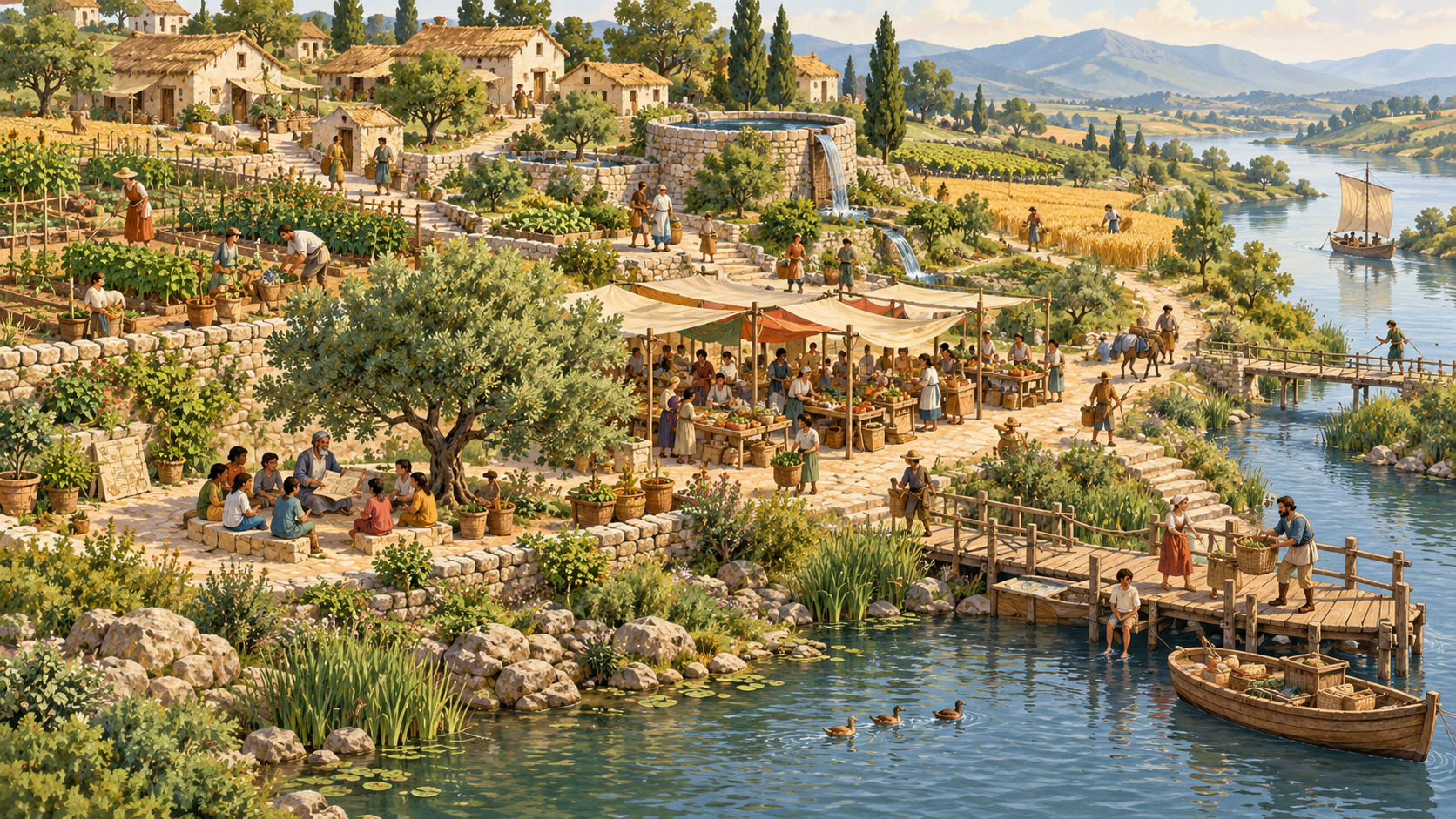
Series cover: AI-generated conceptual illustration of Riverbend, the starting community in these guides. It is not a literal depiction of every scenario, a historical reconstruction or an engineering plan.
Choose your next learning question
Follow a route into the expanded chapters, or choose a specific activity from the index.
Full chapter index
Chapters 1–8: Read an offer and a choice
- 1. Begin with what someone offers and what someone wants
- 2. Distinguish possession from availability to exchange
- 3. Keep item types and quantity units attached to the numbers
- 4. Let preferences be specific without turning them into personal labels
- 5. Complete a direct trade through a mutually accepted sequence
- 6. See why two interested roles may still lack a direct exchange
- 7. Carry out a three-way exchange without an unauthorised middle step
- 8. Check each step in a sequence of separate exchanges
Chapters 9–16: Trace items and agreements
- 9. Offer a complete bundle without treating its pieces as interchangeable
- 10. Make a stall's message understandable before calling it an offer
- 11. Compare complete offers rather than isolated ratios
- 12. Keep an exchange result separate from a judgement of people
- 13. Read a Square report through requests, agreements and transfers
- 14. Make a complete little exchange square with a valid ending
- 15. Trace an exchange through the people and places it connects
- 16. Distinguish an attractive offer from an accepted exchange
Chapters 17–24: Connect exchanges and deliveries
- 17. Conserve stock when an exchange changes its holder
- 18. Use an exchange rate as a whole-bundle agreement
- 19. Connect accepted exchanges with a finite delivery route
- 20. State when an offer and its required stock are available
- 21. Separate exchanging existing objects from making new ones
- 22. Keep work and transport costs beside the exchanged quantities
- 23. Make a shortage visible before proposing another offer
- 24. Change an offer with a clear boundary between versions
Chapters 25–32: Compare and participate
- 25. Let more than one participation route lead to a real choice
- 26. Solve a multistep exchange without spending the same stock twice
- 27. Compare two complete routes to the same requested objects
- 28. Hand over an exchange square whose promises match its stocks
- 29. Let an exchange begin with an offer that can be declined
- 30. Compare bundles without turning tokens into a measure of people
- 31. Make the market encounter a story without stereotyping its characters
- 32. Preserve alternatives when a proposed exchange does not fit
Chapters 33–40: Review and exchange together
- 33. Keep a bundle rate attached to the offer that defines it
- 34. Match an accepted exchange with a complete delivery event
- 35. Read exchange evidence without inventing agreement or satisfaction
- 36. Work through a complete exchange chain and conserve every item
- 37. Teach offers and market stories in the first two sessions
- 38. Teach chains, capacity and evidence in two further sessions
- 39. Complete the Seven-Event Exchange Square project
- 40. Repair a missed carrier period and a changed accepted offer
CHAPTER 1 OF 40 · Read an offer and a choice
1. Begin with what someone offers and what someone wants
Riverbend's Exchange Square opens with three paper stalls. One holds illustrated doorway cards, another patterned strips and a third little story tokens. A child announces that everything on display can be traded. A stall card says otherwise: some pieces belong in a permanent exhibition and others are offered only for a particular exchange. Learners begin by asking what is actually offered, what is requested and who can accept the proposed change.
The Square is a fictional tabletop setting. Its objects, preferences, quantities and agreements are supplied for learning. Children do not exchange real possessions, recommend money arrangements or make claims about actual financial, legal or investment decisions. The model explores one family of possible exchanges without presenting barter as the origin of money or a compulsory stage through which civilisations must pass. Paper pieces make particular relationships visible; they do not describe every real market.
Give one learner an offer card and another a request card. The offer says that Stall A may exchange one blue strip for one doorway card. The request says that Stall B will exchange one doorway card for one blue strip. The quantities and item types align, but the exchange still needs both fictional roles to confirm under the activity's rule. A visible possibility is not yet a completed agreement.
Parents can use two mats labelled before and after. Before, A holds the strip and B the doorway. After an accepted exchange, A holds the doorway and B the strip. The two objects remain the same identified pieces. The class can trace their movement without creating another copy simply because the objects appear in both a starting drawing and a final drawing. The record describes states at different times, not a larger stock.
Explore the example
Now introduce a third object, a star token beside A's stall. Its card says it is not offered. B's interest in the star does not authorise moving it. A proposed trade can include a request to change that condition, but the change needs a supplied confirmation before the piece becomes available. Learners should not solve an exchange puzzle by treating every visible item as freely movable.
A useful first activity asks children to invent a polite offer for two fictional characters. One collects maps of impossible islands and another likes doorway stories. The proposed objects can have imaginative names while their exchange categories remain clear. A strip called River Ribbon is still a strip under this model unless the rule gives it another property. Naming can enrich the scene without quietly changing the quantity or acceptance conditions.
An older learner can distinguish wanting, offering, accepting and completing. A role may want a doorway but offer nothing suitable. Two offers may be compatible without being accepted yet. Both roles may accept, but the pieces may still be awaiting the defined handover. These distinctions are useful because they identify the next legitimate action rather than let a promising conversation become a claim that the exchange already occurred.
The opening Square record contains an offer, a request and one completed before-and-after example. Riverbend's learners can now see trade as a specific relationship between people and objects under stated conditions, rather than a general permission to rearrange a pile. The activity remains imaginative, but another child can tell which change was proposed, which was accepted and which identified pieces actually moved.
CHAPTER 2 OF 40 · Read an offer and a choice
2. Distinguish possession from availability to exchange
Stall A visibly holds six paper objects. A visitor asks for three, assuming possession means availability. The stall's record divides them into retained display pieces, reserved exchanges and uncommitted offers. Learners now examine those states separately. An object can be physically present while already committed to another model purpose. The class needs to know which change the fictional keeper is authorised to make, not merely count everything within reach of a paper counter.
Use a fresh inventory of ten identified map cards. Four are held for the story exhibition, two are reserved under an already accepted exchange and four are available for new offers. The categories sum to ten. A new request for five exceeds currently uncommitted stock by one. The role may ask to revise a reservation or exhibition allocation, but the current record does not authorise taking a card from either category.
Parents can place the cards in three labelled envelopes. The learner names both location and status before moving a piece. A reserved card may be physically beside the uncommitted cards on the table, yet its commitment remains different. Conversely, putting a card in a separate envelope does not establish a new right or obligation outside the classroom. The activity's supplied status card governs the paper arrangement.
Now complete the earlier accepted exchange. The two reserved cards leave A's possession and arrive at B's stall. A then holds eight map cards: four retained and four available. A's available count remains four, not six, because completing a reservation does not release the reserved objects back into its supply. A matching receiving record shows B's two acquired cards. The combined card count across both stalls is unchanged by the movement.
Explore the example
A practical exercise supplies a record saying ten present, six unavailable and four available. Ask the child whether it gives enough information to explain why the six are unavailable. It does not. The more detailed four-retained/two-reserved breakdown answers a question about next actions. The short total may be sufficient for a narrow availability query, while a review of commitments needs the separate reasons.
Introduce a returned proposal. A visitor asked for one available card but has not accepted the terms. Under this model, a proposal alone does not reserve stock. If the role wants a temporary hold, the activity must supply an accepted hold and its duration. This rule prevents a casual question from silently tying up every piece. Another classroom model could use another convention, provided its participants know which status a proposal creates.
Older learners can compare possess, display, offer and transfer in a set of short sentences. The stall displays two cards that another role owns under the fiction. Its keeper may explain them but may not exchange them. The class should identify the supplied boundary rather than infer permission from physical handling. That distinction can be practised through invented roles without asking children about actual belongings or real ownership disputes.
Finish with a status inventory and one proposed exchange that genuinely fits it. Riverbend's Square becomes easier to understand when quantities are attached to current commitments. A full stall does not establish a large freely available supply, and a successful trade does not create extra stock. Children can remain curious about the objects while being precise about which ones the current role may actually include in a new agreement.
CHAPTER 3 OF 40 · Read an offer and a choice
3. Keep item types and quantity units attached to the numbers
A Square offer says three for two. One child reads three individual strips for two cards; another reads three packs for two pairs. The numbers alone cannot establish a common agreement. Learners now name item types, units and bundle contents so a fictional trade can be checked before objects move. The task is not to rank the objects' true worth, but to ensure the participants understand the same proposed transfer.
For a fresh model, one strip pack contains three individual strip tokens. One card pair contains two individual map cards. An offer of two strip packs for three card pairs therefore means six strips for six cards. Equal counts of six do not establish equal desirability. They simply translate the agreed bundles into individual pieces. The fictional roles' supplied preferences determine whether the offer is acceptable to them.
Parents can give children pack outlines and individual pieces. The learner assembles two packs of three and three pairs of two, then writes the offer in both forms. A partner checks that the contents agree. If one pack contains only two strips, it is incomplete under the definition. The role should not conceal the missing component behind the word pack or expect another player to infer that this pack is an exception.
Now supply a second kind of pack: a story bundle contains one doorway card and two star tokens. Four story bundles need four doorway cards and eight stars. A stall with five doorways and seven stars can form only three complete bundles, leaving two doorways and one star. The stars limit the count. Four visible doorway cards do not establish four complete bundles when the bundle definition includes other components.
Explore the example
A practical comparison asks whether the stall can accept an exchange requiring four story bundles. Under the opening inventory it cannot fulfil that offer unchanged. It can propose three bundles, seek another star through an authorised separate exchange or ask whether a different supplied combination is accepted. The class should preserve the original request rather than silently report a three-bundle delivery as fulfilment of a four-bundle agreement.
Introduce a descriptor that does not alter the quantity unit. A card may be blue, striped or named The Unfinished Island. Unless the model specifies otherwise, those labels do not make it count as two cards. Some descriptors matter to acceptance, however. A role requiring a doorway illustration may not accept a blank map even if both are cards. The learner should inspect the actual offer condition instead of treating everything made from paper as interchangeable.
Older learners can identify three kinds of mismatch: wrong number, wrong unit and wrong item type. Delivering five individual strips for two three-strip packs is a number shortfall of one. Delivering two individual strips instead of two packs confuses the unit. Delivering six star tokens instead of six strips changes the item. These distinctions suggest different clarifications and prevent a general complaint about fairness from hiding a simple disagreement about the stated objects.
End with a readable offer card containing source, destination, item category, unit, quantity and any bundle rule. Add an imaginative name if it helps the scene. Riverbend's learners can now make playful invitations precise enough to act on. Their arithmetic clarifies what would move, while leaving the separate question of whether each fictional role accepts that move to its own supplied decision card.
CHAPTER 4 OF 40 · Read an offer and a choice
4. Let preferences be specific without turning them into personal labels
The Square's characters value different paper objects for different activities. Neri wants a doorway card to continue a story. Sol wants a patterned strip to connect two display panels. Tavi collects star tokens for an invented night map. These preferences belong to the supplied scenes. They do not establish enduring personality types, real social categories or a universal ranking in which one object is inherently worth more than another.
Begin with a preference card that identifies an acceptable result, not a secret motive the child must guess. Neri will exchange one offered strip for one doorway card and retain the rest of the collection. Sol will exchange one doorway for one strip. Their preferences align for a direct trade. The class can describe the agreement without claiming to know why every person who likes a doorway card must behave in the same way.
Parents can offer two fictional reasons for the same choice. One character wants a blue strip because it matches a drawn river. Another wants it because a question is written on its back. A third simply selects blue among accepted alternatives without supplying a reason. The classroom task can respect all three. It need not demand a personal explanation when the agreement already provides the information required to check the proposed transfer.
Now give Tavi a conditional choice. Tavi accepts either two plain stars or one star carrying the current story identifier. Those are the model's explicit alternatives. A plain star does not become current-labelled merely because it is attractive. The child can inspect the identifier and determine which offered combination fits. This activity describes a supplied acceptance rule, not a recommendation for setting actual prices or judging artworks.
Explore the example
A worked example gives a stall four plain stars and one current-labelled star. It can satisfy Tavi's one requested combination either by transferring two plain stars or the labelled one, if Tavi and the stall both confirm that option. The resulting inventories differ. Transferring two plain stars leaves two plain and one labelled; transferring the labelled star leaves four plain. Counting three remaining objects in the first case and four in the second does not determine which outcome is preferable for the stall's next purpose.
A practical choice activity gives the stall its own request card. It must retain at least one current-labelled star for a later story display. The two-plain-star option preserves that condition; the labelled-star option does not. The stall should therefore not accept the second unchanged while claiming both commitments are met. Children can find an acceptable trade by connecting both participants' conditions, rather than treat one character's preference as permission to ignore the other's.
Older learners can examine a changed preference. Tavi later wants a doorway card instead. The earlier accepted trade remains a record of the earlier agreement. A new desire does not automatically reverse a completed exchange or alter another role's commitments. The group can propose a new exchange under current inventories and acceptance conditions, preserving time and status in the story.
Finish with two fictional preference cards and one agreement that respects both. Invite the child to invent a short conversation showing the characters' different purposes. Riverbend's exchange becomes richer when objects carry particular uses and stories without becoming measures of people's worth. The activity can acknowledge choice, ask for relevant clarification and leave unprovided motives outside the record, instead of turning every request into an explanation of what kind of person the requester must be.
| Offer feature | Question |
|---|---|
| Item and unit | Exactly which token or whole bundle is offered? |
| Available stock | Which items are owned and available for this offer? |
| Accepted condition | What has each fictional participant confirmed? |
| Timing | When may the stated transfer occur? |
CHAPTER 5 OF 40 · Read an offer and a choice
5. Complete a direct trade through a mutually accepted sequence
The Square's first direct exchange looks simple: one strip changes places with one doorway card. Yet the class still needs a start, an acceptance and a completion rule. Learners now play a complete small exchange whose steps can be checked from the supplied facts. The aim is to make a meaningful meeting between two fictional purposes, rather than reduce the scene to unexplained movement between trays.
In this fresh model, A starts with strip S1 and retained star T1. B starts with doorway D1 and retained map M1. A is authorised to offer S1 only and accepts D1 in return. B is authorised to offer D1 only and accepts S1. Both keep their retained objects. All identifiers and conditions are visible. The model contains no additional items, hidden obligations or later return requirement.
A proposes S1 for D1. B compares the proposal with its card and confirms. A then confirms that the same offer remains active. Under this game's handover rule, the teacher moves S1 and D1 in one paired exchange after both confirmations. Before that step, neither participant may treat the expected incoming item as already available for another trade. The paired handover is a supplied classroom operation, not a claim about how real transactions must work.
After completion, A holds D1 and T1; B holds S1 and M1. The combined inventory remains four objects, one of each identifier. No retained item moved, and neither source transferred more than it held. A child can check each condition against the start. Repeating the offer aloud after completion does not transfer another strip or doorway; a new exchange would need a new current proposal and appropriate holdings.
Explore the example
Parents can make the scene playful through the objects' stories. S1 might be the river in Sol's exhibition, while D1 opens a question in Neri's tale. The fiction explains why the exchange matters to the characters without changing the legal pieces. A character can thank the other with an invented greeting that carries no extra game payment or promise unless both roles explicitly add one through a new supplied agreement.
Now introduce a proposed variation: B offers M1 instead of D1. The active acceptance card for A does not permit M1 as a substitute. The exchange cannot complete unchanged. The class may seek a new confirmation card allowing the map or preserve the unsuccessful proposal as a conversation. It should not infer that A is uncooperative because the requested item is different from what the proposal supplies.
Older learners can compare willingness and ability. B may willingly promise two doorway cards, but it holds only D1 in this dataset. Acceptance does not create the missing second card. Conversely, A may hold S1 but be authorised to retain it under a changed role card. A complete agreement requires both a suitable available object and the relevant acceptance. One condition cannot stand in for the other.
Finish with a before-and-after diagram and the two confirmations. Ask a reviewer to identify the exact operation that completed the exchange and one condition that would have stopped it. Riverbend's learners now have a direct trade they can replay without hidden assumptions. Their imaginative scene remains grounded in a finite, mutually accepted change that another child can reconstruct and question through the shared record.
CHAPTER 6 OF 40 · Read an offer and a choice
6. See why two interested roles may still lack a direct exchange
Neri has a doorway card and wants a star. Sol has a patterned strip and wants the doorway. Both see something interesting in the Square, yet their two offers do not make a direct exchange under the supplied preferences. Learners now examine an incomplete match without turning it into a failure of generosity or assuming that every desired trade must be possible with the people currently present.
Use three item categories named doorways, strips and stars. In this chapter Neri holds one doorway, offers it and accepts one star only. Sol holds one strip, offers it and accepts one doorway only. The direct proposal strip for doorway meets Sol's incoming preference but not Neri's. The class should check both sides instead of treating the role with the strongest request as entitled to make the other accept a different item.
Parents can use arrows from each role's offered object to its desired object. The two arrows do not close into a mutually acceptable pair. A younger child can point to the missing star; an older learner can explain that stock possession and preference alignment are different conditions. The model has no rule permitting a player to rename a strip as a star or decide that a different paper object must be good enough.
Now reveal a third role, Tavi, holding one star and accepting one strip. The three-role cycle becomes visible: Neri can receive Tavi's star, Sol can receive Neri's doorway and Tavi can receive Sol's strip. This observation identifies a possible final allocation. It is not yet a legal transfer sequence. The activity needs an agreed operation or interim conditions that make the movement possible without asking a role to accept something its card rejects.
Explore the example
A practical discussion offers two alternatives. The group can use a supplied three-party exchange operation with all confirmations before any piece moves. Or the tutor can provide an explicitly authorised temporary holding process. These are different models and should not be mixed. In the next chapter the class will use the first, so no participant must accept an unwanted interim object or hand over a retained object under an unstated promise.
Children can invent a conversation in which the characters discover the cycle. The story may involve the doorway leading to a star map and the strip becoming its river. The imaginative connection does not itself authorise the trade. Each role still needs to accept the same final proposal. A convincing speech cannot manufacture confirmation, and a participant's silence is not a supplied acceptance under this activity's rule.
Older learners can examine a fourth visitor who wants the star but offers nothing in the current model. The visitor's interest can become another story possibility, but it does not automatically alter the three-role plan. The class should identify what would need to change: an offered object, a new acceptance condition or another explicit provision. Not every new desire must be solved inside the same tiny inventory.
Finish with the three arrows and a clear label saying possible allocation, awaiting agreement and handover. Riverbend's learners can now distinguish an opportunity from a completed transaction. The model shows one reason a direct match may be absent and one possible way a wider agreement could help, without claiming that all exchanges follow this pattern or that an unmet desire proves anything about a person's willingness to cooperate.
CHAPTER 7 OF 40 · Read an offer and a choice
7. Carry out a three-way exchange without an unauthorised middle step
The Square now completes the cycle introduced through three offered objects, restating the full setup so the activity can stand alone. Neri holds doorway D1 and accepts star T1. Sol holds strip S1 and accepts D1. Tavi holds T1 and accepts S1. Each is authorised to offer its named object, and no other possessions are included. Learners will verify a complete three-party operation rather than describe a desirable final picture that no supplied move can reach.
The model's rule permits a circular exchange only when all three roles confirm the same proposal before any object moves. The proposal names every source and destination: D1 moves from Neri to Sol, S1 from Sol to Tavi and T1 from Tavi to Neri. It also states that the operation completes as one grouped classroom handover. If any confirmation is absent or withdrawn before that operation, no part of this proposal is performed.
First Neri checks that its outgoing D1 is available and its incoming T1 is the requested star. Sol checks S1 and D1. Tavi checks T1 and S1. The teacher then supplies or reads each fictional confirmation card. A learner may represent one role through pointing to the card rather than acting a public speech. The group's enthusiasm does not replace any missing role's recorded choice.
For the grouped handover, prepare three destination envelopes with the recipients' names. Under the supplied operation, the teacher collects all three offered objects into a temporary transfer area only after the confirmations. The objects retain their identifiers and are not available for any other use there. The teacher then places D1 in Sol's envelope, S1 in Tavi's and T1 in Neri's, completing the operation before another trade may begin. The temporary area is an authorised part of this model, not an extra participant receiving unwanted items.
Explore the example
The final inventory is Neri with T1, Sol with D1 and Tavi with S1. Exactly three identified objects exist before and after. Each role receives what its acceptance card specifies, and no one must hold an unwanted object as an ordinary completed trade on the way. The grouped operation is deliberately chosen to make those preconditions explicit. It does not establish that a sequence of ordinary two-party trades would work under the original strict preferences.
Parents can invite children to test an invalid proposed order. Giving D1 to Sol first while Neri waits for a later promise is not the supplied grouped operation if the other confirmations are missing. The child should identify the missing condition, not accuse a fictional character of bad motives. A future variant could authorise a different process, but it would need its own clear permissions and risks within the paper model.
Now add one retained object R1 to Neri's mat. The same exchange can still proceed with R1 untouched. The total across all mats becomes four objects, while three participate. A child who counts only the transferred pieces should not report that the whole Square inventory contains three. This small extension makes the boundary between participating stock and retained stock visible without changing the cycle's terms.
Finish with the proposal, three confirmations and final state. A reviewer checks source availability, destinations and the count of each identifier. The characters can celebrate by adding a shared sentence to their imagined map. Riverbend's learners have completed a three-way trade through a valid supplied operation, preserving both the pleasure of discovering a cycle and the precision needed to explain how every accepted transfer actually happened.
CHAPTER 8 OF 40 · Read an offer and a choice
8. Check each step in a sequence of separate exchanges
The Square's three-way cycle used one grouped agreement. A different story can involve two independent trades performed in order, with an intermediate object genuinely accepted by the role that receives it. Learners now inspect that distinction. A sequence can be valid, but only when each step meets its own conditions from the state actually reached. A desirable final object does not make every imagined route to it authorised.
Use a fresh inventory. A holds strips S1 and S2. B holds doorways D1 and D2. C holds star T1. A may offer S1 for D1 and explicitly accepts D1 as an object it may keep or offer later. S2 is retained. B offers D1 for S1 and retains D2. C offers T1 for D1. All three cards permit the named exchange when the role currently holds its outgoing object and confirms the proposal.
First A and B confirm S1 for D1 and complete the paired handover. A now holds S2 and D1, B holds S1 and D2, and C still holds T1. The total is five objects. A's possession of D1 is now established by a completed trade, not merely expected from a future plan. C can inspect that current state before considering another proposal.
Second A offers D1 to C for T1. A's card authorises that use of D1, and C's acceptance matches it. After both confirm, the paired handover leaves A with S2 and T1, B with S1 and D2, and C with D1. The five original identifiers remain exactly once each. No retained object moved, and no role promised an outgoing item it did not hold at the moment of its trade.
Explore the example
Parents can ask what happens if C does not confirm the second proposal. The first exchange remains completed under this model because it was not conditional on the second. A keeps D1 and S2. The class should not automatically reverse A and B's earlier trade or force C to proceed because A hoped to obtain a star. A grouped all-participant agreement would be a different arrangement, like the earlier cycle.
A practical sequencing game gives a child two exchange cards and asks which can occur first. The D1-for-T1 step cannot occur before A acquires D1 under the initial inventory. The S1-for-D1 step can. A younger learner can move identified pieces between mats; an older learner can write a state after each completed step. Checking the intermediate state is what makes the final claim reconstructable.
Now offer a false shortcut: A promises C D2, which remains retained by B. The existing sequence gives A no permission over D2. The fact that a doorway is visible somewhere in the Square does not establish that A can transfer it. A new agreement with B could be proposed, but the class must supply its terms and confirmation rather than insert the missing movement between two neatly drawn arrows.
Finish with the two valid exchanges and a short note explaining A's accepted intermediate holding. The fictional objects can carry an unfolding map story as they change hands. Riverbend's learners have a sequence that respects current possession, available offers and independent acceptance at every step. They can now distinguish a legal chain from a final allocation whose arrows conceal an unauthorised or unsupported middle action.
CHAPTER 9 OF 40 · Trace items and agreements
9. Offer a complete bundle without treating its pieces as interchangeable
A visitor asks for a story bundle containing one doorway card and two star tokens. A stall offers three strips and calls it the same amount because both collections contain three pieces. Equal object counts do not make categories interchangeable under the supplied request. Learners now use bundles to explore how an agreement can depend on a combination, not just a total or a persuasive description.
For this chapter, bundle Q contains one doorway and two stars. A requester accepts one complete Q in exchange for one offered map card. The provider holds four doorways, seven stars and no map cards. It can form three Q bundles, requiring three doorways and six stars, leaving one doorway and one star. The fourth doorway does not establish a fourth bundle because that would need another two stars.
Parents can let children build the bundles inside drawn frames. Ask which leftovers would make another complete Q. One doorway and one star are not enough, while an additional accepted star would complete the fourth. The child should not split a star into two merely because the pieces are paper. The model's tokens are indivisible and retain their identifiers unless a different activity explicitly defines a transformation.
Now supply two requesters, each offering one map for one Q. The provider may accept both if it confirms each agreement and assigns distinct components. After issuing two bundles, it has two doorways, three stars and two acquired maps. Two more Q bundles would require four stars, so only one further Q is supported. This account begins with loose components and ends with objects distributed across the parties; it should not create additional stock by counting both a bundle and its contents as separate holdings.
Explore the example
A practical dialogue compares a substitution proposal with fulfilment. The provider asks whether one doorway and one labelled star could replace the original two stars under a new option. A requester may accept if its supplied card permits that alternative. Without confirmation, the smaller combination does not meet Q. Calling the labelled star special does not change the original definition. A charming story can accompany an offer while its actual components remain explicit.
Introduce a separate requester who accepts either Q or a single current-labelled star for its map. The provider's opening stock contains no current-labelled star, so that branch is not available merely because the acceptance card lists it. The class can identify a possible route to obtaining one, but should not mark the trade complete until the needed object is actually held and authorised for offer. Demand alternatives and available supply are separate records.
Older learners can compare an indivisible bundle with permission to trade its components separately. The present provider may offer loose doorways or stars only if a new offer card explicitly authorises them. An accepted bundle reservation should not be dismantled for another trade without the relevant revision. The model can be flexible, but its flexibility should have a stated form so another player knows which pieces remain available.
Finish with one bundle definition, a valid two-requester sequence and the final loose stock. Invite a child to name the bundle imaginatively, perhaps The Doorway to Three Questions, while checking that the name does not alter its components. Riverbend's Square can make combinations meaningful without confusing number, type and acceptance. A complete offer is something another role can inspect, understand and actually receive under the same definition it accepted.
CHAPTER 10 OF 40 · Trace items and agreements
10. Make a stall's message understandable before calling it an offer
The Square's most colourful sign says take a river, leave a doorway. A newcomer cannot tell whether river means a strip token, a map illustration or the stall's whole display. Another sign says today only, but its copy has no model period. Children now design exchange messages that preserve their imaginative invitation while carrying the information necessary for an actual paper agreement.
Give a stall an authorised offer: one strip token labelled River Ribbon for one doorway card during model period three. The stall can exchange up to two strips because only S1 and S2 are available. A sign may use the story name, but should link it to the strip category, quantity and period. It should also identify the role that confirms the proposal. Displaying an offer does not give every visitor permission to take objects without that agreed step.
Parents can ask a child to write two connected lines. The first invites a story: bring a doorway for our unfinished river. The second states the model terms plainly: one available strip for one doorway card, confirmed by the keeper during period three. Another learner should recover both the fiction and the transfer. The plain line need not erase the image; it makes the image's role in the activity intelligible.
A supplied interpretation check has eight visitor cards. Five identify the correct item and quantity, two identify the strip but assume two are offered for each doorway, and one cannot identify the active period. Five out of eight, or 62.5%, recover the full terms under this check. The three other responses concern different gaps. A clearer quantity line addresses one; a visible period label addresses another. The class should not call all three visitors uninterested or careless.
Explore the example
Now place a historical sign beside the current one. The earlier version offered two strips for one doorway during period one. It can remain part of the story exhibition if labelled as an earlier offer, but it should not be confused with the active terms. A larger version number alone does not establish authorisation. The source card should identify which offer the fictional keeper currently accepts and which old arrangement has ended.
A practical activity gives one learner the keeper card, another a proposed exchange and another the sign. They compare the three before moving any piece. A proposal for two strips may be a valid question even when it does not match the posted offer. The keeper may decline or consider a newly authorised variation. The visitor has not completed a trade merely by asking, and the keeper should not report the request as acceptance of different terms.
Older learners can inspect missing context in a short reply. Yes, that works may refer to an earlier one-strip offer, a two-strip proposal or a different object altogether. The accepted agreement needs a shared reference to the same terms. Children can add an offer identifier or repeat the relevant quantities. This is a paper communication task, not a real contract lesson; its purpose is to prevent mismatched understandings from being hidden by a friendly word.
Finish with a stall sign, its current offer card and one complete proposed exchange. Ask a newcomer to describe what remains to happen before handover. Riverbend's learners have made communication part of exchange itself. A market-like scene can be imaginative and inviting while keeping the difference between a story phrase, a proposed change and a confirmed transfer clear enough for the next participant to use.
CHAPTER 11 OF 40 · Trace items and agreements
11. Compare complete offers rather than isolated ratios
A stall offers two map cards for six strips. Another offers three maps for six. A learner announces that the second is always better because it asks for fewer strips per map. The supplied ratios do differ, but an actual choice also depends on quantities wanted, indivisible bundles, stock and acceptance. Children now compare finite offers without turning a model ratio into advice about real prices or markets.
In this fresh exercise, all map cards meet the same supplied category requirement. Offer A is an indivisible bundle of two maps for six strips. Offer B is an indivisible bundle of three maps for six strips. Each stall has exactly one such bundle available and confirms only the complete bundle terms. A requester holds eight available strips and wants exactly four maps for a story display. It may keep unused strips and may decline any offer.
A's ratio is three strips per map, while B's is two. But the requester cannot obtain four maps from either single bundle as offered. One A gives two maps and leaves two strips; one B gives three maps and leaves two strips. The remaining strips cannot purchase a fraction of either indivisible bundle under these rules. A favourable ratio does not itself complete the stated task.
Parents can let a child arrange the eight strips beside the two offer frames. The learner should not move two of B's maps into a new informal bundle unless its keeper authorises that change. A stall may discuss a different proposal, but the published calculation concerns the available complete offers. The child can explain both the comparative ratio and the unmet exact-map requirement without treating them as contradictory findings.
Explore the example
Now supply Offer C. Its keeper has four current map cards and accepts two strips for each, with each one-map exchange independently permitted until stock runs out. The requester can complete four accepted transfers, using all eight strips and receiving four maps. After the first, it holds six strips and one map; after the second, four and two; after the third, two and three; after the fourth, no strips and four maps. Every step uses objects currently available under the supplied terms.
C's ratio matches B's two strips per map. Its divisibility and quantity fit differ. The successful four-map result therefore does not prove that C's individual maps are worth more or that B was unfair. The model supplies equivalent category suitability and different available offer structures. The class should describe that relationship precisely rather than turn one task's fit into a universal ranking of stalls.
Older learners can examine an additional requirement: retain at least two strips for a separate accepted commitment. Under that changed condition, only six strips are available for the new map task. The four-map C plan no longer fits while preserving the reservation. A three-map acquisition would fit the six-strip allowance but leave the original exact-four request unresolved. The planner needs an explicitly revised commitment or another supplied source, not a new label that makes eight strips count as ten.
Finish with a comparison sheet containing bundle terms, ratio, available stock and the request each can actually meet. Riverbend's learners have used arithmetic to clarify a choice without letting arithmetic omit the choice's conditions. A finite exchange offer is more than an attractive fraction: the pieces must exist, the unit must match and the proposed sequence must reach the result the fictional requester is actually seeking.
CHAPTER 12 OF 40 · Trace items and agreements
12. Keep an exchange result separate from a judgement of people
One fictional visitor exchanges a single illustrated doorway for four plain star tokens. Another accepts two stars for a different doorway. A child declares the second visitor worse at trading. The Square's records do not establish that conclusion. The doorways, preferences and circumstances may differ, and a completed exchange is not a measure of someone's intelligence, importance or dignity. Learners now examine what a small model result can say and what it leaves outside.
Begin with supplied purposes. Visitor A needs four stars for a four-place night-map pattern and accepts that combination for its offered doorway. Visitor B needs two stars for a two-place pattern and explicitly accepts two for a different offered doorway. Both own and may offer their named cards. Each trade is confirmed by its other participant and completed through the paired rule. The class can establish fulfilment of each supplied request without asserting a common value scale the model never defined.
Parents can ask children to write two accurate captions. A received four stars for doorway DA; B received two for doorway DB. A second sentence identifies whether each requested pattern can now be made. An unsupported caption says A is twice as clever. Doubling a token count does not double a person's capability, and the different requests make a simple comparison even less informative. The model offers evidence about transfers and tasks, not a scoreboard of human worth.
Now introduce a role whose accepted exchange leaves its later purpose unmet because it forgot a retained commitment in the record. The class should inspect the actual condition: perhaps two of its stars were already reserved for another display. This can reveal an incomplete planning check. It does not justify attaching a permanent label such as foolish to the character, and it should not become an accusation against the real child arranging the pieces.
Explore the example
A practical dialogue can hold disappointment without inventing a different agreement. A character says I wish I had kept the doorway. Another asks whether a new proposal is available. The completed earlier trade does not reverse automatically under this model. The group can supply a separately accepted return exchange, keep the regret as part of the story or revise a future planning routine. Those are different next actions, not evidence that the original objects never moved.
Learners can also examine unequal starting inventories. A role with many available tokens may have more possible proposals in this particular finite model. That observation does not establish why it has those tokens, whether every option is desirable or what happens in real economies. The class can compare a stated invitation, such as one proposal opportunity per role, without pretending that equal proposal counts guarantee identical experiences or outcomes.
Older learners can ask what fairness question the activity actually intends. Does it concern clear terms, use of retained objects, an opportunity to decline or fulfilment of a stated request? These questions are concrete enough to inspect. A universal verdict that every mutually accepted trade is fair would go beyond the exercise; so would the claim that differing outcomes automatically prove wrongdoing. The evidence and the purpose need to be named before the conclusion.
Finish with a short record of one exchange and a separate reflection on a character's supplied response. Riverbend's learners can appreciate a clever arrangement, notice a missing condition and tell a story about regret or delight without making the number of acquired pieces a ranking of people. The Square becomes a richer place to imagine when its participants remain more complex than the inventory left on their mats.
| Record | What to preserve |
|---|---|
| Owner | Who currently owns each identified item |
| Location | Where the same item is represented |
| Offer | Which current conditions apply |
| Completed transfer | Which agreed handover actually occurred |
Extend this learning question through How Education Works.
CHAPTER 13 OF 40 · Trace items and agreements
13. Read a Square report through requests, agreements and transfers
The Exchange Square's report celebrates twelve successful trades. Its source folder contains twelve proposals, nine accepted agreements and eight completed handovers. The headline has moved from one stage to another without evidence. Learners now follow a finite record set, keeping requests, acceptance and actual movement distinct. A busy conversation can be valuable, but its count should not be presented as a larger set of completed transfers than the record supports.
For this chapter, every proposal has one unique identifier. The model states that the nine accepted proposals are a subset of the twelve, and the eight completed handovers a subset of the nine. Three proposals have no accepted agreement in the record. One accepted agreement has no completion record. Those states do not reveal motives: an absent confirmation may reflect a declined term, an unresolved question or missing information under the fiction.
Accepted agreements are nine out of twelve proposals, or 75%. Recorded completed handovers are eight out of twelve, about 66.7%, of proposals, and eight out of nine, about 88.9%, of accepted agreements. Each denominator names a different question. The class should not choose the largest percentage simply to make the Square look effective, or the smallest to make it look unsuccessful. The records have several stages worth describing.
Parents can place proposal cards on a strip and add acceptance and completion markers to the same identifiers. The markers do not create additional proposals. Adding twelve, nine and eight would produce twenty-nine stage records, not twenty-nine distinct trades. A younger learner can trace one card through the markers; an older learner can identify the exact stage at which a claim lacks evidence.
Explore the example
Now inspect the eight completed transfers. Six match their accepted quantities and item types, one has an item-type mismatch and one lacks enough detail for the checking rule. Six out of eight, or 75%, are confirmed matching completions in this supplied audit. The mismatch still involved some recorded movement, so it should not disappear from the handover count. The unchecked completion should not be labelled matching or mismatching until the necessary detail is supplied.
A practical review gives the mismatch a specific form. The agreement required one doorway D1, while the recorded recipient holds blank map M1 instead. The class must compare the identifiers and ask whether a later accepted revision exists. If none is supplied, the current record does not establish fulfilment of the original agreement. A corrective exchange would need its own available objects and confirmation; writing fixed beside the report cannot move D1 from its actual location.
Older learners can choose one useful follow-up. Recovering the missing completion record addresses the accepted-but-unconfirmed agreement. Checking the vague handover addresses the eight-transfer audit. Reading the three unaccepted proposal replies addresses a different question. The class can prioritise according to a supplied purpose without demanding every possible record before saying anything useful about the Square.
Finish with three sentences: proposal activity, confirmed agreements and checked transfers. Add one imaginative line from a fictional stall keeper about a memorable doorway or star. Riverbend's exchange remains a social scene as well as a finite model. Its report becomes more trustworthy when the story is connected to records that preserve what was asked, what was accepted and what the identified pieces actually did.
CHAPTER 14 OF 40 · Trace items and agreements
14. Make a complete little exchange square with a valid ending
The opening project ends with Three Stalls and a Travelling Map, a complete fictional activity for three roles. A holds strips S1 and S2 plus retained map M1. B holds doorways D1 and D2. C holds star T1 and retained story card R1. Seven identified objects exist in total. The group will complete one supplied direct exchange and one circular exchange, with each role's permissions and accepted incoming objects stated before any movement.
The first offer permits A to exchange S1 with B for D1. B explicitly accepts S1 and offers D1. A explicitly accepts D1 as a permitted intermediate holding it may retain or offer later. S2 and M1 are not part of this first agreement. A and B confirm, then the paired operation transfers S1 to B and D1 to A. The current state becomes A with S2, D1 and M1; B with S1 and D2; C with T1 and R1.
The second proposal is a three-role cycle. A may offer its newly acquired D1 and accepts T1. B may offer D2 and accepts D1. C may offer T1 and accepts D2. The proposal names D1 from A to B, D2 from B to C and T1 from C to A. B's S1, A's S2 and M1, and C's R1 remain outside the cycle. The activity permits this new agreement only after the first handover has completed, because A must actually hold D1 before offering it.
All three roles confirm the same circular proposal. The teacher then uses the grouped transfer operation: collect the three identified outgoing objects in a temporary transfer area, keep them unavailable for any unrelated purpose and distribute them to the named recipients before another exchange begins. No individual two-party trade inside that grouped operation is required to satisfy a separate interim preference. The authorised operation is the whole confirmed cycle, not an invitation to move one card while guessing whether the rest will follow.
Explore the example
The final state is A with S2, T1 and M1; B with S1 and D1; C with D2 and R1. Counts are three, two and two, still seven altogether. Each of the seven original identifiers appears exactly once. The original retained M1 and R1 did not move, and S2 remained unoffered throughout. B's newly acquired S1 remains with B after the cycle. The record can therefore explain both what changed and which earlier acquisition was preserved.
The activity ends when both agreed exchanges are completed and the final state is checked against that list. It has no winner, price score, chance draw or requirement to continue trading every available object. A missing confirmation pauses the relevant proposal without completing it. The first accepted trade remains independent if the later cycle never receives all three confirmations. A new attempt can reset to the original inventory only through an openly supplied restart, not by silently mixing pieces from different states.
Parents can give the roles fictional purposes. A wants a star for a question map, B wants a doorway to continue an illustrated tale and C wants a doorway for a travelling exhibition. The purposes enrich the scene while the specific acceptance cards control each transfer. A child can narrate the objects' journeys, arrange the pieces, read the proposal or check conservation. Meaningful participation need not require every learner to deliver the same kind of speech.
Finish with the initial state, intermediate state, final state and a short shared story about M1, the map that stayed while other pieces travelled. Riverbend's learners have built an exchange square whose possibilities can be reconstructed without hidden objects, permissions or middle steps. The imaginative world remains open, but its completed activity has a clear ending and a finite account another group can verify before inventing a new offer of its own.
CHAPTER 15 OF 40 · Trace items and agreements
15. Trace an exchange through the people and places it connects
Riverbend's fictional Exchange Square contains three paper stalls, a meeting mat and labelled route links. A learner draws arrows between the stalls and announces that exchange is possible. The class asks what each arrow means: an offered bundle, an accepted arrangement, a journey or a completed transfer? Children examine the connections through offer cards and existing tokens. All agreements and quantities belong to the tabletop model, with no claim about actual finance, legal rights or how every real market works.
The first activity uses three categories: story cards, pattern tiles and lantern tokens. Stall Reed holds six story cards, Stall Window holds four pattern tiles and Stall Arch holds three lantern tokens. An offer card says Reed accepts one pattern tile for two story cards. Another says Window accepts one lantern token for two pattern tiles. These are arbitrary local agreements, available for the stated exercise only. The categories have no universal exchange value outside those cards.
A visitor begins with one lantern token and wants four story cards for a supplied display. Window's offer can convert the lantern into two pattern tiles. Reed's offer can then convert those two tiles into four story cards. The finite solution needs two accepted exchanges if Reed permits both pattern tiles to be exchanged together as two complete bundles, which this version explicitly does. A drawn network becomes useful because the offers connect the visitor's starting stock with the desired category.
Record every participant's resulting stock. Window receives one lantern and gives two pattern tiles, leaving two of its original four tiles. Reed receives two pattern tiles and gives four stories, leaving two of its six. The visitor ends with four stories and none of the starting lantern or intermediate tiles. Arch's three lantern tokens have not moved. An unused stall remains part of the model, but its stock should not be included in a transaction merely because it is drawn nearby.
Explore the example
Across all participants, the total count in each category is conserved. Six story cards remain distributed between Reed and the visitor, four pattern tiles remain between Window and Reed, and four lantern tokens remain between Arch and Window when the visitor's initial one is included. Exchange changes who holds the existing objects. It does not produce new stories or lanterns. A parent can count the whole system before and after to check that the intermediate tiles have moved rather than appeared twice.
Now give Reed a limit of one accepted two-story bundle during this round. The same visitor can obtain only two stories through the stated route before that offer is exhausted. The network still has a line, but its finite offer capacity changes the result. The class should keep the remaining tile in the visitor's account and mark two stories as still required, rather than assume that an offer can be repeated indefinitely.
For a tutor activity, ask the learner to draw separate styles for available offers, accepted exchanges and completed movements. Another learner traces one object through the diagram. The resulting network can show both possibilities and facts without mixing them. Riverbend's exchange inquiry starts with a complete, inspectable connection: who offers what, who accepts, which stock supports the offer and what actually changes hands when the agreed transfer occurs.
A network map can also show a route that leads to the right category but not the right identified card. If the display needs Story Four specifically and Reed offers any two stories from a mixed set, the class needs a selection rule or a card-specific offer. Counting four generic stories cannot establish that the required scene is present. The visitor's actual task determines the relevant detail.
CHAPTER 16 OF 40 · Trace items and agreements
16. Distinguish an attractive offer from an accepted exchange
A paper stall advertises three ribbon tokens for one doorway card. A visitor wants ribbons but has not agreed to part with the doorway card, which belongs to their planned story display. Riverbend's Exchange Square does not treat seeing an offer as accepting it. Children explore the choices on both sides through prepared role cards. The activity concerns fictional objects and agreements, not advice about real purchasing or contracts.
Give the seller an offer card naming the bundle, requested return, available number of bundles and applicable round. The seller holds nine ribbons, so the stated three-ribbon bundle can be offered at most three times from that stock if no other commitment claims it. Give the visitor one doorway card and a choice card saying they may accept or decline. The role's interest in ribbons does not settle the decision; another supplied purpose may make keeping the doorway more useful within this exercise.
The visitor's current display requires one doorway and two window cards. They hold the doorway and both windows, so that display is complete before any exchange. Accepting the ribbon offer would give three ribbons while removing a required display component. The class can describe the result without deciding that every exchange must increase some single score. A role can choose a different creative purpose, but the record should say which purpose changed and which earlier task is no longer supported.
Now supply an alternative accepted plan. Another fictional role holds two doorway cards and needs three ribbons for its own specified activity. Its card explicitly accepts the offered exchange. After transferring one doorway for three ribbons, it holds one doorway and three ribbons. The stall's ribbons fall from nine to six and its doorway stock rises from zero to one. The earlier visitor who declined retains their own stock unchanged. A completed exchange by one role does not imply consent or a stock change for everyone who saw the offer.
Explore the example
A parent can lay an offer card between two trays and ask the learner to identify the moment when objects should move. The objects move after the supplied acceptance and any conditions are satisfied. A proposal placed beside a tray is not an already completed transfer. This simple distinction prevents an inventory from reporting both the visitor's unspent doorway and three newly received ribbons when the visitor has not accepted the arrangement.
Introduce an incomplete advertisement: ribbons available for a doorway. The bundle quantity is missing. A learner should ask for clarification before calculating how many ribbons a doorway would receive. The class should not fill the gap with the earlier three-ribbon offer unless the current card links to it. An old agreement can be useful context, but a new offer needs its own applicable terms or an explicit reference to the existing ones.
For a tutor exercise, write three short role responses: accept this bundle, decline while preserving the earlier display, and ask which round the offer covers. Each can be a meaningful participation in the paper square. Riverbend's children learn that exchange requires more than matching objects on a chart. Offers present possibilities, while acceptance connects a particular role, quantity and period with a transfer the model can then record truthfully.
CHAPTER 17 OF 40 · Connect exchanges and deliveries
17. Conserve stock when an exchange changes its holder
Riverbend's Exchange Square keeps a joint record for two stalls exchanging paper symbols. The first draft adds received objects to one stall but forgets to remove them from the other. The square appears to have gained stock without any making task. Children practise a two-sided record that follows the same identified objects through a transfer. The aim is to make conservation visible, not to turn a short game into an elaborate accounting exercise.
Stall Cedar begins with twelve circle tiles and two square tiles. Stall Birch begins with three circles and ten squares. Their accepted agreement exchanges four circles from Cedar for three squares from Birch. After the transfer, Cedar has eight circles and five squares. Birch has seven circles and seven squares. The whole system still contains fifteen circles and twelve squares, twenty-seven tiles altogether. The categories retain their identities even when the total count is also useful.
A parent can use numbered paper counters and have the learner move them physically before updating the ledger. Circle C4 should not remain listed at Cedar after it has been transferred to Birch. A copy of the transaction record is information about C4, not another circle tile. The distinction matters when both stalls keep records; two records of a transfer do not mean two transfers occurred.
Now supply a second accepted agreement in the same direction: another four circles for three squares. Cedar moves from eight circles and five squares to four circles and eight squares. Birch moves from seven and seven to eleven circles and four squares. Totals remain fifteen and twelve. The repeated transaction is supported because both stalls have the required components before it occurs. A finite second exchange can be checked without assuming that a third or fourth is automatically available.
Explore the example
A third same-direction exchange would leave Cedar with zero circles and eleven squares, and Birch with fifteen circles and one square. It is still supported by the stocks immediately before it. A fourth is not: Cedar would lack four circles and Birch would also lack the three squares required by that bundle. The class should stop at the actual limiting state, rather than let a familiar exchange rule create negative physical holdings.
For a tutor activity, give the learner a ledger with one incorrect field, such as Cedar receiving three squares while Birch loses only two. Ask them to locate the inconsistency through whole-system totals, then check the identified objects to determine which field is wrong. A total discrepancy signals a problem, but the record of the accepted transfer supplies the evidence for the correction. The class should not adjust any convenient field merely to force the sums to match.
The final record can show opening, outgoing, incoming and closing stock for each category at each stall. It should name the accepted offer and the number of repetitions actually completed. Riverbend's learners can then explain why an exchange changes distribution while preserving existing stock under this model. That foundation lets later activities examine routes, changed offers and alternatives without building their conclusions on objects accidentally counted in two places at once.
Let the learner check one category before combining the physical-piece total. A record could accidentally replace one circle with one square and preserve twenty-seven pieces while changing both category balances. The overall total would miss that error. Numbered pieces and category totals provide different checks, helping the class see why a conservation claim should name what is being conserved under the supplied exchange rule.
CHAPTER 18 OF 40 · Connect exchanges and deliveries
18. Use an exchange rate as a whole-bundle agreement
The Exchange Square posts an offer of two paper maps for three lantern tokens. A learner divides one map into one and a half lanterns and begins drawing fractions on the inventory. The model says maps and lantern tokens are indivisible. Children therefore examine the rate as a whole-bundle agreement, keeping arithmetic ratios separate from the transfers the current rules actually permit.
A visitor starts with eleven lantern tokens and no maps. The stall holds eight maps and accepts complete two-map-for-three-lantern bundles, up to its available stock. The visitor can accept three bundles, giving nine lanterns and receiving six maps. Two lanterns remain. A fourth bundle would require twelve lanterns in total, one more than the visitor has. The six-map result follows from complete accepted bundles, not from rounding an imagined fractional map to the nearest convenient integer.
The stall's opening lantern stock is one. After those three exchanges, its maps fall from eight to two and lanterns rise from one to ten. Across visitor and stall, maps remain eight and lanterns remain twelve. The transferred nine lanterns have not disappeared as a cost outside the model; they are held by the stall. A parent can count the two categories across both trays to check the result.
A ratio calculation can still have a defined use. Two maps per three lanterns is two thirds of a map per lantern as an arithmetic ratio. It does not authorise a one-lantern transaction in this rule set. The class should write the operational condition alongside the ratio: exchanges occur only in complete bundles. A different offer could allow one map for another specified quantity, but it would be a new agreement rather than a hidden permission inside this one.
Explore the example
Now supply an accepted alternative offer of one map for two lanterns at a separate stall. With eleven lanterns and enough maps, five such exchanges would give five maps and leave one lantern. That outcome differs from six maps with two lanterns left under the first offer. The comparison holds only if the role accepts both possible terms and the stalls' stocks and round limits support them. The class should not invent availability or acceptance to make one arithmetic comparison universal.
For a tutor activity, ask for exactly four maps rather than as many as possible. The first offer requires two bundles and six lanterns, leaving five of the opening eleven. The second offer requires eight lanterns and leaves three. Both can meet the exact map task under supplied acceptance. A learner can explain the different remainders without claiming that either offer is fair for every fictional purpose or that these arbitrary rates describe real values.
End with a whole-bundle card naming objects given, objects received, indivisibility and available repetitions. Another learner should be able to demonstrate one permitted and one unsupported exchange. Riverbend's square becomes easier to understand when a ratio travels with its operational rule, allowing children to use fractions thoughtfully while preserving the actual objects and choices the tabletop agreement provides.
The visitor may want only one map, while the first stall accepts only two-map bundles. The original offer does not meet that exact request without an additional decision about the extra map. The class can record the mismatch instead of assuming that receiving more always serves a role better. A whole-bundle rule can make an otherwise attractive ratio unsuitable for a particular narrowly defined task.
| Accepted offer | Complete repetitions | Maps received | Lanterns given | Lanterns remaining |
|---|---|---|---|---|
| Two maps for three lanterns | 3 | 6 | 9 | 2 |
| One map for two lanterns | 5 | 5 | 10 | 1 |
CHAPTER 19 OF 40 · Connect exchanges and deliveries
19. Connect accepted exchanges with a finite delivery route
A visitor has accepted a paper exchange at Riverbend's West Stall, but the required story tiles are at the East Store. The Exchange Square adds a delivery task. An agreement can be accepted while its physical transfer remains incomplete in the model. Children follow the stock through source, carrier and destination, asking what route and capacity are needed before the visitor receives the agreed objects.
The fresh scenario has ten story tiles at East Store, all assigned to the accepted West exchange. A carrier card can hold four tiles per trip. The supplied route takes three model minutes from East to West, the handover at West one minute and the return to East three. A complete return trip therefore takes seven minutes. Three trips are needed to deliver ten indivisible tiles: four, four and two. Two unused spaces on the final carrier do not imply two missing tiles.
Starting at minute zero with one carrier and immediate loading under this simplified rule, the first handover ends at four and the carrier returns at seven. The second handover ends at eleven and return at fourteen. The final handover ends at eighteen. If the task ends at completed delivery, elapsed time is eighteen; if the final return is required, it ends at twenty-one. The class should identify the endpoint instead of calling both figures the trip time.
At minute eleven, eight tiles have reached West, none are on the returning carrier after handover, and two remain at East. The visitor has not yet received the final two unless another supplied transfer event says so. A ledger can record tiles at East, in transit and at West without counting the accepted promise as another physical stock. The ten assigned tiles remain ten throughout the route.
Explore the example
A parent can lay a timeline beside three location trays and ask the learner to reconstruct the state just before the second handover. Four tiles are already at West, four are on the carrier and two remain at East. Their locations matter to a visitor whose activity needs all ten at West. The whole-system total alone cannot establish that the accepted exchange has been physically completed at the required place.
Now supply a West activity deadline of minute seventeen. The eighteen-minute complete delivery misses it by one under the stated single-carrier arrangement. The class can consider another supported resource or a revised deadline, but should not count acceptance as timely delivery. A second equivalent carrier with its own supplied operator could move eight tiles on the first outward trip and leave two for one later trip. Its exact sequence needs a separate calculation with the same endpoint rule.
For a tutor exercise, give the child the accepted-offer card, source stock and carrier capacity but omit the return duration. Ask which timing claim remains unresolved. The minimum number of loads can be established, while repeated-trip elapsed time cannot yet be completed. Riverbend's exchange network connects intention with logistics through explicit events, preserving the difference between a promise, a load in transit and the agreed objects actually available at the destination.
An accepted transfer can name a split-delivery arrangement, but that requires the visitor's prepared card to accept it. If four tiles at minute four let the visitor begin a smaller activity, the early arrival may be useful even though all ten arrive later. The record should distinguish that supported partial use from completion of the full delivery, preserving both the benefit and its boundary.
| Trip | Tiles carried | Handover ends at model minute | Return ends at model minute |
|---|---|---|---|
| 1 | 4 | 4 | 7 |
| 2 | 4 | 11 | 14 |
| 3 | 2 | 18 | 21 |
CHAPTER 20 OF 40 · Connect exchanges and deliveries
20. State when an offer and its required stock are available
Riverbend's Exchange Square has an offer that lasts during a particular model window. A visitor arrives with the right tokens after the window ends. The quantities match, but the supplied agreement no longer applies. Children combine offer availability, stock arrival and transaction duration in a paper timeline. The activity does not provide instructions for real markets or predict how actual sellers respond to late requests.
The offer accepts three ribbon tokens for one story sheet between model minutes eight and twenty. Completing an exchange takes two continuous minutes, and this version requires completion by twenty. A visitor whose ribbons are available at minute fifteen can start then and finish at seventeen. A start at nineteen would finish at twenty-one and miss the offer window by one. The latest feasible start is eighteen under the stated uninterrupted transaction rule.
Now add a journey from the visitor's starting station taking four model minutes. If the ribbons are present at departure and no other task is required, the latest departure for completion by twenty is fourteen. A visitor whose ribbons arrive only at fifteen cannot meet that route-and-exchange sequence, because departure at fifteen leads to arrival at nineteen and finish at twenty-one. The right bundle existing somewhere before closing is not sufficient.
A parent can provide movement and exchange strips and place them backwards from the closing mark. Ask the learner to identify when both the visitor and the three ribbons must be ready to depart. The model allows no advance exchange without the required ribbons unless a separate card supplies that arrangement. A hoped-for arrival should not be treated as if the visitor already holds the objects at the earlier start.
Explore the example
For a separate finite service example, six visitors with complete accepted bundles arrive together at minute zero. One exchange mat handles one transaction at a time, each taking three minutes. The first transaction runs from zero to three, the second three to six and so on, with the sixth ending at eighteen. This sequence supplies every arrival before service and uses no later visitors. It establishes a finite completion schedule rather than a claim about an unspecified continuing queue.
If the mat closes at minute fifteen and transactions must finish by closing, only five of those six can complete under the unchanged rule. One remains unserved at that boundary. The class may state the outcome without deciding who that person is unless an order has been supplied. A first-come rule would not distinguish simultaneous arrivals by itself. The exercise needs another explicit ordering convention or can leave the identity of the sixth as unresolved.
For a tutor activity, ask the child to write two truthful reports: the quantities required by each offer and the timing supported by the current arrangement. One can be adequate while the other is not. Riverbend's learners gain a clearer picture of exchange as an event situated in time, with a complete bundle, an applicable offer and enough defined service time needed before a promised result can be recorded as finished.
| Account | What it describes |
|---|---|
| Item stock | The named physical tokens in this model |
| Whole bundles | The combinations permitted by the offer |
| Work or movement | Separately defined supporting tasks |
| Time | The supplied events and capacities across periods |
CHAPTER 21 OF 40 · Connect exchanges and deliveries
21. Separate exchanging existing objects from making new ones
A learner watches Riverbend's two stalls exchange patterned tiles and says the square has produced more useful things. The tiles may now serve different purposes, but no new physical tile has appeared under the exchange rule. The class distinguishes transfer from production through two explicit paper activities. This avoids making a broad claim that every exchange is beneficial or that every increase in one stall's stock represents newly created supply.
Begin with Stall Oak holding eight blank cards and Stall Gate holding six marked cards. An accepted exchange transfers three blanks from Oak for two marked cards from Gate. Oak then holds five blanks and two marked cards; Gate holds three blanks and four marked cards. Across both stalls there are still eight blank and six marked cards, fourteen altogether. The distribution changes, and the roles can describe how the changed holdings relate to their supplied tasks.
Now introduce a making station with a separate rule. One blank card and one symbol token can be transformed into one marked card, using two work tokens. The inputs leave their original categories and the output enters the marked-card category. The model does not create a card from nothing: a blank becomes marked. Symbol tokens are consumed under this fictional transformation, while work tokens record an assigned task. The rule represents paper-state change only.
The making station begins with five blanks, three symbol tokens and six work tokens. It can complete three transformations, using three blanks, three symbols and six work tokens. It ends with two blanks and three newly marked cards. Five physical cards remain, while their category composition changes from five blank to two blank and three marked. If the class counts symbols as physical pieces too, the total-piece account follows that separate convention and should not be confused with card conservation.
Explore the example
A parent can ask the learner to sort event cards into exchange, transformation and unresolved. A marked card moving between stalls is exchange. A blank card becoming marked under the station rule is transformation. An unexplained new marked card is unresolved until a source event is supplied. The child should not invent a production task after the fact merely to make an incorrect ledger seem plausible.
A role may be able to obtain the marked cards it wants through either route. An accepted offer could exchange two existing blanks for one marked card, while the station transforms a blank with a symbol and work. These options use different resource categories and have different prerequisites. The class can compare their consequences if the offers and station capacity are supplied, but should not subtract work tokens from card quantities as though all inputs were one unit.
For a tutor exercise, give a child a before-and-after stock record and ask what kind of event could account for it. More marked cards at one stall might reflect an incoming exchange or a making task; the stock change alone does not identify which. Riverbend's square becomes more understandable when learners can trace the actual event rather than infer production from possession, preserving the distinctions needed to discuss exchange routes and everyday making together.
Ask the child to identify the source of a symbol token used at the making station. If it is borrowed from another role, the station's transformation would consume an object that still belongs in an outstanding return agreement under the model. The class needs an accepted change or another supplied input. A physical piece being nearby does not establish that it is free to use in every proposed task.
CHAPTER 22 OF 40 · Connect exchanges and deliveries
22. Keep work and transport costs beside the exchanged quantities
Two fictional stalls offer the same four picture cards in return for six pattern tokens. Riverbend's visitor can accept either, but one stall requires a longer paper journey and the other a preparation task. The Exchange Square compares the complete supplied alternatives while keeping categories separate. The objects exchanged, model work and movement costs answer different questions. No conversion between them is assumed merely because every account contains numbers.
Offer A exchanges six pattern tokens for four pictures at the Near Mat. The visitor's journey costs five movement units out and five back, totaling ten. Preparing its exchange bundle takes two work tokens. Offer B has the same six-for-four exchange at the Far Mat, with movement costs eight out and seven back, totaling fifteen, but no bundle-preparation task under its supplied rule. Both offers are accepted options on the visitor's role card and have sufficient available stock.
A visitor holding six pattern tokens, twelve movement units and three work tokens can complete A under these assumptions, spending ten movement units and two work tokens and receiving four pictures. B's fifteen-unit route exceeds the movement allowance by three even though its work requirement is lower. The visitor cannot use the spare work tokens as movement units without another stated rule. Adding unlike remainders into one total would conceal the actual restriction.
Now supply a carrier pass that reduces B's outward movement cost from eight to four, leaving the return at seven. The B route becomes eleven movement units and fits the twelve-unit allowance, leaving one. A leaves two movement units and one work token; B leaves one movement unit and all three work tokens. The class can compare those different outcomes without announcing a universal winner. A role's further tasks may make one remainder more useful under the supplied brief.
Explore the example
A parent can give the visitor a second task that requires two work tokens after the exchange. Under A, only one work token remains, so that later task is unsupported by one. Under the revised B route, three remain and the later task fits, leaving one. The visitor may now prefer B despite its higher movement cost. The choice changes because the complete task changes, not because eleven has somehow become smaller than ten.
For a tutor activity, ask the learner to place three account sheets beside the offer: transferred objects, movement and work. They should write the closing balance on each after choosing an option. Another learner checks whether every required task is included and whether the offer still has stock. A detailed route with an expired or exhausted offer does not establish a feasible exchange, just as an attractive exchange ratio does not supply the route needed to reach it.
The final comparison names a supported option and the purpose of the remaining resources. It can also preserve an alternative for a different role. Riverbend's learners see that the terms of an exchange are only part of the surrounding activity. Their paper decisions become more useful when they describe what is given, what is received and what additional work or movement enables the transfer, without forcing those distinct relationships into one unsupported numerical score.
CHAPTER 23 OF 40 · Connect exchanges and deliveries
23. Make a shortage visible before proposing another offer
Riverbend's Story Stall has seven picture cards, while five visitors each hold accepted offers for two. The total accepted request is ten, exceeding the physical stock by three. The Exchange Square cannot solve that gap by displaying more offer cards. Children examine the mismatch between commitments and available objects, then consider only alternatives whose terms, stock and acceptance the tutor actually supplies.
The five visitor cards are identified A through E. Each visitor begins with two owned pattern tokens and has accepted two picture cards in exchange for those two tokens. The supplied order is A, B, C, D and E, and each original transfer must provide that complete two-card bundle. The first three can receive six cards, leaving one. D and E cannot receive their unchanged two-card bundles from the remaining one. Four requested cards remain unsupported across those two visitors, while one physical card remains at the stall. A stock shortfall of three and four portions of unfilled bundle demand are different counts because the remaining one cannot complete either bundle.
A parent can put one outline mat beside each accepted offer and move the cards in the stated order. Ask why the fourth visitor does not automatically receive the remaining single card. The answer is the whole-bundle agreement, not a judgement that the single card has no use. The class can propose a changed arrangement, but it needs acceptance from the affected fictional role rather than silently reducing what was promised.
The tutor supplies one alternative: D accepts a single picture for one pattern token instead of the original two pictures for two tokens. D holds the required token and receives the remaining card. E still has no supported picture provision. All seven pictures have transferred, with A, B and C receiving two each and D one. The report should not say four original bundles were fulfilled. Three original bundles and one changed one-card exchange occurred.
Explore the example
Another supplied option is a different stall holding three suitable pictures. It accepts one story ribbon for each picture, but E's role holds two pattern tokens and no ribbon. Available pictures somewhere in the square do not establish an accepted route to E's requested two. The class needs a connecting offer or another supplied source of ribbons. It can record the alternative as a possibility while keeping E's request unresolved.
For a tutor exercise, provide a connecting offer that exchanges two pattern tokens for two ribbons, with sufficient stock and E's explicit acceptance. E can then exchange the two ribbons for two pictures at the second stall. The second stall retains one picture. These are two additional completed exchanges, not evidence that the first stall had more than seven. Each participant's outgoing and incoming quantities should be recorded so the new route does not manufacture intermediate ribbons.
The shortage note can distinguish the original stock gap, the incomplete bundle requests, the accepted one-card revision and the later route serving E. Riverbend's square has found a finite solution only because the exercise supplied particular new agreements. Children learn to make the limits explicit before celebrating the alternative, preserving what changed and who accepted it rather than rewriting the original seven-card promise as though it had always covered ten.
A shortage can also concern the particular pictures requested rather than their number. Seven picture cards may include only one of a named doorway image needed twice by a display. Give the learner a category-specific request and ask for a new component check. The original total remains correct, but it does not answer the revised question about which images the accepted bundle must contain.
CHAPTER 24 OF 40 · Connect exchanges and deliveries
24. Change an offer with a clear boundary between versions
The Ribbon Stall posts a new offer midway through Riverbend's fictional activity. The earlier card exchanges one doorway token for three ribbons; the new one exchanges one doorway for two. Children examine which offer applies to a particular proposed transfer. The square's version rule is supplied openly: an accepted exchange keeps the terms named on its acceptance card, while unaccepted proposals use the currently active offer. This is a classroom convention with no claim about real contractual rules.
The stall begins with twelve ribbons and no doorways. Before the change, visitors A and B each accept the three-ribbon offer and have not yet collected. Six ribbons are assigned to those accepted transfers. Visitor C has only viewed the sign and has made no acceptance. After the change, C explicitly accepts the new two-ribbon offer. The total assigned stock is now eight ribbons, leaving four unassigned before any handover occurs.
When all three handovers complete, A and B each give one doorway and receive three ribbons, while C gives one doorway and receives two. The stall ends with four ribbons and three doorways. The visitors collectively receive eight ribbons and give three doorways. Different ribbon quantities follow the stated version rule, not an unrecorded preference for one visitor. A parent can attach the offer identifier to each acceptance card so the distinction remains inspectable.
Now add visitor D, who holds two doorway tokens and accepts two complete bundles under the new offer. Those bundles require four ribbons and transfer exactly the stall's remaining stock. D gives two doorways and receives four ribbons. The stall closes with zero ribbons and five doorways. Another unaccepted request cannot be promised simply because the new offer sign remains visible; its stock-backed capacity has been exhausted in this scenario.
Explore the example
Ask what happens if the old sign is left beside the active one without version labels. A newcomer may reasonably ask which applies. The class should clarify the display rather than accuse the role of demanding a bargain that no longer exists. The earlier sign can be kept in a history folder, while the active offer and accepted earlier commitments remain separate records. This preserves both current clarity and a truthful account of why past transfers used different terms.
For a tutor activity, give learners four cards: viewed old sign, accepted old offer, accepted new offer and unresolved offer reference. Ask what can be calculated for each. A viewed sign alone does not establish a completed exchange. An acceptance with a clear identifier supports the terms, while an unresolved reference needs clarification. The child should not borrow whichever version produces the most convenient stock balance.
End with a change note naming the effective model mark, active offer and outstanding accepted transfers. Riverbend's learners see that changing an offer can affect future possibilities without changing the recorded history. The paper square becomes easier to join when the applicable version travels with each agreement, keeping quantities, acceptance and stock connected through a rule everyone in the exercise can examine and question.
Extend this learning question through How Teamwork Works.
CHAPTER 25 OF 40 · Compare and participate
25. Let more than one participation route lead to a real choice
The Exchange Square displays offers in a small symbol code that its makers know well. A prepared newcomer role can see the cards but cannot tell what must be given or received. Another role understands the code but can join only during the later model period. Children examine participation through complete offer encounters, using fictional cases rather than asking anyone to reveal actual circumstances or financial experience.
A usable offer route lets the role identify the bundle, understand the applicable conditions, choose whether to accept and complete the required transfer if accepted. These stages are distinct. A picture card that shows the received objects but omits the outgoing ones does not provide the complete choice. A spoken explanation represented by a script can add missing information, but its availability must match the role's participation window.
The supplied pack has eighteen role cards. Ten can interpret the original symbol offer, five more can use a plain-label version and the remaining three need the introduction script. These groups are distinct by the exercise's definition. Ten of eighteen is approximately 55.6%; fifteen of eighteen, after adding the label version, is approximately 83.3%. These shares concern offer interpretation for the prepared roles, not universal access to every part of the exchange.
Now supply timing. The script is offered in period one only, while two of the three roles needing it can participate only in period two. Only one of those three has a complete script-and-time route under the current arrangement. With the ten original and five label users whose periods are explicitly supported, sixteen roles have a usable interpretation route. Two remain unresolved. Counting three available formats does not establish that all eighteen can use them.
Explore the example
A parent can use role cards and two period mats, then ask the learner to trace one offer from explanation to acceptance or refusal. A role may understand perfectly and choose to decline. That is a valid decision in this activity, not a failed participation count. The record should distinguish inability to recover the offer from a deliberate choice to keep the starting objects for another supplied purpose.
The tutor can add a second-period introduction requiring three work tokens to prepare and two to deliver in the model, for five. If the square has four uncommitted work tokens, the arrangement is short by one. The class can request another allocation or supply a revised task through the exercise, while preserving the two unresolved roles until the necessary route actually exists. Good intentions do not automatically establish the preparation and delivery tasks.
For a tutor discussion, ask which choices belong to the participant when someone provides reading support. The helper can explain the terms without deciding whether the participant should accept them. Riverbend's square can welcome different ways of encountering a paper offer while keeping the central choice meaningful. Participation becomes more than a count of people standing near a stall: it includes an understandable option, an applicable period and a genuine opportunity to accept, question or decline.
A newcomer can ask to see one complete example without committing to the offer. The demonstration should show both trays before and after, including the objects given up. This lets the participant inspect the transfer rather than only admire the received bundle. If the example uses another offer version, the helper should identify that difference before the newcomer uses it to make a current choice.
CHAPTER 26 OF 40 · Compare and participate
26. Solve a multistep exchange without spending the same stock twice
Riverbend's visitor wants three festival badges and begins with eight story tokens. Three stalls offer a possible route. Children make a finite exchange plan, checking each intermediate stock before moving on. The challenge is not to discover a universal trading strategy. It is to solve a particular paper task through accepted offers whose capacities and indivisible bundles are fully supplied.
Stall A accepts two stories for one pattern tile and has four tiles. Stall B accepts one pattern tile for two ribbon tokens and has six ribbons. Stall C accepts two ribbons for one badge and has three badges. The visitor explicitly accepts these possible terms. Every offer remains active for the round, and no transport cost applies in this simplified version. The omission is a stated boundary, not a claim that actual exchanges require no supporting work. For this exercise, each participant starts with only the item types and quantities named here.
To obtain three badges, the visitor needs six ribbons at C. Six ribbons require three pattern tiles at B. Three tiles require six story tokens at A. A finite solution therefore exchanges six stories for three tiles, all three tiles for six ribbons and all six ribbons for three badges. The visitor ends with three badges and two story tokens. No intermediate tile or ribbon remains in the visitor's final stock.
Check the stalls. A gives three of its four tiles and receives six stories, leaving one tile. B gives all six ribbons and receives three tiles. C gives all three badges and receives six ribbons. The whole system still contains the original counts in each category. The visitor's spent stories are held by A; the intermediate tiles are held by B; the ribbons are held by C. None is a consumed cost unless a separate supplied rule says so.
Explore the example
Now ask whether the visitor can use the remaining two stories to obtain a fourth badge. A could supply its last tile, but B has no ribbons remaining and C has no badges. The route cannot repeat to a fourth result under the current finite stocks. A repeated ratio calculation that ignores those capacities would invent outputs. Children should identify the first unsupported step rather than let the existence of a fourth tile stand for a complete fourth chain.
For a parent activity, ask the learner to work backwards from the three-badge task, then enact the plan forwards with identified tokens. Backward calculation identifies requirements, while forward movement checks that each step is available in order. The same six story tokens cannot remain freely assignable to another visitor's promise after A has received them. A planning diagram and an inventory should refer to the same objects.
A tutor can change B's ribbon stock from six to four in a separate scenario. Only two badges can then be obtained through the unchanged route, requiring four stories and leaving four of the visitor's eight unspent if no unnecessary first-stage exchanges are made. The child can explain why obtaining all four tiles first might leave extra intermediate stock rather than more badges. Riverbend's multistep exchange rewards a complete finite solution that respects both goals and capacities, preserving the difference between a possible link and a supported chain.
| Participant | Stories | Pattern tiles | Ribbons | Badges |
|---|---|---|---|---|
| Visitor | 2 | 0 | 0 | 3 |
| Stall A | 6 | 1 | 0 | 0 |
| Stall B | 0 | 3 | 0 | 0 |
| Stall C | 0 | 0 | 6 | 0 |
CHAPTER 27 OF 40 · Compare and participate
27. Compare two complete routes to the same requested objects
The Exchange Square offers two ways to obtain four paper scenery cards. A visitor begins with twelve story tokens. Children compare the routes through accepted bundle agreements, separate capacities and explicit leftover quantities. The comparison is useful only because both routes lead to the same specified output under the conditions supplied. A cheaper-looking first step that leads to another kind of object would not answer this task.
Route A exchanges three story tokens for two pattern tiles at one stall, then two pattern tiles for one scenery card at another. Four scenery cards therefore need eight pattern tiles and twelve stories. The stalls have enough stock and accept four complete repetitions each. The visitor receives the four requested cards and has no stories or tiles left. The route contains eight bundle exchanges if each repetition is recorded separately.
Route B exchanges two story tokens for one ribbon, then one ribbon for one scenery card. Four cards need four ribbons and eight stories, leaving four of the initial twelve stories. Its two stalls have enough stock and explicitly accept the visitor. It also contains eight separate bundle exchanges under the same counting convention. A shared action count does not imply equal quantities given or the same surrounding work.
Now add movement costs. The complete Route A journey costs six movement units, while B costs eleven. The visitor has ten movement units available. A fits with four left, while B exceeds the allowance by one despite requiring fewer story tokens. The class cannot pay the movement gap with the four unspent stories unless another accepted arrangement provides that relationship, which this version does not. A count of transferred objects and a route allowance remain different accounts.
Explore the example
A parent can ask the learner for two conditional recommendations. Under the ten-unit movement allowance, A is supported and B is not. If a separate scenario raises the allowance to twelve, both routes fit; A leaves six movement units and no stories, while B leaves one movement unit and four stories. Which remainder matters depends on the visitor's further supplied task. The activity should not turn a conditional result into a claim that one route is always best.
For a tutor exercise, add a required later task costing three story tokens and no movement. Under the twelve-movement scenario, A leaves too few stories, while B can meet the later task and retain one. The complete two-task plan now supports B. Ask the child to identify the new requirement and explain why it changes the recommendation. The earlier comparison was not arithmetically wrong; it answered a narrower task.
The route record should show accepted offers, repetitions, closing stocks and movement conditions. Another learner can verify one route without needing the maker's private explanation. Riverbend's square becomes a place for reasoned choice when alternatives are compared through the whole task, leaving room for different supported decisions without inventing a conversion between every kind of token or assuming that a smaller number in one account settles the entire exchange.
CHAPTER 28 OF 40 · Compare and participate
28. Hand over an exchange square whose promises match its stocks
A new fictional team takes over Riverbend's paper stalls. It inherits current offers, accepted transfers not yet completed and several route plans. The handover should let the next group distinguish an invitation to exchange from an assigned quantity and a finished delivery. A lively square can keep room for choice while its record remains clear enough to prevent the same objects supporting two incompatible promises.
The fresh handover scenario contains twelve picture cards at Stall Elm. Three accepted transfers each promise two pictures, assigning six. Two further two-picture offers are displayed but unaccepted. The unaccepted cards do not yet assign another four under this exercise's rule. Six physical pictures remain unassigned. The next group should be able to identify both the stock total and the commitments without adding displayed offer quantities as though they were new supply.
When the first accepted transfer completes, two pictures move to its visitor. Elm's physical stock falls to ten, while four of those ten remain assigned to the two accepted transfers still outstanding. Six are still unassigned. Completed transfer has reduced physical stock and outstanding assignment together, so free stock does not increase merely because a promise was fulfilled. The same event can change two recorded relationships without creating additional objects.
The tutor supplies a newly accepted request for three complete two-picture bundles. That assigns all six unassigned pictures. Outstanding promises now total ten pictures: four for the earlier two transfers and six for the new request. Ten are physically present at Elm, so the commitments reconcile exactly before further changes. Another unaccepted visitor cannot be promised two pictures from this stock until an actual release, arrival or other supported change occurs.
Explore the example
Ask what the next group needs beside that quantity record. It needs the applicable offer versions, the objects each visitor must give, current route conditions and the model periods when handovers can occur. An exact stock balance does not establish that every exchange can finish on time or that the visitor accepts an altered offer. The handover can point to linked cards instead of repeating the entire square's history in one long instruction.
For a parent activity, give one learner the state record and another the next-action cards. They identify a supported transfer, an unaccepted proposal and a request needing more supply. If the accepted visitor's outgoing tokens are not yet available, the exchange remains an outstanding arrangement rather than a completed event. The class can preserve that state without moving the picture cards twice or erasing the commitment because its delivery has not yet occurred.
The final square portfolio contains one finite multistep solution, one conservation check and one choice the visitor deliberately declined. These records show that everyday exchange includes possibilities, limits and decisions, not only a count of things changing hands. Riverbend's learners can pass the model to another group with its quantities and meanings intact. The successor inherits a square it can enter, question and revise, while knowing which promises already claim the existing stock and which new ideas remain open for agreement.
Invite the successor to restate one outstanding promise in their own words before moving any objects. It should include quantity, offer version, required return objects and current completion state. A mismatch between the restatement and the record becomes a question to resolve. This brief exchange preserves continuity without requiring the new team to accept every earlier design choice or repeat every past conversation.
| Question | Useful evidence |
|---|---|
| What is present? | A reconciled inventory by item type |
| What is agreed? | The active accepted offers |
| What has happened? | The recorded transfers and deliveries |
| What remains? | The specific unfinished task or unresolved choice |
CHAPTER 29 OF 40 · Compare and participate
29. Let an exchange begin with an offer that can be declined
Riverbend Exchange Square contains paper stalls, item tokens and fictional characters carrying offer cards. A cheerful stall keeper proposes a swap, but the visitor wants to keep its token for another story activity. Children explore mutual acceptance through a model in which an offer is an invitation rather than an instruction. There is no actual money, purchasing, financial decision or legal agreement in the exercise. The tokens are classroom objects with invented uses. The central question is whether each character understands what would move and chooses the proposed exchange, including the possibility that no swap occurs and both characters remain welcome in the square.
Give the keeper four circle tokens and the visitor two square tokens. The keeper offers two circles for one square, with at most one bundle available in this encounter. The visitor’s prepared card says it needs both squares for a later map and declines. No tokens move. The final stocks remain four circles at the keeper and two squares at the visitor. Ask learners to record that unchanged state as a complete result. A declined offer is not an incomplete calculation that must be repaired by making the visitor accept. The exchange question has been answered, while the story encounter can continue through conversation or another offered activity.
A different visitor card accepts the same bundle. The keeper transfers two circles and receives one square. The visitor transfers one square and receives two circles. The keeper then owns two circles and one square; the visitor owns two circles and one square. The combined stock remains four circles and two squares. Both now happen to hold the same composition, but equality of holdings is not the rule that authorised the swap. The authority came from the supplied acceptance of that particular bundle. Another starting state could produce unequal holdings through an equally accepted fictional exchange.
Ask learners to distinguish an offer from a completed event. A signed-looking acceptance symbol on a prepared card may permit a future bundle, but the items still belong to their current owners until the model’s transfer event occurs. Place an accepted-offer card beside the stock without moving tokens. Then open the event card and move both sides together. This arrangement makes the difference visible. The model supplies an atomic exchange rule: if either side lacks the required items at the event, neither side transfers. It is a classroom convention, not a statement about real contracts. Its purpose is to prevent one side’s token from disappearing while the other side’s promised contribution is silently invented.
Explore the example
Try a host line that makes declining uncomfortable: “Everyone else exchanged, so you should too.” The visitor’s choice does not become less valid because other fictional roles accepted. Learners can rewrite the line as a clear offer with an option to keep the current stock. A visitor may ask a question, propose a different bundle or leave without exchanging. The keeper need not accept a counteroffer. Mutual acceptance means both have a choice, not that one side must keep proposing until the other agrees. Use supplied role replies so children are not pressed to disclose actual spending or sharing experiences.
For a playful scene, the keeper sells no real product at all: its circles stand for invitations to an imaginary cloud orchestra. The visitor’s squares mark doorways on a paper map. Their story uses can explain why a swap is attractive to one role and unattractive to another. Those meanings do not establish a universal rate between circles and squares. The class can invent a comic conversation while keeping the bundle exact. A cloud conductor may insist that a circle contains a very long trumpet solo, but that speech does not authorise taking a visitor’s square without its supplied acceptance.
The final record contains the offer, the reply and the resulting stock. Useful words include offer, acceptance, decline, counteroffer and transfer. Ask a learner to show one accepted exchange and one declined encounter, with conservation checked in both. The square remains lively in either case. People can meet, compare ideas and enjoy an invented stall without being required to trade. A civilisation’s everyday exchange becomes more understandable when the welcome to participate is separated from a demand to complete a transaction, and when a clear no leaves the tokens and the conversation in an honest state.
CHAPTER 30 OF 40 · Compare and participate
30. Compare bundles without turning tokens into a measure of people
Two Riverbend stalls offer different bundles for the same story-making task. One asks for three circles in exchange for two stars, while another asks for two circles for one star. Children can compare those rates within the supplied model. The comparison does not measure the worth of a maker, visitor, community or kind of person. It also does not establish actual prices, financial value or a real market pattern. The tokens are arbitrary paper items. A useful calculation identifies what the fictional role wants to obtain, what each offer requires and whether the role has enough owned stock to choose the offered bundle.
The visitor wants exactly two star tokens and owns six circles. Taking one bundle from the first stall transfers three circles and receives two stars, leaving three circles. Taking two bundles from the second transfers four circles and receives two stars, leaving two. Under these conditions, the first option requires one fewer circle for the same two-star output. It does not follow that the first keeper is more generous as a person, or that the second is acting wrongly. Their supplied offers simply differ. The class can describe the difference accurately without inventing motives or turning a rate comparison into a character judgement.
Now change the visitor’s task to needing exactly one star, with no use for another. The first stall still offers only its indivisible two-star bundle for three circles. The second offers one star for two circles. The first would supply an unwanted extra star and does not meet the exact one-star quantity unchanged; the second does. The smaller bundle also uses fewer circles for the stated one-star requirement, although its circle-per-star rate is higher. Ask learners to identify the question before choosing the apparently better number. A per-item comparison and a complete-task comparison can support different decisions. The visitor may prefer an extra star for a future story, but that future use must be supplied rather than assumed whenever it makes a favoured offer look attractive.
Bundle limits also matter. The first stall has one accepted bundle available. A request for four stars cannot be met there twice unless another bundle is supplied. The visitor could take two stars for three circles and then seek another accepted offer, but its remaining three circles support only one two-circle star at the second stall. That combined route yields three stars, not four. Six circles of owned stock cannot fund the seven-circle combination of one first-stall bundle and two second-stall bundles. A neat average rate cannot make an unaffordable sequence legal in the model. Children should trace the stock after each event.
Explore the example
A comparison sheet can show quantity wanted, bundle size, circles transferred and remaining stock. It should also retain non-numeric conditions relevant to the fictional task, such as whether the star carries the needed story identifier. Two visually similar stars may refer to different scenes. If the brief requires Star North and the first stall offers Star Echo, equal shape counts do not establish substitution. The role may accept the alternative if its card permits a changed story. It should not be described as receiving its original requested item merely because both tokens have five points on the drawing.
For a discussion, provide three captions: “This role can obtain two matching stars with three circles,” “This keeper is worth more because its bundle is larger” and “This offer uses fewer circles for the visitor’s two-star task.” The first and third can be supported under the stated conditions. The second assigns a human ranking from an item count and should be replaced. Ask learners to write a specific comparison that preserves the distinction. A parent or tutor can also invite a fictional visitor who declines both bundles because it wants to keep its circles. That choice needs no proof that the bundles are mathematically bad.
End with a recommendation limited to one supplied role and task. Vocabulary such as bundle, rate, indivisible, requirement and alternative can be introduced through the star offers. The class may enjoy inventing stall signs or a cloud orchestra’s absurd descriptions of the stars. Keep the arithmetic tied to owned tokens and accepted quantities, not a story that numbers reveal who deserves greater respect. Comparing exchange possibilities can sharpen a choice while leaving room for different aims, a refusal to exchange and an honest recognition that a lower unit rate does not answer every question a visitor brings to the square.
CHAPTER 31 OF 40 · Compare and participate
31. Make the market encounter a story without stereotyping its characters
Riverbend Exchange Square is a stage for imagined meetings as well as a place where item tokens move. A map keeper meets a visitor with a folded doorway, a cloud messenger offers a repeated greeting and a stall keeper remembers an earlier parade. Children explore the stories an exchange can carry without assigning a trading style, motive or skill to an actual community. The characters are invented individuals. Their choices come from supplied role cards and the present scene. A title such as visitor or keeper does not determine whether the character bargains, declines, gives a gift or asks for another explanation.
Begin with two characters whose goals are different but compatible. The map keeper has three star tokens and wants a square to mark a new story entrance. The doorway visitor owns two squares and wants one star to finish a scene. The supplied accepted offer is one star for one square, limited to one bundle. After the event, the keeper has two stars and one square; the visitor has one star and one square. The scene can include surprise, hesitation or a joke, but the stock record remains exact. The story explains why this particular swap is useful without claiming a universal relationship between stars and squares.
Ask learners to write the dialogue before the transfer. One line should identify the offer, one ask a genuine question and one record acceptance or decline. “Will the star be part of the doorway scene?” can open a story conversation, while “You must be good at this because you are a visitor” makes an unsupported group inference. The tutor can help revise the latter into a character-specific observation: “You noticed the missing doorway mark.” That sentence refers to an action in the supplied encounter. It leaves the character’s wider abilities and motives open rather than deriving them from a role label.
Introduce three alternate replies from the visitor. It accepts the bundle, declines because the square is already assigned to another scene, or proposes a star plus a story line for a square. Each branch creates a different encounter. The keeper’s role card accepts only the original item bundle, so the added-line counteroffer remains unaccepted unless another supplied reply authorises it. Children should not treat a creative proposal as a completed transfer. The line can still be a valuable story contribution offered separately if both roles agree. A distinction between conversation, gift and exchange keeps the event understandable rather than letting every spoken contribution silently become payment.
Explore the example
The characters can also disagree about what an item means. A star suggests a meeting place to the keeper and an unvisited destination to the visitor. The token may move while its meaning changes in the receiving story. A note can preserve both interpretations without forcing agreement. If the original maker’s fictional display preference requires its title to remain credited, that condition belongs on a supplied card rather than being inferred from the shape. These are classroom agreements about the invented work, not actual ownership or copyright rules. The story becomes richer when a transfer opens another interpretation while the record still identifies which object moved.
For a creative activity, give each pair the same two stocks and accepted rate but different scene prompts: a reunion, a comic misunderstanding and a first visit. The numeric exchange can remain identical while the dialogue changes. Ask another learner to identify what the words add that the token count cannot establish. A pause may suggest uncertainty in one prepared reading, but it does not universally reveal a motive. The makers should point to the specific context and remain open to another supported interpretation. The square’s cultural life appears through those encounters, not through a claim that one style of exchange belongs to one kind of person.
The final scene contains dialogue, an exact stock change and one retained difference of meaning. Useful vocabulary includes character, motive, interpretation, counteroffer and gift. A child can contribute through drawing the stall, reading a role line, checking the transfer or imagining the next scene. The activity does not require everyone to act publicly. Everyday exchange becomes an interesting civilisation-building topic when its people remain more than arithmetic operators. They can choose, misunderstand, ask, remember and invent, while the model still makes clear which shared conditions authorised a token to pass from one character’s collection into another’s.
CHAPTER 32 OF 40 · Compare and participate
32. Preserve alternatives when a proposed exchange does not fit
The Exchange Square visitor needs a triangle token for an invented lantern story. A stall has triangles, but its only offer asks for three squares and the visitor owns two. The class could end with a shortage, invent another square or pressure the keeper to reduce the bundle. Riverbend instead asks learners to examine the alternatives actually supplied. A declined or unaffordable offer can leave several possibilities: a different task, a later encounter, an accepted counteroffer or keeping the current items. The exercise contains no real money or financial advice. Its purpose is to reason from available choices without pretending that every appealing plan has already been authorised.
The initial stock is two owned squares at the visitor and four triangles at the keeper. The offer gives one triangle for three squares, with no partial bundles. The visitor cannot complete it. Transferring two squares and calling the rest owed is not permitted by this model, which contains no borrowing or deferred obligation rule. Ask learners to state the present result: no accepted affordable bundle, so no transfer. The keeper’s four triangles remain its own, and the visitor retains two squares. This is a useful starting state for another question, not a failure of effort that the teacher must hide.
Supply an alternative stall offering one triangle for two circles. The visitor has no circles, so that offer also does not fit its present stock. A third character offers two circles for one square, accepted by both roles for one bundle. If the events occur in order, the visitor can exchange one square for two circles, leaving one square and gaining two circles. It can then exchange those two circles for a triangle at the second stall. The final visitor stock is one square and one triangle. The class must also record the other owners’ corresponding changes, because an alternative route is not complete if the intermediate circles appear from nowhere or remain counted in two collections.
Give the third character an opening stock of two circles and no squares, and the alternative stall two triangles and no circles. After the first event, the third character has one square and no circles. After the second, the alternative stall has one triangle and two circles. Across all three participants in this route, opening and closing totals are two squares, two circles and two triangles. The first keeper with the unaffordable offer remains outside the route and keeps its four triangles. Including it in the overall account raises the triangle total to six, unchanged. Ask learners to keep the boundary of the comparison visible.
Explore the example
Another supplied alternative changes the story task rather than obtaining a triangle. The visitor may use a square as a doorway sign and rewrite the lantern scene accordingly. Its role card explicitly accepts that creative branch. No item transfer is needed, and the original triangle requirement is replaced rather than fulfilled. Learners should describe it as a new story option. Calling it a successful triangle provision would erase the difference. A role can reasonably prefer the original story and decline the rewrite. The teacher should not make the cheaper or easier option compulsory simply because it produces a tidy ending.
For a route-of-exchanges activity, draw each participant’s owned stock inside a separate circle. Move labelled tokens only after the relevant accepted event. A recorder checks the visitor’s intermediate stock before the next offer is used. A playful narrator can describe the circle tokens as tickets to a cloud orchestra, but their fictional use does not change the quantity transferred. If the second offer expires before the first event occurs, the route needs another timing check. The tutor must supply any offer windows; the class should not assume that every offer remains open indefinitely whenever it helps a proposed sequence.
The final alternatives map shows the unaffordable original, the valid two-event route and the accepted story rewrite. Vocabulary such as affordable in the model, intermediate stock, sequence, substitute and boundary can be taught through those branches. Ask a learner to explain why a route can be possible without being obligatory. The visitor may keep its squares, choose the exchange chain or adopt another fictional story. The square remains a place of genuine choices when the model preserves those alternatives and makes their consequences visible, rather than quietly creating a missing item or treating every invitation to exchange as a demand to complete one.
CHAPTER 33 OF 40 · Review and exchange together
33. Keep a bundle rate attached to the offer that defines it
Riverbend’s offer board displays circles, squares and triangles in several combinations. A learner sees two circles exchanged for one square and announces that a square always equals two circles. The model establishes only that two particular roles accepted that bundle under a supplied card. Children examine rates as relationships within offers, with quantities, limits and timing attached. The activity is not a description of actual prices or a universal origin story about markets. Its usefulness comes from making a small exchange precise enough that another learner can calculate what would happen without importing an unsupported rule from a different stall.
Offer A gives one square for two circles and permits up to three whole bundles. One bundle moves two circles and one square. Three bundles move six circles and three squares. Offer B gives two squares for three circles and permits one bundle. For a role seeking exactly two squares, Offer B requires three circles while two A bundles require four. For a role seeking exactly three squares, one B bundle plus one A bundle requires five circles if both are available and accepted, while three A bundles require six. The comparison depends on stock, bundle limits and the task. A rate is useful only when those conditions remain visible.
Ask learners to calculate a circle-per-square rate for each offer. A is two; B is one and a half. The fraction describes the ratio of complete item quantities. It does not authorise splitting a square or completing half a B bundle. If the visitor owns two circles, A can be used once while B cannot be used at all under its three-circle whole-bundle requirement. A lower per-square ratio does not automatically make the complete offer available. Place the visitor’s owned circles beside the offer cards so the distinction between a ratio and an affordable bundle is concrete.
Now introduce a new card at the same stall with a different story identifier. It offers one Square Echo for three circles, while the earlier card offered Square North for two. These are different items in the model even if both are drawn as squares. A role needing North cannot count Echo as a match without a supplied acceptance of that alternative. The class can compare shapes, identifiers and accepted uses. A meaningful exchange account may need all three. Ignoring the identifier makes the arithmetic easy by changing the task silently. The teacher should ask which requirement the proposed substitute actually meets.
Explore the example
A sequence of rates also needs complete event rules. Suppose one accepted card gives one triangle for two squares, while another gives one square for two circles. Obtaining a triangle through those cards requires two square-producing bundles, transferring four circles, followed by one triangle event. The final visitor receives a triangle for four circles through a specific route. That does not create an offer of triangle-for-four-circles at every stall. The intermediate owner must have the two squares, the receiving owner the triangle, and every event must fit its limit. A combined ratio summarises the route only after those conditions are supplied.
For a classroom puzzle, give three visitors different starting stocks: two circles, three circles and five circles. Treat these as independent scenarios, restoring the opening offers and their bundle limits before considering each visitor; they are not three customers jointly using the one available B bundle. Their common task is to obtain two unmarked square tokens using A or B under the original limits. The two-circle visitor cannot obtain two from these offers. The three-circle visitor can use B once. The five-circle visitor can also use B and retain two circles, or use A twice and retain one. A role may choose either accepted route if it has another supplied reason, but the component totals remain different. Learners should report the possible route rather than assign a personality to the choice.
The final rate key contains an item identifier, whole bundle, limit and accepted participants. Useful words include ratio, unit rate, whole bundle, identifier and route. Ask a learner to write one statement that the offers support and one they do not. “This role can receive two squares for three circles through Offer B” is supported under its conditions. “Every square is worth one and a half circles to everyone” is not. The Exchange Square becomes more understandable when its numbers describe actual supplied opportunities, leaving people free to have different purposes and preventing an attractive arithmetic shortcut from inventing agreement that the role cards never gave.
CHAPTER 34 OF 40 · Review and exchange together
34. Match an accepted exchange with a complete delivery event
An offer can be accepted while its items remain at their current paper stations. Riverbend’s Exchange Square adds delivery cards so children can distinguish willingness from completion. A delivery event represents a simultaneous change of ownership under the fictional model. No real transport, money or legal process is involved. The class asks whether the items named in the accepted bundle are present, whether the delivery capacity can carry the whole event and when the receiving role can use the result. This protects a promising chain of exchanges from depending on items that have not yet arrived or have already been assigned to another event.
Use one accepted bundle of two circles from A for one square from B. A carrier card has capacity for four item tokens in one event, counting both directions together. The bundle uses three of those places and fits. The model permits only whole bundles, so two bundles would need six places and do not fit one carrier event. A four-place carrier is not the same as permission to perform every accepted offer in a period. Its quantity limit and the number of events it can complete are separate rules. Supply one event per carrier per period for this example.
Three bundles therefore need three periods with one carrier, even though total transported items number nine. Dividing nine by four and rounding up also gives three here, but that agreement is not a general proof for every bundle composition. If a bundle used three places, two cannot share a four-place event. The whole-bundle condition must remain in the reasoning. A second equivalent carrier with a separate fictional operator can complete another event in the same period if the owned stocks support both. The class should not assume that the second carrier supplies extra circles, squares or acceptance.
Define the event boundary clearly. Items received at the end of a period can be offered in a later period, not in another simultaneous event during the same one. If A receives a square at the end of period one, a square-for-triangle event using that item can occur in period two or later. A plan showing the same square arriving and leaving during period one violates this model’s timing rule. Children can mark each labelled token with its owner before and after the boundary. The mark changes once the complete event succeeds, making it harder to count the item at both source and destination.
Explore the example
Now supply a failed event: A has reserved two circles, but B’s square has already been used in an earlier completed exchange. Under the atomic rule, the event does not proceed and neither of A’s circles transfers. A reservation is not a delivery. The record should identify the missing owned square rather than mark a partial success. The roles can consider a later event or another accepted offer. They cannot treat the two circles as lost or claim that an unspecified future square has already completed the bundle. A failed preparation can leave the actual stock unchanged while still providing a useful diagnosis.
For a hands-on activity, place owned items inside role mats and accepted event bundles on separate planning cards. A reviewer checks two simultaneous events for overlapping assignments. If both claim the same labelled circle, one cannot proceed under the current plan. If they use distinct circles owned by the same role and the role’s accepted limits permit both, simultaneous delivery can be supported. The class should inspect the source totals and identifiers, not simply ban a role from participating twice. A playful carrier may be drawn as an impossible cloud cart; its story does not alter the four-token capacity on its rule card.
The completed delivery plan names participants, bundle, owned source items, period and resulting stock. Vocabulary such as reservation, capacity, simultaneous, boundary and completion can be taught through one traced token. The exchange story becomes more coherent when a visitor can say both “I accept that offer” and “I have not received the item yet” without contradiction. Children can enjoy planning a chain through the square while recognising the precise event that changes what each character owns and which later choice becomes possible. Delivery is part of the model’s actual sequence, not a decorative arrow added after the arithmetic is finished.
CHAPTER 35 OF 40 · Review and exchange together
35. Read exchange evidence without inventing agreement or satisfaction
The Exchange Square’s report celebrates twenty offer cards. Another learner asks how many were accepted, how many events completed and what the visitors actually chose to say afterwards. Children examine evidence as several related records rather than one success count. An offer is not a transfer, a transfer is not proof of satisfaction and a declined offer does not establish hostility. The activity uses predetermined fictional responses, so no child needs to disclose actual spending, possessions or social experiences. A precise report can preserve the square’s lively story while identifying a missing record or an item mismatch that deserves attention.
The supplied ledger contains twenty distinct offers. Twelve are accepted, five declined and three have no recorded reply. Among the accepted twelve, nine complete matching transfers, two remain scheduled and one has a reported item mismatch. The completed matching share is nine out of twelve accepted offers, or 75%. It is nine out of twenty offers, or 45%, across the whole ledger. Neither percentage by itself measures whether the square was welcoming. Five roles made a confirmed choice to decline, and three reply statuses remain unknown. Their records should not be forced into a failure category merely to simplify the total.
Read the mismatch card carefully. A visitor expected Square North but received Square Echo. The token shape matches, the identifier does not. The class should compare the accepted offer and the actual event record before deciding what correction the model allows. The current stock cannot be changed by rewriting the visitor’s expectation after the event. A repair may involve a new mutually accepted reverse transfer or another supplied replacement event, with ownership checked. The report should identify that proposal as a next action until the necessary acceptance and items are provided. A desirable correction is not already a completed one.
A visitor-response pack follows six matching events. Three visitors say the received item fits their planned story, one wants a different future option, one quotes the stall’s opening line and one has no response. These six comments are not the same unit as all twenty offers. The absence of a comment does not establish disappointment, and the quoted line does not necessarily represent an independent interpretation. Ask learners what each record actually says. A visitor may be satisfied with a completed event and still prefer another offer next time. The model has no reason to reduce that combination to a permanent judgement about its character.
Explore the example
A source question adds another layer. Two different response cards describe the same transfer from different viewpoints. They are two accounts of one event, not two completed events. Their agreement can support a check of that event while the count of transfers remains one. Children can label the event identifier beside both cards. If the identifiers are absent, the class should ask whether the records concern the same event before adding them. A precise total cannot repair an uncertain relationship between evidence units. The report needs enough provenance to explain what has been counted and what remains unresolved.
For a diagnosis activity, give learners four claims to revise. “Twenty offers means twenty exchanges” confuses invitation with completion. “The five decliners disliked the square” invents a motive. “Nine matching transfers are confirmed” fits the ledger. “The scheduled two have already changed ownership” confuses future events with current stock. Ask children to replace each unsupported sentence with a supported observation and a question where needed. A parent or tutor can play a newspaper reader who wants a cheerful headline. Learners should preserve an accurate story rather than stretch the evidence to satisfy the headline’s tone.
The final report separates replies, transfer states and visitor comments. Useful words include ledger, accepted offer, scheduled event, mismatch and account. It can celebrate nine matching events while recording an unresolved identifier problem and two future commitments. A child can add a fictional scene about a visitor’s new map without claiming that every completed exchange produced the same feeling. Evidence supports a richer market encounter when it leaves people’s unprovided motives open and keeps the actual item movements visible. The square’s story then has room for welcome, refusal, questions and repair without treating one number as proof of everything that happened there.
CHAPTER 36 OF 40 · Review and exchange together
36. Work through a complete exchange chain and conserve every item
This laboratory gives three fictional roles a finite set of owned tokens and accepted offer cards. A owns six circles, B four squares and C three triangles. No role owns another type initially. All items are distinguishable paper tokens, and there is no common pool from which extra pieces can be taken. The model contains no money, debt or real obligation. Every event transfers both sides simultaneously and succeeds only when the roles currently own their contributions. Received items are available for later events. The task is to trace a complete accepted plan and check the ownership account after each step.
The first offer permits A to give two circles to B and receive one square, up to two whole bundles. Both roles have accepted those two bundles. The second permits B to give two squares to C for one triangle, limited to one accepted bundle. The third permits C to give one triangle to A for two circles, also limited to one accepted bundle. These rates belong to these cards alone. The role goals are A obtaining two squares and one triangle, B obtaining four circles and one triangle, and C obtaining two circles and two squares. Keeping an initial item is allowed; goals concern minimum received holdings, not a requirement to empty every collection.
Complete the two A–B bundles first. A transfers four circles and receives two squares, so A holds two circles and two squares. B receives four circles and gives two of its four squares, so B holds four circles and two squares. C remains at three triangles. Across the roles, circles still total six and squares four. The fact that B now holds four circles does not make those circles available to A’s next offer. Each item has one current owner. A must use the two circles it still owns if the third event is later completed.
Next complete the B–C bundle. B gives its two remaining squares and receives one triangle. B now holds four circles and one triangle. C now holds two squares and two triangles. A’s stock remains two circles and two squares. Finally complete the C–A bundle: C gives one triangle, A gives two circles. A ends with two squares and one triangle. B ends with four circles and one triangle. C ends with two circles, two squares and one triangle. Each supplied goal is met. Total final stock is six circles, four squares and three triangles, matching the opening quantities exactly.
Explore the example
A false shortcut claims that A can complete a third A–B bundle before the last event and still give C two circles. It fails in two ways. The accepted A–B limit is two bundles, so a third lacks authorisation. Even if another accepted bundle were supplied, A’s remaining two circles would move to B, leaving none for the C–A event unless a new source or changed route was explicitly provided. Children should identify both the permission and stock conditions. A transfer can be numerically possible but unaccepted, or accepted in principle but unsupported by current ownership. One check does not replace the other.
For a physical exercise, label the circles C1 through C6, squares S1 through S4 and triangles T1 through T3. Learners choose exact token identifiers for each bundle and move them between role mats. The labels are identifiers, not an additional item category. A recorder writes each role’s holdings after the event. Another learner checks that thirteen tokens remain across all mats and none appears twice. This total-piece check complements the type totals, because a misplaced square and triangle could preserve thirteen pieces while altering the required composition. Both the conservation and goal checks should be made.
The answer sheet contains opening stock, accepted limits, three event stages and final goals. Vocabulary such as owner, bundle limit, current stock, conservation and goal can be introduced through the moves. The playful scene may turn the triangle into a paper lantern invitation or the squares into map doors. Those stories can explain why the characters welcome the exchange, but the class should not present their reasons as universal rates or obligations. The laboratory is complete when another learner can reproduce every accepted transfer and show exactly why the tempting extra bundle would break the supplied plan rather than improve it.
| Prompt | Useful distinction |
|---|---|
| Choice | A supplied preference rather than an inferred identity |
| Count | A named unit rather than a judgement of worth |
| Participation | The routes the activity actually offers |
| Review | A supported outcome and a specific next question |
CHAPTER 37 OF 40 · Review and exchange together
37. Teach offers and market stories in the first two sessions
Parents and tutors can organise Exchange Square into four paper sessions. Prepare item tokens, separate ownership mats, offer cards and fictional replies. Use no actual money, possessions or promised rewards. Children can narrate, move labelled pieces, read a role card or check a stock account. The first two sessions examine mutual acceptance and the stories surrounding a swap. The later two connect accepted bundles to capacity, evidence and a complete project. Leave time for playful encounters: a cloud orchestra’s invitation or a map keeper’s missing doorway gives the arithmetic a reason to matter. The model should remain a shared imagined scene rather than a worksheet pretending to describe every real market.
Session one begins with the keeper’s four circles and the visitor’s two squares. The offer is two circles for one square, limited to one bundle. Use a prepared decline first. Ask learners what moves and what the final stocks are. The correct unchanged state is a complete outcome, not a prompt to make the visitor accept. Then reset to the opening stocks and use the accepting reply. Both finish with two circles and one square, while the combined type totals remain four circles and two squares. The reset matters: the second scenario should not borrow the ending of the first or count an accepted card as a transfer before the event occurs.
Add the atomic rule and let a reviewer inspect the event. Both roles must own the named contributions, and both sides transfer together. A host line that pressures the visitor can be rewritten as an offer with a clear decline route. The teacher should ask which sentence preserves the visitor’s choice, rather than praise a swap merely because tokens moved. A non-trading visitor can still join a story conversation in the square. Keep acceptance, participation and completed transfer as separate ideas. The group can celebrate a clever exchange while recognising that another role may reasonably keep its current collection under the supplied task.
Continue with the star offers: two stars for three circles and one star for two. For a visitor needing exactly two stars, the first uses one fewer circle. For a visitor needing exactly one with no use for another, the indivisible two-star bundle gives an unwanted extra and does not meet the exact quantity unchanged. The one-star offer does. Ask learners to name the task before describing an offer as better. This comparison can be made with physical bundles so that the larger bundle’s ratio does not hide its complete entry requirement. A lower per-item rate is not a universal answer to every visitor’s question.
Explore the example
Session two develops the map keeper and doorway visitor scene. Their accepted one-star-for-one-square exchange gives each a new story object. Ask pairs to write an offer line, a question and a reply. Try different scene prompts with the same numeric event: reunion, first visit and comic misunderstanding. A character’s title should not dictate its skill or motive. The teacher can help replace an unsupported group claim with an observation about the specific scene. A visitor may notice the missing doorway without being described as naturally better at exchange because it is a visitor.
Then use the unaffordable triangle offer requiring three squares from a role with only two. No partial transfer or debt rule exists. Show the valid alternative chain: one square for two circles with the third character, then two circles for a triangle at another stall. Trace every owner, including the third character and alternative stall. The original four-triangle keeper remains outside the route and keeps its stock. A story rewrite using a square is another supplied branch, not a fulfilment of the original triangle request. Learners should compare those choices without making the role take whichever produces the tidiest ending.
The first two sessions leave an offer-and-reply record, a rate comparison and a short market scene. Ask each learner to identify one action that was possible and one that was not authorised. Vocabulary such as bundle, acceptance, counteroffer, identifier and alternative can be reviewed through the pieces. The next sessions will examine delivery and current ownership more closely. The joyful square remains central: the tokens can become cloud-orchestra tickets or map entrances, while their exact movement lets another learner follow the encounter and recognise which new story opportunity the exchange actually provided.
CHAPTER 38 OF 40 · Review and exchange together
38. Teach chains, capacity and evidence in two further sessions
The third session starts with offer rates and whole bundles. Display A’s one square for two circles, up to three bundles, and B’s two squares for three circles, limited to one. Consider the visitors with two, three and five circles as fresh independent scenarios, resetting the offers before each. The two-circle role cannot obtain two squares, while the other two can use B once. Ask why a one-and-a-half circle-per-square ratio does not permit half a bundle. The complete offer requires three owned circles. A learner who distinguishes the ratio from the entry requirement has identified the mathematical condition that makes this offer available or unavailable.
Move to delivery cards. A bundle moving two circles one way and one square the other uses three places on a four-item carrier. Two bundles need six and cannot share that event. With one event per carrier per period, three bundles require three periods. The teacher should state when received items become available: at the period’s end, for later periods only. Learners can trace a labelled square arriving in period one and being offered in period two. A plan using it in a simultaneous period-one event is unsupported. This is a classroom timing convention, not an assumption about actual transport or exchange practice.
Use the conservation laboratory with A owning six circles, B four squares and C three triangles. Two A–B bundles give A two squares and leave it two circles. One B–C bundle gives B a triangle and C two squares. The final C–A bundle gives A a triangle and C two circles. Learners should write all three final stocks, not only the role whose goal they prefer. A ends with two squares and one triangle; B four circles and one triangle; C two circles, two squares and one triangle. Six circles, four squares and three triangles remain across the mats. The thirteen-token count is a complementary check, not a substitute for checking each type.
The fourth session examines a false extra bundle. A third A–B event exceeds its accepted limit and would also consume the two circles needed for the C–A event. Ask learners to identify both failures. The teacher can supply a proposal for another bundle, but it remains a proposal until the affected roles accept and the stock route is rebuilt. This supports a useful distinction: an event may be mathematically funded but unaccepted, or accepted in principle but not funded by current owned items. A clear game-like state lets children discuss both without turning the mistake into a judgement about the player.
Explore the example
Continue with the twenty-offer ledger. Twelve are accepted, five declined and three unanswered; among the accepted, nine matching transfers are complete, two scheduled and one mismatched. Nine out of twelve is 75%, while nine out of twenty is 45%. Ask what each denominator describes and why neither alone establishes whether the square was welcoming. The visitor’s Square North versus Square Echo mismatch needs an item-and-offer comparison. A proposed reverse transfer cannot be recorded as complete without the necessary acceptance and stock. The repair discussion should preserve actual ownership even when the class agrees that correcting the error would be desirable.
End with a paired report exercise. One learner writes a cheerful account of the square using only supported observations; another checks for offers counted as transfers, duplicated event accounts or invented motives for decliners. The aim is not to remove the story. A fictional map keeper can celebrate a new doorway while the report still says which event supplied it. A visitor comment can reveal an interpretation without proving general satisfaction. Keep one unresolved record visible. The group can ask a better next question when it does not hide uncertainty behind an impressive percentage or a broad label such as success.
Before the capstone, assign optional roles in moving, recording, narrating and checking. The project supplies fresh stocks, accepted rates, delivery capacities and events within its own chapters. Earlier powers, rates or extra tokens do not carry forward. Ask learners to bring one question from the sessions: whether a source item is owned, whether a bundle is accepted or whether the delivery occurs early enough. Those questions will support a complete shared task without taking over its imaginative purpose. The Exchange Square should feel like a place where characters meet and discover possibilities, with clear records that keep their choices meaningful rather than a system that forces every visitor into the same transaction.
Extend this learning question through How Vocabulary Works.
CHAPTER 39 OF 40 · Review and exchange together
39. Complete the Seven-Event Exchange Square project
This capstone supplies a complete fictional exchange project for three roles, A, B and C. A begins owning twelve circle tokens, labelled C1 through C12. B begins owning nine squares, S1 through S9. C begins owning six triangles, T1 through T6. No other items exist in the project, and there is no shared stock from which a role may take extras. The labels identify individual tokens; they do not change the item types. The characters are a map maker, a story arranger and a lantern collector in the invented Riverbend scene. Their goals and offers are supplied choices, not claims about real occupations or communities.
A’s goal is to finish with at least three squares and two triangles. B’s is at least six circles and two triangles. C’s is at least six circles and four squares. Any remaining items may be kept. Three offer cards have already been accepted by the two roles on each card for the named whole-bundle limits. Card AB transfers two circles from A to B and one square from B to A, exactly three bundles in the planned project. Card BC transfers two squares from B to C and one triangle from C to B, exactly two bundles. Card CA transfers one triangle from C to A and three circles from A to C, exactly two bundles. No card authorises another participant to take an item, and no additional bundle is assumed.
The project has periods one through seven, with a completion deadline at the end of seven. One carrier is available in every period. It can complete at most one whole exchange bundle per period, and a bundle may contain at most four item tokens counting both directions together. AB and BC each move three items; CA moves four. Every transfer is atomic: the participants must own and reserve all contributions at the period’s start, then both sides change ownership at its end. If any condition fails, neither side transfers. Items received at one period’s end can be used in later periods. There is no borrowing, partial bundle, loss, transformation or hidden source in this model.
For simultaneous events in any later variant, the same source token cannot be reserved twice. Distinct owned tokens may be reserved for separate accepted events if the carrier count and source stock permit them. The present base plan has only one event per period. Its offer cards remain available through period seven unless a supplied change says otherwise. A role may propose a different project or decline a new offer; the worked plan uses only the explicitly accepted cards. The deadline and carrier convention are rules of this classroom task, not statements about actual commerce. The project asks for a possible accepted plan, not a claim that every role is obliged to carry it out outside the fiction.
Explore the example
Use periods one, two and three for the three AB bundles. Transfer C1 and C2 for S1 in period one, C3 and C4 for S2 in period two, and C5 and C6 for S3 in period three. At that point, A owns C7 through C12 and S1 through S3. B owns C1 through C6 and S4 through S9. C still owns all six triangles. Each AB event fits the three-item load and uses a permitted whole bundle. Three squares have moved to A, while six circles have moved to B. The same circles are not still available at A simply because its original stock card remains in the folder.
Use period four for BC with S4 and S5 moving to C and T1 moving to B. Period five completes the second BC bundle with S6 and S7 for T2. B then owns six circles, S8 and S9, and T1 and T2. C owns S4 through S7 and T3 through T6. Use period six for CA with T3 moving to A and C7, C8 and C9 moving to C. Period seven completes CA with T4 for C10, C11 and C12. Every source token is owned before its event, every load fits and the seven events use exactly the seven available carrier periods. The final event completes at the deadline.
The final stocks are A with S1 through S3 and T3 and T4; B with C1 through C6, S8 and S9, and T1 and T2; C with C7 through C12, S4 through S7, and T5 and T6. All supplied goals are met. Circles total twelve, squares nine and triangles six, matching the twenty-seven opening items. Invite children to give each received bundle a fictional use: a doorway on the map, a scene in the story or a lantern invitation. The portfolio should hold the opening ownership, accepted cards, seven-event plan and final collections. It is complete when another learner can trace any labelled item without finding a duplicated source, an unaccepted rate or a carrier event that exceeds its four-item capacity.
CHAPTER 40 OF 40 · Review and exchange together
40. Repair a missed carrier period and a changed accepted offer
Begin a changed branch at the end of period four in the Seven-Event project. Periods one through three completed AB, and period four completed the first BC bundle exactly as described. A owns C7 through C12 and S1 through S3. B owns C1 through C6, S6 through S9 and T1. C owns S4 and S5 plus T2 through T6. The second BC and both CA bundles have not happened. This starting state is essential: the branch must not count base-plan period-five receipts as present stock. There are three remaining bundle events before the original end-of-period-seven deadline.
A disruption card makes the normal carrier unavailable in period five. No event begins, no items leave their owners and no partial transfer waits in transit. With only the normal carrier in periods six and seven, at most two of the remaining three events could occur. The original deadline cannot be met through that capacity alone. This is a finite count of whole events, not a statement that the participants should act faster. A proposed record showing the second BC bundle completed during period five fails the carrier condition. The actual state remains the period-four state until a later valid event changes it.
A second card changes the proposed CA offer before either CA event. C now offers one triangle for two circles per bundle rather than three and revises its own goal from six circles and four squares to four circles and four squares. Its fictional lantern story now needs four circle signs. A explicitly accepts the revised two-bundle offer. B and C retain their accepted remaining BC bundle. The new CA card replaces the old CA rate for this branch; it does not change a completed exchange. A’s and B’s goals remain unchanged. If A’s acceptance were absent, the revised rate would remain a proposal and could not be used merely because it requires fewer circles from A.
The changed pair of CA bundles requires four circles instead of six, reducing the total circle transfer from A to C by two. This fits C’s revised goal but would not meet its old six-circle goal. Learners should preserve that distinction. A favourable-looking rate change is not automatically a solution to an unchanged target. Under the new card, each CA bundle moves three items, one triangle and two circles, within the four-item carrier capacity. A still owns six circles at the branch point, so two will remain after the four-circle transfer. No circle is created by the reduced rate; fewer change ownership.
Explore the example
The tutor supplies one temporary second carrier in period six, with its own fictional operator, the same four-item limit and one-bundle capacity. In period six, the normal carrier completes BC using S6 and S7 from B for T2 from C. Simultaneously, the temporary carrier completes the first revised CA using T3 from C for C7 and C8 from A. At the period’s start, C owns both T2 and T3 and reserves them separately, so the two events do not duplicate a token. B owns both squares and A both circles. Each carrier moves three items. At period six’s end, both complete atomic transfers are recorded.
In period seven, the normal carrier completes the second revised CA with T4 from C for C9 and C10 from A. A finishes with C11 and C12, S1 through S3, and T3 and T4. B finishes with C1 through C6, S8 and S9, and T1 and T2. C finishes with C7 through C10, S4 through S7, and T5 and T6. A meets its original square-and-triangle goal, B its original circle-and-triangle goal and C its explicitly revised four-circle-and-four-square goal. The final totals remain twelve circles, nine squares and six triangles. The temporary carrier restores an event opportunity, while the accepted rate change alters the ownership distribution; these are different parts of the repair.
A separate fully stated alternative uses no temporary carrier. If all affected roles accept extending the offer availability and project deadline through period eight, complete BC in six and revised CA in seven and eight. The same final stocks result, one period later. Without that supplied extension, the alternative is late. Finish the portfolio with base and changed branches separate, the revised acceptance and goal, simultaneous reservations, final stocks and the later-deadline alternative. Ask learners which condition repairs capacity and which changes the requested outcome. A comic market scene can celebrate the lantern collector’s new four-sign story without claiming that anyone was forced to accept it. The project is complete when its imagined encounter, authorised bundles and conserved items tell one coherent account of what actually changed and why the proposed repair works.
Continue through the civilisation learning routes
Choose another Civilisation Building guide · What is Civilisation? · Civilisation, Society and Culture
For a wider reading route through eduKate’s ecosystem, see Learn and Understand Civilisation: Economy, Trade, Money, Work and Markets. That overview connects several economic topics and existing learning guides. Use it alongside these activities while keeping Riverbend’s fictional quantities and exchange conventions separate from its broader discussion.