
Guide 25 · Civilisation Building
Previous guide: Trade, Markets and Everyday Exchange · Full series index
A line between two places is the beginning of a journey question. Who wants to travel, when can they leave, which connections can they use and what must happen along the way? Riverbend’s fictional Journey House turns those questions into paper maps, traveller cards and vehicle timelines that children, parents and tutors can explore together.
Choose a short activity from these forty chapters. Children can trace a directed route, compare a distance with a duration, follow a transfer or check where a vehicle must be before another trip begins. Parents and tutors can ask for a drawing or spoken explanation, then review the worked example together. The final project provides its own starting locations, rules and quantities for a complete journey plan and a changed situation to examine.
Every route, duration, seat count, traveller condition and vehicle rule assigned to Riverbend is invented for the paper activity. The maps are not real navigation instructions or transport plans. Use the supplied cards and diagrams rather than making an actual journey to test a model. Read each setup carefully: a connection on a map, a scheduled service and a completed passenger journey describe different things.
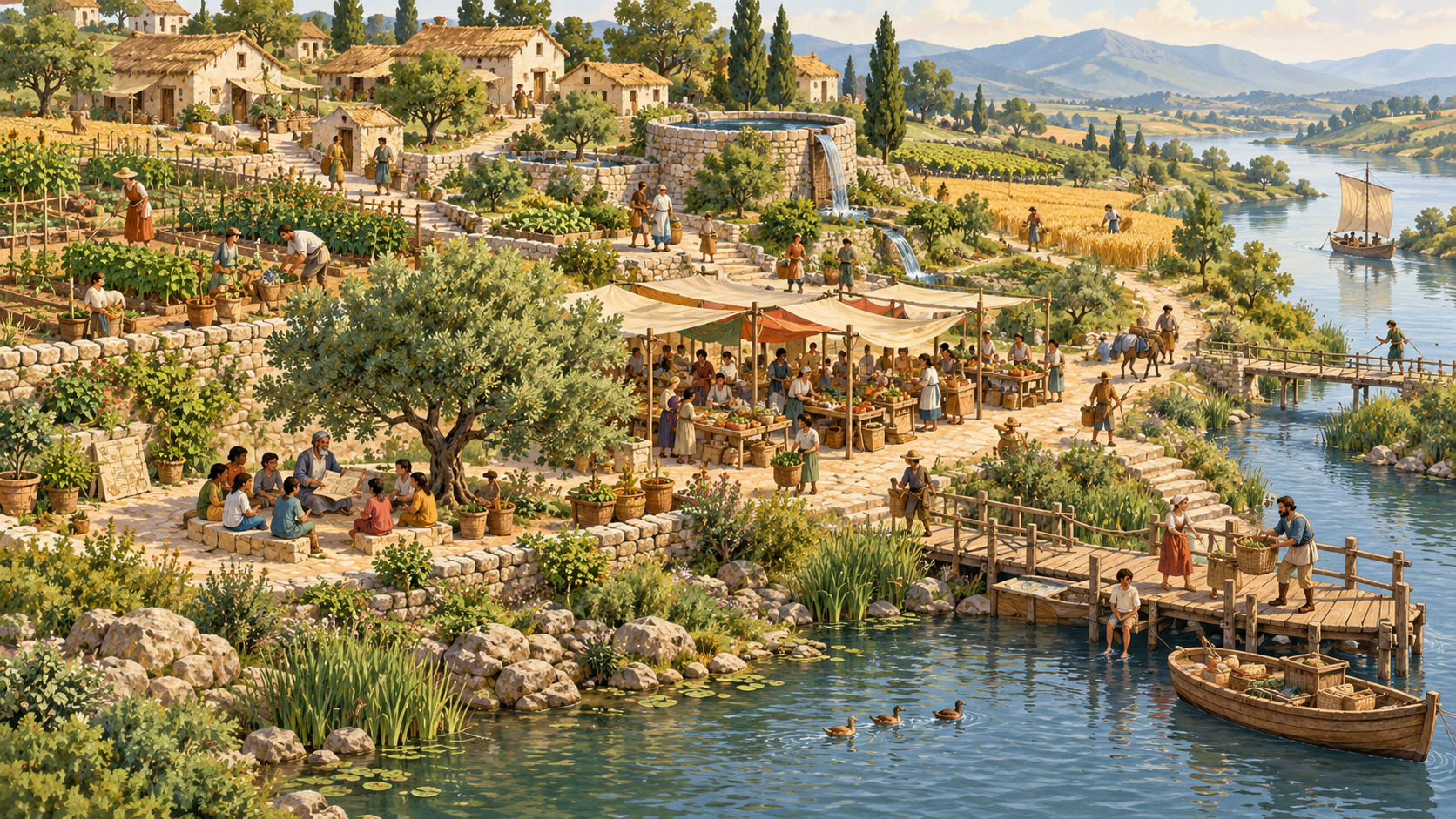
Series cover: AI-generated conceptual illustration of Riverbend, the starting community in these guides. It is not a literal depiction of every scenario, a historical reconstruction or an engineering plan.
Choose your next learning question
Follow a route into the expanded chapters, or choose a specific activity from the index.
Full chapter index
Chapters 1–8: Begin with a journey question
- 1. Begin with the activity a person is trying to reach
- 2. Describe origins, destinations and stops as different roles
- 3. Check connectedness before measuring how far a place looks
- 4. Read a directed link in the direction it is supplied
- 5. Distinguish a route length from a straight separation
- 6. Keep distance and duration in separate accounts
- 7. Compare a small complete network before claiming a minimum
- 8. Give a transfer its own place in the journey
Chapters 9–16: Read routes and connections
- 9. Connect arrival with a listed onward departure
- 10. Check which routes this traveller may use
- 11. Plan a shared arrival without treating people as one counter
- 12. Make room for an optional journey that is valued for its story
- 13. Read a journey record without inventing its missing steps
- 14. Build a complete everyday journey with a justified finish
- 15. Distinguish a drawn connection from a usable service
- 16. Read departure and arrival as separate timetable events
Chapters 17–24: Plan services and transfers
- 17. Test a transfer through the time needed between services
- 18. Keep a vehicle at the place its previous movement reached
- 19. Match seat capacity with a complete sequence of trips
- 20. Follow a finite waiting group with arrivals before boarding
- 21. Count passenger journeys separately from vehicle trips
- 22. Keep distance, vehicle time and role work in their own accounts
- 23. Give stops their stated duration before promising another departure
- 24. Follow a disruption from the vehicle's present location
Chapters 25–32: Make journeys usable
- 25. Compare complete alternatives for the same traveller task
- 26. Match an activity window with a supported return journey
- 27. Use more than one vehicle without losing the individual traces
- 28. Hand over a journey plan with travellers and vehicles still located
- 29. Describe a usable journey without turning a route condition into a personal label
- 30. Invite travellers to help shape the route information
- 31. Let a journey carry stories without assigning one experience to everyone
- 32. Compare whole journeys and preserve who gains or waits longer
Chapters 33–40: Review and travel on paper
- 33. Keep route alternatives honest about what each one provides
- 34. Follow the vehicle as carefully as the passengers
- 35. Report journeys through the outcomes the records actually show
- 36. Diagnose the broken connection before choosing a remedy
- 37. Teach route conditions and journey stories in the first two sessions
- 38. Teach vehicle states, diagnosis and review in two further sessions
- 39. Complete the Six Travellers transport project
- 40. Repair a closed link from the vehicle’s actual position
CHAPTER 1 OF 40 · Begin with a journey question
1. Begin with the activity a person is trying to reach
Riverbend's Journey House opens with a paper map and a traveller counter waiting beside a home symbol. A child asks where the counter should go. The character card answers a more useful question: the traveller wants to hear the opening of a story at the Learning Room and then return a response at the Square. A journey is connected to an activity, not merely movement across a page. Learners begin by identifying what the person is trying to make possible.
All places, travellers, routes and durations in this guide are invented tabletop conventions. Children use paper maps, supplied connection cards and fictional circumstances. The activities provide no actual navigation, traffic, engineering or safety guidance, and they do not assess a real person's ability to use a route. No offsite journey is required. A line, number or access mark means exactly what its model rule supplies, without establishing the performance of actual transport.
Give each traveller a task card containing an origin, a desired destination and a purpose. One wants to join a map discussion, another to visit an imaginary exhibition and another to return home after a story. The destination identifies a place; the purpose identifies something the traveller hopes to do there. Reaching the correct symbol does not establish that the activity is available or that the character understands how to join it.
Parents can ask a younger learner to draw a speech bubble above the counter: I want to hear the first story. An older learner can name the information needed to examine that request, such as a permitted connection, arrival point and starting period. The group should not supply everything at once. A manageable first question might concern which listed route connects the origin with the story room, leaving opening times for a later step.
Explore the example
For a fresh opening map, Home connects to Square and Square connects to Learning Room. Each link is usable in both directions, with no other links in this model. The route Home, Square, Learning Room is a valid outward journey. Learning Room, Square, Home is a valid return. A direct Home-to-Learning-Room line drawn by a child is a proposal for a new connection, not a permitted shortcut within the supplied map.
Now give the traveller a second purpose at Square after the story. Its complete task sequence becomes Home to Learning Room, then Square for a response, then Home. The stop at Square on the outward journey does not automatically complete the later response task. The character has not yet heard the story or received its response card. A route can pass through a place several times while serving a different purpose at each visit.
A playful activity lets children invent what the traveller expects to hear: a river that forgets its name, a cloud messenger or a doorway that appears only in drawings. The story gives the journey a reason to matter without changing the map's legal connections. A character may wish to fly directly home, but that becomes a movement option only if the rule explicitly supplies it.
Finish with a journey brief naming person, purpose, origin, destination and one question still open. Riverbend's learners have connected movement with everyday life while keeping the model small enough to inspect. Later chapters will add directions, costs, stops and transfers. Those details will remain answerable to the central question: can this supplied traveller use these connections to reach the particular activity the card actually names?
CHAPTER 2 OF 40 · Begin with a journey question
2. Describe origins, destinations and stops as different roles
The Journey House's map marks the Square with a large star. One traveller starts there, another ends there and a third passes through on the way to the Story Room. The same place can play different roles in different journeys. Children now distinguish origin, destination and intermediate stop so a route record can explain what a person is doing, rather than assign one permanent function to every symbol.
Use a fresh map with Home H, Square S, Story Room R and Garden Display G. The only links are H–S, S–R and S–G, all usable in both directions. A traveller from H to R uses H, S, R. H is the origin, R the destination and S an intermediate place. A traveller from R to G can use R, S, G, making the earlier destination an origin for a different journey.
Parents can give the learner three coloured label cards and ask them to place origin, destination and intermediate beside a counter's route. Then change the task without moving the map. The labels should change when the route changes. This helps a younger child understand the terms through a visible relationship instead of memorising definitions detached from movement.
A worked day card requires a traveller to start at H, visit R for a story, visit G for a drawing and finish back at H. Under the supplied links, one route is H, S, R, S, G, S, H. It contains six link traversals: H–S, S–R, R–S, S–G, G–S and S–H. S appears three times as an intermediate visit. The sequence contains two task destinations before the return home, not six different activities.
Explore the example
Now ask whether the traveller can visit G before R. The map permits H, S, G, S, R, S, H. If the task card imposes no activity order, this is another valid sequence with six traversals. If a later card says the drawing responds to the story, R must precede G. The dependency comes from the task, not the appearance of the map. Children should inspect both rather than choose an order only because it looks symmetrical.
A practical exercise gives three short route descriptions, one missing an intermediate place. H, R is not a valid consecutive sequence on this map because H has no listed direct link to R. The child can repair it by inserting S. R, S, G is valid. H, S, R, G is invalid at its final pair because R and G have no direct link. A route should be checked pair by pair, not accepted because every named place appears somewhere on the same connected drawing.
Older learners can distinguish passing through from stopping for a task. A model may permit passage through S without a delay while a question visit there takes a stated interval. The current chapter supplies no durations, so traversal count cannot yet become journey time. The child can identify the missing rule and preserve a correct sequence without inventing a number to make the record look complete.
Finish with two traveller cards using the same map differently. Ask a partner to reconstruct each sequence and name the role of S. Riverbend's learners can now describe an everyday journey through relationships that belong to the task. Places remain flexible parts of people's lives, while the route record stays precise about where this traveller begins, what they visit and which named links connect the required stops.
CHAPTER 3 OF 40 · Begin with a journey question
3. Check connectedness before measuring how far a place looks
A paper Learning Room sits close to a home anchor, while a more distant-looking Square has a clearly listed connection. A learner assumes the nearby room is easier to reach. The Journey House first asks whether any permitted route connects the points. Visual closeness and connectedness are different properties. Children now inspect the links before calculating a cost that might belong to no legal journey at all.
Prepare five places, A through E. The listed bidirectional links are A–B, B–C and D–E. There are no other links. A traveller at A can reach B and C, but not D or E under this model. A traveller at D can reach E but not A, B or C. The map has two separate connected groups. Their spacing on the sheet does not add a bridge between them.
Parents can draw A and D almost touching while putting B farther away. Ask the child to move only along the supplied strips. The activity exposes an assumption without requiring a real navigation task. A younger learner can sort the places into groups that a counter can visit from A. An older learner can explain that every route from A must remain within A, B and C because no listed link leaves that group.
Now supply a new bidirectional link C–D. The full sequence A, B, C, D, E becomes valid. Adding one connection joins the earlier groups, allowing all five places to be reached from A. The child should mark this as a new model condition. It is not a discovery that the old map secretly contained a connection, and it does not establish a real engineering possibility.
Explore the example
For a worked count, the original map has three links and two connected groups. The revised map has four links and one connected group. Those numbers describe this particular arrangement. They are not a general rule that four links always connect five places. Four links could be arranged differently, leaving a place isolated or forming a loop among fewer places. The actual endpoint pairs matter.
A practical comparison uses another five-place map with A–B, B–C, C–A and D–E. It also has four links, yet retains two connected groups. Children can trace the triangle among A, B and C and the separate pair D, E. A link total cannot substitute for reading the structure. The group can propose one additional joining link and explain which endpoints it connects.
Older learners can inspect a route whose final step crosses an unconfirmed link. The counter can reach the last confirmed place, but the whole journey remains conditional. A continuous pencil stroke in the background does not override the link list's status. The class should distinguish available, proposed and not established, using a clear key rather than leaving an unexplained blank that a reader may interpret as either permission or absence.
Finish with a connectedness statement naming the traveller's origin and the places reachable under the current list. No distance total is needed to establish that an unconnected destination cannot be reached within this model. Riverbend's learners have gained an important first check: before comparing short and long journeys, identify which journeys the supplied network actually permits and which apparent possibilities still require a new connection or further evidence.
CHAPTER 4 OF 40 · Begin with a journey question
4. Read a directed link in the direction it is supplied
The Journey House adds arrows to a paper map. A child follows an arrow from Square to Story Room, then turns the counter around for the return. The link card permits only the outward direction. A return path may exist through other places, but it is not created by reversing the drawing. Learners now examine directed connections as explicit model rules, keeping them separate from assumptions about real streets or transport.
Use four places: Home H, Square S, Story Room R and Return Desk D. The directed links are H to S, S to R, R to D and D to H. Each takes the counter only in the named direction. These four links form a complete loop. H, S, R reaches the story room, and R, D, H returns home. The outward and return sequences differ while both remain valid.
Parents can give children arrow strips that fit between place cards. The learner reads each strip aloud before moving the counter. An older child can check a written route by examining every ordered pair. H, S, R, S, H is invalid on this map because R to S and S to H are not supplied. The fact that the corresponding outward links exist does not authorise their reversal.
A worked full journey H, S, R, D, H uses four traversals. It returns to its origin without retracing the outward arrows. A different route H, S, R, D, H, S ends at Square after five traversals. Repeating a place is allowed in this chapter, provided every directed step exists. The class should not reject a route simply because it forms a loop, nor assume that any loop reaches the destination a task requires.
Explore the example
Now add a new arrow S to H. A traveller at Square can return directly to Home under the revised model. The earlier S-to-R-to-D-to-H route remains valid too. The new link creates another choice; it does not erase the old one. If no costs are supplied, the class can compare traversal counts but cannot establish travel time or real suitability from that count alone.
A practical challenge asks whether every place reachable from H can also reach H. In this particular loop, the answer is yes because following the remaining arrows completes the circuit. Compare a fresh map with H to S and S to R only. H can reach R, but R has no outgoing arrow, so no return is supplied. Reachability in one direction does not establish a round trip.
Older learners can describe a bidirectional connection as two permitted directions when the model chooses that convention. If the card says H and S are linked both ways, it supplies H to S and S to H. The class should not rely on a plain line whose meaning changes between sheets. A key can make the distinction readable, especially when directed and bidirectional links appear together.
Finish with one outward route and a separately checked return. A character can invent a story about why it uses the Return Desk, but the narrative should not substitute for an arrow that is absent. Riverbend's learners now understand that a usable everyday connection includes direction. Another group can follow their route because the sequence respects the actual ordered links rather than the author's unspoken expectation that every journey can simply be reversed.
| Journey feature | Question |
|---|---|
| Origin | Where does this fictional traveller start? |
| Destination | Where must the traveller arrive? |
| Permitted movement | Which links and directions apply? |
| Condition | Which time or participation requirement matters? |
CHAPTER 5 OF 40 · Begin with a journey question
5. Distinguish a route length from a straight separation
Riverbend's paper home and Learning Room sit diagonally apart on a grid. A child draws a straight line between them and calls it the journey distance. The supplied model permits travel only along a listed horizontal-and-vertical route. The direct separation is useful geometry, but it does not establish the length of that permitted journey. Learners now keep these quantities distinct instead of letting the most appealing line on the map decide the answer.
Place Home at (1,1) and Learning Room at (5,4), reading horizontal coordinate first. A listed route goes from (1,1) to (5,1), then to (5,4). Both segments are permitted in both directions. The first is four grid units long and the second three, giving seven. Each grid unit represents ten invented model distance units, so the route length is seventy model units. The full out-and-back journey along those same links is 140.
For learners ready for the mathematical relationship, the exercise supplies a right-triangle calculation. Four squared plus three squared equals twenty-five, making the direct separation five grid units, or fifty model distance units. Younger children can compare prepared five-unit and seven-unit strips. The diagonal is not a permitted link here. It therefore cannot replace the seventy-unit route merely because it is shorter geometrically.
Parents can ask a child to finish two sentences: the points are this far apart directly, and this listed route has this length. The difference is twenty model distance units. Relative to the fifty-unit direct separation, the route is 40% longer. Relative to the seventy-unit route, the difference is about 28.6% of its length. The denominator identifies the comparison; neither percentage is a universal measure of how inconvenient a journey feels.
Explore the example
Now supply a second permitted route through the waypoints (1,1), (0,1), (0,4) and (5,4), with each consecutive segment usable in both directions. Its lengths are one, three and five grid units, or ten, thirty and fifty model distance units, totalling ninety. The original seventy-unit route is shorter by twenty among these two candidates. The class should not call it the shortest possible route in every network unless it has examined the complete relevant link list. A candidate comparison establishes a bounded result, leaving unknown connections as questions rather than inventing them to improve the answer.
A practical exercise changes the background drawing while preserving the supplied lengths. Move a destination symbol closer on a separate diagram but keep its link card at eighty model units. If the diagram is explicitly not to scale, measuring the pencil line does not override the listed weight. The child can add a not-to-scale note or redraw the sheet consistently. A map's visual arrangement should help readers rather than silently contradict the quantities they are meant to use.
Older learners can inspect a separate task scenario in which the original seventy-unit route gains a twenty-unit detour to a required question desk. The total grows because the task changed, not because the earlier addition was wrong. The report should identify whether it measures a direct destination journey or a complete task journey with the detour. Comparing seventy with ninety without naming the added purpose would hide a meaningful difference in what the routes accomplish.
Finish with a route strip carrying endpoints, permitted segments, distances and the direct-separation comparison as a separate note. Riverbend's learners can now use geometry to illuminate a journey without letting it grant a connection the model does not supply. Everyday movement becomes more understandable when the record names the route actually available to the person, not just the shortest line someone can draw between its beginning and end.
CHAPTER 6 OF 40 · Begin with a journey question
6. Keep distance and duration in separate accounts
The Journey House receives two route cards. Route A is forty model distance units long and takes six model time units. Route B is sixty distance units long and takes four time units. A learner assumes the shorter route must also be quicker. The model explicitly supplies otherwise. Children now read each quantity through its own unit and rule, without deriving an actual speed or performance claim from an invented tabletop journey.
Give the traveller a purpose card requiring arrival no later than mark five after departure at zero. Route A arrives at six and misses that boundary. Route B arrives at four and meets it. Under a different purpose of minimising supplied distance with no arrival restriction, A would be shorter. These statements can coexist because the questions differ. The class should name the criterion before announcing that one route is better.
Parents can place distance counters beside one row and time strips beside another. A child traces the same route identifier across both. The numbers should not be added into a total of forty-six or sixty-four without a defined conversion or comparison rule. Distance units and time units are different quantities. An adult can ask what the sum would mean before the learner performs an operation simply because both cards contain numbers.
A worked two-link journey has distance twenty plus thirty, or fifty, and duration two plus four, or six. A required stop at the intermediate place takes three additional time units but adds no distance under this model. Total duration becomes nine while distance stays fifty. The class can show the stationary interval on the timeline rather than draw an extra route segment to represent it.
Explore the example
Now introduce a separately defined constant-rate scenario. A single link is forty model distance units, and the exercise states that the traveller covers ten of those units per model time unit with no waiting or stops. The supplied duration is four by division. This relationship belongs only to that scenario. It does not authorise applying the same rate to Route A, Route B or actual people outside the paper model.
A practical comparison gives learners three labels: measured on this model card, calculated from a supplied relationship and not established. Route A's six-unit duration is supplied directly. The constant-rate link's four units are calculated from the rule. The duration of an unlabelled seventy-unit route is not established. A child can recognise the missing relation instead of importing the most convenient number from a nearby example.
Older learners can examine averages. A complete journey of sixty model distance units over ten elapsed time units has an average of six distance units per time unit. If the interval includes a four-unit stop, that average does not describe movement during every moment. The class can preserve the total relationship while noting that no per-link rate is supplied. A summary can be mathematically correct yet insufficient for predicting an intermediate arrival.
Finish with a two-line journey account: total listed distance and total stated duration including named stops. Another learner should be able to identify which numbers are supplied and which are derived. Riverbend's everyday journeys gain clarity when a short route, a quick arrival and a usable task connection remain related but distinct questions, each answered through the quantity and conditions the paper activity actually provides.
CHAPTER 7 OF 40 · Begin with a journey question
7. Compare a small complete network before claiming a minimum
The Journey House wants the least-cost route from Home H to Learning Room L. A child finds one route and calls it the best. The class needs a complete relevant map and a stated cost before it can justify a minimum. Learners now examine a tiny weighted network in which every candidate can be traced, making a proof of minimum part of the puzzle rather than an unsupported superlative attached to the first answer.
The places are H, Square S, Garden G and L. The only directed links are H to S with cost two, H to G with cost five, S to G with cost one, S to L with cost six and G to L with cost two. Costs are invented journey points, all positive, with no separate durations implied. There are no reverse links, waiting effects or hidden connections. The traveller starts at H and finishes at L.
The complete H-to-L routes are H, S, L; H, G, L; and H, S, G, L. Their costs are two plus six equals eight, five plus two equals seven, and two plus one plus two equals five. The last route has the smallest total among the complete list. It is therefore a minimum-cost route for this supplied network, not a recommendation about a real route or proof of an unstated distance minimum.
Parents can help younger learners branch a paper route tree. From H, the first choice is S or G. From S, the next choice is G or L. From G, only L follows. Every branch ends, so the class can see why no route was missed. An older child can explain that the directed map has no loop and that the outgoing choices at each visited place have all been covered.
Explore the example
Now change the H-to-G cost from five to one. The H, G, L route costs three and becomes the new minimum, while the former five-point route remains legal. The topology has not changed; one supplied weight has. The child should update the relevant total rather than reuse a memorised answer. A route's validity and its ranking answer different questions.
A practical extension asks for a route visiting S as part of the task. Under the changed costs, H, G, L misses that requirement. H, S, G, L costs five and H, S, L costs eight, so five is the minimum among routes that include S. The lower three-point route still exists but does not perform the requested journey. Eligibility must be checked before a cost comparison is interpreted as useful to a person.
Older learners can write a short minimum argument with two parts: every permitted candidate has been listed, and their totals have been compared under the same rule. Merely saying I tried several is not enough. The class can keep larger or unfamiliar maps as exploration tasks without claiming a proven minimum when the candidate set has not been established completely.
Finish with the original network, all three routes and a separate changed-weight scenario. Add a story purpose for visiting S, such as collecting the question to be discussed at L. Riverbend's learners have made mathematical economy serve an everyday task. Their minimum claim is strong precisely because it is narrow: the route is least costly within this complete directed model and its stated requirement, with no hidden link, cost or permission needed to make the conclusion work.
CHAPTER 8 OF 40 · Begin with a journey question
8. Give a transfer its own place in the journey
A traveller reaches Riverbend's paper Junction X but still cannot begin the next segment immediately. The connection card requires a two-unit change between the blue route and the gold route. The Journey House now represents transfers explicitly. A place shared by two route lines can be a useful connection, but its appearance does not establish that every onward movement begins with no additional interval or condition.
Use a fresh directed map with Home H, Junction X, Corner Q and Learning Room L. Its only links are H to X taking three model time units, X to L taking four, H to Q taking five and Q to L taking five. H-to-X is blue, X-to-L gold, while both links through Q belong to silver. Changing from blue to gold at X requires two additional time units. Continuing silver at Q requires none. There are no scheduled departures or other stops in this first comparison.
The X route takes three plus two plus four, or nine time units. The Q route takes five plus five, or ten. Adding only the moving segments through X would give seven and omit the required transfer. Counting the transfer twice would give eleven. The timeline should show one named two-unit interval between arrival at X and departure from X, making the relationship inspectable rather than hiding it inside an unexplained total.
Parents can give children separate movement and transfer strips. A younger learner places them in the order H-to-X, change, X-to-L. An older learner can compare the two route records and explain why a route with a transfer is still quicker in this supplied example. The result does not establish a general rule about transfers. It reflects the particular link durations and change interval supplied here.
Explore the example
Now add a story task at X that requires one additional interval after arrival and cannot overlap the transfer under this model. The X journey becomes ten units, matching the Q journey's duration. However, Q does not visit X and therefore does not complete the new task. The two totals are equal for journeys with different purposes. A child should not report that either route equally fulfils the X-task request simply because their arithmetic matches.
A practical diagram uses one large junction symbol and two small arrival/departure points inside it. The transfer strip connects those points. This is a representational choice, not a real station design. It helps the reader see that arriving at a named place and being ready for its next connection can be distinct events. The class can use a simpler symbol once the convention is understood, provided the required interval remains in the record.
Older learners can inspect a missing transfer rule. A new route line appears on the map, but the card does not say how a traveller changes onto it. The class should identify the missing information rather than borrow the two-unit X rule automatically. Different examples may use different conventions. A connection can remain proposed or incomplete while the learner still describes the parts already established.
Finish with the X route's arrival, transfer and onward departure labelled separately. Riverbend's learners now have a way to explain a connected journey through more than adjacent lines. The transfer becomes a concrete part of the person's day, alongside the activity that gives the journey purpose, and another group can verify that no required transition was silently removed to make a preferred route look quicker.
CHAPTER 9 OF 40 · Read routes and connections
9. Connect arrival with a listed onward departure
The Journey House gives a traveller two paper services whose route lines meet at a transfer point. The traveller reaches the point after one onward departure has already occurred. A line connection remains available in the model, but a particular timed connection has been missed. Children now use explicit departure lists to build a complete journey, keeping arrival, readiness and onward departure as separate events.
In this fresh scenario, the traveller is ready at Home H at model mark three. The H-to-X service departs at marks two, six and ten, and each trip takes three time units. A traveller may board only at a listed departure at or after readiness. The next usable departure is six, arriving at X at nine. The mark-two and mark-ten departures remain on the list, but neither is the selected next opportunity from the stated readiness.
The X-to-L service departs at eight, twelve and sixteen and takes two units. At X, the traveller requires one full unit to become ready for the onward departure. Arrival at nine therefore gives readiness at ten. Departure eight is already past, while twelve is the next permitted one. The traveller arrives at L at fourteen. No additional boarding duration, capacity restriction or early-arrival requirement is included in this model.
Parents can place departure cards on a numbered strip and ask the learner to move a readiness marker only after the previous segment ends. Waiting at H from three to six takes three units. Movement to X takes three. The transfer from nine to ten takes one, and waiting from ten to twelve takes two. Final movement takes two. These parts total eleven, matching fourteen minus three. The two-unit wait at X should not be added on top of a separate three-unit nine-to-twelve wait, which would count the transfer interval twice.
Explore the example
A practical change makes the traveller ready at H at mark one. It can use departure two, arrive X at five, become ready at six, use departure eight and arrive L at ten. The overall readiness-to-arrival interval is nine units. This earlier starting condition changes which departures connect. It is a new scenario, not proof that the original traveller could have left earlier without a supplied change to their circumstances.
Now supply a task requiring arrival at L by fourteen inclusive. The original plan meets it exactly. If the task instead requires arrival strictly before fourteen, the same plan does not meet that wording. The class should mark the boundary on the timeline and preserve the actual condition. A deadline can be clarified without inventing an earlier vehicle or changing a departure list after the answer is known.
Older learners can explain why adding the two movement durations, three plus two, is insufficient to predict total journey duration. The departure pattern and transfer readiness supply the remaining six units in the original case. Another departure list could produce another result with the same link durations. Children can compare scenarios through their actual event sequences rather than treat a five-unit movement sum as a complete everyday connection.
Finish with a timed itinerary naming readiness, departures, arrivals and the deadline interpretation. The traveller can carry an invented question to L, preserving the story purpose while the timeline stays exact. Riverbend's learners have shown how a usable connection requires more than a place where lines touch: the person must become ready before a departure that the model actually supplies.
CHAPTER 10 OF 40 · Read routes and connections
10. Check which routes this traveller may use
A paper network offers a short route through a marked gate and a longer route without it. One fictional traveller holds the gate pass, while another does not. The Journey House now checks eligibility before comparing cost. The pass is an invented game condition, not an assessment of real physical access, identity or legal permission. It makes a precise point: a low-cost route that fails the supplied traveller's conditions is not an available solution for that card.
Use a fresh directed map with H to A costing two journey points, A to L costing two, H to B costing three and B to L costing three. These are the only links, and all costs are positive. The A-to-L link requires pass P. A traveller who already holds P may use H, A, L at cost four or H, B, L at six. Four is the minimum among the complete candidate list for that traveller.
A second traveller starts at H without P. The card does not permit borrowing or creating a pass during the journey, and no pass station appears in this model. H, A, L fails at its final link. H, B, L remains valid at cost six. A report giving both travellers the four-point route would ignore an explicit condition rather than demonstrate a universally efficient plan.
Parents can place a small P marker beside the relevant traveller card. The child checks link conditions as the counter moves, then adds costs only for routes that reach L legally. If the counter arrives at A without P, it has not completed the requested journey. The class can preserve the partial route as a state but should not treat the final link as available because the destination is close on the page.
Explore the example
Now supply a new accepted model rule: the second traveller receives P at H before departure, with no journey-point cost in this particular variant. The four-point route becomes available. The source and timing of that new permission should be recorded. It does not show that the earlier six-point result was a mistake; the traveller's starting conditions changed. Nor does it authorise taking a pass assigned to another role unless the variant explicitly provides that operation.
A practical exercise gives three traveller cards different accepted destinations as well as pass states. One needs L, another needs B and a third needs to visit A before L. The child should not reuse the same route simply because all start at H. The B task uses H to B at three. The A-before-L task requires P under the original map. Without it, the current model supplies no complete eligible route for that task, even though another route reaches L.
Older learners can distinguish unavailable from not yet established. A missing pass condition on a new link leaves a question; a clearly stated P requirement with no P establishes ineligibility under these rules. The class should avoid a vague crossed-out symbol that could mean either. Naming the condition gives another learner a useful next question or a clear explanation of why the candidate does not fit.
Finish with a route table separated by traveller card. Riverbend's learners can now justify different minimum results without ranking the people. The differences come from supplied conditions and purposes, not a claim about personal merit or actual capability. A usable everyday journey is a relationship between a particular task, a particular traveller and the links the current model actually permits them to use.
CHAPTER 11 OF 40 · Read routes and connections
11. Plan a shared arrival without treating people as one counter
Five fictional travellers want to arrive together for Riverbend's opening story. Three start at Home A and two at Home B. A single group counter would hide their different beginnings and waiting intervals. The Journey House now compares individual movement with a shared arrival, showing how people can meet through a plan without pretending they all experience the same journey.
The only listed outward links are A to Square taking two model time units, B to Square taking five, and Square to Learning Room taking three. Every traveller is ready at mark zero. Links have enough supplied model capacity for all five at once, and no departure schedule applies. The group agrees to meet at Square and continue together when everyone is present. These conditions define the whole exercise; no real walking or transport rate is implied.
The three A travellers reach Square at two and the two B travellers at five. The A group waits three units. All depart Square at five and arrive at Learning Room at eight. The group's elapsed interval from the common readiness mark to arrival is eight. Each traveller spends that eight-unit interval somewhere, but their movement and waiting components differ.
For a worked account, each A traveller moves for two plus three, or five units, and waits three. Across three A travellers that is fifteen movement units and nine waiting units of person-time. Each B traveller moves for five plus three, or eight, with no wait, giving sixteen movement units across two people. Combined movement is thirty-one person-time units and waiting nine, totalling forty. Five people across eight elapsed units also gives forty. Person-time is a defined sum across travellers, not another duration to put on the single journey clock.
Explore the example
Parents can draw one row per traveller on a timeline. Children can colour movement and waiting differently while keeping all rows aligned. An older learner can explain why eight elapsed units does not mean only eight units when adding everyone's represented time. The two measures answer different questions. Neither measures effort, comfort or enjoyment, which the model does not supply.
Now compare a second accepted plan. The A group continues immediately from Square at two and reaches L at five. The B group arrives at L at eight. If the shared story begins at eight, all can attend, with A waiting at L instead of Square. The time totals remain the same under the stated movement lengths and starting marks, but the waiting location changes. The class can inspect whether the purpose requires travelling the final link together or merely being present for the opening.
A creative variation offers the A travellers a supplied three-unit postcard activity at Square during their original wait. They can complete it from two to five without delaying the joint departure. This changes what happens during that interval, not its elapsed length. The class should describe nine units of person-time engaged in the postcard activity rather than still label them unoccupied waiting if the new activity is included in the account. No additional movement is required by the supplied variant.
Finish with the two plans and a sentence about the group's actual agreement. Riverbend's learners can preserve companionship, individual origins and optional activity in the same model. A shared arrival becomes more useful when its record shows where different people move or wait, instead of flattening the group into one counter whose tidy route hides everyone else's daily experience.
CHAPTER 12 OF 40 · Read routes and connections
12. Make room for an optional journey that is valued for its story
The Journey House receives a traveller card saying I would like to see the paper lantern display before the story begins. The direct route to the Learning Room is shorter, but it does not pass the lanterns. Learners now examine an optional journey without assuming every extra movement is a failure or that every longer route must be justified through a practical necessity. A person can have a supplied preference that changes what the journey is for.
Use a fresh directed map with Home H, Display D and Learning Room L. H to L takes four model time units. H to D takes three and D to L three. These are the only outward links. The direct journey takes four; the display route takes six before any stop. A supplied two-unit display visit makes the optional journey eight. The character's activity card values the visit but permits declining it if the full plan does not fit.
The story begins at mark ten, and the traveller is ready at zero. Both routes can reach the opening under this first scenario. Direct arrival is four, while display arrival is eight. The longer journey serves an additional chosen purpose. Calling the direct route better solely because four is smaller would omit that purpose. The child can describe the trade-off without claiming the display will create a particular feeling for every viewer.
Parents can ask a learner to invent what the fictional display contains: a lantern waiting for a name, a cloud drawn inside a cup or a doorway made of questions. The story should not alter the listed movement durations. If the child wants the visitor to remain longer, add the chosen stop duration explicitly and recheck the opening condition. Imagination can enrich the itinerary while the timeline remains a shared rule.
Explore the example
Now make the traveller ready at mark three. The direct route arrives at seven. The eight-unit optional journey arrives at eleven and misses the story's start. The class can compare accepted alternatives. Omitting the two-unit display stop would arrive at nine but would not complete the defined visit. Changing the stop to one unit is a new proposal needing the character's acceptance and a supplied rule that the visit's purpose can be met in that time.
A practical activity offers three endings. The character chooses the direct route and preserves the story opening, accepts a later partial story under a new explicit activity card or postpones the display visit. The group should not decide that the character must value one experience more because an adult prefers the shorter plan. Use the supplied preference and available alternatives to make a reasoned choice. If no acceptable complete option fits both purposes, that conflict can remain an honest result.
Older learners can distinguish optional from unimportant. A preference may be flexible while still mattering to the character. The plan can record that an optional visit was not included rather than report that every desired part of the day was met. A shorter itinerary may satisfy essential conditions and leave an unfulfilled wish. Both are worth naming when comparing the traveller's experience within the fiction.
Finish with two itinerary cards and a short character line explaining the chosen route. Riverbend's learners have seen everyday transport as part of life rather than a constant search for the smallest number. Minimum cost remains a useful question when that is the task. An optional story journey asks a different question: which available route and stop combination supports what this fictional person wants to do under the actual time conditions?
| Record | What it can establish |
|---|---|
| Link | A permitted movement between the named points |
| Route | A connected sequence of applicable links |
| Duration | Time under the supplied movement rules |
| Arrival | A traveller reaching the stated destination |
Extend this learning question through How Education Works.
CHAPTER 13 OF 40 · Read routes and connections
13. Read a journey record without inventing its missing steps
A traveller's paper log says Home, Square, Learning Room. The map has those places, but the current version permits Square to Home rather than Home to Square. Another log gives a start and finish without its intermediate link. The Journey House now checks records through the map and task they actually refer to. A plausible story about arrival does not establish that every recorded journey followed the supplied links or met its stated purpose.
Use a fresh audit of eight route logs submitted for checking against one explicitly named map edition. Six list permitted consecutive directed links. One reverses a one-way link and one omits the information needed to identify its final connection. Six out of eight, or 75%, have confirmed link-valid records under this audit rule. The reversed record fails the stated direction condition. The incomplete one remains unconfirmed rather than automatically invalid, because its missing detail could matter.
Parents can give children the map key and one log at a time. The child checks every ordered pair and marks the exact point of a difficulty. The exercise does not ask them to judge an actual person's navigation skill or infer why the record differs. The error could belong to a copied route, a different map edition or another supplied circumstance. The current evidence supports a record check, not a diagnosis of a real traveller.
Now supply activity outcomes for the six link-valid logs. Four include arrival before the opening, one records a later arrival and one has no arrival mark. Four out of six have confirmed on-time arrival within that subgroup. Across all eight audited logs, four have that combined confirmation. The map-validity count should not become an on-time-use count. A legal route and a timely task connection are separate conditions.
Explore the example
A practical source check reveals that the log with reversed direction was copied from an earlier edition in which the link was bidirectional. Its earlier sequence may have been valid for that older model. The current enquiry concerns the newer edition, so the class must identify which period the log describes before calling it a failed journey. A historical record does not become false simply because a later map changes, but it cannot automatically guide a current itinerary.
Older learners can compare two accounts of the same journey. One reports departure at two and arrival at nine, while another lists movement durations of three and two. The movement sum is five, while elapsed time is seven. The difference suggests a question about stops, waiting or the relationship between the sources. It does not prove that someone fabricated a duration. The learner can preserve both supplied records and ask for the missing two-unit explanation without inventing one as established fact.
Ask children to rewrite a broad headline such as all travellers reached the story easily. A supported replacement names the six link-valid logs and four confirmed on-time arrivals, while identifying missing information and edition differences. The word easily would require a suitable supplied definition or response record. It should not be inferred from a small cost number or the absence of a complaint.
Finish with an evidence note containing map edition, route validity, arrival condition and unresolved question. Add one fictional traveller response if the exercise supplies it, keeping its meaning distinct from the route arithmetic. Riverbend's learners can now tell a useful journey story without forcing every record into success or failure. Careful checking preserves both what the model establishes and the specific information another enquiry would need to continue.
CHAPTER 14 OF 40 · Read routes and connections
14. Build a complete everyday journey with a justified finish
The opening Journey House project ends with a traveller who wants to hear a story, return a response and arrive back at Home. This fresh directed model contains Home H, Square S, Story Room R and Response Desk D. The only links are H to S taking two model time units, S to R taking three, H to R taking six, S to D taking six, R to D taking two and D to H taking four. All durations are positive and fixed, with no scheduled departures or capacity limits.
The traveller starts at H ready at mark zero. It must first complete a three-unit story activity at R, then a one-unit response activity at D and finally return to H. A visit to D before the story does not complete the later response requirement. In the first scenario the activities can begin immediately on arrival, and no other waits or transition intervals apply. The complete task ends when the traveller returns home after both activities.
One valid plan uses H, S, R, D, H. Arrival at S is two and at R five. The story runs from five to eight. The R-to-D link gives arrival at ten, and the response runs from ten to eleven. The final link returns the traveller home at fifteen. Movement totals two plus three plus two plus four, or eleven. The two activities add four, giving fifteen elapsed units from the common start.
A direct H-to-R opening gives arrival at six, story completion nine, D arrival eleven, response completion twelve and Home arrival sixteen. Both plans are legal, but the first is quicker under these conditions. To justify fifteen as a minimum, inspect the complete route structure. The first arrival at R must use H to R at six or S to R at three after H to S at two, possibly with additional loops. Positive-duration loops cannot reduce either arrival time. The earliest R arrival is therefore five.
Explore the example
After the story, R has only its listed link to D, taking two. The required one-unit response then precedes the only D-to-H link, taking four. Adding earliest R arrival five, story three, movement two, response one and return four gives fifteen. This lower bound is achieved by the worked route, so the minimum is established for the full task. A route through S to D before R adds a loop back through H and cannot lower that bound or replace the ordered activities.
Now supply a separate scenario in which the story cannot begin before mark seven. The H–S–R route arrives at five and waits two; the direct route arrives at six and waits one. Both begin the story at seven, finish at ten, reach D at twelve, finish the response at thirteen and return home at seventeen. Different movement totals can therefore lead to the same earliest finish when a shared opening boundary controls the next stage. The lower bound is seven plus three plus two plus one plus four, also seventeen.
Parents can ask a younger learner to arrange the movement and activity strips for one plan. An older learner can explain the minimum argument and identify which change made the earlier arrival cease to improve completion. A character line can give the response a playful meaning, such as returning a question about a river that forgot its name. The fiction supports the purpose without supplying an extra link or removing an activity interval.
Finish with the map, two labelled scenarios and one itinerary another learner can reconstruct. Riverbend's opening project has made an everyday journey more than a line between buildings. Its record connects a person's purposes with directions, durations, stops and a justified completion time. Another group can continue from it because the conditions remain visible, leaving room for new story journeys without claiming that the paper model advises an actual person where or how to travel.
CHAPTER 15 OF 40 · Read routes and connections
15. Distinguish a drawn connection from a usable service
Riverbend's fictional Journey House lays a paper home cluster, a story pavilion and a vehicle card on the table. A line connects the places, so a learner says everyone can make the journey. The class asks whether a vehicle actually travels along that line, when it departs, who can board and whether the destination activity is available after arrival. A route graph supplies one relationship within a journey. It does not establish every condition needed to complete the activity.
All vehicles, traveller roles, distances and times in these chapters are invented tabletop quantities. Children move counters on maps and follow supplied event cards. They are not planning real travel, assessing traffic or learning actual vehicle operation. A model vehicle follows the explicit rules of the exercise, with no unstated claim about engineering or safety. Parents and tutors can use drawn rectangles and numbered cards to make the relationships visible.
The first network has links Home to Junction at three model distance units and Junction to Pavilion at five. The connected path totals eight distance units. The paper vehicle service, however, runs only between Junction and Pavilion. A traveller starting at Home still needs a supplied way to reach Junction. The class should mark that link as connected but without an established service, instead of assuming the vehicle travels everywhere the pen has drawn a line.
Now supply a connector service from Home to Junction. It departs at model minute two and takes four minutes, arriving at six. The Pavilion vehicle departs Junction at eight and takes five, arriving at thirteen. The traveller can make the transfer under a rule requiring no additional transfer time in this first scenario. From the minute-two departure to minute-thirteen arrival, the journey occupies eleven elapsed minutes, including two at Junction between services.
Explore the example
The eight distance units and eleven elapsed minutes measure different things. The supplied service durations need not equal the link distances. A parent can place a distance label beside each map line and a timetable strip below the map. Ask the learner to point to the source for each quantity. A valid calculation uses the supplied relationship rather than silently turning one model distance unit into one minute.
Add a Pavilion activity that closes at minute fifteen and requires four continuous minutes. Arrival at thirteen would lead to completion at seventeen, outside that window. The transport connection and transfer are supported, but the complete activity journey is not. Children can preserve both findings. A valid service can still fail a particular task's timing, and that does not mean the route graph itself was arithmetically wrong.
For a tutor activity, give three stamps represented by words on a worksheet: connected, service supplied and task supported. Ask the learner to apply each only when the relevant evidence exists. These are different milestones rather than a ladder every journey automatically completes. Riverbend's transport inquiry begins by following a particular traveller through a particular task, keeping the attractive map connected with the services and periods that make its lines usable within the paper model.
Ask the learner to make a missing-information card for the Home-to-Junction link before its connector service is supplied. The card should request a departure, duration and boarding condition, rather than simply ask for a better map. This turns an unresolved access claim into a specific modeling question. Another learner can answer it with a supplied service card, showing exactly which additional evidence changes the result.
CHAPTER 16 OF 40 · Read routes and connections
16. Read departure and arrival as separate timetable events
The Journey House writes Home, Square, Pavilion on a route card but gives no times. Another learner adds a single number beside each place without saying whether it marks arrival, departure or the end of a stop. Children create a timetable that names those events. Clear boundaries allow another player to reconstruct the vehicle's location rather than infer movement from a list of destinations.
The supplied vehicle begins at Home before model minute zero, with boarding already complete for its first departure. It departs at zero, travels five minutes and arrives at Square at five. A two-minute stop follows, ending with departure at seven. Travel from Square to Pavilion takes four, so arrival there is eleven. Unloading takes one, making the passengers' destination-ready time twelve. The outward trip's vehicle arrival and the completed passenger handover are distinct endpoints.
A traveller boarding at Home spends eleven elapsed minutes from departure to vehicle arrival, or twelve to destination readiness under the stated unloading rule. A traveller boarding at Square at seven spends four to arrival and five to readiness. Those figures are not contradictory accounts of one uniform passenger duration. They refer to different boarding events on the same supplied service. A parent can place the two traveller counters onto the vehicle at their actual stops.
The timetable must also say what happens next. In this version, the vehicle remains at Pavilion after unloading and provides no return service during the exercise. The class cannot use the same card for a new Home departure at minute fifteen unless a return or another vehicle is supplied. A route can have an end without an immediate return, but the end location needs to remain visible.
Explore the example
Now supply a separate continuation. After unloading ends at twelve, the vehicle waits three minutes at Pavilion, departs at fifteen and travels four back to Square, arriving at nineteen. It stops one minute, departs at twenty and takes five back to Home, arriving at twenty-five. This completes a defined return movement. The earlier outward arrival at eleven does not mean the vehicle was available at Home from eleven onward.
For a tutor activity, ask the child to state the vehicle's location at minutes six, ten, fourteen and twenty-two. It is stopped at Square at six, traveling towards Pavilion at ten, waiting at Pavilion at fourteen and traveling towards Home at twenty-two. The answer should name an interval when the card is between places. Drawing every minute at a station would hide the actual movement periods.
The finished timetable has columns or sentences for arrival, stop task and departure, with a note identifying the first boarding condition and final location. Another learner can check one event from its predecessor's time plus the supplied duration. Riverbend's model transport becomes easier to share when a timetable shows the journey's events precisely, allowing traveller experience and vehicle availability to be discussed through the same clear clock without treating every number beside a place as interchangeable.
A time mark belongs to a boundary, while a stopped interval occupies the space between two boundaries. The Square stop from five to seven lasts two minutes even though three whole-number marks can be written there. A tutor can draw two equal boxes and place the marks at their edges. This simple representation helps a learner avoid adding a phantom minute at every stop.
| Place/event | Arrival minute | Departure or ready minute |
|---|---|---|
| Home initial departure | Already present | 0 |
| Square outward | 5 | 7 |
| Pavilion outward | 11 | Passenger ready at 12; return departs at 15 |
| Square return | 19 | 20 |
| Home return | 25 | Final location Home |
CHAPTER 17 OF 40 · Plan services and transfers
17. Test a transfer through the time needed between services
A paper traveller reaches Riverbend's Exchange Stop at the same model minute the connecting vehicle departs. A learner declares the connection successful because the numbers match. The Journey House asks what must happen between arrival and boarding. A transfer may require a supplied explanation, movement between marked platforms or a confirmation step. These are invented activities on the tabletop, not instructions for real stations or judgments about actual travellers.
The first service leaves Home at minute three and travels six minutes, arriving at Exchange Stop at nine. Its unloading task takes one, so the traveller is ready to begin the transfer at ten. The connecting service departs at twelve. Under a supplied two-minute transfer task, the traveller reaches the boarding-ready state at twelve. This version explicitly permits boarding at the departure boundary once the transfer is complete, so the connection fits exactly with no remaining transfer margin.
The second vehicle's trip takes five minutes, arriving at Story Hall at seventeen. A one-minute destination handover ends at eighteen. The complete journey from Home departure at three to destination readiness at eighteen lasts fifteen minutes. That includes six on the first trip, one unloading, two transfer, five on the second trip and one final handover. The sum agrees with the elapsed endpoints.
Now change only the transfer task from two minutes to three. Boarding readiness becomes thirteen, after the twelve-minute departure. The route is still connected, but that connection cannot be used under the present timetable. The class should not erase the first unloading minute to make it fit. The task definition has explicitly retained that minute in both scenarios.
Explore the example
A later connecting departure is supplied at minute sixteen, with the same five-minute trip and one-minute handover. The traveller ready at thirteen waits three minutes, arrives at twenty-one and becomes destination-ready at twenty-two. The complete elapsed journey from minute three is nineteen. Its longer time includes the changed transfer and the later departure. A parent can ask which portions of the interval involve a vehicle and which occur between services.
For a tutor exercise, place first-service arrival, unloading, transfer and second departure on separate cards. The learner works forwards from departure and backwards from the connection. Ask them to identify the latest first-service arrival for the original twelve-minute connection when unloading is one and transfer two. It is minute nine. If the first arrival were ten, the traveller would be ready at thirteen and would miss the stated departure by one.
A transfer note should identify the particular traveller role and the supplied task duration. Another role card may have a different transfer requirement, so success for one does not establish success for every fictional traveller. Riverbend's learners can make the connection calculation precise while keeping the model's limits clear. A shared clock helps when it connects actual required events, rather than using matching printed numbers as a substitute for the work between them.
A traveller who misses the twelve-minute connection need not have made an incorrect choice. The supplied three-minute transfer requirement alone explains why boarding readiness occurs at thirteen. Ask the child to write that event without describing the traveller as careless. A useful journey record identifies the actual condition that prevented the connection, allowing the class to examine a timetable alternative rather than invent a personal cause.
CHAPTER 18 OF 40 · Plan services and transfers
18. Keep a vehicle at the place its previous movement reached
The Journey House needs one paper vehicle to make repeated journeys between Riverbend's Craft Stop and Story Stop. A first draft timetable shows Craft departures every six minutes, but the vehicle has not returned by then. Children build the cycle from its actual movements. A departure requires the vehicle to be at the origin and ready under the supplied rule, not merely available somewhere on the map.
The vehicle begins at Craft before minute zero, and first boarding is already complete. It departs at zero, travels four minutes to Story and arrives at four. Unloading and destination preparation take two, so the return departs at six. That empty return takes four and reaches Craft at ten. One minute of origin preparation follows, making the next Craft departure eleven. These explicit tasks define an eleven-minute repeating departure cycle.
The next outward arrival is fifteen, destination work ends at seventeen, the empty return reaches Craft at twenty-one and preparation permits departure at twenty-two. A third outward arrival is twenty-six. If the task ends when the third vehicle arrival occurs, the elapsed endpoint is twenty-six. If it requires the third destination work as well, readiness is twenty-eight. A further return and origin preparation would reach a new ready state at thirty-three.
A parent can place a vehicle token on a two-place map and move it only at the listed events. At minute eight it is on the return link, not waiting at Craft. At minute twelve it is on the second outward link. This simple location check can reveal an impossible departure that a column of appealing intervals conceals. The vehicle's card should never occupy both stops at once unless the model actually contains two vehicles.
Explore the example
Ask what the return contributes. It carries no passenger counters in this scenario, but it uses vehicle time and the supplied route. It is necessary for the next Craft departure. Calling it empty does not make its four minutes disappear. If the class wants passengers to use the return, it needs a return-service and boarding rule rather than assuming the empty movement automatically provides accepted traveller access.
For a tutor activity, give the learner a mistaken minute-six second departure from Craft. Ask which prior event makes it impossible. The vehicle is at Story at six, beginning its return. A new Craft vehicle could support another departure, but that would be a different fleet scenario with another stated starting location. The child can label that proposal without silently duplicating the original card.
The cycle record should show outward movement, destination task, return movement and origin task, along with the endpoint used in each report. Riverbend's transport model becomes more credible when it preserves the location reached after every event. Children can explore more frequent service later, but a valid plan begins by accounting for the movements and pauses that make the same vehicle ready to depart again.
The repeated cycle assumes each new load is ready for the stated origin preparation. If the next group arrives at minute twelve instead of being available by the minute-eleven departure, that cycle cannot carry it at eleven. The vehicle's readiness and the travellers' readiness are distinct. A child can show both on separate rows, preserving an available departure without claiming that every requested group can use it.
CHAPTER 19 OF 40 · Plan services and transfers
19. Match seat capacity with a complete sequence of trips
Seven fictional travellers need to move from Riverbend's Drawing Stop to the paper theatre. The vehicle card has three seats and begins at Drawing before model minute zero. The Journey House asks for a complete finite plan. Dividing seven by three suggests three outward loads, but the vehicle must also return for the later travellers. Children connect seat arithmetic with a trace that preserves its location and the stated boarding and unloading tasks.
All seven travellers are present before boarding begins at zero. Boarding one load takes one model minute regardless of whether it contains one, two or three travellers, under the supplied classroom rule. Outward travel takes five, unloading takes one and the empty return takes five. A first load of three boards from zero to one, departs at one, arrives at six and is destination-ready at seven. The vehicle then returns and reaches Drawing at twelve.
The second load of three boards from twelve to thirteen, arrives at eighteen and becomes ready at nineteen. The vehicle returns to Drawing at twenty-four. The last traveller boards from twenty-four to twenty-five, arrives at thirty and is ready at thirty-one. The complete passenger task ends at thirty-one when all seven have reached the defined ready state. The vehicle remains at the theatre unless the exercise separately requires its final empty return.
If that last return is included, it runs from thirty-one to thirty-six and ends at Drawing. There are three outward vehicle trips and two empty returns before passenger completion, making five moving legs. With the final return, six moving legs occur. The number seven describes travellers, three describes outward loads and five or six describes defined vehicle movements. Those quantities should not be exchanged for one another in the result statement.
Explore the example
A parent can use seat outlines and seven identified counters. Two full loads and one one-person load provide seven occupied outward seat-journeys out of nine offered seat-journeys across the three outward trips. The occupied share is seven ninths, approximately 77.8%, for this narrowly defined count. It does not describe comfort, satisfaction or the share of all vehicle movement that carried travellers. Empty returns belong to another account.
For a tutor activity, ask the learner to identify when Traveller Seven can first board under the supplied load order. It is minute twenty-four, with departure at twenty-five. If the order changes, another identifier may occupy that last position, but the finite seven-person completion time remains the same under these unchanged durations. A timetable should distinguish the capacity calculation from the convention assigning particular travellers to loads.
The final plan can show each load, boarding interval, departure, arrival, ready time and return event. Children should include a required endpoint in the brief before judging success. Riverbend's class learns that a vehicle's three seats do not become nine simultaneously available places just because three trips are possible. The repeated service creates access over time through a sequence that must be feasible all the way back to the origin for every later load.
A request for all seven to arrive together differs from a request for all seven eventually to arrive. The three-seat repeated plan meets only the latter under this dataset. If the fictional theatre needs simultaneous arrival as part of its game, another supported arrangement is required. The learner should state that task boundary before treating the thirty-one-minute completion as a solution to every seven-person request.
CHAPTER 20 OF 40 · Plan services and transfers
20. Follow a finite waiting group with arrivals before boarding
The Journey House examines a short service run with three departure events. Children track a finite group of paper travellers waiting at one origin, with every new arrival placed before boarding at the stated mark. The model includes an explicit order so a claim about the original travellers can be checked separately from a claim about the total waiting group. No real waiting or passenger behavior is inferred from the counters.
One vehicle with four seats begins ready at Origin before minute zero. Boarding is instantaneous at the departure event in this particular model. Outward travel takes four minutes, unloading one, empty return four and origin preparation one, giving ten minutes between origin departures. The scheduled departures are zero, ten and twenty. New traveller arrivals at each of those marks occur immediately before boarding. Earlier arrivals board first, with identifiers providing the supplied order within simultaneous arrivals.
Seven original travellers O1 through O7 are present before the minute-zero boarding. Four board, leaving O5, O6 and O7 waiting. At minute ten, three new travellers N1 through N3 arrive before boarding. Six are waiting, so four board: the three remaining original travellers and N1. Two new travellers remain. At minute twenty, N4 arrives before boarding, giving three, all of whom board. Total waiting counts after the three boardings are three, two and zero.
There are seven original travellers and four later arrivals, making eleven distinct travellers. The outward loads contain four, four and three, also totaling eleven. A report of ten would omit the final new arrival. All seven originals board by minute ten, while the entire finite group finishes boarding at twenty. These are different endpoints even though the last waiting count is zero in the supplied run.
Explore the example
Destination arrival occurs four minutes after each departure and destination readiness one minute later. The last originals therefore arrive at fourteen and are ready at fifteen. The final load arrives at twenty-four and is ready at twenty-five. A waiting group becoming empty at the origin does not mean every traveller is already at the destination. A parent can keep a separate in-vehicle tray to make that distinction visible.
For a tutor activity, give a learner the three total waiting counts and ask whether they alone identify when the originals boarded. They do not without the ordering and cohort information. In this case the first-arrival-first-boarded rule supplies the answer. A different priority convention could give another original-group result while retaining some aggregate counts. The class should cite the actual rule rather than infer cohort completion from a falling total.
End with a finite event record showing arrivals, preboarding group, boarded identifiers, postboarding group and destination-ready marks. Riverbend's learners can now explain a small waiting system without mixing old and new travellers or confusing boarding with completed journeys. The model remains manageable because its arrivals, service opportunities and final endpoint are fully specified, leaving no continuing demand hidden beyond the three departures the class actually examined.
The remaining original travellers at minute ten can be checked by their identifiers, not by subtracting total new arrivals from a later waiting total. Put O5, O6 and O7 onto the second departure before N1 under the stated order. Then trace N2 and N3 to the third departure. This small enactment makes the cohort claim directly visible while the aggregate balance remains a separate check.
| Departure minute | Initial group / new arrivals | Waiting before boarding | Boarded identifiers | Waiting after boarding | Destination-ready minute |
|---|---|---|---|---|---|
| 0 | 7 | 7 | O1–O4 | 3 | 5 |
| 10 | 3 | 6 | O5–O7 and N1 | 2 | 15 |
| 20 | 1 | 3 | N2–N4 | 0 | 25 |
CHAPTER 21 OF 40 · Plan services and transfers
21. Count passenger journeys separately from vehicle trips
Riverbend's exhibition day uses the same vehicle for several paper groups. A report says six journeys occurred, but its source counts vehicle departures. Another sheet counts travellers and a third counts boardings. The Journey House defines each unit before interpreting the result. A useful report can describe the service from several perspectives without treating the largest available number as the true size of the activity.
For this chapter, a vehicle trip is one directed movement between named terminal stops. A passenger journey is one traveller's complete task from its stated origin to destination, even if a transfer is required. A boarding is one event in which a traveller enters a vehicle. These are local counting conventions, and the chapter's records use them consistently. A different study could define another unit, provided it explains the change.
The supplied day has eight distinct travellers. Five make a direct journey using one vehicle trip each as passengers. Three use a transfer, boarding one service and then another. There are eight passenger journeys and eleven passenger boardings: five plus six. The number of vehicle trips cannot be derived from these counts alone, because several travellers may share the same trip. The class needs the vehicle timetable or trip identifiers.
Now supply four vehicle trips. Trip A carries the five direct travellers together. Trip B carries all three transfer travellers on their first leg. Trip C carries those same three on their second leg. Trip D is an empty repositioning movement after the passenger task. The record therefore has four vehicle trips, three carrying passenger groups and one empty. Eight distinct people appear across eleven boardings. No extra passenger journey is created by the empty trip.
Explore the example
A parent can use one large card per vehicle trip and one counter per traveller. The three transfer counters appear on B and C at different times but remain the same identifiers. Their second boarding does not create three additional people. A linked journey sheet can show each traveller's origin, transfer and destination, while the trip cards describe the vehicle movements serving those journeys. Both accounts help answer different questions.
For a tutor exercise, give one traveller a return task later in the model day. That adds one passenger journey under the supplied one-direction-task convention and whatever boardings its route requires. It does not add another distinct person. If the return uses a vehicle movement that was previously empty, that trip's passenger status changes, but its existence as a vehicle trip was already counted. The class should update the relevant relationships rather than add everything again.
The final report can say that eight travellers completed eight supplied journeys through eleven boardings on three passenger-carrying trips, followed by one empty trip. The word completed requires the exercise's outcome record, not just the schedule, to confirm the destination events. Riverbend's learners gain a clear language for transport activity, preserving the shared movements and repeated traveller appearances that a single headline count would otherwise flatten into an inaccurate picture.
Trip identifiers make the relationship between the accounts testable. Give each traveller a short sequence such as B then C and ask the learner to place those identifiers in the passenger-journey row. The timetable can then confirm whether C departs after that traveller becomes transfer-ready. A correct boarding count does not by itself establish that the two legs connect into a valid complete journey.
CHAPTER 22 OF 40 · Plan services and transfers
22. Keep distance, vehicle time and role work in their own accounts
Riverbend's paper carrier travels between a material shelf and a story stage. A learner reports twelve units of transport without saying what was counted. The Journey House separates route distance, vehicle occupation and the work of fictional supporting roles. These quantities can describe the same activity while answering different questions. A sum is useful only when its units and boundary remain intelligible to the next learner.
The supplied outward route is six model distance units and takes four model minutes. The return route is four distance units and takes five minutes. The asymmetry is an invented property of this route graph, not a claim about an actual path. The vehicle begins at the shelf, makes one outward trip and then returns after its destination task. Its moving distance is ten units and its moving time nine minutes. No speed conversion is supplied or needed.
Loading takes two minutes at the shelf and unloading takes one at the stage. Including those tasks, the vehicle is occupied for twelve elapsed minutes from loading start until return arrival: two plus four plus one plus five. A fictional driver role attends throughout, contributing twelve role-minutes. A separate loader attends only the two-minute loading task, and a stage helper only the one-minute unloading. Total role attendance is fifteen role-minutes under those explicit assignments.
The vehicle's twelve minutes and the fifteen role-minutes do not contradict one another. The loader and driver overlap during loading, while the stage helper and driver overlap during unloading. A parent can place role tokens on a common timeline and count each token's occupied intervals. The vehicle's clock runs once, while several roles may contribute during a particular interval. The activity should not turn every kind of time into a single unsupported effort score.
Explore the example
Now supply a second load with the same route and tasks, beginning only after the vehicle has returned. Two complete cycles occupy twenty-four elapsed minutes, twenty distance units and thirty role-minutes of attendance if the same assignments apply. A twenty-minute activity window cannot contain both full cycles, although their twenty distance units happen to share its numerical value. The coincidence does not create a conversion between distance and time.
For a tutor activity, ask the child to write three accurate captions for one cycle. One concerns distance moved, another vehicle occupation and the third role attendance. Then give them an incorrect caption saying the loader worked twelve minutes because the vehicle did. They identify which actual task the loader performs and correct the duration to two. A record can preserve useful participation information without inflating every person's work to match the whole journey.
End with a unit key and the chosen endpoint. If the brief ends at stage unloading rather than return arrival, the vehicle distance and occupation account would cover only the outward segment and its supporting tasks. Riverbend's learners can report either boundary when it matches the question, but should not combine the outward-only work with the complete-cycle distance and call it one consistent total. Clear accounts make the hidden return and shared work visible without losing the particular purpose of the journey.
The model could supply a new conversion for a different purpose, but it should say what the conversion represents. A rule assigning one work token to each named loading task would not convert all vehicle minutes into work tokens. Ask the learner which quantity the new rule actually links. This prevents a narrow task convention from becoming a universal exchange rate among distance, attendance and elapsed time.
CHAPTER 23 OF 40 · Plan services and transfers
23. Give stops their stated duration before promising another departure
A paper vehicle reaches Riverbend's Puzzle Stop at minute six, and a learner immediately sends it onward. The timetable requires a stop task before departure. The Journey House makes that interval visible: it may represent a fictional passenger handover, a count check or preparation for the next modeled leg. The task is defined on a card, not inferred from real transport operations.
The supplied vehicle begins at Start with boarding complete and departs at minute zero. Travel to Puzzle takes six. The stop task lasts three, so the onward departure is nine. The next link to Display takes four, arriving at thirteen. A two-minute final handover makes travellers ready at fifteen. The complete from-departure-to-ready interval is fifteen, made of ten movement minutes and five stop-task minutes.
A parent can offer a misleading twelve-minute plan that adds only the two travel links and final handover. It omits the three-minute intermediate stop. Ask the learner to point to the missing task rather than change the travel durations to force the desired finish. The route remains the same, but the plan must include every required interval that connects the start with the stated destination-ready result.
Now supply a stop task composed of two independent activities: a two-minute traveller handover and a three-minute picture-card check. Separate fictional roles can perform them simultaneously, and onward departure waits for both. The stop lasts three minutes, not five, under these stated conditions. This arrangement retains the original fifteen-minute finish. If the same one role must do both sequentially, the stop lasts five and the finish becomes seventeen.
Explore the example
Ask what the picture-card check establishes. In this scene it confirms that the model's displayed destination identifier matches the next route card. It does not establish any real vehicle condition or safety result. A completed three-minute check supplies a specific paper comparison. Keeping that purpose clear lets children reason about the timing without imagining that a classroom role has assessed actual transport suitability.
For a tutor exercise, give the learner two schedules with the same six-minute first trip and four-minute second trip. One uses separate roles at the stop and the other one role. Ask them to identify why onward departure differs. The child should cite the dependency and role arrangement rather than conclude that one fictional team was generally slower. A different resource condition can explain a timing difference without a judgement about the people represented.
The stop record should say when its required outputs are complete, not merely when the vehicle arrives. Another learner can then calculate the next departure and final ready time. Riverbend's model journeys become more coherent when places on the route contain their actual supplied activities. A service is more than movement between dots, and an earlier arrival cannot become an earlier onward departure until the conditions for leaving have actually been met.
A stop can have the right total duration but an impossible internal order. If the destination-identifier check requires the handover record, those tasks are no longer independent. Under the supplied two- and three-minute durations, they then need five sequential minutes even with separate roles. The tutor can change that dependency card and ask the learner to revise the onward departure from the actual information relationship.
CHAPTER 24 OF 40 · Plan services and transfers
24. Follow a disruption from the vehicle's present location
A change card reaches the Journey House during a fictional service run. One route link is unavailable for the next outward movement. The class should identify the vehicle's current location and the particular travellers affected before drawing an alternative. A disruption does not move the vehicle back to its original station or erase a completed journey. Children work from the state the paper trace has actually reached.
The vehicle begins at Origin, departs at zero, travels four minutes to Destination and completes unloading at five. The change card is applied at minute five, while the vehicle is still at Destination. It says that the direct Origin-to-Destination link is unavailable for subsequent outward trips, while the separately listed Destination-to-Origin return link remains available and takes four minutes. These directions are explicit model rules, not assumptions that a real route behaves this way.
The vehicle returns from five to nine and completes one minute of origin preparation by ten. A proposed second direct outward departure at ten cannot use the unavailable link. The next travellers are at Origin; the completed first group remains at Destination. A record that combines those groups as one undelivered total would erase the distinction between an already completed task and the later affected request.
An alternative outward route is supplied through Junction P. Origin to P takes three minutes, a required junction task one and P to Destination five. Departure at ten reaches P at thirteen, leaves at fourteen and arrives at Destination at nineteen. Unloading ends at twenty. Under the original four-minute outward route, the second load would have been ready at fifteen, so the change adds five to that load's ready time under the stated arrangement.
Explore the example
A parent can ask where the vehicle is at the moment the change applies and where the next load is waiting. These two locations anchor the revised plan. Starting the alternative at Junction P at minute ten would remove a three-minute movement that the vehicle still needs. Starting again at Origin at five would erase the required return from Destination. A valid revision must retain all completed events and begin from the actual current state.
Now add a second vehicle initially at Junction P, but with no travellers aboard. It could travel onward from P, yet that does not transport the group still at Origin unless a feeder or pickup arrangement is supplied. The class should not treat an available vehicle near the destination as if it already carries the affected people. A new fleet resource can help only through a route that connects its location with the required boarding task.
For a tutor activity, ask the learner to make a three-part disruption note: completed journeys, affected future journeys and supported revised route. It can preserve an unresolved alternative without pretending the whole service has failed or that every request is restored. Riverbend's learners practise adaptation as a precise continuation from a changed state, keeping vehicle location, traveller location and completed work visible throughout the revised paper journey.
The alternative route needs an applicable service permission as well as connected links. In this scenario the change card explicitly authorises the vehicle to use Origin–P–Destination for the next outward trip. If that permission were absent, the class could propose the route but could not mark it as an active service merely because the movement durations are known. The traveller plan should name that supplied authorisation.
Extend this learning question through How Teamwork Works.
CHAPTER 25 OF 40 · Make journeys usable
25. Compare complete alternatives for the same traveller task
Riverbend's exhibition visitor can reach the Hall directly or transfer at the Market Mark. The Journey House compares both complete arrangements from the same earliest-ready time. A route with shorter movement may involve a later departure or a longer transfer. Children examine the full traveller timeline rather than select whichever diagram has fewer links or the smallest number beside one segment.
The visitor is ready at Home at minute zero. Direct Service A departs at eight, travels seven minutes and needs one minute for destination handover. The visitor waits eight before departure, arrives at fifteen and is ready at sixteen. From earliest readiness to destination readiness, the journey occupies sixteen elapsed minutes. Reporting eight minutes would describe only travel and handover after departure, leaving out the initial wait.
Alternative B departs at two, travels four minutes to Market and unloads for one, making the visitor ready for transfer at seven. A two-minute transfer task finishes at nine. The connection departs at ten, travels four and unloads for one, making destination readiness fifteen. Its complete elapsed time from zero is fifteen. Vehicle movement totals eight minutes, which is longer than the direct service's seven, yet the full journey ends one minute earlier because its timing differs.
A parent can ask the child to mark waiting separately from movement and required transfer work. In B, waiting before the first departure is two minutes and between transfer readiness and connecting departure is one. Other intervals have their own stated purposes. The learner can reconcile all fifteen minutes without assigning every nonvehicle interval to one vague category. Different questions may care about different parts of the encounter.
Explore the example
Now supply the visitor's accepted-choice card: the role can use no more than one boarding for this activity. A is supported by that condition, while B's two boardings are not, despite its earlier destination-ready time. This is an invented role requirement, not a claim that transfers are generally unsuitable. The comparison question changes when the role's actual conditions are included. The class should not silently relax the requirement to preserve the numerically earlier result.
For a tutor exercise, give another role that accepts both alternatives but must be ready by minute fifteen. Under unchanged schedules, B fits exactly and A misses by one. Two roles can reasonably have different supported choices on the same map. Ask the learner to write a recommendation naming role, task, conditions and endpoint rather than simply announcing that B is the best route.
The alternatives record can keep movement time, boarding count and complete elapsed duration side by side. None needs to replace the others. Riverbend's learners see why a valid journey comparison begins with the same starting state and follows every required step to the same kind of finish. A direct line, a shorter ride and an earlier complete activity are different relationships, each useful when attached to the particular traveller question the model actually asks.
Ask the learner to compare a departure-based duration with the earliest-ready duration. Service A takes eight minutes from its departure to destination readiness but sixteen from the traveller's minute-zero readiness. Both are useful when labelled. A report that compares A's eight with B's full fifteen would use different starting boundaries and could reverse the apparent conclusion without changing any service.
CHAPTER 26 OF 40 · Make journeys usable
26. Match an activity window with a supported return journey
The Journey House's paper traveller can reach a story gathering, but the role must also return to its starting station within the supplied available period. A map of the outward trip alone does not answer that task. Children connect activity duration, outward arrival and the return departure, keeping the two directional services separate. The model does not ask anyone to undertake or plan an actual journey.
The traveller begins ready at Home at model minute zero. An outward vehicle departs at three, takes five minutes and completes a one-minute handover at the Hall, so the traveller is ready there at nine. The story activity takes eight continuous minutes, ending at seventeen. The return service departs Hall at twenty, takes six minutes and needs one minute for the Home handover. The complete task ends at twenty-seven.
The role's available period ends at twenty-eight, leaving one minute of margin under those conditions. The traveller waits three before outward departure and three between the activity end and the return. The full twenty-seven-minute interval comprises those six waiting minutes, eleven movement minutes, two handover minutes and eight activity minutes. A parent can ask the learner to account for the entire period rather than treat arrival at the Hall as completion of the day.
Now lengthen the activity to twelve minutes. Beginning at nine, it ends at twenty-one and misses the minute-twenty return departure. The original return cannot be used merely because the vehicle is drawn at the Hall. A later return is supplied at twenty-four with the same six-minute trip and one-minute handover, giving Home readiness at thirty-one. That exceeds the role's available period by three.
Explore the example
The tutor can supply a shorter ten-minute activity as a genuine alternative, ending at nineteen and fitting the original return. It omits a defined final story exchange in the fictional brief. The class should say what changes rather than claim that twelve minutes of content fit into ten without an altered task. The shorter activity may be accepted by the role, but that acceptance is supplied on a separate choice card.
For a tutor activity, give children an outward ticket card, an activity strip and two return cards. Ask them to assemble a complete supported task and then explain an unsupported alternative. The valid arrangement needs the traveller ready to board the return, not just physically somewhere in the Hall during the departure minute. If a transfer or boarding preparation task is added, its duration must appear before the return boundary.
The return record should also identify which vehicle provides it. The outward vehicle need not remain at Hall unless the timetable says so. A distinct return-service card can supply the later journey without pretending the first vehicle waits there all day. Riverbend's learners can support everyday participation more truthfully when outward transport and the route back are both connected with the activity's real timing inside the paper model.
A return card can be available while a particular role cannot use it. The later minute-twenty-four service exists in this model, yet it returns after the role's available period ends. The child can mark the service as supplied and the complete task as unsupported for that role. This preserves a useful distinction between absence of transport and a mismatch between the transport and the traveller's whole activity.
CHAPTER 27 OF 40 · Make journeys usable
27. Use more than one vehicle without losing the individual traces
Riverbend's paper parade asks the Journey House to provide departures from two origins. Two vehicle cards may help, but each has its own initial location and sequence. Children compare a single-vehicle plan with a two-vehicle plan using explicit movements. Additional vehicles create possibilities only when their positions, capacity and preparation conditions connect with the required travellers.
Vehicle A begins at East and Vehicle B at West before minute zero, both with boarding complete. Each holds three travellers and takes five model minutes to the shared Hall. Each then spends one minute unloading. Three travellers are waiting at East and three at West, so simultaneous departures at zero make all six destination-ready at six. Total moving vehicle time is ten vehicle-minutes, while elapsed time until all six are ready is six.
If each vehicle has a fictional driver attending through the unloading endpoint, combined driver attendance is twelve role-minutes. The vehicles are both at Hall at six. They cannot make new East and West departures at seven unless return movements are supplied. A parent can keep A and B's tokens on separate timeline rows, preventing an appealing fleet total from hiding an impossible second use of either individual vehicle.
The tutor supplies return durations of five minutes to each vehicle's original station and one minute of origin preparation. Returning from six reaches the origins at eleven, and preparation ends at twelve. Both could then depart at twelve with another supported load. Their second destination-ready time would be eighteen. These future loads require their own traveller arrival cards; the existence of seats does not create more people who need to use them.
Explore the example
Now consider one vehicle initially at East, with the same three-seat capacity. It carries the East group from zero to five and unloads by six. A separate Hall-to-West link takes four minutes, so it reaches West at ten. Boarding the three West travellers takes one, departure is eleven, travel to Hall five and unloading one, making the second group ready at seventeen. The six-person task finishes at seventeen, with the vehicle at Hall.
The single-vehicle route contains a four-minute empty repositioning movement between the two passenger trips. Omitting it would place the vehicle at West immediately after unloading at Hall. The supplied plan's moving time is five plus four plus five, or fourteen vehicle-minutes, while elapsed time is seventeen after adding two unloads and the West boarding. The two-vehicle arrangement uses ten moving vehicle-minutes but two initially positioned resources, a difference the recommendation should acknowledge.
For a tutor exercise, ask the learner to name the starting locations required for the six-minute result. If both vehicles instead begin at East, the original simultaneous West departure is unsupported. Another route may exist, but it needs a new trace. Riverbend's fleet reasoning remains tied to individual cards, allowing children to discover useful parallel service without letting a larger number of vehicles erase the movements that connect each one with its passengers.
To test the importance of initial location, place both vehicle cards at East and retain the two departure requests at zero. Only one origin is actually served by that starting arrangement. A child may send a vehicle towards West, but the empty movement needs a supplied link and duration before a later West departure can be calculated. The extra vehicle should never appear at West simply because the demand is there.
CHAPTER 28 OF 40 · Make journeys usable
28. Hand over a journey plan with travellers and vehicles still located
A new group takes over Riverbend's paper Journey House midway through an exhibition day. The handover needs more than a destination list. It must preserve the current vehicle location, the travellers' present states and the next events actually supported. Children prepare a compact record that lets another learner continue the model without moving people or vehicles across an unexplained gap.
The fresh state is named at model minute twelve. One three-seat vehicle is at Origin, with three travellers already boarded under the supplied completed boarding event. Two other travellers remain at Origin. Four earlier travellers are destination-ready at Hall. The vehicle is ready to depart at twelve. The total traveller set contains nine distinct identifiers: three aboard, two waiting and four already ready at the destination.
The next outward trip takes five minutes, arriving at Hall at seventeen, followed by one minute of unloading to eighteen. The three aboard then join the four earlier arrivals, making seven destination-ready. The vehicle returns empty for five minutes and reaches Origin at twenty-three. Boarding the remaining two takes one minute, departure is twenty-four, arrival at Hall twenty-nine and unloading ends at thirty. All nine are destination-ready at thirty under this sequence.
From the handover mark twelve to final readiness thirty, eighteen elapsed minutes pass. That includes two outward trips of five each, one empty return of five, two unloads of one each and one boarding minute at Origin. The first boarding was already complete before the handover and is not charged again inside this interval. A parent can ask the child to point to each completed condition in the starting state and each future task on the timeline.
Explore the example
If the brief requires the vehicle back at Origin after the final load, another five-minute empty return ends at thirty-five. This does not change when the nine travellers became destination-ready, but it changes the vehicle's next availability. A handover can report both endpoints, keeping the passenger task separate from the fleet condition needed by a later service. The same card cannot begin an Origin activity at thirty-one while still at Hall under the earlier endpoint.
For a tutor activity, let one learner prepare the handover and another enact it without oral corrections. Ask the receiver to identify who remains at Origin after the first future departure and where the vehicle is at minute twenty. It is returning from Hall, while the two later travellers remain at Origin. These location questions make the trace checkable without requiring a large administrative folder.
The final portfolio can preserve one complete passenger journey, one vehicle cycle and one valid disruption alternative. Each should identify its scenario so quantities from different examples are not mixed. Riverbend's learners can then pass on more than a map: they share a method for connecting places, services, traveller conditions and actual movements through time. The paper world remains imaginative, while its journeys are coherent enough for another group to enter, question and continue without hidden returns or impossible departures.
The incoming learner can preserve the earlier timetable beside the current state record, clearly marking which events have actually completed. A previously planned departure is not a fact merely because it appears on that timetable. The handover state should identify the evidence for the boarded group and the four earlier completed journeys, so the next trace continues the supplied record rather than a convenient unverified plan.
| Event | Model minute | Destination-ready travellers |
|---|---|---|
| Depart with three already aboard | 12 | 4 |
| First future load ready | 18 | 7 |
| Empty return reaches Origin | 23 | 7 |
| Depart with remaining two | 24 | 7 |
| All travellers destination-ready | 30 | 9 |
| Optional final empty return reaches Origin | 35 | 9 |
CHAPTER 29 OF 40 · Make journeys usable
29. Describe a usable journey without turning a route condition into a personal label
Riverbend Journey House gives three fictional roles the same destination and different paper instructions. One can use the route marked with a circle, another needs a plain-name key and a third can travel only during a supplied period. Children investigate the connection between a role’s current conditions and an available journey. The exercise does not identify actual needs, diagnoses or personal traits. Every place, duration and capability is supplied for a tabletop model, with no claim about real navigation or transport. A journey can be usable for one prepared role and unresolved for another without making either person more capable, more deserving or more interested in taking part.
Begin with a map containing Home, Square and Story Hall. Home connects to Square and Square to Hall. The role needs to reach the Hall’s question activity, not merely the sign beside it. Give the first link a circle mark and the second a triangle. A role card says it can follow only a route whose complete mark sequence is explained by its current key. If the key includes circle but not triangle, the journey is unresolved. The class should identify the missing explanation. Calling the role confused would replace a specific information gap with a broad judgement that the map does not establish.
The tutor supplies an enlarged key containing both marks and a plain destination name. This gives the role a supported interpretation route under the exercise’s stated conditions. It does not change the physical line on the map or prove anything about the role’s experience outside the model. Ask learners to distinguish the change in information from a change in movement time. If the original route takes three model minutes to Square and four to Hall, it still takes seven after the key is added, unless a separate timing rule says otherwise. A useful explanation can make a route understandable without making it shorter.
Now give another role exactly three permitted departure marks, minute two, minute three or minute four, and require arrival by ten. No other departure marks are allowed in this example. The seven-minute journey fits if departure is two or three, producing arrivals nine or ten. Departure at four produces eleven and misses the boundary by one. The role’s availability has not become a personal quality such as lateness. It is a supplied set of departure choices that must connect to the journey. Children can draw the valid starts and explain the exact condition. The task is to find a supported arrangement, not to criticise the role for having a window different from another’s.
Explore the example
Use three contrasting captions. “This role has no journey because it is difficult” invents an explanation. “The route key lacks the triangle link” identifies a present information gap. “With the complete key and departure at three, this supplied role can arrive at ten” states a supported conditional result. Ask learners to rewrite the first caption using evidence. They may need to ask for a missing key, a changed start or another route. Keeping the question specific lets a parent or tutor offer a relevant next card rather than a generic reassurance or a label attached to the fictional traveller.
For a creative activity, invent a paper messenger who carries greetings between cloud doors. Let a learner choose one current journey condition for the messenger, such as requiring the complete sequence of destination names before departure. Another learner designs the information card that meets it. The story can include extravagant clouds and comic greetings, while the route condition remains exact. Do not assign that condition to a real group or describe it as a trait every cloud messenger must have. The fictional character is an individual in this scene, and another story may supply different choices.
The final journey note names the task, route, interpretation support and applicable start. Vocabulary such as connection, condition, key, window and supported route can be taught through the map. Ask a reviewer to trace the complete path to the activity and identify one conclusion the note does not support. The map can establish an arrival under stated assumptions without establishing comfort, enjoyment or real-world suitability. That boundary leaves room for human stories while making the paper reasoning precise. Everyday movement becomes more understandable when the class examines the relationship that needs support instead of making the person the explanation for every unresolved journey.
CHAPTER 30 OF 40 · Make journeys usable
30. Invite travellers to help shape the route information
The Journey House’s makers know the paper map so well that they no longer notice its abbreviations. A prepared newcomer sees two buildings labelled SH and Story Hall and cannot tell whether they are the same place. Children explore participation through route explanations made with the travellers rather than only about them. The roles and comments are supplied fictional cases. Nobody needs to reveal a home address, actual journey or private circumstance. The task is to use a traveller’s question to identify a concrete information relationship, then test whether the revised map supports the intended choice without relying on the original maker’s memory.
Give three roles different questions. One asks which end of the dotted line reaches the Hall entrance. Another asks whether the return arrow uses the same route. A third asks where to wait before its departure period. These are not interchangeable comments that can all be answered by printing the title larger. Ask learners to connect each question to the relevant mark or missing instruction. A route explanation should respond at the place a decision is needed. The traveller’s contribution becomes meaningful when it changes a feature or reveals a real uncertainty, rather than being collected on a card that never affects the current map.
The tutor supplies a ten-role consultation pack. Six roles identify the destination from the original map, two can identify it after receiving the full-name key and two still cannot connect the sign to the entrance. Eight of ten have a supported destination interpretation after the key, or 80%. The remaining two need a different information repair. A new entrance arrow may address them if the supplied follow-up confirms it. The class should not count an intended revision as a completed result. It can say the key improved the route for two prepared cases while the entrance connection remains unresolved for two others.
Now give the entrance revision a separate six-card trial. Five prepared responses trace the complete route and one stops at an unlabelled junction. Five of six is approximately 83.3% within this trial. It is not five additional people to add to the original eight, because the record sets may overlap and the units describe separate tasks. Children should keep the trials distinct unless identifiers and a common question justify combining them. A precise percentage should help a reader understand the evidence, not hide that one group was answering a destination question while another traced an entire journey.
Explore the example
Invite the route makers to write a short response to each original question. The return-arrow reply may say that only the outward direction is currently supplied and the return remains unknown. That is more honest than drawing a convenient reverse link with an invented time. The waiting-place reply should identify a paper location and whether waiting there occupies any vehicle space under the model. A child can propose a new connection, but it remains a proposal until its direction, duration and availability are stated. Travellers can help ask the question without being made responsible for inventing every missing resource themselves.
For a role-play, let one learner be a prepared visitor and another the map maker. The visitor asks what happens after reaching the Hall sign. The maker first restates the question, then points to the current information or records the gap. Swap roles so familiarity is not permanently attached to one person. A third learner checks whether the final map addresses the actual question. The scene can include a paper moon courier who mistakes a decorative star for a stop, giving the class a playful reason to distinguish decoration from a route instruction without blaming the traveller for following an ambiguous mark.
The finished information map includes a question, revision, supplied result and remaining uncertainty. Useful words include participation, junction, entrance, direction and trial. Ask a learner to identify one contribution that came from someone who did not draw the original map. A civilisation’s everyday routes depend on shared understanding as well as lines. The Journey House can preserve imagination and local names while making their connections explicit, so a new traveller has a usable choice and a way to question the explanation. Consultation becomes practical when the role’s specific encounter remains visible in what the makers decide to change.
CHAPTER 31 OF 40 · Make journeys usable
31. Let a journey carry stories without assigning one experience to everyone
Riverbend’s fictional travellers pass the same paper square for different reasons. One returns to a story begun in an earlier round. Another notices the square for the first time. A third is simply transferring between two drawn routes. Children explore the cultural meaning of journeys through invented scene cards. The model does not claim that a particular route produces a universal feeling or that people who move in a certain way share an identity. The movement record says where the role goes and when. The story can add memory, curiosity or an imagined association, provided those meanings remain connected to the particular character and scene.
Prepare three landmark cards: an empty chair beside a doorway, a lantern drawn above a meeting mat and a bridge shape appearing in a wall pattern. These are paper images, not actual infrastructure instructions. Ask a traveller role which detail it notices and what context supports the reading. The returning role may remember the chair from a supplied earlier tale. The newcomer may interpret it as a place waiting for someone. The transferring role might not attend to it at all. The class should not treat that absence as a failure of imagination. A journey can serve a practical task without requiring every role to interpret every landmark.
Give each role the same three-minute pause at the square in a story version. One writes a greeting, one asks about a place name and one chooses quiet observation. The equal duration does not establish identical experience. The teacher can invite learners to create a short scene for one role without describing what the others must feel. A name question can reveal that the map calls the same place Lantern Square and Meeting Mat. The host may preserve both names with a visible connection. That information repair can support the next journey while the story retains the different associations that made the names interesting.
A route sequence can shape a story’s entry point. Visiting the empty chair before the lantern may raise a question about absence; reversing the order may foreground a gathering. These are possible readings of the supplied images, not guaranteed effects. Ask learners to arrange three scene cards and explain what is known after each. A later caption can change the interpretation without changing the actual earlier image. Keep the difference between narrative order and travel order explicit. A story may remember an earlier stop after arrival, while a vehicle’s timed movement must still follow its actual connections. Creative sequence does not authorise a vehicle to skip an edge.
Explore the example
For a small pattern exercise, a traveller collects one drawn greeting at each of four supplied story stops. The greetings are circle, circle, square and triangle. There are four records but three distinct greeting shapes. A report saying the traveller met four different kinds of greeting would be inaccurate. Conversely, the two circle greetings may have different words or meanings in their scenes. Shape equality does not erase those differences. Ask learners to label what is being compared: records, shapes or story interpretations. The arithmetic supports a clearer account of the encounter rather than measuring how culturally rich the journey was.
Make a journey ribbon from strips carrying a location, a visible detail and one fictional line. Another learner reads it and proposes an alternative interpretation with a feature as evidence. The maker can explain its intention without requiring agreement. A paper cloud courier may see the lantern as an invitation, while another role calls it a reminder to return. If both readings connect to supplied context, the ribbon can retain them. There is no need to choose one official emotion for the landmark. A route becomes part of shared culture through stories people can explain and revisit, not through a fixed translation assigned to every symbol.
The final portfolio separates the movement timeline from the story ribbon. Useful terms include landmark, association, narrative order, distinct type and memory. Ask what the story adds and what the timing record establishes. A child who prefers precise route checking can contribute without performing a character, while another may invent the courier’s impossible greeting. Those contributions meet in a coherent paper journey. The Journey House makes space for meaning beyond arrival while preserving the conditions of actual movement within the model, allowing the same square to be a destination, a transfer point and the beginning of several different fictional accounts.
CHAPTER 32 OF 40 · Make journeys usable
32. Compare whole journeys and preserve who gains or waits longer
The Journey House considers moving a fictional workshop from Site A to Site B. One site has a smaller total journey time across the supplied travellers, but some roles would travel longer. Children compare both the whole account and its distribution. The route times are invented and do not describe actual walking, vehicle performance or the suitability of a real place. A shorter total can be relevant without becoming proof that every participant benefits. A clear recommendation should name the purpose, the roles affected and the time question it answers, rather than announce one location universally better because it wins a single number.
Three starting groups contain three, two and one fictional travellers. One-way times to Site A are two, five and eight model minutes respectively. If every traveller makes one journey, the total is three times two plus two times five plus one times eight, or twenty-four traveller-minutes. Site B has times four, three and five, giving twelve plus six plus five, or twenty-three traveller-minutes. B reduces the supplied total by one. The first group’s three members each travel two minutes longer, adding six across that group. The second saves four in total and the third saves three, producing the one-minute overall reduction.
The average one-way time is four minutes at A because twenty-four is divided among six travellers. At B it is twenty-three sixths, approximately 3.83 minutes. Neither average describes a journey any particular role must take. A recommendation should retain the group-specific values. The teacher can ask a learner to represent each traveller with a separate strip and then combine the strips. The total becomes visibly made from different experiences. A smaller average cannot answer whether a role with a supplied six-minute maximum has a usable route; the individual times are needed for that question.
Apply that six-minute one-way limit to every role in a separate scenario. At A, five of six meet it and the one eight-minute traveller does not. At B, all six supplied times meet it. This gives B a particular access advantage beyond its smaller total. It does not make the longer journeys for the first group irrelevant. Children can explain both in one sentence. If the class chooses B, it can acknowledge the additional six traveller-minutes for that group while identifying that the previously unsupported role now has a journey within the model’s stated limit. A trade-off is clearer when its costs remain visible.
Explore the example
Now change the task to a return journey and supply reverse times explicitly. From A, the reverse times to the three origins are three, four and seven. From B, they are four, four and six. The weighted return totals are nine plus eight plus seven, or twenty-four, for A and twelve plus eight plus six, or twenty-six, for B. Complete outward-and-return totals become forty-eight at A and forty-nine at B. The one-way advantage reverses in the complete-task comparison. Learners should not double the outward times or retain the one-way recommendation without identifying this changed boundary.
For an exercise, give one role a task ending at the workshop and another a task requiring return. Each chooses a supported site recommendation using the relevant conditions. The characters may prefer different options without either being unable to count. A parent or tutor can add a further supplied condition, such as an activity start window, only after the initial comparison is recorded. Ask which calculations remain valid and which conclusion needs review. The original arithmetic need not be erased. It answered one question; the new task may ask another. This distinction encourages revision without treating every changed recommendation as a mistake.
The comparison sheet shows outward, return, individual and combined accounts with their units. Vocabulary includes weighted total, average, distribution, return and task boundary. The story may give the sites imaginative names, but the names do not change the supplied times. A child can choose a favourite fictional setting while explaining which route claim the evidence supports. Movement planning becomes more useful when the class can compare possibilities honestly, recognise an unsupported role and preserve the burden of longer travel for others, rather than let a single average speak on behalf of everyone in the paper neighbourhood.
CHAPTER 33 OF 40 · Review and travel on paper
33. Keep route alternatives honest about what each one provides
Riverbend’s story festival can be reached by a direct paper shuttle or a two-link journey through the square. The shuttle has a smaller movement time, while the square route includes a supplied story stop. Children compare alternatives without assuming that every route serves the same task. The vehicle names are invented labels, not claims about actual modes of transport. A role may want the fastest arrival, a particular intermediate visit or a journey available during its departure window. The model needs those aims stated before learners decide which number matters. An alternative is useful when its consequences are clear, not merely because another line appears on the map.
The direct shuttle takes five model minutes from Home to Hall and permits boarding at minute four only. The square route takes three minutes from Home to Square and four from Square to Hall, with immediate continuation allowed. A role ready at minute four can take the shuttle and arrive at nine, or use the square route and arrive at eleven. The direct journey is two minutes shorter for that role. A role ready at minute five cannot board the already departed shuttle under the current rule. The seven-minute square route remains available and arrives at twelve. A faster listed service is not automatically a usable option at every start.
Now supply a task requiring the traveller to collect a story card at Square before reaching Hall. Collection takes two model minutes and is available from six through ten, with completion required by ten. Departing Home at four reaches Square at seven, collection ends at nine and the final link reaches Hall at thirteen. The direct shuttle does not visit Square, so its nine-minute arrival fails the complete task despite being earlier. A proposed later square visit would need return links and a new sequence, neither supplied here. Children should not treat reaching the final building as proof that every required activity along the journey has occurred.
A different role wants only the Hall event and declines the Square story stop. Its choice can be supported without a lesson about what travellers ought to value. The class can keep the two role goals beside the map and explain the different recommendations. A storyteller might invent an appealing square encounter, but the traveller’s acceptance remains part of the fictional role. An optional activity should not silently become a required detour. Conversely, a task that explicitly includes the stop cannot be described as completed by a direct route that skips it. Clear goals protect both flexibility and truthful completion claims.
Explore the example
For a resource comparison, the tutor supplies two counters: each direct shuttle journey uses one seat allocation, while each square-route traveller uses two movement cards. These are distinct model resources and cannot be subtracted into a net saving. Stock contains three shuttle seats and eight movement cards. Three roles ready at four can all use the shuttle; four roles could use the square route if its other conditions fit. A request for five square-route travellers is short of two movement cards. An unused shuttle seat in another scenario does not become a movement card without a supplied conversion or another accepted arrangement.
Make an alternatives fan with one branch per complete task. Each branch names departure condition, links, intermediate activity and arrival. A learner can illustrate the Square branch with a ridiculous greeting from a paper cloud, while another checks its two-minute collection. The teacher asks what remains unknown if the direct shuttle is missed. The answer should not invent a second departure. It may identify the square route or request a new service card. A planned service not supplied is a possibility to explore, not an event that has already made the journey possible.
The finished comparison includes one usable fast route, one task-complete route with a stop and one unavailable departure. Vocabulary such as alternative, departure, intermediate stop, complete task and allocation can be learned through these branches. A child should be able to explain why a route can be shorter yet unsuitable for a particular purpose, or slower yet the only currently usable option. The Journey House keeps choice real by showing what each alternative actually offers and where its conditions end. That leaves room for different fictional journeys without forcing them into one universal ranking of travel experiences.
CHAPTER 34 OF 40 · Review and travel on paper
34. Follow the vehicle as carefully as the passengers
The Journey House’s paper shuttle carries passengers to a story gathering. A first draft moves the travellers correctly but leaves the vehicle available at its starting point after every drop. Children investigate the vehicle’s own journey. A capacity card does not create a new shuttle each time a passenger needs one. The model supplies one vehicle, directed links and explicit boarding and alighting intervals. All times concern paper events. The activity makes no claim about actual vehicles, driving, traffic or safe operation. Its purpose is to keep passenger flow and vehicle location in one coherent sequence.
Use three locations: Start, Tree and Hall. Vehicle V begins at Start at minute zero and has two passenger spaces. Three roles, A, B and C, wait at Start from zero; D waits at Tree. All choose the supplied journey to Hall and can use every stated link. The directed travel times are Start to Hall three minutes, Hall to Start two, Start to Tree one and Tree to Hall two. No reverse link is implied. Boarding at a pickup takes one minute for the whole group, regardless of whether one or two board. Alighting at Hall takes one minute, after which those passengers have completed their journey. Transit without boarding or alighting adds no dwell.
One complete plan boards A and B from zero to one. V departs Start at one, reaches Hall at four and alights both from four to five. It is empty at Hall at five. The required empty return uses Hall to Start from five to seven. Boarding C takes seven to eight. V then travels Start to Tree from eight to nine, boards D from nine to ten and travels Tree to Hall from ten to twelve. The final alighting interval is twelve to thirteen. All four passengers have completed by thirteen, and V ends empty at Hall. The brief requires no return after the final completion.
Check the occupancy after every event. The first outward leg carries two, within capacity. The empty return carries none. Start to Tree carries C only. Tree to Hall carries C and D, again two. D’s presence at Tree does not count as occupying V before boarding, and A and B do not remain in its spaces after their alighting interval. A token can be waiting, onboard, alighting or completed under the supplied record. Those statuses should not be collapsed into a general arrived count when the next capacity decision depends on which seats are actually free.
Explore the example
A false plan boards C at Start at minute five immediately after the first alighting. V is still at Hall then. Its next possible Start arrival through the supplied empty return is seven, so boarding cannot begin at five. The error is not a missing passenger or an arithmetic addition; it is a vehicle-location contradiction. Ask learners to trace V with a separate token and point to the interval that repairs the plan. Adding a second vehicle could change the result, but its initial location, capacity and operator arrangement would need to be supplied. A drawn vehicle elsewhere is not an already available auxiliary resource.
For a practical exercise, place passenger cards beside the location mats and a small vehicle tray on the timeline. The tray physically carries the onboard cards. A recorder writes departure location, arrival location, occupants and time. Another learner checks a single boundary, such as minute seven, when V has reached Start but has not yet finished boarding C. Boundary questions encourage precision without racing players. The characters can exchange comic story greetings while waiting, provided those optional lines do not add required model time unless the task explicitly assigns it.
The final record contains both vehicle and passenger histories. Useful words include occupancy, empty return, dwell, directed link and completed journey. A learner can check that the last passengers finish at thirteen rather than twelve, because alighting is part of completion. The model does not need an unsupported claim that this is the fastest possible plan. It establishes a constructive feasible one. That is enough to show why a transport promise needs more than the sum of passenger requests: the same finite vehicle must travel, stop, release seats and return to the place where its next accepted pickup actually begins.
CHAPTER 35 OF 40 · Review and travel on paper
35. Report journeys through the outcomes the records actually show
Riverbend’s story festival invited twenty fictional travellers. The Journey House receives departure cards, vehicle records and a few visitor comments. Children examine which events those records establish. An invitation is not a boarding, a boarding is not a completed journey and a completed journey does not reveal how the role experienced it. The exercise uses supplied evidence rather than actual travel histories. A report can celebrate an arrival while retaining an unresolved transfer or missing record. Precision makes the story more useful because another learner can see which next question would clarify the remaining uncertainty.
The twenty-role list contains sixteen confirmed journey requests, two declines and two unanswered invitations. Of the sixteen requesters, thirteen have confirmed boarding records. Eleven of those thirteen have completed arrival-and-alighting records, one remains in the model’s transfer interval and one lacks a final record. Eleven out of sixteen is 68.75% confirmed completion among requesters. Eleven out of thirteen is approximately 84.6% among recorded boardings. These are different denominators. Neither describes all twenty as failed or successful. The decliners made another supplied choice, and the unanswered invitations have no confirmed request outcome.
Three requesters without boarding records remain a separate category from the boarded role without an arrival record. The former may need a pickup clarification; the latter needs a vehicle-event check. The class should not merge all missing outcomes into one story about travellers being late or unwilling. A prepared source card may eventually identify a reason, but the current absence is a limit of the report. Ask learners to name what they would seek next. A precise question such as “Was G2 on V after the Tree stop?” can be answered by a supplied occupancy record without inventing a general explanation of G2’s behaviour.
A small visitor pack follows eight completed journeys. Three describe noticing the lantern square, two mention the story greeting, two report only reaching the Hall and one offers no comment. The primary topic counts total eight. Three of eight is 37.5%, but it is not a measure of cultural benefit or enjoyment. A role reporting only arrival may still have noticed other things. A role repeating the host’s greeting may be quoting rather than providing an independent interpretation. Read individual wording and context. The class can preserve an imaginative scene without claiming that every completed transport event produced the same meaning for its passengers.
Explore the example
Now compare two accounts of the same vehicle arrival. One lists four alighting roles; another says the vehicle was full with four passenger cards immediately before the stop. Those can be consistent if the supplied capacity is four and all four alight. They are not evidence of eight completed journeys. The event identifier connects the accounts. If one record instead names three, the discrepancy needs inspection rather than an arbitrary adjustment to match the desired headline. Both a total check and a token-level record can be useful. Agreement of totals alone would not reveal one passenger identifier counted twice while another is omitted.
For a report exercise, give learners three sentences. “Eleven requesters have confirmed completed journeys” is supported. “Every role without a final record disliked the trip” invents an experience. “The transfer record should be checked before counting that role complete” is a reasonable next action. Ask the class to rewrite unsupported sentences as observations or questions. A parent or tutor can play the festival narrator who wants a triumphant ending. The children can provide a warm account of the fictional welcome while keeping the transfer and missing record visible. A cheerful tone does not require turning a planned event into an accomplished one.
The report sheet separates invitations, requests, boardings, completions and comments. Vocabulary such as requester, occupancy record, transfer, confirmation and account can be reviewed through these layers. A learner should identify one result worth celebrating and one limit that remains. The Journey House then has a truthful story of movement and encounter. It can recognise the people represented by its cards without attaching traits to them, and it can improve a future model journey through evidence about a particular missing connection rather than a broad judgement about the travellers who have not yet appeared in its final column.
CHAPTER 36 OF 40 · Review and travel on paper
36. Diagnose the broken connection before choosing a remedy
The Journey House receives twelve prepared journey records with different outcomes. A rushed response proposes another vehicle for every difficulty. Children inspect where each journey stops and which condition a remedy would actually change. The model is a set of paper connections, periods and instructions, not an assessment of real people or transport systems. A role may lack an explained direction, miss an activity window or need a transfer interval that the schedule omitted. These different problems can produce the same final absence from the Hall. A useful diagnosis identifies the supplied relationship rather than treating every incomplete arrival as a shortage of vehicles.
The records contain five completed journeys, two arrivals after the required activity start, two journeys stopped at an unexplained arrow, one transfer with no onward connection stated and two with no final outcome. The categories total twelve. Five are confirmed completed, five confirmed not completing the specified task and two remain unknown. A completion share of five twelfths, approximately 41.7%, describes this supplied pack. The unknown two should not automatically join the non-completion count. Nor should the late arrivals be described as never reaching the Hall. They reached it, but after the particular task boundary in the brief.
Match each evidence card to a next question. The two late cases need the departure, travel and dwell sequence checked against the activity time. The unexplained arrows need a current direction key. The transfer needs an onward edge and its available departure. The unknown outcomes need information. A new vehicle could help a particular timing case if its location and service are supplied, but it does not explain an arrow’s meaning or invent a missing onward link. Ask learners to show the mechanism of a proposed remedy. “More transport” is too broad to establish what changed for the role in front of them.
The tutor provides a bounded first revision. A plain-name arrow key resolves both direction cases in a later prepared trial. A complete onward link and departure card resolve the transfer case. The five earlier completions remain unchanged. The pack then contains eight confirmed completions, two late task arrivals and two unknowns, provided the trial uses the same twelve identifiers and task definition, which this exercise states. Eight of twelve is two thirds. The improvement is three completed tasks, or twenty-five percentage points. It does not solve the two timing cases or produce evidence for the two unknown outcomes.
Explore the example
Inspect one late case in detail. The role departs at minute four, travels six, spends two in boarding or transfer dwell and travels another three, arriving at fifteen. The task begins at fourteen and requires arrival by then. The total elapsed journey is eleven, and the four-minute departure produces the one-minute miss. The tutor supplies an earlier departure at three as an available option. Under unchanged durations, arrival becomes fourteen and fits. This is a supported timing repair. The class should not claim the same solution for the other late role without its departure window. Similar outcomes do not establish identical feasible remedies.
For an activity, use a chain of paper links labelled information, departure, movement, transfer and activity. Place each record at the link its evidence identifies. A learner proposes a change and another checks whether it reaches that link. The characters can narrate an amusing detour through a cloud library, but the route only exists if the model supplies its direction and time. This keeps imagination available as a design proposal while protecting the current record from convenient invented connections. A parent or tutor can ask what remains unprovided rather than add an auxiliary vehicle whenever the children encounter a difficult state.
The diagnosis board ends with observation, proposed change, supplied result and unresolved condition. Useful words include bottleneck in this finite case, direction key, transfer, task boundary and trial. A child can contribute by noticing that a vehicle remains at the wrong location or that the evidence concerns arrival rather than activity completion. The aim is a better question followed by a relevant test, not a requirement to solve every case in one session. Everyday movement becomes more intelligible when the Journey House can explain exactly which connection failed and which part of the imagined journey is now supported after the revision.
| Claim | Check |
|---|---|
| Route exists | Its links connect in permitted directions |
| Service is available | A usable departure and sufficient capacity are supplied |
| Journey is completed | The named traveller reaches the required destination |
| Participation is supported | The supplied information and role conditions fit |
CHAPTER 37 OF 40 · Review and travel on paper
37. Teach route conditions and journey stories in the first two sessions
Parents and tutors can organise Journey House into four paper sessions. Prepare location mats, direction cards, role descriptions, a timeline and separate tokens for vehicles and passengers. No activity requires actual travel or information about a child’s home. The first two sessions connect usable routes with participation and story. The later two add vehicle states, evidence and a complete transport project. Children can contribute by narrating a traveller, pointing to a link, checking a time or recording an unanswered question. The aim is a journey that another learner can understand, with an imaginative encounter worth reaching rather than a collection of arrows detached from any purpose.
Session one begins with Home, Square and Story Hall. The route takes three model minutes and then four. A supplied role has a key for the first link but not the second. Ask learners to identify the precise information gap before offering a new route or describing the traveller. Add the complete key and distinguish that information change from movement time, which remains seven. Then use the role permitted to depart only at marks two, three or four, with arrival required by ten. Departures two and three fit; four does not. The discrete departure choices should be stated, so learners do not mistake a list of examples for a claim about every possible continuous start.
Continue with the ten-role destination pack. Six interpret the original map, two more use the full-name key and two still cannot connect the sign to the entrance. Eight of ten is 80%, but a successful key has not resolved the separate entrance gap. The teacher can ask a prepared newcomer to explain where the journey stops. Learners draw the relevant arrow or request a missing connection. A later six-card complete-route trial stays a separate record. Five of six is approximately 83.3% in that task, not five additional successful people to add to the earlier eight. Units and identifiers preserve the difference.
End the first session with a visitor-and-maker role-play. The visitor asks about a return direction or waiting place, and the maker responds from the current map or records a gap. A paper moon courier can mistake a decorative star for a stop. The scene remains comic while the diagnosis stays specific. Ask the observer to identify which question produced an actual revision. The teacher should not require a private explanation of the visitor’s need. The role card already supplies the relevant condition, and the class can improve the journey through that evidence without turning it into a label for a real person.
Explore the example
Session two uses the lantern square and empty-chair story. Give returning, arriving and transferring roles different scene cards. Each may notice a different landmark or choose to attend only to the practical transfer. Learners arrange a journey ribbon with location, visible detail and invented line. A second learner proposes an alternative interpretation grounded in the scene. Keep the movement timeline separate from narrative order. A story can remember a stop after arrival, but the vehicle still follows actual directed edges. This distinction allows creative play without letting a beautiful sequence silently replace the transport conditions the task requires.
Follow with the Site A and Site B comparison. Six travellers produce outward totals of twenty-four and twenty-three traveller-minutes, while the first group travels longer at B. Under a supplied six-minute one-way limit, B supports all six and A only five. Add the explicit reverse times and obtain complete totals forty-eight and forty-nine. Ask learners what changed in the question. The first calculation was not wrong; it concerned one-way movement. A recommendation for a return task needs the return account. The teacher can accept different reasoned preferences while requiring the individual burden and relevant limit to remain visible.
The first two sessions produce an information repair, a story ribbon and a comparison sheet with its boundary. Ask each learner to name one supported journey and one unresolved relationship. Vocabulary such as directed link, key, departure mark, landmark and distribution can be reviewed through those records. The next session will place a finite vehicle on the map. The group is ready when it can explain why a line, an understood instruction and a usable arrival are related but different. That clarity supports a playful traveller’s story while preventing the map from making claims about people or actual places that the paper evidence does not establish.
CHAPTER 38 OF 40 · Review and travel on paper
38. Teach vehicle states, diagnosis and review in two further sessions
The third session begins with the shuttle and square-route alternatives. A five-minute shuttle leaves at four, while a seven-minute route through Square remains available for later departures. A role ready at five cannot use the departed shuttle. Add the required two-minute story collection at Square and trace a departure at four through arrival seven, collection ending nine and Hall arrival thirteen. The direct Hall arrival at nine skips the required collection. Ask learners to distinguish a faster movement from a complete task. A new option should be assessed through what it actually lets the role do, not the appeal of the vehicle’s invented name.
Move to the four-passenger vehicle laboratory. V starts at Start with two spaces. A and B board from zero to one, arrive at Hall at four and finish alighting at five. The empty return reaches Start at seven. C boards to eight, V reaches Tree at nine, D boards to ten and the final Hall arrival is twelve, with completion at thirteen. Use a physical vehicle tray to carry the onboard passenger cards. A learner should be able to point to V’s location at five and explain why C cannot board it at Start then. The same finite vehicle must make the supplied empty return.
Check occupancy as well as times. C alone is onboard between Start and Tree, then C and D travel together. A and B have already completed and do not keep occupying spaces. The final alighting minute is part of the task, so the last completion is thirteen rather than twelve. A parent or tutor can ask whether V must return after that. The brief says no; adding a final return would be a new task. This question prevents a common opposite mistake: omitting a needed repositioning before another pickup, or adding an unrequired return after the complete task has already ended.
The fourth session reads the twenty-invitation evidence pack. Sixteen request journeys, two decline and two have no reply. Thirteen board, while eleven of those have confirmed completed records, one is in transfer and one has no final record. Learners calculate eleven sixteenths as 68.75% and eleven thirteenths as approximately 84.6%, naming the different groups. The five requesters without confirmed completion do not all share the same state. Three have no boarding record, one is transferring and one is boarded with no ending record. The teacher should retain those categories instead of asking for a single explanation of all incomplete outcomes.
Explore the example
Use the twelve-record diagnosis board. Five complete, two arrive after the activity boundary, two stop at unexplained arrows, one lacks the onward transfer and two remain unknown. The supplied revisions resolve the two directions and one transfer, raising confirmed completion to eight of twelve while timing and unknowns remain. The gain is three cases, or twenty-five percentage points. Read the detailed late journey: departure four plus travel six, dwell two and travel three gives arrival fifteen. A supplied departure at three moves it to fourteen. Do not apply that remedy to the other late role without its available start information.
For a review exercise, one learner proposes a remedy and another names the condition it changes. An additional vehicle needs a starting place, capacity and complete movement plan. A direction key addresses information. A new departure may address timing. A traveller’s imaginative story can suggest a route worth exploring, but the model needs its edges before it becomes a supported journey. The class should preserve the difference between a proposal and a supplied later result. An unresolved case can remain a meaningful lesson outcome when the next question is clear, rather than being hidden by an invented auxiliary resource.
The four-session folder now holds route conditions, information questions, stories, vehicle histories and evidence limits. Before the capstone, ask each learner to choose a checking role or a narrative role and explain how it contributes. The complete project supplies fresh locations, times and passengers, so earlier vehicle powers and links do not carry over. A cloud courier can still invent a funny greeting at the destination. Its greeting is optional flavour unless the new brief assigns it time. The class is prepared to keep a journey enjoyable and coherent by following the same finite vehicle, the same passengers and the exact conditions of the shared task.
Extend this learning question through How Vocabulary Works.
CHAPTER 39 OF 40 · Review and travel on paper
39. Complete the Six Travellers transport project
This capstone supplies a complete paper transport project for Riverbend’s fictional story meeting. There are three initial locations, Home, Garden and Hall. Four passenger roles, H1 through H4, begin at Home at model minute zero. Two, G1 and G2, begin at Garden at zero. All six request a journey to Hall, can use every supplied link and are ready to board from zero. G2 uses a supplied shape-and-name information card available at Garden before the project starts; reading it adds no extra time under this model. All six must complete alighting at Hall by minute nineteen. No one is initially at Hall.
One vehicle, V, begins empty at Home at minute zero. It has three passenger spaces. Its fictional operator is part of the supplied vehicle arrangement and does not occupy a passenger space. There is no second vehicle, remote pickup or unlisted transport. The directed travel links are Home to Hall taking four minutes, Hall to Home three, Home to Garden two, Garden to Hall three, Hall to Garden four and Garden to Home two. A link’s reverse time is supplied separately where present. Only these links exist in the base project. Travel takes the complete stated duration; it cannot be divided into an unstated shortcut or shortened by an imagined vehicle power.
At a pickup, boarding takes one full model minute for the whole chosen group, whether one, two or three board. The vehicle remains at that location during boarding, and no movement overlaps the interval. Already onboard passengers may remain while others board if total occupancy stays within three. At Hall, alighting also takes one minute for the whole group. Passengers count as onboard during that interval and complete their journey at its end, when spaces become free. A stop with no boarding or alighting adds no dwell, so consecutive travel links may join immediately at a transit point. Waiting is allowed at locations without using another resource. All these are paper-model rules, not actual vehicle procedures.
V may carry an empty return journey, and any repositioning needed before a later pickup must be included. After all six have completed at Hall, the brief requires V to end empty at Hall; no final return to Home or Garden is requested. Passengers may wait at their initial locations until their assigned pickup. Boarding order H1, H2, H3 first and H4 later is accepted by the supplied role cards for this worked plan. The plan establishes a feasible construction, not a claim that it is the fastest or only one. The final story meeting begins at nineteen and needs no further movement after a passenger has completed alighting.
Explore the example
Begin boarding H1, H2 and H3 at Home from zero to one. V departs at one, travels Home to Hall for four minutes and arrives at five. Alighting takes five to six. Those three complete at six, and V is empty at Hall. Reposition V along Hall to Home from six to nine, an empty return using the supplied three-minute edge. At nine, V is at Home with three free spaces and H4 still waiting. Boarding H4 takes nine to ten. A plan boarding H4 at Home at six would contradict V’s location; the empty return is necessary to this construction.
V departs Home at ten with H4, reaches Garden at twelve and boards G1 and G2 from twelve to thirteen. Occupancy becomes three: H4, G1 and G2. It departs Garden at thirteen, travels three minutes to Hall and arrives at sixteen. Alighting from sixteen to seventeen completes all three. All six passengers are now at Hall, V is empty there and the nineteen-minute completion deadline has two minutes of margin. The earlier passengers waited at Hall from six without occupying V, while G1 and G2 waited at Garden until their boarding interval. Waiting was permitted by the supplied setup and has not been erased from their story.
The portfolio contains the directed map, separate passenger and vehicle histories, occupancy at each leg and the accepted boarding order. A reviewer should trace G2 from Garden through its available information card, boarding and completed alighting, then trace V’s empty return independently. Invite learners to give each arrival a fictional greeting for the lantern meeting without adding a required action to the timed brief. The map’s arithmetic supports the shared occasion rather than replacing it. The project is complete when every location, minute and occupied space can be reconstructed from the record, with no missing return, overlapping vehicle movement or passenger counted complete before the required alighting ends.
CHAPTER 40 OF 40 · Review and travel on paper
40. Repair a closed link from the vehicle’s actual position
Begin a changed branch at minute nine in the Six Travellers project. H1, H2 and H3 have already completed at Hall at six. V has finished its empty return and is now at Home, empty, at nine. H4 waits at Home; G1 and G2 still wait at Garden with the supplied information card available. No later base-plan boarding or travel has happened. The deadline remains nineteen, and the boarding, alighting, capacity and completion rules remain unchanged. This explicit state prevents a repair from silently starting V at Garden or counting a base-plan arrival that belongs to another branch.
A change card closes the directed Home-to-Garden link for departures at or after minute nine and before minute fourteen. A departure exactly at fourteen is permitted again. The closure affects that link only; it does not change Hall-to-Home, Garden-to-Hall or any passenger’s condition. A journey already begun before nine would continue under this branch rule, though none is on that link at the actual starting state. V cannot use Home to Garden at ten as in the base plan. Drawing the same arrow with a different colour does not restore it, and the closure does not create a second vehicle to pick up the Garden roles.
One proposed response boards H4 from nine to ten and waits at Home until the link reopens. Departing at fourteen reaches Garden at sixteen. Boarding G1 and G2 takes sixteen to seventeen, Garden to Hall takes seventeen to twenty and alighting ends at twenty-one. This complete waiting plan is legal but misses the nineteen deadline by two. Another proposal takes H4 directly Home to Hall after boarding, arriving at fourteen and completing alighting at fifteen. V then travels empty Hall to Garden for four minutes, arrives nineteen, boards to twenty, reaches Hall at twenty-three and alights to twenty-four. That plan also misses the original deadline, by five. Both calculations must retain the empty repositioning and final alighting.
The tutor supplies an alternative paper connection available from minute nine: a new transit location X, with a directed Home-to-X edge taking one minute and a directed X-to-Garden edge taking two. No passengers or vehicles begin at X. It is not an extra carrier or pickup service. There are no other X links, no required transit dwell there and no additional resource or task. All three waiting passenger roles can use these supplied links. The original Home-to-Garden closure still applies; the repair uses a different complete connection. These additions are fictional route rules and provide no information about the suitability of any actual path or infrastructure.
Explore the example
A valid repaired sequence boards H4 at Home from nine to ten. V travels Home to X from ten to eleven and continues immediately X to Garden from eleven to thirteen. The zero transit dwell is permitted because nobody boards or alights at X. Boarding G1 and G2 at Garden takes thirteen to fourteen. V then carries all three along Garden to Hall from fourteen to seventeen. Alighting takes seventeen to eighteen. H4, G1 and G2 complete at eighteen, so all six meet the unchanged nineteen deadline with one minute of margin. V ends empty at Hall as required. The detour adds one minute to the base Home-to-Garden movement, which explains the shift from completion seventeen to eighteen.
Check the state at the important boundaries. At eleven, V is at X with H4 onboard, not at Garden. At thirteen, it has reached Garden but G1 and G2 have not finished boarding. At fourteen, all three are onboard and V can depart. At seventeen, it is at Hall but the final passengers are still within alighting; completion is eighteen. These distinctions stop an apparently tidy timeline from giving a passenger a place before boarding or declaring the deadline met on arrival alone. The vehicle never exceeds three spaces and never occupies two locations at once. The original three completed passengers remain at Hall throughout the repair branch.
A separate alternative requires no new X links if all affected roles accept a revised meeting and completion deadline of twenty-one. Use the waiting plan already calculated, which finishes exactly then, and state that the original nineteen-minute brief is changed. Without that supplied extension, it remains late. Finish the portfolio with the base plan, actual minute-nine state, closure rule, repaired X route and later-deadline alternative clearly separated. Ask learners which condition each alternative changes and what remains true in both. A traveller’s comic greeting can celebrate reaching the lantern meeting, while the record preserves its waiting and detour. The project ends with a supported shared journey whose story, vehicle movement and passenger states agree, leaving another learner able to continue or question the plan without inventing a missing minute, connection or vehicle.
Continue through the civilisation learning routes
Choose another Civilisation Building guide · What is Civilisation? · Civilisation, Society and Culture
For a broader connection through eduKate’s ecosystem, read Learn and Understand Civilisation: Roads, Railways, Aviation and Public Transport. That overview connects several transport systems and existing learning routes. Keep its wider discussion separate from Riverbend’s invented maps, durations and service rules here.