
Quick answer: Island and archipelago networks is a useful way to describe how people organise everyday survival, knowledge, livelihoods, public responsibilities and networks under particular conditions. This is not a fixed historical stage and does not rank the worth or intelligence of any culture. The purpose of this guide is to help a parent, pupil or tutor turn the category into an understandable, testable civilisation-building project that respects real history and living communities.
Did you know? A visible structure may attract attention while the more important work occurs out of sight. Families depend on safe food, water, care, learning, fair rules and skilled people who maintain systems. A monument or spectacular landscape cannot by itself demonstrate public health, legitimate authority or social justice. We use the question “how does this actually work?” to turn an attractive image into a learning process.
Welcome to Islandbridge, a fictional learning civilisation operated only as a paper game for children. At the classroom activity the children receive an ocean map, three islands, two lagoons, one mainland trading partner and several coloured cards for homes, school, fresh water, health care and food. They rush to connect every island with straight lines. The assumption checker places a ‘rough conditions’ card on the only transport crossing, and the evidence reviewer asks why a line on paper was mistaken for a service that families could rely upon. The fictional society must learn to coordinate essentials across water without commanding people to take unsafe voyages.
In this series the evidence reviewer is a fictional learning guide who checks whether younger readers understand each decision and whose needs are missing. The assumption checker is a fictional geographic and evidence-checking guide, who verifies the logic of maps, numbers and proposed repairs. They interact at the lesson facilitator in the imaginary classroom activity. These are educational characters, not claims about real autonomous agents governing communities, operating safety systems or publishing historical facts independently.
the lesson facilitator board uses five dimensions: Life for access to essentials; Knowledge for reliable information and teaching; Trust for fair public decisions; Systems for working connections and maintenance; and Repair for the ability to recognise, verify and correct failures. These dimensions assess a student’s fictional design, not the supposed superiority of a nation, ethnic group or past society.
This is a continuation of eduKateSG’s Types of a Civilisation series: compare How to Build a Civilisation and Why Types Are Not Levels. The preceding field guides cover maritime networks, mobile and pastoral systems, and forest systems. A society can combine several types at once; the comparison should sharpen understanding rather than impose a ladder.
A five-minute route, a deep route and a tutor route
- Parents: read the opening story, the six foundations, and the weekly questions; invite a child to explain one link and change it after a new condition.
- Primary-school learners: use paper cards and simple labelled diagrams rather than a long uninterrupted reading assignment.
- Secondary-school learners: solve one calculation, identify its assumptions and source, and write what the result cannot establish.
- Tutors: assign a mission, keep an evidence-and-revision log, and use the lesson sequence and rubric later in the guide.
- History readers: compare the six verified case files while keeping fictional Islandbridge data separate.
- Advanced learners: connect the physical network to rights, livelihoods, resilience, ecology and institutions, then retest the design.
The first Islandbridge morning: a visible problem hides a larger system
A child on the smallest island needs an appointment at a clinic across the channel. The school is on a different island, the food store is near a sheltered bay, and a public water point relies on safe freshwater rather than the surrounding sea. What routes and information systems must exist before the first ferry is drawn?
The evidence reviewer hands pupils six cards marked “Freshwater and protected supplies”, “Ferries, transport and accessibility”, “Coastal food systems and inland gardens”, “Navigation, wayfinding and safe information”, “Ecological habitats and public stewardship”, “Trade, schools, clinics and service continuity”. Rather than put them on a map randomly, they must decide who uses each service, who maintains it and what evidence would show that it is functioning. An adult or a trusted source may need to supply information that is absent from the game; children are not permitted to claim that a drawing settles safety, law or historical practice.
The assumption checker adds a change card. One essential connection is not available, and a public notice from the original designer has no date. The class must distinguish the underlying problem from a rumour, identify an appropriate authorised source of help, and revise the diagram. The game celebrates useful correction rather than the grandest architecture.
The classroom’s fictional food store has 1,260 usable tokens, and the three communities use 210 each day. That gives six days of nominal coverage. When the next ferry is delayed and the use rate changes, the group must recalculate rather than keep promising six days. Each token is a learning device, never real emergency nutrition guidance.
The critical discussion is not exhausted by arithmetic. What can actually be used? Is the store or service accessible to people with different needs? Has anyone verified the condition of the resource? Who is being asked to work or give up something? A numerically balanced plan may still fail because the cost of scarcity was shifted to people who could not be heard. The evidence reviewer demands clarity and fairness; the assumption checker demands testable claims.
The six foundations of island and archipelago networks
| Foundation | Classroom design question | Evidence of learning |
|---|---|---|
| Freshwater and protected supplies | What basic need is being served? | A user story with a route |
| Ferries, transport and accessibility | Who is responsible for keeping it available? | A maintainer and record |
| Coastal food systems and inland gardens | Whose lived experience would expose a hidden cost? | An inclusion-and-rights check |
| Navigation, wayfinding and safe information | What would cause a useful revision? | A tested backup diagram |
| Ecological habitats and public stewardship | Can an outsider understand the rule? | Plain-language instructions |
| Trade, schools, clinics and service continuity | How would a problem be observed and verified? | A dated correction and teach-back |
Every foundation depends on other parts of the system. A school needs learners and transport; a water service needs safe quality and delivery; markets need honest measures; infrastructure needs skilled maintainers; public power needs review. The aim is to teach children how parts reinforce—or undermine—one another. No one dimension can cancel a failure to protect essential human needs.
Words, misunderstandings and the evidence boundary
A type is an analytical lens: it describes one aspect of how a society organises life. A stage would imply position in a developmental sequence, which we deliberately do not infer from this category. Infrastructure includes physical and organisational systems supporting everyday life. Governance describes decision rules, oversight and correction. Resilience concerns preparedness, continuity, adaptation and learning, not a guarantee that nothing can break.
An observation should be distinguished from an inference. A photograph, historic inscription or government website can establish some facts but cannot by itself reveal every person’s experience. Fictional Islandbridge includes invented quantities and decisions that are useful for Maths and critical thinking but are never historical statistics. A respectful reader names whose knowledge is being cited and states where uncertainty or debate remains.
Sixteen practical civilisation-building missions
- Mission 01 — Map islands, reefs, coasts and community needs
- Mission 02 — Keep safe freshwater and sanitation available
- Mission 03 — Balance food systems across land and sea
- Mission 04 — Understand navigation and seasonal connections
- Mission 05 — Design reliable ferry, boat and access networks
- Mission 06 — Protect public health, schooling and community care
- Mission 07 — Plan ports, markets, storage and inventories
- Mission 08 — Respect navigation heritage, language and cultural knowledge
- Mission 09 — Coordinate fair agreements across separate islands
- Mission 10 — Protect coastal ecosystems and customary stewardship
- Mission 11 — Understand waste, materials and circular logistics
- Mission 12 — Create accessible alerts, records and trusted messages
- Mission 13 — Test storms, sea disruption and supply interruptions
- Mission 14 — Keep digital tools accurate with offline alternatives
- Mission 15 — Design a resilient and inclusive archipelago future
- Mission 16 — Teach the next generation and transfer the principles
The historical case file reading route
- Palau Rock Islands Southern Lagoon — original institution’s reference
- Nan Madol, Pohnpei — original institution’s reference
- East Rennell, Solomon Islands — original institution’s reference
- Rapa Nui National Park — original institution’s reference
- Taputapuātea, Raiatea — original institution’s reference
- Chief Roi Mata’s Domain, Vanuatu — original institution’s reference
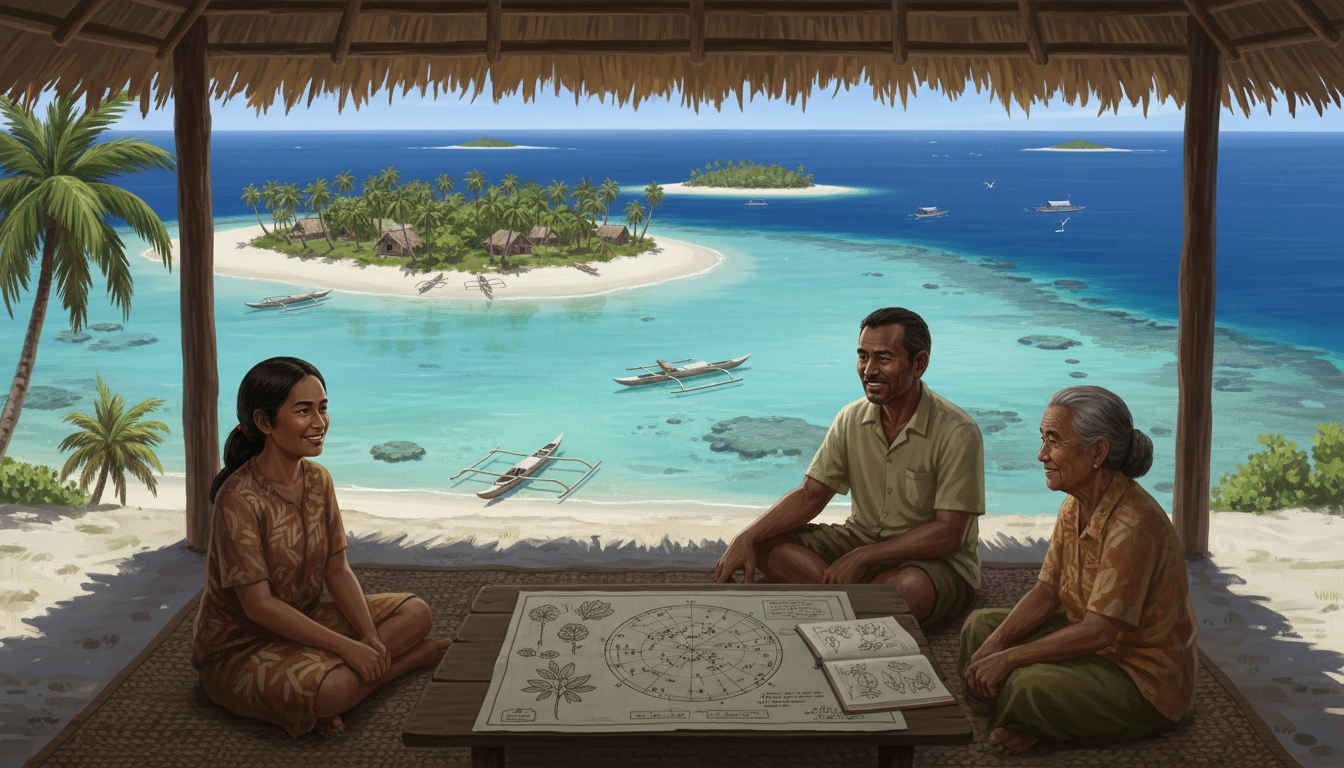
Image transparency: A reused original AI-generated Kiribati-inspired educational illustration depicts fictional adults studying a lagoon and island model. It is a symbolic composite, not a photograph of any one island, a historic reconstruction or a navigation chart. No claim about a named Pacific culture is inferred from the illustration. It is used as educational conceptual artwork with existing media-library provenance. It should not be mistaken for historic visual evidence or for a safety plan. Google image guidance favours relevant surrounding context, helpful alt text and truthful provenance, not keyword-heavy image captions.
Mission 01 — Map islands, reefs, coasts and community needs
Islandbridge scene: The assumption checker draws three fictional islands, one coral reef, a river on the largest island and a sheltered lagoon. The children connect every island with identical straight lines and place the school on the island with the most beautiful beach. The evidence reviewer introduces a student who needs wheelchair access, a ferry worker and a family that does not own a boat. The team sees that geographical proximity and dependable services are not the same thing.
Understand the mechanism and evidence boundary
An archipelago is a group of islands, while each island may differ in geology, relief, freshwater availability, habitat and history. Reefs, lagoons and channels influence possible maritime activity but cannot be judged safe from a drawing. A historical island polity should be investigated through its own records, archaeology and oral traditions. The island network lens names spatial separation and cooperation, not an automatic political constitution.
Historical facts require a named source and the particular period or place it describes. Islandbridge’s routes, needs and quantities are constructed solely for learning. A modern operator’s information also has dates and limitations. Ask pupils to separate what is observed, what is inferred and what is imagined; the most confident speaker is not necessarily the person with the strongest evidence.
Build a service that works for ordinary people
Create three layers: physical land and sea, essential services and routes, and community rights or responsibilities. Label what is observed in a sourced map versus invented in Islandbridge. Place safe public water, care, homes, school and a market, then test access for households with different abilities and schedules. A map of real reefs or routes would need qualified charts and official information.
Add three arrows to the initial diagram: an input, a service to an end user, and a feedback path by which a problem can be reported. Identify who maintains the system and how a new learner could understand the instructions. If an arrow is ambiguous, the team must clarify it before adding more technology. The lesson facilitator recognises inspectable operations, not decoration.
The Maths test and what the answer does not show
The fictional school has 90 pupils, with 25 on island A, 35 on B and 30 on C. If the school offers 60 in-person places on one island and the others require separate transport, there are at least 30 pupils whose ordinary access must be solved another way. This does not establish which route is feasible; accessibility, times and responsibilities have not been specified.
A primary pupil may calculate with counters; a secondary pupil can use a table and calculate the proportion or scenario change. Both should state what the denominator and unit mean. An island with nominal reserves may still have inaccessible supplies, and a service may have spare numerical capacity while being unavailable for practical reasons. The limitation is part of the answer.
The assumption checker’s surprise: which dependency fails?
A rough-water card closes the only sea connection between islands B and C. The supposedly alternate route is simply the same waterway with a different colour. The pupils identify which services remain available locally, which are interrupted and what additional authoritative information would be needed before a practical decision.
The team should record observation, uncertainty, authorised support, a proposed improvement and verification. A fictional safety or public-health issue does not licence real sailing, water treatment or emergency instructions. Pupils learn to be clear about missing expertise and to direct real-world questions to appropriate authorities.
The evidence reviewer’s fairness and cultural respect check
A map should not assume everyone has private transport or can use steep landings. Communities may have customary and legal relationships with shore and reef sites; an unlabeled beach is not automatically public space. A respectful exercise listens to residents without inventing an entire culture’s rights from a tourist photograph.
Ask whose experiences were absent from the first plan, who performs the hidden work and whether affected people can question the decision. The answer may be more complex than a quick vote or a mathematically equal allocation. Every island society has a specific history and rights context; the classroom must not speak as if all Pacific communities were interchangeable.
A family activity and a tutor challenge
At home: Use coloured cardboard islands, paper school and clinic cards, and string routes. Ask another learner to remove a string, then explain which people are affected and what information is missing. Older pupils can calculate group proportions and evaluate a second service layout.
For younger learners, request one labelled picture and three clear sentences. For older learners, add a second scenario, a specific source or a counterexample. Let another child test the instructions without the designer’s help and revise the paper model where the explanation fails.
What this teaches about civilisation
The map becomes a civilisation plan only when the lines describe credible responsibilities, access and continuity instead of decorative connections. The next mission keeps the same Islandbridge map, allowing families and tutors to see how knowledge, access and repair become more detailed across the teaching sequence.
Mission 02 — Keep safe freshwater and sanitation available
Islandbridge scene: The Islandbridge children look at an ocean of blue and declare that water is plentiful. The evidence reviewer asks where a child can actually obtain safe drinking water, and the assumption checker marks the distinction between seawater, stored freshwater, used water and rain. The team discovers that each island may face a different set of constraints even though all are surrounded by the same sea.
Understand the mechanism and evidence boundary
Seawater is not an ordinary source of potable water without appropriate treatment. Islands may depend on varied sources such as rain catchment, groundwater, surface reservoirs, imported supplies or engineered systems, subject to quality controls. Groundwater lenses on some low coral islands can be vulnerable to salinity and contamination, but specific conditions require local evidence. Sanitation, water safety, storage and distribution must be planned separately; a picture of a clear lagoon cannot certify potability.
Historical facts require a named source and the particular period or place it describes. Islandbridge’s routes, needs and quantities are constructed solely for learning. A modern operator’s information also has dates and limitations. Ask pupils to separate what is observed, what is inferred and what is imagined; the most confident speaker is not necessarily the person with the strongest evidence.
Build a service that works for ordinary people
Make a paper flow diagram for each Islandbridge location: source, authorised safety process, usable storage, distribution and end users. Separately show used-water and waste management. Add a qualified provider contact and a public notice process; avoid real treatment or collection instructions. Have students check access during a fictional interruption without assuming household needs are identical.
Add three arrows to the initial diagram: an input, a service to an end user, and a feedback path by which a problem can be reported. Identify who maintains the system and how a new learner could understand the instructions. If an arrow is ambiguous, the team must clarify it before adding more technology. The lesson facilitator recognises inspectable operations, not decoration.
The Maths test and what the answer does not show
Island A has an invented essential demand of 210 water tokens per day, B 160 and C 130: 500 combined. Available usable fictional supply is 540, giving 40 spare. A 15 per cent service loss reduces usable capacity to 459, causing a gap of 41. The tokens are not drinking-water standards or island measurements; they expose how totals and buffers change.
A primary pupil may calculate with counters; a secondary pupil can use a table and calculate the proportion or scenario change. Both should state what the denominator and unit mean. An island with nominal reserves may still have inaccessible supplies, and a service may have spare numerical capacity while being unavailable for practical reasons. The limitation is part of the answer.
The assumption checker’s surprise: which dependency fails?
An unverified message claims that every rooftop rain collection will always be safe to drink, while another message reports a temporary supply problem. The evidence reviewer rewrites the notice to direct people toward legitimate safe-water information. The assumption checker checks date, source and which island’s service is affected rather than pretending one message applies everywhere.
The team should record observation, uncertainty, authorised support, a proposed improvement and verification. A fictional safety or public-health issue does not licence real sailing, water treatment or emergency instructions. Pupils learn to be clear about missing expertise and to direct real-world questions to appropriate authorities.
The evidence reviewer’s fairness and cultural respect check
A distant station may meet aggregate demand but be inaccessible to elderly residents, caregivers or people without transport. Service plans must not rely on private purchasing power alone. The children should investigate fair procedures and support rather than assume an island’s cultural values from its infrastructure.
Ask whose experiences were absent from the first plan, who performs the hidden work and whether affected people can question the decision. The answer may be more complex than a quick vote or a mathematically equal allocation. Every island society has a specific history and rights context; the classroom must not speak as if all Pacific communities were interchangeable.
A family activity and a tutor challenge
At home: Draw five boxes for the public water service and one for sanitation. Make the group trace a failure through each island’s model and name what only an expert may establish. A tutor can use percent reduction and a short public notice as the lesson product.
For younger learners, request one labelled picture and three clear sentences. For older learners, add a second scenario, a specific source or a counterexample. Let another child test the instructions without the designer’s help and revise the paper model where the explanation fails.
What this teaches about civilisation
Water surrounding an island does not make water security automatic. Dependable service comes from quality, knowledge, access, maintenance and fair decisions. The next mission keeps the same Islandbridge map, allowing families and tutors to see how knowledge, access and repair become more detailed across the teaching sequence.
Mission 03 — Balance food systems across land and sea
Islandbridge scene: Islandbridge’s first team places fish baskets at every market and calls the food system complete. The assumption checker asks how the islands obtain other foods, which habitats support fisheries and what happens if a voyage is interrupted. The evidence reviewer asks whether families who do not fish can buy or receive adequate food. A second team discovers that crops and trade on land may be essential to an archipelago’s wellbeing.
Understand the mechanism and evidence boundary
Island food systems can combine crops, fisheries, aquaculture in some contexts, preservation, trade, gardens and regional supply networks. Fish catch cannot be equated automatically with fish population size or nutritional security. Coral reefs, seagrass, mangroves and other habitats can have ecological value, but their functions are specific to places. Food security involves safety, availability, accessibility, diverse needs and the ability to withstand interruptions.
Historical facts require a named source and the particular period or place it describes. Islandbridge’s routes, needs and quantities are constructed solely for learning. A modern operator’s information also has dates and limitations. Ask pupils to separate what is observed, what is inferred and what is imagined; the most confident speaker is not necessarily the person with the strongest evidence.
Build a service that works for ordinary people
Give each fictional island two local food options and one imported item. Draw the route from producer to inspection or handling, storage, public distribution and households. Introduce a seasonal uncertainty card and ask who records losses and verifies usable supply. This is not real fishing or food-preservation advice; children only move paper cards.
Add three arrows to the initial diagram: an input, a service to an end user, and a feedback path by which a problem can be reported. Identify who maintains the system and how a new learner could understand the instructions. If an arrow is ambiguous, the team must clarify it before adding more technology. The lesson facilitator recognises inspectable operations, not decoration.
The Maths test and what the answer does not show
Island A produces 75 units of one food, B 60 and C 45 in the model, totalling 180. If the sea connection prevents 30 units from moving to their intended users, the aggregate production remains 180, but accessible stock at the destination may be only 150. Do not confuse overall quantity with actual availability to a particular family.
A primary pupil may calculate with counters; a secondary pupil can use a table and calculate the proportion or scenario change. Both should state what the denominator and unit mean. An island with nominal reserves may still have inaccessible supplies, and a service may have spare numerical capacity while being unavailable for practical reasons. The limitation is part of the answer.
The assumption checker’s surprise: which dependency fails?
A cargo delivery is delayed and one trader declares the network has no food. The assumption checker checks dated stocks and which type of food is available; the evidence reviewer drafts a truthful response. The team identifies authorised backups and does not propose taking resources from vulnerable people by force.
The team should record observation, uncertainty, authorised support, a proposed improvement and verification. A fictional safety or public-health issue does not licence real sailing, water treatment or emergency instructions. Pupils learn to be clear about missing expertise and to direct real-world questions to appropriate authorities.
The evidence reviewer’s fairness and cultural respect check
Cultural and legal rights to fisheries or coastal resources may matter. A public decision should include fishers, market workers, households, local knowledge holders and ecological responsibility. Beware the narrative that islanders eat only fish or that a single picturesque catch proves all community needs are met.
Ask whose experiences were absent from the first plan, who performs the hidden work and whether affected people can question the decision. The answer may be more complex than a quick vote or a mathematically equal allocation. Every island society has a specific history and rights context; the classroom must not speak as if all Pacific communities were interchangeable.
A family activity and a tutor challenge
At home: Make three paper markets connected with boats and farms. Remove one connection and ask the child to calculate lost delivered supply and propose a record that would reveal the problem early.
For younger learners, request one labelled picture and three clear sentences. For older learners, add a second scenario, a specific source or a counterexample. Let another child test the instructions without the designer’s help and revise the paper model where the explanation fails.
What this teaches about civilisation
A rich ocean is not a complete menu, and successful harvesting is not identical to a fair or dependable food system. The next mission keeps the same Islandbridge map, allowing families and tutors to see how knowledge, access and repair become more detailed across the teaching sequence.
Mission 04 — Understand navigation and seasonal connections
Islandbridge scene: The assumption checker draws a short dotted route across Islandbridge’s lagoon, and the pupils nominate it as the best. The evidence reviewer asks whether a parent travelling to care understands the timetable and who decides when a boat can operate. An ‘unsafe conditions’ card removes the route; suddenly the team must distinguish straight-line distance, actual safe availability and truthful communication.
Understand the mechanism and evidence boundary
Marine navigation requires specific skills, knowledge, vessels, relevant charts, weather information, competent operators and compliance with law. Pacific and other island peoples developed rich ocean-going navigation traditions in particular cultures and periods; these are not a single universal technique. Modern forecasts and digital navigation can be useful, but a school map is never a chart for real travel. UNESCO’s Taputapuātea illustrates relationships among ceremonial landscapes, navigation, sea routes and Polynesian connections.
Historical facts require a named source and the particular period or place it describes. Islandbridge’s routes, needs and quantities are constructed solely for learning. A modern operator’s information also has dates and limitations. Ask pupils to separate what is observed, what is inferred and what is imagined; the most confident speaker is not necessarily the person with the strongest evidence.
Build a service that works for ordinary people
Make a timetable and service-availability board with separate fields for scheduled, confirmed, delayed and unavailable. Each island has essential travel needs, a contact process and an alternate plan that does not instruct anyone to travel when conditions are unsafe. Test whether an older resident or a pupil can understand the notice, including dates and sources.
Add three arrows to the initial diagram: an input, a service to an end user, and a feedback path by which a problem can be reported. Identify who maintains the system and how a new learner could understand the instructions. If an arrow is ambiguous, the team must clarify it before adding more technology. The lesson facilitator recognises inspectable operations, not decoration.
The Maths test and what the answer does not show
A teaching vessel carries at most 24 passenger tokens each round. If 80 people require transportation over multiple rounds, four trips are an arithmetic capacity minimum with 96 nominal spaces. This calculation says nothing about legal passenger limits, timings, vessel suitability or safety. Ask learners to state the hidden assumptions.
A primary pupil may calculate with counters; a secondary pupil can use a table and calculate the proportion or scenario change. Both should state what the denominator and unit mean. An island with nominal reserves may still have inaccessible supplies, and a service may have spare numerical capacity while being unavailable for practical reasons. The limitation is part of the answer.
The assumption checker’s surprise: which dependency fails?
A forwarded timetable is older than the actual disruption notice. The group must correct the record rather than rely on the most popular message. The assumption checker checks what is known, and the evidence reviewer makes the revised message understandable to residents without devices.
The team should record observation, uncertainty, authorised support, a proposed improvement and verification. A fictional safety or public-health issue does not licence real sailing, water treatment or emergency instructions. Pupils learn to be clear about missing expertise and to direct real-world questions to appropriate authorities.
The evidence reviewer’s fairness and cultural respect check
Historic navigational knowledge should be credited to the cultures that hold it; stories and sacred information are not automatically available for copying. Accessible transport affects education and care, especially for residents who cannot use private boats.
Ask whose experiences were absent from the first plan, who performs the hidden work and whether affected people can question the decision. The answer may be more complex than a quick vote or a mathematically equal allocation. Every island society has a specific history and rights context; the classroom must not speak as if all Pacific communities were interchangeable.
A family activity and a tutor challenge
At home: Place a schedule beside three paper islands, cancel one imaginary service, recalculate minimum capacity and compose a dated notice without suggesting any real voyage.
For younger learners, request one labelled picture and three clear sentences. For older learners, add a second scenario, a specific source or a counterexample. Let another child test the instructions without the designer’s help and revise the paper model where the explanation fails.
What this teaches about civilisation
Navigational knowledge and public transport reliability are connected but distinct, and both require responsible people and truthful information. The next mission keeps the same Islandbridge map, allowing families and tutors to see how knowledge, access and repair become more detailed across the teaching sequence.
Mission 05 — Design reliable ferry, boat and access networks
Islandbridge scene: Islandbridge has two routes printed on its map, so the children proudly label it resilient. The assumption checker traces both lines to the same tiny landing place; a closure of that site would interrupt both. The evidence reviewer asks how a patient, pupil and worker would obtain help when the supposed alternatives depend on the same node.
Understand the mechanism and evidence boundary
Transport networks consist of nodes and links, and reliability requires more than multiple lines. Ferries may depend on landings, vessels, crew, permits, weather, maintenance, information and appropriate service priorities. In real settings, routes and schedules must come from operators and competent authorities. In a fictional classroom, students can examine network design safely without estimating real travel times or directing voyages.
Historical facts require a named source and the particular period or place it describes. Islandbridge’s routes, needs and quantities are constructed solely for learning. A modern operator’s information also has dates and limitations. Ask pupils to separate what is observed, what is inferred and what is imagined; the most confident speaker is not necessarily the person with the strongest evidence.
Build a service that works for ordinary people
Draw one ordinary and one disruption network. Label shared landing points, accessible pedestrian paths and services that rely on each crossing. Assign a qualified responsible operator card to every transport element. Add an information alternative for a family without a phone and ask what would be possible locally if movement stops.
Add three arrows to the initial diagram: an input, a service to an end user, and a feedback path by which a problem can be reported. Identify who maintains the system and how a new learner could understand the instructions. If an arrow is ambiguous, the team must clarify it before adding more technology. The lesson facilitator recognises inspectable operations, not decoration.
The Maths test and what the answer does not show
A fictional service carries up to 30 supply crates per arrival. The island needs 110 crates under its stated assumption; four completed services carry up to 120. If one planned service is unavailable, remaining nominal capacity is 90, a shortfall of 20. The quantities do not reveal real voyage feasibility, cargo safety, lead time or handling restrictions.
A primary pupil may calculate with counters; a secondary pupil can use a table and calculate the proportion or scenario change. Both should state what the denominator and unit mean. An island with nominal reserves may still have inaccessible supplies, and a service may have spare numerical capacity while being unavailable for practical reasons. The limitation is part of the answer.
The assumption checker’s surprise: which dependency fails?
The harbour crossing is interrupted. A council member points to the secondary line without noticing the shared terminal. The assumption checker marks the common-cause failure; the evidence reviewer requires a corrected public statement and a verifiable plan rather than a reassuring but false claim.
The team should record observation, uncertainty, authorised support, a proposed improvement and verification. A fictional safety or public-health issue does not licence real sailing, water treatment or emergency instructions. Pupils learn to be clear about missing expertise and to direct real-world questions to appropriate authorities.
The evidence reviewer’s fairness and cultural respect check
Ferry access matters differently to households seeking health care, school, work or social connections. A fair service policy recognises diverse needs without asserting authority to override actual transport safety rules. Do not represent every small island community as uniformly isolated.
Ask whose experiences were absent from the first plan, who performs the hidden work and whether affected people can question the decision. The answer may be more complex than a quick vote or a mathematically equal allocation. Every island society has a specific history and rights context; the classroom must not speak as if all Pacific communities were interchangeable.
A family activity and a tutor challenge
At home: Use string and paper landings. Close one shared landing and discover why two apparent routes are not independent. Ask learners to write a systems explanation rather than invent a marine safety instruction.
For younger learners, request one labelled picture and three clear sentences. For older learners, add a second scenario, a specific source or a counterexample. Let another child test the instructions without the designer’s help and revise the paper model where the explanation fails.
What this teaches about civilisation
More routes on a diagram can conceal one crucial weakness; resilience depends on independent capacity and tested operating arrangements. The next mission keeps the same Islandbridge map, allowing families and tutors to see how knowledge, access and repair become more detailed across the teaching sequence.
Mission 06 — Protect public health, schooling and community care
Islandbridge scene: A child’s family moves from Islandbridge C to Islandbridge A for a season, but their school notebook stays at the other island’s classroom. The evidence reviewer asks whether a child should lose continuity because their family lives among separated places. The assumption checker checks the communication and records pathways and a model of how qualified care providers can be reached during a delayed service.
Understand the mechanism and evidence boundary
Human welfare depends on health, education, social support and legitimate public institutions regardless of island size. Some services may be local, others regional or remote, and arrangements vary by law, resources and geography. Digital tools may assist continuity but can be unavailable and may involve privacy considerations. A paper lesson should not prescribe medical treatment or override responsibilities of qualified educators and health professionals.
Historical facts require a named source and the particular period or place it describes. Islandbridge’s routes, needs and quantities are constructed solely for learning. A modern operator’s information also has dates and limitations. Ask pupils to separate what is observed, what is inferred and what is imagined; the most confident speaker is not necessarily the person with the strongest evidence.
Build a service that works for ordinary people
Write a mock pupil learning record containing no actual personal information, a next-step plan, a responsible teacher and a paper fallback. Draw a separate clinic-contact procedure that distinguishes obtaining information from actual care. Have a student who did not design it attempt to follow the instructions, then revise confusing parts.
Add three arrows to the initial diagram: an input, a service to an end user, and a feedback path by which a problem can be reported. Identify who maintains the system and how a new learner could understand the instructions. If an arrow is ambiguous, the team must clarify it before adding more technology. The lesson facilitator recognises inspectable operations, not decoration.
The Maths test and what the answer does not show
In the learning model, 72 pupils are scheduled to receive twelve activities each, totalling 864 activity assignments. A disruption affects three activities per pupil, creating 216 delayed activity slots. That arithmetic does not measure learning loss; pupils’ understanding must be assessed through appropriate retrieval and transfer probes.
A primary pupil may calculate with counters; a secondary pupil can use a table and calculate the proportion or scenario change. Both should state what the denominator and unit mean. An island with nominal reserves may still have inaccessible supplies, and a service may have spare numerical capacity while being unavailable for practical reasons. The limitation is part of the answer.
The assumption checker’s surprise: which dependency fails?
An internet outage makes the timetable and learning record unavailable. A naive plan blames pupils for not accessing a platform. The evidence reviewer requires a fair continuation, while the assumption checker checks whether the proposed paper backup actually exists and can be used securely.
The team should record observation, uncertainty, authorised support, a proposed improvement and verification. A fictional safety or public-health issue does not licence real sailing, water treatment or emergency instructions. Pupils learn to be clear about missing expertise and to direct real-world questions to appropriate authorities.
The evidence reviewer’s fairness and cultural respect check
A child’s access to appropriate schooling, safeguarding and care should not depend on wealth, disability, language or owning a boat. There may be hard resource constraints, but a humane plan makes the burden explicit and seeks lawful, practical alternatives.
Ask whose experiences were absent from the first plan, who performs the hidden work and whether affected people can question the decision. The answer may be more complex than a quick vote or a mathematically equal allocation. Every island society has a specific history and rights context; the classroom must not speak as if all Pacific communities were interchangeable.
A family activity and a tutor challenge
At home: Create a mock learning passport and a continuity scenario. Ask pupils to teach back one concept after the route is restored rather than counting attendance alone as success.
For younger learners, request one labelled picture and three clear sentences. For older learners, add a second scenario, a specific source or a counterexample. Let another child test the instructions without the designer’s help and revise the paper model where the explanation fails.
What this teaches about civilisation
An island network becomes more capable when education and care continue across its geography instead of assuming everyone lives beside the largest centre. The next mission keeps the same Islandbridge map, allowing families and tutors to see how knowledge, access and repair become more detailed across the teaching sequence.
Mission 07 — Plan ports, markets, storage and inventories
Islandbridge scene: The Islandbridge ferry unloads a stack of crates, and pupils announce that the island’s food shortage is finished. The assumption checker asks whether the goods were inspected, recorded and delivered to the intended users. The evidence reviewer asks whether people with limited mobility can reach the market and whether a paper receipt says the truth. Arrival at a port is only one handoff in a much longer supply chain.
Understand the mechanism and evidence boundary
Island provisioning depends on sourcing, shipping, landing, safe storage, local movement, honest measures and public communication. Imported goods can expand choice and create vulnerability when deliveries are interrupted. Inventory should distinguish ordered, arrived, inspected, usable and distributed quantities. Real food and medical handling belongs to trained operators; this article uses fictional tokens and does not provide safety procedures.
Historical facts require a named source and the particular period or place it describes. Islandbridge’s routes, needs and quantities are constructed solely for learning. A modern operator’s information also has dates and limitations. Ask pupils to separate what is observed, what is inferred and what is imagined; the most confident speaker is not necessarily the person with the strongest evidence.
Build a service that works for ordinary people
Give each island a small stock ledger and a map of receiving, storage, school, clinic and household routes. Every handoff needs a sender, receiver, date and evidence of condition. One entry is deliberately wrong. Ask a new student to reconcile the record with the physical paper cards, then document the correction.
Add three arrows to the initial diagram: an input, a service to an end user, and a feedback path by which a problem can be reported. Identify who maintains the system and how a new learner could understand the instructions. If an arrow is ambiguous, the team must clarify it before adding more technology. The lesson facilitator recognises inspectable operations, not decoration.
The Maths test and what the answer does not show
A ferry is said to bring 120 paper crates. The ledger assigns 40 to market A, 35 to school and care, 30 to local stores and 10 to a neighbouring island: only 115 accounted for, leaving five unallocated. The missing five should trigger an inspection or record check, not an immediate accusation. The discrepancy is 5/120 ≈4.17 per cent.
A primary pupil may calculate with counters; a secondary pupil can use a table and calculate the proportion or scenario change. Both should state what the denominator and unit mean. An island with nominal reserves may still have inaccessible supplies, and a service may have spare numerical capacity while being unavailable for practical reasons. The limitation is part of the answer.
The assumption checker’s surprise: which dependency fails?
The network’s shared warehouse route is interrupted, and a rumour claims all supplies vanished. The assumption checker checks source and recorded usable stock, while the evidence reviewer prepares a calm update. The group tests whether another delivery method shares the same blocked landing.
The team should record observation, uncertainty, authorised support, a proposed improvement and verification. A fictional safety or public-health issue does not licence real sailing, water treatment or emergency instructions. Pupils learn to be clear about missing expertise and to direct real-world questions to appropriate authorities.
The evidence reviewer’s fairness and cultural respect check
A supposedly efficient system may give priority to businesses that can pay for private delivery while essential households wait. The classroom designs an accountable decision process and accessible information without pretending it can replace actual law or emergency authorities.
Ask whose experiences were absent from the first plan, who performs the hidden work and whether affected people can question the decision. The answer may be more complex than a quick vote or a mathematically equal allocation. Every island society has a specific history and rights context; the classroom must not speak as if all Pacific communities were interchangeable.
A family activity and a tutor challenge
At home: Use paper parcels and receipts to trace their route from ferry to user. Introduce a five-crate discrepancy and let the team repair the record after checking evidence.
For younger learners, request one labelled picture and three clear sentences. For older learners, add a second scenario, a specific source or a counterexample. Let another child test the instructions without the designer’s help and revise the paper model where the explanation fails.
What this teaches about civilisation
Supply success is verified handoff to the people who need goods, not a photograph of arriving freight. The next mission keeps the same Islandbridge map, allowing families and tutors to see how knowledge, access and repair become more detailed across the teaching sequence.
Mission 08 — Respect navigation heritage, language and cultural knowledge
Islandbridge scene: The children read about Polynesian ocean navigation and want to copy every practice into Islandbridge. The evidence reviewer reminds them that cultural knowledge has named holders and may include sacred or restricted meaning. The assumption checker asks which statements are supported by UNESCO’s Taputapuātea description and which are inventions added to the game. The learners revise their account to credit its sources.
Understand the mechanism and evidence boundary
Island societies have rich histories of navigation, oral tradition, political institutions, craft and cultural exchange. UNESCO’s Taputapuātea recognises a cultural seascape on Raiatea linked with Polynesian networks and ceremonial spaces. UNESCO’s Chief Roi Mata’s Domain in Vanuatu describes continuing landscape relationships with oral tradition and chiefly authority. These cannot be merged into one anonymous ‘island culture’, and preserved sites do not prove all groups shared identical beliefs.
Historical facts require a named source and the particular period or place it describes. Islandbridge’s routes, needs and quantities are constructed solely for learning. A modern operator’s information also has dates and limitations. Ask pupils to separate what is observed, what is inferred and what is imagined; the most confident speaker is not necessarily the person with the strongest evidence.
Build a service that works for ordinary people
Make a two-column teaching sheet labelled ‘documented by source’ and ‘our fictional learning model’. A third column holds sensitive knowledge that should not be reproduced without permission. Children write a plain-language harbour notice in their own words, credit the historical institution for factual statements and ask whether readers unfamiliar with its terminology would understand.
Add three arrows to the initial diagram: an input, a service to an end user, and a feedback path by which a problem can be reported. Identify who maintains the system and how a new learner could understand the instructions. If an arrow is ambiguous, the team must clarify it before adding more technology. The lesson facilitator recognises inspectable operations, not decoration.
The Maths test and what the answer does not show
In a pretend island survey, 100 households prefer notices by phone (45), paper (30), community meeting (15) or calls (10). Those are exclusive fictional choices, not a real sample. If the council uses only phones, 55 households prefer other channels. Preference alone does not measure actual delivery or understanding; ask what would establish coverage.
A primary pupil may calculate with counters; a secondary pupil can use a table and calculate the proportion or scenario change. Both should state what the denominator and unit mean. An island with nominal reserves may still have inaccessible supplies, and a service may have spare numerical capacity while being unavailable for practical reasons. The limitation is part of the answer.
The assumption checker’s surprise: which dependency fails?
A translated announcement has the wrong date and a newcomer follows it. The class must correct the published version instead of blaming unfamiliar people or asserting that one language is superior.
The team should record observation, uncertainty, authorised support, a proposed improvement and verification. A fictional safety or public-health issue does not licence real sailing, water treatment or emergency instructions. Pupils learn to be clear about missing expertise and to direct real-world questions to appropriate authorities.
The evidence reviewer’s fairness and cultural respect check
Some cultural practices and stories require informed consent and careful attribution. Historical forms of power may have excluded some people; recognising achievements does not require pretending the past was always fair. A respectful lesson separates cultural significance from invented claims about individuals.
Ask whose experiences were absent from the first plan, who performs the hidden work and whether affected people can question the decision. The answer may be more complex than a quick vote or a mathematically equal allocation. Every island society has a specific history and rights context; the classroom must not speak as if all Pacific communities were interchangeable.
A family activity and a tutor challenge
At home: Compare a UNESCO description with a fictional Islandbridge speech. Highlight factual statements, interpretations and imaginative dialogue in three colours, and replace an overconfident caption with a sourced note.
For younger learners, request one labelled picture and three clear sentences. For older learners, add a second scenario, a specific source or a counterexample. Let another child test the instructions without the designer’s help and revise the paper model where the explanation fails.
What this teaches about civilisation
Historical sophistication grows clearer through precise attribution and respectful uncertainty, not through generic stereotypes or copying sacred traditions. The next mission keeps the same Islandbridge map, allowing families and tutors to see how knowledge, access and repair become more detailed across the teaching sequence.
Mission 09 — Coordinate fair agreements across separate islands
classroom activity scene: A shared ferry agreement was announced by the large island before anyone consulted residents of the smaller islands. The fictional route depends on one landing that all three share, yet only one council has arranged maintenance. The evidence reviewer asks whose voice is missing. The assumption checker questions whether the agreement has authority, funding, an accessible notice and a way to resolve disputes.
Understand the physical and social mechanism
Political and customary arrangements vary; island societies are not one political system. A shared service needs identified participants, lawful authority, budget responsibilities, access rules, review and appeal. A historical case such as Chief Roi Mata’s Domain in Vanuatu provides evidence for particular traditions and institutions, not a universal constitution for all archipelagos.
The classroom model is invented. When naming a living community or historical island, give its location and period and cite appropriate sources. A material remain, an oral account and a current official notice may each answer different questions. The responsible habit is to describe what is established and what needs further evidence rather than filling every gap with a confident story.
Map the responsibilities and the missing information
At the lesson facilitator, the children draw the flow of resources, people and public messages. A line between places is not yet a functioning service. It needs an input, an accountable maintainer, a way for a resident to report a problem and a method for confirming that the issue was addressed. Have a fresh student read the diagram without help from the original author. Where a label creates confusion, improve it before adding another structure.
Mathematics with a clear interpretation
Three councils contribute 25, 35 and 40 tokens, totalling 100. A repair costs 18. Six extra tokens each would balance the budget, but an equal split could be unfair if benefits and ability to contribute differ. Which additional information would justify a different formula?
Teach pupils to underline units and time periods and say what the denominator means. A balanced total may conceal unequal access; a higher score can hide a safety-critical weakness; and a numerical claim about an invented civilisation is not a statistic for a real place. Older students should write one missing-evidence question or test a second scenario.
The assumption checker’s interruption and correction
An unannounced schedule change leaves residents on B and C using old information; they are accused of breaking a rule they had no reliable chance to read.
Consult affected people, distinguish the verified rule from rumour, correct the communication and propose a transparent appeal without allowing one powerful centre to speak automatically for everybody.
Students should distinguish confirmed information from rumour, use qualified or lawful decision makers for real-world risks, and record a check that would verify any eventual improvement. A paper scenario cannot certify navigation, water quality, ecological impact or safety. The purpose is to cultivate precise inquiry and calm correction rather than dramatic improvisation.
The evidence reviewer’s fairness check
Ask whose views and practical needs were omitted. Residents of small communities, workers who perform maintenance, children, older people and people with disabilities may be affected differently. Give each stakeholder a chance to pose one objection. This does not mean that all objections prove the same thing; it means decisions should be based on legitimate authority and accountable evidence, with a peaceful way to challenge an error.
Family task and tutor extension
Hold a paper council meeting with three groups and a new ferry rule. Require a dated notice, a budget explanation, a maintenance role and a peaceful appeal. Ask an older learner to compare equality with equity.
For Primary children, ask for a labelled map and three sentences beginning ‘We noticed’, ‘We checked’ and ‘We changed’. For Secondary learners, add a quantity, a source boundary and an alternative. Keep the first model so the learner can demonstrate precisely how the revision improved it.
Carry the lesson to the next island
A reliable archipelago is an organised network of physical services, human responsibilities, rights, knowledge and corrective processes. Add the current evidence and one remaining uncertainty to Islandbridge’s continuing learning notebook rather than claiming the system can never fail.
Mission 10 — Protect coastal ecosystems and customary stewardship
classroom activity scene: A developer calls the Islandbridge lagoon empty because it has no houses. The assumption checker places conceptual habitat symbols across the water, while the evidence reviewer asks about resource users and whether there is permission to build. The first pretty map has become a misleading claim about open land and sea.
Understand the physical and social mechanism
Island habitats vary dramatically. Coral reefs, seagrass, mangroves and marine lakes have different ecological functions and sensitivities; Palau Rock Islands and East Rennell demonstrate distinctive environments. Protected or customary sites must not be treated as vacant spaces. A paper diagram is not an environmental assessment.
The classroom model is invented. When naming a living community or historical island, give its location and period and cite appropriate sources. A material remain, an oral account and a current official notice may each answer different questions. The responsible habit is to describe what is established and what needs further evidence rather than filling every gap with a confident story.
Map the responsibilities and the missing information
At the lesson facilitator, the children draw the flow of resources, people and public messages. A line between places is not yet a functioning service. It needs an input, an accountable maintainer, a way for a resident to report a problem and a method for confirming that the issue was addressed. Have a fresh student read the diagram without help from the original author. Where a label creates confusion, improve it before adding another structure.
Mathematics with a clear interpretation
Of 200 hypothetical marine squares, 55 are flagged for professional ecological assessment and 145 are not yet assessed. Calculating 72.5 per cent unflagged does not establish that 72.5 per cent may safely be developed. Unknown does not mean suitable.
Teach pupils to underline units and time periods and say what the denominator means. A balanced total may conceal unequal access; a higher score can hide a safety-critical weakness; and a numerical claim about an invented civilisation is not a statistic for a real place. Older students should write one missing-evidence question or test a second scenario.
The assumption checker’s interruption and correction
A promotion promises zero ecological harm before any measurements or consultations have taken place.
Name the absent evidence and affected communities, compare alternative locations or demand changes, and replace absolute claims with testable statements. No real construction, sampling or access is authorised by the lesson.
Students should distinguish confirmed information from rumour, use qualified or lawful decision makers for real-world risks, and record a check that would verify any eventual improvement. A paper scenario cannot certify navigation, water quality, ecological impact or safety. The purpose is to cultivate precise inquiry and calm correction rather than dramatic improvisation.
The evidence reviewer’s fairness check
Ask whose views and practical needs were omitted. Residents of small communities, workers who perform maintenance, children, older people and people with disabilities may be affected differently. Give each stakeholder a chance to pose one objection. This does not mean that all objections prove the same thing; it means decisions should be based on legitimate authority and accountable evidence, with a peaceful way to challenge an error.
Family task and tutor extension
Use clear overlays for habitat, cultural access and public services. Ask one child to propose a route and another to identify what the drawing cannot prove about ecology or legal rights.
For Primary children, ask for a labelled map and three sentences beginning ‘We noticed’, ‘We checked’ and ‘We changed’. For Secondary learners, add a quantity, a source boundary and an alternative. Keep the first model so the learner can demonstrate precisely how the revision improved it.
Carry the lesson to the next island
A reliable archipelago is an organised network of physical services, human responsibilities, rights, knowledge and corrective processes. Add the current evidence and one remaining uncertainty to Islandbridge’s continuing learning notebook rather than claiming the system can never fail.
Mission 11 — Account for waste, repair and the materials life cycle
classroom activity scene: Every supply arrow points into Islandbridge, but nothing shows a product’s repair, reuse or final destination. The assumption checker moves the spent paper tokens to the edge of the map and asks who is responsible. The evidence reviewer wonders whether exporting a cost merely makes it harder for residents to see.
Understand the physical and social mechanism
Small island waste systems may face constraints in infrastructure and transport; circumstances vary. Repair and material efficiency can help but require safe operations, proper accounting and legitimate disposal. Recycling labels are not proof of net environmental benefit, and hazardous materials should never be used in classroom demonstrations.
The classroom model is invented. When naming a living community or historical island, give its location and period and cite appropriate sources. A material remain, an oral account and a current official notice may each answer different questions. The responsible habit is to describe what is established and what needs further evidence rather than filling every gap with a confident story.
Map the responsibilities and the missing information
At the lesson facilitator, the children draw the flow of resources, people and public messages. A line between places is not yet a functioning service. It needs an input, an accountable maintainer, a way for a resident to report a problem and a method for confirming that the issue was addressed. Have a fresh student read the diagram without help from the original author. Where a label creates confusion, improve it before adding another structure.
Mathematics with a clear interpretation
A paper ledger receives 360 tokens. It records 120 reused, 90 recovered and 150 assigned for other disposal, so the reuse-and-recovery fraction is 210/360 or about 58.3 per cent. That fraction does not establish carbon neutrality or verified end treatment.
Teach pupils to underline units and time periods and say what the denominator means. A balanced total may conceal unequal access; a higher score can hide a safety-critical weakness; and a numerical claim about an invented civilisation is not a statistic for a real place. Older students should write one missing-evidence question or test a second scenario.
The assumption checker’s interruption and correction
A contractor claims every exported item is recycled, although the records stop at the quay.
Require a traceable chain of custody, correct the unsupported claim and identify the people and ecosystems bearing hidden burdens without making accusations unsupported by evidence.
Students should distinguish confirmed information from rumour, use qualified or lawful decision makers for real-world risks, and record a check that would verify any eventual improvement. A paper scenario cannot certify navigation, water quality, ecological impact or safety. The purpose is to cultivate precise inquiry and calm correction rather than dramatic improvisation.
The evidence reviewer’s fairness check
Ask whose views and practical needs were omitted. Residents of small communities, workers who perform maintenance, children, older people and people with disabilities may be affected differently. Give each stakeholder a chance to pose one objection. This does not mean that all objections prove the same thing; it means decisions should be based on legitimate authority and accountable evidence, with a peaceful way to challenge an error.
Family task and tutor extension
Make a four-product paper life-cycle ledger from purchase to use, repair, reuse and lawful disposal. Ask where the evidence trail ends and name two missing environmental variables.
For Primary children, ask for a labelled map and three sentences beginning ‘We noticed’, ‘We checked’ and ‘We changed’. For Secondary learners, add a quantity, a source boundary and an alternative. Keep the first model so the learner can demonstrate precisely how the revision improved it.
Carry the lesson to the next island
A reliable archipelago is an organised network of physical services, human responsibilities, rights, knowledge and corrective processes. Add the current evidence and one remaining uncertainty to Islandbridge’s continuing learning notebook rather than claiming the system can never fail.
Mission 12 — Build accessible warning and information systems
classroom activity scene: Residents see two ferry notices with conflicting dates. Some have phones, some rely on a public board and others use community contacts. The evidence reviewer asks what a child should read, while the assumption checker checks the original issuer and whether repeated screenshots are independent evidence.
Understand the physical and social mechanism
Reliable public messages include a source, valid time, affected location, clear status and a correction route. Digital communication may not reach people without connectivity or suitable language. Historic island information systems varied, and modern smartphones should not be projected backward as a universal feature.
The classroom model is invented. When naming a living community or historical island, give its location and period and cite appropriate sources. A material remain, an oral account and a current official notice may each answer different questions. The responsible habit is to describe what is established and what needs further evidence rather than filling every gap with a confident story.
Map the responsibilities and the missing information
At the lesson facilitator, the children draw the flow of resources, people and public messages. A line between places is not yet a functioning service. It needs an input, an accountable maintainer, a way for a resident to report a problem and a method for confirming that the issue was addressed. Have a fresh student read the diagram without help from the original author. Where a label creates confusion, improve it before adding another structure.
Mathematics with a clear interpretation
Out of 200 households, 130 receive a digital notice and 100 a paper copy; 65 are in both groups. The union is 165, leaving 35 unreached. Simply adding 130 and 100 would double-count overlap. Even delivery does not demonstrate comprehension.
Teach pupils to underline units and time periods and say what the denominator means. A balanced total may conceal unequal access; a higher score can hide a safety-critical weakness; and a numerical claim about an invented civilisation is not a statistic for a real place. Older students should write one missing-evidence question or test a second scenario.
The assumption checker’s interruption and correction
An old undated screenshot is forwarded as if it describes current service status.
Verify against a dated authoritative source, correct obsolete copies and maintain a non-digital channel. The simulation does not direct anyone to travel or undertake emergency actions.
Students should distinguish confirmed information from rumour, use qualified or lawful decision makers for real-world risks, and record a check that would verify any eventual improvement. A paper scenario cannot certify navigation, water quality, ecological impact or safety. The purpose is to cultivate precise inquiry and calm correction rather than dramatic improvisation.
The evidence reviewer’s fairness check
Ask whose views and practical needs were omitted. Residents of small communities, workers who perform maintenance, children, older people and people with disabilities may be affected differently. Give each stakeholder a chance to pose one objection. This does not mean that all objections prove the same thing; it means decisions should be based on legitimate authority and accountable evidence, with a peaceful way to challenge an error.
Family task and tutor extension
Create two fictional notices and test them with a younger learner. Use counters for overlap and ask how households not reached by either channel can seek accurate information.
For Primary children, ask for a labelled map and three sentences beginning ‘We noticed’, ‘We checked’ and ‘We changed’. For Secondary learners, add a quantity, a source boundary and an alternative. Keep the first model so the learner can demonstrate precisely how the revision improved it.
Carry the lesson to the next island
A reliable archipelago is an organised network of physical services, human responsibilities, rights, knowledge and corrective processes. Add the current evidence and one remaining uncertainty to Islandbridge’s continuing learning notebook rather than claiming the system can never fail.
Mission 13 — Test storms, sea disruption and essential supply continuity
classroom activity episode: Islandbridge has planned for a calm season. The assumption checker adds one fictional rough-weather closure and a temporary loss of the service-notice network. The evidence reviewer asks what the families really know about water, care and usable reserves. The first group’s elaborate emergency poster has never been read by anyone outside the team.
The science and social mechanism
A resilience plan links prevention, preparedness, accurate warnings, continuity of essentials, recovery and learning. Different island environments face different hazards; a coral atoll, volcanic high island and raised limestone island cannot be treated as technically identical. A paper test must never be used to direct real sea travel or emergencies, and actual warnings belong to responsible authorities.
Because the model is fictional, its numbers cannot establish anything about the actual safety, laws or cultural history of an island. Real source material must be attributed to named peoples, institutions and periods. A careful pupil explains the boundary between what has been observed and what merely seems plausible.
Design a system that somebody can maintain
Show the essential input, end user, maintainer and an accountable route for a correction. If the whole function relies on one individual or one platform, circle that point of failure. The evidence reviewer asks whether a younger learner or a resident without devices can understand how to seek help. The assumption checker examines whether the proposed alternative avoids the same original weakness.
Mathematics that does not hide its assumptions
The fictional food reserve holds 1,440 tokens with ordinary demand 240 per day: six days. A model change to 288 per day reduces cover to five days. If inspection removes 144 unusable tokens, 1,296 remain, equal to 4.5 days at the new rate. A service plan must change its public claim when these assumptions change.
A number can be exact within a teaching game while remaining unsupported as a real-world statistic. Ask students to state the time period, denominator and units. The most useful next question may concern access, safety or a missing measurement rather than further decimal places.
The interruption and a verified correction
The backup ferry relies on the same temporarily unavailable landing as the first. What the map calls two independent connections is one shared failure point.
Correct the message, identify services that remain usable locally, seek appropriate authorised alternatives and make a record of the weakness. Do not instruct unqualified people to travel during unsafe conditions. A future backup counts only after its operation has been verified.
The classroom response is a responsible learning sequence: observe, separate facts from uncertain claims, seek authorised support for critical decisions, revise the proposal, and plan verification. The group should never issue real weather, emergency, navigation or medical advice from this game.
The people affected
Families with fewer resources or mobility limitations may have little private capacity to improvise. A humane response recognises access to public care and accurate information without placing every burden on individuals.
Assign one student as the service user, one the maintainer, one a concerned neighbour and one an evidence reviewer. The reviewer should identify a hidden cost or an unsupported claim. Rotate these roles so the most confident student does not always determine the answer. Fairness is not guaranteed by a numerical total.
Try it with a parent or tutor
Close one node in a cardboard archipelago and recompute the fictional reserve duration. Secondary learners must show the changed denominator and prepare a dated correction.
Parents can request a three-sentence teach-back and a revised picture. Tutors can add a Maths calculation, one externally sourced historical claim, and an explanation of what the case does not prove. The child should show how feedback altered the first decision.
The principle to inherit
In Islandbridge, the best idea is the one that future children can understand, test and improve while protecting people and respecting the living environments and cultures on which they depend. Carry this principle forward without pretending that every real island society needs the same institutions.
Mission 14 — Keep digital tools accurate with offline alternatives
classroom activity episode: The school, food store and ferry office all use a single Islandbridge platform. The dashboard looks impressively efficient until the assumption checker removes internet access. The evidence reviewer asks whether families can still find the school timetable, obtain verified care information and correct an old service notice.
The science and social mechanism
Modern communications, sensors and databases can help coordination but depend on electricity, networking, maintenance, accurate inputs, privacy safeguards and competent oversight. A dashboard does not certify the state of an actual harbour or marine route. Societies also preserve important knowledge through spoken, written, craft and local practices, which should not be dismissed because they are not digital.
Because the model is fictional, its numbers cannot establish anything about the actual safety, laws or cultural history of an island. Real source material must be attributed to named peoples, institutions and periods. A careful pupil explains the boundary between what has been observed and what merely seems plausible.
Design a system that somebody can maintain
Show the essential input, end user, maintainer and an accountable route for a correction. If the whole function relies on one individual or one platform, circle that point of failure. The evidence reviewer asks whether a younger learner or a resident without devices can understand how to seek help. The assumption checker examines whether the proposed alternative avoids the same original weakness.
Mathematics that does not hide its assumptions
The imagined platform records 25 transactions per session over four sessions, giving 100 potential records. An outage cancels one entire session; only 75 are verified through that process, a drop of 25 per cent. This does not reveal real capacity or whether an authorised paper workaround could make up the difference.
A number can be exact within a teaching game while remaining unsupported as a real-world statistic. Ask students to state the time period, denominator and units. The most useful next question may concern access, safety or a missing measurement rather than further decimal places.
The interruption and a verified correction
A stale digital map continues to show an old route status and staff have no tested offline procedure. Residents receive confident but outdated guidance.
Mark information as dated and uncertain, consult the legitimate service source, create a tested privacy-respecting fallback and record who can issue corrections. Technology should assist, not replace, accountable human judgement.
The classroom response is a responsible learning sequence: observe, separate facts from uncertain claims, seek authorised support for critical decisions, revise the proposal, and plan verification. The group should never issue real weather, emergency, navigation or medical advice from this game.
The people affected
People without devices, high-speed access or suitable languages need realistic alternatives. Privacy and community control of sensitive data also matter. No person should be excluded by default because they cannot use the designer’s favourite platform.
Assign one student as the service user, one the maintainer, one a concerned neighbour and one an evidence reviewer. The reviewer should identify a hidden cost or an unsupported claim. Rotate these roles so the most confident student does not always determine the answer. Fairness is not guaranteed by a numerical total.
Try it with a parent or tutor
Make two mock records with timestamps and ask learners to identify which is stale. Then remove power in the fictional model and draw a paper procedure for continuing one essential service.
Parents can request a three-sentence teach-back and a revised picture. Tutors can add a Maths calculation, one externally sourced historical claim, and an explanation of what the case does not prove. The child should show how feedback altered the first decision.
The principle to inherit
In Islandbridge, the best idea is the one that future children can understand, test and improve while protecting people and respecting the living environments and cultures on which they depend. Carry this principle forward without pretending that every real island society needs the same institutions.
Mission 15 — Design a resilient and inclusive archipelago future
classroom activity episode: Islandbridge gains cleaner energy concepts, more reliable transport, research tools and modern learning spaces. The children want to rank it as a superior civilisation. The evidence reviewer asks whether smaller communities still have choices and whether residents with disabilities can reach care. The assumption checker asks how every new technology will be maintained and what ecological costs remain.
The science and social mechanism
Advanced describes stronger humane capability under real constraints, not a universal stage that makes other cultures inferior. A future archipelago could combine responsible technology, water stewardship, inclusive education, ecological monitoring and community-led governance. Each innovation has material inputs, training requirements and sometimes new single points of failure. An elegant illustration does not prove that the promised outcomes have been measured.
Because the model is fictional, its numbers cannot establish anything about the actual safety, laws or cultural history of an island. Real source material must be attributed to named peoples, institutions and periods. A careful pupil explains the boundary between what has been observed and what merely seems plausible.
Design a system that somebody can maintain
Show the essential input, end user, maintainer and an accountable route for a correction. If the whole function relies on one individual or one platform, circle that point of failure. The evidence reviewer asks whether a younger learner or a resident without devices can understand how to seek help. The assumption checker examines whether the proposed alternative avoids the same original weakness.
Mathematics that does not hide its assumptions
The lesson facilitator uses five fictional 0–4 scores: Life 4, Knowledge 4, Trust 3, Systems 4, Repair 1. Total 16/20 may hide a repair deficiency. A competing plan scores 3 in all five, totalling 15; its lowest score is higher. Ask why an essential minimum threshold may matter more than a single average, and never apply the rubric to rank real cultures.
A number can be exact within a teaching game while remaining unsupported as a real-world statistic. Ask students to state the time period, denominator and units. The most useful next question may concern access, safety or a missing measurement rather than further decimal places.
The interruption and a verified correction
A digital warning platform fails while its trained human support has been cut to save money. The shiny new infrastructure becomes less useful precisely during an interruption.
Rebuild legitimate oversight, retain tested independent communication and name a responsible maintainer. Publish remaining uncertainty and invite affected residents to critique the design. More equipment is not proof of improvement.
The classroom response is a responsible learning sequence: observe, separate facts from uncertain claims, seek authorised support for critical decisions, revise the proposal, and plan verification. The group should never issue real weather, emergency, navigation or medical advice from this game.
The people affected
A future network should not assume small islands must imitate one distant metropolitan model. People have cultures, rights and goals of their own; benefits and burdens must be evaluated with them.
Assign one student as the service user, one the maintainer, one a concerned neighbour and one an evidence reviewer. The reviewer should identify a hidden cost or an unsupported claim. Rotate these roles so the most confident student does not always determine the answer. Fairness is not guaranteed by a numerical total.
Try it with a parent or tutor
Add one invented future feature to the paper map and remove its main dependency. Ask a child what capability remains, who maintains it and which new cost was introduced.
Parents can request a three-sentence teach-back and a revised picture. Tutors can add a Maths calculation, one externally sourced historical claim, and an explanation of what the case does not prove. The child should show how feedback altered the first decision.
The principle to inherit
In Islandbridge, the best idea is the one that future children can understand, test and improve while protecting people and respecting the living environments and cultures on which they depend. Carry this principle forward without pretending that every real island society needs the same institutions.
Mission 16 — Teach the next generation and transfer island knowledge
classroom activity episode: The original Islandbridge designers leave the classroom activity. A new group receives the map without spoken explanation and cannot tell which route is verified, who repairs the public water point or why one cultural location was withheld from publication. The evidence reviewer tests whether the manual is readable, and the assumption checker changes the fictional environment to a mountain valley.
The science and social mechanism
Knowledge transfer involves more than naming a term. Children must understand mechanisms, practise with feedback and apply principles under changed conditions. Oral, written, practical and digital records all have roles, and culturally sensitive knowledge requires appropriate permission. A completed map is not adequate if its successor cannot maintain or correct the services it depicts.
Because the model is fictional, its numbers cannot establish anything about the actual safety, laws or cultural history of an island. Real source material must be attributed to named peoples, institutions and periods. A careful pupil explains the boundary between what has been observed and what merely seems plausible.
Design a system that somebody can maintain
Show the essential input, end user, maintainer and an accountable route for a correction. If the whole function relies on one individual or one platform, circle that point of failure. The evidence reviewer asks whether a younger learner or a resident without devices can understand how to seek help. The assumption checker examines whether the proposed alternative avoids the same original weakness.
Mathematics that does not hide its assumptions
A new learner recalls six definitions, explains four dependencies and transfers one of three concepts to a novel context. That shows strong recall but weaker transfer in this classroom probe; it is not an intelligence measurement. The tutor should identify the missed principle, provide varied practice and retest rather than simply awarding a label.
A number can be exact within a teaching game while remaining unsupported as a real-world statistic. Ask students to state the time period, denominator and units. The most useful next question may concern access, safety or a missing measurement rather than further decimal places.
The interruption and a verified correction
A child copies a ferry route into an inland highland valley. The general objective of reliable access remains relevant, but the implementation fails because the landscape no longer contains navigable connections.
Explain which concept transfers and which environmental or institutional details must change. Add dates and sources to a revised manual. Test the revised explanation on a new learner without claiming one design is right for all human societies.
The classroom response is a responsible learning sequence: observe, separate facts from uncertain claims, seek authorised support for critical decisions, revise the proposal, and plan verification. The group should never issue real weather, emergency, navigation or medical advice from this game.
The people affected
Historical heritage and living knowledge have named holders, not a universal owner called ‘civilisation’. Respect cultural rights, and distinguish imagination from what a real source establishes.
Assign one student as the service user, one the maintainer, one a concerned neighbour and one an evidence reviewer. The reviewer should identify a hidden cost or an unsupported claim. Rotate these roles so the most confident student does not always determine the answer. Fairness is not guaranteed by a numerical total.
Try it with a parent or tutor
Give a family member the map legend and ask them to teach it back. Change the setting to a highland or forest and preserve the underlying principle without copying the same route.
Parents can request a three-sentence teach-back and a revised picture. Tutors can add a Maths calculation, one externally sourced historical claim, and an explanation of what the case does not prove. The child should show how feedback altered the first decision.
The principle to inherit
In Islandbridge, the best idea is the one that future children can understand, test and improve while protecting people and respecting the living environments and cultures on which they depend. Carry this principle forward without pretending that every real island society needs the same institutions.
Six source-grounded island case files
The historical and natural heritage cases below are not six stages on a ladder. They span different Pacific regions and types of evidence: archaeological structures, natural protected areas, Indigenous living traditions and cultural seascapes. The dates and place names matter. The classroom activity never claims to recreate them. The evidence reviewer helps readers identify whose heritage is being described, while the assumption checker checks each comparison against the relevant UNESCO source.
Case 1 — Palau’s Rock Islands Southern Lagoon
Source-grounded starting point: UNESCO describes the Rock Islands Southern Lagoon in Palau as a complex marine and island environment containing 445 limestone islands, coral reefs, marine lakes and archaeological traces of former island settlements. The property is presently uninhabited yet retains cultural connections for Palauans whose ancestors lived there. Archaeological remains and oral traditions contribute different kinds of evidence about lives and relationships with the marine environment over time. Read the UNESCO World Heritage description.
A historically meaningful question
Inquiry: How can uninhabited islands in the present retain histories, cultural meanings and continuing stewardship? A small island community may depend on marine harvesting, specialised navigation, fresh-water access and links to other settlements. However, a UNESCO property description should not be stretched into a claim that every household shared the same practices or that all changes arose from one climatic cause. Natural and cultural evidence must be read alongside social and historical context.
A strong History lesson asks which claims are directly supported, which arise from interpretation and which remain uncertain. A heritage inscription is useful but cannot serve as the complete lived story of every resident. Archaeology, oral history, ecological evidence and modern policy documentation have distinct scopes. Do not combine them into a confident invented timeline when a date or mechanism needs research.
What the source does not license us to claim
Avoid describing Palau’s lagoon as merely an empty tourist attraction. Some sites have cultural significance, and actual visitation or resource-use permissions require current local rules. UNESCO discusses changes to former settlement and the need for heritage and marine protection; it does not provide a safe tourist-navigation chart or a formula for predicting reef damage.
Respecting the evidence is not a weakness in the story. It is how a reader learns to distinguish persuasive writing from reliable scholarship. A source may establish the form of an archaeological feature yet tell us less about the individual who used it. An official conservation account may be current for a particular period but not an instruction for today’s public access. Name these boundaries whenever the conclusion matters.
An ordinary-life and stewardship lens
Ask how water, shelter, food, care, work, transport and meaningful relationships might have been organised, while carefully distinguishing a question from a claim. Residents’ knowledge and choices are not just scenery around a monument or habitat. A child’s imaginative character can raise an important research question, but we do not assign invented conversations to historic people as if they were documented.
Also ask who maintains the heritage or ecology today and whether the people with continuing relationships to a site are represented in decisions. Protected-area status is not proof that the environment needs no work or that every economic choice is obvious. Long-term stewardship can involve cooperation, funding, respect for local rights and repeated monitoring.
Maths without fake archaeological statistics
A fictional Islandbridge conservation map contains 200 paper squares, with 80 labelled marine habitat, 30 land and shore, 25 cultural places and 65 still unassessed. The numbers total 200, but one may not treat the unassessed area as available for development. The purpose is classification with uncertainty rather than a claim about Palau’s protected-area dimensions.
Label these calculations as Islandbridge data. Tutors should reward a clear interpretation and an honest caveat, not the confidence with which a child can connect a made-up number to a famous island. When real numerical information is wanted, retrieve the original source with the date, unit and relevant methodological definition. A number with the wrong geography is not made reliable by correct arithmetic.
The evidence reviewer and the assumption checker audit the claim
The evidence reviewer asks the class to credit Palauan knowledge and explain that a former village’s meaning cannot be reduced to whether tourists can photograph its walls. She reminds the pupils that descendants remain connected to their heritage and that some cultural information may require consent.
The assumption checker asks which statements are directly supported by UNESCO’s World Heritage summary, which arise from archaeology, and which from recorded oral traditions. He does not invent a site map or a universal rule for island abandonment.
Family activity and learning transfer
Read the UNESCO summary and label three columns: documented island features, interpretations about former settlement, and questions needing additional sources. Then compare with Islandbridge’s completely fictional route plan.
Carry forward: A present-day settlement count cannot define the richness of an island’s heritage. Cultural connection, ecological systems and legitimate stewardship can continue when people live elsewhere.
Exit ticket: write one documented feature, one question requiring more evidence and one aspect of Islandbridge that merely illustrates a general dependency. A primary learner can do this with three labelled pictures. A secondary learner should provide a citation and distinguish a direct observation from a causal explanation. The structure helps parents, teachers and students study complex island worlds with care rather than ranking communities.
Case 2 — Nan Madol on Pohnpei: monumental island architecture and institutions
Source-grounded starting point: UNESCO describes Nan Madol as more than 100 constructed islets offshore of Pohnpei, with extensive basalt and coral-boulder stonework. Its remains include ceremonial, residential and mortuary features associated with the Saudeleur dynasty, particularly between approximately 1200 and 1500 CE. The site is evidence of technical skill, social organisation and the importance of traditional institutions, and UNESCO notes serious conservation challenges including siltation and vegetation impacts. Read the UNESCO World Heritage description.
A historically meaningful question
Inquiry: What can stone structures reveal about technical and social organisation, and what do they not reveal about everyone’s daily experience? Built islets, waterways, stone transport and ceremonial areas suggest complex coordinated work, but a physical layout is not a complete diary of social relationships. Institutions and power may influence construction while households, craft workers and surrounding communities experience consequences differently. A tutor should distinguish the dating of the visible remains from speculation about every generation or activity.
A strong History lesson asks which claims are directly supported, which arise from interpretation and which remain uncertain. A heritage inscription is useful but cannot serve as the complete lived story of every resident. Archaeology, oral history, ecological evidence and modern policy documentation have distinct scopes. Do not combine them into a confident invented timeline when a date or mechanism needs research.
What the source does not license us to claim
Do not equate Nan Madol with an entire Micronesian civilisation or assume that every building had a completely established purpose. Modern conservation needs are different from the historical construction process. Access restrictions and site management must be followed as they currently exist; a classroom drawing cannot authorise visiting or reconstructing damaged remains.
Respecting the evidence is not a weakness in the story. It is how a reader learns to distinguish persuasive writing from reliable scholarship. A source may establish the form of an archaeological feature yet tell us less about the individual who used it. An official conservation account may be current for a particular period but not an instruction for today’s public access. Name these boundaries whenever the conclusion matters.
An ordinary-life and stewardship lens
Ask how water, shelter, food, care, work, transport and meaningful relationships might have been organised, while carefully distinguishing a question from a claim. Residents’ knowledge and choices are not just scenery around a monument or habitat. A child’s imaginative character can raise an important research question, but we do not assign invented conversations to historic people as if they were documented.
Also ask who maintains the heritage or ecology today and whether the people with continuing relationships to a site are represented in decisions. Protected-area status is not proof that the environment needs no work or that every economic choice is obvious. Long-term stewardship can involve cooperation, funding, respect for local rights and repeated monitoring.
Maths without fake archaeological statistics
Islandbridge’s invented islet model contains 28 blocks, of which eight are reserved for community services, seven for ceremonial spaces in the game, nine for housing and four for other work. These invented quantities teach classification, not actual figures for Nan Madol. Ask which kinds of evidence could justify a real interpretation of a structure.
Label these calculations as Islandbridge data. Tutors should reward a clear interpretation and an honest caveat, not the confidence with which a child can connect a made-up number to a famous island. When real numerical information is wanted, retrieve the original source with the date, unit and relevant methodological definition. A number with the wrong geography is not made reliable by correct arithmetic.
The evidence reviewer and the assumption checker audit the claim
The evidence reviewer asks the children to write a respectful explanation that credits the people of Pohnpei and does not treat monumental scale as proof of universal prosperity or legitimate authority. Who may have performed the hidden work? Which individuals are absent from surviving elite architecture?
The assumption checker marks buildings, waterways and surrounding island systems as separate research layers. He asks whether the stone remains justify every imagined supply route and reminds the group that UNESCO’s heritage summary is not a current engineering assessment.
Family activity and learning transfer
Use paper blocks to create a ceremonial-islet concept and a separate family-services map. Ask pupils what their model can teach about coordination and why it cannot claim to reproduce Nan Madol.
Carry forward: Monumental island construction and long-lasting institutions show complex human capability, but respect for evidence means keeping archaeology, interpretation and classroom invention apart.
Exit ticket: write one documented feature, one question requiring more evidence and one aspect of Islandbridge that merely illustrates a general dependency. A primary learner can do this with three labelled pictures. A secondary learner should provide a citation and distinguish a direct observation from a causal explanation. The structure helps parents, teachers and students study complex island worlds with care rather than ranking communities.
Case 3 — East Rennell, Solomon Islands: customary stewardship and limited access
Source-grounded starting point: UNESCO describes East Rennell as part of the world’s largest raised coral atoll, including Lake Tegano, a large brackish lake with endemic species. The property is under customary land ownership and management. The UNESCO account also highlights logistical constraints linked to remote transport and access to markets, food or medical supplies. East Rennell is a natural heritage example rather than a replica of an ancient maritime city-state. Read the UNESCO World Heritage description.
A historically meaningful question
Inquiry: How can natural heritage, remote access, livelihoods and customary responsibility coexist in one island landscape? An island’s ecosystem may be important scientifically and culturally while residents also need dependable public services and economic opportunities. Transport limitations are not proof of cultural isolation or lack of knowledge. A heritage and conservation discussion should include local decision making and the practical capacities needed for stewardship, rather than supposing that a remote island should be treated as a people-free reserve.
A strong History lesson asks which claims are directly supported, which arise from interpretation and which remain uncertain. A heritage inscription is useful but cannot serve as the complete lived story of every resident. Archaeology, oral history, ecological evidence and modern policy documentation have distinct scopes. Do not combine them into a confident invented timeline when a date or mechanism needs research.
What the source does not license us to claim
The brackish nature of Lake Tegano means it must not be casually described as a safe drinking-water reservoir. UNESCO’s conservation statements do not establish current local service conditions for every family. Weather and transport hazards are context specific; no school map can direct travel, fishing or water use.
Respecting the evidence is not a weakness in the story. It is how a reader learns to distinguish persuasive writing from reliable scholarship. A source may establish the form of an archaeological feature yet tell us less about the individual who used it. An official conservation account may be current for a particular period but not an instruction for today’s public access. Name these boundaries whenever the conclusion matters.
An ordinary-life and stewardship lens
Ask how water, shelter, food, care, work, transport and meaningful relationships might have been organised, while carefully distinguishing a question from a claim. Residents’ knowledge and choices are not just scenery around a monument or habitat. A child’s imaginative character can raise an important research question, but we do not assign invented conversations to historic people as if they were documented.
Also ask who maintains the heritage or ecology today and whether the people with continuing relationships to a site are represented in decisions. Protected-area status is not proof that the environment needs no work or that every economic choice is obvious. Long-term stewardship can involve cooperation, funding, respect for local rights and repeated monitoring.
Maths without fake archaeological statistics
An imaginary clinic serves 120 Islandbridge households. A paper communication channel reaches 80, another reaches 70 and 45 receive both. The union is 105, leaving 15 outside those channels. That model highlights the difference between nominal public information and actual coverage but is not a measured East Rennell service statistic.
Label these calculations as Islandbridge data. Tutors should reward a clear interpretation and an honest caveat, not the confidence with which a child can connect a made-up number to a famous island. When real numerical information is wanted, retrieve the original source with the date, unit and relevant methodological definition. A number with the wrong geography is not made reliable by correct arithmetic.
The evidence reviewer and the assumption checker audit the claim
The evidence reviewer invites children to see customary owners and community members as active decision makers, not scenery. She asks how conservation and health access might be discussed in a legitimate process without outsiders claiming authority to prescribe every outcome.
The assumption checker checks the distinction between a raised coral island, a volcanic high island and a low atoll. These categories may have different freshwater, ecology and terrain, so a simple island comparison must explain what can and cannot transfer.
Family activity and learning transfer
Draw a three-layer page: ecological features documented by UNESCO, public-service needs in a fictional scenario, and governance questions that the class cannot answer without local consultation.
Carry forward: A natural World Heritage listing can coexist with complex living rights and practical service challenges, showing why ecology and human capability must be examined together.
Exit ticket: write one documented feature, one question requiring more evidence and one aspect of Islandbridge that merely illustrates a general dependency. A primary learner can do this with three labelled pictures. A secondary learner should provide a citation and distinguish a direct observation from a causal explanation. The structure helps parents, teachers and students study complex island worlds with care rather than ranking communities.
Case 4 — Rapa Nui National Park: Indigenous cultural heritage and historical uncertainty
Source-grounded starting point: UNESCO describes Rapa Nui National Park as preserving remarkable Indigenous Polynesian sculpture and architecture, including moai and associated ceremonial landscapes. These remains testify to the creativity and social organisation of Rapa Nui people over centuries. Rapa Nui is a named living cultural history, not an interchangeable symbol for every remote island and not a simple lesson about human failure. Read the UNESCO World Heritage description.
A historically meaningful question
Inquiry: Why must a memorable monument be separated from unverified stories about an entire population’s choices and fate? Stone sculpture, archaeology, place names, oral histories and ongoing community knowledge may contribute to a fuller understanding of Rapa Nui. Explanations of demographic and ecological change have been contested and require appropriate interdisciplinary evidence. A dramatic narrative of inevitable self-destruction should not replace careful research about actual events, colonisation, disease, coercion and Indigenous perspectives.
A strong History lesson asks which claims are directly supported, which arise from interpretation and which remain uncertain. A heritage inscription is useful but cannot serve as the complete lived story of every resident. Archaeology, oral history, ecological evidence and modern policy documentation have distinct scopes. Do not combine them into a confident invented timeline when a date or mechanism needs research.
What the source does not license us to claim
Do not turn the moai into cargo tokens or use an unsourced tale about deforestation as a moral accusation against all Rapa Nui. A World Heritage property has real cultural significance and management rules; it is not a playground for invented engineering instructions. The classroom may model resource constraints without claiming those numbers describe the island’s past.
Respecting the evidence is not a weakness in the story. It is how a reader learns to distinguish persuasive writing from reliable scholarship. A source may establish the form of an archaeological feature yet tell us less about the individual who used it. An official conservation account may be current for a particular period but not an instruction for today’s public access. Name these boundaries whenever the conclusion matters.
An ordinary-life and stewardship lens
Ask how water, shelter, food, care, work, transport and meaningful relationships might have been organised, while carefully distinguishing a question from a claim. Residents’ knowledge and choices are not just scenery around a monument or habitat. A child’s imaginative character can raise an important research question, but we do not assign invented conversations to historic people as if they were documented.
Also ask who maintains the heritage or ecology today and whether the people with continuing relationships to a site are represented in decisions. Protected-area status is not proof that the environment needs no work or that every economic choice is obvious. Long-term stewardship can involve cooperation, funding, respect for local rights and repeated monitoring.
Maths without fake archaeological statistics
A fictional Islandbridge store has 900 supply tokens and a paper demand of 150 per day, giving six days. After a model loss of 20 per cent only 720 remain, or 4.8 days. The arithmetic teaches buffers and cannot demonstrate anything about Rapa Nui’s historical food system or population.
Label these calculations as Islandbridge data. Tutors should reward a clear interpretation and an honest caveat, not the confidence with which a child can connect a made-up number to a famous island. When real numerical information is wanted, retrieve the original source with the date, unit and relevant methodological definition. A number with the wrong geography is not made reliable by correct arithmetic.
The evidence reviewer and the assumption checker audit the claim
The evidence reviewer asks the class to credit Rapa Nui people by name and distinguish a documented artwork from an assumption about motives. She asks whether an Indigenous speaker’s perspective or a dated scholarly source would challenge the most popular oversimplified explanation.
The assumption checker maps the difference between a particular archaeological monument and broad environmental history. He asks which claim can be directly observed, which is inferred from material or ecological evidence, and which is a speculative story.
Family activity and learning transfer
Read a short UNESCO section, write one grounded sentence, one uncertainty question and one false generalisation to avoid. Then keep Islandbridge’s numerical exercise in a clearly separate box.
Carry forward: Islands teach nuanced historical reasoning when we avoid turning living Indigenous peoples and remarkable heritage into a one-dimensional warning story.
Exit ticket: write one documented feature, one question requiring more evidence and one aspect of Islandbridge that merely illustrates a general dependency. A primary learner can do this with three labelled pictures. A secondary learner should provide a citation and distinguish a direct observation from a causal explanation. The structure helps parents, teachers and students study complex island worlds with care rather than ranking communities.
Case 5 — Taputapuātea on Raiatea: navigation and Polynesian cultural connections
Source-grounded starting point: UNESCO describes Taputapuātea on Raiatea as a cultural landscape and seascape with a significant marae complex, ceremonial functions and links to wider Polynesian political and social networks. The site’s significance includes the relationship between land, lagoon and ocean navigation. Outrigger canoe and navigation skills feature in the UNESCO account of past connections, alongside continuing cultural meaning. Read the UNESCO World Heritage description.
A historically meaningful question
Inquiry: How did cultural and political networks connect ocean-separated communities without making every island culturally identical? Land and sea can form a connected cultural setting. Travel depends on skills, institutions, knowledge and the particular historical period; a sacred ceremonial centre cannot be reduced to a transport terminal. The word ‘network’ should lead to questions about communication, recognised relationships, authority and exchange rather than a claim that all communities shared one constitution.
A strong History lesson asks which claims are directly supported, which arise from interpretation and which remain uncertain. A heritage inscription is useful but cannot serve as the complete lived story of every resident. Archaeology, oral history, ecological evidence and modern policy documentation have distinct scopes. Do not combine them into a confident invented timeline when a date or mechanism needs research.
What the source does not license us to claim
Do not copy a marae’s sacred context as a decorative object for a fictional resort or classroom ranking game. Some knowledge requires respect and appropriate attribution. The site is not a modern navigation route guide; children should not infer real voyaging instructions from a historical description of ocean connections.
Respecting the evidence is not a weakness in the story. It is how a reader learns to distinguish persuasive writing from reliable scholarship. A source may establish the form of an archaeological feature yet tell us less about the individual who used it. An official conservation account may be current for a particular period but not an instruction for today’s public access. Name these boundaries whenever the conclusion matters.
An ordinary-life and stewardship lens
Ask how water, shelter, food, care, work, transport and meaningful relationships might have been organised, while carefully distinguishing a question from a claim. Residents’ knowledge and choices are not just scenery around a monument or habitat. A child’s imaginative character can raise an important research question, but we do not assign invented conversations to historic people as if they were documented.
Also ask who maintains the heritage or ecology today and whether the people with continuing relationships to a site are represented in decisions. Protected-area status is not proof that the environment needs no work or that every economic choice is obvious. Long-term stewardship can involve cooperation, funding, respect for local rights and repeated monitoring.
Maths without fake archaeological statistics
A paper network connects six islands through five hypothetical route edges in a simple chain. If the middle edge becomes unavailable, the network separates into two groups. Adding more total route length elsewhere does not necessarily restore connectivity. This is graph reasoning, not a historic map of Taputapuātea.
Label these calculations as Islandbridge data. Tutors should reward a clear interpretation and an honest caveat, not the confidence with which a child can connect a made-up number to a famous island. When real numerical information is wanted, retrieve the original source with the date, unit and relevant methodological definition. A number with the wrong geography is not made reliable by correct arithmetic.
The evidence reviewer and the assumption checker audit the claim
The evidence reviewer asks learners to write a clear paragraph about navigational knowledge and ceremonial importance without using a generic phrase such as ‘primitive seafarers’. She invites them to identify the specific cultural terms whose meaning they need to source more carefully.
The assumption checker distinguishes geographic facts about Raiatea, the lagoon and seascape from reconstructed network assumptions. He asks which aspects of the UNESCO description are material and which concern intangible traditions.
Family activity and learning transfer
Draw a hypothetical network of islands using string, then compare its purely mathematical connectivity with what UNESCO documents about real Polynesian cultural relationships. Keep both diagrams properly labelled.
Carry forward: Maritime capability includes the social and cultural institutions that sustain relationships, as well as the practical knowledge needed to cross water.
Exit ticket: write one documented feature, one question requiring more evidence and one aspect of Islandbridge that merely illustrates a general dependency. A primary learner can do this with three labelled pictures. A secondary learner should provide a citation and distinguish a direct observation from a causal explanation. The structure helps parents, teachers and students study complex island worlds with care rather than ranking communities.
Case 6 — Chief Roi Mata’s Domain, Vanuatu: authority, oral tradition and landscape
Source-grounded starting point: UNESCO recognises Chief Roi Mata’s Domain in central Vanuatu as a landscape of three sites associated with the life and death of a paramount chief around the early seventeenth century, spanning Efate, Lelepa and Artok. The account links archaeological locations with oral tradition, customary restrictions and continuing cultural significance. This is evidence of island society’s political and moral heritage in a particular historical setting. Read the UNESCO World Heritage description.
A historically meaningful question
Inquiry: How can several islands form one cultural landscape through remembered institutions and places? A landscape’s meaning may depend on relationships among locations, oral accounts, practice and authority. Material evidence and oral traditions can illuminate different parts of a history; neither should be stripped of its source and converted into a universal law for all islanders. Contemporary legal and customary management arrangements also need to be understood in their own context.
A strong History lesson asks which claims are directly supported, which arise from interpretation and which remain uncertain. A heritage inscription is useful but cannot serve as the complete lived story of every resident. Archaeology, oral history, ecological evidence and modern policy documentation have distinct scopes. Do not combine them into a confident invented timeline when a date or mechanism needs research.
What the source does not license us to claim
Do not reenact sacred or restricted practices in a game without community permission, and do not assume that a chiefly institution is directly equivalent to a modern municipal council. UNESCO’s account is a heritage summary, not an excuse to invent dialogue or policies for the historic individuals concerned. The islands’ real protected locations must be respected.
Respecting the evidence is not a weakness in the story. It is how a reader learns to distinguish persuasive writing from reliable scholarship. A source may establish the form of an archaeological feature yet tell us less about the individual who used it. An official conservation account may be current for a particular period but not an instruction for today’s public access. Name these boundaries whenever the conclusion matters.
An ordinary-life and stewardship lens
Ask how water, shelter, food, care, work, transport and meaningful relationships might have been organised, while carefully distinguishing a question from a claim. Residents’ knowledge and choices are not just scenery around a monument or habitat. A child’s imaginative character can raise an important research question, but we do not assign invented conversations to historic people as if they were documented.
Also ask who maintains the heritage or ecology today and whether the people with continuing relationships to a site are represented in decisions. Protected-area status is not proof that the environment needs no work or that every economic choice is obvious. Long-term stewardship can involve cooperation, funding, respect for local rights and repeated monitoring.
Maths without fake archaeological statistics
In fictional Islandbridge, three sites have maintenance budgets of 30, 25 and 35 tokens, totalling 90. If a shared inspection costs 15 more, the total becomes 105. The calculation concerns invented public stewardship; it is not a historical estimate of Roi Mata’s domain.
Label these calculations as Islandbridge data. Tutors should reward a clear interpretation and an honest caveat, not the confidence with which a child can connect a made-up number to a famous island. When real numerical information is wanted, retrieve the original source with the date, unit and relevant methodological definition. A number with the wrong geography is not made reliable by correct arithmetic.
The evidence reviewer and the assumption checker audit the claim
The evidence reviewer asks the children to distinguish customary authority, oral tradition and modern fictional governance, and to acknowledge whose voices may not survive in the historical record. A pupil should not assign motives to historical people without a source.
The assumption checker checks that three linked locations are mapped as distinct places and that a cultural connection is not mistaken for a proven year-round ferry timetable. He separates archaeological site descriptions from fictional logistics.
Family activity and learning transfer
Mark three imaginary places as a cultural network and write a short note showing how a story may link them. Then read the UNESCO page for the actual places, people and sources and label what is not known.
Carry forward: An island civilisation can carry shared meanings and authority across places, demonstrating that knowledge and institutions are as important as physical connectivity.
Exit ticket: write one documented feature, one question requiring more evidence and one aspect of Islandbridge that merely illustrates a general dependency. A primary learner can do this with three labelled pictures. A secondary learner should provide a citation and distinguish a direct observation from a causal explanation. The structure helps parents, teachers and students study complex island worlds with care rather than ranking communities.
Ten sessions a parent or tutor can actually teach
A long reference is not a demand for young learners to read the whole article in one sitting. Divide it into manageable tasks with a visible output and a feedback loop. The goal of the teaching sequence is to learn one system in depth, practise basic calculations and source evaluation, and revise an idea after a new condition. The child’s revised model is a more useful indicator of learning than a perfect decorative poster.
| Session | classroom activity output | Tutoring link |
|---|---|---|
| 1. Map the islands | Draw three physical island types and choose service points using clear legends. | Geography, vocabulary, maps and the importance of missing information. |
| 2. Water and care | Explain freshwater versus seawater, then build a fictional safe-service chain. | Science, health literacy, accessible public services and limits of a paper model. |
| 3. Food and habitat | Follow a locally produced paper food token and an imported one. | Ecosystems, supply chains and the distinction between catch and stock. |
| 4. Movement and navigation | Create a mock service schedule, remove a route and correct the notice. | Distance, capacity, timing, skilled operators and truthful communication. |
| 5. Markets and buffers | Balance a ledger with arrival, inspected stock, use and losses. | Multiplication, division, fractions and stock-flow interpretation. |
| 6. Rights and civic coordination | Hold a three-island meeting with a fair rule and an appeal. | English discussion, Social Studies and responsibility across distance. |
| 7. Waste and ecology | Map repair, materials and a habitat needing investigation. | Science, measurement limits and environmental accountability. |
| 8. Compare real islands | Read a UNESCO page and separate a fact from inference and fiction. | History, source criticism, cultural attribution and respectful uncertainty. |
| 9. Stress test | Introduce a route disruption and data failure and inspect the backup. | Cause and effect, graphs, accessible messages and independent redundancy. |
| 10. Advanced transfer | Teach a new group the model, then adapt one principle to highlands. | Retrieval, reasoning, cross-curricular transfer and a correction log. |
For a forty-minute tutorial, use five minutes of story, ten minutes of map building, ten minutes of a calculation or source check, ten minutes of the assumption checker’s interruption and five minutes of the evidence reviewer’s teach-back. This can be shortened for younger learners or extended into a project over several weeks. The tutor should keep the learner’s original sketch, the corrected sketch and a note explaining the improvement. Parents may ask for an oral explanation rather than insisting on a polished paragraph before the idea is understood.
A practical assessment rubric that does not rank real cultures
Score a learner’s project across six dimensions from 0 to 4. Zero means no useful evidence is shown. One means the element is named but not explained. Two means the child gives a plausible mechanism. Three means the mechanism is checked and improved. Four means the child can discuss its limits, adapt it to a new context and explain the reason. These are developmental classroom descriptors only. No total should be used as a ranking of entire peoples or civilisations.
| Dimension | What to inspect | What strong evidence looks like |
|---|---|---|
| Life | Safe water, food, care and accessible daily connections | Different residents can obtain essentials with a named fallback |
| Knowledge | Clear records, accurate sources and teach-back | Another learner can use and correct the instructions |
| Trust | Public rules, genuine consultation and appeal | An affected person can question a decision safely |
| Systems | Routes, stock, service roles and credible assumptions | Shared failure points and hidden dependencies are visible |
| Ecology | Site-specific environmental questions and rights | No unsupported promise of zero harm or unlimited resources |
| Repair | A dated observation, correction and verification | A problem is checked, improved and taught to successors |
If Life or Repair scores are critically low in the fictional design, a high score for technology or artistic appearance should not cancel them out. A child who notices that their entire network relies on one landing or one data provider and redraws it thoughtfully may demonstrate more understanding than a peer who adds five impressive facilities. Reward the repair, not an illusion that the first plan was perfect.
A comparison lab: what changes across civilisation types?
Take one human need and compare how different environments shape its delivery. Water is an easy example. A river valley may have abundant surface water yet need public quality control; a dryland oasis may have a scarce spring; a mobile pastoral network may require lawful access across seasonal regions; a highland village may depend on a protected catchment and challenging paths; an island may be surrounded by saline seawater with separate freshwater infrastructure. The need is shared, but its physical and institutional solutions are not interchangeable.
Transport offers another comparison. A maritime port coordinates cargo and passengers across the sea; an archipelago may depend on repeated connections among several small islands; a river valley may use roads and river crossings; a highland system may need routes across steep terrain; a modern digital network supports information exchange but cannot teleport food or health staff. For each example ask what can genuinely fail, who is affected first and what a useful alternative would have to change.
Governance is equally diverse. A city-state might use civic institutions within a concentrated urban territory, but historically some residents could be excluded from political participation. Island communities have developed various chiefly, communal, state or other systems, sometimes across several locations. A teaching game should not simply replace those real histories with an idealised modern council. Instead it can ask how legitimate authority, rights, public information and peaceful correction help make shared services reliable.
Finally consider what ‘advanced’ means. An island with sophisticated navigation but limited digital equipment is not an inferior human society. A rich city with poor water reliability or coercive labour is not automatically more humane because it has expensive buildings. Useful progress should be discussed along specific dimensions: health, education, rights, material capabilities, ecological impacts and the ability to repair a fault. These questions are especially useful for parents teaching children to challenge vague claims about civilisation.
Twelve weekly parent questions
- How is an archipelago different from a single island or a mainland port?
- Why does abundant seawater not automatically provide drinking water?
- What is one hidden maintenance role behind a reliable ferry service?
- Why is the shortest line on a map not necessarily a usable route?
- What does a food reserve measured in crates fail to tell us?
- Who may hold rights in a coastal place that looks empty?
- Why do islands need both physical connections and trusted information?
- Can two routes share one failure point even if they have different names?
- How can a pupil distinguish UNESCO’s documented facts from Islandbridge fiction?
- Why should cultural knowledge and oral histories be credited to named communities?
- What does a waste-recovery percentage leave out of an ecological assessment?
- Which part of your first Islandbridge model did you improve after evidence changed?
Frequently asked questions for busy families
Are all island civilisations maritime trading empires?
No. Island societies differ in livelihood, scale and political institutions. Some rely heavily on fishing, farming, local exchange or specialised knowledge without controlling distant trade. Maritime connectivity is relevant, but it is not a single social destiny.
Can a small island contain advanced knowledge?
Yes. Navigation, ecological stewardship, construction, agriculture, community institutions and cultural memory can be highly sophisticated regardless of settlement size.
Does every atoll have the same water problem?
No. Freshwater, groundwater, rain and engineered systems vary with geology, climate, land use and public infrastructure. Never assume potability from appearance.
Why are some archaeological islands uninhabited today?
The answer depends on each place’s history. Environmental, demographic, political and social changes can all matter. Avoid a single simplistic story of inevitable decline.
Is UNESCO a source for ferry timetables?
No. World Heritage descriptions explain recognised cultural or natural values. Current transport operations and safety instructions require appropriate local authorities.
Do traditional navigation stories provide actual present-day navigation advice?
No. Traditions should be studied and credited in their proper context. A classroom historical discussion cannot replace the qualified requirements for real voyages.
Why use invented food tokens?
To help pupils practise ratios, units, reserves and constraints without pretending to have measured a real island. The numbers must be labelled fictional.
What if the child cannot read a twenty-thousand-word article?
Read one small section aloud, draw it, calculate or observe one thing, then practise a correction. The guide is a reference for adults as much as for pupils.
How do we treat sacred places in a project?
With source attribution, community respect and appropriate permission. Do not assume that visiting or reading about a place authorises copying restricted cultural practices.
Is more technology always better?
No. An innovation can improve services while adding maintenance costs, environmental loads, privacy issues or a shared failure point. Evaluate its actual benefits and risks.
Why not rank island civilisations against mainland civilisations?
A single ranking mixes geography, technology, rights, culture and human dignity into an unsupported hierarchy. Comparisons should use defined dimensions and evidence.
What is the purpose of the assumption checker and the evidence reviewer?
They are fictional educational guides: one checks evidence and physical dependencies, the other checks comprehension, fairness and who may be missing from a plan.
Glossary of useful island and civilisation words
| Term | Simple meaning |
|---|---|
| Archipelago | A collection of islands in one geographic area |
| Atoll | A ring-like reef or island formation enclosing a lagoon |
| Lagoon | A body of water separated from the open sea to some extent |
| Freshwater | Water with low dissolved-salt content; safety for drinking still requires appropriate assurance |
| Brackish | Water with salt content between typical freshwater and seawater |
| Catchment | Land that drains into a connected water system |
| Navigation | Determining and following a route using suitable knowledge and methods |
| Landing | A place where transport users or goods may transfer between water and land |
| Hinterland | Inland communities and systems connected to an economic gateway |
| Customary rights | Rights or arrangements that may derive from traditions and require specific legal context |
| Stewardship | Informed care and responsibility for a shared resource over time |
| Biodiversity | Variation among living organisms and ecological systems |
| Reef | A natural structure often formed by coral or rock in shallow marine settings |
| Habitat | The conditions and place supporting particular living organisms |
| Provenance | Information about where a source, claim or image originated |
| Inventory | A dated record of stock held, used or dispatched |
| Buffer | Extra usable stock, time or capacity for disruptions |
| Redundancy | An additional independent capacity or route |
| Dependency | Something required for another function to operate |
| Governance | Rules and institutions for decisions, oversight and correction |
| Appeal | A fair process for requesting review of a decision |
| Resilience | Capacity to prepare, adapt, continue essentials and recover |
| Transfer | Using a learned principle appropriately in a different situation |
Where to continue through eduKate’s civilisation ecosystem
Next in the teaching sequence are City-State and Civic Systems and Agrarian Surplus and Rural Networks, which examine how political institutions, towns, farming and exchange organise everyday life. The original Types of a Civilisation overview also connects mobile, pastoral, forest and advanced hybrid forms. The order is a curriculum route, not an assertion that world history follows one staircase.
Sources, AI disclosure and educational limits
- UNESCO World Heritage — 1386
- UNESCO World Heritage — 1503
- UNESCO World Heritage — 854
- UNESCO World Heritage — 715
- UNESCO World Heritage — 1529
- UNESCO World Heritage — 1280
- Google Search Central: Image SEO Best Practices
- Google Search Central: Image Metadata
Source boundary: Islandbridge’s places, people, stock, routes and dialogue are invented teaching constructs. The UNESCO case files support only the specific heritage statements to which they are linked; a source about ceremonial remains does not authorise us to invent the full politics of every island society. Real water safety, clinical care, navigation, conservation or legal questions must be decided by appropriate authorities and qualified professionals.
Image disclosure: this guide uses an existing eduKate original AI-generated symbolic Kiribati-inspired illustration of fictional adults examining an island terrain model. It is not a photograph of one real island, an authentic depiction of a particular historical event or an actual marine chart. Its existing media-library metadata and descriptive alt text should be preserved; surrounding text makes the conceptual context explicit. Accurate disclosure does not guarantee search ranking.
Final classroom activity question: Can a new generation understand where Islandbridge’s food and safe water come from, how the community cares for people when a connection stops, which knowledge belongs to others and how to correct a false claim? An island civilisation becomes more resilient when its people inherit those abilities, not merely a map full of beautiful blue water.