
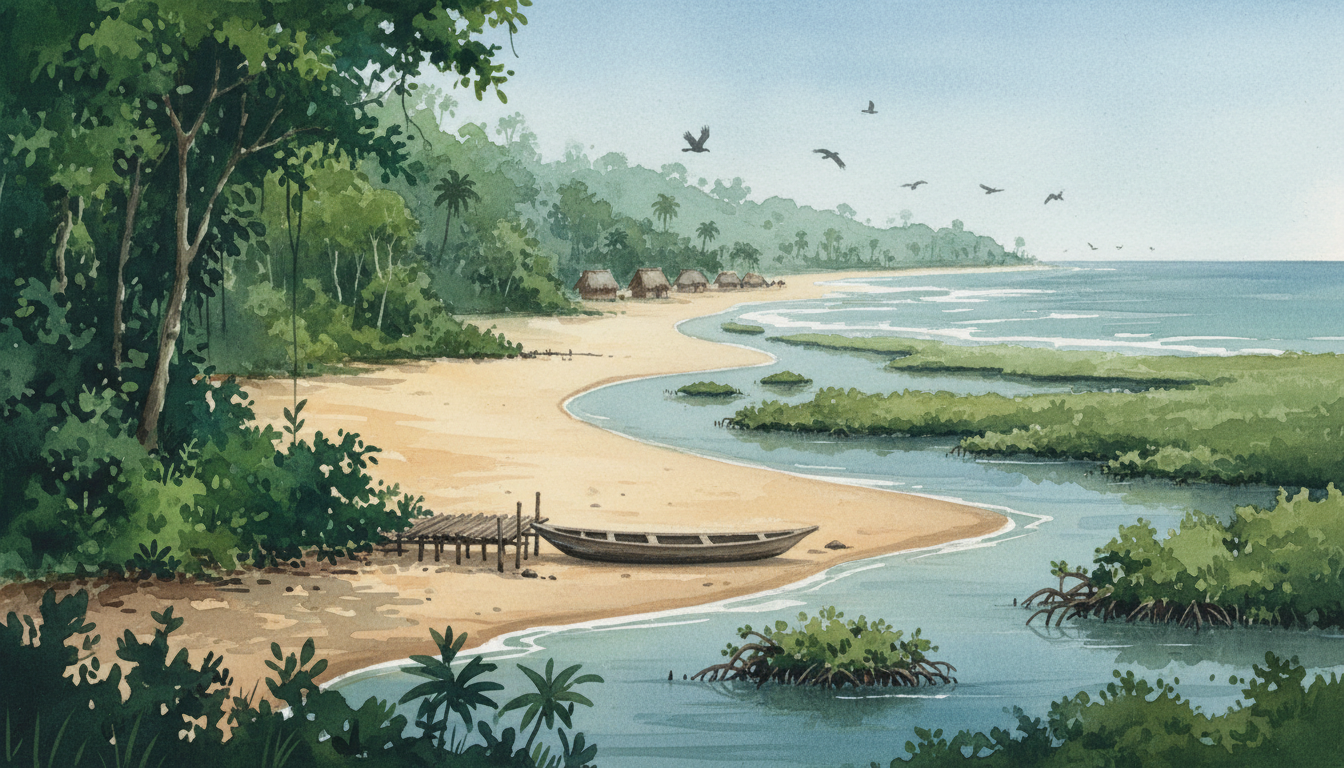
Quick answer: Forest and agroforestry civilisations are human communities and networks whose daily life, livelihoods, knowledge and institutions are deeply connected with trees, woodland ecosystems and managed landscapes. Forests can support biodiversity, watershed functions, livelihoods, materials and cultural identity, while agroforestry deliberately integrates trees or other woody perennials with crops and/or animals. Forest people are not one culture or one ‘stage’ of development. A forest may be carefully managed without looking like a conventional farm, and an agroforestry plot may contain multiple layers of food, shelter and ecological functions. To build a reliable fictional forest civilisation, begin with safe water, food and access; investigate habitats and rights; map which trees and crops interact; organise learning and work; protect cultural knowledge; and test how the system responds when a route, harvest or rule fails.
Did you know? What appears to be a single mass of green leaves from above can contain very different human and ecological systems. Some areas may be protected forest, others multi-layer gardens, houses, river corridors, managed timber areas or sacred places. A bird’s-eye image cannot reveal who has permission to collect materials, where children’s schools are, how knowledge is taught, or which plants and soils are under pressure. A civilisation is not defined by how many tall buildings stand above its forest. It is also defined by the institutions, skills and care that allow human beings to cooperate without quietly destroying their own supporting systems.
This is the next guide in eduKateSG’s Types of a Civilisation progression. The foundation begins with How to Build a Civilisation; the earlier environments include River Valleys, Maritime Networks, Drylands and Oases, Mobile Pastoral Networks and Highland Communities. This article examines what changes when forests, trees and living landscapes become central to the systems a community relies upon.
Our fictional learning region is Canopyhaven, a place with a wooded catchment, a village, mixed home gardens, a public learning space, a river crossing, a protected grove, a market and communities with different ways of using the surrounding landscape. The evidence reviewer helps children read information, explain the everyday human consequences and ask whose voice is missing. The assumption checker maps habitats, inputs, uncertainties, competing explanations and repair plans. They operate the fictional the lesson facilitator in the classroom activity, with five evidence dials: Life, Knowledge, Trust, Systems and Repair. These are educational characters and a classroom imagination framework, not autonomous forest authorities or real historical people.
Important respect rule: Indigenous Peoples, traditional communities, farmers, scientists, forest workers and urban residents are diverse. A community’s knowledge should be identified with its proper name and sources; it should not be packaged as anonymous ‘tribal wisdom’. Some cultural and ecological knowledge may be private or restricted, and a research or learning project needs appropriate consent. The labels forest-based, agroforestry, woodland, sacred grove and conservation landscape are not interchangeable. We will use them to ask evidence-based questions, never to rank people’s value.
A route through this long guide for busy parents and tutors
- Five-minute family route: start at the Canopyhaven story, read the six foundations, then ask the weekly questions.
- Primary learners: draw a forest, protected water source, home, school and garden; then explain why a new road or harvest plan might change them.
- Secondary learners: model changing crop yields, canopy cover, material flows and unequal access, always separating teaching assumptions from measurements.
- Tutors: teach one mission at a time, use the ten-session plan and measure learning through teach-back and revision.
- Historical readers: compare the source-grounded case files on Chagga Kihamba, Gedeo, Jingmai tea forests, Brazil’s erva-mate, Mijikenda kaya forests and Osun-Osogbo.
- Advanced learners: test the interaction of ecology, rights, markets, climate, digital systems and long-term maintenance without assuming one perfect solution.
Canopyhaven: what the first classroom activity map gets wrong
The assumption checker unrolls a wide green map. The children see a forest, a winding river, a small cluster of houses, a grove of tall trees and a few familiar crops. They celebrate: there is plenty of land, plenty of wood and plenty of space for a market. Their first design cuts a straight road across the forest, expands farms until almost every tree has been replaced, and draws one large store near the river. The evidence reviewer asks what will happen to the people who collect forest products, whose school is now far from the road, and whether the grove has a cultural or protected status. Nobody had checked these basic matters.
The assumption checker removes the fictional road from the map and asks the group to identify the actual links connecting homes, school, clinic, clean-water service, fields and market. The children discover that one useful route is not the same as the only route. He then adds a catchment line and asks where water may move after heavy rain. A sunny drawing gives no evidence that the forest floor is safe to cross or that any river water is safe to drink. The evidence reviewer has the children label known, assumed, needs expert assessment and not for publication.
A second group imagines a multi-layer garden. It places larger trees above small trees and shrubs, crops underneath, and a leaf-litter layer at ground level. The children are excited because there are several kinds of plants in one area. The assumption checker asks whether the specific plants are suitable for the local environment, whether one species shades another excessively and what maintenance each requires. The picture cannot answer those questions; it is a conceptual model that needs site-specific knowledge before it could become actual agricultural advice.
In the third round, the forest harvest ledger shows 200 fictional material tokens, of which 120 are planned for housing repairs, 50 for tools and 60 for trade. The proposed total is 230, already 30 above the available amount. The children cannot solve a deficit by writing ‘sustainable’ on the board. They must revisit needs, find alternatives, compare the costs and explain how a community would verify both lawful access and ecological limits. The evidence reviewer asks whether the people most dependent on the forest have an effective voice in deciding.
Finally, a visiting researcher offers to publish everything the children learned from the imagined local knowledge holders. A classmate asks whether the stories, plant uses and culturally significant locations are theirs to distribute. They are not automatically public. The assumption checker adds a source-and-permission column to the notebook; the evidence reviewer asks the group to remove unverified and restricted claims. The students see a crucial civilisational principle: knowledge can be powerful and should be shared responsibly, with rights and community dignity built into the process.
What is a forest-based civilisation? What is agroforestry?
Forest-based is a broad analytical lens for human relationships with wooded environments, ranging from settlements using forest resources to protected cultural landscapes, multi-layer food production and trade networks. It is not a formal universal category used identically by every historian. Agroforestry, by contrast, has a more precise land-use meaning. The Food and Agriculture Organization of the United Nations describes it as land management where woody perennial plants are deliberately combined with crops and/or animals, with ecological and socioeconomic interactions among the components.
FAO distinguishes, among others, agrisilvicultural systems (trees with crops), silvopastoral systems (trees with grazing animals) and agrosilvopastoral systems (trees, crops and animals). A forest on its own is not necessarily agroforestry. Planting a token tree in a conventional crop field is not proof of effective agroforestry either; the management and interactions matter. Species selection, rainfall, soils, shade, livelihoods, markets and maintenance must be considered in the relevant setting.
A forest may also have cultural or spiritual importance independent of its direct value as a commercial resource. UNESCO recognises sacred forest landscapes such as the Mijikenda Kaya Forests in Kenya and Osun-Osogbo Sacred Grove in Nigeria. These should not be called ordinary farms or assigned invented harvest targets. The conservation status and cultural significance of a particular site must be respected; traditional knowledge and access may be governed by community-specific rules.
One further distinction matters: intact natural forest, managed woodland, agroforestry garden and plantation may differ strongly in species composition, structure, ecological value and governance. They are not made equivalent by the colour green in a satellite image. Forest restoration, food security, water protection and livelihoods are important goals but may involve trade-offs. The right lesson is to examine evidence and people rather than treat a general slogan as an engineering or ecological prescription.
Six foundations of a humane forest and agroforestry civilisation
| Foundation | What the fictional community builds | How the child should test it |
|---|---|---|
| Life and access | Safe water, food, care, school and routes | Can families obtain essentials when a path or harvest changes? |
| Forest ecology | Knowledge of habitats, soils, plants and water pathways | Which claimed effects are measured and which are assumptions? |
| Livelihoods | Crops, forest products, craft, markets and fair work | Are use rights, yields and ecological costs realistically considered? |
| Cultural memory | Learning, consent, records and respect for knowledge holders | Can a successor understand the plan without exposing restricted material? |
| Governance and rights | Rules, stewardship, appeals and transparent decisions | Have affected users and communities participated meaningfully? |
| Repair and resilience | Monitoring, backups, inspection, adaptation and learning | Does a fix work under a second test without shifting hidden burdens? |
These foundations are connected, not six historical stages. A protected water source may depend on appropriate catchment management; a food garden may depend on skills transmitted through generations; a market depends on roads and honest records; and a conservation rule may change the work and wellbeing of households who rely on forest areas. The evidence reviewer and the assumption checker do not award a single civilisation-rank number. They ask children whether essential functions remain safe, fair, understandable and repairable.
The atlas of forest-related civilisation patterns
| Pattern | What it illustrates | False shortcut to avoid |
|---|---|---|
| Multi-layer home gardens | Trees and crops combined in planned vertical and temporal arrangements | More green layers always mean more food |
| Forest-edge farming and craft | Links between natural woodland, fields and households | Everything wooded is available for harvesting |
| Shade-grown agroforestry | Crop production within managed tree shade | Shade always increases yield |
| Silvopastoral systems | Trees and livestock managed in interaction | Any animals among trees prove ecological success |
| Sacred forest landscapes | Cultural meaning, stewardship, access and community practices | Cultural knowledge belongs to anyone who visits |
| Managed forest-product networks | Harvest, processing, markets and long-term renewal | Commercial receipts measure every ecological cost |
| Transboundary conservation | Cooperation across protected landscapes and jurisdictions | A park is the same thing as a village civilisation |
| Urban and peri-urban forest systems | Trees, residents, public services and ecological functions | A city forest requires no maintenance or governance |
| Regenerative hybrid systems | Data, community knowledge, stewardship and repair | A dashboard or carbon slogan proves success |
The patterns can overlap. A household may tend a shade-grown garden, sell goods in an urban market, participate in a community forest programme and preserve culturally significant places. Historical landscapes can also change. The category helps organise questions; it should never erase the name, rights, history or internal diversity of the people involved.
The sixteen Canopyhaven learning missions
- Mission 01 — Map living forest layers and human services
- Mission 02 — Keep safe water and forest catchments understandable
- Mission 03 — Design a realistic multi-layer agroforestry garden
- Mission 04 — Understand soils, nutrients, shade and time
- Mission 05 — Compare harvest, storage and food access
- Mission 06 — Protect habitats, biodiversity and ecological uncertainty
- Mission 07 — Trace forest products, craft and sustainable-use claims
- Mission 08 — Build fair access, rights and public rules
- Mission 09 — Preserve cultural knowledge, consent and attribution
- Mission 10 — Develop honest markets, measurements and records
- Mission 11 — Balance conservation, livelihoods and services
- Mission 12 — Create reliable schools, health and community infrastructure
- Mission 13 — Test drought, storms, disease risk and route closure
- Mission 14 — Use mapping, research and AI responsibly
- Mission 15 — Build a regenerative and accountable future network
- Mission 16 — Teach the next generation and transfer across types
Illustration disclosure: The cover is an existing original eduKate composite landscape inspired by a forested central African coast, including rainforest, a mangrove estuary and a distant settlement. It is not a photograph of an identified place, an image of the fictional Canopyhaven, or a reconstruction of any Indigenous community or UNESCO property. It visually introduces the subject but cannot verify historical or ecological claims. No new image was produced for this article; the media library retains the original descriptive metadata.
Mission 01 — Map living forest layers and essential community services
classroom activity field note: The assumption checker gives the Canopyhaven team a bird’s-eye picture of a dense woodland. The children colour every area the same dark green, place one school and decide that the forest is complete. The evidence reviewer asks which area is a protected habitat, which is an agricultural garden, where families live, which trails they use and whose permission is required for a visitor to enter. The team discovers that colour on a map is not a land-use agreement and that a tree canopy may hide many different functions beneath it.
Understand the science and its limits
A forest includes trees but is also a complex ecosystem of soils, water, fungi, plants, animals and interactions among them. Height, canopy closure and species composition vary by region, disturbance and management. A woodland may contain natural forest, second-growth areas, managed use zones and spaces with strong cultural meaning. The number of visible canopy trees does not establish total biodiversity, food production, carbon benefits or land rights. The Food and Agriculture Organization describes agroforestry as deliberate integration of woody perennials with crops or animals; this is one possible land-management practice and should not be mistaken for every forest.
The first task is to distinguish what the picture depicts from what evidence can demonstrate. If a child is using a real cultural or ecological example, name the region and reference rather than treating it as interchangeable with every forest. If using Canopyhaven, label numbers, species, seasons and hazards as fictional assumptions. It is appropriate to say that an outcome may be possible; it is not appropriate to promise it without a credible method of checking.
Construct the system people will maintain
Give students four transparent overlays. The first marks a watershed and landform assumptions; the second distinguishes protected habitat, possible managed plots and settlement; the third shows homes, safe public-service access and a market; and the fourth records management rights, information uncertainty and maintenance roles. Children must provide a plain-language map legend and distinguish fictional assumptions from sourced ecological facts. A community member role may refuse publication of a culturally sensitive place. The refusal is a boundary to respect, not an obstacle to bypass.
The evidence reviewer gives the class household cards: a student, elderly resident, farmer, visiting trader, maintenance worker and cultural knowledge holder. They use the overlays to find school, water access, care and a path toward market. The assumption checker checks whether a forest path and the public-service route were assumed to be identical. The students can make an access route in their paper world but should never interpret the sketch as an invitation to cross a protected site or use a real unmarked forest trail.
At the lesson facilitator, the team must draw and explain the connections between everyday users, sources of materials, skilled workers, information and repair. The evidence reviewer tests clarity with a younger learner, while the assumption checker asks whether a claimed ecological effect was measured or merely inferred. A society needs an operating system for knowledge and maintenance as well as a physical system for food or shelter.
The Mathematics laboratory
The imagined landscape has 120 grid squares. Thirty represent protected forest, 35 a mixed agroforestry area, 20 village and public services, 15 paths and waterways, and 20 additional managed or uncertain land. The sum is 120. A proposal transfers ten squares from protected forest to crops. Protected area would drop by one-third, from 30 to 20, but that paper percentage says nothing directly about species loss or water safety. Discuss which ecological and legal information would be needed before anyone could assess such a real plan.
Write a complete solution using units and a stated denominator. An increase in one total can hide a loss elsewhere; a short-term yield improvement may come with longer-term costs; and some qualities cannot be collapsed into one score. When a crucial input is missing, naming it is often a stronger answer than improvising a number. Older learners can compare sensitivity to two different assumptions and write an evidence-based explanation.
The assumption checker’s interruption and a defensible response
A market organiser announces a straight road through a sacred grove, claiming it is vacant land because no houses appear there. A visitor’s video makes the plan look simple, but no one has consulted the knowledge holders or verified legal protection. The evidence reviewer asks who was missing from the decision; the assumption checker marks the route as unapproved and explores alternative options that still require review.
The careless solution is to treat a colourful map as proof of open access and ignore community concerns. A responsible classroom solution separates a map from rights, documents the uncertainties and conducts a respectful consultation. Some areas may require protection, others may have legitimate managed uses, and the map cannot settle those decisions without evidence. The team should explain that a final real plan would require appropriate law, ecological expertise and community participation.
A completed response explains what was observed, what remains uncertain, whose professional or community authority is required, and how the result can be checked. The classroom activity does not authorise actual land clearing, drainage, drinking-water treatment or other potentially hazardous interventions. Children are invited to test a paper decision, revise their reasoning and record the limitation rather than acting on imaginary technical instructions.
the evidence reviewer fairness test
Land labelled as wilderness may still have human histories, cultural relationships and uses. Indigenous and traditional communities should not be assumed invisible simply because an outsider’s aerial photograph shows only trees. At the same time, people in towns and farms may have genuine needs for safe routes and services. The exercise practises how to weigh several interests without equating the wealthiest or most confident voice with the correct answer.
The child who plays the maintainer, the user who may lose access and the person holding culturally sensitive knowledge should all have a voice. Rotate the roles rather than presenting entire real cultures as stereotypes in a simulation. Good enquiry asks whose evidence is absent, who would bear unexpected costs and whether the public explanation offers a way to challenge an error.
Family practice and tutor extension
At home: Colour four layers on transparent paper: trees, water, homes and paths. Give the child a ‘protected grove’ card and ask them to find a way to communicate its status clearly. Then remove an access path and ask which household loses service.
With a tutor: Primary Geography: legends, directional terms and the difference between a map symbol and reality. Primary English: explain a route in clear sentences. Secondary Geography: percentages, land-use overlays, sources of bias and limits to satellite interpretation. Advanced learners compare a mapped feature with the legal or cultural evidence needed to manage it responsibly.
Conclude with a short teach-back. A younger child may explain one dependency using a coloured diagram. A Secondary learner can use a calculation, a credible source and a statement of uncertainty. Preserve the first attempt and the corrected version; the difference makes learning visible without rewarding appearance over understanding.
What the next generation must retain
A forest civilisation cannot be understood from a uniform green picture. The real complexity lies in relationships between ecology, communities, rights, work and services that must be mapped and maintained carefully. Read FAO: What Is Agroforestry? for source-grounded context and note where it differs from Canopyhaven’s invented examples.
Mission 02 — Protect safe water and understand forest catchments
classroom activity field note: Canopyhaven’s pupils draw a clear stream from the forest to their fictional village and declare the drinking-water problem solved. The assumption checker changes the storm card, altering their imagined runoff and access. The evidence reviewer asks whether water that looks clear has been verified as safe for human use. No student can answer from the colour blue. The class learns that a living catchment and a public drinking-water service are related but different systems.
Understand the science and its limits
Trees, soils and vegetation may influence rainfall interception, infiltration, evapotranspiration, erosion and some water-quality pathways, but the effect depends on soils, rainfall, landform, species and management. Planting more trees is not a universal guarantee of increased downstream water supply. A watershed includes areas where water flows into connected streams and waterways, and it may lie far beyond a village’s view. Safe drinking water requires relevant professional controls, testing or treatment and protected distribution. An untreated forest stream should never be declared potable just because it looks beautiful.
The first task is to distinguish what the picture depicts from what evidence can demonstrate. If a child is using a real cultural or ecological example, name the region and reference rather than treating it as interchangeable with every forest. If using Canopyhaven, label numbers, species, seasons and hazards as fictional assumptions. It is appropriate to say that an outcome may be possible; it is not appropriate to promise it without a credible method of checking.
Construct the system people will maintain
Make a dry paper diagram with four distinct parts: upper catchment, observed stream, safe-water infrastructure and users. Add separate arrows for used-water and waste pathways so the children cannot treat sanitation as invisible. Draw two hypothetical information channels for warnings: one that may use a device and another that works when connectivity fails. Identify whose responsibility it is to check the suitability of a real supply, and forbid all classroom attempts to drink or sample unknown water.
The village clinic, learning centre, food preparation area, gardens and households may need water for different purposes. In the paper model, a source can have adequate nominal quantity yet be unreachable after a path closure. A storage tank can exist while access is unequal. A public notice can be distributed while some households cannot read it. Ask the team to test all four dimensions—quantity, quality, accessibility and reliability—before calling the service functional.
At the lesson facilitator, the team must draw and explain the connections between everyday users, sources of materials, skilled workers, information and repair. The evidence reviewer tests clarity with a younger learner, while the assumption checker asks whether a claimed ecological effect was measured or merely inferred. A society needs an operating system for knowledge and maintenance as well as a physical system for food or shelter.
The Mathematics laboratory
The teaching town has 160 residents using an invented model demand of four clean-water tokens per day, or 640 tokens. A hypothetical supply of 700 leaves only 60 surplus. If the fictional working capacity falls by 15 per cent, supply becomes 595, leaving a shortfall of 45 tokens. The numbers are not hydration recommendations, health standards or actual stream-flow estimates. Ask students to identify the change in supply, avoid promising what cannot be delivered and consider alternatives under qualified guidance.
Write a complete solution using units and a stated denominator. An increase in one total can hide a loss elsewhere; a short-term yield improvement may come with longer-term costs; and some qualities cannot be collapsed into one score. When a crucial input is missing, naming it is often a stronger answer than improvising a number. Older learners can compare sensitivity to two different assumptions and write an evidence-based explanation.
The assumption checker’s interruption and a defensible response
An online rumour claims the forest spring has been contaminated, while another message says it must be safe because it passes through tree roots. Neither statement includes a source. Some children want to sample the stream themselves and publish a conclusion from its appearance.
The evidence reviewer rejects unverified potability claims and asks for a calm statement directing families to qualified public-health or water-provider information. The assumption checker asks for a properly sourced condition report, timestamp and method of checking. The team may model a safe alternate supply in its paper scenario, but it must not invent practical water treatment instructions or authorise actual use of a source.
A completed response explains what was observed, what remains uncertain, whose professional or community authority is required, and how the result can be checked. The classroom activity does not authorise actual land clearing, drainage, drinking-water treatment or other potentially hazardous interventions. Children are invited to test a paper decision, revise their reasoning and record the limitation rather than acting on imaginary technical instructions.
the evidence reviewer fairness test
A centralised water station can satisfy a spreadsheet total while imposing a difficult walk on families with disabilities, children or limited time. Environmental protection decisions also affect residents whose livelihoods depend on land use. The group must show accessible service choices and a meaningful way to question an allocation decision. A forest’s water functions and a community’s water rights should be researched for their specific setting.
The child who plays the maintainer, the user who may lose access and the person holding culturally sensitive knowledge should all have a voice. Rotate the roles rather than presenting entire real cultures as stereotypes in a simulation. Good enquiry asks whose evidence is absent, who would bear unexpected costs and whether the public explanation offers a way to challenge an error.
Family practice and tutor extension
At home: Draw a four-box water chain using coloured pencils: source, check, delivery and user. Ask the child which box is missing from an attractive picture of a river and why a forest cannot itself certify safe drinking water.
With a tutor: Primary Science: water sources, conservation and safety language. Secondary: percentage change, quantity versus quality, and causal uncertainty. English: rewrite a falsely certain statement as a sourced, dated and appropriately cautious public notice. Remind all learners that real hazards require responsible authorities.
Conclude with a short teach-back. A younger child may explain one dependency using a coloured diagram. A Secondary learner can use a calculation, a credible source and a statement of uncertainty. Preserve the first attempt and the corrected version; the difference makes learning visible without rewarding appearance over understanding.
What the next generation must retain
A forest’s ecological functions may support a community, but safe public water remains a technical, institutional and equitable responsibility that cannot be solved by green imagery alone. Read Ecological Stewardship and Resource Renewal for source-grounded context and note where it differs from Canopyhaven’s invented examples.
Mission 03 — Design a realistic multi-layer agroforestry garden
classroom activity field note: The Canopyhaven children draw giant trees over smaller fruit trees, shrubs and ground-level crops. Their coloured diagram seems productive at every height. The evidence reviewer asks who will harvest, maintain and distribute the food. The assumption checker asks whether a tall tree’s shade could reduce a crop’s performance and whether each plant is suited to the climate and soil. The class discovers that ‘many layers’ is a design hypothesis, not proof of success.
Understand the science and its limits
Agroforestry deliberately combines woody perennials with crops and/or animals. FAO names home gardens, alley cropping, tree crops and several livestock-integrating systems among possible approaches. Trees may provide fruit, fodder, wood or environmental benefits, but interactions depend on species, density, nutrients, shade, water, pests and management. Some combinations may support biodiversity and diversified income; others can create competition, losses or new labour demands. A child-friendly layer diagram must not be treated as real planting advice without local specialist assessment.
The first task is to distinguish what the picture depicts from what evidence can demonstrate. If a child is using a real cultural or ecological example, name the region and reference rather than treating it as interchangeable with every forest. If using Canopyhaven, label numbers, species, seasons and hazards as fictional assumptions. It is appropriate to say that an outcome may be possible; it is not appropriate to promise it without a credible method of checking.
Construct the system people will maintain
Give teams separate paper cards for canopy tree, smaller tree, shrub, crop, ground cover, soil, water supply and maintenance. Some combinations are deliberately marked ‘needs further investigation’. Children must plan one hypothetical garden and justify why its parts may be compatible in the imaginary conditions. Add a calendar for tasks that occur at different times, not only a diagram of plants at maximum size. Each design names who maintains it and how a new worker learns the procedure.
A home garden may produce food while also supporting a household’s economy, culture and nutrition. Yet food needs appropriate handling, safe access and preservation; shade trees need maintenance and some may grow for years before producing a crop. A garden cannot be evaluated only by one harvest photograph. The team should ask how production, labour, ecological change and household income interact over short and long periods.
At the lesson facilitator, the team must draw and explain the connections between everyday users, sources of materials, skilled workers, information and repair. The evidence reviewer tests clarity with a younger learner, while the assumption checker asks whether a claimed ecological effect was measured or merely inferred. A society needs an operating system for knowledge and maintenance as well as a physical system for food or shelter.
The Mathematics laboratory
The fictional design has three paper crop zones with yields of 90, 75 and 55 units, totalling 220. After a hypothetical change in tree shade, the second zone’s yield falls by 20 per cent, losing 15 units; the revised total is 205. A different arrangement might offset the effect, but the class has no measured basis to claim how much. Have students distinguish arithmetic inside the given assumptions from an actual forecast of crop production.
Write a complete solution using units and a stated denominator. An increase in one total can hide a loss elsewhere; a short-term yield improvement may come with longer-term costs; and some qualities cannot be collapsed into one score. When a crucial input is missing, naming it is often a stronger answer than improvising a number. Older learners can compare sensitivity to two different assumptions and write an evidence-based explanation.
The assumption checker’s interruption and a defensible response
A decorative tree is added beside the garden without studying its size or local suitability. During the next fictional season, the crop under its canopy receives less useful light. One student proposes cutting every tree down, while another claims additional trees can never cause competition.
A stronger response uses observations, appropriate agricultural expertise and an honest comparison of crop, labour and ecological goals. The evidence reviewer asks whose food and work are affected. The assumption checker labels the shade-change result as a scenario, not a general finding, and requests field evidence before claiming a certain design will succeed. The children may redesign paper spacing but should not implement risky horticultural practices from the exercise.
A completed response explains what was observed, what remains uncertain, whose professional or community authority is required, and how the result can be checked. The classroom activity does not authorise actual land clearing, drainage, drinking-water treatment or other potentially hazardous interventions. Children are invited to test a paper decision, revise their reasoning and record the limitation rather than acting on imaginary technical instructions.
the evidence reviewer fairness test
Smallholder farmers and family members may maintain complex gardens with considerable skill. The effects of any proposed crop or tree replacement may differ by household and by who controls the land and harvest. A practical design should include labour, access, possible loss of income and the household’s choices rather than presenting a fashionable system as universally superior.
The child who plays the maintainer, the user who may lose access and the person holding culturally sensitive knowledge should all have a voice. Rotate the roles rather than presenting entire real cultures as stereotypes in a simulation. Good enquiry asks whose evidence is absent, who would bear unexpected costs and whether the public explanation offers a way to challenge an error.
Family practice and tutor extension
At home: Place a paper canopy card over imaginary garden crops and use a simple light-and-shade drawing to show that one plant may change the conditions of another. Ask the child what would need to be tested by knowledgeable adults.
With a tutor: Primary Mathematics: addition and percentage reductions using small numbers. Science: plants’ needs and conditional explanations. Secondary Geography: land-use interactions, trade-offs and testable hypotheses. Ask learners to compare why two agroforestry gardens need not use the same plants.
Conclude with a short teach-back. A younger child may explain one dependency using a coloured diagram. A Secondary learner can use a calculation, a credible source and a statement of uncertainty. Preserve the first attempt and the corrected version; the difference makes learning visible without rewarding appearance over understanding.
What the next generation must retain
The skill of agroforestry lies in understanding and managing interactions among trees, crops, people and ecology over time. A multi-layer picture is the start of a question, not a certificate of sustainability. Read FAO: Sustainable Forest Management Toolbox — Agroforestry for source-grounded context and note where it differs from Canopyhaven’s invented examples.
Mission 04 — Understand soils, nutrients, shade and time
classroom activity field note: Canopyhaven celebrates one successful invented harvest and assumes the same field will perform forever. The assumption checker asks where soil nutrients came from and what could change after repeated harvests. The evidence reviewer asks who is responsible for maintaining a garden after the student designer has moved on. The children notice leaf litter, soil and decomposers in the picture only after being told to look down rather than up at the canopy.
Understand the science and its limits
Soil is a living and physical system with minerals, organic matter, water, air and organisms. Nutrients cycle through processes of uptake, decomposition, weathering, additions and losses. Different tree and crop combinations may influence shade, litter, root competition and soil properties in different ways. It would be misleading to claim that every tree always enriches soil or that a single green-looking layer proves fertility. Assessing actual soil condition, species suitability and fertiliser needs requires context and appropriate expertise. Classroom work should use fictional diagrams or safe ordinary materials, not unknown compost or pesticides.
The first task is to distinguish what the picture depicts from what evidence can demonstrate. If a child is using a real cultural or ecological example, name the region and reference rather than treating it as interchangeable with every forest. If using Canopyhaven, label numbers, species, seasons and hazards as fictional assumptions. It is appropriate to say that an outcome may be possible; it is not appropriate to promise it without a credible method of checking.
Construct the system people will maintain
Draw a layered paper cross-section showing a canopy, one understory, ground cover, organic litter and imaginary root zones. Use arrows to represent possible water and material pathways, with question marks for mechanisms not established. Add a timeline of one, three and ten teaching years to show that trees and crops may have different growth periods. Ask who manages the ground cover and maintains the paths, and how ecological observations are recorded rather than inferred from colour alone.
A household may value soil protection, food, shade, wood, heritage and market income simultaneously. The most visible harvest is not necessarily the most important outcome. Some maintenance is immediate; other benefits or costs may become apparent only later. A good civilisation’s records track both short-term availability and long-term resource renewal, and should include a clear process for changing practices when evidence indicates harm.
At the lesson facilitator, the team must draw and explain the connections between everyday users, sources of materials, skilled workers, information and repair. The evidence reviewer tests clarity with a younger learner, while the assumption checker asks whether a claimed ecological effect was measured or merely inferred. A society needs an operating system for knowledge and maintenance as well as a physical system for food or shelter.
The Mathematics laboratory
In the fictional model, a plot begins with 100 nutrient tokens. Each harvest removes 18, and a hypothetical cycle returns 12. After one round the modeled balance falls by six to 94. After four identical rounds it would be 76. These ‘nutrient tokens’ are invented arithmetic and cannot represent a true soil analysis; real nutrient budgets involve multiple elements, flows and transformations. Ask students why one scalar cannot describe actual soil health.
Write a complete solution using units and a stated denominator. An increase in one total can hide a loss elsewhere; a short-term yield improvement may come with longer-term costs; and some qualities cannot be collapsed into one score. When a crucial input is missing, naming it is often a stronger answer than improvising a number. Older learners can compare sensitivity to two different assumptions and write an evidence-based explanation.
The assumption checker’s interruption and a defensible response
A garden operator claims that leaves on the ground are simply untidy waste and should all be removed. Another insists no material should ever be removed regardless of health and management needs. The assumption checker asks for a source-supported explanation of ecosystem functions; the evidence reviewer asks who carries the work and what practical problem each approach is trying to solve.
The class should separate appearance, pest or safety concerns, soil ecology and realistic maintenance. An expert-led site-specific plan may make different choices for different contexts. The children can compare trade-offs on paper without issuing instructions for handling mould, dangerous organisms, fertilisers or hazardous chemicals. No single attractive photo can settle how a real garden should be managed.
A completed response explains what was observed, what remains uncertain, whose professional or community authority is required, and how the result can be checked. The classroom activity does not authorise actual land clearing, drainage, drinking-water treatment or other potentially hazardous interventions. Children are invited to test a paper decision, revise their reasoning and record the limitation rather than acting on imaginary technical instructions.
the evidence reviewer fairness test
Long-term land use depends on the people doing repeated small jobs, and maintenance may fall disproportionately on one household or group. A new crop introduced for commercial gain can change workloads and food access. Fair decisions account for labour, legitimate land rights and intergenerational knowledge rather than celebrating a high output at the expense of unrecorded burdens.
The child who plays the maintainer, the user who may lose access and the person holding culturally sensitive knowledge should all have a voice. Rotate the roles rather than presenting entire real cultures as stereotypes in a simulation. Good enquiry asks whose evidence is absent, who would bear unexpected costs and whether the public explanation offers a way to challenge an error.
Family practice and tutor extension
At home: Use paper arrows to draw an imagined cycle from fallen leaves to soil processes and growing plants. The child should name which arrow is a plausible classroom explanation and which needs evidence in a real environment.
With a tutor: Science: decomposition, nutrient cycling and plant needs. Mathematics: repeated subtraction and simple recurrences. English: precise conditional statements. For stronger students, ask why an invented one-number nutrient model cannot replace actual soil measurements.
Conclude with a short teach-back. A younger child may explain one dependency using a coloured diagram. A Secondary learner can use a calculation, a credible source and a statement of uncertainty. Preserve the first attempt and the corrected version; the difference makes learning visible without rewarding appearance over understanding.
What the next generation must retain
A forest civilisation must understand that plants and soils live on different timescales from a weekly market. Long-term renewal requires observation, competent care, fairness and records that survive generations. Read FAO: Agroforestry Overview for source-grounded context and note where it differs from Canopyhaven’s invented examples.
Mission 05 — Compare harvest, storage and food access
The Canopyhaven scene: Canopyhaven’s students cheer when their imaginary tree gardens produce more fruit than last term. The evidence reviewer asks who can obtain the food, which items are appropriate to eat, and whether the community has a safe way to preserve them. The assumption checker compares the cheerful harvest poster with the store’s more recent ledger. Several boxes are already assigned to other uses, and part of the path to the school is unavailable in a fictional storm. Production and food security are no longer the same number.
The principle and its evidence boundaries
A forest-connected food system may include cultivated crops, trees, livestock in some agroforestry arrangements, wild foods where law and ecological limits permit, markets and storage. Food security includes availability, access, utilisation and stability; total harvest does not by itself establish nutrition or equity. Agroforestry can diversify production, but exact yield, labour and health outcomes vary greatly by system. FAO describes potential food-security and resilience benefits while emphasising tailoring to context. Children should not identify or consume wild plants or handle spoiled food based on a class exercise.
When a tutor uses a named historical or ecological example, students should identify the community, source, relevant period and what the source actually supports. The classroom activity story uses invented characters and quantities. A diagram may demonstrate a dependency, but it cannot prove biodiversity quality, an individual’s rights or an appropriate harvesting rate. A credible learning habit is to label each claim as observed, inferred, hypothetical or not yet verified.
Build an operating system rather than a display
Create a Canopyhaven food ledger with three categories: locally produced garden goods, lawful verified external supplies and an emergency reserve. Add an accessible delivery map connecting homes, school and community care. Record the amount received, used, inspected or lost with a date and unit. Assign a trained-adult role for actual food safety rather than having children judge appearance. The team must explain what changes when a route is closed and which alternative is more credible than a vague promise of unlimited supply.
Food depends on reliable paths and information, but also on clean water and sensible storage. A diversified garden may produce different foods at different times; that can widen options but complicate seasonal planning. An impressive total of fruit tokens does not tell us whether the harvest meets a defined household need, whether produce can reach the market, or whether vulnerable users can afford it. A good map shows who is responsible for each hand-off and how a discrepancy is investigated.
At the lesson facilitator, the assumption checker traces sources, users, hand-offs, quantities and known vulnerabilities. The evidence reviewer tests clarity with children and asks who has been overlooked. Every essential function receives a maintenance role, a route for asking for help and a method of checking that a promised repair actually occurred. The team does not earn a point simply by adding a new building or drawing another cluster of green leaves.
Quantitative literacy: an answer and its limits
The fictional settlement begins with 1,440 usable food tokens, which represents six days of a stated community model at 240 per day. A new harvest adds 360 tokens, but a checked loss of 120 leaves 1,680. The nominal duration is seven days. If a festival increases daily demand by 20 per cent to 288, the store lasts 1,680 ÷ 288 ≈5.83 days. These are deliberately invented tokens, not real nutrition guidance, food-preservation standards or agroforestry yield data.
After solving the arithmetic, children should explain which quantities are included, which are not, and whether the result tells us what the decision maker actually needs to know. A complete sum may still hide unequal distribution. A precise percentage of land cover may not measure ecological quality. The child can be proud of a correct calculation while recognising that professional measurements or further sources are needed.
The field test and the repair log
One road into the woodland market becomes unavailable, and a seller claims that everyone must buy at double price because no food remains. Another claims that fallen fruit of any species can be eaten safely. Both assertions are unsupported. The evidence reviewer asks whom to consult for safe provision; the assumption checker reviews the dated inventory and route status without trying to identify plants or certify actual food.
In the learning world, responsible adults verify usable supplies, consider legitimate alternatives and communicate confirmed information without shaming families. The children should neither improvise real food safety decisions nor pretend that a high output makes unfair distribution acceptable. Their paper plan names a review and a backup that is not dependent on the same blocked route.
The responsible sequence is to identify a specific claim, check it through the appropriate sources, avoid unsupported accusations, protect essential needs and design an accountable follow-up. Children do not test unknown water, handle wild foods, collect protected materials or direct real land-use operations. The exercise develops reasoning about the decisions that qualified people would need to consider.
The evidence reviewer asks about human dignity
Forests and mixed gardens can support livelihoods, yet people may have unequal access to land, markets or income. Some families may maintain trees while others receive most of the sale revenue. Ethical design therefore asks who works, who owns, who eats and who can appeal a disputed allocation. Sustainable food planning includes fairness and resilience, not only a kilogram total.
Let the student acting as maintainer describe the invisible work; the affected household explains access; the evidence reviewer names uncertainty; and the knowledge-holder role defines what may or may not be shared. Rotate these roles each time. Never have children caricature real Indigenous Peoples or invent restricted cultural stories. The purpose is to think humanely and substantively about systems.
An activity parents and tutors can actually use
At home: Use coloured counters for fruit, vegetables and a reserve. Give the child an imaginary harvest card, then a paper loss and a demand-change card. Ask for a correct ending stock and a clear explanation of why the original number became outdated.
With a tutor: Primary Mathematics: addition, subtraction and division into days. Secondary: percentages, demand scenarios and fair interpretation. English: rewrite a misleading market rumour using confirmed quantities and a simple access explanation. Science: separate safe source claims from an attractive food picture.
The learning product should fit on one page: map or table, a clearly interpreted number, a reason for the choice, and a visible correction after a challenge. A younger learner can narrate the change. An older learner can cite a specific passage or compare an alternative conclusion. An honest ‘I need to check’ is useful when the missing information matters.
The lesson to carry forward
A civilisation becomes dependable when the food system produces, stores, distributes, checks and adapts fairly—not merely when a picture shows a generous harvest. Further context: FAO: Agroforestry and Food Security.
Mission 06 — Protect habitats, biodiversity and ecological uncertainty
The Canopyhaven scene: The assumption checker offers three forest panels: one old mixed woodland, one managed garden and one single-species tree stand. All are green. The children announce that each has equal biodiversity because each contains trees. The evidence reviewer gives them a bird, soil organism, pollinator and household livelihood card. The same colour on the map no longer implies the same biological conditions. The group learns to ask which species, habitats and ecological processes have actually been measured.
The principle and its evidence boundaries
Biodiversity includes variation among species, within species and among ecosystems, and can be considered through abundance, composition, habitat features and other measures. Different natural forests, restored forests and agroforestry systems may provide different biodiversity outcomes. Some well-managed tree-crop combinations support wildlife and other ecological functions, but they are not interchangeable with old-growth forests. The right question is what species and processes are present under the relevant local conditions, not whether a plantation’s aerial photograph looks sufficiently green.
When a tutor uses a named historical or ecological example, students should identify the community, source, relevant period and what the source actually supports. The classroom activity story uses invented characters and quantities. A diagram may demonstrate a dependency, but it cannot prove biodiversity quality, an individual’s rights or an appropriate harvesting rate. A credible learning habit is to label each claim as observed, inferred, hypothetical or not yet verified.
Build an operating system rather than a display
Give children a pretend habitat map with three areas whose conservation status and species information are deliberately incomplete. Add four indicator cards—tree diversity, bird records, soil condition and connectivity—but do not pretend these alone measure the entire ecosystem. A team may propose monitoring, consultation and protected connections while naming which claims require expert study. Use paper or approved publicly available observations rather than handling wildlife or visiting restricted areas.
A forest habitat is connected to water, seeds, pollinators, soil and people, sometimes across much larger regions. A road may shorten market travel but change habitat connectivity; a production choice may affect shade or water; protection may affect access arrangements. These links cannot be reduced to a guaranteed one-step chain because ecological effects depend on scale and context. The assumption checker asks for the mechanism and its evidence; the evidence reviewer asks who is affected by the decision.
At the lesson facilitator, the assumption checker traces sources, users, hand-offs, quantities and known vulnerabilities. The evidence reviewer tests clarity with children and asks who has been overlooked. Every essential function receives a maintenance role, a route for asking for help and a method of checking that a promised repair actually occurred. The team does not earn a point simply by adding a new building or drawing another cluster of green leaves.
Quantitative literacy: an answer and its limits
Three fictional surveys record 12, 14 and 11 observed bird types, but the observation effort differs among rounds. It is invalid to conclude that biodiversity has truly risen and fallen by exactly those amounts without considering sampling conditions. In a second simplified exercise, a habitat corridor covers 18 of 90 grid squares, or 20 per cent. That percentage describes mapped area only, not ecological adequacy or species survival.
After solving the arithmetic, children should explain which quantities are included, which are not, and whether the result tells us what the decision maker actually needs to know. A complete sum may still hide unequal distribution. A precise percentage of land cover may not measure ecological quality. The child can be proud of a correct calculation while recognising that professional measurements or further sources are needed.
The field test and the repair log
A company offers to replace a natural forest section with a uniform tree plantation and promises ‘one hundred per cent forest restored’ because the new area will be green on satellite imagery. The class must investigate what was lost or gained: species composition, carbon, habitats, land rights, livelihoods and other conditions remain undocumented.
A responsible response separates tree cover from forest quality and demands context-specific evaluation and legitimate community participation. The evidence reviewer asks whether the public is being misled by the headline. The assumption checker lists what a field ecologist or credible report would need to establish, and the class revises its paper plan without authorising real land clearing or species introductions.
The responsible sequence is to identify a specific claim, check it through the appropriate sources, avoid unsupported accusations, protect essential needs and design an accountable follow-up. Children do not test unknown water, handle wild foods, collect protected materials or direct real land-use operations. The exercise develops reasoning about the decisions that qualified people would need to consider.
The evidence reviewer asks about human dignity
Biodiversity conservation can provide widespread benefits, but the people living in and around conservation areas may experience restrictions and costs. A just process respects lawful rights, knowledge and community participation. Indigenous Peoples and local communities must not be presented as either inherently destructive or inherently perfect ecological managers. Their rights and diverse choices matter independent of a simplified sustainability score.
Let the student acting as maintainer describe the invisible work; the affected household explains access; the evidence reviewer names uncertainty; and the knowledge-holder role defines what may or may not be shared. Rotate these roles each time. Never have children caricature real Indigenous Peoples or invent restricted cultural stories. The purpose is to think humanely and substantively about systems.
An activity parents and tutors can actually use
At home: Draw three different sets of tree symbols with similar green areas but different species labels. Ask the child why equal canopy colour does not prove equal biodiversity, then propose one observation that might help.
With a tutor: Primary Science: habitat, species and ecosystem. Secondary: sampling error, inference limits, percentage cover and competing land-use effects. English: separate a marketing claim from a measurable ecological conclusion. Older learners compare ‘area restored’ with ‘ecological recovery’ using source-based criteria.
The learning product should fit on one page: map or table, a clearly interpreted number, a reason for the choice, and a visible correction after a challenge. A younger learner can narrate the change. An older learner can cite a specific passage or compare an alternative conclusion. An honest ‘I need to check’ is useful when the missing information matters.
The lesson to carry forward
Protecting a forest means learning to observe living systems accurately and to respect the people who depend on them, not simply increasing the number of green pixels. Further context: UNESCO: Sangha Trinational Forest Conservation.
Mission 07 — Trace forest products, craftsmanship and sustainable-use claims
The Canopyhaven scene: The children begin selling imaginary baskets, fibres and timber from Canopyhaven. A trader announces that anything originating in a forest is automatically renewable and therefore sustainable. The evidence reviewer asks who made the goods, whether the harvesting was permitted, and who received the payment. The assumption checker checks whether each product has a traceable source and whether the proposed harvest exceeds the exercise’s agreed limits. The team discovers that a renewable resource can still be mismanaged.
The principle and its evidence boundaries
Forests can provide materials, fibre, fruits, resins and other products, depending on the ecosystem and lawful practices. Sustainable use requires attention to species, growth, extraction rates, ecological consequences, rights, labour, governance and future needs. A material coming from a tree is not inherently sustainable at any volume or under any method of extraction. Some resources may be renewable over decades while households need income this season. The claims need a precise reference point and a transparent way to track impacts.
When a tutor uses a named historical or ecological example, students should identify the community, source, relevant period and what the source actually supports. The classroom activity story uses invented characters and quantities. A diagram may demonstrate a dependency, but it cannot prove biodiversity quality, an individual’s rights or an appropriate harvesting rate. A credible learning habit is to label each claim as observed, inferred, hypothetical or not yet verified.
Build an operating system rather than a display
Prepare an imaginary chain-of-custody ledger with source area, permitted product, quantity, collector, processing step, trader, buyer and date. Give each card a clear meaning and protect any information the community chooses not to publish. Introduce a source marked ‘approval unknown’ and ask whether a product should be treated as verified simply because a seller calls it natural. The learning activity does not direct pupils to collect wild plants, resins or timber from any actual forest.
A crafted basket may combine ecological knowledge, hand skills, transport and honest sale. A wooden tool depends on a source, a maker, appropriate material, quality checking and maintenance. In some communities products have cultural or ritual significance that prevents casual copying or commercialisation. The child learns to distinguish physical traceability from lawful permission, quality assurance and cultural consent. One stamp cannot establish every aspect of sustainability.
At the lesson facilitator, the assumption checker traces sources, users, hand-offs, quantities and known vulnerabilities. The evidence reviewer tests clarity with children and asks who has been overlooked. Every essential function receives a maintenance role, a route for asking for help and a method of checking that a promised repair actually occurred. The team does not earn a point simply by adding a new building or drawing another cluster of green leaves.
Quantitative literacy: an answer and its limits
In a fictional non-specific resource ledger, the community sets a provisional exercise budget of 300 material tokens for the year. Housing upkeep requests 120, tools 85 and trade 110, totalling 315 and exceeding the paper budget by 15. If trade is revised to 90, the proposed total becomes 295 with five tokens left. This does not establish a safe harvest rate in any real forest; the budget is a device for practising arithmetic and transparent decisions.
After solving the arithmetic, children should explain which quantities are included, which are not, and whether the result tells us what the decision maker actually needs to know. A complete sum may still hide unequal distribution. A precise percentage of land cover may not measure ecological quality. The child can be proud of a correct calculation while recognising that professional measurements or further sources are needed.
The field test and the repair log
A supplier offers 50 additional ‘sustainable’ units but cannot identify the original source or whether lawful collection rights exist. The market wants to accept the goods immediately because a cultural festival is approaching and visitors are willing to pay a high price.
The evidence reviewer asks for honest labelling that does not invent provenance or appropriated cultural meaning. The assumption checker checks the available documentation and marks unverified claims as unverified. The team revises the market message and seeks proper advice rather than treating a high price or attractive certificate as proof of sustainability.
The responsible sequence is to identify a specific claim, check it through the appropriate sources, avoid unsupported accusations, protect essential needs and design an accountable follow-up. Children do not test unknown water, handle wild foods, collect protected materials or direct real land-use operations. The exercise develops reasoning about the decisions that qualified people would need to consider.
The evidence reviewer asks about human dignity
Products may be made by craftspeople whose names are absent from tourist labels and who receive little of the profit. Forest use rules may affect households that rely on income or food from their land. A fair system must examine the distribution of benefits, safe working conditions and rights, including Indigenous or community rights where relevant. Transparency should not force publication of sensitive cultural locations or proprietary personal data.
Let the student acting as maintainer describe the invisible work; the affected household explains access; the evidence reviewer names uncertainty; and the knowledge-holder role defines what may or may not be shared. Rotate these roles each time. Never have children caricature real Indigenous Peoples or invent restricted cultural stories. The purpose is to think humanely and substantively about systems.
An activity parents and tutors can actually use
At home: Create a paper chain for a toy wooden pencil or imagined woven basket, noting source, maker, seller and buyer. Ask which claims the class can verify and which it cannot. Do not collect or use unknown forest materials.
With a tutor: Mathematics: budget constraints and ledger reconciliation. English: accurate product descriptions without greenwashing. Social Studies: rights, labour and provenance. Older students distinguish resource renewability from proof of sustainable management or ethical trade.
The learning product should fit on one page: map or table, a clearly interpreted number, a reason for the choice, and a visible correction after a challenge. A younger learner can narrate the change. An older learner can cite a specific passage or compare an alternative conclusion. An honest ‘I need to check’ is useful when the missing information matters.
The lesson to carry forward
The value of a forest product includes the living landscape, the skills and rights of its makers, and the institutions that prevent present benefit from becoming future loss. Further context: FAO: Sustainable Forest Management and Agroforestry.
Mission 08 — Design fair access, community rights and public decisions
The Canopyhaven scene: Canopyhaven’s council proposes that every family may collect any amount of material from the wooded catchment. One group celebrates unlimited access; another wants to ban all use permanently. The evidence reviewer asks both to listen to the people who live there, the knowledge holders and families needing public services. The assumption checker marks customary-use uncertainty, possible legal protection and a conservation zone on separate overlays. The children realise that a single unqualified slogan cannot become a fair forest rule.
The principle and its evidence boundaries
Forest governance may involve national laws, customary arrangements, community rights, protected-area rules and different tenure systems depending on the place. Agroforestry systems may be managed by families, communities or other entities. An effective decision needs legitimate authority, informed participation, transparent records and mechanisms for resolving disputes. Cultural forests may have restricted access for reasons that are not reducible to a timber budget. None of these arrangements can be inferred simply from seeing houses near trees.
When a tutor uses a named historical or ecological example, students should identify the community, source, relevant period and what the source actually supports. The classroom activity story uses invented characters and quantities. A diagram may demonstrate a dependency, but it cannot prove biodiversity quality, an individual’s rights or an appropriate harvesting rate. A credible learning habit is to label each claim as observed, inferred, hypothetical or not yet verified.
Build an operating system rather than a display
Give the group five stakeholder cards: resident farmer, community knowledge holder, forest steward, town service provider and a child who uses the forest-edge path for school. Each identifies a need, a possible burden and a missing fact. The students must draft a decision process, not claim to own the land. The process includes consultation, evidence checking, a public explanation, maintenance duty, review date and peaceful appeal. The fictional allocation is not a legal instrument for any real community.
An access rule may affect food gathering, craft, water, conservation or travel between villages. A road can improve clinic access and also change habitats or cultural sites. A protected-area rule can preserve valued places while raising issues about legitimate livelihoods. Real debates have legal and historical details that deserve attention. The children’s task is to show the competing dependencies and identify appropriate authority rather than invent a universal solution.
At the lesson facilitator, the assumption checker traces sources, users, hand-offs, quantities and known vulnerabilities. The evidence reviewer tests clarity with children and asks who has been overlooked. Every essential function receives a maintenance role, a route for asking for help and a method of checking that a promised repair actually occurred. The team does not earn a point simply by adding a new building or drawing another cluster of green leaves.
Quantitative literacy: an answer and its limits
Canopyhaven’s fictional public budget has 100 tokens. Safe-water monitoring needs 28, public care and access 25, ecological observations 22 and maintenance training 15. This leaves 10 tokens for other priorities. A new 18-token cultural display cannot be funded without changing the proposed budget or finding an authorised additional source. Ask which essential function should be protected and what process would justify a change rather than simply declaring one choice good.
After solving the arithmetic, children should explain which quantities are included, which are not, and whether the result tells us what the decision maker actually needs to know. A complete sum may still hide unequal distribution. A precise percentage of land cover may not measure ecological quality. The child can be proud of a correct calculation while recognising that professional measurements or further sources are needed.
The field test and the repair log
An unverified social-media post claims that a protected grove is empty land open for commercial collection. Another voice asserts that every household must abandon all contact with the forest regardless of recognised rights. The class must distinguish misinformation, protection, lawful access and community decision making.
The evidence reviewer drafts a cautious public message directing questions to the legitimate decision makers and respecting restricted knowledge. The assumption checker checks dated sources and refuses to turn the paper map into a land-use permit. The group does not assign guilt or impose restrictions from a classroom exercise; it documents the real questions that a qualified, participatory process would have to resolve.
The responsible sequence is to identify a specific claim, check it through the appropriate sources, avoid unsupported accusations, protect essential needs and design an accountable follow-up. Children do not test unknown water, handle wild foods, collect protected materials or direct real land-use operations. The exercise develops reasoning about the decisions that qualified people would need to consider.
The evidence reviewer asks about human dignity
People who cannot attend a meeting, who have less wealth or who communicate differently may be excluded unless participation is accessible. Indigenous Peoples and local communities should not have their cultural landscapes renamed by an outsider’s preferred classification. At the same time, safeguards for vulnerable people and ecological protection remain legitimate concerns. A fair process uses evidence and respectful authority rather than treating any participant’s identity as an automatic substitute for checking a claim.
Let the student acting as maintainer describe the invisible work; the affected household explains access; the evidence reviewer names uncertainty; and the knowledge-holder role defines what may or may not be shared. Rotate these roles each time. Never have children caricature real Indigenous Peoples or invent restricted cultural stories. The purpose is to think humanely and substantively about systems.
An activity parents and tutors can actually use
At home: Hold a short family council about the use of three imaginary forest zones. Write one rule, one exception that requires review and a process for appealing a mistake. Mark the entire exercise fictional.
With a tutor: Primary English and Social Studies: write understandable rules and take turns respectfully. Secondary: public budgets, opportunity costs, rights, source checking and counterarguments. History: compare UNESCO’s treatment of sacred Mijikenda forests with a modern agrisilvicultural farm without treating them as the same legal category.
The learning product should fit on one page: map or table, a clearly interpreted number, a reason for the choice, and a visible correction after a challenge. A younger learner can narrate the change. An older learner can cite a specific passage or compare an alternative conclusion. An honest ‘I need to check’ is useful when the missing information matters.
The lesson to carry forward
Trust grows when decisions are legitimate, intelligible, accountable and open to correction. A forest is not governed well merely because it has many trees or a confident council. Further context: UNESCO: Sacred Mijikenda Kaya Forests.
Mission 09 — Protect cultural memory, consent and accurate attribution
classroom activity scenario: The Canopyhaven children have collected stories about imagined forest plants and traditions. A visiting publisher offers to turn every story into a popular online guide. The evidence reviewer asks who owns or controls that knowledge, which parts may be shared and whether the names of real communities are being replaced by a generic label. The assumption checker reviews the bibliography and finds that the children’s captions contain claims that no source actually supports. They must decide what to correct before calling the document educational.
Read the mechanism and source limits
Forests can be integral to identity, sacred places, oral traditions and community life, not only food or commodities. UNESCO’s Mijikenda Kaya Forests and Osun-Osogbo Sacred Grove listings provide distinct cases of forested cultural landscapes whose significance cannot be reduced to commercial yield. UNESCO’s Gedeo and Jingmai Mountain accounts likewise connect managed vegetation and community institutions. These sites differ in histories and meanings; an outsider cannot infer permission to reproduce a ritual, name a protected location or disclose restricted ecological knowledge. Consent, attribution and accurate context are essential.
One culture cannot stand for all forest communities. A modern FAO description of agroforestry is not a historical reconstruction of a sacred grove; a World Heritage description is not a permit for real harvesting or travel. The learners should name their evidence and keep the imaginary Canopyhaven figures distinct. This careful habit builds intellectual confidence while discouraging stereotypes and invented precision.
Build a functioning and accountable system
Create a field notebook with three labelled categories: public facts supported by sources, classroom fiction used for discussion, and information not to share without community guidance or permission. Ask a new learner to use the notebook and explain one forest-system dependency without inventing a sacred practice. The group maintains a citation list with a date and description of what each source actually establishes. A map can show generic woodland functions without publishing culturally sensitive coordinates or pretending to reconstruct a named sacred grove.
Cultural knowledge may include language, art, ecological observation, food practices, land stewardship and education across generations. Some aspects can be taught through demonstration, apprenticeships, stories or records; others require appropriate participation in the source community. A society’s memory depends on people who choose to teach and people who listen responsibly. The mere existence of a website does not guarantee that its summary is accurate, authorised or fair to those represented.
At the lesson facilitator, the children must show who uses the system, who maintains it, where information comes from and how a complaint can be heard. The assumption checker inspects assumptions, labels and common failure points. The evidence reviewer tests whether the explanation reaches a younger child, a visitor and a person whose situation differs from the designer’s. The strongest outcome is a network another learner can understand and improve.
Mathematics that can be explained rather than displayed
In the imaginary research notebook, 24 claims have been drafted. Twelve have a clear source and bounded wording, seven are obviously fictional Classroom Canopyhaven examples, and five lack adequate attribution or permission. The number needing correction before factual publication is five, or 5/24 ≈20.8 per cent. However, the 12 sourced claims still require careful reading; citation count alone does not prove every interpretation correct. Ask the child to identify this distinction.
Write the steps with correct units, then ask what is missing. Totals may mix unlike goods, maps may equate green areas of very different ecological value, and statistical contact does not guarantee human comprehension. An excellent student can identify the difference between what has been calculated and what the decision maker still needs to learn.
The assumption checker’s test and a repair that can be verified
A paragraph claims that a living community performs a particular ceremony because a decorative forest image ‘looks sacred’. The named community objects. A child suggests keeping the invented story but adding an attractive disclaimer at the end. The evidence reviewer asks why correction, respect and appropriate consultation matter more than preserving a catchy sentence.
The assumption checker removes unsupported detail, checks what the source actually says and records the correction. The evidence reviewer helps the student write an accurate attribution and makes sure the page does not ask children to imitate restricted ceremonies. The team can still explain that forest cultural landscapes exist, but it must not assign fabricated beliefs or traditions to real peoples.
The classroom response is to check evidence, recognise legitimate responsibilities, communicate carefully, protect essential needs and propose a bounded improvement. It is not an invitation to handle hazardous materials, collect protected species, enter restricted forest sites or make real medical or land-use decisions. Children can rehearse the judgement needed to ask the right people for help without taking their place.
Human rights, ecology and hidden work
A knowledge project may bring recognition but also expose sensitive locations, facilitate cultural appropriation or strip credit from the people who maintain a tradition. Ethical publication should not pressure a community to share what it wishes to protect. Nor should cultural identity be frozen into one timeless depiction. Living communities can change, disagree internally and shape how their own heritage is described.
Invite a resident, worker, affected neighbour and evidence reviewer to challenge the model. Roles should rotate, not caricature real Indigenous cultures or make children speak as if they own other peoples’ knowledge. The second version must record one change based on listening and evidence. In a mature civilisation lesson, the correction is part of the achievement.
A family activity and a tutor challenge
Family activity: Give the child three paper labels—fact, fiction and ask before sharing. Sort imaginary descriptions and one verified public heritage statement into the right category, then explain a correction.
Tutor extension: Primary English: accurate naming and the difference between imagined and real. Secondary History: provenance, attribution, source limits and consent. Stronger pupils can compare two UNESCO heritage listings to show why the word sacred does not make their traditions interchangeable.
A Primary pupil can draw the original arrangement and its corrected version with a short explanation. A Secondary pupil can include a small calculation, a paragraph of source-based reasoning and a limitation. In both cases the learner must be able to teach the idea to somebody else and adjust it when one assumption changes.
The lesson the next team inherits
A civilisation’s memory is an institution built on teaching and trust. Passing knowledge forward must preserve both accuracy and the rights of people who hold it. Connected reference: UNESCO: Sacred Mijikenda Kaya Forests.
Mission 10 — Build honest markets, measurements and forest-product records
classroom activity scenario: The Canopyhaven market advertises berries, crafted baskets, legally sourced timber and a shade-grown crop as if they are all the same sort of good. Buyers see appealing green leaves behind every label. The assumption checker asks whether amounts and origins are verifiable. The evidence reviewer asks who receives the proceeds and whether the makers’ names and rights have been respected. The children learn that trust in a forest economy requires much more than writing natural on a stall sign.
Read the mechanism and source limits
Forest and agroforestry livelihoods may interact with towns, processors, transport networks, local and distant markets. A product’s quality, safety, origin, legal status and community rights require different evidence. Some goods are perishable; others are crafts or building materials. The underlying resource may be renewable under certain conditions, but this does not mean unlimited collection is sustainable. Consumers and producers need accurate information, agreed units, and an appropriate way to challenge errors or misleading environmental claims.
One culture cannot stand for all forest communities. A modern FAO description of agroforestry is not a historical reconstruction of a sacred grove; a World Heritage description is not a permit for real harvesting or travel. The learners should name their evidence and keep the imaginary Canopyhaven figures distinct. This careful habit builds intellectual confidence while discouraging stereotypes and invented precision.
Build a functioning and accountable system
Establish a fictional market with four stalls: approved garden produce, an ordinary safe paper craft, a verified external supply and a culturally sensitive product not for sale. Use mock receipts showing sender, destination, unit, quantity, date and a public correction route. Do not have pupils collect wild foods, handle unknown plant materials or imitate restricted cultural objects. The challenge is to design an evidence trail, not to advertise a product that may not be lawfully or ethically available.
A forest product passes through observation, lawful access, collection or cultivation, skilled preparation, inspection, transport and exchange. If one stage is unknown, the product may not have the claimed provenance. A buyer’s label can be accurate about the weight but misleading about ecology, ownership or safety. The children should distinguish quality assurance, traceability, sustainability and fair compensation instead of treating them as interchangeable stamps.
At the lesson facilitator, the children must show who uses the system, who maintains it, where information comes from and how a complaint can be heard. The assumption checker inspects assumptions, labels and common failure points. The evidence reviewer tests whether the explanation reaches a younger child, a visitor and a person whose situation differs from the designer’s. The strongest outcome is a network another learner can understand and improve.
Mathematics that can be explained rather than displayed
The imaginary market receives 18 packets of a crop at 250 g each and 12 packets at 400 g each. Totals are 4,500 g and 4,800 g, or 4.5 and 4.8 kg. The second shipment has fewer packets but more total mass. If five packets in the first lot are not yet inspected, counting them as usable stock would be unjustified. Ask how the reliable inventory changes and which information about price or condition is missing.
Write the steps with correct units, then ask what is missing. Totals may mix unlike goods, maps may equate green areas of very different ecological value, and statistical contact does not guarantee human comprehension. An excellent student can identify the difference between what has been calculated and what the decision maker still needs to learn.
The assumption checker’s test and a repair that can be verified
A seller labels a forest product as ‘zero environmental impact’ because its wrapping contains a green symbol. Another trader claims that their competitors are dishonest based on an anonymous message. The assumption checker finds that neither claim is supported by actual documentation. The town must correct its marketplace information before undermining trust.
The evidence reviewer asks for plain-language labels that separate verifiable attributes from claims requiring proof. The assumption checker writes a source-and-check log, reconciles the actual counted goods and leaves uncertain data marked unknown. A fair market rule provides a peaceful dispute process, not a public punishment based on rumour.
The classroom response is to check evidence, recognise legitimate responsibilities, communicate carefully, protect essential needs and propose a bounded improvement. It is not an invitation to handle hazardous materials, collect protected species, enter restricted forest sites or make real medical or land-use decisions. Children can rehearse the judgement needed to ask the right people for help without taking their place.
Human rights, ecology and hidden work
The people who collect or cultivate and the craftspeople who process forest goods may have much less negotiating power than intermediaries. An honest market should recognise lawful rights, safe labour and cultural ownership. A price that looks efficient may hide environmental costs or exploitation. Discuss these possibilities without assuming that every trade in a given historical community was just or unjust in the same way.
Invite a resident, worker, affected neighbour and evidence reviewer to challenge the model. Roles should rotate, not caricature real Indigenous cultures or make children speak as if they own other peoples’ knowledge. The second version must record one change based on listening and evidence. In a mature civilisation lesson, the correction is part of the achievement.
A family activity and a tutor challenge
Family activity: Use paper packets labelled with different masses and mock receipts. Ask the child to compute totals and find an incomplete origin claim that must be corrected.
Tutor extension: Primary Mathematics: multiplication with gram and kilogram units. Secondary: inventory reconciliation, evidence quality and misleading green claims. English: write a factual product description that avoids promising more than the source supports.
A Primary pupil can draw the original arrangement and its corrected version with a short explanation. A Secondary pupil can include a small calculation, a paragraph of source-based reasoning and a limitation. In both cases the learner must be able to teach the idea to somebody else and adjust it when one assumption changes.
The lesson the next team inherits
A forest economy is sustained through material, work, rights, knowledge and trustworthy exchange. Provenance is a chain of evidence rather than a decorative word. Connected reference: FAO: Shade-grown Erva-mate Agroforestry in Paraná.
Mission 11 — Balance conservation, livelihoods and essential community services
classroom activity scenario: Canopyhaven receives a proposal to mark most of the forest as protected, while the market town asks for an extension of its road and local farmers seek viable income. The first group simply bans every use; the second clears the woodland in its model; the third promises all goals can be achieved without cost. The evidence reviewer asks them to stop and name the actual concerns. The assumption checker draws separate layers for habitats, livelihood connections, public services, legal rights and uncertainties, revealing both trade-offs and possible cooperation.
Read the mechanism and source limits
Conservation is not one universally identical governance arrangement. Some forests have natural World Heritage significance, such as the Sangha Trinational complex in the Congo Basin, which spans protected areas in Cameroon, Central African Republic and Republic of Congo. Others are living cultural landscapes, sacred forests or productive agroforestry systems. Those categories should not be collapsed into one label. Protection may be essential for ecological integrity, while related decisions still need lawful management and consideration of the rights and wellbeing of surrounding communities.
One culture cannot stand for all forest communities. A modern FAO description of agroforestry is not a historical reconstruction of a sacred grove; a World Heritage description is not a permit for real harvesting or travel. The learners should name their evidence and keep the imaginary Canopyhaven figures distinct. This careful habit builds intellectual confidence while discouraging stereotypes and invented precision.
Build a functioning and accountable system
Create a zoning exercise with four fictional areas: protected habitat, managed agroforestry, public-service settlement and uncertain access corridor. Each group proposes a specific problem to solve, a plausible option and the evidence it would need. A reviewer marks where the plan depends on specialist ecology, land law or cultural consent. The children’s role is to distinguish questions and consider trade-offs—not to designate real protected land, issue permits or create a resource-use plan.
A forest conservation decision may influence water protection, biodiversity, roads, market access, food and cultural meaning. A livelihood project can also have ecological consequences beyond its original plot. A decision beneficial to a broader region may impose costs on particular local households. A responsible plan includes a way to hear those affected and checks whether compensation, access or alternatives are practical in the actual legal context. In the classroom, these are policy design considerations, not a decision on behalf of any real people.
At the lesson facilitator, the children must show who uses the system, who maintains it, where information comes from and how a complaint can be heard. The assumption checker inspects assumptions, labels and common failure points. The evidence reviewer tests whether the explanation reaches a younger child, a visitor and a person whose situation differs from the designer’s. The strongest outcome is a network another learner can understand and improve.
Mathematics that can be explained rather than displayed
Canopyhaven has an imaginary 500-area-token region. A proposal assigns 210 to protected habitat, 140 to agroforestry, 100 to settlement and services and 50 to connecting corridors. The total is 500. A new road request takes 20 from the corridors, reducing them to 30, a 40 per cent paper-area reduction. Does that reveal exactly how species movement or public access would change? No. The figure only identifies a land allocation change within the stated model.
Write the steps with correct units, then ask what is missing. Totals may mix unlike goods, maps may equate green areas of very different ecological value, and statistical contact does not guarantee human comprehension. An excellent student can identify the difference between what has been calculated and what the decision maker still needs to learn.
The assumption checker’s test and a repair that can be verified
A public campaign states that increasing the percentage of protected land guarantees that all local livelihoods and wildlife will improve. A second campaign claims conservation inevitably destroys all community wellbeing. Both use absolute language and ignore evidence and context.
The assumption checker asks which biological and social outcomes would be monitored, and which source supports each claim. The evidence reviewer requires transparent information, meaningful participation and a process for correction. The children may propose alternatives but are not authorised to impose restrictions. A report should admit conflicts and unresolved questions when they remain.
The classroom response is to check evidence, recognise legitimate responsibilities, communicate carefully, protect essential needs and propose a bounded improvement. It is not an invitation to handle hazardous materials, collect protected species, enter restricted forest sites or make real medical or land-use decisions. Children can rehearse the judgement needed to ask the right people for help without taking their place.
Human rights, ecology and hidden work
Rights and consultation matter particularly where Indigenous Peoples and local communities depend on forest landscapes. They must not be erased by describing their territory as untouched empty wilderness. The needs of conservation staff, farmers, students and people seeking health services may also differ. Public legitimacy depends on appropriate lawful institutions, not a token vote by outsiders.
Invite a resident, worker, affected neighbour and evidence reviewer to challenge the model. Roles should rotate, not caricature real Indigenous cultures or make children speak as if they own other peoples’ knowledge. The second version must record one change based on listening and evidence. In a mature civilisation lesson, the correction is part of the achievement.
A family activity and a tutor challenge
Family activity: Draw four land-use cards and move a small paper road. Ask the child what changed for each group and which ecological and social effects remain unknown.
Tutor extension: Primary: map labels and perspectives. Secondary: percentage land changes, civic institutions, evidence quality and ethical evaluation. Stronger learners compare an FAO productive heritage system with a UNESCO natural forest conservation site without pretending their purposes are the same.
A Primary pupil can draw the original arrangement and its corrected version with a short explanation. A Secondary pupil can include a small calculation, a paragraph of source-based reasoning and a limitation. In both cases the learner must be able to teach the idea to somebody else and adjust it when one assumption changes.
The lesson the next team inherits
A humane forest civilisation can value ecological protection and human capability together, but not by denying actual constraints, rights or trade-offs. Connected reference: UNESCO: Sangha Trinational.
Mission 12 — Create reliable education, health and community infrastructure
classroom activity scenario: Canopyhaven now has thriving conceptual gardens and careful public rules. Yet one family’s path to the school crosses a stream, and the clinic’s supplies travel along a route that is unavailable during a fictional storm. The evidence reviewer asks why the town’s quality of life has been measured only through plant growth. The assumption checker shifts the map toward households, water, information, education and health services. The children discover that a forest-connected community has the same fundamental human needs as a dense city, even though the ways it meets them may differ.
Read the mechanism and source limits
Education, healthcare, safe water, sanitation, communication and public services are human capabilities that must be maintained within any settlement or mobile network. Forest geography can create distance and logistics challenges; livelihoods may also depend on seasonal harvest and changing routes. Schooling needs qualified educational support and continuity, while real healthcare requires trained professionals and authorised services. A picturesque forest setting does not excuse unsafe drinking water, inaccessible care or disregard for children.
One culture cannot stand for all forest communities. A modern FAO description of agroforestry is not a historical reconstruction of a sacred grove; a World Heritage description is not a permit for real harvesting or travel. The learners should name their evidence and keep the imaginary Canopyhaven figures distinct. This careful habit builds intellectual confidence while discouraging stereotypes and invented precision.
Build a functioning and accountable system
Map four public-service connections: learning space, legitimate health support, safe-water supply and market. Include a network for communications and a process for reporting disruptions. Assign a student to test whether the diagram is understandable without its designer present. Give another the role of a person with restricted mobility who must reach public help without relying on a steep path or smartphone. The children should revise the map and explain which needs require actual professional assessment.
Forest gardening skills may be taught across generations, but formal learning and safe public services also matter. Knowledge holders can teach practical skills without replacing trained science and health professionals in technical or clinical roles. A community may use paper records alongside digital tools; the important issue is whether information is accurate, respectful and available when ordinary connectivity fails. A dependable learning framework includes targets, feedback and verification of learning rather than copying information alone.
At the lesson facilitator, the children must show who uses the system, who maintains it, where information comes from and how a complaint can be heard. The assumption checker inspects assumptions, labels and common failure points. The evidence reviewer tests whether the explanation reaches a younger child, a visitor and a person whose situation differs from the designer’s. The strongest outcome is a network another learner can understand and improve.
Mathematics that can be explained rather than displayed
The imagined community has 140 households. Ninety can receive a school notice via an app and 80 receive paper notices, with 45 counted in both groups. The number reached by at least one method is 90 + 80 − 45 = 125, leaving 15 unreached. The calculation says nothing about whether the message was actually understood. Students must design a legitimate additional check rather than assume that delivery equals comprehension.
Write the steps with correct units, then ask what is missing. Totals may mix unlike goods, maps may equate green areas of very different ecological value, and statistical contact does not guarantee human comprehension. An excellent student can identify the difference between what has been calculated and what the decision maker still needs to learn.
The assumption checker’s test and a repair that can be verified
A route closure coincides with an unreliable internet connection. A scheduled healthcare support visit is delayed in the fictional system and school instructions no longer reach some families. The town council says the network is fully connected because every building appears on the map.
The evidence reviewer drafts an accessible, calm notice explaining the limitation and pointing to appropriate qualified services. The assumption checker checks whether the proposed communication alternative is independent of the unavailable internet and whether supplies or routes are confirmed. The children identify which arrangements must be handled by responsible adults and authorities rather than improvising real medical or transport decisions.
The classroom response is to check evidence, recognise legitimate responsibilities, communicate carefully, protect essential needs and propose a bounded improvement. It is not an invitation to handle hazardous materials, collect protected species, enter restricted forest sites or make real medical or land-use decisions. Children can rehearse the judgement needed to ask the right people for help without taking their place.
Human rights, ecology and hidden work
Children, caregivers, older residents and people with disabilities may experience service gaps differently. A plan based only on total enrolment or devices may hide a group left unserved. Equitable institutions should hear those affected and preserve useful offline alternatives without publishing private student or health information. Cultural and livelihood contexts matter, but they do not erase children’s rights to suitable education and safety.
Invite a resident, worker, affected neighbour and evidence reviewer to challenge the model. Roles should rotate, not caricature real Indigenous cultures or make children speak as if they own other peoples’ knowledge. The second version must record one change based on listening and evidence. In a mature civilisation lesson, the correction is part of the achievement.
A family activity and a tutor challenge
Family activity: Create a paper school notice for an imaginary village and ask another family member to explain it. Remove the app channel and identify who still receives the instructions.
Tutor extension: Primary English: clear notices and teach-back. Secondary Mathematics: set overlap and coverage percentages. Systems thinking: dependency maps. learning framework: test understanding rather than count completed worksheets.
A Primary pupil can draw the original arrangement and its corrected version with a short explanation. A Secondary pupil can include a small calculation, a paragraph of source-based reasoning and a limitation. In both cases the learner must be able to teach the idea to somebody else and adjust it when one assumption changes.
The lesson the next team inherits
A thriving forest society is not only an ecologically attractive landscape. It must support the everyday lives, care, dignity and learning of all its people. Connected reference: Culture, Memory and Education Across Generations.
Mission 13 — Test drought, severe rain, disrupted services and cascading failures
The classroom activity challenge: Canopyhaven has a thriving garden, reliable paper records and a newly approved public path. The children feel confident that their civilisation can withstand every problem. The assumption checker introduces three hypothetical cards: less water is reaching one agricultural plot, a bridge is unavailable and a school notice was based on yesterday’s information. The evidence reviewer asks which people need immediate help, which facts are verified and which systems may fail together. The class learns that one apparently small interruption can affect education, care, markets and the garden at once.
Mechanisms and evidence
Forested systems face many possible stressors, including changing rainfall, storms, pests or disease affecting particular plants, fires in some environments, habitat disruption and economic pressures. Their effects are highly context-dependent. A resilient community observes conditions, prepares reasonable alternatives, coordinates qualified responses, communicates truthfully and learns from failure. A forest should never be labelled fireproof, floodproof or pestproof merely because it has long-lived trees. Similarly, ecological restoration is not proof that every current hazard has disappeared.
A child should be able to say which idea comes from a particular trusted source, which arises from the imaginary Canopyhaven model and which is an interpretation that requires checking. Environmental, cultural and public-service claims are not confirmed by a plausible diagram alone. Encouraging accurate uncertainty is a form of intellectual discipline, not a failure of imagination.
Design for the people who must use and maintain it
Create a dependency map with ten fictional nodes: forested catchment, authorised water service, mixed garden, food store, school, clinic, forest-use authority, trade road, bridge and public communications. Draw arrows only when the class can explain the transfer of water, people, supplies, information or responsibility. Give the nodes responsible roles and mark those that need professional assessment in real life. Remove one node and trace which daily functions may become unavailable; then check whether each proposed fallback depends on the same removed node.
A food garden may still be producing while its road is blocked; a water source may have quantity but not verified safe delivery; a public notice may be sent but not read. The group must distinguish resource availability, operational access, quality and information. A reliable repair log should include what changed, who observed it, what was verified, the people affected, the authorised response and the retest. The drama of a crisis does not remove the need for accurate units and humble language.
The evidence reviewer asks who can access the service, what a younger learner understands and whether the affected residents are heard. The assumption checker checks the network, source and failure routes, asking who is competent to verify the promised result. A design without training and maintenance cannot be counted complete. When a claimed improvement is uncertain, the team should name a measurable check instead of inventing a result.
Mathematics that is useful but not magical
In the Canopyhaven model, the food reserve holds 1,920 usable units and demand is 320 units per day, a six-day nominal buffer. If demand rises by 25 per cent during a fictional disruption, it becomes 400 and duration falls to 4.8 days. If a subsequent documented loss removes 120 units, 1,800 remain, lasting 4.5 days. Children should update the calculation and explain that none of these tokens constitutes real nutrition or emergency guidance.
A teacher can show the first arithmetic step and then ask what the computed quantity actually means. A reserve is time only after its denominator is specified; a score may hide an essential weakness; and a classification metric depends on how the classes were defined. Strong learners will identify missing data and explain why a neat answer does not settle every ethical or ecological issue.
Stress test, correction and safe limits
The town’s paper map names two ways to reach a healthcare service, but both routes share the same damaged bridge. A social-media post says that all care is available because ‘the backup is open’. The evidence reviewer asks the team to correct the message without causing panic or revealing private household details. The assumption checker identifies the common failure and refuses to treat a drawn alternative as verified access.
The team drafts a dated factual notice and directs people to appropriately qualified or official help. The corrected longer-term plan proposes a separate route for expert review and a realistic offline communication channel. Children do not attempt to cross floodwater, clear fallen trees, collect unsafe foods, fight fires or perform first aid based on the classroom drawing. The safe educational result is better systems reasoning and a more honest account of uncertainty.
Every classroom activity interruption ends with an evidence log: what was seen, what remains uncertain, what qualified people or institutions must handle, what was changed in the paper design, and how the change would be verified. No activity instructs children to intervene in real fires, floods, forests, medical problems or land disputes. The goal is transferable systems thinking and responsible communication.
The dignity and long-horizon review
Disruptions may affect people who do not own private transport, can no longer reach their jobs or have limited ability to store supplies. Access to emergency information is also unequal. A community’s preparedness should not depend on individual wealth or fluency in one language. Respect for Indigenous and local communities includes avoiding outsider assumptions about their knowledge or responses to hazards.
The class includes users, caretakers, cultural knowledge holders and evidence reviewers in rotating roles. Avoid turning real cultures into props. A community’s rights and choices matter even when an outside observer is fascinated by a particular forest. The strongest design treats future generations as people who will need understandable records, fair rules and freedom to learn and improve rather than a fixed display.
An achievable parent task and tutor extension
At home: Use nine paper service cards connected by string, remove the bridge card and ask a child to identify every service that might rely on it. Have them revise a misleading public statement with a timestamp and source.
In tutoring: Primary learners sequence cause, effect and revision. Secondary learners use percentage changes, rate-to-buffer calculations and dependency graphs. Stronger pupils should discuss why a backup that shares its vulnerability with the main service is not independent.
Ask for the student’s first attempt and a second attempt after a challenge. A younger learner can explain a revised arrow on a drawing. A Secondary learner can add a source-based claim, a calculation and a stated uncertainty. The visible improvement matters more than the number of words copied or the complexity of a decorative illustration.
The knowledge to pass forward
Resilience means retaining and restoring essential functions honestly and fairly, not declaring that trees, technology or one impressive building make failure impossible. Connected reading: Advanced Civilisations and Long-Term Resilience.
Mission 14 — Use maps, research, digital tools and AI with accountability
The classroom activity challenge: The classroom activity receives a futuristic forest dashboard. It uses a colourful satellite image to estimate tree cover and shows a number labelled ‘perfect sustainability’. The assumption checker asks what the instrument actually measured and whether the image is current. The evidence reviewer asks if the dashboard includes cultural access rights, food security, children’s schooling or the forest workers’ conditions. The students discover that a visually persuasive digital score may conceal nearly everything that matters to a humane civilisation.
Mechanisms and evidence
Remote sensing and digital records can help monitor land cover, vegetation, fires, changing land use and other measurable conditions. Their results depend on sensors, resolution, data processing, ground validation and context. Canopy cover is not identical to biodiversity, carbon benefit, land rights or livelihoods. Artificial intelligence may assist classification or analysis but may also misclassify land, reproduce biased data or generate unsupported text and images. Human experts, affected communities and accountable institutions remain essential to interpretation and decisions.
A child should be able to say which idea comes from a particular trusted source, which arises from the imaginary Canopyhaven model and which is an interpretation that requires checking. Environmental, cultural and public-service claims are not confirmed by a plausible diagram alone. Encouraging accurate uncertainty is a form of intellectual discipline, not a failure of imagination.
Design for the people who must use and maintain it
Create a paper research dashboard with four separate tiles: an observed quantity with its unit and source, a dated map, a community feedback summary and an unresolved question. Every tile must display a limitation. Include a method for correcting errors and restrict publication of sensitive locations or private information. Ask a second team to explain what the dashboard can and cannot establish. If a claim cannot be traced to an appropriate source, mark it uncertain rather than disguising it with a confident illustration.
An accurate vegetation map can be useful to forest stewards while saying little about whether children receive care or whether a community’s culturally significant grove is accessible. Some data may be freely public, while other information could require consent or security safeguards. A decision maker needs to understand the purpose and limits of each dataset. A model with impressive predictive accuracy on a narrow technical task is not therefore a moral authority over an entire landscape.
The evidence reviewer asks who can access the service, what a younger learner understands and whether the affected residents are heard. The assumption checker checks the network, source and failure routes, asking who is competent to verify the promised result. A design without training and maintenance cannot be counted complete. When a claimed improvement is uncertain, the team should name a measurable check instead of inventing a result.
Mathematics that is useful but not magical
The imaginary forest monitoring system identifies 90 of 100 sample squares as wooded, but a ground check verifies only 78 as correctly classified forest under the classroom definition. The overall percentage cannot be described from those figures alone without examining what happened in the other categories, false positives and false negatives. Ask students to create a simple confusion table with stated assumptions and explain why accuracy depends on the definition and sampling method.
A teacher can show the first arithmetic step and then ask what the computed quantity actually means. A reserve is time only after its denominator is specified; a score may hide an essential weakness; and a classification metric depends on how the classes were defined. Strong learners will identify missing data and explain why a neat answer does not settle every ethical or ecological issue.
Stress test, correction and safe limits
An AI-generated description claims an old forest community used a particular sacred technique, relying on a fabricated citation. The generated illustration contains plausible-looking ceremonial objects that no historical source verifies. Another child suggests publishing it because the image is attractive and people will probably enjoy it.
The evidence reviewer removes unsupported cultural detail and requires accurate, respectful attribution, while the assumption checker checks each reference rather than trusting the system’s fluent wording. The group explicitly labels conceptual artwork as fictional and avoids falsely presenting generated images as historical documents. It also sets a process for correcting the article if evidence later changes. No child is encouraged to gather sensitive ecological or cultural data without permission.
Every classroom activity interruption ends with an evidence log: what was seen, what remains uncertain, what qualified people or institutions must handle, what was changed in the paper design, and how the change would be verified. No activity instructs children to intervene in real fires, floods, forests, medical problems or land disputes. The goal is transferable systems thinking and responsible communication.
The dignity and long-horizon review
Digital tools can widen educational access but can exclude families without devices or transfer control of data away from communities. Algorithms can carry assumptions about what counts as ‘forest’, ‘valuable’ or ‘productive’. A humane design invites knowledgeable affected people to question the definitions and records their objections appropriately. Automated classification never overrides basic rights or the need for professional safety decisions.
The class includes users, caretakers, cultural knowledge holders and evidence reviewers in rotating roles. Avoid turning real cultures into props. A community’s rights and choices matter even when an outside observer is fascinated by a particular forest. The strongest design treats future generations as people who will need understandable records, fair rules and freedom to learn and improve rather than a fixed display.
An achievable parent task and tutor extension
At home: Draw a pretend satellite tile, assign it one measurable purpose, and list three claims it cannot establish. Compare an invented AI caption with a short paragraph from an identifiable official source and correct the unsupported sentence.
In tutoring: Mathematics: classification rates and false positives. English: citation verification and careful image captions. Secondary computing: model limitations, provenance and audit trails. History: distinguish conceptual illustrations from documentary photographs and archaeological interpretations.
Ask for the student’s first attempt and a second attempt after a challenge. A younger learner can explain a revised arrow on a drawing. A Secondary learner can add a source-based claim, a calculation and a stated uncertainty. The visible improvement matters more than the number of words copied or the complexity of a decorative illustration.
The knowledge to pass forward
Intelligent tools are helpful when their limits are clear, their outputs can be checked and human knowledge, consent and correction remain central. Connected reading: Google Search Central: Generative AI Content Guidance.
Mission 15 — Build a regenerative, fair and adaptable forest civilisation
The classroom activity challenge: In the final advanced design round, the children add energy systems, long-lived gardens, responsible forestry, conservation corridors, libraries, clinics and digital monitoring to Canopyhaven. They proudly title the map ‘The Most Advanced Forest Civilisation’. The evidence reviewer asks whether the people who rely on the land can exercise their rights and reach services. The assumption checker asks whether the new systems actually improve ecological function or simply shift material extraction elsewhere. The game begins to measure better outcomes rather than more technology.
Mechanisms and evidence
A regenerative aim involves maintaining or improving ecological and human systems over time; it is an intention to test, not a universal certificate of success. Forest restoration may be needed in degraded areas, and agroforestry may offer benefits under certain conditions, but exact outcomes depend on location, species, land history, rights, maintenance and monitoring. A resilient civilisation also supports education, health, fair work, reliable access, scientific inquiry and the correction of past mistakes. Neither new gadgets nor traditional practices are automatically optimal everywhere.
A child should be able to say which idea comes from a particular trusted source, which arises from the imaginary Canopyhaven model and which is an interpretation that requires checking. Environmental, cultural and public-service claims are not confirmed by a plausible diagram alone. Encouraging accurate uncertainty is a form of intellectual discipline, not a failure of imagination.
Design for the people who must use and maintain it
Draw two Canopyhaven maps: the current fictional system and a proposed twenty-year future. Each proposed improvement must show a benefit, a resource input, a responsible role, a monitoring method, a plausible failure and a way of responding. Preserve the rights and participation of affected residents. The group must keep part of its budget for training future workers, inspection and public communication, not spend every token on visibly exciting construction. Label every outcome estimate as hypothetical.
A garden may deliver food and incomes while being connected to soil, habitat and water. A school may preserve scientific and cultural knowledge; a market may reward or penalise responsible practices depending on rules and information. An automated map can reveal some changes while hiding others. To judge a proposed system, compare wellbeing, ecological indicators, access, legitimacy and the ability to correct errors. Avoid an unjustified claim that one numerical score proves human or ecological superiority.
The evidence reviewer asks who can access the service, what a younger learner understands and whether the affected residents are heard. The assumption checker checks the network, source and failure routes, asking who is competent to verify the promised result. A design without training and maintenance cannot be counted complete. When a claimed improvement is uncertain, the team should name a measurable check instead of inventing a result.
Mathematics that is useful but not magical
The lesson facilitator uses five classroom dimensions, each 0–4: Life, Knowledge, Trust, Systems and Repair. Proposal A receives 4, 4, 4, 4, 0—total 16. Proposal B receives 3 in all dimensions—total 15. The larger total conceals that A has no demonstrated repair capability. Ask students to define a minimum acceptable condition for essential functions and explain how a low value might trigger investigation even when the total seems impressive.
A teacher can show the first arithmetic step and then ask what the computed quantity actually means. A reserve is time only after its denominator is specified; a score may hide an essential weakness; and a classification metric depends on how the classes were defined. Strong learners will identify missing data and explain why a neat answer does not settle every ethical or ecological issue.
Stress test, correction and safe limits
The imagined town declares itself ‘carbon neutral’ because all its visible local buildings are surrounded by trees. The assumption checker asks for energy use, material supply chains, relevant emissions and measured ecological change. The evidence reviewer asks who bears the costs of the town’s imported devices and whether the marketing phrase deceives readers. The original claim does not survive the evidence check.
The team replaces sweeping publicity with defined, testable goals and independently checkable measurements. It identifies data gaps rather than manufacturing the missing values. Affected people are consulted, the most important safety and fairness needs are protected, and the design is revised when credible evidence contradicts the first assumptions. The lesson is ambition with accountability, not suspicion of improvement itself.
Every classroom activity interruption ends with an evidence log: what was seen, what remains uncertain, what qualified people or institutions must handle, what was changed in the paper design, and how the change would be verified. No activity instructs children to intervene in real fires, floods, forests, medical problems or land disputes. The goal is transferable systems thinking and responsible communication.
The dignity and long-horizon review
A forest region may be home to Indigenous Peoples, farmers, workers and city residents with different priorities and legal arrangements. A regenerative label must not be used to take control of their land, knowledge or future without legitimate participation. Neither an outside investor nor a fictional child designer can confer authority over a real community. A humane future gives people the capacity to shape, understand and correct decisions.
The class includes users, caretakers, cultural knowledge holders and evidence reviewers in rotating roles. Avoid turning real cultures into props. A community’s rights and choices matter even when an outside observer is fascinated by a particular forest. The strongest design treats future generations as people who will need understandable records, fair rules and freedom to learn and improve rather than a fixed display.
An achievable parent task and tutor extension
At home: Ask a child to add one ‘future’ feature to Canopyhaven, then ask what it uses, who maintains it and how its benefit will be checked. Replace one exaggerated promise with a measurable, dated learning goal.
In tutoring: Primary: needs versus wishes and evidence. Secondary: compare multi-criteria scores, environmental claims, lifecycle reasoning and governance. Ask the learner to defend a thoughtful trade-off while acknowledging that the evidence could justify revision.
Ask for the student’s first attempt and a second attempt after a challenge. A younger learner can explain a revised arrow on a drawing. A Secondary learner can add a source-based claim, a calculation and a stated uncertainty. The visible improvement matters more than the number of words copied or the complexity of a decorative illustration.
The knowledge to pass forward
An advanced forest civilisation is better described as a society strengthening its human and ecological capacities with trustworthy knowledge and repair, not as a picture of a futuristic green city. Connected reading: Designing and Testing an Advanced Civilisation.
Mission 16 — Transfer the lesson and teach the next generation
The classroom activity challenge: The first Canopyhaven class leaves the classroom activity and gives its files to a new group. The second group can identify the tallest trees but cannot explain why one garden zone was left undisturbed. The evidence reviewer asks whether the original children preserved evidence, reasons and the right to ask questions. The assumption checker changes the environment to a dryland oasis and asks which forest-system principles still work there. Their civilisation must pass on the ability to adapt knowledge, not merely its original map.
Mechanisms and evidence
Education turns experience into capabilities that new people can use. A learner might remember a definition of agroforestry yet fail to explain when shade can help or harm a crop. They might calculate a shortfall but fail to identify who loses access. The learning framework approach of targets, practice, outputs, probing, feedback, repair and retest helps diagnose these gaps. Transfer requires recognising a shared principle while adapting it to new conditions, not copying an invented forest diagram onto every landscape.
A child should be able to say which idea comes from a particular trusted source, which arises from the imaginary Canopyhaven model and which is an interpretation that requires checking. Environmental, cultural and public-service claims are not confirmed by a plausible diagram alone. Encouraging accurate uncertainty is a form of intellectual discipline, not a failure of imagination.
Design for the people who must use and maintain it
Ask the first group to produce a Canopyhaven field manual with a dated map, safe public-service routes, an evidence table, a rights-and-consent note, one resource ledger and a repair log. The second group must answer three questions without speaking to the original authors: where does the safe public water service come from, how is a forest-product claim verified, and who can challenge a protected-area decision? Where they cannot answer, they mark the missing information and request clarification. The original designers must revise and retest the manual.
The manual should distinguish technical expertise, cultural knowledge and publicly useful instructions. Some methods need qualified teaching and cannot be performed safely by children, while some community knowledge should not be distributed without permission. A strong civilisation honours both continuity and change. Future residents may choose new technologies or livelihoods; the aim is not to freeze the forest in one past image but to preserve the ability to make humane, informed decisions.
The evidence reviewer asks who can access the service, what a younger learner understands and whether the affected residents are heard. The assumption checker checks the network, source and failure routes, asking who is competent to verify the promised result. A design without training and maintenance cannot be counted complete. When a claimed improvement is uncertain, the team should name a measurable check instead of inventing a result.
Mathematics that is useful but not magical
One imaginary learner achieves 5/5 in vocabulary definitions, 4/5 in familiar calculations and 1/5 in a new-context ecological reasoning task. The high average in familiar work does not prove strong transfer. The tutor should diagnose the specific missing ability, give varied practice and retest with a different scenario. This is an individual teaching diagnostic, never a score of a culture’s worth.
A teacher can show the first arithmetic step and then ask what the computed quantity actually means. A reserve is time only after its denominator is specified; a score may hide an essential weakness; and a classification metric depends on how the classes were defined. Strong learners will identify missing data and explain why a neat answer does not settle every ethical or ecological issue.
Stress test, correction and safe limits
A learner copies Canopyhaven’s wet tropical garden into an imagined dryland community and claims it must succeed because agroforestry is sustainable. The assumption checker asks whether rainfall, soils, species, labour and lawful access are comparable. The evidence reviewer asks whether the local community actually wants the proposal and how consent would work. The student must keep the general evidence-and-fairness principles while changing the design.
The final correction lists what can transfer—clear resource accounts, public health, rights, observation, maintenance, learning and honest uncertainty—and what cannot be copied without local information. Another child tries the revised explanation and identifies one additional question. The project ends with a living document that invites future correction rather than pretending the current designers solved civilisation forever.
Every classroom activity interruption ends with an evidence log: what was seen, what remains uncertain, what qualified people or institutions must handle, what was changed in the paper design, and how the change would be verified. No activity instructs children to intervene in real fires, floods, forests, medical problems or land disputes. The goal is transferable systems thinking and responsible communication.
The dignity and long-horizon review
The next generation inherits both benefits and errors. A respectful education does not call anyone primitive because their system looks different from an industrial or digital model. It credits named communities and allows people to shape their own futures. An ambitious child can still learn to respect limits, rights and uncertainty while developing new ideas that genuinely improve lives.
The class includes users, caretakers, cultural knowledge holders and evidence reviewers in rotating roles. Avoid turning real cultures into props. A community’s rights and choices matter even when an outside observer is fascinated by a particular forest. The strongest design treats future generations as people who will need understandable records, fair rules and freedom to learn and improve rather than a fixed display.
An achievable parent task and tutor extension
At home: Give a family member the child’s Canopyhaven map and ask them to explain a connection using only the written legend. Revise the confusing part and try again with a new hypothetical environment.
In tutoring: Use Depth, Load and Transfer probes for one concept, then return to the first observed weakness. Older students can write a comparison across forest, river and maritime systems with source attribution and a paragraph about why the detailed solution changes.
Ask for the student’s first attempt and a second attempt after a challenge. A younger learner can explain a revised arrow on a drawing. A Secondary learner can add a source-based claim, a calculation and a stated uncertainty. The visible improvement matters more than the number of words copied or the complexity of a decorative illustration.
The knowledge to pass forward
The greatest inheritance in civilisation-building is a community that can learn, disagree respectfully, maintain its essential systems and pass forward the capacity to repair what the present generation could not solve. Connected reading: eduKate learning framework.
Seven source-grounded case files: diverse forest and agroforestry worlds
The Canopyhaven map is an invention. The case files below are grounded in named UNESCO World Heritage or FAO agricultural heritage descriptions and should be used to compare rather than flatten very different social landscapes. Some concern deliberately managed agroforestry systems; others concern forests of deep cultural meaning and restricted access. Keeping them distinct is part of the lesson. A UNESCO heritage listing cannot substitute for every local voice, and FAO’s general account does not provide a legal permit or an engineering prescription.
The assumption checker’s Source Notebook asks for a place, date, name of the community, documented feature, inference and unresolved question. The evidence reviewer’s Teaching Notebook asks whose skills are involved, whose dignity or rights need consideration, what can responsibly be shared and how a child can explain the point in understandable language. The notebooks reinforce each other: facts without people can be incomplete, while sympathetic stories without evidence can misrepresent the same people they seek to celebrate.
Case 1 — Shimbwe Juu Kihamba: Chagga Agroforestry on Mount Kilimanjaro, Tanzania
FAO identifies the Shimbwe Juu Kihamba Agro-Forestry Heritage Site as a Globally Important Agricultural Heritage System recognised in 2011. The site in northern Tanzania reflects the Chagga homegarden or Kihamba system, characterised by multi-layer vegetation resembling a tropical montane forest and by integration with livestock and cultivated products. Its detailed account recognises that the system is embedded in social, cultural, ecological and economic relationships rather than simply a botanical arrangement. The publicly described site should not be taken to stand for every Chagga household or every farming practice across Kilimanjaro. Verified starting reference: Shimbwe Juu Kihamba: Chagga Agroforestry on Mount Kilimanjaro, Tanzania — FAO or UNESCO source.
A productive question and evidence trail
Ask: How can a garden be both a productive livelihood and a long-lived learning and stewardship system? The FAO page offers a credible foundation for discussing multi-layer agroforestry and the community’s expertise. The basic observation is that tree and crop arrangements form interacting layers and provide varied functions. Detailed claims about yields, water use or how an individual farmer cultivates a particular plot would require suitable site-level measurements or research beyond a general designation summary. An article should credit the Chagga people rather than presenting the system as a modern outsider’s invention.
Separate what the official source describes from what a child invents in the classroom. A recognised heritage system is evidence that specialists and relevant institutions have documented particular attributes, but a short summary may simplify long periods and complex experiences. When a new claim concerns a yield, legal arrangement, water effect or private custom, seek additional credible evidence. One rich case is more valuable than a catalogue of unsourced cultural generalisations.
Ordinary work and living systems
Imagine a fictional household planning fruit harvests, shade, animal care, school attendance and trading opportunities. Those tasks require different timings and labour. A picture can show trees and roofs but not every maintenance responsibility or household decision. The children should ask which skills are taught through apprenticeship and which institutions help with shared resources. This is an imaginative lens, not a claim to know any particular Chagga family’s private routine.
An excellent educational diagram makes invisible work visible: maintaining paths, checking records, teaching a new person, negotiating access, or adapting a livelihood when market conditions change. Yet an invented resident must remain clearly fictional. The reason to imagine an ordinary day is to generate questions about sources and systems, not to pretend that we know the personal motivations or exact tasks of someone who left no record.
Change, conservation and rights
An educational comparison should not equate a well-established traditional system with an automatically perfect or timeless one. Economic change, land constraints, market conditions and generational preferences can matter. If a family chooses schooling or a different livelihood, that does not make them less authentic. The fair question is how knowledge, opportunity and ecological care can be maintained with people’s participation as circumstances evolve.
A living cultural or productive landscape must not be reduced to a tourist’s desire for a perfect, unchanging view. People should be able to discuss aspirations, employment, education and the responsibilities of long-term ecological care. Historical research should also recognise that institutions can contain inequalities or disputes. Respect does not mean claiming every traditional practice is beyond examination; it means asking careful questions with affected people and credible evidence.
Mathematics clearly labelled as a Canopyhaven exercise
In a fictional homegarden, three annual product categories yield 80, 60 and 40 teaching units, totalling 180. After a hypothetical dry-season reduction of 25 per cent to the second category, its amount becomes 45 and the total 165. The calculation does not estimate real Kihamba production; it illustrates the importance of separating scenario arithmetic from actual agronomic records.
The calculation helps children reason about categories, proportions and assumptions. It does not estimate actual crop yields, forest cover, household income or local water flow. A correct numeric answer should be followed by a sentence explaining its boundary. When a real statistic is needed, identify its source and time period; do not create a false historical statistic by attaching an invented number to a genuine heritage photograph.
The evidence reviewer’s people check and the assumption checker’s ground check
The evidence reviewer asks a Primary pupil to define homegarden and then say why the term does not mean simply a decorative lawn. She asks the child to credit the Chagga community and avoid repeating an unverified claim that all multi-layer gardens have equal benefits. A Secondary pupil should identify one sentence that needs more evidence before becoming a factual report.
The assumption checker draws a cross-section of imagined canopy, crop and ground-cover layers without claiming their exact arrangement at Shimbwe Juu. He asks which relationships are described by FAO, which are plausible ecological mechanisms and which are variables that have not been measured in the exercise. The pupils build a source table to avoid conflating these categories.
Family task and useful takeaway
Try this: Draw a completely fictional layered garden with two tree sizes and three lower crop layers. Name what each layer might provide, then add an uncertainty label for a relationship needing professional evidence. Explain the design to another learner and correct unclear wording.
Remember: The Kihamba example shows that a productive landscape may also be a repository of skilled work, memory and family life. Its living quality is important: it is neither a frozen museum scene nor an invented universal formula for all forests.
Exit ticket: identify one source-supported feature, one specific uncertainty, one person or group whose work deserves recognition, and one general systems lesson that can transfer to a different environment without copying this case’s unique cultural practices. A younger pupil may use four boxes; an older learner should add page references or the appropriate source passage.
Case 2 — The Gedeo Cultural Landscape, Ethiopia: Living Indigenous Agroforestry
UNESCO inscribed the Gedeo Cultural Landscape in Ethiopia in 2023. The World Heritage description portrays a living tradition of multi-layer agroforestry along the eastern escarpment of the Ethiopian highlands, with large trees sheltering enset and coffee alongside other crops. It describes forest areas preserved for sacred purposes and sites containing megalithic monuments, connecting cultivation, community institutions and cultural meaning. The traditions are associated with the Gedeo people; the landscape should not be presented as an anonymous collection of trees or a laboratory invented in the present day. Verified starting reference: The Gedeo Cultural Landscape, Ethiopia: Living Indigenous Agroforestry — FAO or UNESCO source.
A productive question and evidence trail
Ask: How does a living cultural landscape connect productive plants, ecological stewardship, institutions and memory? The UNESCO description directly supports the importance of the layered land-use arrangement and cultural traditions. It also identifies vulnerability to social and economic pressures and concerns about the strength of institutions supporting traditional management. The statement that the system has endured a long time should not be stretched into a precise construction date for every field or a claim that all management practices are identical across the region. Detailed agronomic effects require their own evidence.
Separate what the official source describes from what a child invents in the classroom. A recognised heritage system is evidence that specialists and relevant institutions have documented particular attributes, but a short summary may simplify long periods and complex experiences. When a new claim concerns a yield, legal arrangement, water effect or private custom, seek additional credible evidence. One rich case is more valuable than a catalogue of unsourced cultural generalisations.
Ordinary work and living systems
Picture an imagined educational map with homes, garden plots, sacred forest sections, water routes and a local market. Learners can ask how work and public rules are coordinated without pretending to know a particular family’s daily activities. The system is about both living use and the transmission of knowledge. A well-written paragraph gives the Gedeo people agency and recognises that change, choices and differing aspirations exist within the community.
An excellent educational diagram makes invisible work visible: maintaining paths, checking records, teaching a new person, negotiating access, or adapting a livelihood when market conditions change. Yet an invented resident must remain clearly fictional. The reason to imagine an ordinary day is to generate questions about sources and systems, not to pretend that we know the personal motivations or exact tasks of someone who left no record.
Change, conservation and rights
A conservation plan focused entirely on the visual form of tree layers could ignore livelihoods, rights and the living role of cultural institutions. Conversely, an economic project that treats sacred forest as unused land may destroy values not captured by the immediate price of wood. Students should learn that legitimate conservation requires context, community participation and an understanding of what is being protected.
A living cultural or productive landscape must not be reduced to a tourist’s desire for a perfect, unchanging view. People should be able to discuss aspirations, employment, education and the responsibilities of long-term ecological care. Historical research should also recognise that institutions can contain inequalities or disputes. Respect does not mean claiming every traditional practice is beyond examination; it means asking careful questions with affected people and credible evidence.
Mathematics clearly labelled as a Canopyhaven exercise
The fictional Canopyhaven analogue has a 200-square paper landscape. Forty squares are marked as cultural-forest protection, 80 as multi-layer agriculture, 50 as settlement and service access and 30 as other linked areas. A proposal converts 12 cultural-forest squares without consultation, reducing that category by 30 per cent. That is a paper zoning calculation, not the actual area or ecological condition of Gedeo.
The calculation helps children reason about categories, proportions and assumptions. It does not estimate actual crop yields, forest cover, household income or local water flow. A correct numeric answer should be followed by a sentence explaining its boundary. When a real statistic is needed, identify its source and time period; do not create a false historical statistic by attaching an invented number to a genuine heritage photograph.
The evidence reviewer’s people check and the assumption checker’s ground check
The evidence reviewer asks which parts of the landscape’s meaning would disappear from a story that counts only crop output. She invites pupils to write a respectful description identifying the Gedeo people, and to label cultural claims with source references rather than invent private rites. The value of a living landscape must be explained without stereotyping every resident.
The assumption checker checks the interaction of tree cover, cultivated plants, water and settlement on a conceptual diagram. He refuses to assign exact local hydraulic effects to a simplified arrow without measurement. Children use UNESCO’s text to identify which components are documented, then list a real research question about monitoring or maintenance that could require further work.
Family task and useful takeaway
Try this: Draw two maps of the same fictional agroforestry area: one with only plants, the other with homes, shared rules, learning and public access. Ask which map better supports a discussion of civilisation and what each still omits.
Remember: Gedeo teaches that the human and ecological aspects of a forested landscape may be inseparable, while also showing why present-day pressure and community aspirations make maintenance an ongoing process rather than an ancient secret that never changes.
Exit ticket: identify one source-supported feature, one specific uncertainty, one person or group whose work deserves recognition, and one general systems lesson that can transfer to a different environment without copying this case’s unique cultural practices. A younger pupil may use four boxes; an older learner should add page references or the appropriate source passage.
Case 3 — Jingmai Mountain Old Tea Forests, China: Blang and Dai Traditions
UNESCO inscribed the Cultural Landscape of Old Tea Forests of the Jingmai Mountain in Pu’er, southwestern China, in 2023. Its account describes old tea groves, plantations, surrounding forests and villages developed through long-standing practices of the Blang and Dai peoples. Tea trees cultivated within understorey forest conditions form one distinctive component of a land-use and governance system that responds to local mountain ecology. The source also describes associated cultural beliefs and ceremonies. These are particular traditions of named communities, not an invitation to invent or reproduce private religious practices for a classroom game. Verified starting reference: Jingmai Mountain Old Tea Forests, China: Blang and Dai Traditions — FAO or UNESCO source.
A productive question and evidence trail
Ask: What does a tea-producing forest reveal about cultivation, community institutions and the limits of standard farm pictures? The UNESCO description supports a historically layered system of forests, tea groves and villages, with management related to local knowledge and institutions. Its account should be read in the context of Jingmai Mountain, rather than being taken as a claim that any shaded tea field anywhere is identical. Statements about the quality of tea, future climate outcomes, household income or present marketing should be sourced separately. The living system’s vulnerability to change is relevant, as is the community’s role in management.
Separate what the official source describes from what a child invents in the classroom. A recognised heritage system is evidence that specialists and relevant institutions have documented particular attributes, but a short summary may simplify long periods and complex experiences. When a new claim concerns a yield, legal arrangement, water effect or private custom, seek additional credible evidence. One rich case is more valuable than a catalogue of unsourced cultural generalisations.
Ordinary work and living systems
Imagine an educational map showing a village, old tea groves, managed woodland and links to other markets. The learner can ask how the tea reaches buyers, who maintains plantings and how information travels. Those are general economic and institutional questions; no classroom drawing can establish the trade arrangements of a particular Blang or Dai household. The appropriate history activity is to distinguish a verified heritage attribute from a plausible but unconfirmed detail.
An excellent educational diagram makes invisible work visible: maintaining paths, checking records, teaching a new person, negotiating access, or adapting a livelihood when market conditions change. Yet an invented resident must remain clearly fictional. The reason to imagine an ordinary day is to generate questions about sources and systems, not to pretend that we know the personal motivations or exact tasks of someone who left no record.
Change, conservation and rights
Commercial pressure for a valuable product may influence land management, while heritage protection can create new obligations or constraints. Neither outcome should be described as automatically beneficial or harmful. The point is that continued stewardship and community decisions matter. A source can describe a cultural landscape without settling every contemporary rights or income issue; use respectful language and identify the actual research needed.
A living cultural or productive landscape must not be reduced to a tourist’s desire for a perfect, unchanging view. People should be able to discuss aspirations, employment, education and the responsibilities of long-term ecological care. Historical research should also recognise that institutions can contain inequalities or disputes. Respect does not mean claiming every traditional practice is beyond examination; it means asking careful questions with affected people and credible evidence.
Mathematics clearly labelled as a Canopyhaven exercise
A fictitious forest-market exercise records 50 tea-product packets and 30 other crop packets. One trader claims that tea provides 70 per cent of all goods. Actually, 50 of 80 packets represent 62.5 per cent by packet count; the result cannot be converted into a share of income without prices. It is classroom arithmetic, not an authentic Jingmai market statistic.
The calculation helps children reason about categories, proportions and assumptions. It does not estimate actual crop yields, forest cover, household income or local water flow. A correct numeric answer should be followed by a sentence explaining its boundary. When a real statistic is needed, identify its source and time period; do not create a false historical statistic by attaching an invented number to a genuine heritage photograph.
The evidence reviewer’s people check and the assumption checker’s ground check
The evidence reviewer asks the child to use the names Blang and Dai correctly and to explain why the same forest can carry both practical and cultural values. A student may enjoy a story about tea without imagining that all traditions are available to copy. The assignment should include one source-supported sentence and one marked as an unanswered question.
The assumption checker draws a conceptual connection among tea groves, forest canopy, village services and a market, then asks for the evidence behind each arrow. He checks dates and warns against transferring one site’s precise land-use pattern directly to a different region with unknown soils and climate. The map serves comparison rather than reproduction.
Family task and useful takeaway
Try this: Use paper cards to design a market with tree-crop and cultural-heritage layers. Ask the child to mark which statements are documented, hypothetical or inappropriate to publish without permission.
Remember: Jingmai demonstrates that forest production can persist as a complex cultural landscape with living institutions and distinct local histories. Its lesson is careful attribution and inquiry, not a generic advertisement for growing crops under shade.
Exit ticket: identify one source-supported feature, one specific uncertainty, one person or group whose work deserves recognition, and one general systems lesson that can transfer to a different environment without copying this case’s unique cultural practices. A younger pupil may use four boxes; an older learner should add page references or the appropriate source passage.
Case 4 — The Amazonian Chakra, Ecuador: Kichwa and Kijus Agroforestry in Napo
FAO recognises the Amazonian Chakra agroforestry system in Ecuador’s Napo province as a Globally Important Agricultural Heritage System designated in 2023. Its account credits Kichwa and Kijus communities with a diversified system combining staple crops such as cassava and plantain with other useful plants, trees and crops of commercial importance including cocoa and coffee. The description discusses multiple vegetation strata and the local cycle of cultivation, resting and regeneration. It is a system of knowledge, livelihood and culture rather than a collection of plants arranged by an outside designer. Verified starting reference: The Amazonian Chakra, Ecuador: Kichwa and Kijus Agroforestry in Napo — FAO or UNESCO source.
A productive question and evidence trail
Ask: How can different species, temporal practices, family knowledge and market participation fit into one agroforestry system? FAO’s detailed account provides a helpful example of multi-layer agroforestry in an Amazonian setting and explains cultural and livelihood contexts. It includes descriptions of species diversity and forms of local management, but the claims apply to the designated system and should not be copied mechanically to another tropical country. A class should not infer that every Amazonian community follows one Chakra method or that all plants in a list are safe for unsupervised use.
Separate what the official source describes from what a child invents in the classroom. A recognised heritage system is evidence that specialists and relevant institutions have documented particular attributes, but a short summary may simplify long periods and complex experiences. When a new claim concerns a yield, legal arrangement, water effect or private custom, seek additional credible evidence. One rich case is more valuable than a catalogue of unsourced cultural generalisations.
Ordinary work and living systems
The system may involve family choices about staple foods, market crops, local knowledge and cultivation across seasons. FAO also highlights cultural values and community relationships, which cannot be captured by a simplified crop-yield sum. In Canopyhaven, children can model the idea that different plants and activities occupy separate space and time, while recognising that the details of actual cultivation belong to appropriately knowledgeable people in their own setting.
An excellent educational diagram makes invisible work visible: maintaining paths, checking records, teaching a new person, negotiating access, or adapting a livelihood when market conditions change. Yet an invented resident must remain clearly fictional. The reason to imagine an ordinary day is to generate questions about sources and systems, not to pretend that we know the personal motivations or exact tasks of someone who left no record.
Change, conservation and rights
Commercial demand and conservation goals may create trade-offs in land, labour and resource use. A new crop or an externally imposed improvement may change the system. The educator’s responsibility is to avoid prescribing a universal agricultural formula or assuming Indigenous knowledge is raw data available without consent. The question is how a community preserves options and evaluates new information while exercising its rights.
A living cultural or productive landscape must not be reduced to a tourist’s desire for a perfect, unchanging view. People should be able to discuss aspirations, employment, education and the responsibilities of long-term ecological care. Historical research should also recognise that institutions can contain inequalities or disputes. Respect does not mean claiming every traditional practice is beyond examination; it means asking careful questions with affected people and credible evidence.
Mathematics clearly labelled as a Canopyhaven exercise
A fictional family garden in Canopyhaven produces 100 staple-food tokens, 70 market-crop tokens and 30 other-use tokens, totalling 200. If market output rises by 20 per cent to 84 while staple output falls by 15 to 85, the new total is 199. Even that tiny one-unit difference does not tell us household nutrition or income; the categories are not interchangeable. No number is claimed for the actual Amazonian Chakra.
The calculation helps children reason about categories, proportions and assumptions. It does not estimate actual crop yields, forest cover, household income or local water flow. A correct numeric answer should be followed by a sentence explaining its boundary. When a real statistic is needed, identify its source and time period; do not create a false historical statistic by attaching an invented number to a genuine heritage photograph.
The evidence reviewer’s people check and the assumption checker’s ground check
The evidence reviewer guides pupils to identify the Kichwa and Kijus communities rather than simply say ‘Amazon tribes’. She asks which local knowledge practices require consent, and why the label ancestral should not be turned into a claim that people reject contemporary education or trade. The explanation can be accurate, warm and respectful without exoticising anyone.
The assumption checker represents temporal management with an invented three-stage map: one area producing, another recovering and a third under observation. He explicitly labels it a teaching analogy, not a technical reconstruction of the Chakra-ushun-purun-realce practice. The learner checks which parts are directly described in FAO’s source before making any historical claim.
Family task and useful takeaway
Try this: Create a garden-card timeline with one crop, one tree and one resting area in a fictional climate. Ask how a decision differs when plant growth takes months versus years, and list which details would need expert site-specific assessment.
Remember: The Amazonian Chakra teaches that an agroforestry system is ecological, economic and cultural at once. The complexity is not captured by the word jungle or a single harvest photograph.
Exit ticket: identify one source-supported feature, one specific uncertainty, one person or group whose work deserves recognition, and one general systems lesson that can transfer to a different environment without copying this case’s unique cultural practices. A younger pupil may use four boxes; an older learner should add page references or the appropriate source passage.
Case 5 — Shade-Grown Erva-mate in Brazil’s Araucaria Forest, Paraná
FAO describes shade-grown erva-mate in Paraná, southern Brazil, as a traditional agroforestry system recognised within its Globally Important Agricultural Heritage Systems programme in 2025. Indigenous Peoples and traditional communities have cultivated erva-mate with forest cover and other agricultural or forest products, and FAO connects the system to biodiversity, livelihoods and cultural continuity within the threatened Araucaria Forest. The named GIAHS recognition is recent, but the practices it recognises have deeper histories. The designation should not be misread as a claim that every part of southern Brazil uses one identical system. Official source: Shade-Grown Erva-mate in Brazil’s Araucaria Forest, Paraná — FAO or UNESCO.
A useful historical or ecological question
Question: How can a forest-connected market crop support livelihoods without reducing the forest to one saleable product? The FAO site provides a credible source for this heritage system’s location, recognition and attributed cultural importance. A separate FAO media archive may contain photographs of farmers and plants, but its licensing and editorial conditions must be respected; reusing those images requires attention to the stated terms. A classroom should not copy a farmer’s picture into its article without appropriate permissions or pretend the film or photo documents every aspect of management.
The distinction between a source and an interpretation should be made before asking for a long written answer. A heritage designation recognises particular attributes but does not provide a complete account of every family’s life, current legal dispute, ecological process or future choice. An educational article that refuses to overclaim is more respectful and scientifically useful than a dramatic narrative built from an attractive image.
Ordinary lives and invisible responsibilities
A hypothetical household may plan harvest, other crops, forest care, public services and a market trip in the same month. The children can trace the relationship among these tasks without claiming to know the private schedules of Guarani or other community members. The system’s value may combine incomes, cultural meaning and ecological functions; a single product price captures only part of that picture. A good student asks who controls the harvesting decisions and who receives the economic benefits.
Let a child imagine a generic everyday question—how does somebody receive information, learn a skill, care for a place or earn a livelihood—while making clear that the character is fictional. It is irresponsible to assign invented personal experiences to actual members of a named community without evidence. The aim is to see the work and relationships that a photograph can hide, not to turn them into a colourful story without sources.
Change, rights and long-term responsibility
Market enthusiasm can lead outsiders to demand more production, while conservation goals may bring different responsibilities. Neither should be treated as automatically beneficial without evidence and legitimate participation. Indigenous and traditional community knowledge must be attributed and not used as a decorative stamp on unrelated commercial products. Existing living systems may evolve and incorporate research or technology without ceasing to have cultural meaning.
A living cultural system may face changing economic pressures, ecological conditions, governance questions and public-service needs. People do not cease to have agency because an international institution recognises their heritage. Conservation and cultural learning must respect that agency, the responsibilities of legitimate authorities and the rights of the communities concerned.
A Mathematics example clearly marked as invented
An invented Canopyhaven supplier has 40 erva-mate-like paper packets at 250 g each, totalling 10,000 g or 10 kg, and 15 packets of another fictional product at 400 g each, or 6 kg. Total mass is 16 kg, but packet count or mass alone does not describe value or household income. The calculations do not represent actual harvests, yields or prices in Paraná.
Have students check the units, the denominator and which categories can legitimately be combined. One exact calculation from invented data does not become a heritage statistic merely because it sits beside a UNESCO or FAO citation. Older children should write a sentence stating what the number cannot show and which evidence would be needed before a real claim could be made.
The evidence reviewer and the assumption checker read the source together
The evidence reviewer asks a learner to write a sentence acknowledging the Indigenous and traditional communities involved without treating them as one homogeneous population. She then asks what additional source would be needed to make a claim about farm income, rights or particular local practices. A child should not treat a product label as proof of cultural consent.
The assumption checker draws a forest, managed shaded crop and market as distinct nodes. He requires a separate note on forest condition because the existence of tree shade does not automatically quantify biodiversity or carbon outcome. The student labels all paper yields and route lengths as hypothetical, using the FAO source only to establish the genuine system and context.
Teach-back and transfer
Family or tutor activity: Make a pretend supply-chain ledger for a tree-associated product with a verified-origin box, a maker’s credit box and an uncertainty box. Ask the child which claims can be made from a price tag and which require further evidence.
Key takeaway: The Paraná case teaches that a forest-related crop may connect ecology, livelihoods and identity, but neither its commercial popularity nor its heritage recognition replaces careful monitoring and respect for community rights.
A strong exit ticket identifies one documented fact, one legitimate uncertainty, one reason to acknowledge community rights or knowledge, and one transfer principle that might help in a completely different setting. The transfer should concern sound processes—verification, safe access, care and fair decisions—not the uncritical copying of another community’s sacred practices or farming techniques.
Case 6 — Sacred Mijikenda Kaya Forests, Kenya: Culture, Place and Stewardship
UNESCO’s Sacred Mijikenda Kaya Forests World Heritage listing describes ten forested sites along Kenya’s coast containing remains of fortified villages known as kayas associated with the Mijikenda peoples. The former settlements became revered as sacred ancestral places and are connected with living religious and cultural traditions. Forest conservation and restrictions on some uses are discussed as part of the heritage context. This is not an agroforestry farm case: its importance lies especially in the relationship between forested places, cultural continuity, stewardship and memory. Official source: Sacred Mijikenda Kaya Forests, Kenya: Culture, Place and Stewardship — FAO or UNESCO.
A useful historical or ecological question
Question: Why can a protected forest have deep social value that cannot be expressed as a crop yield or material budget? UNESCO’s heritage summary gives information about the site groupings, the kayas, their cultural significance and conservation concerns. A learner should not treat that summary as permission to enter sacred sites, reproduce restricted rituals or identify sensitive locations. Details of beliefs, community governance and present-day access require sources and legitimate voices appropriate to the specific Mijikenda community and kaya. The existence of several sites is itself a warning against imagining one interchangeable sacred grove.
The distinction between a source and an interpretation should be made before asking for a long written answer. A heritage designation recognises particular attributes but does not provide a complete account of every family’s life, current legal dispute, ecological process or future choice. An educational article that refuses to overclaim is more respectful and scientifically useful than a dramatic narrative built from an attractive image.
Ordinary lives and invisible responsibilities
A heritage site may form part of the identity of a wider living community even when it is not used as an ordinary farm or residence today. Its protection may depend on elders, responsible institutions and practical maintenance, while community members also have modern livelihoods, schools and public needs. The child’s task is to recognise that culture, rights, place and ecology may interact without forcing all of them into a commercial inventory.
Let a child imagine a generic everyday question—how does somebody receive information, learn a skill, care for a place or earn a livelihood—while making clear that the character is fictional. It is irresponsible to assign invented personal experiences to actual members of a named community without evidence. The aim is to see the work and relationships that a photograph can hide, not to turn them into a colourful story without sources.
Change, rights and long-term responsibility
Tourism, development pressure, changing knowledge transmission and conservation obligations may affect the future of the kayas. The ethical response is not to freeze communities as museum exhibits or to treat sacred landscape as unused space waiting for economic conversion. Any account of their management should respect named communities and current legal and cultural protections. A classroom map should remain generic and avoid implying it is a visitor route for these sites.
A living cultural system may face changing economic pressures, ecological conditions, governance questions and public-service needs. People do not cease to have agency because an international institution recognises their heritage. Conservation and cultural learning must respect that agency, the responsibilities of legitimate authorities and the rights of the communities concerned.
A Mathematics example clearly marked as invented
A fictional Canopyhaven map covers 100 land tokens, with 20 marked as culturally protected, 35 for managed gardens, 25 for village services and 20 for other areas. A proposal takes eight tokens from the protected category, a 40 per cent reduction of that paper section. The number can demonstrate the scale of a model change but does not measure the value or real extent of Mijikenda heritage, which cannot be reduced to an area percentage.
Have students check the units, the denominator and which categories can legitimately be combined. One exact calculation from invented data does not become a heritage statistic merely because it sits beside a UNESCO or FAO citation. Older children should write a sentence stating what the number cannot show and which evidence would be needed before a real claim could be made.
The evidence reviewer and the assumption checker read the source together
The evidence reviewer asks the learner to distinguish ‘a sacred ancestral site’ from ‘a resource to harvest’. She invites a respectful explanation of why a protected cultural place can matter even when no tourist or outsider has the right to access or use it. The answer must name the Mijikenda peoples, avoid fabricated rituals and treat the heritage description as one starting source.
The assumption checker reviews the Canopyhaven protected-grove card and identifies where a proposed route would intersect it. Rather than treating the UNESCO page as an engineering or legal map, he asks what a real decision maker would need: relevant law, community authority, site protection rules and qualified ecological advice. The paper challenge tests responsible reasoning, not actual route permissions.
Teach-back and transfer
Family or tutor activity: Give children three cards labelled ‘food garden’, ‘natural habitat’ and ‘culturally protected forest’. Ask why the same public access, use rights or measure of success cannot be assumed for all three. They should write one statement backed by the UNESCO description and one question needing further research.
Key takeaway: The Mijikenda case shows why a forest civilisation cannot be reduced to extracting supplies: cultural continuity, authority, memory, ecological care and the right to restrict access also matter.
A strong exit ticket identifies one documented fact, one legitimate uncertainty, one reason to acknowledge community rights or knowledge, and one transfer principle that might help in a completely different setting. The transfer should concern sound processes—verification, safe access, care and fair decisions—not the uncritical copying of another community’s sacred practices or farming techniques.
Case 7 — Osun-Osogbo Sacred Grove, Nigeria: A Living Yoruba Forested Cultural Landscape
UNESCO describes Osun-Osogbo Sacred Grove in southern Nigeria as a surviving sacred forest associated with Yoruba religious tradition and identity, containing a river, shrines, sanctuaries, sculptures and artworks. The site’s significance includes continuing cultural and spiritual relationships. Its heritage listing is not a claim that all Yoruba people follow one identical set of practices or that the grove is an ordinary agricultural plot. The specificity of the Osogbo site, its history and community links should be preserved in education. Official source: Osun-Osogbo Sacred Grove, Nigeria: A Living Yoruba Forested Cultural Landscape — FAO or UNESCO.
A useful historical or ecological question
Question: How can art, cultural identity and a protected forest form one meaningful landscape without treating cultural practices as decoration? The UNESCO page is a credible basis for describing the recognised site’s cultural and natural attributes. It does not establish the personal beliefs of every individual, grant unrestricted access to rituals, or approve copying artistic and sacred designs for commercial use. A photograph of sculpture is evidence of an object and place, but cannot necessarily explain every interpretation held by community participants. Detailed cultural meaning requires appropriate sources and respect.
The distinction between a source and an interpretation should be made before asking for a long written answer. A heritage designation recognises particular attributes but does not provide a complete account of every family’s life, current legal dispute, ecological process or future choice. An educational article that refuses to overclaim is more respectful and scientifically useful than a dramatic narrative built from an attractive image.
Ordinary lives and invisible responsibilities
A child visiting an ordinary public learning programme may learn the names of different forms of cultural heritage and practise careful description without being invited to impersonate believers or copy a religious ceremony. Local people may engage with the place in varied ways. The lesson can ask what ‘living heritage’ means and how conservation institutions work, while recognising that modern residents also need employment, schools, care and their own choices about the future.
Let a child imagine a generic everyday question—how does somebody receive information, learn a skill, care for a place or earn a livelihood—while making clear that the character is fictional. It is irresponsible to assign invented personal experiences to actual members of a named community without evidence. The aim is to see the work and relationships that a photograph can hide, not to turn them into a colourful story without sources.
Change, rights and long-term responsibility
UNESCO notes concerns about managing conservation and visitor impacts. A beautiful tourist image alone cannot judge how tourism, maintenance or living cultural practice should be balanced. Community voice matters. Neither automatic commercialisation nor complete denial of contemporary livelihood needs is a satisfactory outsider’s solution. The objective is to recognise cultural dignity while investigating the specific evidence and governance arrangements.
A living cultural system may face changing economic pressures, ecological conditions, governance questions and public-service needs. People do not cease to have agency because an international institution recognises their heritage. Conservation and cultural learning must respect that agency, the responsibilities of legitimate authorities and the rights of the communities concerned.
A Mathematics example clearly marked as invented
For the paper exercise, an imaginary Canopyhaven school has four different learning activities, with 25 pupils in a forest-ecology discussion, 20 in an art-history discussion, 15 in source criticism and 10 in a general cultural-heritage lesson. Their total is 70 attendance slots if each pupil attends once; if people can attend more than one, summing participation counts does not establish 70 distinct pupils. This is not a statistic about Osun-Osogbo visitors.
Have students check the units, the denominator and which categories can legitimately be combined. One exact calculation from invented data does not become a heritage statistic merely because it sits beside a UNESCO or FAO citation. Older children should write a sentence stating what the number cannot show and which evidence would be needed before a real claim could be made.
The evidence reviewer and the assumption checker read the source together
The evidence reviewer asks children to write the name Yoruba correctly, and to explain that a cultural landmark can be important for identity without being owned by every visitor. She distinguishes respectful public description from invention of personal beliefs. When information is unclear, a phrase such as ‘UNESCO describes the grove as…’ can be more accurate than an absolute claim about all people.
The assumption checker separates the conceptual Canopyhaven forest map from the actual Osun-Osogbo site. He asks what UNESCO verifies and warns against constructing routes, reproducing artwork or assigning environmental performance numbers from a photograph. The field note includes both ecological and cultural limits rather than treating a cultural forest as a generic recreational park.
Teach-back and transfer
Family or tutor activity: Ask learners to compare a general forest habitat picture, an agroforestry garden and UNESCO’s description of a sacred grove. For each, identify the primary learning question, a relevant source and an appropriate boundary about use or access.
Key takeaway: Osun-Osogbo shows that civilisation includes living cultural relationships to places and arts, and that evidence-based education can recognise those relationships without claiming to own, simplify or reproduce them.
A strong exit ticket identifies one documented fact, one legitimate uncertainty, one reason to acknowledge community rights or knowledge, and one transfer principle that might help in a completely different setting. The transfer should concern sound processes—verification, safe access, care and fair decisions—not the uncritical copying of another community’s sacred practices or farming techniques.
A ten-session teaching route that fits real families
The full article is a reference library, not a twenty-thousand-word assignment for a young child. A parent or tutor should select one mechanism, teach the words, draw a system, test it with a small number or source, then invite a respectful correction. This is particularly important for long-form civilisation education because learners may otherwise remember decorative imagery but not understand how everyday life depends on institutions and ecology.
| Session | classroom activity product | Main learning outcomes |
|---|---|---|
| 1 — Forest layers | Three-layer map with homes, habitat, river and public services | Accurate vocabulary, legend and limitations of map colour |
| 2 — Water and soil | Catchment, safe-water chain and conceptual soil diagram | Distinguish ecological function from public supply and hazard assessment |
| 3 — Agroforestry design | Hypothetical tree-crop layout with assumptions | Recognise interactions, maintenance and context specificity |
| 4 — Food and material flows | Ledger comparing stocks, uses and plausible losses | Units, rates, provenance and transparent arithmetic |
| 5 — Biodiversity | Comparison of three wooded plots with evidence questions | Species, habitat, sampling and greenwashing |
| 6 — Rules and rights | An accessible fair-rule card with appeal and consultation | Human dignity, lawful authority and community knowledge |
| 7 — Cultural heritage | Verified heritage passage and respectful summary | Attribution, consent and source boundaries |
| 8 — Markets and services | Receipt, route and school access diagram | Trustworthy exchange, public service continuity |
| 9 — Disruption and repair | Dependency graph, an interruption and a verified correction | Systems thinking, realistic backups and responsible information |
| 10 — The future | First and revised Canopyhaven maps, teach-back and transfer | Reasoned improvement under uncertainty |
A useful forty-minute tutorial can divide into five minutes of a scene, ten minutes of joint construction, ten minutes of number work or reading, ten minutes of the assumption checker interruption and five minutes of teach-back. For children with developing literacy, use fewer words and more accurately labelled cards; for advanced pupils, ask them to compare a documented FAO agroforestry system with a cultural or natural UNESCO forest. The distinction between evidence and analogy should remain visible at every level.
Assess the child’s reasoning without ranking civilisations
Use a formative rubric with a score from 0 to 4 for each classroom skill: 0 means no visible evidence; 1 names the idea; 2 explains how it could work; 3 tests and revises it using some evidence; and 4 also explains limitations and transfers the principle responsibly to an unfamiliar context. These values belong only to the student’s design process. They are not an empirical index of the knowledge, wellbeing or worth of real historical peoples.
| Dimension | What the tutor checks | What strong evidence looks like |
|---|---|---|
| Life | Safe basic access and public services | A plan for vulnerable people and an interruption |
| Ecology | Trees, soils, habitats and water interpreted carefully | Specific claims separated from missing measurements |
| Knowledge | Plain explanations and credible sources | Teach-back, accurate citation and respectful consent |
| Trust | Consultation, lawful roles, fairness and appeal | The design changes after an affected voice is heard |
| Systems | Connected service and material flows | A clear description of dependencies and honest units |
| Repair | Checks, uncertainty, maintained alternatives and retest | A verifiable correction another learner can use |
Do not hide a vital weakness inside the total. A child who builds an attractive market but leaves public drinking-water access unexamined needs to revisit Life before receiving praise for sophistication. A learner who spots the omission and revises it has demonstrated greater ability to correct systems than one who makes a perfect-looking poster that no one can use. The point is progress in judgement.
Weekly parent check: twelve questions
- What is the difference between a forest and an agroforestry farm?
- Why are a native forest, a plantation and a mixed homegarden not automatically the same ecosystem?
- Can you explain one way that tree shade helps a plant and one reason it might be a problem in another setting?
- Why can a clear-looking forest stream not be assumed safe to drink?
- How would a child reach school or care if a forest path became unavailable?
- Who checks the source and lawful permissions for a forest product?
- Why does counting many trees not prove that biodiversity has improved?
- What role do soils, water and the passage of time play in a garden?
- Why might a culturally sacred forest require a different approach from a commercial farm?
- How can a community challenge a decision about shared land without using threats?
- What does an AI-generated caption fail to prove about a real historical landscape?
- What did you change after your latest Canopyhaven test, and what evidence would confirm the improvement?
Invite a child to explain two of these questions in their own words. For example, ‘More trees are good’ is a starting idea. A deeper explanation recognises that species, location, forest history, ecology and people determine what a particular planting will do. A child who can name uncertainty and propose an appropriate way to investigate is developing an important form of scientific literacy.
Frequently asked questions for parents and students
Does a forest have to contain a city to support a civilisation?
No. Complex knowledge, governance, cultural life and exchange can develop in varied settlement patterns. A city is not a measure of a people’s worth or the only way to organise social capability.
What is the simplest definition of agroforestry?
Deliberate integration of woody perennial plants with agricultural crops and/or animals, with interactions among the components. The arrangement must be understood in its environmental and social context.
Is agroforestry automatically good for the environment?
Not in every possible form and location. It can offer ecological and livelihood benefits, but actual species choices, land management and measurable outcomes matter. Do not treat a green-looking image as sufficient evidence.
What is the difference between a sacred forest and an agroforestry garden?
A sacred forest may carry protected cultural and spiritual significance under specific community and legal arrangements. An agroforestry garden is a deliberate land-management system combining trees with crops or animals. Their purposes and rights cannot be assumed identical.
Can forest communities be modern or digitally connected?
Yes. Forest-related livelihoods and cultural identities can coexist with urban ties, education, modern health services and digital tools. The forms differ according to people’s choices, rights and circumstances.
Does a forest always prevent flooding or drought?
No blanket promise is scientifically valid. Vegetation, soils, rainfall and catchment conditions can influence hydrology, but specific effects require site-appropriate evidence and professional analysis.
Can children use this article as planting instructions?
The diagrams and numbers are fictional educational exercises. Real crop selection, forest use and ecological interventions require local expertise, lawful permission and suitable safety practices.
How does the classroom activity game use AI responsibly?
The evidence reviewer, the assumption checker and the lesson facilitator are fictional teaching devices. The article asks children to verify sources, label generated or conceptual content accurately and avoid presenting speculation as historical fact.
Why are there many FAO and UNESCO examples?
They show that forest relationships are diverse: productive agroforestry systems, culturally meaningful sacred sites and conservation landscapes should be studied with different questions rather than forced into one stereotype.
How should my child approach the long guide?
One short mission or source-grounded case at a time. Draw, calculate or check one claim, explain a choice, accept a challenge, revise and return later.
Essential forest and civilisation vocabulary
| Term | Reader-friendly meaning |
|---|---|
| Forest | An ecosystem with trees and many interacting living and physical components |
| Agroforestry | Deliberate integration of trees with crops and/or animals |
| Canopy | The upper layer formed by the crowns of trees |
| Understory | Vegetation growing below a taller tree layer |
| Agrisilvicultural | An agroforestry arrangement with trees and agricultural crops |
| Silvopastoral | An arrangement integrating trees and livestock or pasture |
| Agrosilvopastoral | An arrangement involving trees, crops and animals |
| Biodiversity | Variation among living organisms and their ecosystems |
| Habitat | A place providing conditions relevant to living organisms |
| Watershed | An area connected by drainage toward a shared water system |
| Soil | A complex living and physical material in which many plants grow |
| Decomposition | Breakdown of organic materials through physical, biological or chemical processes |
| Restoration | Efforts to recover valued ecological features or functions |
| Regeneration | Renewal of living systems or resources through processes over time |
| Stewardship | Taking responsibility for a shared place and future users |
| Provenance | Information about where a source, claim or object originated |
| Consent | Permission given through an appropriate informed process |
| Cultural landscape | A place shaped by relationships between people and environment |
| Livelihood | How people obtain the resources and income supporting daily life |
| Governance | How shared decisions and rules are made, applied and corrected |
| Buffer | Extra usable stock, capacity or time for disruption |
| Dependency | A condition or service on which another function relies |
| Uncertainty | A meaningful limit to what the available evidence establishes |
| Verification | Checking that a claim, observation or promised repair is supported |
| Repair loop | Notice, investigate, act appropriately, verify and teach the correction |
| Transfer | Applying an understood principle appropriately to a different situation |
Continue across the Types of a Civilisation ecosystem
Canopyhaven’s forest guide follows the river, coast, dryland, mobile pastoral and highland guides because forests reveal a different family of dependencies. The next useful lens may examine islands and archipelagos, city-states, trade networks, industrial societies and digital or advanced hybrid systems. This is a teaching order, not a proposed universal history in which one civilisation type must become another.
Return to Types of a Civilisation | How to Build a Civilisation for the full atlas. Compare forest habitats with Highland and Terraced Communities, Mobile and Pastoral Networks and Dryland and Oasis Networks. For systems maintenance, use Ecological Stewardship and Resource Renewal.
Primary source routes, AI-image disclosure and educational boundaries
- FAO: What Is Agroforestry?
- FAO: Sustainable Forest Management Toolbox — Agroforestry
- FAO: Shimbwe Juu Kihamba Agroforestry
- UNESCO: The Gedeo Cultural Landscape
- UNESCO: Old Tea Forests of Jingmai Mountain
- FAO: The Amazonian Chakra
- FAO: Shade-grown Erva-mate, Paraná
- UNESCO: Sacred Mijikenda Kaya Forests
- UNESCO: Osun-Osogbo Sacred Grove
- UNESCO: Sangha Trinational
- Google Search Central: Image SEO Best Practices
- Google Search Central: Guidance for Generative AI Content
Image transparency: The featured media is an existing eduKate original editorial forest-and-coast illustration inspired by Gabon, not an actual documentary photograph of a particular site or an accurate portrayal of the fictional Canopyhaven. It shows a symbolic rainforest coast, mangrove estuary and distant village. The media library provides descriptive alt text and an illustration-focused description. No new image was produced for this article. The illustration does not authenticate a cultural, historical, botanical or ecological claim, and no named Indigenous people are portrayed as reconstructed subjects.
Evidence and safety: All Canopyhaven residents, calculations, crops, climate events, scores, budgets and diagrams are fictional educational models. Real land rights, forest permits, wildlife handling, public-health decisions, crop choices, fire response and ecological interventions require appropriate law, current local information and qualified expertise. A historic or living cultural tradition should be represented with accurate source attribution and respect for knowledge that is not public.
Final classroom activity question: If Canopyhaven’s current planners left their community tomorrow, would the children who followed still understand how to obtain safe water and care, protect living habitats, grow food responsibly, recognise cultural boundaries, question a misleading claim and repair a system that was failing? That is the measure this classroom cares about: knowledge and human dignity strong enough to survive change.