
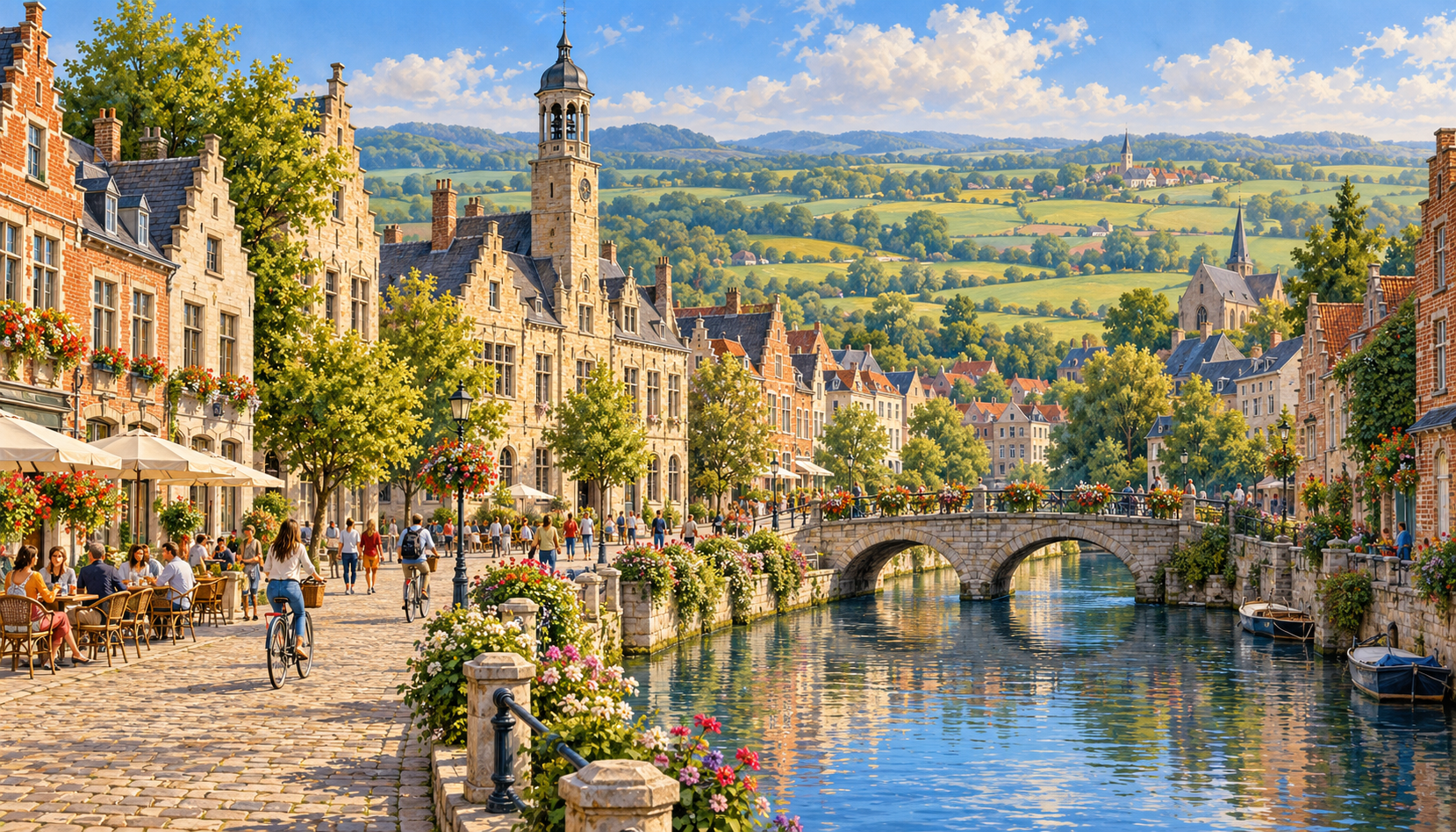
Belgium Children Vocabulary | Words for Character and Nation Building gives international children 20 useful English terms, four source-grounded chapters and practical ways to check the accuracy of their words. How can a country contain several official languages, historic towers that symbolised city freedoms, a coastal fishing tradition and festivals shared with neighbours? Belgium offers four different settings for children to practise language that is precise, respectful and useful in a community.
For international learners about 8–12 years old, with adult support for history and legal vocabulary. This guide is not a Belgian school syllabus, a political campaign, instructions for riding working horses or a claim that everyone in Belgium shares one language, festival or opinion.
Country facts worth checking first: Belgium’s official federal information identifies three official languages—Dutch, French and German—and distinguishes language-based Communities from territory-based Regions. UNESCO recognises the Belfries of Belgium and France, shrimp fishing on horseback at Oostduinkerke, and processional giants and dragons shared by towns in Belgium and France. Importantly, UNESCO removed the Ducasse of Ath component from the giants-and-dragons element in 2022; heritage lists should not be represented as unchanging or unconditional endorsements.
Educational definition of character and nation building: Here ‘character and nation building’ means habits that let different neighbours share institutions and places: listening across languages, using facts to explain civic authority, crediting skilled workers, avoiding stereotypes and correcting an erroneous claim. It never requires children to endorse a party, monarchy, religious position or compulsory national story.
Quick answer: the child’s learning objectives
| Learning resource | What children practise | Important boundary |
|---|---|---|
| 20 explained vocabulary entries | Define, contrast and use a word in an original sentence | Knowing a difficult spelling is not proof of meaning |
| Four chapters linked to real country facts | Explain evidence, people, places and safe responsibilities | A named cultural example does not describe everyone |
| Fictional learning story and six worked answers | Identify, justify and repair a misleading claim | Imaginary school characters are not real witnesses |
| Seven-day learning sequence | Notice, speak, read, compare, decide, write and transfer | Children should not be tasked with adult legal or safety duties |
Go to 20 vocabulary words · four chapters · fictional story · six checks · study plan · guidance for adults · common questions · institutional sources.
20 children’s vocabulary words: meanings, limits and sentences
Read five related words at a time. Every definition includes what the word does not mean, preventing empty memorisation and overconfident generalisations. Sample sentences are original teaching examples, not accounts of real named pupils.
1. Languages, Communities and jurisdiction in a federation
| Word | Meaning and precise distinction | Model sentence |
|---|---|---|
| federation | A country whose political responsibilities are shared between a federal level and constituent entities; not one local council. | Belgium’s federation has different levels of authority. |
| community | In Belgian constitutional government, one of three language-based entities; in everyday English, also a group connected by shared interests. | The Flemish Community has responsibilities that differ from a Region’s. |
| region | A territorial part of a country with defined authority; not another name for every language group. | The Brussels-Capital Region is one of Belgium’s three Regions. |
| jurisdiction | The scope of legal responsibility for a particular decision; not simply whichever office is closest. | The class checked which jurisdiction handled an education question. |
| multilingual | Using or living among multiple languages, without implying everybody speaks all of them equally. | A multilingual notice needed clear explanations for its intended readers. |
2. Belfries and public responsibility across centuries
| Word | Meaning and precise distinction | Model sentence |
|---|---|---|
| belfry | A tower often associated with bells and historic town government; not any church spire. | UNESCO lists belfries connected to the history of urban liberties. |
| charter | A formal document recording rights or arrangements; not a casual note on a desk. | The model museum explained why a town might safeguard a charter. |
| municipal | Relating to town or city administration, rather than the whole state. | A municipal service can maintain a local public place. |
| civic liberty | A freedom or public right connected with community life; not permission to ignore every rule. | The belfry could symbolise a town’s growing civic liberties. |
| restoration | Work to repair or recover a historic structure with attention to evidence; not proof every detail is unchanged. | The heritage caption distinguished rebuilding from the original tower. |
3. Oostduinkerke shrimp fishing and trained cooperation
| Word | Meaning and precise distinction | Model sentence |
|---|---|---|
| Oostduinkerke | A Belgian coastal locality known for traditional horse shrimp fishing; not the name of a kind of shrimp. | The pupils placed Oostduinkerke on their coastal map. |
| draft horse | A strong horse trained for pulling work, not simply any horse at a riding school. | A trained draft horse pulled equipment through the surf. |
| net | Woven or knotted material used to catch or hold items; not automatically a safe tool for unsupervised fishing. | The drawing showed the shape of the shrimp net. |
| tide | The regular rise and fall of sea level, not the same as a storm wave. | The fishers must understand tides and coastal conditions. |
| apprenticeship | Learning a skilled practice through guided experience; not proof a child should undertake hazardous adult work. | The heritage explanation described beginners learning from skilled fishers. |
4. Processional giants, craft transmission and responsible representation
| Word | Meaning and precise distinction | Model sentence |
|---|---|---|
| effigy | A figure representing a person, animal or mythical character; not a living giant. | The parade used a large effigy built by craftspeople. |
| procession | An organised movement of people and objects along a route for a ceremony or celebration; not any crowd. | The model procession followed an agreed path. |
| craftsmanship | Skill developed through careful making and practice; not simply bright decorations. | The giant required months of craftsmanship and maintenance. |
| transmission | Passing a skill or tradition between people and generations; not merely uploading one picture. | The community supported transmission by teaching new makers. |
| accountability | The willingness to explain choices and correct errors; not treating all traditions as automatically beyond criticism. | The team demonstrated accountability by amending an outdated UNESCO caption. |
Four chapters: learn the country fact, apply the word and correct an error
These chapters connect documented information with five-word clusters. Each offers a common error and a safe activity. Cultural practices are described but not treated as permission for outsiders to copy restricted rituals, dangerous work or a community’s identity.
1. Belgium’s language Communities are not identical to its Regions
Focus words: federation · community · region · jurisdiction · multilingual.
Belgium’s government describes the country as a federation. In its federal structure, Communities, Regions and the Federal State hold different responsibilities. That is more precise than saying ‘the government handles everything’. Children often hear the word community used for a neighbourhood or a group of friends. In Belgium’s constitutional system it has a particular meaning: the Flemish, French and German-speaking Communities are organised around language-linked matters, such as culture and important parts of education. A region is instead a territory with responsibilities such as aspects of transport, environment and the economy. Their names may overlap in everyday conversation, but their legal purposes should not be confused.
Belgium identifies Dutch, French and German as three official languages. That does not imply that every Belgian child speaks all three at home. Brussels is the capital of a Region with its own language arrangements, and communities elsewhere have different patterns. A multilingual society contains several languages, not an identical language profile in every household. A careful sentence would be: ‘Belgium has three official languages, while individual language skills and preferences vary.’ It would not be accurate to label all of Belgium’s schools as belonging to one uniform national curriculum without considering Community responsibilities.
Jurisdiction answers the question ‘Who has the authority to decide this matter?’ Imagine a fictional child asking why a school timetable differs from a cousin’s. The first answer might be ‘Belgium has different school systems’. That is a useful starting point, but the pupil should check which Community, school level, school and year are involved before comparing the rules. Educational jurisdiction is a more reliable way of describing the situation than assuming the two cousins’ experiences must match merely because they live in the same country.
Children can learn this distinction without needing to act as political advisers. Use an invented wall chart with three columns labelled Federal State, Communities and Regions. Put example questions such as ‘Which school language guidance?’, ‘Which local environment decision?’ and ‘Which national defence matter?’ on separate cards. Students should ask which body probably handles the subject and what source would confirm the answer. Some powers intersect; the chart is a simplified learning aid rather than a complete legal classification.
A second activity can focus on the meaning of a notice. Write a fictional event invitation in English: ‘The school library event starts at 10 a.m. in Room 5. Borrowed books must be returned by Friday.’ Invite a partner to paraphrase the instructions. If the partner changes the day or room, the meaning has not been preserved. In a multilingual setting, a translated notice also needs to keep practical details accurate. Saying ‘we provided three languages’ is not enough if a reader cannot understand an important condition. The lesson values comprehension as well as recognition.
Students should also learn that a language can have official status without being a test of an individual’s worth or right to be respected. A child with a different mother tongue or a new school experience deserves a clear explanation. Welcoming people does not require that everybody abandon their home language. The word ‘multilingual’ becomes a civic word when it encourages accurate messages and real participation instead of a boast about national diversity.
Finally, ask pupils to write three separate statements: one legal fact, one personal preference and one practical change. For example, ‘Belgium has three official languages’ is a legal fact. ‘I prefer to read in Dutch’ is an individual’s preference. ‘The club supplied a clearer caption’ is an observable change. Different sorts of statements require different evidence. A student who can tell them apart is ready to communicate more fairly in an international classroom.
Common mistake and repair: Misleading: ‘Belgium has three official languages, so every child must speak all three and every Region is the same as a Community.’ Repair: ‘The constitutional Communities and territorial Regions have different roles; individual language use varies.’
Transfer task: Design a mock multilingual library invitation, then test whether its place, date and deadline remain accurate when another pupil explains it. Label one administrative question that needs official verification.
2. Belfries show why architecture can represent historical civic rights
Focus words: belfry · charter · municipal · civic liberty · restoration.
UNESCO’s Belfries of Belgium and France World Heritage entry covers a group of historic towers on both sides of a modern international border. These towers developed during the growth of medieval towns and were associated with urban rights, municipal authority, bells, local records and public life. A belfry is therefore more than a tall building that photographs nicely. In some towns it served practical purposes, including a place for communal bells, important documents or watch functions. It could also express a town’s status in relation to older forms of feudal or religious power.
A charter is a formal document recording particular grants, rights or arrangements. Historic charters sometimes mattered to town governments because they made recognised privileges or duties explicit. The word municipal describes the level of a city or town’s public administration. These two words help children avoid turning the belfry into a fairy-tale tower with no real civic role. They can ask what was stored, who was authorised to make decisions, and who could use the space. A grand tower should not be interpreted as evidence that every resident enjoyed equal rights at that time.
UNESCO explains that some belfries represented the emergence of municipal independence in parts of north-western Europe. The phrase civic liberty helps describe historic rights and freedoms connected with towns. It does not mean that medieval people enjoyed every modern democratic freedom or that all social groups were treated equally. Children need to distinguish a historical change in power from a claim of complete justice. A source may document a town’s independence from a lord without establishing universal political participation among all its inhabitants.
The World Heritage property includes 33 belfries in Belgium and 23 in northern France. That joint listing is important. If a guide is titled ‘Belgian belfries’, it should not quietly rewrite the entire UNESCO property as exclusively Belgian. Cultural connections can cross modern borders. A class can still study one Belgian example while accurately naming the shared international inscription. The word ‘Belgian’ identifies where a particular tower stands, not the ownership of every tower in the collection.
Many historic belfries have been damaged and rebuilt during wars and other events. Restoration includes work undertaken to preserve or repair a valued structure, guided by evidence and heritage expertise. A present-day photograph does not establish that every stone is original or that a tower looks exactly as it did centuries ago. UNESCO specifically discusses the significance of rebuilding as an expression of a community’s continued attachment. A good caption can explain both the continuity of meaning and the change in physical fabric without treating restoration as a flaw.
Imagine a school exhibition called ‘A Tower and a Town’. One pupil writes ‘Every belfry was the castle of a king’. A second studies UNESCO’s explanation of the relationship between communal authority, feudal keeps and church towers. The class corrects its label: ‘Belfries were associated with urban communal power; specific uses varied among sites’. They add a drawing of a town square, a bell and an official record box. The objects are teaching symbols, not proof that a particular belfry contained every feature in the diagram. That qualification makes the exhibit stronger, not weaker.
For a civic transfer exercise, ask what a class council can and cannot do. Pupils might agree on how to display their work or plan a reading break, but they do not possess the legal authority of a municipal council. This reinforces the distinction between participation and jurisdiction. Students can practise fairness and discussion without pretending that a mock classroom is a real government.
End by comparing ‘A tower proves everybody had freedom’ with ‘A belfry could symbolise a historic town’s municipal power and particular liberties’. The latter is narrower but defensible. Vocabulary for character should teach a child to respect the complexity of historic rights, not merely admire the height of buildings.
Common mistake and repair: Misleading: ‘UNESCO belfries were all royal castles and prove full equality for every medieval citizen.’ Repair: ‘Belfries had varied municipal functions and symbolised particular urban liberties, without proving universal equality.’
Transfer task: Write a 70-word museum caption for a fictional town tower. Identify a belfry, a civic role, a source-supported historic liberty and one question requiring local archives.
3. Horse shrimp fishing shows skill, trust and sea-safety boundaries
Focus words: Oostduinkerke · draft horse · net · tide · apprenticeship.
UNESCO inscribed shrimp fishing on horseback in Oostduinkerke as intangible cultural heritage in 2013. Its description identifies a small number of households that keep this tradition active and pass knowledge to younger practitioners. In the practice, strong Brabant draft horses are used to pull nets in shallow coastal surf under trained handlers. The net catches shrimp while the horse and fisher move along the coast. It would be misleading to describe the activity as children riding ponies into the sea for fun.
Oostduinkerke names the locality associated with this particular practice. This is a good lesson in how to use proper nouns: naming a place matters because not every Belgian beach uses this fishing method. A child can appreciate a country-wide cultural connection without pretending that the whole population lives by the sea or that every fishing worker performs the same job. The UNESCO entry’s focus is specific, and the article should keep it specific.
The word tide describes the regular rise and fall of sea level. It is not identical to a storm surge or an individual breaking wave. Experienced shrimp fishers need knowledge of beach conditions, currents and the movement of water to work safely. The activity also demands a high level of trust and respect between the handler and horse. Understanding the terms in a glossary is not evidence that a child knows how to judge an actual tide or manage an animal in surf. This distinction is central to good character: knowing your limits is more responsible than volunteering for unsafe tasks.
Apprenticeship here refers to beginners learning from experienced practitioners. Skills include the use and maintenance of fishing equipment, knowledge of the coast and horse handling. UNESCO describes shared values and interdependence among those who participate. When a pupil sees an image of a shrimp basket, they can ask whose labour produced the catch and who kept the equipment usable. The finished product is not the entire story. A respected tradition often depends on less visible work such as net weaving, preparation and teaching.
A class should avoid making simplified moral promises about the practice. Saying ‘Because UNESCO listed it, every aspect of horse treatment is automatically perfect’ would be a mistaken inference. A source documents a heritage element and the significance of trust and respect; welfare and safety questions still deserve informed, current assessments by people responsible for the animals. Likewise, claiming that the practice is unsafe solely from an unfamiliar photograph would not be a properly researched conclusion. Children can ask about appropriate care without pretending to be veterinary experts.
Imagine an illustration with four stages: preparation on shore, coastal movement with horse and net, collection of the catch, and cleaning the equipment. Ask pupils to describe where an adult’s judgement is critical. A child-friendly answer might name the horse’s training, sea conditions and safe use of equipment. The drawing should be a conceptual account of the practice, not a field manual with instructions to enter the water. Real demonstrations and visitor access require current official local guidance.
UNESCO also describes the tradition’s link with the Shrimp Festival and community participation. Some people construct floats or make costumes rather than fish. This helps the class see that a cultural event can have multiple kinds of contribution. An older fisher sharing knowledge, a craftsperson mending a net and a person explaining the tradition to visitors perform different jobs, yet the cultural meaning depends on them working within their responsibilities.
For a final transfer task, compare the fishing tradition with an ordinary supervised school group project. The equipment changes, but some principles carry over: prepare responsibly, recognise the leader’s experience, assign suitable jobs and check the outcome. Do not carry over the risky task itself. The educational purpose is understanding the meanings of tide, apprenticeship and cooperation—not turning a vulnerable coastal activity into children’s homework.
Common mistake and repair: Misleading: ‘Anyone who learns the word tide can safely ride a horse and pull shrimp nets in the sea.’ Repair: ‘The heritage practice depends on trained practitioners, local conditions and respect for animal and human safety.’
Transfer task: Make a four-panel concept diagram of preparation, net use, heritage transmission and equipment care. Label it an educational model, not fishing instructions.
4. Processional giants show both cultural creativity and the duty to revise
Focus words: effigy · procession · craftsmanship · transmission · accountability.
UNESCO recognises processional giants and dragons in Belgium and France as living intangible heritage. A large effigy is a constructed figure representing a historic, mythical or local character. In a procession, performers and community members move with figures along an arranged route. It can take months to plan, build and maintain the structures, which vary among towns. A child looking at a photograph of a nine-metre figure should not claim to know how it was balanced or carried from the image alone. Such technical details belong to practitioners and reliable documentation.
UNESCO describes events in particular Belgian towns including Brussels, Dendermonde, Mechelen and Mons, as well as towns in France. This is a multinational inscription, not a claim that every Belgian village has the same festival. The stories, figures and customs vary. One parade may feature a dragon and a local legend; another may use a giant linked with local history. The word craftsmanship covers the developed skill behind making these large and often fragile figures. It is more specific than saying ‘the festival is colourful’.
Transmission involves experienced makers and organisers teaching others how a practice works. People who make costumes, rehearse music, manage structures and remember stories contribute to a festival over time. Some work is visible in the parade; other tasks happen long before visitors arrive. A strong explanatory poster names these different contributions so that skilled and careful labour does not vanish behind the largest object in the square.
Living heritage also changes. UNESCO’s current entry records a modification made in 2022: the Ducasse of Ath component was removed from the inscription. A child should not be taught that every part of a famous cultural tradition is automatically or permanently endorsed simply because a UNESCO entry exists. Accountability means checking an inscription’s present scope and being willing to correct an outdated caption. It is not a command to attack the people who enjoy a festival. It is an invitation to describe heritage responsibly and recognise that public representations may be reassessed over time.
Consider a fictional class producing a poster of ‘All UNESCO Giants’. They include a festival removed from the listing, and a teacher notices the outdated claim. The correct response is to inspect UNESCO’s current entry, change the label and explain that the list’s scope has changed. Deleting the mistake without telling group members why would miss a teaching opportunity. The revised label is more valuable because it reflects a documented decision and shows that accuracy matters even with exciting subjects.
Another important lesson is avoiding stereotypes. An effigy can represent a mythical creature, profession or historic person, but a figure’s existence does not prove that everyone today shares its story or approves of every portrayal. Children can ask who designed it, whose viewpoint it represents, and whether the representation treats real communities respectfully. They should not create humiliating caricatures of classmates or cultural groups in the name of ‘tradition’. Heritage learning is a chance to distinguish appreciation from uncritical copying.
For a safe classroom activity, build a small original paper puppet based on a fictional character. Create a title and story that do not impersonate a real town’s protected tradition. A group can plan a short walk in a classroom with adult supervision and identify the jobs of designer, builder, narrator and safety checker. The exercise is not a claim to recreate the actual UNESCO tradition. It simply helps the learner understand an effigy, a procession and the work behind them.
Finish with a short paragraph using all five terms: ‘A processional effigy requires craftsmanship. Practitioners transmit their skills, and responsible organisers check how the figures represent their communities. Accountability includes correcting outdated information’. This is a precise summary. It makes nation building a practice of shared work and truthful public communication, rather than a demand that children applaud every parade without question.
Common mistake and repair: Misleading: ‘Everything ever called a processional giant remains on UNESCO’s list and must never be questioned.’ Repair: ‘UNESCO’s inscription has a defined, updated scope; responsible descriptions and representations can be reviewed.’
Transfer task: Design an original paper figure with its own invented story. Identify how makers, performers and a source-checker contribute, and explain why it is not an official representation of a town’s UNESCO tradition.
Fictional story: build trust by checking and revising
At a fictional Belgian children’s history fair, Louise writes that every Belgian school uses the same language curriculum. Noor checks Belgium’s federal information and distinguishes Communities from Regions. Jonas makes a belfry model but labels it the private tower of a medieval king; the group reads UNESCO and rewrites the caption around historic town power. Emma draws a horse shrimp fisher and proposes that classmates attempt it at the beach, but their teacher changes the assignment to a safe paper diagram. Finally, the class checks UNESCO’s current processional giants listing and corrects an outdated entry. The students and fair are imaginary; the legal and heritage claims are sourced.
Four reading-comprehension questions
- 1. Which two Belgian institutions did Louise’s first label confuse?
- 2. Why did Jonas’s belfry explanation miss its historic civic function?
- 3. What is the difference between learning shrimp-fishing vocabulary and safely conducting the practice?
- 4. Why did a UNESCO source check lead to a change in the giants poster?
Ask the learner to identify the line that supports each answer. For statements about the country, ask which named source corroborates the description. The story’s imaginary classroom events are not source evidence about real schools.
Six self-checks with worked answers
Check 1: Does the existence of three official languages prove every person in Belgium speaks all three?
Worked answer: No. The legal list does not establish individual proficiency or home-language preferences.
Reasoning practice: Name the precise word, explain why a tempting alternative is wrong, and give one new sentence in a different context. An accurate reason is more important than simply recalling the bolded answer.
Check 2: Are Belgian language Communities identical to its three territorial Regions?
Worked answer: No. They have different constitutional roles and responsibilities.
Reasoning practice: Name the precise word, explain why a tempting alternative is wrong, and give one new sentence in a different context. An accurate reason is more important than simply recalling the bolded answer.
Check 3: Does every belfry historically serve as a private royal tower?
Worked answer: No. Many were associated with municipal power, public bells, documents and urban rights.
Reasoning practice: Name the precise word, explain why a tempting alternative is wrong, and give one new sentence in a different context. An accurate reason is more important than simply recalling the bolded answer.
Check 4: Can a child safely fish on horseback after learning five vocabulary words?
Worked answer: No. The living heritage practice depends on trained fishers, horses and coastal judgement.
Reasoning practice: Name the precise word, explain why a tempting alternative is wrong, and give one new sentence in a different context. An accurate reason is more important than simply recalling the bolded answer.
Check 5: Are UNESCO’s processional giants and dragons inscribed solely for Belgium?
Worked answer: No. It is a multinational Belgium–France element, and its scope was modified in 2022.
Reasoning practice: Name the precise word, explain why a tempting alternative is wrong, and give one new sentence in a different context. An accurate reason is more important than simply recalling the bolded answer.
Check 6: A class corrects an outdated inscription label instead of defending it. Which quality is shown?
Worked answer: Accountability supported by checking the current source.
Reasoning practice: Name the precise word, explain why a tempting alternative is wrong, and give one new sentence in a different context. An accurate reason is more important than simply recalling the bolded answer.
Seven-day study plan: accurate vocabulary becomes useful
| Session | What to do | Evidence of understanding |
|---|---|---|
| Day 1 — Notice | Read the first five terms, then explain each without copying its definition. | A correct distinction and non-example |
| Day 2 — Speak | Use words 6–10 in two everyday family or school scenarios. | Original sentences that preserve meaning |
| Day 3 — Source | Read a short age-suitable excerpt from one listed official source with an adult. | One supported fact and one open question |
| Day 4 — Compare | Study words 11–15 and sort three claims into observed, sourced or fictional. | No unsupported national generalisation |
| Day 5 — Decide | Use words 16–20 to propose a safe change to an imaginary group activity. | One achievable responsibility and success check |
| Day 6 — Write | Write 80–120 words using three words, plus a line that explains a source. | Coherent accurate paragraph without decorative jargon |
| Day 7 — Transfer | Use three general-purpose words in a situation outside this country. | Correct new use without copying culture-specific details |
A simple assessment for adults
Do not judge a learner by how quickly a word is pronounced. Ask for a definition in the child’s own words, a wrong example they can correct, and a fresh use they can defend. Mark the three abilities as ‘not yet’, ‘with help’ or ‘independently’. Repeat the check after a few days instead of assuming that one perfect recitation is lasting mastery.
For writing, require a clear subject, a relevant verb, the selected word’s correct meaning, a traceable source for every real-world claim and an explicit indication that an exercise is fictional where appropriate. Honest uncertainty is preferable to invented names, dates, cultural meanings or scientific measurements.
Parent and teacher notes: character is observable, not a slogan
- Use primary sources for factual anchors. A UNESCO listing describes a specific practice or property; it does not establish what every citizen believes.
- Separate country and community. Living traditions may be shared across borders and practised by particular groups, not uniformly by entire countries.
- Distinguish official status from individual identity. A constitutional language label does not prove a child’s mother tongue or level of understanding.
- Credit the people behind the work. Makers, performers, guides, documenters and community members often have different roles.
- Never turn dangerous adult work into children’s homework. Fishing in surf, managing marine wildlife, large constructions and legal governance require appropriate training and authority.
- Recognise historical complexity. A heritage recognition may be updated, and an admired cultural site may also have histories that deserve critical explanation.
- Make small acts visible. A readable notice, corrected map, properly attributed recording or honest progress report can demonstrate character.
- Invite questions without humiliation. A child who corrects a claim after checking a source is making progress, not failing.
Frequently asked questions
How many official languages does Belgium have?
Three: Dutch, French and German. That does not mean every resident is fluent in all three.
What is the difference between a Community and a Region in Belgium?
Communities are language-based constitutional entities; Regions are territory-based and hold different sets of responsibilities.
Why are belfries important to civic history?
UNESCO documents their municipal functions and symbolic connection with urban liberties in Belgium and France.
Does UNESCO automatically approve every part of a festival forever?
No. Entries have a defined scope that can be modified. UNESCO removed the Ducasse of Ath component from the processional giants-and-dragons inscription in 2022.
Sources, companion articles and the A–K vocabulary branch
The named country facts were checked against the institutional sources below as at 23 October 2026. Reading stories, sample sentences and classroom activities are editorial teaching material, not national syllabuses or eyewitness reports. Consult current official guidance for any real site access or safety questions.
- Belgium Federal Government | Belgium, a federal state
- Belgium Federal Government | Communities
- Belgium Federal Government | Regions
- UNESCO | Belfries of Belgium and France
- UNESCO | Shrimp fishing on horseback in Oostduinkerke
- UNESCO | Processional giants and dragons in Belgium and France, updated inscription
- UNICEF | Convention on the Rights of the Child
Explore this country in eduKateSG
- Everything About Belgium
- How Belgium Works
- How Education System of Belgium Works
- Top 100 Comics Vocabulary Words | Belgium
- Top 100 Bernissart Dinosaur Vocabulary Words | Belgium
A–K Children Vocabulary: linked country reading
Afghanistan Children Vocabulary · Albania Children Vocabulary · Algeria Children Vocabulary · Andorra Children Vocabulary · Angola Children Vocabulary · Antigua and Barbuda Children Vocabulary · Argentina Children Vocabulary · Armenia Children Vocabulary · Australia Children Vocabulary · Austria Children Vocabulary · Azerbaijan Children Vocabulary · Bahamas Children Vocabulary · Bahrain Children Vocabulary · Bangladesh Children Vocabulary · Barbados Children Vocabulary · Belarus Children Vocabulary · Belgium (this guide) · Belize Children Vocabulary · Benin Children Vocabulary · Bhutan Children Vocabulary
Return to a main education and vocabulary hub
- Vocabulary Learning Hub | Primary to Junior College
- Vocabulary by Age and Purpose
- How Countries Work | Global Index
- Top 20 Unique Vocabulary by Country
The goal of this Belgium chapter is for children to use English vocabulary to identify a real fact, distinguish a limited observation from an invented interpretation, respect the people behind a tradition and complete one safe, explainable contribution. Careful language makes shared life easier to understand.