
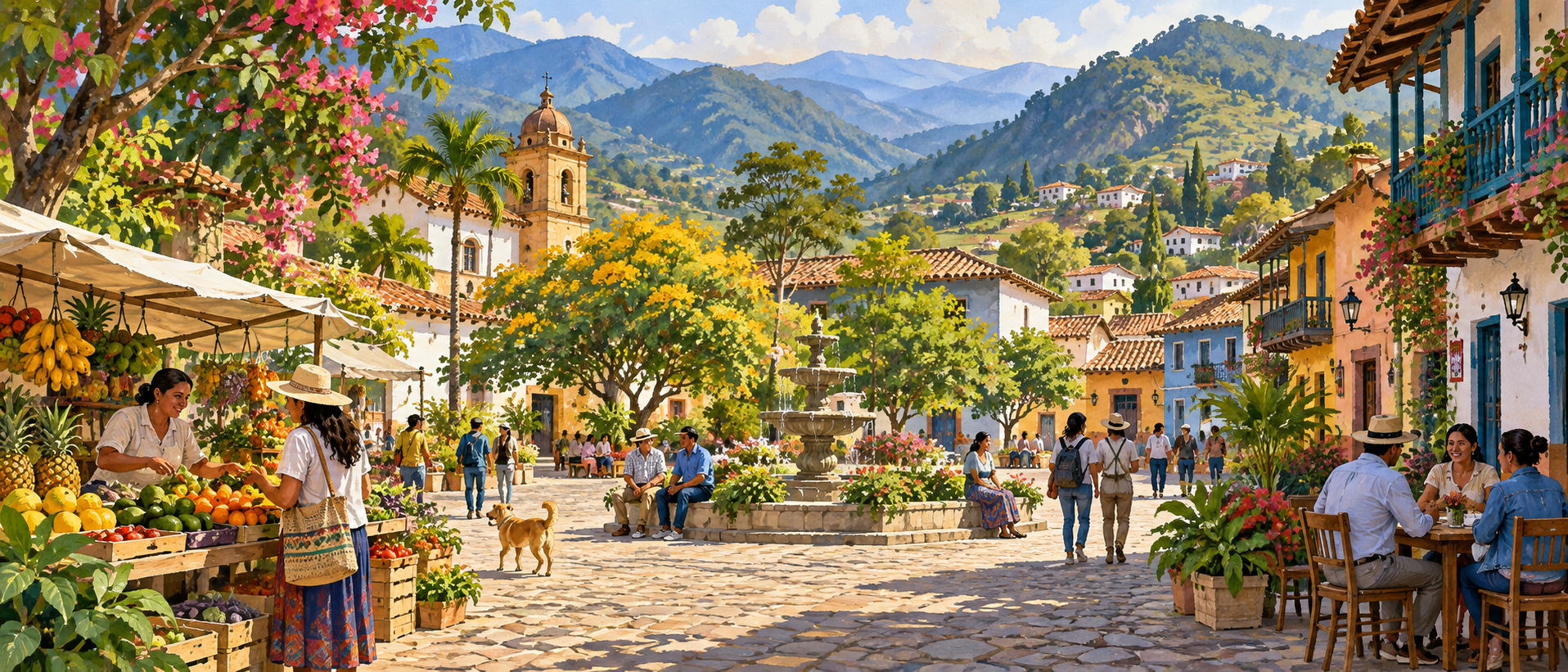
Colombia Children Vocabulary | Words for Character and Nation Building. A country-based English guide using twenty defined words, four substantial readings, a fictional narrative and worked practice. How can a delicate resin craft, a community founded by people seeking freedom, mountain coffee farms and a remote rainforest with important rock art help children become careful readers? Colombia’s examples teach children to use words for real skills, historical dignity, ecological care and respect for communities rather than broad national stereotypes.
For international learners approximately eight to twelve years old, with parents or teachers selecting age-appropriate source excerpts. This independent English guide is not Colombia’s official curriculum, permission to collect natural resins or enter protected areas, or a request to imitate community practices. Historical enslavement is described without graphic detail. All classroom characters and examples are invented.
Source-supported country facts: UNESCO inscribed Pasto Varnish mopa-mopa knowledge on the urgent safeguarding list in 2020, the Cultural Space of Palenque de San Basilio in 2008, the Coffee Cultural Landscape of Colombia as World Heritage in 2011, and Chiribiquete National Park as World Heritage in 2018. The latter property has strict protections for Indigenous communities in voluntary isolation, so its heritage listing must never be used as an invitation to visit.
Learning meaning of character and nation building: Character and nation building in this article means accurately crediting other people’s work, learning about freedom without romanticising oppression, caring for shared landscapes with evidence and respecting communities’ right to make decisions about their own cultural knowledge. Children are not asked to promote a government or carry out professional conservation.
Quick guide: from words to usable thinking
| Component | What children do | What children avoid |
|---|---|---|
| 20 vocabulary entries | Explain a word, reject a near-miss and use it in an original sentence | Memorising without meaning |
| Four country-grounded chapters | Distinguish a documented fact from a guess, with clear named people | One local example becoming a stereotype about everyone |
| An original story and six checks | Find, explain and repair a misleading claim | Passing invented characters off as real eyewitnesses |
| Seven-day practice programme | Read, speak, research, revise, write and transfer knowledge | Handling adult jobs, dangerous sites or restricted ceremonies |
Go to word bank · learning chapters · fictional story · worked checks · seven-day plan · adult guidance · questions · references and hubs.
20 words for children: meanings, distinctions and sentences
Definitions explain both what a word means and what it does not mean. All model sentences are original teaching examples. Culture-specific names belong to particular practitioners and places, not to every resident of an entire country.
1. Pasto Varnish: three linked trades and careful attribution
| Word | Meaning and important distinction | Original example sentence |
|---|---|---|
| mopa-mopa | A tree-derived material used in the Colombian Pasto Varnish tradition; not ordinary shop-bought paint. | The class identified mopa-mopa as a material in a specialist craft. |
| resin | A plant-derived substance that can be processed for different uses; not the finished decorated object. | The maker prepared resin before decorating an item. |
| woodcarving | Shaping or decorating wood with skilled tools; not simply applying a picture to paper. | Woodcarving contributed to the vessel’s form. |
| varnishing | Applying or working a coating on a surface; traditional Pasto Varnish involves specialised techniques. | The article credited the varnishing craftsperson. |
| apprenticeship | Structured learning with experienced practitioners; not proof a beginner is already an expert. | An apprenticeship can help pass on rare skills. |
2. Palenque de San Basilio: freedom, language and historical remembrance
| Word | Meaning and important distinction | Original example sentence |
|---|---|---|
| palenque | In Colombian history, a community founded by people who escaped enslavement; not every village. | Palenque de San Basilio has a distinctive historical origin. |
| self-determination | The ability of a community or people to shape decisions affecting their lives; not a visitor’s licence to speak for them. | The caption respected community self-determination. |
| Palenquero | A Spanish-lexifier creole language associated with Palenque de San Basilio; not simply incorrect Spanish. | The class learnt that Palenquero has its own structures. |
| oral tradition | Knowledge or expression passed through speech and performance; not merely one printed page. | Songs and stories may belong to an oral tradition. |
| remembrance | Truthful care for people and events from the past, including injustice; not only praise for famous monuments. | The display made room for remembrance of people denied freedom. |
3. Coffee Cultural Landscape: slopes, farmers and environmental responsibility
| Word | Meaning and important distinction | Original example sentence |
|---|---|---|
| cultural landscape | A place shaped by interactions among people, work and nature over time; not untouched scenery. | UNESCO recognises Colombia’s coffee cultural landscape. |
| slope | Land rising or falling at an angle; not the same as flat farmland. | The farmer’s coffee plot occupied a steep slope. |
| coffee cherry | The fruit of a coffee plant that contains seeds processed as coffee beans; not a prepared drink. | Harvesters selected ripe coffee cherries. |
| erosion | The removal or transport of surface material by water, wind or other processes; not all soil movement being deliberate. | Heavy rain can contribute to erosion on a bare slope. |
| stewardship | Responsible care of a shared or entrusted resource, according to evidence and rules; not acting as its owner. | The project used stewardship to explain careful land management. |
4. Chiribiquete: rock art, biodiversity and the right to be left undisturbed
| Word | Meaning and important distinction | Original example sentence |
|---|---|---|
| Chiribiquete | A protected Amazonian national park in Colombia with important natural and cultural heritage; not a public rock-art playground. | The UNESCO account places Chiribiquete in Colombia’s Amazon. |
| tepui | A steep-sided table-top mountain or sandstone plateau; not every flat roof or ordinary hill. | A drawing showed a tepui rising above forest. |
| pictograph | A painted image or symbol, including some forms of ancient rock art; not an engraving cut into stone. | The source describes rock pictographs at Chiribiquete. |
| biodiversity | The variety of organisms and ecological relationships; not just how many jaguars appear in one photo. | Biodiversity requires wider ecological evidence. |
| non-interference | Respecting limits by refraining from unwanted intrusion; particularly important for peoples in voluntary isolation. | Non-interference meant not proposing a tourist visit to restricted sacred sites. |
Four reading chapters: real knowledge, careful claims and safe practice
Each chapter explains five focus words with factual context, an overstatement to correct and an activity a child can safely complete using paper, discussion or supervised reading. None of the activities authorises field research or reproduces sensitive community knowledge.
1. Mopa-mopa craft depends on forest harvesters, woodworkers and varnishers
Five focus words: mopa-mopa · resin · woodcarving · varnishing · apprenticeship.
UNESCO inscribed Traditional knowledge and techniques associated with Pasto Varnish mopa-mopa of Putumayo and Nariño in 2020 on its List of Intangible Cultural Heritage in Need of Urgent Safeguarding. It did not inscribe every kind of varnishing in Colombia. The element involves a particular traditional process with connected skills and communities. A school poster that shows a glossy wooden box without naming the people behind the work misses much of what UNESCO is trying to safeguard.
The UNESCO account identifies three important trades: people who harvest material from the mopa-mopa tree in Putumayo, woodworkers in Nariño who prepare and shape objects, and varnishers who decorate them. This is why the words mopa-mopa, woodcarving and varnishing need separate definitions. A forest harvester and a person who finishes a wooden object are not necessarily the same worker. The final object can involve knowledge from several specialists, and an accurate caption should acknowledge the different roles rather than assigning all credit to an anonymous country.
Resin is a plant-derived material, but a reader should not imagine that taking any sticky substance from a tree produces traditional Pasto Varnish. UNESCO describes specialist knowledge of when to collect buds, how to avoid harming the source plants and how the material is prepared for decoration. Harvesting involves local ecological knowledge and attention to appropriate conditions. Those facts belong to trained practitioners, not children attempting to find an unknown tree in a park. A learner can understand the word resin without being asked to collect any.
The makers’ work is skilled and careful. A piece of carved wood may have its own technical demands, while the decorative stage involves different methods and experience. A photograph reveals colour and shape but cannot record the number of decisions a particular person made. It also cannot identify a maker’s name or date without a label. Children who want to give accurate attribution should ask which source documents the object. Inventing a master craftsperson’s name to make a caption sound complete would be less respectful than writing ‘maker not identified’.
The term apprenticeship is relevant because UNESCO’s safeguarding work has supported experienced practitioners sharing skills directly with learners. UNESCO describes a 2022–2024 safeguarding project with training, one-to-one apprenticeship work, documentation and opportunities to discuss the craft’s future. Such initiatives help illustrate the difference between declaring a tradition valuable and undertaking work to keep it viable. The presence of a programme is not, by itself, proof that all practitioners’ difficulties have disappeared.
UNESCO notes risks from access to materials, the conditions of production and limited opportunities for younger people to enter the trades. That means the entry’s urgent safeguarding status is not a decorative badge of perfection. It identifies a living tradition facing specific pressures. The child should not write ‘UNESCO says the craft is dying tomorrow’ or ‘UNESCO recognition means the craft is secure forever’. Both would overstate the source. The accurate lesson is that sustaining knowledge requires people, materials, training and appropriate livelihoods over time.
Imagine a fictional museum caption: ‘A Colombian varnish machine created this box in one minute’. Another student checks UNESCO and discovers separate harvesting, woodwork and varnishing stages. The class revises the label: ‘Pasto Varnish mopa-mopa is a living craft involving forest harvesters, skilled woodworkers and varnishers’. The stronger caption recognises the human knowledge concealed by the original object’s smooth finish. The correction is a real act of educational fairness, even though the school did not produce the craft itself.
A safe paper exercise can use three cards labelled material, shape and decoration. Pupils draw an imaginary object and then name which specialist would be involved in each stage of the real heritage. It must not be described as an authentic Pasto Varnish sample or permission to use specialist tools. The exercise does not require hot materials, sharp instruments or unknown plant products. It teaches how teamwork can involve people with different expertise, rather than requiring everyone to perform all tasks.
Children can also learn why source dates matter. An official listing in 2020, a particular assistance project in 2022–2024 and a photograph dated in another year are separate events. A caption that collapses them into one date may mislead. If the lesson uses a photograph, check whether its creator, date and workshop are recorded. A reliable source might establish the general craft while leaving the particular object’s origin unknown. The writer must keep those two levels of certainty apart.
The nation-building connection is therefore modest and concrete. Someone who sees the final work can recognise that forest knowledge, specialised craftsmanship, fair attribution and opportunities for younger learners all matter. The article does not need to make every child a varnisher or claim that all Colombians practise the craft. It needs to teach precise English and respect for the people whose skill makes a tradition possible.
Correct the misleading sentence: Incorrect: ‘Pasto Varnish is ordinary paint produced automatically by one anonymous maker, and UNESCO recognition solved all its challenges.’ Repair: ‘It is a specific three-trade tradition whose skills and materials require continuing safeguarding.’
Child-safe transfer activity: Create a safe three-stage paper flowchart for harvesters, woodworkers and varnishers. Explain which parts are UNESCO facts and which are your invented model.
2. Palenque de San Basilio connects remembrance with living language and freedom
Five focus words: palenque · self-determination · Palenquero · oral tradition · remembrance.
UNESCO inscribed the Cultural Space of Palenque de San Basilio on its intangible-heritage list in 2008, following an earlier proclamation in 2005. This is a specific community near Cartagena in Colombia, not a name for every settlement in the country. UNESCO describes how palenques were communities created as refuges by people who escaped enslavement during the colonial period. Palenque de San Basilio is especially important for the survival of its cultural practices and language. The founding story should not turn forced labour into ordinary voluntary employment.
The word self-determination helps explain why a refuge community matters. People who had been denied freedom sought places where they could establish community life on their own terms. A child can be taught that enslavement was unjust and that escape involved attempts to regain freedom, without being shown distressing images or asked to invent a person’s voice. Self-determination should not be reduced to the casual idea that anyone may simply take ownership of another community’s traditions. It concerns autonomy and the right to make meaningful decisions about one’s own life and cultural future.
The term Palenquero names a creole language associated with the community. UNESCO identifies it as an important cultural feature and explains that it combines African linguistic contributions with a Spanish-lexifier form. A learner should not describe it as simply careless Spanish. Languages develop structures that are meaningful to their speakers, and a country’s official language does not erase the languages used in individual communities. The phrase ‘Palenquero is part of Colombia’s language heritage’ is more accurate than ‘everyone in Colombia speaks Palenquero’.
UNESCO’s account also describes music, dance, social organisation, oral traditions and cultural knowledge. An oral tradition passes stories, sayings or performance knowledge through speech and participation. It is not necessarily identical to one printed book. A recording can document a particular performer, but it does not grant outsiders permission to publish all material or decide a secret meaning on behalf of its bearers. If a class wishes to use a story or image, accurate attribution and appropriate consent matter.
Remembrance is the decision to tell the past honestly. In a history caption, the phrase ‘people who escaped slavery’ should be made clear to younger readers: enslaved people were denied freedom and treated unjustly, and some established places of refuge. The existence of a thriving living culture does not make that earlier injustice acceptable. A child’s paragraph can recognise both historical harm and the dignity, skill and creativity of people who built lives despite it. Truthful language avoids turning oppression into a romantic adventure.
Palenque de San Basilio is a living community, not an uninhabited historical theme park. People have current needs, choices and different ways of participating in heritage. An international class must not assume every resident knows or performs the same dance or that a person’s heritage is available for public use. UNESCO recognition identifies cultural significance, not a requirement that community members entertain visitors. Students may ask questions using official sources instead of demanding that a classmate represent an entire tradition.
The word self-determination can be linked to a simple classroom analogy without equating school life with enslavement. In a mock planning task, pupils may choose the theme of a class reading display, ask participants what they want and give them an opportunity to say no. This illustrates consent and meaningful participation. It does not reproduce the extreme denial of rights that made historical palenques necessary. Teachers should state that the scale and gravity of the situations are completely different.
A common writing mistake is to turn the name Palenque into an adjective for the whole country. ‘Colombia is Palenque’ would erase many communities and histories. A more informative sentence names the community, its location, its historical origin and the UNESCO heritage element. It should also distinguish the town itself from the cultural practices UNESCO recognises. A living town can have a history and a language without every current resident performing every documented practice.
Imagine a fictional heritage poster saying, ‘The town was founded by workers who chose to take jobs away from the city’. A teacher checks UNESCO’s description and revises it: ‘Palenques were established by people escaping enslavement, and San Basilio became a distinctive community with its own cultural space’. The correction matters because the earlier label concealed coercion. Good education does not require long shocking descriptions; it requires clear terms that do not mislead.
For a child-friendly study task, write a three-column note titled ‘Historic setting’, ‘Living language’ and ‘Who should speak for the community?’. The first column uses UNESCO’s documented origins, the second explains the Palenquero language, and the third states that practising community members have their own voices and choices. Ask learners to identify which claim comes from a public source and which would need a particular person’s consent. Their final paragraph should respect both historic memory and living agency.
Character is visible when a pupil corrects a misleading euphemism, names the community properly, and stops short of inventing personal experience. These habits are not unique to Colombian history. They help children write truthfully about difficult subjects anywhere in the world while allowing people to define their own identities.
Correct the misleading sentence: Incorrect: ‘Palenque was simply a tourist village founded by willing colonial workers, and Palenquero is just bad Spanish.’ Repair: ‘UNESCO documents a refuge community with its own language and traditions rooted in resistance to enslavement.’
Child-safe transfer activity: Write a five-sentence heritage note: name the place, explain the word palenque, mention Palenquero, attribute UNESCO and ask one respectful question rather than inventing a person’s memories.
3. Colombia’s Coffee Cultural Landscape is a working landscape, not just an attractive slope
Five focus words: cultural landscape · slope · coffee cherry · erosion · stewardship.
UNESCO inscribed the Coffee Cultural Landscape of Colombia on the World Heritage List in 2011. Its description covers a series of six sites that incorporate eighteen urban settlements and productive coffee areas in a mountainous region. A cultural landscape is a place shaped by interactions between people and their environment over time. This property is not a single coffee shop, nor does it mean every Colombian farm is included in the protected area. A precise reader distinguishes the property boundaries from the wider country’s coffee economy.
The mountainous slope helps explain the nature of local farming. UNESCO describes coffee plantations on steep terrain where the landscape, farms, roads and settlements have developed together. A field on a steep slope presents different management challenges from a flat plain. Workers need techniques suited to terrain, rainfall, access and the crop. A child can understand that difference through a paper hill diagram without being asked to operate farm machinery or visit a dangerous hillside.
A coffee cherry is the fruit of the coffee plant, containing seeds that may later be processed into coffee beans. It is not an already prepared drink. This distinction helps pupils see different kinds of work: cultivation, selection, harvest, processing, transport and sale. UNESCO’s landscape description emphasises the cultural and economic importance of coffee growing, but it does not prove that each worker completes every stage or receives identical income. A value chain needs several roles, whose circumstances require their own evidence.
UNESCO describes family farms and methods passed across generations. That can be a meaningful example of cultural continuity, but pupils should not infer that every child in the region must become a farmer or that everybody’s family owns land. A landscape has many residents, jobs and opportunities. The source establishes the heritage significance of this particular combination of farms, communities and terrain, not one prescribed life path for every resident.
The word erosion matters when considering steep agricultural land. Soil can be carried away by rainwater or other forces, particularly under unsuitable land management. UNESCO’s discussion of the site’s pressures includes soil erosion and concerns about pesticides, fertilisers and water management. A child should not write that every coffee farm is damaging the environment or, conversely, that every farm is perfectly sustainable because UNESCO inscribed the landscape. Actual results depend on practices, conditions and evidence.
Stewardship is care that recognises a place’s shared value and the needs of those who use it. In a living agricultural landscape, conservation cannot simply mean turning every farm into a museum and stopping people from working. UNESCO’s management objectives include environmental sustainability and the social and economic wellbeing of residents and farmers. Good decisions must consider heritage features, changing livelihoods and practical resources. Young learners can ask what a proposed change would affect, without taking over the decisions of farmers or authorities.
Aerial photographs can make a coffee region look beautifully uniform, but a photograph does not identify every ownership pattern, crop practice or income level. Pupils should learn to look for what the source actually measures. ‘There are coffee farms on steep slopes within the property’ is supported by UNESCO. ‘Every household in the region gets rich from coffee’ would require a different kind of evidence and is unlikely to reflect varied lives accurately. The adjective ‘prosperous’ should never be substituted for a careful economic statement without support.
A school project might draw a hill with rows of imagined coffee plants. Label the diagram fictional, then identify the slope, a possible erosion path and a place where water needs consideration. Ask what farmers or environmental specialists would need to know before changing land use. Avoid presenting the class drawing as a real management plan or recommending particular farming chemicals. Real agricultural advice involves specialists and local context.
For a simple supply-chain exercise, create five paper cards: coffee cherry, harvest, sorting, processing and buyer. Explain that this is a general model and that actual production routes vary. Pupils can practise the phrase ‘documented source’ by writing which detail comes from UNESCO and which is their illustrative assumption. If the activity uses invented prices, labels must say they are fictional rather than presenting the numbers as current Colombian incomes.
It is also important not to use the World Heritage label as a guarantee of current ecological condition. The property was inscribed for outstanding cultural landscape value, and UNESCO continues to review management and pressures over time. An inscription date differs from an assessment of each farm today. A photograph dated in 2011 cannot answer a question about this year’s erosion, and an anecdote about one family’s harvest cannot establish a region-wide trend.
The final writing challenge is to complete the sentence ‘A cultural landscape is valuable because … but its care requires …’. A sound answer might mention interaction between mountain environment and coffee-growing communities, and the need for informed, ongoing land management. A child who can include the people, place and evidence is describing character in a practical way: they have learned to admire a landscape without turning its residents into scenery.
Correct the misleading sentence: Incorrect: ‘UNESCO recognised every Colombian farm, so all coffee growers have the same income and environmental results.’ Repair: ‘The listing concerns a particular working landscape with varied livelihoods and ongoing management challenges.’
Child-safe transfer activity: Draw a fictional hillside coffee farm with a slope and water runoff arrow. Explain how heritage, livelihood and stewardship are different concepts that have to be considered together.
4. Chiribiquete requires careful non-interference as well as biodiversity science
Five focus words: Chiribiquete · tepui · pictograph · biodiversity · non-interference.
UNESCO inscribed Chiribiquete National Park – “The Maloca of the Jaguar” in 2018. The property is in Colombia’s Amazonian region and combines remarkable natural heritage with significant Indigenous rock art. A key feature is its tepuis, steep-sided, table-top sandstone formations rising above the forest. These formations are not ordinary artificial monuments and cannot be understood by treating a natural rock arch as a human carving. The geological landscape and painted shelters form distinct but connected parts of the site’s importance.
UNESCO describes many thousands of pictographs on rock shelter walls, including representations interpreted as animals, hunting, dances and ceremonial scenes. A pictograph is a painted form. It is different from a petroglyph, which is carved into a surface. The word identifies a technique, but not automatically the exact age or meaning of each individual image. Researchers may propose interpretations, while additional evidence and Indigenous knowledge are needed for other questions.
Chiribiquete has extraordinary biodiversity, influenced by its location where different biogeographical regions meet. UNESCO lists numerous plants, animals and ecological habitats, including species found only in restricted geographic ranges. That description does not allow the claim that every species is safe forever or that a single photograph of a jaguar records the whole park’s ecological state. Species surveys and monitoring have specific dates, methods and limitations. Good science writing includes those details rather than borrowing a headline’s excitement.
The property has a crucial human-rights dimension. UNESCO identifies it as a sacred place to Indigenous communities and stresses the need to protect peoples in voluntary isolation. The term non-interference is important here: the fact that a place contains world-significant rock art does not give outsiders permission to approach isolated people, enter their lands, film ceremonies or seek contact. UNESCO’s assessment identifies potential threats from tourism and scientific expeditions to the rights of peoples who have chosen to remain uncontacted.
The official UNESCO description states that tourism access is not permitted inside the property. A children’s heritage article should therefore never include a suggested route for visiting the rock shelters or propose an expedition to learn about ‘tribes’. Such a suggestion would be both unsafe and inconsistent with the site’s protection. The safe activity is reading institutional material, studying authorised maps and explaining why some valuable places must be protected from the very curiosity they inspire.
Non-interference does not mean a child should stop learning or that Indigenous culture lacks significance. It means respecting that other people can have rights, privacy and self-determination that set limits on what an outsider may do. A visitor may be fascinated by a photograph, but fascination is not consent. Learning to say ‘I will not ask for access to this restricted sacred site’ can demonstrate greater maturity than promising to take a brave photograph.
The rock art’s interpretation should also be handled cautiously. UNESCO connects some imagery with a purported spiritual understanding relating to the jaguar, but an English teacher should not say that every depicted figure has one universally agreed meaning or that a present student has decoded private ceremonial knowledge. The phrase ‘UNESCO’s description interprets some scenes as …’ is more accurate than an invented first-person account of an ancient artist. The distinction between source interpretation and observation is part of historical honesty.
Imagine a fictional school website posting ‘Visit the sacred paintings and meet uncontacted people’. Another pupil checks the UNESCO property description and explains the access restrictions and rights concerns. The group replaces the invitation with a learning note: ‘Chiribiquete is a protected Amazonian park with exceptional rock art and biodiversity; outsiders must respect restrictions and the rights of isolated communities’. The corrected text communicates real educational value without encouraging harmful intrusion.
A learner can draw an original tepui shape on paper with rainforest at its base. The diagram might also include a fictional painted wall, but it should clearly state that the drawing is not a replica of restricted rock art. Ask why an actual image would need source attribution and possibly special sensitivity. Students should not produce an imaginary map showing how to access real shelters or archaeological locations. The activity is about concepts, not physical exploration.
In an English class, stewardship and non-interference can be compared. Stewardship generally means taking responsible care. Sometimes responsible care means doing a supervised helpful task; in other cases, it means leaving a sensitive place undisturbed and following the people and authorities who know it. A child need not physically enter Chiribiquete to respect it. Accurate words, refusal to invent access advice and recognition of Indigenous rights are all meaningful decisions.
The chapter concludes with a sentence that is both informative and bounded: ‘Chiribiquete protects exceptional Amazonian habitats, table-top rock formations and Indigenous pictographs, while strong restrictions respect the rights of communities in voluntary isolation’. The description does not assume that its speaker owns the culture or has permission to visit. The child has learnt that the most ethical response to a remarkable heritage place may be to observe its limits from afar.
Correct the misleading sentence: Incorrect: ‘UNESCO-listed rock art means the public should visit Chiribiquete to meet isolated peoples.’ Repair: ‘The property has access restrictions and protections grounded in conservation and Indigenous self-determination.’
Child-safe transfer activity: Write a fact-checked online information panel about Chiribiquete that explains non-interference, biodiversity and the difference between a rock painting and a geological landform. Do not offer visitor directions.
Fictional model story: better captions after checking evidence
At a fictional Colombian school fair, Simón calls a Pasto Varnish object ‘machine-painted wood’ and forgets the forest harvester. He reads UNESCO’s three-trade account and corrects the caption. Lucía describes Palenque de San Basilio as a place where enslaved workers freely chose jobs; her class explains the historic role of refuge and uses the word enslavement accurately. Mateo draws a coffee landscape and claims every grower has identical income; the teacher asks him to limit his statement to what the heritage source supports. Finally, Sara plans a tourist tour of Chiribiquete’s sacred rock paintings. She reads the UNESCO protection requirements and changes the plan into a remote classroom study that respects Indigenous peoples’ rights. All characters, statements and the school event are invented; the UNESCO descriptions are cited below.
Four close-reading questions
- 1. Why did Simón need to name several craft roles, not just a finished varnished object?
- 2. What historical injustice was missing from Lucía’s first account of Palenque?
- 3. Why can a UNESCO cultural landscape listing not establish every farmer’s income?
- 4. What made Sara’s revised Chiribiquete plan more respectful?
Explain which invented action answers the question. Use the named official source for any real heritage, historic or ecological fact. A fictional pupil’s words must not be cited as independent evidence about a community.
Six self-check questions with worked explanations
Check 1: When did UNESCO place mopa-mopa Pasto Varnish skills on its urgent safeguarding list?
Worked answer: 2020; the entry identifies linked harvesting, woodwork and decorative varnishing trades.
The complete response explains the supporting fact, shows why a tempting alternative is incorrect and creates a fresh sentence in a different setting. The reason is more important than reciting the bold word.
Check 2: What does the word palenque mean in the heritage context?
Worked answer: A refuge community founded by people who escaped enslavement, such as Palenque de San Basilio.
The complete response explains the supporting fact, shows why a tempting alternative is incorrect and creates a fresh sentence in a different setting. The reason is more important than reciting the bold word.
Check 3: Is Palenquero just a careless version of standard Spanish?
Worked answer: No. It is a creole language with its own history and structure.
The complete response explains the supporting fact, shows why a tempting alternative is incorrect and creates a fresh sentence in a different setting. The reason is more important than reciting the bold word.
Check 4: Does UNESCO’s 2011 Coffee Cultural Landscape inscription include every coffee farm in Colombia?
Worked answer: No. The listed property has defined component areas in a particular mountainous region.
The complete response explains the supporting fact, shows why a tempting alternative is incorrect and creates a fresh sentence in a different setting. The reason is more important than reciting the bold word.
Check 5: Can one photo of a jaguar establish all of Chiribiquete’s biodiversity?
Worked answer: No. Biodiversity requires wider, methodical evidence about many living things.
The complete response explains the supporting fact, shows why a tempting alternative is incorrect and creates a fresh sentence in a different setting. The reason is more important than reciting the bold word.
Check 6: Is planning tourism in Chiribiquete’s restricted sacred areas a suitable classroom project?
Worked answer: No. UNESCO identifies access protections and the rights of peoples in voluntary isolation; study from authorised sources instead.
The complete response explains the supporting fact, shows why a tempting alternative is incorrect and creates a fresh sentence in a different setting. The reason is more important than reciting the bold word.
Seven-day learning plan: build vocabulary children can transfer
| Day | Task | How to check understanding |
|---|---|---|
| 1 — Notice | Study words 1–5. Give a plain definition and one misleading near-example for each. | The child’s own accurate explanation |
| 2 — Speak | Use words 6–10 in safe family or classroom examples. | Two understandable original sentences |
| 3 — Read | Read an age-appropriate source excerpt with a teacher or caregiver. | One documented fact and one unanswered question |
| 4 — Compare | Study words 11–15. Separate observation, sourced fact, inference and fictional model. | No invented detail presented as country evidence |
| 5 — Decide | Study words 16–20 in an imaginary supervised group project. | One child-sized duty with an outcome to check |
| 6 — Write | Compose 80–120 original words using at least three terms and a cited source. | Accurate prose, credit and context |
| 7 — Transfer | Apply three general English words to another location or everyday issue. | Correct new use without transplanting stereotypes |
Simple assessment: define, distinguish and transfer
Ask a learner to define each word without copying, repair a convincing misuse and then create a sentence about a new situation. Note progress as ‘not yet’, ‘with help’ or ‘independently’. Revisit the terms several days later. When the child corrects a claim using a source, treat the revision as progress rather than as a failure of confidence.
Assess written work for a clear subject and verb, accurate vocabulary selection, credit to makers and source institutions, an explicit distinction between fiction and history, and a safe action appropriate to a child. A short supported paragraph can teach more than a long impressive-sounding speech that makes unsupported claims.
Parents and teachers: character without slogans
- Keep country, government and community distinct. One protected site or local cultural element cannot describe every resident’s beliefs or occupation.
- Honour practitioners and makers. Name where skills come from and avoid inventing identities or permission to share private material.
- Discuss difficult history clearly. Enslavement was not voluntary employment. Children can learn the truth without graphic imagery.
- Separate types of evidence. UNESCO heritage status is not a live wildlife census, while a photograph cannot establish a person’s private beliefs.
- Leave specialist work with competent adults. Forest harvest, wildlife contact, technical processing, protected-site access and conservation decisions need expertise and permission.
- Make accessibility real. An invitation helps only when the reader can understand and use its time, place and instructions.
- Reward factual corrections. Identifying a misleading caption and repairing it is an act of fairness to the people and place described.
- Use repeated, small learning sessions. Five connected words at a time with reading, speaking and writing strengthen independent use.
Frequently asked questions
Is Pasto Varnish simply ordinary paint?
No. UNESCO describes mopa-mopa as a skilled linked craft involving forest harvesters, woodworkers and varnishers.
Why is Palenque de San Basilio part of character education?
Its history calls for truthful language about enslavement, dignity, self-determination and the survival of living community language and culture.
Does Coffee Cultural Landscape mean coffee farming is automatically safe for nature?
No. The UNESCO site is a working landscape whose management includes ongoing environmental and community concerns.
Is Chiribiquete a destination where children should plan a rock-art excursion?
No. UNESCO identifies strict restrictions and the need to protect peoples in voluntary isolation. A source-based study is appropriate.
Do all Colombians speak Palenquero or practise the same traditions?
No. These are particular community, regional and heritage examples; Colombia contains many different people and cultural practices.
What is the value of correcting a heritage caption?
It separates what a verified source establishes from what a photograph suggests or a writer invents, making the final explanation more respectful and useful.
Institutional references, country articles and vocabulary hubs
Country-specific cultural, environmental and legal facts are based on the named sources below, checked in October 2026. Model stories, original student names, worked examples and activities are editorial English-learning material, not an official national syllabus or a claim that actual school events occurred. Confirm present rules and site conditions with the responsible authorities.
- UNESCO | Pasto Varnish mopa-mopa, urgent safeguarding (2020)
- UNESCO | Project for safeguarding Pasto Varnish skills
- UNESCO | Cultural Space of Palenque de San Basilio
- UNESCO World Heritage | Coffee Cultural Landscape of Colombia
- UNESCO World Heritage | Chiribiquete National Park
- UNICEF | Convention on the Rights of the Child
Related country guides in eduKateSG
- Everything About Colombia
- How Colombia Works
- Colombia Education System
- Top 100 Pasto Varnish Vocabulary Words
- Top 100 Pre-Hispanic Goldworking Vocabulary Words
Continue the A–K Children Vocabulary branch
China Children Vocabulary · Colombia (this article) · Comoros Children Vocabulary · Congo (Republic of the Congo) Children Vocabulary · Costa Rica Children Vocabulary
Core vocabulary and world-learning hubs
- Vocabulary Learning Hub
- Vocabulary by Age and Purpose
- How Countries Work | A–Z
- Country Vocabulary Index
A child should complete this Colombia lesson able to use twenty words clearly, distinguish a claim’s source and limits, give credit to real people and make one appropriate, safe correction. Character learning is most useful when words improve what someone can understand and do.