
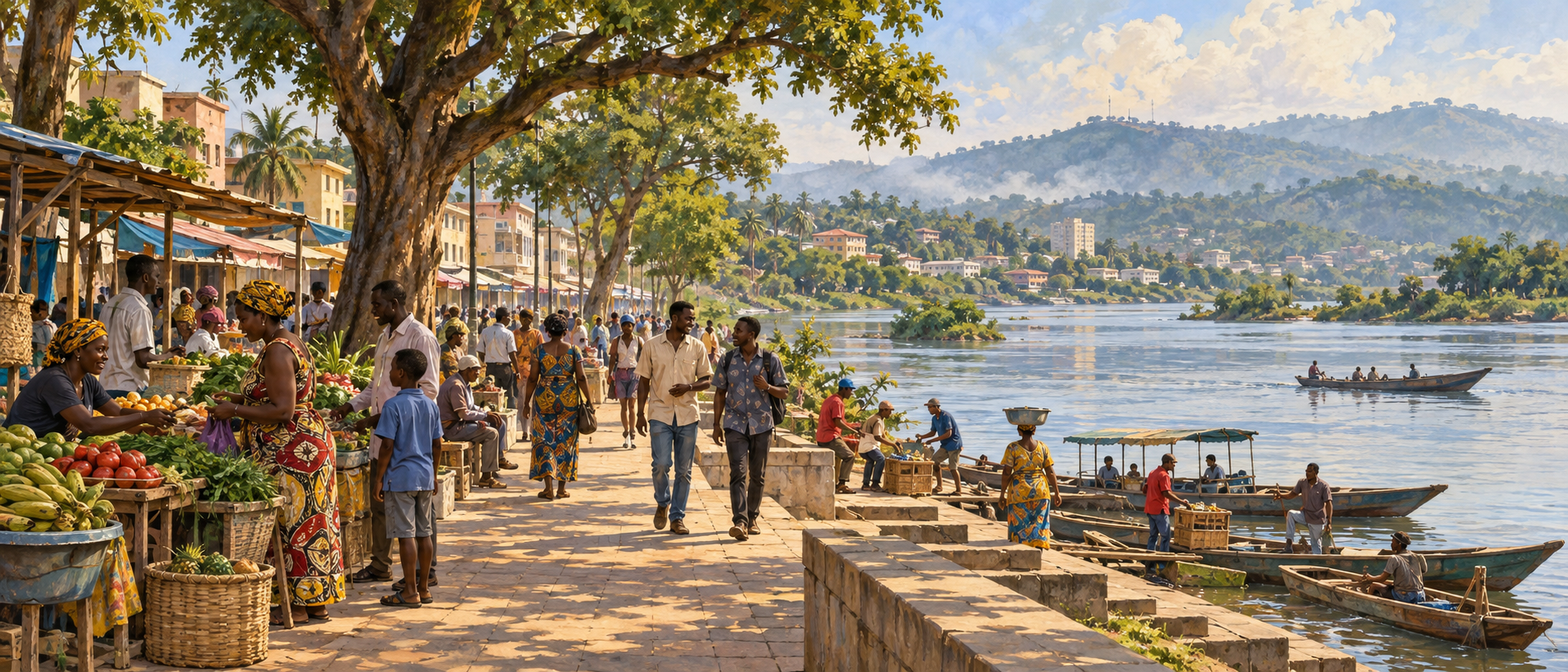
Congo (Republic of the Congo) Children Vocabulary | Words for Character and Nation Building. This independent English-reading guide uses twenty carefully defined terms, four substantive country-grounded chapters and original assessments. A musical tradition shared across the Congo River, an epic storyteller’s instrument, an extraordinary forest recovering over former savanna and a country’s language framework teach children that many kinds of knowledge need different kinds of care. This is a guide to the Republic of the Congo, whose capital is Brazzaville—not to be confused with the Democratic Republic of the Congo, whose capital is Kinshasa.
This independent English guide is for international children roughly eight to twelve years old and adults helping them. It is not an official school syllabus, a legal handbook, a mandate to perform community rituals or an invitation to enter protected forests. Its pupils, classrooms and practice scenes are invented. It gives credit to the people who practise traditions rather than claiming all Congolese have identical views.
Country-specific facts: UNESCO recognised Congolese rumba as shared intangible heritage of the Republic of the Congo and Democratic Republic of the Congo in 2021, and Mvet Oyeng as a shared element of Gabon, Cameroon and Congo in 2025. UNESCO inscribed the Forest Massif of Odzala-Kokoua in the Republic of the Congo in 2023 and recognises the separate three-country Sangha Trinational property. Article 4 of Congo’s 2015 Constitution names French official and Lingala and Kituba as national vehicular languages.
Purpose of character and nation building: Nation building here means accurate attribution, listening when artistic and community experiences differ, informed stewardship of ecosystems and accessible public communication. It is not a political endorsement, a claim of shared ownership of another country’s heritage or a task for children to handle professional conservation work.
Quick guide: from a word to an accurate action
| Resource | The pupil’s task | Misconception to avoid |
|---|---|---|
| 20 English vocabulary words | Explain the meaning, reject an inaccurate near-example, use it in context | A familiar spelling automatically means full understanding |
| Four chapters of country-specific learning | Compare a documented fact with an assumption and safe classroom analogy | A heritage practice belongs to every citizen in identical ways |
| An invented story and six answered checks | Spot misleading wording and justify a source-backed repair | A fictional pupil is an eyewitness to real events |
| One-week study plan | Read, say, compare, decide, write and transfer ideas | A child should act as a government or heritage professional |
Go to word bank · four chapters · fictional story · six self-checks · seven-day plan · parents and teachers · questions · verified references.
20 vocabulary words for children: meanings, boundaries and sentences
The definitions include a common misleading meaning to avoid. All sample sentences are original educational material, rather than statements by real named children. The cultural terms remain linked to named places and practitioners.
1. Congolese rumba: a two-country musical heritage with named performers
| Word | Definition and distinction | Original model sentence |
|---|---|---|
| Congolese rumba | A music-and-dance tradition shared by the Republic of the Congo and DR Congo; not every song from Central Africa. | The class credited both countries on its rumba programme. |
| rhythm | A pattern of beats and timing; not the same as loudness. | The pupils described the rumba’s rhythm without copying a song. |
| orchestra | A coordinated group of musicians or instruments; not necessarily a Western symphony orchestra. | An orchestra accompanied the dancing. |
| transmission | Passing knowledge or practice from one person or generation to another; not simply storing a file. | Music clubs can support transmission of skills. |
| attribution | Naming the creator, performer or source of a work; not pretending an anonymous upload is one’s own. | The poster provided attribution for the performance. |
2. Mvet Oyeng: storytelling, sacred and public forms, and practitioners’ rights
| Word | Definition and distinction | Original model sentence |
|---|---|---|
| Mvet Oyeng | A living Ekang art of epic storytelling, music and related skills; the name also connects to an instrument and performer. | The group explained Mvet Oyeng using UNESCO’s account. |
| Ekang | Communities associated with Mvet Oyeng in Gabon, Cameroon and the Republic of the Congo; not every Congolese person. | The class credited Ekang heritage bearers. |
| epic | A long narrative often describing significant events or characters; not every short classroom anecdote. | The storyteller performed part of an epic. |
| storyteller | Someone who presents stories through words or performance; not necessarily the inventor of every story. | The programme identified the storyteller. |
| safeguarding | Helping living heritage continue through practitioners and appropriate learning; not copying restricted rites. | Safeguarding should respect community permission. |
3. Odzala-Kokoua: forest succession and evidence-based biodiversity care
| Word | Definition and distinction | Original model sentence |
|---|---|---|
| Odzala-Kokoua | A protected forest-massif World Heritage site in the Republic of the Congo; not the same as all Congo Basin forest. | The map showed Odzala-Kokoua separately from Sangha. |
| ecological succession | Change in the communities of plants and organisms occupying an area over time; not a ceremony of political succession. | The forest demonstrates ecological succession from savanna. |
| forest clearing | An open area within or among trees; not necessarily evidence of damage. | Some forest clearings serve wildlife. |
| primate | A mammal of the group including monkeys and apes; not every forest animal. | Gorillas are primates. |
| monitoring | Organised observations repeated over time to assess change; not a conclusion from one photograph. | Wildlife monitoring requires comparable records. |
4. Brazzaville, Lingala and Kituba: identify the right country and use clear language
| Word | Definition and distinction | Original model sentence |
|---|---|---|
| Brazzaville | The capital of the Republic of the Congo; not the capital of the neighbouring Democratic Republic of the Congo. | The map placed Brazzaville opposite Kinshasa across the river. |
| French | The Republic of the Congo’s constitutionally official language; not everyone’s sole home language. | The legal paragraph names French as official. |
| Lingala | A national vehicular language named in the Republic of the Congo’s constitution; not a name for every African language. | The class identified Lingala in Article 4. |
| Kituba | A national vehicular language named alongside Lingala; not another name for French. | Kituba was separately listed in the language note. |
| comprehension | Understanding a spoken or written message, beyond pronouncing its words. | A paraphrase helped the teacher check comprehension. |
Four reading chapters: source-supported learning and a safe exercise
Each chapter links five words with verifiable cultural, scientific or legal material. The concluding contrast corrects a tempting false claim and the activity builds vocabulary without requiring dangerous work or imitation of restricted cultural practices.
1. Congolese rumba belongs to practitioners in two neighbouring countries
Five focus words: Congolese rumba · rhythm · orchestra · transmission · attribution.
UNESCO inscribed Congolese rumba on the Representative List of the Intangible Cultural Heritage of Humanity in 2021. The nomination was shared by the Republic of the Congo and the Democratic Republic of the Congo. This distinction is essential. The countries have similar names and sit across the Congo River from each other, but they are separate states. Brazzaville is the capital of the Republic; Kinshasa is the capital of the Democratic Republic. UNESCO’s shared cultural entry does not turn them into one government or erase the distinct people involved.
UNESCO describes rumba as music and dance common in urban settings and connected with celebrations, remembrance, religious spaces and other social occasions. The word rhythm describes an organised pattern in time, not how loudly a performance is played. An orchestra is a coordinated group of musicians, which may include different instruments and roles. A pupil who hears a short excerpt can notice repetition and accompaniment without claiming to understand all the forms and history of Congolese rumba.
The UNESCO entry traces connections with an earlier dance called nkumba in Kikongo and describes the modern tradition as multicultural. This means history is more complex than a claim that one modern capital invented the entire form in one afternoon. Traditions develop through people who compose, perform, teach and adapt them. Sharing credit across borders does not deprive either country of a meaningful connection. It simply states what the nomination and practitioners actually document.
Transmission is an important word because music needs opportunities for learners to practise. UNESCO describes neighbourhood clubs, schools, community groups and apprenticeship relationships supporting skills and instrument-making. A recording preserves one rendition, but it is not identical to learning the cultural knowledge of an experienced musician. Performers can differ in style and repertoire. A student should not assert that every person in the Republic of the Congo knows how to dance rumba or that one clip represents all performances.
The term attribution concerns the people behind creative work. A particular recording may have a singer, composer, instrumentalists, producer and other contributors. The proper label should identify those that can be verified. A file on a video website is not automatically free to reuse, and an unidentified musician’s name should not be invented. Children can read UNESCO’s general description and write their own explanation without reproducing copyrighted song lyrics or full recordings.
UNESCO mentions how women have contributed to important forms of rumba, including romantic and religious styles. A culturally respectful lesson acknowledges that work rather than presenting the entire genre as the achievement of one famous male bandleader. At the same time, the source does not give a licence to guess every artist’s gender, beliefs or role from a photograph. Specific claims need specific records. The whole genre should not be reduced to a stereotype about who may perform.
In a fictional school exhibition, one pupil writes ‘Congo’s rumba belongs exclusively to Brazzaville’. Another checks UNESCO and changes the label to ‘Rumba is an intangible heritage element shared by the Republic of the Congo and the Democratic Republic of the Congo’. The correction is simple but significant. It turns a vague nationalistic statement into a source-supported one and makes the space available for the actual artists’ names.
The music also illustrates the difference between participation and possession. A person can enjoy a performance without claiming to own the composition, speak for all practitioners or understand every ritual context in which music is used. When a student wants to play a recording in class, a teacher should select a licensed source and identify the performer. If no suitable recording is available, a description and original listening exercise are enough. Cultural literacy does not require unauthorised media distribution.
A safe English activity asks three pupils to read a short invented poem with a repeated line and two supporting parts. This can illustrate rhythm and coordinated roles, but must be labelled a generic classroom exercise, not traditional Congolese rumba. The pupils can practise attentive listening and decide whether every line was understood. Their performance does not give them authority to teach authentic rumba or rewrite its history.
A related character question asks whether a group member who checks sources has contributed as much as one who makes an attractive poster. The answer is yes. Accuracy, copyright respect and correct attribution are meaningful work. UNESCO’s cultural listing offers rich examples of performance, but the child’s practical action may be as simple as fixing the programme to name both countries and the actual performers.
The lesson ends with a precise statement: ‘UNESCO recognised Congolese rumba in 2021 as musical and dance heritage shared by two separate Congolese countries and carried by practising artists’. A child who can explain each part is learning the value of national connection without the error of exclusive ownership.
Correct the misleading claim: Incorrect: ‘Congolese rumba belongs only to the Republic of the Congo, so naming Brazzaville credits every artist.’ Repair: ‘The UNESCO element is jointly recognised for two countries and particular performances require individual attribution.’
Child-safe transfer: Write a five-line imaginary concert programme distinguishing the two countries, performer, rhythm and orchestra. Add a credit field that stays blank rather than inventing an unknown artist.
2. Mvet Oyeng shows why an epic can be both musical and community-specific
Five focus words: Mvet Oyeng · Ekang · epic · storyteller · safeguarding.
In 2025 UNESCO recognised Mvet Oyeng, musical art, practices and skills associated with the Ekang community. The element is shared by Gabon, Cameroon and the Republic of the Congo. UNESCO describes its traditional forms as a combination of sung epic stories, dancing and a particular stringed instrument. The term Mvet Oyeng may refer not just to stories, but also to the instrument, storyteller and musician. A child should not treat it as the generic label for every African song.
An epic is a long narrative often involving people, events and themes considered important within a tradition. A storyteller communicates the narrative to listeners through performance. UNESCO explains that the audience may actively participate by clapping, singing and responding to the storyteller. This is different from an ordinary classroom student reading one sentence from a book. Yet an invented school story can help teach the general English term epic if it is clearly not presented as an authentic Mvet Oyeng account.
The Ekang communities sustain the practice, and UNESCO differentiates between sacred and popular forms. The sacred form is used at particular occasions and follows strict initiation arrangements for transmission. The popular form is more flexible and may be performed publicly. This distinction is especially important when an international child sees a video. A publicly available clip is not permission to imitate sacred material or claim to hold knowledge reserved for practitioners.
Safeguarding is the work of supporting the continuation of a living practice with its people. UNESCO notes the roles of performers, sponsors, craftspeople making instruments and others who organise performances. A tradition requires more than an attractive museum label. It needs knowledgeable bearers, appropriate teaching, places and social settings. An official inscription may support recognition but does not automatically ensure that every community’s needs have been met.
UNESCO documents the practice’s connections with historical knowledge, language, community values and collective memory. It also mentions principles of justice, cooperation and peace. These are meanings the heritage entry associates with the community’s use of stories. They do not prove that every person of Ekang heritage holds identical beliefs or that all conflicts disappear when a story is sung. A culturally careful writer says what the source reports without turning associated values into universal claims about private lives.
The instrument itself involves craft. Someone who makes or tunes a stringed instrument may contribute a different form of knowledge from someone who narrates an epic. A student should not call both jobs ‘the singer’ and stop there. If a programme note names an actual performer, it must be based on reliable documentation. When a photograph’s maker or date is unknown, it is better to leave that field incomplete than to invent a name for the sake of a polished-looking display.
The regional nature of the inscription is another lesson. An article about the Republic of the Congo can describe Mvet Oyeng’s significance while also naming Gabon and Cameroon. Cultural connections do not always fit neatly inside political borders. That does not mean the three countries are the same or that every Ekang performer uses an identical repertoire. The current UNESCO entry recognises a shared element with diverse participating communities.
A misleading fictional caption might read ‘UNESCO invented Mvet Oyeng in 2025 and everyone in Congo plays it at weddings’. The correction should explain that 2025 was the inscription year for an existing practice, and that UNESCO describes sacred and public forms with their own settings. A source does not authorise a statement about all weddings. Children should be able to underline ‘everyone’ and ‘invented’ as words causing the errors.
A safe classroom activity can involve students composing their own short English tale about returning a lost notebook. One learner tells the story, others respond with a repeated original phrase, and another checks that no real person’s name has been invented. Label it ‘our story-and-listening exercise’, not ‘Mvet Oyeng performance’. The exercise demonstrates the words storyteller and audience while preserving the distinct authority of Ekang practitioners.
Consent also matters when a particular person performs a community tradition. Permission to listen does not automatically permit commercial recording or online reposting. A child should ask adults for guidance and use appropriate published sources. The fact that a heritage listing exists makes information available for education, but not all materials are free of rights or cultural restrictions. The classroom can credit UNESCO for factual descriptions without taking private knowledge.
When the group discusses the meaning of the word ‘heritage’, remind them that living people are not objects to be preserved. They make choices about their language, art and participation. UNESCO’s recognition may create educational interest, but outsiders should not require a pupil of Ekang background to recite a story to prove their identity. They may choose to speak or not. Respectful attention to individual agency is itself an observable character skill.
Finish with an accurate sentence: ‘Mvet Oyeng is an Ekang storytelling-and-music practice recognised by UNESCO in 2025 for Gabon, Cameroon and Congo, with sacred and popular forms’. Children who can explain what the name refers to and why the forms have different participation rules have understood the term rather than merely memorised it.
Correct the misleading claim: Incorrect: ‘Anyone who watches a Mvet Oyeng video can claim initiation and perform its sacred form.’ Repair: ‘UNESCO distinguishes sacred forms with strict transmission from more flexible public performances.’
Child-safe transfer: Write a source-backed programme note naming the Ekang community, the three countries, storyteller and instrument. Compose a separate original school tale with no claim of cultural authenticity.
3. Odzala-Kokoua teaches forest succession, not just a photograph of a gorilla
Five focus words: Odzala-Kokoua · ecological succession · forest clearing · primate · monitoring.
UNESCO inscribed the Forest Massif of Odzala-Kokoua in the Republic of the Congo in 2023. This is a specific protected property, not an alternate name for all forests along the Congo River. UNESCO highlights its unusual ecological history, especially the way forest vegetation has recolonised former savanna. The area brings together forest types and stages of change that make it significant to understanding ecological processes. A picture of dense trees cannot fully explain this long development.
Ecological succession means changes in living communities over time. Grasses, shrubs and trees may occupy an area in different stages, influenced by climate, soils, water, disturbance and other processes. UNESCO’s account of Odzala-Kokoua emphasises forest re-expansion into savanna environments after earlier climatic periods. The term succession here does not concern who becomes a political leader or inherits property. English words can have very different meanings in ecology and civics, and context guides interpretation.
UNESCO describes important forest formations including Marantaceae-rich vegetation and different ages or stages of forest. A child might see an area of grasses and call it ‘land that has been destroyed’. That is not always valid. A forest clearing can be a natural feature with ecological functions, and UNESCO notes clearings maintained or used by wildlife. Some open spaces help animals move, feed or exchange nutrients. The actual ecological state of a clearing needs observation, not a label based on appearance alone.
Odzala-Kokoua supports important wildlife including forest elephants, gorillas, chimpanzees and other primates. A primate is a mammal belonging to a group that includes monkeys and apes. It is not another word for every forest creature. UNESCO’s source describes the property as an important stronghold for regional wildlife, but an older species count or population estimate is not necessarily the precise number present this year. A student should distinguish a dated scientific inventory from an instant, permanent guarantee.
The term monitoring refers to repeated, systematic observations. UNESCO discusses surveys of elephants, great apes and other conditions, as well as monitoring management actions and pressures. A photograph of a gorilla taken many years ago may demonstrate that one gorilla was photographed at that time. It does not establish the trend of the entire protected population. Scientists require suitable methods, time periods and comparison data.
There is also a large buffer zone around the main property, and UNESCO’s assessment discusses surrounding forestry activities and community needs. A buffer zone is not necessarily identical to the World Heritage property’s core area. The different zones have different management functions. Students should learn to identify where a source is describing the inscribed property and where it describes surrounding land. Treating every hectare around a park as governed by identical access rules would be an inaccurate generalisation.
UNESCO emphasises the rights and livelihoods of local communities and Indigenous peoples, including the importance of free, prior and informed consent in appropriate decisions. This means protected-area management is not just a matter of declaring that animals are valuable. People affected by conservation measures need consideration and appropriate participation. A child can understand why a decision should not be made by outsiders with no knowledge of the community’s circumstances, without pretending to write actual park regulations.
The Odzala-Kokoua property is distinct from Sangha Trinational, another World Heritage site connected with the Republic of the Congo. Sangha is a three-country property that also includes Cameroon and the Central African Republic. A map should not combine the two properties under one name or place them in exactly the same location. Both are important examples of Congo Basin conservation, but each has its own geography, inscription history and evidence.
Imagine a fictional school poster declaring, ‘All forest clearings in Odzala are illegal destruction and every gorilla population is rising’. The source supports neither sweeping claim. The group corrects it to say that the property demonstrates forest succession and important habitat diversity, while current wildlife trends require monitoring. A revised caption can also explain that some clearings are ecologically significant. Good scientific language distinguishes changes that happen naturally from damage caused by unsuitable activity.
An original paper activity can show a sequence of fictional landscapes: open grassland, shrubs, younger forest and older forest. Label this an illustration of ecological succession, not a measurement of an actual Odzala site. Add a forest clearing and ask which animal activities might be relevant, but do not invent current sightings. If pupils need a numerical graph, use clearly fictional observations and explain that real research would require the park authority’s data.
Conservation work is professional and sometimes hazardous. Children should never enter a protected forest to count great apes, confront people engaged in illegal wildlife activities or collect specimens without permission. Their role can be reading UNESCO’s description, making an accurate map and reporting where a claim exceeds the evidence. A supervised litter-awareness activity at their own school is a suitable small analogy for stewardship, but it should not be described as direct restoration of Odzala-Kokoua.
The chapter ends with an evidence-based sentence: ‘Odzala-Kokoua is a 2023 UNESCO World Heritage forest massif whose ecological succession, habitats and wildlife require continuing scientific care’. It is more useful than saying ‘there are a lot of trees and gorillas’. The full sentence explains what makes the property special and why learning about it involves more than an attractive animal photograph.
Correct the misleading claim: Incorrect: ‘Any clearing proves deforestation, and a UNESCO listing guarantees every primate population is increasing.’ Repair: ‘Odzala-Kokoua includes ecologically important clearings and forest succession; population trends need current monitoring.’
Child-safe transfer: Create a fictional four-stage forest-succession diagram. Compare it with UNESCO’s actual Odzala-Kokoua description, and mark which ecological claims still need measured data.
4. Brazzaville, French, Lingala and Kituba help children identify the country correctly
Five focus words: Brazzaville · French · Lingala · Kituba · comprehension.
The Republic of the Congo has its capital in Brazzaville. Across the Congo River is Kinshasa, capital of the separate Democratic Republic of the Congo. These similar country names can create confusion in headlines, maps and school projects. An English writer must identify the right state before making claims about its laws, protected areas or schools. Calling a Brazzaville institution part of the Kinshasa government would mislead readers even if the surrounding sentence sounded plausible.
Article 4 of the Republic of the Congo’s 2015 Constitution names French as the official language and identifies Lingala and Kituba as national vehicular languages. That is a legal statement with specific terms. The word ‘vehicular’ here refers to languages used for communication among people who may have different first languages. It is unrelated to motor vehicles. This is a good example of why context and specialist definition matter.
A legal language label cannot tell a teacher which language every child uses at home. Some learners may be more confident in one community language, others in French or different languages. A pupil should not assume everyone in Brazzaville speaks Lingala or everyone elsewhere speaks Kituba. Nor should a family have to prove belonging by speaking a particular language for a class demonstration. The person concerned can choose what they wish to share.
Comprehension means understanding the meaning of a message, not merely pronouncing words correctly. Imagine an invitation stating ‘The museum poster contest begins at ten, but entries close at nine’. A child can read the words accurately while confusing the two times. A clearer layout or paraphrase may help. A teacher can check what the reader understood without embarrassing them or judging their intelligence by language background.
A good country guide keeps the law, the community and the individual separate. ‘French is the Republic of the Congo’s official language’ comes from the constitution. ‘My grandmother speaks Kituba at home’ would be a possible personal account requiring the family’s voluntary statement. ‘Our class printed a simpler notice’ is an action that can be checked. These three kinds of statement need different evidence, and none should be substituted for another.
The music chapters also involve language. UNESCO’s rumba entry has links with Kikongo and other regional cultural forms, while Mvet Oyeng involves the Ekang community and its expressive traditions. The presence of cultural languages and stories does not mean they are constitutionally official or that every speaker lives in the Republic of the Congo. A child should be able to retain culturally specific words without changing their legal status. A community’s linguistic contribution remains valuable regardless of whether it appears in a country’s official-language article.
The two Congolese states also share significant geography and culture, which can make accurate naming more demanding. Rumba is explicitly recognised by UNESCO for both of them. Odzala-Kokoua, however, is a World Heritage property in the Republic of the Congo. The difference between a shared intangible element and a single-state natural property is central to reliable writing. When using ‘Congo’ alone, clarify whether the source means the Republic of the Congo, the Democratic Republic of the Congo, the river or a wider region.
Imagine a classroom map where a child writes ‘Kinshasa is the capital of Congo-Brazzaville’. Another checks the official source and moves the label to Brazzaville, then marks Kinshasa across the river for the Democratic Republic. The group does not need to decide which country is more important. It only needs to state accurately which capital belongs to which state. This is a small, observable example of accountability in geographic writing.
A second fictional task concerns translation. Suppose a note says the library opens on Tuesday, but a learner’s copied version says Thursday. The class should check and correct the message rather than assume that adding more languages will automatically solve comprehension. If pupils do not know how to translate into French, Lingala or Kituba, they should not invent phrasing and claim accuracy. Qualified support is preferable to a polished but incorrect notice.
Inclusion means that different readers can actually use a piece of information. The country may have legal language arrangements, but a particular school still needs understandable signs, fair opportunities to ask questions and appropriate learning support. A sign saying ‘everyone welcome’ is not enough if no one can find the correct meeting time. Children can practise improving the text and explaining how they verified that the revision worked.
A final character question asks who should answer for an error. The group that printed the wrong capital may acknowledge it, revise the map and cite the official source. It need not blame the quietest pupil or pretend the original label was correct. An accurate correction is not disloyal to a country; it is simply responsible communication. The same habit applies to a festival caption, a wildlife statistic or a family story shared by consent.
Finish with a three-part summary: ‘The Republic of the Congo has Brazzaville as its capital’; ‘French is official, while Lingala and Kituba have national vehicular status’; and ‘A particular reader’s comprehension still needs to be checked’. The learner who can separate geography, law and personal experience has made the vocabulary useful beyond the page.
Correct the misleading claim: Incorrect: ‘Brazzaville and Kinshasa are the same capital, and official French means every person has only one home language.’ Repair: ‘They belong to separate states; legal language status does not describe every family.’
Child-safe transfer: Make a two-country map showing Brazzaville and Kinshasa in their proper states, then create a fictional English event notice and test whether a younger reader understands the time and location.
Fictional classroom story: revise the claim instead of hiding the error
At a fictional international school, Nadège writes that rumba belongs only to the Republic of the Congo. A source-checker finds UNESCO’s joint 2021 inscription and credits both Congolese countries. Pascal hears of Mvet Oyeng and calls every Ekang story a public ceremony anyone can copy; he reads the 2025 UNESCO distinction between sacred and popular forms. Léa labels a natural clearing in Odzala-Kokoua ‘certain destruction’ but learns that clearings can have ecological functions. Finally, Jonas puts Brazzaville in the Democratic Republic of the Congo and copies the wrong language framework; his classmates repair the map and cite the Republic’s constitution. All the students and school events are invented teaching examples.
Four close-reading and evidence questions
- 1. Why did Nadège need to name two states for rumba?
- 2. What made Pascal’s plan to copy a sacred Mvet Oyeng form inappropriate?
- 3. Why could Léa not infer ecological destruction from one clearing photograph?
- 4. Which country and legal source corrected Jonas’s capital and language labels?
Ask pupils to identify the fictional action that demonstrates each word. Use the named institutional source to support country facts rather than treating imagined school dialogue as evidence of an actual event.
Six worked vocabulary and reasoning checks
Check 1: Which two countries share the 2021 Congolese rumba inscription?
Worked answer: The Republic of the Congo and the Democratic Republic of the Congo.
A complete response states why the evidence supports the answer, rules out a tempting but inaccurate alternative and creates one original sentence in another setting. Correct reasoning is more valuable than repeating a glossary term.
Check 2: Which three countries share the 2025 Mvet Oyeng listing?
Worked answer: Gabon, Cameroon and the Republic of the Congo.
A complete response states why the evidence supports the answer, rules out a tempting but inaccurate alternative and creates one original sentence in another setting. Correct reasoning is more valuable than repeating a glossary term.
Check 3: Does Mvet Oyeng have the same participation rules for sacred and popular forms?
Worked answer: No. UNESCO describes strict initiation for sacred forms and more flexible public forms.
A complete response states why the evidence supports the answer, rules out a tempting but inaccurate alternative and creates one original sentence in another setting. Correct reasoning is more valuable than repeating a glossary term.
Check 4: What ecological process makes Odzala-Kokoua particularly important?
Worked answer: Forest succession, including recolonisation of former savanna ecosystems.
A complete response states why the evidence supports the answer, rules out a tempting but inaccurate alternative and creates one original sentence in another setting. Correct reasoning is more valuable than repeating a glossary term.
Check 5: What is the Republic of the Congo’s capital?
Worked answer: Brazzaville; Kinshasa is the capital of the Democratic Republic of the Congo.
A complete response states why the evidence supports the answer, rules out a tempting but inaccurate alternative and creates one original sentence in another setting. Correct reasoning is more valuable than repeating a glossary term.
Check 6: How does Article 4 distinguish French from Lingala and Kituba?
Worked answer: French is official; Lingala and Kituba are designated national vehicular languages.
A complete response states why the evidence supports the answer, rules out a tempting but inaccurate alternative and creates one original sentence in another setting. Correct reasoning is more valuable than repeating a glossary term.
Seven-day vocabulary plan: practise in different ways
| Day and purpose | Age-appropriate practice | What shows progress |
|---|---|---|
| Day 1 — Notice | Read words 1–5 and give each a plain definition and misleading non-example. | A correct contrast in the learner’s words |
| Day 2 — Speak | Use words 6–10 in a familiar home or school situation. | Original clear oral use |
| Day 3 — Verify | With adult support, read an accessible short passage from a source listed below. | One fact and one unanswered question |
| Day 4 — Compare | Study words 11–15; distinguish observations, sourced statements, inferences and fiction. | The child does not present invented details as history |
| Day 5 — Decide | Practise words 16–20 in a safe fictional class problem. | One realistic responsibility and a way to check the result |
| Day 6 — Write | Compose 80–120 words including three target words and an attributable fact. | Useful vocabulary in a coherent paragraph |
| Day 7 — Transfer | Explain a new neighbourhood or country scenario using three general terms. | New meaning without copying cultural stereotypes |
Assess learning without making it a memory contest
A word is becoming usable when the child can define it without copying the printed meaning, correct an appealing error and use the word in a fresh context. Parents can record each stage as ‘not yet’, ‘with guidance’ or ‘independently’. Return to the words after several days. A student who has corrected a statement through evidence is learning, even if they were mistaken initially.
In writing, check subject-and-verb clarity, appropriate vocabulary, traceable sources for factual statements, differentiation between actual people and imaginary characters, and the suitability of the action for a child. An honest ‘unknown’ is preferable to an invented maker, date or scientific statistic.
Parent and teacher notes: build character through accurate habits
- Identify the correct country. Similar geographical names may refer to different states, and an international heritage listing may involve several governments.
- Recognise specific communities. The people who practise an art or live near a site are not interchangeable with everyone in the country.
- Respect living cultural knowledge. Public descriptions of rituals or art do not give outsiders authority to copy restricted elements or claim authorship.
- Preserve historical dignity. Archaeological and burial sites are not sources of souvenirs or entertainment; use age-appropriate research and respectful terms.
- Use the right evidence for each claim. A date of UNESCO recognition, a photograph and a modern scientific trend answer different questions.
- Keep expert work with qualified adults. Protected wildlife access, structural repairs and real resource-management policies are not tasks assigned to children.
- Test participation in practice. A polite invitation may remain inaccessible until the wording, format or explanation is improved.
- Encourage correction without blame. A source-backed revised caption makes the shared project more trustworthy.
Frequently asked questions
Does Congo mean the same country as DR Congo?
No. This guide concerns the Republic of the Congo, with capital Brazzaville. DR Congo is a separate state with capital Kinshasa.
Is Congolese rumba shared or exclusive?
UNESCO recognised it jointly for the two Congolese countries in 2021.
What is Mvet Oyeng?
A musical storytelling tradition of Ekang communities across Gabon, Cameroon and the Republic of the Congo, inscribed in 2025.
Why are forest clearings important at Odzala-Kokoua?
UNESCO describes ecological succession and naturally important clearings among the property’s varied habitats.
Does a wildlife photo establish a current population trend?
No. It is an observation, while trend claims require appropriately dated, comparable monitoring.
Are French, Lingala and Kituba identical constitutional language categories?
No. French is official, while Lingala and Kituba are named as national vehicular languages.
Verified sources, related articles and continued learning
Country facts are supported by the named UNESCO, institutional and legal sources below, reviewed in October 2026. Original model stories, invented student dialogue and exercises are editorial teaching material, not national school syllabuses or eyewitness reports. Seek current official guidance for real heritage visits or conservation activities.
- UNESCO Intangible Heritage | Congolese rumba (2021)
- UNESCO Intangible Heritage | Mvet Oyeng (2025)
- UNESCO | Mvet Oyeng joint decision, Gabon–Cameroon–Congo
- UNESCO World Heritage | Forest Massif of Odzala-Kokoua (2023)
- UNESCO World Heritage | Sangha Trinational
- Republic of the Congo General Secretariat | Constitution 2015, Article 4
- UNICEF | Convention on the Rights of the Child
Explore this country within eduKateSG
- Everything About the Republic of the Congo
- How the Republic of the Congo Works
- How Education System of the Republic of the Congo Works
- Top 20 Unique Vocabulary for Touring the Republic of the Congo
Continue the A–K Children Vocabulary branch
China Children Vocabulary · Colombia Children Vocabulary · Comoros Children Vocabulary · Congo (Republic of the Congo) (this article) · Costa Rica Children Vocabulary
Vocabulary and world-learning hubs
- Vocabulary Learning Hub
- Vocabulary by Age and Purpose
- How Countries Work | A–Z
- Country Vocabulary Index
Children finish this Congo (Republic of the Congo) lesson able to define twenty useful words, explain where a source-supported claim ends, recognise whose work or rights are involved and make one safe, verifiable improvement. Accurate language is a practical way to show consideration for others.