
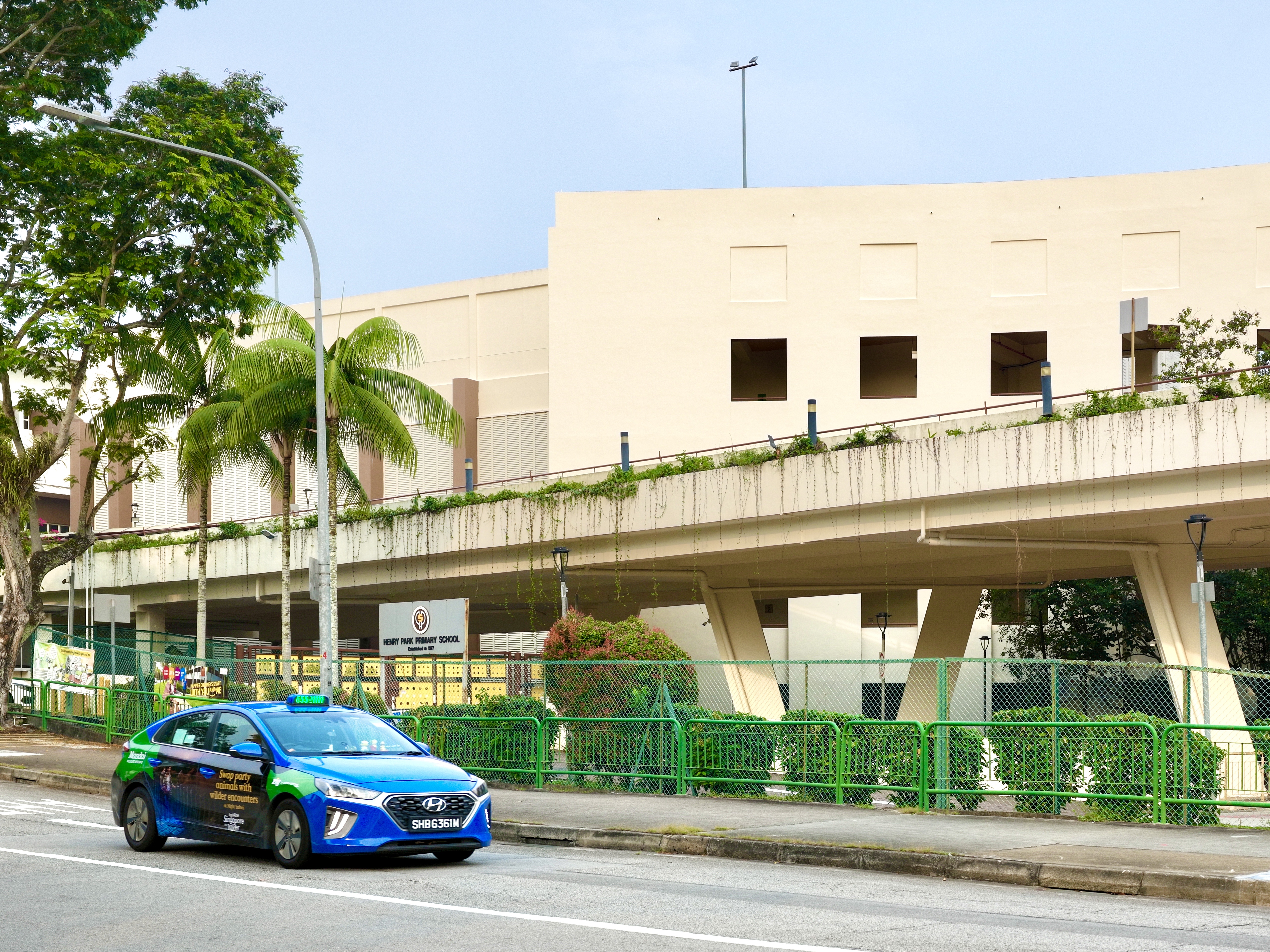

Henry Park Primary School is at 1 Holland Grove Road, Singapore 278790, in the Holland–Bukit Timah–Ulu Pandan area. The school began on 23 March 1977 with 287 pupils and 13 teachers and was officially opened on 7 April 1978. Its October 2026 exterior photograph is an invitation to understand both a real neighbourhood primary school and the changing educational ideas behind its science, sport and leadership programmes.
This is not a ranking of schools or an attempt to deduce teaching standards from a handsome building. The school photo shows a place. Official records explain its origin, academic developments, public transport, campus expansion and distinctive programmes. Combining the two can help children learn local geography while giving families a better starting point for practical questions.
Henry Park Primary School: the essential facts
- Current address: 1 Holland Grove Road, Singapore 278790.
- Area: Holland Grove, near the Bukit Timah and Ulu Pandan school and residential corridors.
- Official location reference: Buona Vista MRT; the school also lists bus services 92, 7, 61, 75, 156 and 165.
- Established: 23 March 1977 with 287 pupils and 13 teachers.
- Officially opened: 7 April 1978, according to MOE’s heritage record.
- Campus development: expansion opened in April 2004; upgraded original campus reopened after 2011–2013 temporary relocation.
- Distinctive Applied Learning Programme: Science for Life, environmental sustainability and STEM inquiry, launched in 2014.
- Learning for Life Programme: Sports4Life, begun in 2015, combining sport, reflection and leadership.
- School organisation: single-session operation since 2015, as recorded in MOE history.
- October 2026 main image: media-library item 275407, uploaded on 18 October 2026.
1. Start with the October 2026 photograph, not a school ranking
The photographed exterior belongs to an actual primary school in an identifiable part of Singapore. That might seem obvious, but much school-search content reduces institutions to score comparisons and forgets that children attend a real place for six years. The photo brings us back to the gate, the street and the everyday geography of Holland Grove Road.
A responsible viewer makes a list of what is visible and what is not. The photograph documents the campus exterior as it appeared from a particular vantage point. It does not prove classroom sizes, PSLE outcomes, admission probability, traffic volumes at 7 a.m. or which child will enjoy learning there.
The date is part of the value. The image joined the eduKateSG media library in October 2026 and serves as a contemporary reference against the school history dating back to 1977. The modern campus has undergone earlier extensions and improvements, so a current photograph should not be called a view of the exact 1978 configuration.
For students, the first learning task is simple: write two sentences. One begins, ‘This image shows…’; the other begins, ‘To learn the school’s history I checked…’. That difference encourages evidence-based observation rather than assumption.
2. Where is Holland Grove Road and why does the area matter?
Holland Grove Road sits in the western Bukit Timah and Holland residential landscape, with routes connecting toward Ulu Pandan, Clementi, Buona Vista and the broader western city. For families, that means the school has both a local street setting and wider public transport connections.
An address is more useful than a general district label. A child can be described as attending school in Bukit Timah yet still spend most of the journey travelling along the Holland side. A neighbourhood guide should therefore name both the precise address—1 Holland Grove Road—and the surrounding districts rather than insist that everything nearby is simply ‘central Bukit Timah’.
MOE’s school finder associates Henry Park Primary with the Bukit Timah region, while the school’s own contact page identifies Buona Vista as its nearest MRT reference. Those two facts are compatible. One describes the administrative geography used in school listings; the other helps a traveller plan how to reach the gate.
The useful family question is not only ‘which town is Henry Park in?’ but ‘how do we get from our home to the correct entrance safely and reliably?’ That requires a live map, pedestrian routes and realistic travel conditions, not a distance guessed from a static photo.
3. A school established in 1977 with 287 children
Henry Park Primary School was established on 23 March 1977. MOE’s heritage account gives a particularly concrete starting point: 287 pupils and 13 teachers drawn from other schools. It was officially opened on 7 April 1978 by Dr Chiang Hai Ding, then Member of Parliament for Ulu Pandan.
Those figures make the original scale real. Instead of a vague description such as ‘long-established’, readers can place the school in Singapore’s educational expansion during the 1970s and imagine the work involved in building a new learning community. Pupil enrolment was not an abstract statistic: a new school required teachers, timetables, classrooms and ways for families to become familiar with it.
The two dates should not be collapsed. Beginning operation in March 1977 and holding a formal opening in April 1978 were separate events. Just as with other institutions in this photo series, writing the correct verb after each date improves accuracy.
The NLB catalogue: Henry Park Primary opening souvenir programme preserves a record of the opening souvenir programme. A student can use the library catalogue and the MOE history to ask what an official opening booklet reveals that a school exterior photograph does not. Archival sources show the institution’s early public life; our 2026 image shows its later physical setting.
4. Growth and the 2004 school-building expansion
The school expanded as its population and needs changed. MOE records the opening of a new school building in April 2004, including a multipurpose hall, gymnasium, tennis courts and improved driveway arrangements. These changes illustrate the material side of an education system responding to greater numbers and a wider programme.
A photograph of an exterior may show parts of a campus, but it cannot tell us which facilities are currently in use, when each was last renovated or what every room contains. Historical records can establish the completion of a major project. A current school guide or authorised visit is needed for present-day facilities.
This separation is useful because school websites sometimes mix photos from different dates. If an old article says a facility was newly opened in 2004, readers should interpret ‘new’ relative to that source’s time, not as a 2026 guarantee. Programmes and buildings are maintained over many years.
For a primary geography lesson, consider why a school would improve its driveway, hall and sports spaces. All are linked to everyday movement and activity—arriving, assembling, playing, learning and returning home. A school campus is infrastructure for a daily community as much as it is a symbol of institutional identity.
5. The temporary holding campus and 2013 upgrades
MOE’s heritage record says Henry Park Primary operated from a holding site between the end of 2011 and 2013 while Programme for Rebuilding and Improving Existing Schools (PERI) works were completed at its original Holland Grove Road premises. The upgrades were completed in 2013.
A holding site is worth explaining to students. When an existing school needs major building works, pupils cannot always remain at the same address. Learning continues in a temporary location while contractors improve the original site. That can affect commuting arrangements for a period without meaning the institution itself has ceased to exist.
The October 2026 image shows the school at its established Holland Grove address after those works. It is not a photo of the holding school, nor of the original campus during construction. For a simple historical sequence, students can label ‘1977 original school’, ‘2004 new building’, ‘2011–2013 holding-site period’ and ‘2013 return to upgraded premises’.
This account also warns against inventing the history of individual walls or blocks. Unless documents say which part was built in a particular year, a modern photograph cannot supply that construction date. A good caption should describe the campus today, leaving specific building history to verified sources.
6. The school became single-session in 2015
According to MOE’s school history, Henry Park became a single-session school in 2015. This is a significant organisational development, even though the change is not visible in an exterior photograph. A single-session model changes how school hours and facilities can be arranged across the day.
For children, time structures matter. Morning preparation, recess, lessons, CCAs, enrichment and after-school care form part of a routine. A single-session arrangement creates possibilities for using facilities and scheduling programmes, but it does not tell us the exact timetable of every class in October 2026.
Families should read the school’s latest schedule and notices before planning transport or student-care commitments. An old school-history milestone does not automatically answer whether a particular CCA finishes at four o’clock or whether a child has an enrichment period on one afternoon.
This is a good example of an educational fact that needs an administrative source instead of a photograph. A picture of a gate may be taken at noon; that doesn’t tell a researcher whether classes meet in one session or two. MOE’s record explains the organisational change directly.
7. Science for Life: a sustainability-focused Applied Learning Programme
In 2014 Henry Park began its Science for Life Applied Learning Programme, according to the MOE Heritage Centre. The school’s current ALP information develops that idea with sustainability, environmental science, inquiry, design thinking, problem solving and STEM experiences.
This is more concrete than saying the school ‘has good science’. The programme identifies particular ways children practise reasoning: noticing environmental problems, framing questions, carrying out investigations and designing solutions. Some activities apply familiar Primary Mathematics concepts to real objects, making abstract classroom ideas easier to test.
The official programme page gives examples across primary levels. Lower-primary pupils design objects with recyclable materials. Older pupils work with variables, fair tests, environmental projects and food-growing activities. These are actual reported initiatives, not activities inferred from the October photo.
What should parents ask? Whether a child’s curiosity is becoming more disciplined. Can the child describe a problem precisely, control the conditions of a simple experiment and explain what the results show? Those habits are useful far beyond an environmental project because they build scientific thinking and an ability to revise a mistaken assumption.
8. An original worked science example: how to make a fair toy-car test
Henry Park’s ALP describes investigating toy-car speed at Primary 4. We can turn that reported theme into a home learning example without pretending this is the school’s actual worksheet. Suppose a toy car travels 120 centimetres in 3 seconds on a level surface. Its average speed is distance divided by time: 120 ÷ 3 = 40 centimetres per second.
Now imagine a second run of 150 centimetres in 3 seconds. The calculated speed would be 50 centimetres per second. But can we conclude that the car itself improved? Only if the investigation controls important conditions: starting position, surface slope, release method, measurement technique and the same portion of the track.
A child learns two distinct things. Mathematics provides a calculation. Science asks whether the comparison is fair and whether the evidence supports the claim. If the second run used a steeper track, the calculation might be correct while the causal interpretation would be weak.
A strong answer therefore states the numbers, units, method and limitations. The lesson is not to memorise a speed formula prematurely but to see how a real question links quantities with careful observation. That is the sort of practical reasoning sustainability and STEM inquiry can encourage.
9. Rice cultivation and the question of food security
One of the school’s most distinctive official ALP examples is rice growing at Primary 4. The programme is used to explore plant reproduction and systems, while connecting science to sustainability and food security. That connection is particularly relevant in Singapore, where food supplies depend heavily on larger regional and international networks.
A rice plant has requirements for water, light, nutrients and suitable growing conditions. Students observing it over time can learn patience and evidence recording. They may discover that real biology does not always conform neatly to a timetable: plants grow at different rates, weather varies and some conditions are difficult to control.
A useful learning journal should record when a seed is planted, the conditions of the growing area, dates of observations, evidence of changes and any intervention. A child should not invent a successful harvest for a school assignment. Honest records, including when something does not grow well, are part of the scientific process.
The lesson connects the school’s physical surroundings with a national question. A small campus growing exercise cannot solve Singapore’s food supply challenges, but it can give pupils a practical understanding of why production, waste and resource use are serious issues.
10. Hydroponics and the environmental side of school learning
The school’s current ALP page also describes hydroponics for Primary 3 pupils. Hydroponics involves cultivating plants using nutrient solution rather than relying on soil in the conventional way. It allows students to consider how growers supply plants with water and nutrients and how cultivation methods can be adapted for different settings.
A classroom investigation could compare plant growth under measured conditions, recording light exposure and water availability. The important teaching point is to keep one variable under study while controlling others. If many conditions change together, the child may know that two plants look different but not why.
The school programme also refers to recycling, waste reduction, edible gardens and eco-monitors. These make the idea of ‘a green school’ more specific. Sustainability learning is a set of habits and investigations, not simply a poster on a corridor wall.
For families, the natural follow-up is a practical home conversation: how can we waste less food, conserve water or notice biodiversity along the route to school? These are accessible questions even for a child who never participates in an advanced science competition. Environmental literacy grows when observations can be linked to ordinary decisions.
11. Sports4Life: learning through movement and reflection
Henry Park’s Sports4Life Learning for Life Programme began in 2015 and focuses on physical development and leadership. The school’s current materials describe a progression: modular gymnastics for Primary 1–3, modular sports experiences for Primary 4–6 and additional training for pupils with developing sporting or leadership interests.
There is an educational method behind this. The school uses an experiential cycle: children try an activity, observe what happened, reflect and apply a better approach. This is useful whether the activity involves balance, movement sequences, teamwork or decision-making in a game.
The point is not that every pupil must become a competitive athlete. A young child can learn confidence and motor control through careful movement. An older pupil can practise respecting rules, communicating with teammates and recovering from a mistake. Reflective coaching turns sport into a learning experience.
The programme’s values of respect, integrity, care and excellence are clear in the school’s own documents. Their practical meaning should be evaluated through observed school routines or appropriate teacher explanations, not assumed to be proved by a sports-hall photograph or a list of competitions.
12. How sports leadership differs from winning a game
Sports4Life includes a leadership development dimension, with pupils who show interest or promise able to engage in additional learning related to mentoring, sports events and basic first aid. The distinction between participation and leadership matters for children who are developing confidence at different rates.
A student who is not the fastest runner may still be a careful organiser, a reliable teammate or someone who notices when another child needs encouragement. Leadership in sport can be practised through responsibility, fair decisions and helping others learn, not merely through a medal count.
Imagine two teams playing a game. Team A wins, but its captain refuses to listen or excludes weaker players. Team B loses, but its captain helps everyone understand the plan and handles a disputed call respectfully. Which team showed better leadership? The answer depends on the behaviours being assessed, not just the score.
That is a valuable family discussion because it connects classroom character education with visible conduct. It also keeps the article from reducing the school’s Sports4Life programme to sporting prestige. The school specifically includes physical and leadership learning, and both should be represented accurately.
13. The Holland–Bukit Timah neighbourhood as a learning environment
Henry Park’s surrounding area offers a useful transition between the major Bukit Timah education corridor and the residential geography of Holland Grove, Ulu Pandan and Clementi. Older students can map the different kinds of places around the school: roads, housing, educational land, green patches and public transport connections.
The school’s proximity to these environments does not imply that every family lives nearby. A primary school’s community includes children with different journeys, schedules and household responsibilities. The street is an everyday learning space precisely because getting to school and moving responsibly through the neighbourhood require attention.
A local fieldwork activity could ask pupils to record types of roadside plants, identify where stormwater drains run or notice how shaded paths affect comfort. Such observations should be made only from safe, lawful public areas with adult supervision appropriate to the child’s age.
Back in the classroom, connect the observation to Science for Life. If children study sustainability, the neighbourhood is a place to look for questions about waste, vegetation, water and transport. The outside world becomes material for inquiry without needing an official school excursion or an invented claim about the school’s field trips.
14. P1 registration: why the exact address matters but cannot promise entry
For Primary 1 registration, MOE uses formal phases, eligibility rules and home-school distance criteria for applicable situations. That makes the full school address important, but it does not mean anyone living in a broadly described Holland or Bukit Timah district is guaranteed admission.
Parents should confirm the current year’s rules through the MOE Primary 1 Registration portal and calculate home-school distance using the official MOE method rather than a straight-line estimate or a photo caption. An address that appears close on a road map may not fall within a particular measured band; the appropriate source is the official system.
Historical balloting and vacancies can provide context, but they do not guarantee future results. Population movement, applicant demand and annual phase rules change the picture. A responsible article should not invent a ‘minimum score’ or present a primary-school admission probability as an established fact.
The family’s task is to separate three questions: whether the child is eligible in a registration phase, whether a place is available under current rules, and whether the school is a good fit for the child. A location photo can help with the final travel-planning component, but it cannot answer the first two questions.
15. GEP history and why programme labels need a date
MOE’s heritage record states that Henry Park became a Gifted Education Programme (GEP) centre in 1997. This was a major educational milestone in the school’s development and is appropriately included in its historical timeline. However, a reader must not treat a historical programme label as a permanent guarantee of the same admissions, placement or support arrangements for every future year.
Programme structures evolve through national policy. Parents need to consult the latest MOE information for high-ability learning support, subject enrichment and any transitions affecting their child’s cohort. A school-history page confirms what happened in 1997; it does not serve as a live placement notification for a future pupil.
The broader lesson is useful far beyond gifted education. Schools may add ALPs, redesign enrichment, change the use of rooms or update co-curricular activities. Preserving older programmes in a historical account makes the institution’s development visible, but current participation requirements must be separately checked.
For a history essay, write, ‘Henry Park became a GEP centre in 1997,’ and cite the MOE Heritage Centre. For a parent making a 2027 decision, use the current school and MOE programme descriptions. Both statements can be useful when clearly labelled by time and purpose.
16. From a 1977 school to a 2026 primary learning community
A timeline helps us see how the institution has adapted. The founding in 1977, official opening in 1978, GEP milestone in 1997, new building in 2004, PERI works in 2013, Science for Life in 2014 and Sports4Life and single-session operation in 2015 are different kinds of developments.
Some represent physical infrastructure. Others concern curriculum, leadership or timetable. Placing them in separate columns allows a student to observe that educational development is not simply ‘more classrooms’ or ‘more examination practice’. The school was changing along several dimensions at once.
The modern October 2026 photograph gives this multi-layered chronology a physical endpoint. Readers can recognise the address and imagine how generations have used the site. But the photograph does not show the complete history by itself, and an article should avoid presenting it as an archival 1977 image.
The school history also records exchange connections with the Singapore Japanese School beginning in 1990 and later home-stay activities. These connections show that school communities can cross national and cultural boundaries even while rooted in one local road. They are a reminder that neighbourhood geography and educational experience have different scales.
17. A worked family research task: programme fit rather than reputation
Suppose two children are interested in the same school. One enjoys science experiments, builds objects and likes observing plants. The other is happiest when moving, working in teams and gradually learning to lead. The school’s ALP and LLP descriptions provide concrete starting points for questions about both children.
Ask how the relevant programmes are organised by year level, which activities reach all pupils, and which require selection or registration. The school provides tiered information, so a family should not assume that an enrichment or leadership opportunity is automatically available to every child in the same way.
Next consider foundational learning and wellbeing. Does the child need support in reading, numeracy or adapting to school routines? How much time will travelling and after-school care require? The best educational environment is one where opportunities are meaningful and daily life remains manageable.
A parent can make a simple decision page with four headings: child’s interests, verified school opportunities, practical travel and questions still unanswered. The purpose is not to score every school numerically. It is to replace vague prestige comparisons with concrete evidence that can guide a conversation or a permitted school visit.
18. A photo-to-fieldwork guide for Holland Grove Road
Before a neighbourhood walk, identify the school’s authorised entrance and make sure children understand that school grounds are not public recreational spaces. Use public pavements, avoid blocking gates and never photograph identifiable pupils for a public project without appropriate permission.
At a safe point, note the relationship between the school frontage, roadway, nearby greenery and pedestrian movement. Does the visible approach provide shade? Where can someone cross legally? How does a larger bus corridor connect to this residential street? If the observation is made at one time of day, label it as such.
Create two maps. The first is a small map of the immediate Holland Grove Road setting. The second is a wider map showing Buona Vista and the nearby Holland and Bukit Timah areas. Explain why a school can be within one planning-region context while its nearest transport reference belongs to a different familiar neighbourhood.
Finally, compare the field notes with the October 2026 image. Record what has changed, if anything, and what cannot be observed from that photo angle. This is an accessible introduction to the idea of a location record rather than an advertisement.
19. A six-day home-learning plan around Henry Park
Day one: Record the full address, year of the modern image, date of school establishment and official opening. Explain the difference between a school opening and a photo being taken.
Day two: Use MOE’s heritage page to make a timeline. Include the 1977 founding, 2004 new building, the holding-site period and the single-session change in 2015.
Day three: Make a safe map of Holland Grove Road, Buona Vista MRT and the wider transport corridor. Identify which details came from a map and which from official school contact information.
Day four: Try a fair-test exercise with a toy car. Measure distance and time, use consistent units, and list variables that need to be controlled. Do not claim the results came from school lessons.
Day five: Start a small seed-growing observation if suitable. Keep a dated notebook and explain why growth observations must reflect what happened, not what the student hoped would happen.
Day six: Describe one sportsmanship situation involving respect, integrity or care. Explain how a player could demonstrate leadership even without winning. Complete the week with a paragraph connecting school history, neighbourhood and contemporary learning.
20. Frequently asked questions
Where is Henry Park Primary School?
At 1 Holland Grove Road, Singapore 278790, in the Holland–Bukit Timah area.
When was Henry Park Primary School founded?
MOE’s heritage record gives 23 March 1977, with 287 pupils and 13 teachers.
When was its official opening?
7 April 1978, with Dr Chiang Hai Ding as the guest of honour.
Which MRT should I check for the school?
The school’s own location page identifies Buona Vista as its nearest MRT reference. Confirm the appropriate bus and walking route before travelling.
Why does its history mention 2004?
An expanded school building opened in April 2004, with facilities including a hall, gymnasium and courts.
Did it move temporarily around 2012?
Yes. MOE records a holding-site period from late 2011 to 2013 while improvements were completed at the Holland Grove site.
What is Science for Life?
The school’s sustainability-oriented Applied Learning Programme, including inquiry, environmental science, STEM and design thinking.
What is Sports4Life?
Its Learning for Life Programme focused on sports participation, reflection, teamwork and leadership.
Does the school teach pupils to grow plants?
Its official ALP page describes activities including hydroponics at Primary 3 and rice cultivation at Primary 4.
Was Henry Park a GEP centre?
MOE’s historical account records that Henry Park became a Gifted Education Programme centre in 1997. Verify the latest programme arrangements for the relevant cohort.
Does living close to Henry Park guarantee a Primary 1 place?
No. MOE’s current registration phases, eligibility, measured home-school distance and demand determine the exercise.
Can I enter to photograph facilities?
Do not assume public access. Follow the school’s visitor policy, protect pupil privacy and use permitted areas.
21. Official sources, local links and photograph record
- Official history and geography: MOE Heritage Centre history of Henry Park Primary; Henry Park Primary contact and location; NLB catalogue: Henry Park Primary opening souvenir programme.
- Programmes and CCA: HPPS Applied Learning Programme: Science for Life; HPPS Learning for Life Programme: Sports4Life; HPPS co-curricular activities.
- Registration guidance: MOE Primary 1 Registration.
- Existing eduKate school fit coverage: Existing eduKate Henry Park school-fit guide; Why Go Henry Park Primary? Science for Life and Sports4Life; Henry Park Primary 2026–2027 Edition.
- October 2026 district photo series: NUS Bukit Timah campus October 2026 photo guide; Nanyang Girls’ High, Linden Drive; Bukit Timah schools overview.
- Photo: original eduKateSG image library ID 275407, uploaded 18 October 2026, identified as ‘Henry Park Primary School’.
Editorial note (18 October 2026): This independent school-area and history guide is based on the original October 2026 exterior photograph and official school materials. Current registration, programmes, transport and visitor conditions should be verified directly with MOE and Henry Park Primary School.