
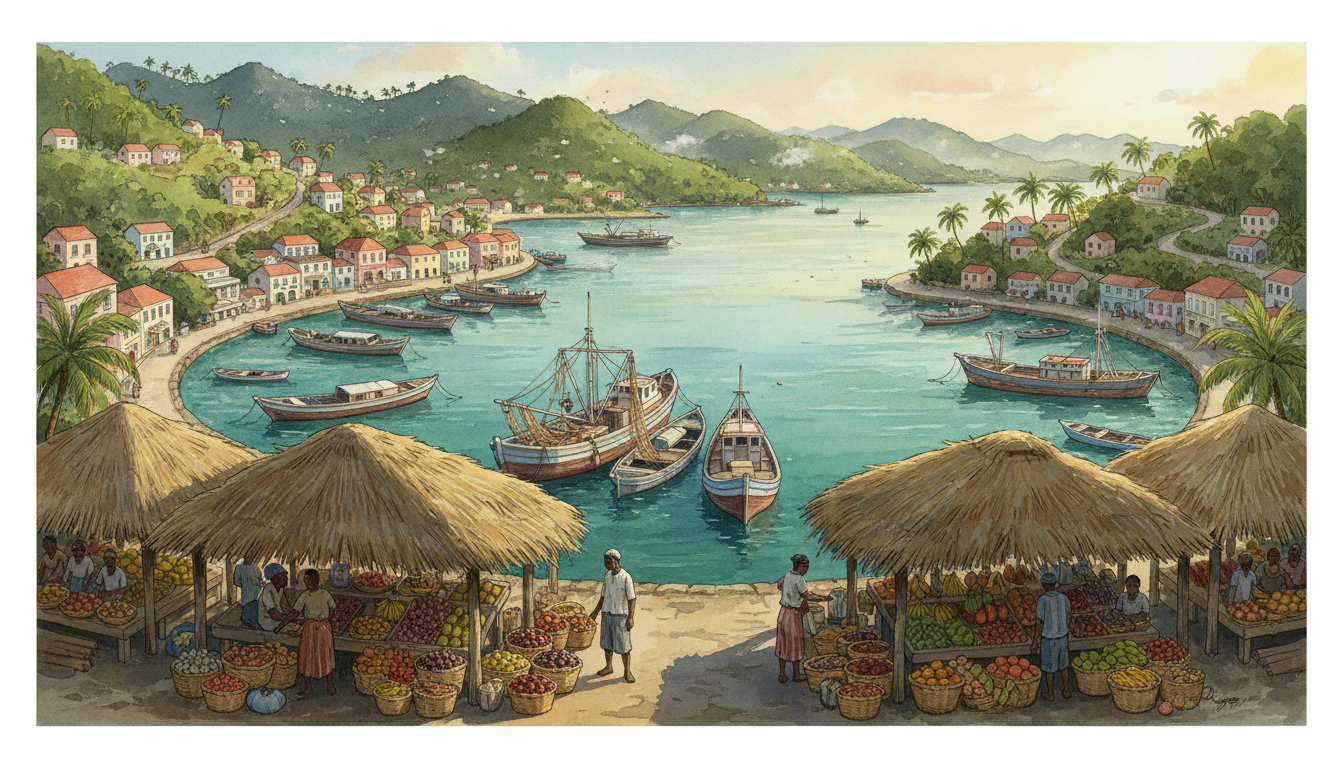
How does Grenada work? Grenada is an independent Caribbean country made up of the main island of Grenada and the smaller islands of Carriacou and Petite Martinique. It is a parliamentary constitutional monarchy: the King is represented by a Governor-General, while the Prime Minister and Cabinet lead Government and are accountable to Parliament. Its daily economy connects tourism, nutmeg and other agriculture, fishing, public services, maritime transport and international partnerships.
Why does an island country need both strong tourism and hurricane planning? Visitors support work and income, but Caribbean storms can interrupt houses, farms, airports, schools, clinics and ports. Hurricane Beryl caused severe damage in 2024, particularly on Carriacou and Petite Martinique. By 2026, reconstruction and stronger resilience were shaping public budgets and investment plans. A working country must serve families in ordinary weather and keep essential services functioning when the sea and sky change.
This guide explains who governs Grenada, why its two parliamentary chambers matter, how the three-island system operates, how tourism and spice farming connect to public finances, where the Eastern Caribbean dollar fits, and how hurricane recovery reaches ordinary households. Check current official rules for health, travel, citizenship, public payments or disaster warnings.
Grenada at a glance: quick answers
| Question | Short answer |
|---|---|
| Is Grenada independent? | Yes. It is an independent Caribbean country and member of the Commonwealth. |
| Who is head of state? | The monarch, represented in Grenada by the Governor-General. |
| Who runs Government? | The Prime Minister and Cabinet, responsible to Parliament. |
| Does Grenada have two parliamentary houses? | Yes: the elected House of Representatives and an appointed Senate. |
| Which islands matter? | Grenada, Carriacou and Petite Martinique. |
| What supports economic activity? | Tourism, construction, agriculture, fisheries, trade and other services. |
| What money is used? | The Eastern Caribbean dollar, shared with other Eastern Caribbean Currency Union members. |
| What is the central resilience question? | How to restore and maintain homes, infrastructure, livelihoods and services after damaging storms. |
1. How does Grenada’s geography shape the country?
Grenada lies in the southeastern Caribbean. Its main island contains the capital, St George’s, along with important administrative, commercial and transport facilities. Carriacou and Petite Martinique are farther north and have communities, livelihoods and service needs of their own. A national decision made on the main island still needs to work for residents who must cross water to reach many services.
An island country depends on ports, jetties, vessels and airports in ways that a land-connected country may not. Food, medicine, fuel, building supplies and school materials can require several transport and handling stages. A simple journey on a map may involve a road, a harbour, a ferry or other boat, another road and a final delivery.
Geography also influences emergency planning. A community may need shelter and reliable communication before a storm makes transport unsafe. It is difficult to deliver everything from the capital after a severe hurricane if the vessels, docks or roads used for delivery have also been damaged.
This is the first principle of Grenada’s national system: count connections, not just facilities. A modern clinic is valuable when patients, health workers and supplies can reliably reach it. A school works when students, teachers, water, electricity and educational materials come together.
2. Who runs Grenada: the King, Governor-General or Prime Minister?
Grenada is a constitutional monarchy and parliamentary democracy. The Constitution provides for the monarch as head of state, with the Governor-General exercising constitutional functions. Day-to-day Government is led by the Prime Minister and Cabinet, who carry political responsibility to Parliament. These offices have different roles and should not be described as interchangeable.
The Governor-General appoints as Prime Minister the elected member of the House who appears likely to command the support of a majority. The Governor-General also appoints ministers and Senators under constitutional arrangements, frequently acting on specified advice. The official Government portal explains those constitutional duties.
The Cabinet develops and executes national policy through ministries and public services. Parliament makes law and examines public decisions. Courts determine legal disputes and interpret the law. None of these institutions can be understood fully by looking only at the most prominent officeholder.
An everyday example makes the distinction clearer. If a new hospital project is proposed, the Prime Minister and Cabinet may set priorities, responsible ministries develop the project, Parliament authorises necessary financing and law, public bodies manage procurement, and clinical staff must ultimately make the facility useful. Ceremonial head-of-state duties do not replace those operational stages.
3. How does Grenada’s House of Representatives and Senate work?
Grenada’s Parliament includes the King represented by the Governor-General, an elected House of Representatives and an appointed Senate. The Government’s official public information describes fifteen elected constituencies for the House and thirteen members in the Senate. Parliamentary rules govern the passage of legislation, scrutiny and constitutional responsibilities.
The two chambers have different selection processes and roles under the Constitution. The House is central to electoral accountability and the formation of Government. Senate appointments provide additional participation under specified arrangements. A parliamentary bill has to follow the correct legal process; a speech by a minister does not by itself become binding law.
Consider a new requirement for disaster-resistant building standards. Officials may develop evidence and options, lawmakers examine the proposed rule, and agencies prepare how to apply it. Builders, householders and inspectors then need clear guidance. A sound law cannot strengthen a roof until the people constructing and maintaining it know what to do.
A citizen’s most useful question is whether a proposed change has reached the stage of legal force and which office enforces it. This helps distinguish political commitments from operative rules. It also creates a clear pathway for questioning and improving policies.
4. How do Grenada’s ministries and public agencies deliver services?
Ministries and their departments turn decisions into education, health, infrastructure, agriculture, financial administration and other public programmes. Delivery requires authority, trained staff, records and a budget. A ministry can announce a priority, but a functioning service needs procedures and a person or team responsible for the next action.
Think about repairing a storm-damaged school. Officials assess the site, record the damage, decide what must be repaired, find money and technical expertise, obtain materials, manage the works and ensure that pupils can return safely. Even a small structure may need transport logistics and procurement decisions.
Service coordination matters because problems do not respect ministry boundaries. A classroom may also require safe water, electricity, transport and healthcare readiness. A road repair may affect emergency access, school attendance and tourism. Improving one isolated part without the others can produce a disappointing result.
A practical method is to list five actors: decision-maker, budget holder, operator, inspector and resident. When you can name each one, you can see where accountability should sit. That method works for virtually any Caribbean public-service programme.
5. Why are Carriacou and Petite Martinique especially important?
Carriacou and Petite Martinique are not decorative islands on a tourist map. They are home to real communities with schools, businesses, fishing activities, cultural life, healthcare needs and families. Their distance from the main island means that national policy requires practical inter-island connections and locally appropriate delivery.
An electricity repair or building-material shipment may have different costs and scheduling challenges on Carriacou than near St George’s. Communities may need local storage of essentials and arrangements that work before adverse weather arrives. That can mean more redundancy or backup capacity than a narrow cost-per-user calculation would recommend.
Hurricane Beryl in 2024 showed how sharply the needs of the smaller islands can rise when infrastructure, houses and livelihoods are damaged. Recovering a community means more than rebuilding walls: schools must reopen, healthcare must operate, safe water must flow, fishing equipment must be replaced where needed and people must regain reliable income.
The lesson is about national inclusion. A country cannot be judged only by whether services work in its capital. An island resident’s experience of waiting for supplies or travel can tell policymakers where a national system needs repair.
6. How did Hurricane Beryl change Grenada’s priorities?
Hurricane Beryl struck in 2024 and caused severe damage across parts of Grenada, especially Carriacou and Petite Martinique. Reconstruction became a practical and financial priority. The IMF’s January 2026 Article IV report describes the continuing post-Beryl recovery, substantial public investment and fiscal responses.
Disaster recovery takes multiple forms. First come immediate safety, food, water, temporary shelter and basic communication. Next, officials must assess damaged property and critical facilities. Then come financing, purchasing, logistics, skilled trades, construction standards and longer-term prevention. Every stage depends on functioning institutions and community knowledge.
The cost is not limited to buildings. An injured worker, lost fishing equipment, damaged hotel, disrupted ferry or closed classroom creates economic effects that may persist after a road has been cleared. A family may receive help for immediate needs but still require stable employment before its finances recover.
Resilience means asking how the next storm can cause less damage. Better construction, safer utilities, risk-aware planning, financial reserves, insurance and clear warnings all contribute. Replacing every damaged object with exactly the same vulnerable design can leave a community at risk again.
7. Why does hurricane recovery affect public debt and budgets?
Reconstruction is expensive and often urgent. Governments must pay for repairs even when the disaster has interrupted business activity and public revenue. For a small island country, the same event can damage tourism income and raise spending needs in the same month. This creates a special fiscal challenge.
According to the World Bank’s Grenada country overview, growth in 2025 was supported by construction as recovery continued, while public finances shifted toward a deficit as post-disaster investment and other spending increased. The 2026 outlook expected investment to remain significant, subject to project timing and external risks.
Good financial resilience includes arrangements made before a disaster: accessible reserves, contingent financing, insurance and sound public-debt management. The IMF noted the role of catastrophe financing and fiscal buffers in Grenada’s response. These tools do not prevent wind damage; they help the country respond without relying solely on emergency improvisation.
Budget choices should still be transparent. A new building may have urgent value but also require future staffing and maintenance. A stronger bridge may protect access for decades. Public finance succeeds when investments preserve services and reduce repeated rebuilding costs.
8. How does tourism create jobs in Grenada?
Tourism supports accommodation, restaurants, transport, guides, shops, cultural attractions and other services. Visitors spend money locally, and some of that demand can reach food growers, craftspeople, maintenance workers and small businesses. The economic benefit depends on how strongly tourism firms are connected to local suppliers and employees.
Tourism is also exposed to global conditions. Flights, household income in visitor-origin countries, travel preferences and extreme weather all affect demand. The World Bank and IMF describe tourism as an important contributor, while noting wider external uncertainty. A country dependent on visitors needs alternatives when demand weakens.
Local residents also experience tourism’s costs. Roads, water, electricity, solid-waste services and coastal areas may be under heavier pressure during popular periods. Housing can become more expensive if demand for temporary accommodation displaces long-term rental options. These effects differ by neighbourhood and policy.
Good tourism policy is not only a race for higher visitor numbers. It should ask whether jobs are dependable, local producers benefit, the environment remains healthy and essential services work for residents throughout the year.
9. Why is Grenada called the Spice Island?
Grenada is widely associated with nutmeg and other spices, along with cocoa and agricultural products. These crops are part of the country’s cultural identity and economic history. Yet agriculture also depends on weather, land, farming skills, storage, processing and available markets.
Nutmeg cultivation illustrates why long-term planning matters. A tree requires care and time, while a major storm can damage productive capacity far beyond one harvest. Farmers may need seedlings, finance, technical advice and access to buyers during recovery. Re-establishing an orchard is different from replacing an annual crop.
Processing, grading and packaging can create additional value, but they require equipment, reliable power, quality standards and access to customers. A product with a famous origin does not automatically bring the greatest possible return to the farmer. Transportation and commercial arrangements determine where value is created.
A useful student exercise is to follow nutmeg from tree to shop. Identify the farmer, processor, packaging, inland delivery, export operator and retailer. Add one storm interruption and ask which link fails first. The exercise reveals why agricultural policy and disaster readiness belong in one conversation.
10. How do fishing, small businesses and local trade fit?
Fishing supports food supply, family income and coastal livelihoods. Fishers need safe vessels, suitable equipment, landing sites, storage and access to consumers. Bad weather can prevent safe fishing or transport, while damaged coastal facilities can disrupt activity for weeks or months.
Small businesses provide much of the practical service economy: shops, repairs, food preparation, transport and professional work. They need customers, financing and predictable access to supplies. An electrician cannot work efficiently if necessary components are delayed; a grocer depends on refrigeration and shipping.
Regional trade helps supply items that a small island economy cannot produce economically in every category. It also makes Grenada sensitive to the cost of imported food, fuel, machinery and medical products. An external price shock may appear quickly at a local supermarket.
A national development strategy should improve business capability and resilience together. Training, infrastructure and finance are linked; providing one without the other can leave enterprise growth constrained.
11. What is the Eastern Caribbean dollar, and who manages it?
Grenada uses the Eastern Caribbean dollar, which is shared with other countries and territories in the Eastern Caribbean Currency Union. The Eastern Caribbean Central Bank, or ECCB, manages the common currency and regional monetary responsibilities. This distinguishes Grenada from a country with a central bank solely responsible for issuing its own national currency.
A stable payments and financial system supports household saving, business trade and public finance. But currency arrangements cannot by themselves guarantee that every family can afford imported goods. The cost of international fuel, shipping or food can still be important.
Banking and financial inclusion help firms pay suppliers and households manage expenses. Digital transfers can reduce delays, but they depend on connectivity, reliable institutions and appropriate security. A business may still need a working ferry and road after completing a payment electronically.
When comparing Grenada with Fiji or Ghana, keep monetary and fiscal policy separate. The ECCB performs shared monetary functions, while Grenada’s elected Government and Parliament make national budget choices under the relevant laws.
12. Why do citizenship-by-investment revenues require careful management?
Grenada has a citizenship-by-investment programme governed by its relevant laws and administrative procedures. The programme can generate public revenue, but it is not the same as recurring income from an ordinary domestic tax base. Its scale may change with international demand, regulation and oversight.
The IMF’s 2026 report identified programme revenues as an important part of Grenada’s financial position, alongside post-disaster financing. That can create opportunities to rebuild or invest, but also a planning risk if temporary or volatile revenue is treated as permanently available for recurrent expenses.
Transparency, integrity checks and accountability matter particularly in citizenship and public-finance programmes. Applicants should not rely on sales claims as substitutes for official eligibility and due-diligence requirements. This guide does not provide advice about obtaining citizenship.
For citizens, the development question is where revenue goes. Does it strengthen reserves, repair vulnerable facilities or improve essential services? A country benefits when temporary inflows create durable capability rather than obligations it cannot support later.
13. How does Grenada’s education system serve its islands?
Schools must connect children to literacy, numeracy, further study, employment and civic participation. Grenada’s education system operates through national arrangements and institutions, but pupils’ lived conditions differ between the main island and the smaller islands. Safe buildings, teachers, materials, transport and electricity determine whether schooling remains continuous.
Disaster interruption makes the difference particularly clear. A child cannot simply recover lost learning because the calendar says school has reopened. Teachers may need to assess what was missed, rebuild routines and provide targeted teaching while families are still repairing homes or workplaces.
Imagine a student who was about to master fractions before an extended disruption. On return, the teacher finds that the student can calculate with whole numbers but has forgotten how fractions represent quantities. The correct response is a brief diagnostic and guided repair, not an assumption that the student is unwilling to learn.
Our dedicated Understanding the Education System of Grenada explores schooling more directly. This article explains education’s connections with household stability, island transport, public money and disaster recovery.
14. How are healthcare and transport connected in Grenada?
Healthcare needs trained staff, clinics, hospitals, medicine supplies, clean water and reliable power. On a smaller island, patients may need referral to a better-equipped facility elsewhere. The clinical decision and the transport arrangements are different tasks, but both affect whether treatment can be delivered.
Disasters introduce extra risks. Roads may be blocked; electricity and communications interrupted; and normal supply routes delayed. Prepared facilities may need backup systems and clear emergency escalation. A large new hospital can strengthen capacity, but local first-contact care and referral still matter.
The World Bank’s 2026 Grenada overview described plans for Project Polaris, a multiyear hospital investment beginning in 2026, within a wider construction programme. A planned project should be reported as planned or underway according to verified status, not as a completed medical service.
Public-health quality is also preventive. Safe drinking water, sanitation, appropriate vaccination programmes, nutrition and communication can reduce pressure on emergency services. A functioning health system reaches into infrastructure and household life long before a patient enters a hospital.
15. Where do roads, ports, utilities and digital systems meet?
Roads connect homes to harbours, schools, clinics and workplaces. Ports connect the islands to domestic and international shipping. Electricity and water allow businesses and public facilities to work. Digital networks help people communicate, transact and receive notices. Each component has its own operator and budget, yet they are used together.
Consider a small business importing spare parts. The order is placed online, paid for through a financial service, transported by ship, processed at a port, carried by road and finally installed by a technician. If the road is impassable or customs handling delayed, the successful digital transaction has not produced a usable part.
Utilities face special island constraints. Generating and distributing electricity, maintaining water supplies and treating wastewater can be costly when demand is spread across multiple locations. A new connection is useful only when operating capacity, repair funding and affordability are considered.
Practical performance indicators include hours of service, outage response, the safety of transport routes and whether residents know where to report a problem. That evidence matters more than photographs of newly installed equipment.
16. Worked example: how does a school on Carriacou recover after a storm?
Illustrative learning scenario, not an account of a specific reconstruction contract: A school on Carriacou suffers roof damage during a hurricane. Before pupils return, school leaders and technical teams must decide whether the building is safe and which temporary arrangements may be needed.
First comes inspection and protection of people. Next, education authorities assess classroom needs while works teams estimate repairs and materials. Financial authorities identify funding, procurement follows applicable rules, and shipping providers arrange delivery. Contractors complete the works while inspectors check safety.
Now consider a transport delay. Roofing materials cannot cross on the planned date. A sensible response requires clear communication with families, alternative learning arrangements where feasible and rescheduling that does not compromise construction quality. A public procurement document alone cannot make an unsafe classroom ready.
Success should be measured in more than money spent or roofs replaced. How quickly did students safely return? Were teachers available? Was lost learning diagnosed? Does the rebuilt structure have stronger protection? Are water and electricity working? This is how a national recovery programme becomes educational opportunity.
17. What can Grenada teach other countries?
Grenada shows how a small independent country must make physical resilience and financial resilience work together. A functioning constitution and public budget matter, but so do safe buildings, vessels, utility networks and local knowledge. A community’s ability to recover can be limited by the weakest connection.
It also shows why economic diversification matters. Tourism, farming, fisheries, investment and local business services create different sources of income, each vulnerable to particular shocks. Stable public finance and well-designed reconstruction can help protect opportunities even when one sector is disrupted.
Compared with Singapore’s dense city-state infrastructure, Grenada has multiple-island logistics and hurricane exposure. Compared with Fiji, it operates inside a different regional monetary system and has its own constitutional institutions. Copying a policy without its underlying geography and financing arrangements rarely reproduces the outcome.
The most useful measure of progress is everyday reliability: a child returns to school, a small business receives stock, a family gets safe water, a patient reaches care and a community can face the next storm with less vulnerability.
Five questions to understand a Grenadian public service
- Which ministry, parliamentary decision or competent operator is responsible?
- Is the service on Grenada, Carriacou or Petite Martinique, and what transport is required?
- How is the service financed now and maintained in later years?
- What happens when a hurricane damages facilities or prevents travel?
- How do we know families are receiving safe, affordable and reliable outcomes?
Frequently asked questions about Grenada
Is Grenada a monarchy or a republic?
Grenada is an independent parliamentary constitutional monarchy. The monarch is head of state and is represented by the Governor-General; the Prime Minister leads Government.
Who chooses the Grenadian Prime Minister?
The Governor-General appoints a House member who appears likely to command majority support, in accordance with the Constitution.
How many houses are in Grenada’s Parliament?
There are two chambers: the elected House of Representatives and appointed Senate, under the Constitution.
What islands are part of Grenada?
The main island of Grenada and the smaller islands of Carriacou and Petite Martinique are central to the country’s geography and public-service arrangements.
What is Grenada’s currency?
The Eastern Caribbean dollar, issued under the shared Eastern Caribbean Central Bank system.
Why is Grenada known for nutmeg?
Nutmeg and other spices are important parts of the country’s agricultural history and cultural identity, alongside tourism and other economic activities.
What happened during Hurricane Beryl?
The 2024 hurricane caused major damage, especially on Carriacou and Petite Martinique, with reconstruction remaining significant in 2026.
Is Grenada’s entire economy tourism?
No. Tourism is important, but agriculture, fisheries, construction, trade, investment and public services also contribute to work and income.
Continue reading: Grenada, the Caribbean and country systems
- How Countries Work | World Civilisation Archive
- How Singapore Works | Civilisation Companion
- Understanding the Education System of Grenada
- Top 10 Places to Visit When Touring Grenada
- Top 10 Things to Learn When Visiting and Touring Grenada
- How Fiji Works | Islands and Everyday Life
- How Greece Works | Parliament, Islands and Ferries
- How Guatemala Works | Government and Communities
- How Guinea Works | Mining, Water and Government
Official sources and reading notes (October 2026)
The constitutional arrangement is grounded in Grenada’s official Government website. The 2024 Hurricane Beryl aftermath, 2025 economic outcome and 2026 plans are described by the World Bank and IMF. Development projects, fiscal figures, rules and storm conditions change, so practical decisions require current official information.
- Government of Grenada — Constitution
- Government of Grenada — Governor-General duties
- Government of Grenada — ministries, Parliament and services
- World Bank — Grenada 2026 overview and hurricane reconstruction
- IMF — Grenada Article IV consultation published January 2026
- Eastern Caribbean Central Bank — regional currency and payments
- Government of Grenada — current services, notices and emergency information