
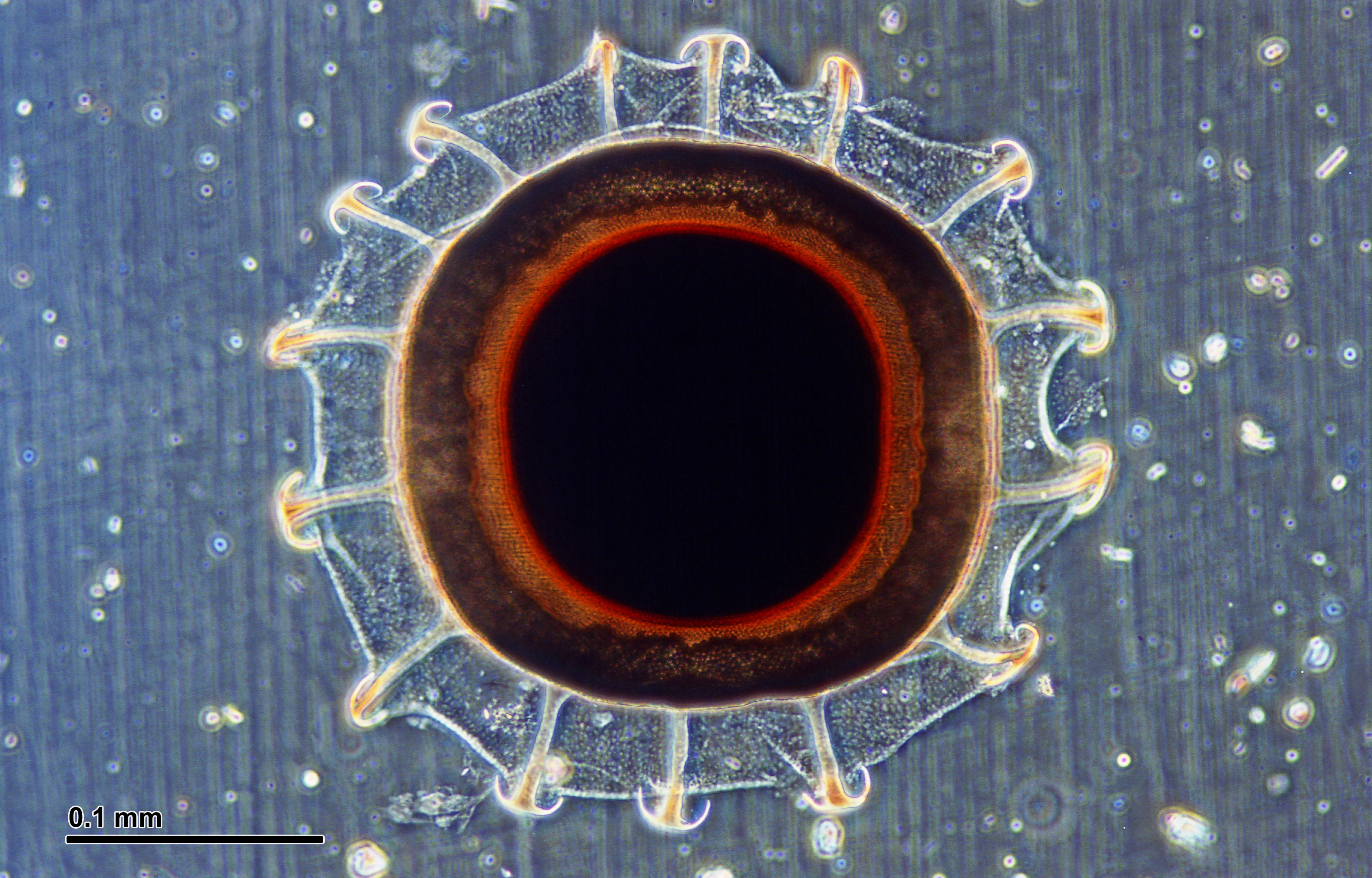
Freshwater bryozoan statoblast analysis uses durable microscopic resting structures to investigate historic lake, wetland and archaeological environments. These objects can preserve evidence of organisms whose soft colonies no longer survive. Their form may support taxonomic identification, and dated deposits can reveal aspects of changing aquatic communities. However, a statoblast valve is not one bryozoan animal, one viable egg or a direct measure of water depth. A trustworthy reconstruction depends on morphology, counting units, transport, ecology and chronology.
This guide follows identification through a fictional Longmere Pond worked example, then examines palaeolimnology, flood transport, recovery bias and research ethics. All Longmere numbers are invented. The featured image is a real modern statoblast of Pectinatella magnifica photographed by Josef Reischig, not a fossil from Longmere or from the research studies cited here.
Two practical scientific starting points are the 2023 Lake Sofia fossil study and Law’s archaeological methods review.


1. Begin with the fossil object, not a ready-made lake story
Freshwater bryozoans are small colonial animals often attached to submerged branches, stones and aquatic vegetation. Some produce durable resting structures called statoblasts that can survive after the soft colony disappears. These structures may be retrieved from lake, river and archaeological sediments, providing clues about past species presence and aquatic habitats. But a statoblast valve is not one complete animal, a direct water-level gauge or evidence that ancient people intentionally engineered a pond. The route from microscopic observation to environmental or cultural history requires several checks.
Start by asking students to distinguish three statements. A sediment sample contains a recognisable statoblast valve. A freshwater bryozoan community contributed to the deposit. Villagers drained and refilled the pond at a particular date. The first is a microscopic identification; the second depends on source and taxon context; the third demands independent archaeological evidence. The class should name the additional measurements required at every step before drawing a conclusion.
2. Understand freshwater bryozoans as colonial animals
Bryozoans are suspension-feeding animals organised into colonies of repeating units called zooids. Many freshwater forms belong to Phylactolaemata, and the full animal colony is not equivalent to one circular statoblast. Their soft, often gelatinous or branching colonies can be overlooked among plants and woody substrates. Colonies may expand asexually in favourable conditions and leave resting bodies when their living structures disappear. One large colony can produce multiple statoblasts, so counted resting structures cannot be converted directly into independent colonies.
Draw a modern colony with attached zooids, feeding tentacles and developing statoblasts. Then contrast the drawing with the isolated circular object in the article’s featured microscope image. Students should describe which biological level each shows—colony, zooid, resting body or separated valve—and which quantities the fossil actually measures. Terminological precision prevents a great deal of quantitative confusion later.
3. Learn why a statoblast is not an ordinary egg
Statoblasts are resistant asexual propagules produced by certain freshwater bryozoans. They commonly contain germinal material enclosed by protective valves and can enable persistence or dispersal through conditions unfavourable for active colony growth. Calling every statoblast a fertilised egg imports reproductive assumptions that do not fit the organism. Some can remain dormant and later establish new colonies, but survival, viability and successful hatching are distinct from fossil preservation.
Present an imaginary archaeological layer with twenty intact statoblasts. Does that prove twenty colonies, twenty sexually produced eggs or twenty viable propagules? No. A responsible note identifies the recovered objects and, if needed, the conditions under which they might retain viability. A fossil count cannot substitute for a specialist viability experiment, and the classroom should not promise that centuries-old structures can be revived.
4. Distinguish floating and attached forms
Some freshwater bryozoans produce floating statoblasts, often termed floatoblasts, while others produce forms that remain attached to a substrate, sometimes called sessoblasts. These categories have different ecological and transport implications, but production and morphology depend on taxon. A floatoblast can travel across the water or into a neighbouring site, while an attached form may indicate a closer relationship to its original substrate if preservation and context are secure.
Ask students to label an illustrated floatoblast, an attached statoblast and an isolated valve. They must identify what additional evidence would be needed to infer where the colony lived. The presence of one floating structure in a pond does not prove a resident population, and an isolated fragment resembling an attached form might have been reworked from elsewhere. Formation history remains a separate question from classification.
5. Identify the two valves and avoid double counting
A typical freshwater phylactolaemate statoblast may have two distinct valves enclosing its central contents. A recovered complete statoblast is a different counting unit from one detached valve. If a resting body splits after burial, two fossil valves can result from one original object. Conversely, damage may erase an entire side or make identification impossible. Researchers should state whether their tables list complete statoblasts, separated valves or identifiable fragments.
Construct a toy specimen tray with eight complete two-valved bodies, six isolated valves and several broken discs. Students should calculate visible pieces without assuming that dividing the valve count by two always provides the true number of original statoblasts. Such simple denominators matter in large lake-core studies, where missing or duplicate valves could alter a purported biodiversity trend.
6. Learn the annulus and fenestra correctly
Many statoblasts show an inner central disc or fenestra surrounded by an annulus that may be buoyant or morphologically specialised. Some have peripheral spines or other ornamentation; others appear smooth. Features can differ between species, dorsal and ventral surfaces, and stages of preservation. A single perfectly round outline is inadequate for confident identification. Surface patterns often need stronger microscopy than an ordinary hand lens.
Use the featured modern Pectinatella magnifica image to label the central region and hooked peripheral projections. Explain that its diagnostic detail belongs to a genuine modern specimen photographed by Josef Reischig, not an ancient specimen from the fictional Longmere Pond. A scale-calibrated photomicrograph is a reference for morphology, not an authentication record for a separate excavation.
7. Describe Pectinatella magnifica carefully
Pectinatella magnifica is a freshwater colonial bryozoan whose modern statoblasts can show conspicuous hooked peripheral spines. Its striking morphology makes it an effective teaching image, but not every spined statoblast recovered in sediment belongs to this species. Identifications require suitable reference material, complete characters and appropriate geographical and taxonomic context. The ecology of one familiar modern species should not be generalised to every fossil bryozoan found in an ancient lake.
Invite learners to compare the featured micrograph with a published drawing of Cristatella and forms assigned to Plumatella. They should identify differences that can be observed and note which characters are unavailable when the valve is broken. A strong report may record a broad bryozoan category rather than force every circular fossil into the name printed below the photograph.
8. Recognise statoblast spines without treating them as complete taxonomy
Peripheral projections, hooks and their number or geometry can support identification for relevant taxa, but they can break during water transport, preparation or burial. A spined fragment lacking its original disc may be ambiguous. It is tempting to count projections and assign a unique species, yet taxonomic diagnosis commonly uses several traits together, including overall shape, surface ornamentation, valve margins and comparative microscopy.
Give students three drawn specimens with missing projections or worn rims. Require a confidence category and an explanation of which features are preserved. They should also record specimen orientation. The teaching purpose is to move from an attractive single character to a defensible character combination, particularly when scientific names may have ecological consequences in later reconstruction.
9. Use SEM when fine sculpture makes a difference
Some bryozoan statoblasts can only be distinguished reliably under scanning electron microscopy because their valve surface microstructures are too fine or overlapping in ordinary transmitted-light views. The 2023 Madagascar study of Lake Sofia recovered numerous statoblast valves from sediment and used electron microscopy on a selected subset to clarify taxonomy, leading to recognition of previously undescribed forms. This is a model of matching instrument choice to diagnostic need rather than naming species from low-resolution images.
Students can compare a light-microscope photograph with an electron-microscope plate of the same general structure. They should specify which additional diagnostic characters might become visible and what limits remain when only a few fossils are suitable for detailed imaging. New taxon description is a specialist research outcome, not something warranted by one unusual classroom sketch.
10. Keep dorsal and ventral surfaces separate
The two sides of a statoblast may exhibit different surface patterns or structural details. Some archaeological remains are incomplete and may preserve only one valve, increasing the risk of comparing non-equivalent surfaces. Research that measures all valves without recording orientation can falsely inflate morphological variation or make one taxon appear to represent several.
Build a reference-sheet exercise with dorsal, ventral and edge views of published specimens. Students must identify where features are comparable and where data are unavailable. Their morphological table should include orientation and damage, not just a species guess. This is especially important when trying to compare fossil lineages against modern reference collections.
11. Understand the source of archaeological statoblasts
Bryozoan colonies may occupy shallow freshwater habitats, attached to submerged vegetation or other surfaces. Their statoblasts can subsequently float, travel along rivers, enter floodwater or become embedded in sediment. Finding statoblasts in an archaeological ditch or cultural layer does not always mean a permanent pond existed at exactly that spot. Material may have arrived during inundation, through imported aquatic plants or through later disturbance.
Use a simple map of a settlement by a river, with a freshwater pond, floodplain and drainage ditch. Have learners trace several plausible routes from an upstream bryozoan colony to a recovered statoblast in the town. The same object may testify to freshwater source habitats without proving the local microenvironment was continuously submerged.
12. Study floating dispersal and landscape connectivity
Some statoblasts can be moved by currents and floating debris, and biological dispersal may also connect separate wetlands. The ecology of dispersal is a scientific reason to treat an isolated statoblast as possible evidence of nearby aquatic connectivity rather than necessarily an established local colony. Transport potential depends on morphology, buoyancy, environmental barriers and survival. A fossil can be transported even if its original colony was a specialised habitat organism.
Ask students to build competing interpretations for one statoblast in a pond with no other bryozoan evidence. Model A proposes local reproduction; Model B proposes delivery by floodwater; Model C proposes transport on aquatic plant material. Their follow-up should identify observations that differentiate these routes, rather than choosing the most dramatic historical explanation.
13. Consider the difference between a statoblast and a colony fossil
Freshwater bryozoan soft-tissue colonies seldom preserve in the same way as hard-shelled marine bryozoan skeletons. Statoblasts can therefore provide a record of freshwater biodiversity even when no recognisable colony remains. Archaeologists studying marine encrusting bryozoans may use different skeletal characters and recovery techniques. Mixing evidence from marine calcified colonies and freshwater resting structures can create severe taxonomic and ecological mistakes.
Have learners compare a piece of hard calcified marine bryozoan encrustation with a photographed freshwater statoblast. Both relate to Bryozoa but answer different kinds of archaeological question. Students must label what was found and whether the associated sediment is marine, brackish or freshwater before drawing palaeoenvironmental conclusions.
14. Use a standardised sediment extraction approach
Archaeological and lake sediment statoblasts can be recovered through appropriate disaggregation, wet sieving and microscope sorting, but the precise method depends on preservation and collection constraints. Law’s 2013 archaeological review discusses practical recovery of freshwater statoblasts and recommends suitable fine mesh where these remains are sought. A change in mesh size or processing intensity can alter the recovered taxonomic and size distribution, sometimes more than any biological difference.
Students compare two fictional cores processed with different sieves. Small or damaged valves are preferentially lost from one dataset. Before claiming ecological turnover, the class must document what passed through each sieve and whether archived sediment allows a harmonised comparison. Microscopy and raw counts are not comparable without a compatible preparation history.
15. Measure valve morphology with calibrated images
Useful observations can include valve length and width, fenestra dimensions, annulus characteristics, presence and arrangement of spines, and surface sculpture. Taxon-specific diagnostic measurements need scale bars, appropriate orientation and an assessment of deformation. A well-preserved reference set is more informative than a single striking photograph. Students should record missing or ambiguous features rather than substituting typical values from a guide.
Set a measurement exercise in which one valve is crushed slightly and another has lost part of its margin. Learners must decide which dimensions remain comparable. A cautious conclusion may limit the specimens to a genus group until better imaging is available. This is a useful lesson in the difference between a measurable object and an unambiguously diagnostic object.
16. Recognise differential preservation
Statoblast walls may survive burial conditions that destroy much softer biological material, but preservation remains selective. Abrasion, oxidation, microbial activity, physical compression and sediment chemistry can damage diagnostic structures. Some isolated valves are recognisable but lack the surface details required for species assignment. A fossil record may therefore appear to show a species decline simply because identifiable surfaces are preferentially lost.
Provide students two imaginary intervals, one with many intact smooth valves and another with damaged spined fragments. They should record completeness and identify the risk of biased taxonomic counting. An indeterminate category is a real part of the evidence, not a nuisance to hide from a polished graph.
17. Record sediment mass and the correct count unit
Statoblast records may be expressed as complete bodies, separated valves or diagnostic fragments per gram or sediment volume. Mixing these units without a conversion method makes apparent abundance changes uninterpretable. A sediment core can also accumulate different volumes through time, so counts per gram are not automatically yearly fluxes. Percentages describe the composition of classified remains, not the number of living colonies.
The fictional Longmere Pond example uses two categories of counted valves—provisionally floating-type and attached-type—under one invented classification protocol. Older interval A yields forty-two and eighteen valves from three grams of sediment. Younger interval B yields twenty-four and forty-eight from six grams. Students should keep the raw numbers beside the calculated rates so the measurement stays auditable.
18. Calculate the fictional Longmere concentration
For Longmere A, the total classified valves are 42 + 18 = 60 from 3 g, or 20 counted valves per gram. For Longmere B, 24 + 48 = 72 from 6 g, or 12 per gram. The total observed fossil-valve concentration therefore falls between the two invented sediment intervals. This does not mean colony density declined by forty percent, because statoblast production, transport, preservation, processing and sediment dilution are unmeasured.
Require students to show the calculations and identify the observation unit in each numerator. They should write ‘valves per gram’ rather than ‘bryozoans per gram’. An accurate arithmetic answer is useful only when the scientific meaning of the variable is also stated correctly.
19. Calculate the apparent floating-to-attached change
In the older fictional interval, floating-type valves are forty-two of sixty, or seventy percent of the classified total. In the younger interval, they are twenty-four of seventy-two, or one-third. Attached-type share consequently rises from thirty to about sixty-seven percent. Yet their observed concentration also changes from 18 / 3 = 6 per gram to 48 / 6 = 8 per gram, while floating-type concentration falls from 14 to 4 per gram. The different measures capture different aspects of the same invented table.
Do not translate this directly into local water level, rainfall or the number of colonies. It may motivate competing hypotheses of changed habitat, transport, reproductive form or preservation. A student who reports both percentages and counts per gram and names the missing context demonstrates stronger scientific judgement than one who selects a single visually impressive statistic.
Invented Longmere raw-valve counts
| Fictional layer | Floating-type valves | Attached-type valves | All identified valves | Dry sediment |
|---|---|---|---|---|
| Older A | 42 | 18 | 60 | 3 g |
| Younger B | 24 | 48 | 72 | 6 g |
20. Consider complete statoblasts and the two-valve bias
Longmere deliberately counts separated valves, not verified original complete statoblasts. If one layer favours disarticulation, the number of counted valves per biological resting body can change. A shift between complete and split specimens may therefore affect the count even if production were stable. A ratio of valve counts cannot be converted to original whole statoblasts without evidence about matching, preservation and recording rules.
Ask students to add a column for complete versus single-valve recovery. The class should recompute the result under defensible alternative counting rules and report whether the direction remains stable. Uncertainty should be made visible rather than hidden by assuming every paired object has separated identically.
21. Read the 2023 Lake Sofia study as methodological evidence
Wood, Unger and Rasoamihaingo examined bryozoan statoblasts in a sediment core from Lake Sofia in Madagascar and reported a peak of sixty-seven valves at 45.5 cm, with a decline in more recent sediments. A carefully selected subset was examined with scanning electron microscopy, and the authors described two new Plumatella species. This is a strong example of the biodiversity information stored in sediment despite preservation limitations; it is not proof that a single ecological cause drove the measured change.
Students should extract four elements from the study: the core context, count unit, microscopic selection and taxonomic claim. They should ask whether the result directly identifies lake depth, temperature or human activity. The answer is more limited. The paper supports the value of statoblasts as a record of historical biodiversity and illustrates how careful specialist identification can reveal taxa overlooked by modern surveys.
Invented Longmere denominators
| Observation | Older A | Younger B |
|---|---|---|
| All identified valves per gram | 20 | 12 |
| Floating-type valves per gram | 14 | 4 |
| Attached-type valves per gram | 6 | 8 |
| Floating-type share of identified valves | 70% | 33.3% |
22. Learn the lesson of Florida’s thirty-lake comparison
A 1986 study by Crisman and colleagues considered statoblasts in surface sediments from thirty Florida lakes across trophic conditions. The authors linked bryozoan distributions to littoral habitat and planktonic food availability while acknowledging difficulty separating food from habitat effects. This is an excellent teaching model because it shows how even a useful ecological relationship can have competing drivers, rather than serving as an exact universal lake-quality formula.
Have students compare two imaginary lakes with equally extensive shore vegetation but different plankton availability. They should not expect identical bryozoan counts solely because substrate habitat matches. A good environmental interpretation includes food, water conditions, attached substrate, colony production and sedimentation rather than assigning one causal variable.
23. Review British archaeological statoblast finds
Law’s 2013 article documented the relevance of bryozoans to archaeological work and reviewed freshwater statoblasts from contexts including river-related deposits and other excavated sediments. The presence of statoblasts in terrestrial archaeological sequences may reflect floodwater introduction, human movement of aquatic materials or earlier water conditions. Such occurrences can be informative without proving that the findspot always lay underwater.
Give the class a hypothetical medieval drainage ditch containing a few statoblasts and no large aquatic shells. Students must propose alternate source pathways and distinguish local freshwater habitat from material introduced by flooding or cleaning. The exercise develops archaeological reasoning about how small ecological traces move through human-managed spaces.
24. Use sedimentary statoblasts for biodiversity baselines
Statoblast morphology can preserve evidence of taxa that are no longer observed at a studied lake today, helping researchers ask whether diversity changed or species were overlooked in modern sampling. However, the fossil record is selective, and species names may depend on preservation and specialist microscopy. A taxon apparently absent from a modern survey could remain nearby or require a different season or habitat to detect.
Ask students to design a comparison of fossil records with contemporary aquatic surveys, including substrate searches, seasonal visits, microscopy and uncertainty. They should not write ‘globally extinct’ when only one lake’s modern sampling failed to find the animal. The distinction between local non-detection and historical species loss is crucial.
25. Do not infer a universal water-quality grade
Some freshwater bryozoan taxa inhabit particular environments, but their presence can depend on temperature, food particles, substrate and flow in addition to nutrients. The literature does not justify rating every statoblast as evidence of pristine water or polluted water under one worldwide index. A more useful result is a conditional reconstruction based on species ecology and regional references, supported by other sediment observations.
Students write two rival explanations for a drop in statoblast concentration: reduced habitat due to shore modification, and reduced food due to changes in plankton production. They propose measurements that could distinguish the alternatives rather than treating the count as a single-variable chemical test.
26. Distinguish long-term dormancy from tested viability
Statoblasts are designed for survival and dispersal, but finding an intact old body in sediment does not prove it remains viable. Viability depends on species, storage, age, burial conditions and experimental handling. A fossil palaeoecology study and a resurrection-ecology experiment ask different questions. Morphology can support historical taxon presence without showing whether a living colony can be produced from the recovered object.
Present a fictional archaeology museum announcing that thirty excavated statoblasts will establish thirty new colonies. Students should revise the announcement to distinguish preserved cases, possible dormant germinal tissue and experimentally demonstrated hatching. This is also a lesson in responsible communication to non-specialists.
27. Connect statoblasts to resting stages of cladocerans
Cladoceran ephippia and freshwater bryozoan statoblasts are both durable reproductive or survival-related structures that may appear in lake sediments. Yet they originate from different animals and have different life histories, morphology and ecology. Their co-occurrence can provide an opportunity to compare littoral conditions and organism life-cycle responses, but a shared trend does not automatically prove a single driver such as drying or pollution.
Students should examine both kinds of resting structure and make an identification table. They must explain why a bryozoan valve is not a water-flea ephippium and identify what additional data would support an environmental link between them. The goal is to improve cross-proxy reasoning without conflating biological mechanisms.
28. Compare statoblast records with aquatic vegetation
Bryozoan colonies may attach to submerged plants and woody substrates, so macrophyte history can help interpret their habitats. Charophyte oospores, plant macrofossils and diatoms may provide useful independent observations, but their source areas and preservation pathways differ. A decline in statoblasts alongside disappearing submerged plants could be consistent with habitat loss, but reduced food, transport or recovery remain possible explanations.
Build a matrix containing taxon identification, direct count, habitat association, source-area assumptions and alternative formation histories for each proxy. A complete interpretation should identify which correlations are genuinely independent and where an assumption is being repeated rather than confirmed.
29. Treat flood deposits and human land use as distinct
Changes in statoblast assemblages may reflect landscape hydrology, but humans may also modify wetlands by damming, cleaning ditches, draining fields or transporting aquatic vegetation. The mere occurrence of resting bodies cannot uniquely distinguish these events from natural floods, shoreline movement or habitat changes. Dating and independent excavation features are necessary before assigning human agency.
Ask students to investigate an invented pond beside an archaeological settlement. Could the same statoblast signal reflect a flood washing in upstream material or deliberate cleaning of a water channel? The strongest assignment identifies which sedimentary structures, artefacts and historical records would separate those explanations, instead of attributing every ecological shift to people.
30. Keep sediment depth separate from calendar time
Statoblasts recovered from different core depths gain chronological meaning only through independent dating and a credible age-depth model. Uneven accumulation, erosion, bioturbation and reworking can mix objects that were originally deposited at different times. One statoblast carried by a later flood into old sediment does not automatically belong to the earliest occupation phase of a nearby site.
Have learners compare a gradual long-term lake change with a single flood deposit and ask whether the fossil sequence resolves annual, decadal or century-level events. Their figures should label actual sample depths and estimated date ranges. It is scientifically better to preserve a broad possible interval than to assign a precise event year unsupported by the chronology.
31. Design a targeted non-destructive teaching workflow
Many teaching questions can be answered with licensed microscopy images, published count tables, comparison charts and carefully curated modern material. Protected archaeological samples need collection permission and responsible stewardship before processing, especially when scarce statoblasts may be destroyed by poorly chosen chemical treatment. Scanning electron microscopy and other specialised techniques should be justified by the diagnostic question rather than chosen for spectacle.
Students prepare a minimal sampling and curation plan specifying excavation provenance, processed mass, size fraction, object identification, scale photographs and retained material. A successful plan produces verifiable information without exhausting an irreplaceable archive. Research ethics belongs in the scientific method, not merely the appendix.
32. Write the final Longmere interpretation responsibly
The invented Longmere dataset shows falling total identified-valve concentration and a relative increase in attached-type valves between two classroom samples. It does not establish a change in absolute colony population, precise lake depth, a drought year or human water engineering. Possible explanations include reproductive strategy, habitat shifts, selective transport, disarticulation and recovery differences. The correct next step is to test the strongest alternatives using ecology, sedimentology and chronology.
A good conclusion might report the observed 20-versus-12 valve-per-gram contrast alongside its uncertainty, then explain the limits of what can be inferred from two simplified observations. Students should be proud of a narrow reproducible result when it is the strongest statement the material supports. That is the gold standard of teaching statoblast palaeoecology.
Twenty-eight case-based identification and site-formation audits
All of the following scenarios are fictional classroom exercises. Their purpose is to demonstrate a specific scientific decision, not to claim new archaeological discoveries.
1. Two valves counted as two resting bodies
A technician labels two detached valves as two separate statoblasts even though they may originally have enclosed one body. Students record the observed pieces and explain why without matching or formation evidence the original statoblast count remains uncertain.
2. A photogenic spine becomes a species
One circular fossil fragment has hooked projections and is instantly assigned Pectinatella magnifica. Learners assess which characters and regional comparisons are still missing and choose a defensible taxonomic rank.
3. The floating object in a dry ditch
A statoblast appears in an archaeological ditch that was likely dry during ordinary use. Students consider temporary floodwater, imported aquatic material and post-depositional disturbance before declaring a permanent lake on the site.
4. The Madagascar new-species claim
A classmate uses one oddly textured valve to name a new Plumatella species. Reviewers examine how the Lake Sofia research used multiple observations and electron microscopy. They describe the specialist comparative work needed before a new name is justified.
5. The wrong sieve size
A laboratory processes older samples with fine mesh and younger samples with coarse mesh. Small statoblast valves appear to decline. Learners flag recovery bias before building a biodiversity-loss narrative.
6. The twenty-per-gram calculation
Longmere A contains sixty counted valves from three grams of dry sediment. Students compute twenty per gram, label the unit correctly and explain why this does not measure colony abundance.
7. The twelve-per-gram comparison
Longmere B contains seventy-two counted valves from six grams. Students compute twelve per gram and state the observed difference without inventing a universal biological response.
8. The seventy-percent floating result
Floating-type valves are forty-two of sixty in the older sample and twenty-four of seventy-two in the younger. Students calculate seventy percent and one-third, then explain why percentages differ from valves per gram.
9. A richer attached-type rate
Attached-type valves increase from six to eight counted valves per gram under the toy method while total identified valves per gram decline. Learners explain the denominator distinction and avoid selecting only the most dramatic statistic.
10. A split-statoblast bias
Two sample layers undergo different rates of mechanical disarticulation. Students determine how this may change valve totals while original statoblast production stays comparable. Their method audit includes complete versus detached condition.
11. The incomplete ventral surface
A fragment retains part of one valve but not the diagnostic surface. A researcher claims a species based on approximate size. Students request adequate reference images or use a broader morphotype category.
12. Plumatella and Pectinatella confusion
Two reference photographs show different kinds of annular and spine structures, but students assume all round statoblasts are the same taxon. The exercise requires careful morphology and acknowledgement of shared or damaged features.
13. The colony count from resting cases
A sample has one hundred valves, leading an author to announce one hundred ancient colonies. Learners identify multiple propagules per colony, two-valve anatomy and variable preservation as reasons that translation fails.
14. The suddenly clean lake
Statoblast counts rise and a manuscript calls it proof the lake became unpolluted. The class examines trophic conditions, phytoplankton availability and littoral substrate using Florida research as a counterexample to simplistic indexing.
15. Food versus habitat in Florida
Two hypothetical lakes have comparable macrophyte cover but different food availability for filter feeders. Learners predict why bryozoan presence might differ and state how both variables would need to be measured.
16. The flood-flotsam alternative
A high-energy sediment layer is rich in floatoblasts. Students examine whether a floating source may have arrived with flood debris rather than through local reproduction. They request sedimentological and hydrological context.
17. The 67-valve figure
A student quotes the published Madagascar sixty-seven-valve peak as seventy colonies. Reviewers correct the observation unit and note that the paper studied the historical fossil record, not colony abundance directly.
18. The hidden indeterminate category
Only intact diagnostic valves are plotted, while a large damaged fraction is omitted. Students add completeness categories and assess whether taxonomic proportions could shift because of preservation.
19. A statoblast with no living colony
An old core contains identifiable statoblasts but modern surveys find no colonies of the taxon. Learners consider extinction, local non-detection, movement from elsewhere and taxonomic uncertainty before declaring disappearance.
20. The wrong historical date
A valve-rich layer is assigned an exact named flood year although the age-depth model spans decades. Students rewrite the chronology honestly and identify which independent dating would narrow the interval.
21. Two apparently contradictory proxies
Cladoceran ephippia rise while bryozoan statoblasts fall. Learners distinguish their ecology, reproductive pathways, taphonomy and source areas, and propose a study that explains rather than conceals disagreement.
22. An impossible hatch guarantee
A museum proposes incubating fossil statoblasts and promises every specimen will produce a living colony. Students separate morphological preservation from viability and explain why successful germination cannot be assumed.
23. The rare Kenyan fossil
A statoblast of a taxon poorly known from modern regional surveys appears in an ancient wetland core. Students discuss what historical presence can mean and why sparse modern data do not establish complete regional extinction.
24. The outdated species key
A modern statoblast is compared with an older taxonomic key lacking newly described regional taxa. Learners state why database and reference coverage matters and why a broad confident morphotype may be safer than an unsupported species.
25. A culturally sensitive wetland
An excavation’s only undisturbed sediment sample is targeted for routine classroom sorting. Students consider conservation permissions, non-destructive imaging and scientifically proportionate sampling before proceeding.
26. The moved aquatic weed
Human residents import aquatic vegetation carrying attached statoblasts to line baskets or maintain ponds. Students consider this source pathway before assuming the taxon grew naturally on the settlement floor.
27. The irreproducible bar chart
A published figure lists relative statoblast abundance but omits sediment mass, valve orientation and processing fraction. Reviewers request the raw observations and calculate what can still be supported.
28. The final Longmere claim ladder
Students must write separate observation, environmental hypothesis and cultural-history statements. For each inference they identify the evidence needed, including ecology, transport, dating and independent archaeological traces.
Advanced microscopy, field and inference clinics
1. Microscope reference clinic
Use a modern Pectinatella image and two published SEM plates of Plumatella statoblasts. Students record which surface characters are visible and which require higher resolution. Identification confidence should vary with the observations, not with the prestige of the instrument.
2. Valve-accounting clinic
A worksheet contains complete statoblasts, paired detached valves, unpaired valves and damaged pieces. Learners present a consistent count and uncertainty notes, then explain why the total cannot be equated with colonies.
3. Flood-routing clinic
Draw upstream wetland, town, channel and pond locations. Students map plausible paths for buoyant statoblasts and propose which sediment facies and associated microfossils could distinguish upstream transport from locally established colonies.
4. Sample-comparability clinic
Two laboratories used different mesh sizes and sorting effort. Learners create a compatibility checklist covering processed sediment, fraction, magnification, identification and damaged-remain treatment. Incompatible data should not be forced into one abundance trend.
5. Viability clinic
A set of preserved cases looks intact under a microscope. Students identify what a separate viability study would need to test and which ethical or handling restrictions apply. Fossil morphology is not evidence of guaranteed successful hatching.
6. Food-and-habitat clinic
A lake’s phytoplankton biomass changes as shoreline vegetation expands. The class predicts competing possible responses of filter-feeding colonies and statoblast deposition without asserting a fixed direction. Their test plan should include modern ecological surveys.
7. Chronology clinic
Fossils from neighbouring depths receive age estimates with overlapping uncertainties. Students redesign a chart that currently assigns an exact year to each bar. The revised figure should distinguish sampling depth, modelled age and any reworking evidence.
8. Habitat-limit clinic
One species is reported from several shallow-water settings. Learners explain why its fossil presence supports a compatible aquatic environment but not a unique lake depth. A specialist reference with narrow verified tolerance may be more informative.
9. Taxonomic revision clinic
An old Lake Sofia catalogue uses broad Plumatella identifications before specialist microscopy. Students compare with the 2023 research and describe how revisions can reveal previously overlooked diversity while leaving original observation records intact.
10. Cultural attribution clinic
A wetland archaeological feature contains freshwater bryozoan statoblasts. Students debate accidental flooding, permanent aquatic habitat and imported organic material, and list the independent evidence required before identifying one human practice.
11. Conservation clinic
Learners choose whether to examine archived photos, existing slides or newly consume protected sediment. The best plan answers an explicit question with the least appropriate material loss and includes permission and custody records.
12. Peer review clinic
A draft manuscript claims statoblast counts prove both lake eutrophication and deliberate drainage. Students retain the real valve counts but test each historical claim against regional ecology, sedimentology and dating. Their final revision should remain informative without overstating certainty.
A three-session student research programme
- Session 1: recognise living bryozoan colonies, floatoblasts, sessoblasts, valves, annuli, fenestrae, spine characters, and identify genuine modern microscopy references.
- Session 2: process a fictional statoblast dataset, distinguish separated valves from complete bodies, calculate Longmere rates and percentages, then test transport, flood deposition and preservation.
- Session 3: use the Lake Sofia and Florida studies to examine species-level identification, freshwater ecology, chronology, independent evidence and justified archaeology.
- Submission: annotated diagnostic images, specimen-condition categories, raw-valve and sediment-mass table, a coherent alternative formation history, an ethical sampling plan and a reproducible conclusion.
Assessment rubric: the research-grade standard
| Question | Required approach | Unsupported leap |
|---|---|---|
| What exactly was recovered? | Intact statoblast, single valve and fragment separately recorded | Two detached valves assumed to be two colonies |
| How was it identified? | Scale, diagnostic surface, orientation and reference acknowledged | All circular objects named Pectinatella magnifica |
| Are two layers comparable? | Mesh, processing effort, sediment mass, condition and count rules reported | Percentages without denominators presented as population size |
| Where did it come from? | Floating transport, local substrate and flood history considered | Find location automatically equated with living colony habitat |
| When did it occur? | Actual layer chronology and reworking uncertainty shown | Depth converted to exact date without dating evidence |
| Can it support a cultural claim? | Independent archaeology tests human water-management hypotheses | One statoblast called proof that people dug a pond |
Frequently asked questions
What are freshwater bryozoans?
Small colonial filter-feeding animals that live attached to substrates in suitable freshwater habitats.
What is a statoblast?
A resistant asexual resting structure produced by certain freshwater bryozoans; it can help colonies persist or disperse.
Why do statoblast valves matter in archaeology?
They can survive in sediments and may support identification of historical bryozoan taxa and aspects of freshwater environments.
Does one statoblast valve mean one bryozoan colony?
No. A statoblast commonly includes two valves, and a colony may produce numerous resting structures.
What is the difference between a floatoblast and a sessoblast?
Some statoblasts float and disperse, while other forms remain associated with a substrate; their morphology and ecology depend on the taxon.
Can statoblasts indicate historic lake level?
Sometimes they contribute clues alongside sedimentology and appropriate modern ecology, but they are not universal numerical lake-level meters.
Why might scanning electron microscopy be needed?
Some taxa differ by fine surface structures not reliably resolved under ordinary light microscopy.
Does an intact fossil statoblast mean it can hatch?
No. Morphological preservation and tested biological viability are distinct.
Do the Longmere sample counts come from a real lake?
No. Longmere Pond is a fictional teaching case with invented raw counts and dry sediment masses.
Could statoblasts enter a dry archaeological ditch?
Yes. Floodwater, transport of aquatic material or later disturbance can introduce freshwater resting bodies into deposits that were not permanently underwater.
Research sources, image credit and connected eduKate references
- Wood, Unger and Rasoamihaingo (2023), bryozoan statoblasts from Lake Sofia, Madagascar
- Original 2023 European Journal of Taxonomy Lake Sofia study
- Law (2013), Bryozoans in Archaeology
- Bath Spa University archive of Bryozoans in Archaeology
- Crisman et al. (1986), bryozoan microfossils in thirty Florida lakes
- Francis, Bryozoan Statoblasts, Tracking Environmental Change Using Lake Sediments
- 2023 US Fish and Wildlife Service freshwater bryozoan statoblasts
- Josef Reischig’s photographed Pectinatella magnifica statoblast and CC BY-SA 3.0 licence
- Teaching Archaeological Cladoceran Analysis
- Teaching Archaeological Charophyte Oospore Analysis
- Teaching Archaeological Sponge Spicule Analysis
- The Gold Standard of Palaeoecology
- The Gold Standard master hub
The gold standard of teaching bryozoan statoblast analysis is a learner who identifies the resting structure rather than inventing a colony count, understands how water and sediment transport affect source history, and reports palaeoecological or archaeological conclusions at exactly the strength the evidence supports.