
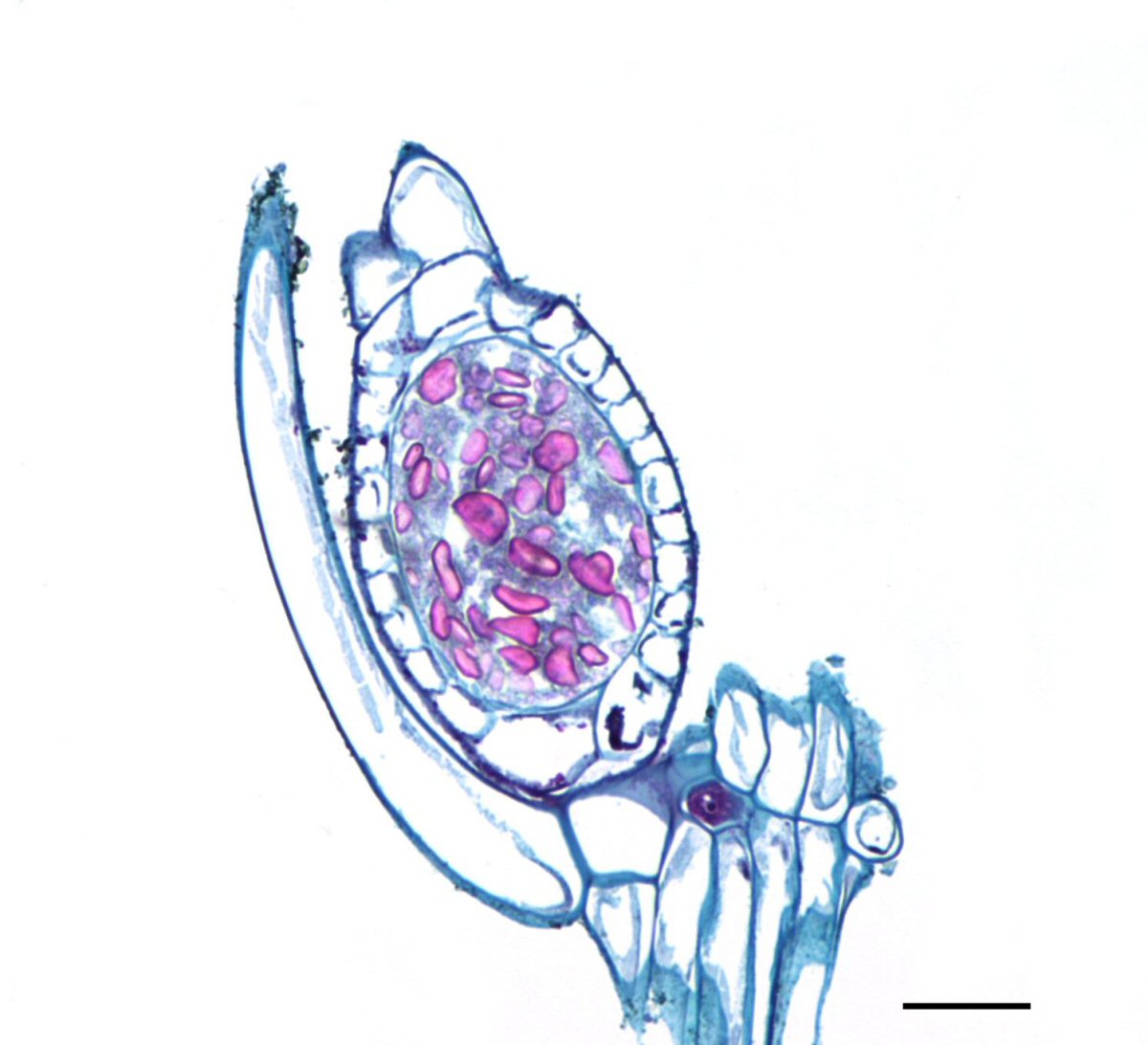
Stoneworts, or charophytes of the order Charales, leave microscopic reproductive structures in lake and wetland sediments. Organic oospores and calcified gyrogonites are related but distinct, and both can contribute evidence about ancient aquatic vegetation, water chemistry and habitat change. They are not automatic meters of salinity, lake level or the area of living meadows. This guide teaches the organism, fossil and measurement before any environmental claim is made.
The original Reedwater Lake example in this article is a fictional teaching case with deliberately invented counts. The featured real Chara oogonium photograph shows a living reproductive structure, not a fossil oospore or gyrogonite from that case. Readers can use the chapter index to move from identification and calcification to transparent quantitative work, palaeolimnology and responsible ecosystem interpretation.
Begin with the 2015 review distinguishing gyrogonites from oospores and research from Laguna de Gallocanta on how morphology and saline lake environments interact.


1. Identify stonewort evidence before describing a lake
Charophytes of the order Charales are submerged multicellular green algae often called stoneworts. Their living stands can contribute to aquatic habitats and influence sediment and water clarity. Sediments may preserve reproductive remains, especially organically walled oospores or calcified structures known as gyrogonites. These objects can provide evidence for past aquatic vegetation, but a single preserved structure is not an exact lake-level gauge or a measure of dissolved salt concentration. The starting question is what structure the analyst has actually found and why it would reach that sediment layer.
Begin with a photograph of the real Chara oogonium featured here, then a drawing of an isolated fossil gyrogonite. Ask the class to distinguish living reproductive structure, mature oospore and mineral fossil before interpreting any counts. This ensures that anatomical identification comes before paleoenvironmental storytelling. Learners should also record that the photograph is a modern microscopic reference, not a fossil from the fictional Reedwater Lake used in the exercises.
2. Distinguish Charales from plants that only look similar
Stoneworts have whorled branchlets and conspicuous reproductive organs but are algae rather than rooted flowering water plants. Their habitats and life histories differ from those of pondweeds and other submerged macrophytes. Some species live in freshwater while others tolerate brackish or more saline environments. That range is why charophytes are interesting palaeoecological evidence, yet it is also why a generic label cannot simply mean clean freshwater or one stable salinity value.
Provide learners with comparative line drawings of Chara, Nitella and a submerged flowering macrophyte. They must identify structural clues and state what is still uncertain from a sedimentary oospore alone. An apparently plant-like stem does not answer which reproductive fossil belongs to it. A responsible identification records the anatomical source and the taxonomic resolution supported by a real reference collection.
3. Learn how the reproductive system is organised
Female reproductive structures in many Charales include an oogonium surrounded by spiralling sterile cells; fertilisation can yield an oospore with a resistant wall. Male reproductive structures are antheridia and should not be confused with the female organ or the eventual fossil. Developmental terms matter because a textbook photograph can show a living gametangium while an archaeological slide contains an isolated seed-like object. Confusing the two collapses several biological stages into one misleading identification.
Ask students to sketch the sequence from living plant to oogonium, fertilisation, oospore maturation, possible calcification and sedimentary burial. They should label which structures may remain recognisable if soft tissue disappears. The first part of the course is successful only when learners can describe what actually fossilised, not just recite the word ‘charophyte’.
4. Keep oospores and gyrogonites separate
The 2015 Aquatic Botany review clarified a critical distinction. Oospores have resistant organic walls, whereas gyrogonites are calcified products associated with the spiral cells surrounding the oospore. These structures are related developmentally but not interchangeable analytical units. The longer geological record of calcareous gyrogonites differs from the preservation history of organic oospores. An article calling all gyrogonites ‘seeds’ without anatomical explanation risks masking what was measured.
In the lab, create two separate columns in the recording sheet: organic-wall oospore and calcified gyrogonite. Learners should mark preservation, identification confidence, dimensions and diagnostic ornamentation for each, leaving an indeterminate category for ambiguous fossils. A scientific table needs that separation before a long-term lake history can be interpreted.
5. Explain why not every genus makes a calcified gyrogonite
Some modern Charales do not develop strongly calcified gyrogonites of the kind familiar from Chara and related genera. The 2015 review notes important exceptions including Nitella and several other lineages. A sediment core that is poor in calcified gyrogonites could therefore still have supported charophytes with different reproductive or mineralisation characteristics. The fossil archive is selective, and that selectivity must not be mistaken for the ancient composition of the living community.
Students should compare a hypothetical assemblage dominated by non-calcifying taxa with one containing robust calcified structures. If both living communities had equal total vegetation, their preserved gyrogonite counts could differ enormously. A correct palaeobotanical answer distinguishes biological production, mineralisation, dissolution and laboratory recovery. This is one of the most important interpretive limits in the whole method.
6. Trace the geological longevity of calcified fossils
Calcareous charophyte gyrogonites form an extensive geological fossil record that reaches far beyond the Late Quaternary organic oospore archive. Their diagnostic morphology has supported biostratigraphy and evolutionary studies as well as lake reconstruction. However, applying the modern ecology of a living species to a distant extinct lineage requires taxonomic and evolutionary caution. A well-preserved ancient calcified object may be genuinely charophyte-related without matching one living genus’s tolerance of salinity or water depth.
Give students two examples: an ancient geological gyrogonite and a recent lake-core oospore. They should identify which reference collection, chronological approach and ecological questions are appropriate to each. The purpose is to prevent a modern peatland habitat assumption from being projected uncritically into deep geological time.
7. Identify spirals, dimensions and shape systematically
Gyrogonite morphology may include spiral cells, apical and basal features, shape ratios, the number and appearance of ridges and degrees of calcification. Oospore morphology may reveal different wall features and size ranges. Variation exists within living taxa as well as among species, and deformation or sediment abrasion may change diagnostic characters. Proper identification therefore requires calibrated measurement and reference images instead of matching one characteristic outline.
Ask the class to build a measurement sheet with maximum length, width, a transparent shape ratio and visible spiral details. A damaged apex should be recorded as missing information, not silently reconstructed. Multiple specimens help reveal morphological ranges; one abnormal gyrogonite should not be named as a newly discovered taxon simply because it differs from a photograph.
8. Recognise ecological plasticity before naming a species
Living charophytes may alter growth and reproduction in response to water chemistry, light and habitat conditions. The Laguna de Gallocanta study in Spain documented unusual Lamprothamnium gyrogonite morphology associated with its distinctive sulphate-rich inland salt-lake conditions. The authors showed that living-reference ecology was crucial: without it, some unusual fossil forms could have been misleadingly interpreted as different taxa. This is a powerful warning against treating every morphological contrast as evolution or species replacement.
Give learners two fictional clusters of gyrogonites that differ in elongation. They must propose alternative hypotheses of separate taxa, developmental variation, mineralisation effects and environmental plasticity. Their follow-up plan should use a range of modern specimens, appropriate chemistry and population-level measurements. A name is a conclusion supported by diagnostic evidence, not a reward for spotting a difference.
9. Record sediment position and aquatic source area
Oospores and gyrogonites may remain near the plants that made them, but water movement, birds, grazing animals and shoreline processes can transport them. A core taken in a lake’s deepest basin may receive material from a shallow stand a considerable distance away. Transport can also move older sediment into younger deposits. Source area is thus part of the interpretation, especially when using apparent oospore abundance to infer vegetation around an archaeological settlement.
Draw a fictional lake with a shallow reedbed, submerged stonewort meadow, inflowing stream and deep coring point. Students trace plausible movement of reproductive remains under ordinary currents, storms and waterbird activity. They must distinguish the habitat where the algae grew from the sediment position where their remains were recovered. That spatial distinction is necessary before any claim about local water depth.
10. Understand light, turbidity and macrophyte growth
Stoneworts depend on underwater light to establish photosynthetic growth. Light availability changes with sediment suspension, algal blooms, water depth and vegetation competition. Work on charophyte germination and establishment has shown that the light needed for successful growth need not be identical to the conditions permitting an oospore to germinate. A lake may contain dormant propagules without being able to sustain an extensive plant meadow.
Give the class a hypothetical lake that becomes more turbid after shoreline disturbance. Suppose oospores remain in bottom sediment but visible Chara stands decline. Students should explain why the presence of a propagule bank is not proof of successful present vegetation. The inference requires habitat conditions, life-stage information and perhaps direct plant macrofossils as corroboration.
11. Describe the importance of water depth properly
Charophytes often respond to depth through light availability, temperature, sediment substrate and water motion. Some species thrive in shallow zones, whereas others inhabit deeper clear water or particular salinity ranges. Consequently, a gyrogonite’s presence does not universally mark the same water-depth threshold. In Gallocanta, species-specific behaviour and modern lake observations helped constrain a local palaeohydrological interpretation; that number should not be exported to unrelated taxa and regions.
Present two lakes with different water transparency but equal depth. Students should ask whether identical stonewort growth limits follow. Their answer should describe a chain of light attenuation, species biology, substrate and chemistry. A sound reconstruction uses a validated local ecology rather than attaching one centimetre value to a fossil type.
12. Keep salinity and ionic composition distinct
Lakes may be fresh, brackish or saline because of different combinations of dissolved ions. Conductivity provides one useful general measurement, while sulphate, chloride, calcium and alkalinity can have distinct biological and mineral effects. Charophyte species may differ in tolerance of each environment. A calcified gyrogonite is therefore not simply a universal salt meter and must not be converted directly into grams per litre without species-specific modern evidence.
Ask learners to compare a hypothetical chloride-rich coastal lagoon with a sulphate-rich inland lake at similar overall dissolved-salt concentrations. Might stonewort growth or calcification differ? The Gallocanta case makes this a substantive scientific question. Students propose reference sampling of local water chemistry, living populations and morphology before quantitative palaeosalinity inference.
13. Explain carbonate availability and calcification
Gyrogonite preservation depends in part on carbonate mineralisation during development and on the chemistry encountered after burial. Water rich or poor in relevant ions, biological regulation and sediment conditions may affect calcification. Not every charophyte oospore develops a comparable mineral shell, and post-depositional dissolution may preferentially remove calcified material. A low count can reflect biological and chemical filters in addition to historic plant abundance.
Design an evidence-chain table with original plant occurrence, reproductive organ production, calcification, deposition, survival and extraction. Students should put a question mark beside any unobserved stage. The purpose is to show why the final microscope count is not proportional to living macrophyte biomass without substantial additional calibration.
14. Recognise dissolution, abrasion and reworking
Water chemistry and sediment disturbance can damage calcareous gyrogonites or organic oospore walls. Partial ridges, eroded ends, secondary mineral growth and transported fragments can complicate identification. More robust fossils may remain when delicate taxa disappear. An apparent species shift within a core can therefore reflect differential survival rather than genuine vegetation replacement.
Give learners two invented thin-layer samples with contrasting preservation. One contains well-formed gyrogonites and the other heavily etched fragments. Students should not compare only named fossil percentages without documenting the damaged and unidentifiable remainder. They need a taphonomic assessment and perhaps sediment geochemistry before drawing a confident ecological conclusion.
15. Choose a defensible recovery method
Sediment subsampling, sieving and microscope sorting need to match the dimensions and durability of the structures being studied. Different mesh fractions can retain different size classes; harsh processing may damage organic oospores or altered gyrogonites. Consistent preparation, documented sample mass and an explicit identification rule are essential for a comparable vertical profile. A beautiful fossil micrograph is of limited value if the recovery protocol is unknown.
Ask learners to describe what would happen if an older sediment interval was sorted with a fine mesh and the next with a coarser mesh. A decline in small oospores may be methodological. A strong methods audit records the fraction processed and identifies whether archived material could be reanalysed under one protocol. Never combine incompatible counts merely because their table headings look alike.
16. Use a fixed sampling denominator
Raw fossil counts can be expressed relative to sediment mass or volume when preparation is comparable. A taxon proportion describes its contribution to the classified assemblage, not the concentration of all remains in the layer. A change in sedimentation rate can also affect concentration. These distinctions matter when interpreting archaeological pond deposits that received changing amounts of mineral or organic sediment.
Give learners two samples with equal raw gyrogonite totals but different processed masses. Their task is to calculate the counts per gram and compare with percentages. The correct conclusion should state which measure changed and why neither alone proves greater plant cover. Every figure needs its numerator and denominator.
17. Work a clearly fictional Reedwater Lake core
Consider the invented Reedwater Lake with two comparable fossil categories: identifiable calcified gyrogonites from a Chara-like group and identifiable non-calcified oospores from a second broad group. In the older interval, the class counts sixty gyrogonites and twenty organic oospores. In the younger interval, it finds twenty gyrogonites and forty organic oospores. Both samples are fictional and deliberately simplified for arithmetic, not actual taxonomic records.
An analyst who compares only relative shares finds the calcified category changing from sixty of eighty, or seventy-five percent, to twenty of sixty, or one-third. But this change alone is not evidence of a precise lake-salinity threshold or species replacement. Learners must consider mineral survival, species-specific reproduction, transport, sediment mass and identification uncertainty before proposing a cause.
18. Reveal Reedwater’s misleading mass comparison
Now add a denominator. Suppose the older Reedwater sample represents three grams of dry sediment and the younger six grams. Total classified reproductive remains are eighty and sixty, giving approximately 26.7 and 10 observed remains per gram respectively. Calcified gyrogonites alone are twenty per gram in the older sample and about 3.3 per gram in the younger. These results describe recovery under the invented method, not a measured reduction in live stonewort meadow area.
Students should show the arithmetic, state the units and explain why a percentage trend may coexist with a different concentration trend. The exercise is effective because the apparent environmental story changes depending on what the graph actually measures. A top-grade answer keeps both descriptions and seeks independent ecological context.
Reedwater: invented reproductive-remain counts
| Category | Older sample | Younger sample |
|---|---|---|
| Calcified Chara-like gyrogonites | 60 | 20 |
| Organic non-calcified oospores | 20 | 40 |
| Total classified objects | 80 | 60 |
19. Avoid confusing reproduction with vegetation abundance
Charophyte oospore production varies with life-cycle conditions, reproductive success and habitat. A bed of living plants may produce few mature reproductive structures in one season, while smaller vegetation could yield many in another. Seed-bank persistence and dispersal can further decouple fossil counts from standing biomass. Thus neither oospore abundance nor gyrogonite abundance automatically measures the area of submerged plants.
Ask the class to contrast a dense meadow with poor reproductive maturation and a smaller meadow producing many mature oospores. If later coring finds more reproductive structures in the second case, a simple ‘more oospores equals more vegetation’ rule fails. A responsible interpretation would integrate macrophyte remains and independent habitat evidence.
Different mass and composition denominators
| Measure | Older | Younger |
|---|---|---|
| Processed dry sediment | 3 g | 6 g |
| All classified objects per gram | 26.7 | 10 |
| Calcified gyrogonites per gram | 20 | 3.3 |
| Calcified category’s share of classified objects | 75% | 33.3% |
20. Separate a fossil oospore bank from viable propagules
Organic oospores may remain in sediment after plants disappear, sometimes contributing to a dormant propagule reservoir. Yet long burial, chemical conditions and species biology determine whether any are still viable. Morphologically identifiable old oospores are not automatically capable of germination. Restoration planning requires a viability question distinct from the palaeoecological presence question.
Use an invented lake restoration proposal that discovers hundreds of fossil structures. Students must state why this does not guarantee natural recolonisation after water quality improves. The correct next step could involve approved viability testing, modern habitat assessment and consideration of existing nearby populations. A fossil count is evidence of past reproductive material, not a planting contract.
21. Use the 2024 restoration literature as a caution
Recent restoration work on Chara meadows reports that experimental planting or re-establishment can be difficult and sensitive to disturbance, competition and light conditions. A 2024 open-access study described unsuccessful or unconvincing outcomes for several tested interventions and emphasised protecting existing habitats. This helps explain why environmental reconstruction and lake management cannot simply reverse the past by counting oospores.
Students should turn a historical oospore record into a restoration research question without claiming that the ancient ecosystem is guaranteed to return. They need modern light, nutrient, substrate and species information, as well as an ethical method for conserving or reintroducing living material. Historical knowledge can inform an intervention while leaving practical uncertainty open.
22. Learn from the Spanish Gallocanta case
Laguna de Gallocanta in Spain offers an instructive published example because researchers compared modern charophyte populations with gyrogonites from surface sediment and a dated core in a sulphate-rich inland saline basin. Changes in morphology and frequency were interpreted with local observations of depth and salinity. The study shows that an apparently unusual fossil form may reflect ecological conditions rather than a new species, and that a valid environmental conclusion needs organism-specific context.
Have students identify which parts of the argument were direct observations—measurements of gyrogonites, species occurrence and core position—and which required modern ecology and chronology. Then ask whether one can transfer the published salinity or depth threshold to Reedwater, an invented unrelated lake. The correct answer is no without matching taxonomy and local environmental calibration.
23. Do not treat waterbird transport as contamination alone
Waterbirds can eat or move charophyte reproductive material and may disperse it among wetlands. Such transport is ecologically meaningful, not merely a laboratory mistake. The presence of an oospore in a pond may reflect local vegetation, nearby source populations or material arriving via animals. Some structures may survive gut passage, but survivorship is taxon- and condition-dependent. The dispersal pathway complicates attempts to locate ancient meadows precisely from isolated remains.
Students map a seasonal wetland network linked by migrating birds. If one site contains charophyte oospores, what observations would help distinguish an established local population from transported propagules? They can propose associated plant macrofossils, abundant reproductive structures across repeated layers and matching modern habitat conditions rather than assuming a single transported item proves a mature meadow.
24. Distinguish ecological status from a fixed taxon score
Modern lake assessments sometimes use aquatic macrophytes, including stoneworts, to indicate aspects of habitat and water quality. However, community interpretation depends on regional ecology and survey methods. A Chara-associated gyrogonite in an archaeological pond does not establish a universally ‘pristine’ environment. Human and natural processes affect light, nutrients, salinity and disturbance in different combinations.
Give learners two modern sites: one clear and nutrient-poor, the other more mineral-rich but with a locally adapted charophyte species. They should compare the actual habitat requirements rather than applying a blanket quality score. Reconstructing ecological condition is a multi-variable research exercise, not assigning adjectives to fossil names.
25. Connect charophytes with diatoms and other microfossils
Diatoms may record aquatic chemistry and productivity, ostracods contribute invertebrate ecology and shell chemistry, while cladocerans can inform food webs and submerged vegetation. Charophyte oospores add another component: the reproductive record of submerged macroalgae. The proxies differ in preservation, transport, source area and taxonomic resolution, which makes their agreement potentially useful but not automatic proof.
Ask learners to combine Reedwater’s invented charophyte count with a hypothetical diatom or cladoceran curve. They must state what each observation independently measures, where ages could differ and which assumptions are shared. If one proxy suggests growing vegetation while another suggests declining plant habitat, the scientific task is to investigate why rather than delete the inconvenient series.
26. Keep age and environmental inference separate
A core’s depth represents a position in sediment. Age estimates require radiocarbon, stratigraphic markers or other valid chronological evidence. Reworked gyrogonites can be older than the layer where they are recovered, and long-lived propagule reservoirs can blur the time between production and burial. A neat increase in fossil counts therefore cannot automatically be assigned to a named historical drainage action or drought year.
Set a fictional layer with an age range spanning decades and an independently recorded lake-engineering event somewhere inside that period. Students should report chronological consistency without treating it as proof of cause. They should propose an independent archaeological or historical test to connect the ecological change to human action.
27. Respect collection access and destructive sampling limits
Sediment cores, protected wetlands and archaeologically significant pond deposits can be limited resources. A laboratory should minimise unnecessary loss, document original sample labels, record preparation and retain voucher images where appropriate. Some analyses are destructive or alter delicate organic structures, so they must be justified by an answerable research question and relevant permission. Proper specimen care is part of scientific validity.
Ask each learner to write a sample stewardship record listing core location, depth, preparation protocol, microscope image reference, identified structures, raw counts and retained fractions. A later reviewer should be able to reconstruct the analysis without contacting the original technician. Documentation protects both the material and its value to future research.
28. Write a testable, evidence-limited lake history
The fictional Reedwater calculation shows fewer recovered reproductive structures per gram and a different proportion of calcified versus organic remains in the younger sample under the invented protocol. The observation is clear. The causes are not: viable explanations include ecological change, reproductive variation, mineral dissolution, different source habitats or sediment transport. A precise salinity or human-drainage claim would require additional information.
Ask students to finish with two sections: what the data show, and what evidence could discriminate among the leading explanations. The strongest proposed next study might include modern reference charophytes, sediment chemistry, dated lake-level indicators and independent submerged-plant remains. This is the gold standard of teaching: retain the useful result while clearly naming where the historical interpretation has not yet been established.
Twenty-eight applied archaeological evidence cases
Each case is a fictional training exercise targeting a distinct identification, environmental or analytical limitation. Their evidence and numbers are not a real archaeological dataset.
1. Oogonium, oospore or gyrogonite?
A student labels a photograph of a whole modern oogonium as an archaeological gyrogonite. The peer reviewer explains the developmental stages and the difference between a living reproductive structure, organic oospore and calcified fossil. The figure is recaptioned without pretending that modern microscopy supplies archaeological provenance.
2. The lost calcification
Two living communities contain charophytes, but one taxonomic group typically lacks calcified gyrogonites. A fossil core counts only calcified structures. Students explain why an apparent absence of the second group does not establish it was absent from the ancient lake.
3. One abnormal spiral
A single elongated gyrogonite is named as a new species. Students request a comparative population sample, chemical context, developmental information and specialist taxonomy. The Gallocanta lesson is used to show how environmental plasticity may resemble taxonomic difference.
4. The salinity shortcut
A brackish-associated gyrogonite occurs in a hypothetical inland lake. An author assigns one exact salinity from a coastal reference. Learners identify ionic composition, local ecology and habitat differences that need investigation before quantitative transfer.
5. The seed-bank viability error
Hundreds of organic oospores are recovered from a historical core, and an environmental manager declares every one capable of germination. Students distinguish recognisable morphology from tested viability and design a cautious restoration evaluation.
6. The light-limited meadow
A lake retains many charophyte propagules but becomes turbid after sediment disturbance. Students explain why the oospore bank may persist without successful standing vegetation. Their follow-up should measure light and competing macrophytes rather than simply count more propagules.
7. The sulfate chloride mismatch
Two lakes have similar bulk salinity but different dominant ions. Students compare possible impacts on calcification and species ecology and propose a modern chemical reference. A single salinity number is not a substitute for the composition of dissolved salts.
8. The mismatched sieve
An older core interval was processed with fine mesh and a younger interval with coarse mesh. Fewer small oospores are found in the younger layer. Students test method bias before interpreting an ecological collapse.
9. The mass denominator reversal
Reedwater’s older eighty structures come from three grams, while the younger sixty come from six grams. Learners calculate approximately 26.7 versus ten remains per gram. They explain why the raw total, composition percentage and normalised concentration tell distinct stories.
10. The 75-to-33 percent trap
The calcified category falls from seventy-five percent of eighty classified remains to one-third of sixty. Students identify the actual numerators and consider whether a fall in calcified preservation rather than species replacement could generate the pattern.
11. Waterbird delivery
An isolated charophyte oospore appears in a seasonally visited pool. Students consider dispersal by birds and nearby wetlands before declaring a local historic meadow. They propose evidence of establishment from repeated deposits and other plant remains.
12. An inland salt lake is not the sea
A charophyte associated with saline water is taken as proof an inland archaeological site was marine. Students map hydrological sources and recognise that evaporation and mineral inputs can create inland salt lakes. The appropriate conclusion concerns local aquatic chemistry, not an invented coastline.
13. Older carbonate in younger mud
A flood carries previously buried gyrogonites into a younger lake horizon. Students distinguish age of production, transport and final deposition. The layer’s age is not automatically the biological age of every reworked fossil.
14. The missing organic wall
A sample has well-preserved carbonate structures but few organic oospore walls. Learners examine organic decay and preparation conditions before concluding the organic-oospore-producing taxa were absent. Differential preservation is a central alternative.
15. The historic canal leap
An inferred lake vegetation change roughly coincides with construction of a settlement canal. Students identify the need for independent archaeology, adequate dating and a causal connection rather than treating chronological overlap as proof of engineering effects.
16. The extinct-lineage extrapolation
A much older geological gyrogonite resembles a living Chara fossil in outline. Students explain why environmental tolerances of the living genus cannot automatically be assigned to a distant extinct lineage without systematic support.
17. An egg is not a seed
A learner calls a stonewort oospore a seed of a flowering plant. The class reviews algal reproductive biology and rewrites the terminology. Precision about organisms prevents mistaken assumptions about germination and vegetation ecology.
18. The two-read taxon disagreement
Two researchers classify a damaged gyrogonite differently. They compare apical, basal and spiral characters using reference material, retain uncertain cases and calculate sensitivity of their assemblage result to different identification choices.
19. The no-plant conclusion
An interval contains no recovered charophyte reproductive bodies. Students list absence of suitable habitat, low reproductive output, lack of calcification, dissolution and poor recovery as alternatives. An honest non-detection statement is narrower than a universal absence claim.
20. The false pristine lake
A student interprets Chara-related remains as proof that a lake was undisturbed and pollution-free. Others discuss regional ecological diversity, saline habitats and independent nutrient records. The class builds a multi-proxy status assessment instead.
21. The restoration shortcut
A project suggests immediate charophyte planting solely because historic oospores were found. Students use contemporary light and disturbance information plus the 2024 restoration study to evaluate whether recolonisation would be feasible.
22. An excessive number of decimals
A toy count is converted into 3.333 gyrogonites per gram and plotted with many decimals, while sample selection and preservation remain poorly controlled. Students distinguish arithmetic precision from environmental certainty and report appropriately rounded observations.
23. The ambiguous stonewort fossil
A fragmentary rounded mineral object lacks diagnostic spiral features but is labelled a charophyte gyrogonite. Students compare other carbonate particles, request suitable imaging and assign an unresolved category rather than force classification.
24. The unequal time intervals
Samples of equal thickness represent different durations because sediment accumulation changed. Learners explain why a count profile cannot be interpreted as a year-by-year reproduction record until chronology and accumulation rate are considered.
25. The overlapping species ranges
A fossil’s measured size falls within two modern charophyte reference ranges. Students avoid choosing the species with a preferred ecological story and consider additional morphology or a broader taxonomic label.
26. The living-meadow paradox
Direct surveys show large Chara stands but few mature oospores during one season. Students explain how life-stage production can differ from standing plant biomass and why a fossil oospore count is not a vegetation-cover map.
27. Independent diatom disagreement
Diatoms suggest increasing nutrient pressure while gyrogonites remain common. Students explore source area, local macrophyte refuges, ecological tolerances and time mismatch. They preserve disagreement as a research question.
28. The final Reedwater peer review
Students receive the invented Reedwater count and a sensational claim of an exact drought, salt concentration and cultural collapse. They retain the valid calculations, state at least three alternative formation histories and propose a concrete independent test for each.
Three-session course and fieldwork sequence
- Session 1: Charales anatomy, living reproductive stages, organic oospores versus calcified gyrogonites, real reference images and taxonomic identification.
- Session 2: environmental plasticity, light and water chemistry, fossil taphonomy and the fictional Reedwater arithmetic with multiple denominators.
- Session 3: local modern calibration, lake chronology, interacting aquatic proxies, ecological restoration uncertainty and a reproducible conclusion.
- Student deliverables: species-confidence record, sample provenance, measured fossil dimensions, processing fractions, raw counts and denominators, two rival hypotheses and one discriminating follow-up observation.
Gold Standard research rubric
| Research question | Evidence needed | Unsupported shortcut |
|---|---|---|
| What was found? | Oogonium, oospore or gyrogonite structure and taxonomic confidence | All reproductive objects called one kind of seed |
| Was it preserved comparably? | Calcification, dissolution, processing and indeterminate counts assessed | Fossil absence equated with algal absence |
| What changed numerically? | Raw count, dry sediment mass and percentages supplied separately | One impressive percentage used as whole ecosystem history |
| What environmental variable? | Species-specific light, salinity, water chemistry and local references | One fossil assigned an exact lake salinity |
| When did it occur? | A dated layer, reworking assessment and chronological limits | Depth interpreted as calendar date |
| What can be published? | Reproducible images, data, methods and competing models | Speculative habitat reconstruction presented as fact |
Frequently asked questions
Are charophytes flowering plants?
No. Stoneworts are multicellular green algae in the order Charales, with their own reproductive structures.
What is the difference between an oospore and gyrogonite?
An oospore has a resistant organic wall; a gyrogonite refers to a calcified structure associated with the surrounding spiral cells in relevant charophytes.
Do all charophytes form calcified gyrogonites?
No. Their formation differs among groups, so absence of calcified fossils does not universally mean absence of charophytes.
Can gyrogonites indicate historical lake salinity?
They may contribute under species- and region-specific calibration, but do not provide a universal exact salinity value.
Does one preserved oospore prove a lake had a large stonewort meadow?
No. Reproduction, transport and preservation can separate fossil occurrence from the original vegetation area.
Are preserved charophyte oospores always viable?
No. Morphological survival and germination ability are different questions requiring independent testing.
Why are shape measurements not enough to name a species?
Environmental plasticity and overlap between taxa can alter dimensions; diagnosis should use multiple diagnostic features and appropriate modern references.
Can an inland salt lake produce brackish-water charophytes?
Yes, certain taxa can inhabit saline inland environments without implying marine inundation.
What are the Reedwater Lake numbers?
Invented teaching counts and sample masses, not actual lake-core measurements.
Can fossil oospores guarantee a lake restoration project succeeds?
No. Current habitat conditions, viable propagules, competition, light, permissions and field trials must be evaluated.
Research references, image credit and connected eduKate chapters
- 2015 Aquatic Botany review: gyrogonites versus organic oospores
- 2017 Laguna de Gallocanta charophyte gyrogonite study
- 2008 charophytes and low-salinity stages in North African salt lakes
- 2004 charophyte germination and low irradiance
- 2024 charophyte restoration methods and habitat conservation
- 2024 review: reproduction, dormancy and charophyte germination
- Chara oogonium microscopy photograph and CC BY-SA 4.0 credit
- Teaching Archaeological Cladoceran Analysis
- Teaching Archaeological Diatom Analysis
- Teaching Archaeological Ostracod Analysis
- Teaching Archaeomalacology
- The Gold Standard of Palaeoecology
- Gold Standard master hub
The gold standard of teaching charophyte oospore analysis is a learner who distinguishes reproductive biology from mineral fossil preservation, understands why ecological and laboratory filters affect a count, and can make a useful claim about changing ancient aquatic habitats without inventing a precise lake history.