
The silica needles and other skeletal structures of freshwater sponges can remain in lake, river and wetland sediment long after the living animals disappear. These spicules contribute information about historic aquatic habitats, but they are not direct measurements of sponge population, water quality or lake depth. Teaching begins with accurate identification of megascleres, microscleres and gemmuloscleres, then follows the transport and preservation processes that determine what survives.
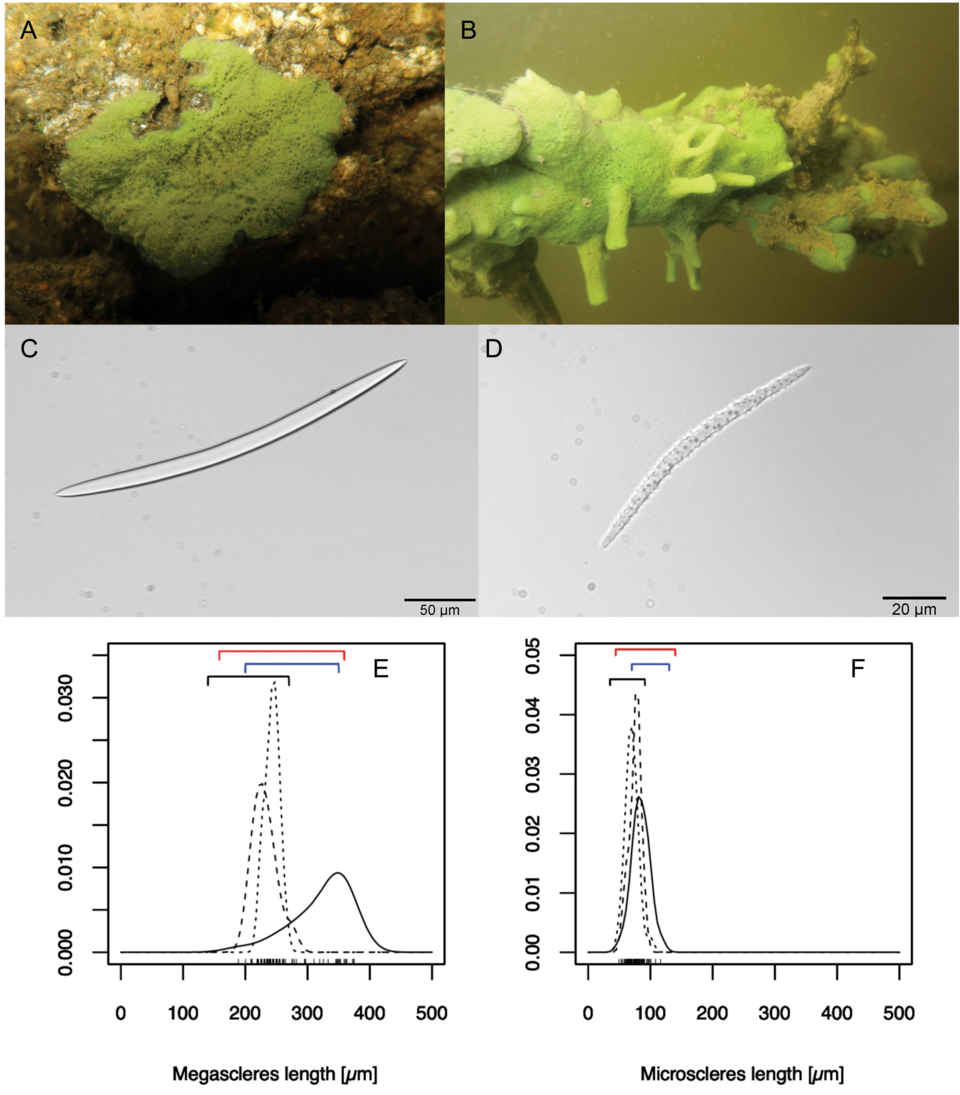
This guide includes real scientific images and a fully invented Willowmere Pond dataset. The featured figure shows living Spongilla lacustris, modern megascleres, microscleres and measured size variation from published 2022 research. It is not a photograph of fossils recovered from Willowmere. Learners move from anatomy to sediment counts, source-area reasoning, ecological comparisons, independent proxies and carefully limited archaeological conclusions.
Begin with the 2022 freshwater sponge spicule morphology guide and 2021 review of taxonomic and ecological limits.


1. See the microscopic skeleton before inferring the river
Freshwater sponges are animals that build supporting skeletons containing siliceous spicules. When a sponge dies or releases material, some microscopic spicules can persist in lake, river or wetland sediment. These fragments may help reconstruct aquatic habitats and changing water conditions, but a sharp transparent silica needle is not an exact measure of water depth, flow speed or ancient rainfall. The first teaching obligation is to identify the particle and its anatomical category before explaining what type of water body could have contributed it.
Present a learner with a microscope image, a sediment depth and a speculative historical statement that people diverted a river. Ask which facts are visible. One can observe a siliceous-looking spicule under suitable optics; identifying its source and habitat requires comparative biology; describing human engineering requires independent archaeology. This chapter retains that evidence ladder through the full laboratory and interpretation workflow.
2. Understand the sponge as a living filter-feeding animal
Sponges are multicellular animals with systems of water channels and cells that move water through their bodies. Freshwater sponges often attach to submerged branches, stones, plants or artificial structures and can occupy lakes, ponds, streams and other suitable environments. They are not plants, despite often resembling green or brown growths. Their local distribution depends on substrate, water quality, water movement, food and biological interactions. A fossil spicule does not preserve this entire living context automatically.
The featured research figure shows Spongilla lacustris actually growing on submerged structures together with microscopic skeletal elements. Students should compare the intact organism to isolated spicules in the figure. A photograph of a living sponge is not evidence that the fictional Willowmere Pond contained exactly that species; it is a scientific anatomical reference to explain where preserved silica elements originate.
3. Distinguish freshwater sponge groups from marine sponges
Many sponges live in the sea, and marine forms also produce siliceous spicules of varied shapes. Freshwater sponge interpretation requires appropriate taxonomy and sediment context, not the assumption that any spicule guarantees a freshwater habitat. The structure, combinations of skeletal elements and local setting help refine a source hypothesis. Similarly, one modern freshwater spicule image is not a universal key to every fossil form in an archaeological layer.
Assign comparative reference images of a freshwater Spongillida spicule and several unrelated marine forms. Ask learners to note shared silica morphology and the diagnostic differences that actually support identification. Their report should remain broad when the structure alone cannot distinguish origin. This is particularly important in coastal archaeological deposits where saltwater, freshwater and reworked older material may converge.
4. Describe siliceous mineral formation accurately
Spongillid skeletal elements are formed from biogenic silica. Their geometry reflects biological regulation and can be influenced by physiological and environmental conditions, yet the extracted mineral particle is an incomplete trace of the original animal. Silica chemistry, dissolution and later sediment conditions affect which spicules remain. A fossil record that overrepresents robust needles may be taphonomically selected rather than ecologically representative.
Students diagram silica supply, skeletal formation, sponge growth, decay, sediment deposition and dissolution. Each arrow adds a potential explanation for a different observed count. The exercise prevents a misleading proportional inference in which every extra microscope needle is treated as an extra living sponge on the ancient lakebed.
5. Learn the megasclere category first
Megascleres are generally larger supporting sponge spicules. Their forms can be useful for identifying broad sponge types, and dimensions may be measured under an appropriate calibrated microscope. However, a long smooth needle or rod may resemble elements from several taxa. Single megascleres often provide less species-specific information than a combination of diagnostic structures. Learners should note length, width, tip shape, curvature, ornamentation and any damage before attaching a name.
Provide a modern reference image with a scale bar and ask students to measure an actual visible megasclere. They should estimate dimensions only from the calibrated image, not from a screenshot displayed at arbitrary magnification. Then remove the distinctive end from the diagram. Does the remaining fragment still support the same taxonomic label? Usually uncertainty increases, and the catalogue should reflect that.
6. Distinguish microscleres as separate evidence
Microscleres are often smaller spicules with characteristic forms that can differ from the larger support elements. Their abundance and morphology may be informative, but small size makes them vulnerable to missed detection under coarse processing or low microscope magnification. A modern figure showing the size distribution of microscleres illustrates why instrument settings and sampling effort matter. The very category that improves identification may also be the one most unevenly recovered.
Ask students to sort hypothetical micrographs into megasclere, microsclere and uncertain silica particle. They must state the actual shape and scale that justify each class. An apparently large gap in microsclere occurrence between sediment layers could be a real community change or a difference in sieving, preparation or recognition; the observation is not causally unique.
7. Understand gemmules and their special spicules
Many freshwater sponges produce resistant asexual resting bodies called gemmules. Spicules associated with gemmules, often termed gemmuloscleres, can be important diagnostic characters for species-level identification. But the connection between a loose gemmulosclere and a particular historical sponge specimen is not always intact after sediment mixing. A gemmule is a reproductive or survival structure, not a seed of a flowering plant or one whole adult sponge.
Students draw a gemmule, its protective layer and associated spicules, then distinguish it from an isolated megasclere. If a sediment sample contains suspected gemmuloscleres but no complete gemmule, what further morphological and taxonomic evidence would be useful? The 2022 morphological guide emphasises the importance of these categories and why isolated spicules require specialist identification care.
8. Use a combination of structures for confident taxonomy
An isolated needle may be too generic for precise identification, while an assemblage of appropriate megascleres, microscleres and gemmuloscleres can support a stronger conclusion under a valid taxonomic key. Yet combinations can be misleading when sediments mix material from several sponges. The analyst must distinguish a genuine anatomical association from spicules merely recovered in the same bulk sample. Not every mixture belongs to one species.
Give students a fictional slide with large needles, small ornamented forms and a few gemmuloscleres. They write two interpretations: one organism providing all structures, or multiple source organisms whose remains became mixed. Their task is to identify what specimen context, modern reference or additional sampling would distinguish those explanations. Taxonomic precision should come from evidence, not the desire for a complete name.
9. Learn from the 2022 Neotropical morphology guide
A 2022 Frontiers in Ecology and Evolution paper supplied an illustrated guide for identifying freshwater sponge spicules from the Neotropics. It explains the major morphological categories and the value of appropriate extraction and image documentation. The authors also stress that differences in taxonomy and a lack of harmonised identification guidance can limit palaeoenvironmental reconstructions. Their work is an excellent model for teaching terminology and comparing actual morphological features.
Ask learners to compare the guide’s illustrated structures with the species-specific Swedish Spongilla research image used here. Both sources are valuable, but the fauna and ecological settings differ. Students should not transfer one regional species label to every similar form elsewhere. The point of reading both studies is learning identification method and its limits.
10. Describe habitat specificity without universal rules
Freshwater sponge species vary in their preferred substrates, flow regimes, water chemistry and ecological tolerance. Some are widely distributed generalists, while others may be more restricted or appear primarily under particular conditions. A 2021 Neotropical review compiled ecological information for dozens of species and identified cases where previous paleoenvironmental interpretations oversimplified living species preferences. This demonstrates why an attractive spicule shape cannot simply be equated with one water-depth or salinity value.
Give students a species ecological table with ranges rather than rigid one-number categories. Their assignment is to describe what happens when two species share the same habitat and one fossil is identifiable only to genus. A broad ‘freshwater-associated sponge remains’ conclusion may be stronger than an invented water-quality measurement.
11. Know the importance of substrate availability
Sponges need suitable attachment and growth conditions. A submerged branch, stable stone, plant stem or engineered surface can provide habitat, while mobile fine sediment may be less favourable to some attached forms. An increase in fossil spicules near an archaeological wooden structure might reflect more suitable substrate, changing water level or transport rather than simply cleaner water. Human structures can affect organisms without directly changing regional climate.
Draw two fictional pond stages, one with fallen trees and one after sediment has buried most stable surfaces. Could the sponge community change even with identical temperature and nutrients? Students should explain the mechanism and propose field observations to test it. Ecological interpretation improves when physical habitat is represented alongside water chemistry.
12. Distinguish flow, waves and sediment transport
Water movement affects living sponge habitats and carries detached spicules after death. A river can move fine siliceous particles from upstream, while waves may concentrate fragments along a lake margin. Different particle shapes and sizes may be transported or sorted differently. Therefore, the sediment position where a fossil is found does not necessarily identify where its source sponge grew. A spicule-rich lens may even reflect a transport event rather than a biological bloom.
Students map an upstream pond, rocky stream reach and quiet lower-water basin. They trace where spicules could be produced, moved and finally deposited. The class should examine sediment grain size, abrasion and independent aquatic proxies before naming the source habitat. This is an archaeological site-formation question, not merely a microscope classification challenge.
13. Separate robust and delicate spicule preservation
Silica can dissolve under certain water and pore-water conditions, and small or thin spicules may disappear before larger structures. Mechanical abrasion, sediment chemistry and microbial activity can also influence preservation. Consequently, one sample may have numerous identifiable megascleres but few microscleres even when both were originally produced. The resulting category ratio is not a pure taxonomic fingerprint without a taphonomic assessment.
Ask students to compare a well-preserved mud layer with one exposed to repeated transport and chemically different pore water. They should list how each process might alter the observed ratio of large to small spicules. A preservation note should accompany every count table rather than be relegated to a final generic disclaimer.
14. Distinguish sponge silica from other biogenic silica
Diatom frustules, phytoliths, certain protist structures and sponge spicules may all contribute siliceous particles to environmental sediments. An analyst should identify each using actual morphology, internal structure and available reference images. A slender silica fragment with lost diagnostic ends might remain unresolved rather than confidently called a sponge. This issue is especially important when combining microscopic disciplines in one project.
Run a blind classification exercise with genuine reference images of sponge spicules, diatom fragments and phytoliths. Students must note the anatomical characters supporting each category. Where the particle is too damaged, the correct output is ‘unidentified siliceous fragment’ with a scale and photograph, not the taxon most useful to the teacher’s preferred lake story.
15. Use microscope scale and imaging method consistently
Spicule shapes can be assessed under transmitted light and, when needed, higher-resolution microscopy. Images must include a calibration or scale bar. Comparing sizes from differently cropped photographs is invalid without the underlying measurements. Electron micrographs can reveal detail but remain context-dependent. A photograph is strongest when connected to specimen identifier, source, magnification and the morphological question it addresses.
Give learners the real Spongilla figure containing measured megasclere and microsclere size distributions. Ask what can be inferred about within- and between-specimen variation and how such variation might cause classification difficulty. Students should not copy the published size range as an identification rule for all freshwater sponges; it belongs to the research context shown.
16. Keep processing fractions and chemical treatment visible
Spicules can be recovered through sediment preparation, sieving or targeted microscopy, but methods differ. Certain chemical treatments may affect associated organic material or silica, while mesh and microscope settings can favour larger structures. An analyst using a technique designed mainly for pollen or another microfossil may unintentionally lose or undercount sponge remains. Comparative numbers are only meaningful under compatible recovery and classification rules.
Students design a methods audit covering sample mass, processing steps, sieved fractions, microscope area, scale calibration and rules for damaged structures. Then they compare two fictional laboratories with different lower size cutoffs. A difference in observed microscleres may be an artefact of method rather than a change in sponge ecology.
17. Distinguish total spicules from identifiable taxa
A count of all silica needles may be useful as a broad descriptive measure, but it does not equal the number of sponge individuals or the number of species. Taxon-identifiable gemmuloscleres or combinations can provide additional ecological resolution, sometimes in a much smaller subset. Mixing identification levels within one ecological percentage calculation needs care, because an unidentified fragment should not be silently allocated to the most common named species.
Create a fictitious sample with one hundred observed spicules, forty attributable to a broad type, ten more specifically diagnosable and fifty unresolved. Learners must design a table that preserves those nested categories without double counting. This is a valuable general lesson about hierarchical taxonomy and observation units.
18. Work the fictional Willowmere Pond core
In the invented Willowmere Pond teaching case, an older sediment interval contains sixty confidently classified megascleres and twenty-four microscleres, while a younger interval contains ninety megascleres and thirty microscleres. These are imaginary teaching counts, not a real palaeolimnological record. The raw totals are eighty-four and one hundred twenty. Looking only at that increase might tempt an author to declare that the historical sponge population grew.
The appropriate next step is to check recovery and denominators. Were the samples the same mass and prepared identically? Did preservation change? Did other taxa contribute to the categories? This staged reveal is deliberate: students should see how a simple correct statement about more counted fragments can coexist with a scientifically unsupported ecological population claim.
19. Add Willowmere’s sediment masses
Suppose Willowmere’s older sample represented four grams of processed dry sediment, while the younger represented twelve grams. The observed rates are eighty-four divided by four, or twenty-one spicules per gram, versus one hundred twenty divided by twelve, or ten per gram. The younger sample has more total counted spicules but a lower simple recovered concentration. The calculation is exact for the fictional measurements, not a statement of living sponge abundance.
Ask learners to calculate the megasclere rate separately: fifteen per gram in the older layer and seven and a half per gram in the younger. Microscleres are six per gram and two and a half per gram respectively. Their table should keep raw numbers visible, so another reader can reproduce every rate. A persuasive conclusion that hides the denominator fails the basic scientific standard.
Willowmere: fictional diagnostic spicule tally
| Observation category | Older sample | Younger sample |
|---|---|---|
| Megascleres | 60 | 90 |
| Microscleres | 24 | 30 |
| All classified spicules | 84 | 120 |
20. Compare spicule types without inferring life histories
In the Willowmere case, the older sample has twenty-four of eighty-four spicules classified as microscleres, roughly 28.6 percent. The younger has thirty of one hundred twenty, exactly twenty-five percent. That modest change in relative share cannot determine whether a distinct species arrived, whether fine spicules dissolved or whether a change in sorting affected the count. Even an abundant gemmulosclere signal would require a clearly stated observation rule.
Give students an uncertainty scenario in which several small fragments were missed in the younger sample. How could the percentage change if those were included? The exercise builds sensitivity analysis while discouraging unsupported precision. A percentage is the arithmetic property of a classified set, not a direct measurement of reproductive behaviour or total biomass.
Willowmere: sediment-normalised comparison
| Measure | Older | Younger |
|---|---|---|
| Dry sediment analysed | 4 g | 12 g |
| All spicules per gram | 21 | 10 |
| Megascleres per gram | 15 | 7.5 |
| Microscleres per gram | 6 | 2.5 |
| Microsclere share of classified spicules | 28.6% | 25% |
21. Assess abrasion before interpreting water energy
Broken or smoothed spicules can suggest mechanical alteration, but a distinctive fracture can also arise during sampling, laboratory preparation or post-depositional change. High-energy current transport is one possible explanation, not a diagnosis from one broken needle. A taphonomic condition table should record intact, broken, abraded and uncertain categories under reproducible criteria.
Students compare two imagined layers: one rich in intact gemmuloscleres and one dominated by isolated abraded needles. They rank possible causes—transport, processing differences, decay or source change—and propose the sedimentological observations needed to distinguish them. The best response preserves uncertainty without becoming uninformative.
22. Use modern species ecology to constrain water quality
Different freshwater sponge taxa can tolerate varying acidity, salinity, temperature, silica supply, depth and hydrodynamics. Palaeoenvironmental interpretation works best when the diagnostic structures allow a taxon or group with well-studied modern preferences, and when the reference conditions are geographically relevant. The Neotropical reviews warn against relying on inadequately checked habitat labels. A universal ‘sponge spicules mean pristine fresh water’ rule would be false.
Students write a reference sheet containing ecology, geographic range, taxonomic confidence and relevant modern observations. They should mark any extrapolation to the fictional Willowmere environment as untested. Reliable science narrows the possible aquatic histories rather than promising one chemical measurement from each silica fragment.
23. Distinguish nutrient enrichment from habitat change
Water quality, nutrient availability and substrate all affect freshwater sponge occurrence. More sedimentary spicules in one interval could reflect changed living abundance, altered silica preservation, greater transport or a new habitat. Eutrophication itself can have complicated biological impacts through algae, oxygen dynamics and sedimentation. A sponge proxy should therefore be interpreted with lake chemistry, diatoms, organic matter and physical habitat rather than assigned to one trophic category automatically.
Give students an invented increase in lake phosphorus coinciding with a change in spicule counts. They must propose at least two pathways linking nutrients to sponge habitat and at least one unrelated alternative. The conclusion should identify which independent data—dissolved oxygen, substrate area or sedimentation—could separate those pathways. A simple correlation is a clue rather than a complete mechanism.
24. Learn from historical lake studies without copying them
Early palaeolimnological research showed that freshwater sponge spicules and resting structures can reconstruct aspects of past aquatic environments when taxonomy and modern ecology are sufficiently known. Studies of real lakes and wetlands established the method, and later reviews expanded identification references and ecological expectations. But a conclusion reached for a documented lake must not be transferred wholesale to a different geography with different fauna and sediment conditions.
Students should critique an actual sponge palaeolimnology paper by separating microscopic observations, modern ecological references, sediment chronology and final environmental inference. They may find a strong study whose broad method transfers well but whose numerical ecological range does not. That is the point of critical reading: adopt a procedure for testing hypotheses, not a memorised conclusion.
25. Combine spicules with other aquatic microfossils
Siliceous diatoms can help reconstruct planktonic or benthic aquatic conditions, ostracods offer crustacean ecology and carbonate clues, cladocerans inform food-web structure, and charophyte remains may illuminate submerged vegetation. Sponge spicules add information about attached animal habitats and silica skeletons. Their signals are complementary but differ in source area, preservation and ecological specificity.
Ask learners to place four proxy curves in chronological order while showing age uncertainty. They should state what each directly measures and whether a proposed environmental event is truly supported across independent indicators. Agreement is persuasive when assumptions have been checked; disagreement can reveal an overlooked transport process or a wrongly generalised reference model.
26. Respect archaeological pond and waterway contexts
Ancient communities sometimes built or modified ponds, ditches, canals and water storage structures. Sponge spicules from such deposits can inform aquatic habitat history, but cannot independently establish the function, ownership or construction date of the feature. An increase in a freshwater-associated fossil does not prove that people supplied clean drinking water or engineered a particular flow route. Those claims require context from structures, artefacts, sediments and chronology.
Give students a fictional settlement pond rich in spicules next to a stone-lined channel. They design tests for natural versus engineered water circulation and evaluate whether the sponge signal supports either. A strong conclusion can remain at the level of aquatic conditions while acknowledging uncertainty about human behaviour.
27. Recognise sediment mixing and chronological limits
Sediment layers are not automatically equal spans of time. Flood pulses, erosion, bioturbation, dredging or excavation disturbance may redistribute spicules and connect particles from different ages. A spicule in one dated archaeological layer may have originated upstream or in an older deposit. Date-model uncertainty should be shown, especially when comparing fossil changes with historical events.
Ask students to draw the chain of source sponge growth, spicule release, transport, burial, possible reworking and core collection. Each stage may have a different date. This teaches why the age of the sampled sediment need not be the exact age of the animal whose skeletal element it contains.
28. Design an ethical and repeatable field protocol
Lake cores and heritage sediment can be irreplaceable. Sampling permissions, cultural responsibilities and collection stewardship should be settled before destructive work. Laboratories should record subsampling amounts, preparation, retained material and identification confidence so the evidence can be reviewed. Specialized acid or digestion protocols require institutional training; a public teaching article should not encourage improvised chemistry outside a proper laboratory.
Set a project brief with limited permitted sample mass. Students allocate material between morphology, sediment context and independent proxies, justifying how each analysis reduces a known uncertainty. They should keep voucher micrographs with scales and preserve the location of every sampled horizon. Conservation and reproducibility are linked, because an exhausted specimen cannot be rechecked easily.
29. Write the final report that survives peer review
A rigorous sponge-spicule report separates observed categories, raw totals, sample mass, extraction method, identification basis, preservation, source area and chronology. It tests competing explanations for community change. For the fictional Willowmere sample, the defensible observation is that the raw spicule total increased while normalised recovery per gram decreased. This does not establish that the historical population rose or fell or that the water became cleaner.
Have students conclude with a specific follow-up: repeated cores from distinct habitats, documented modern sponges and gemmules, independent sediment chemistry, or a matched preparation test. The best next study is the one that distinguishes the remaining plausible explanations. The gold standard is a meaningful result whose limits and supporting data can both be inspected.
Twenty-eight applied palaeolimnology and archaeology audits
These are all fictional teaching cases. Their counts, settings and historical explanations must not be cited as real archaeological discoveries.
1. The sponge-needle impostor
A transparent slender particle is labelled a freshwater sponge megasclere without comparison. Students inspect whether diatom fragments, phytoliths or other siliceous material could appear similar. They request diagnostic ends, surface details and calibrated reference images before assigning a source. A broader identification may be the correct output.
2. One megasclere, one adult?
An analyst finds a hundred needles and calls them a hundred individual sponges. The class traces how one organism produces many supporting structures and how decay scatters them. It rewrites the result using counted spicules as the unit and declines to calculate an unsupported population census.
3. Microscleres lost in coarse mesh
An older interval was processed through a fine fraction but a younger one through a coarser sieve. Microscleres almost disappear. Students evaluate the recovery change before claiming species replacement and design a compatible preparation method or a cautious comparison.
4. The gemmule misunderstanding
A resting gemmule is described as a fertilised plant seed. Learners correct the sponge reproductive biology and explain why gemmule-associated skeletal structures can support taxonomy without proving viability. They distinguish the resting body from a complete adult.
5. Taxonomic identity from mixed parts
A sample contains multiple megasclere and gemmulosclere types. An author assumes one species produced every element. Students consider different sponges mixed in sediment, transport and insufficient association before selecting a taxonomic hypothesis.
6. The generic freshwater inference
A spicule-like particle appears in a coastal archaeological deposit and is called proof of a freshwater pond. Students compare marine and freshwater sponge possibilities and ask for sedimentology and truly diagnostic anatomical context.
7. A large silica needle in low-pH mud
A sample from a chemically reactive layer retains only large robust spicules. Students consider dissolution and selective preservation before interpreting a reduced microsclere fraction as a biological community shift.
8. The Willowmere raw-count trap
The younger fictional interval contains one hundred twenty spicules versus eighty-four in the older. Learners are initially told the sponge population grew. When sample masses are revealed, they calculate ten versus twenty-one recovered spicules per gram and correct the unsupported inference.
9. The separate megasclere rate
Fictional Willowmere yields sixty megascleres from four grams and ninety from twelve grams. Students calculate fifteen and seven and a half per gram and explain the difference between raw counts and normalised fossil recovery.
10. A microsclere ratio of uncertain meaning
Microsclere proportions are approximately 28.6 and twenty-five percent across the toy samples. Students test how a few damaged, missed or reassigned structures change the percentage. They must avoid inferring a precise species trend from a small ratio change.
11. The refitted broken needle
Three sharp pieces are found together and counted as three spicules, though they may refit to one. Learners preserve the raw fragment count, report possible reconstruction and explain which unit is appropriate for a stated question.
12. The falsely exact lake level
A spicule type is assigned a one-metre water depth on the basis of one published lake. Students review species ecology, substrate and local water conditions and rewrite the claim as a conditional habitat inference.
13. The dissolved silica confounder
A silica-concentration change may affect spicule formation or survival. Students discuss why observed fossil abundance could vary with silica supply as well as living sponge abundance. Independent water chemistry and preservation observations become necessary.
14. The flood-delivered fossils
A storm transports fragments from an upstream rocky reach to a downstream quiet pond. Students map where animals lived, where spicules entered water and where they were buried. They reject the claim that every source sponge occupied the coring point.
15. The living structure photograph
A modern Spongilla photograph is presented as a photograph of a fictional ancient sponge fossil. Students rewrite the caption to identify source, license, true organism and the distinct role of the image as a modern comparison.
16. The low-magnification miss
One slide is checked only at a magnification suitable for large spicules and another at higher magnification. Students identify a detection-bias pathway and propose a uniform observation protocol including counted fields and resolution.
17. The arbitrary salinity number
An author assigns a fossil sponge one exact salt concentration from an unrelated ecology table. Learners evaluate taxon, geographic context, species-level identification and measured salinity tolerances before making any quantitative claim.
18. The sponge-as-plant mistake
A class classifies living sponges as aquatic macrophytes because they are attached and greenish. Students explain their animal cell organisation and filter-feeding, distinguishing them from stonewort and pondweed habitat proxies.
19. The missing sediment weight
Two spicule-rich cores are compared by counts with no reported sediment mass or sample volume. Learners request denominators and processing details before calculating concentrations. Data without a comparable sampling basis remain descriptive but limited.
20. The anoxic pond story
One fossil interval suggests altered sponge habitat near a formerly inhabited waterbody. A student attributes it solely to sewage. Others propose substrate burial, lake-level change and sediment transport, then identify evidence that could distinguish them.
21. The sedimentary-age shortcut
Spicules reworked from old mud are deposited with a much younger flood layer. Learners separate source time from burial time and decline to assign every particle the exact date of its final sediment horizon.
22. The gemmulosclere overclaim
One gemmulosclere resembles a diagnostic species, but the overall assemblage is mixed and damaged. Students consider whether the fragment alone supports a taxon or needs broader naming and better preservation evidence.
23. The Northeast-to-Neotropics transfer
A student applies a northern temperate sponge ecology table to a tropical floodplain. Learners evaluate species overlap, substrate and chemistry and propose suitable regional references. A sound method can travel without every local ecological conclusion travelling with it.
24. The opposing diatom record
Sponge spicules suggest a possible habitat change while diatoms show a different aquatic trend. Students examine source areas, preservation and dating instead of deleting the divergent evidence. They design one independent test to reconcile or better frame the results.
25. The miscounted sample total
A student adds taxonomically identified spicules to the total count even though they are already a subset, double counting observations. Learners repair the nested categories and produce a raw table with a logically valid denominator.
26. The destructive-method decision
A single unique archaeological sediment microblock is proposed for a harsh extraction that would prevent further microscopy. Students evaluate research gain, alternative sample sources and necessary permissions before deciding whether the work is justified.
27. The smooth graph without methods
A paleolimnology article shows a smooth spicule concentration curve with no raw count, sampling fraction or age model. Peer reviewers request all underlying information and explain why a visually persuasive line cannot compensate for an unreproducible method.
28. The finished Willowmere report
Students combine the invented raw counts, sediment masses, megasclere and microsclere categories into one evidence table. They describe the observation, document at least three alternative depositional pathways and recommend the smallest follow-up investigation that would reduce the main uncertainty.
Three-session teaching sequence
- Session 1: sponge animal biology, megasclere and microsclere morphology, gemmules, recognition of other silica microfossils and diagnostic image recording.
- Session 2: species ecology, water movement, preservation, recovery methods and Willowmere’s counts, ratios and sediment mass calculations.
- Session 3: comparison with diatoms and other proxies, chronology, site formation, ethical sampling and a justified, evidence-limited historical account.
- Assignment: document real reference structures, produce fictional worked calculations with denominators, supply two plausible formation pathways and defend one specific independent follow-up measurement.
Evidence-grade student assessment rubric
| Criterion | What earns full credit | Unsupported shortcut |
|---|---|---|
| Identification | Actual diagnostic form and structure recorded with an appropriate key | Every long silica particle called a freshwater sponge |
| Counts | Raw fragments, reconstructed elements and denominators specified | One skeletal element treated as one animal |
| Preservation | Size-selective recovery, breakage and silica dissolution assessed | All fossil changes declared biological |
| Habitat | Species-specific modern ecology, substrate and transport considered | One spicule assigned exact salinity or lake depth |
| Site history | Independent strata, dates and archaeological structures consulted | Spicules presented as proof of a human canal |
| Reporting | Images, methods, original tables and limitations archived | Only an attractive final environmental chart published |
Frequently asked questions
Are freshwater sponges plants?
No. They are aquatic animals with filter-feeding biology and siliceous skeletal structures.
What are sponge spicules?
Microscopic skeletal elements, commonly of biogenic silica in freshwater sponges, that can remain in sediment.
What are megascleres and microscleres?
Broad size and anatomical categories of sponge spicules, both relevant to morphology and identification.
Why do gemmuloscleres matter?
Spicules associated with gemmules may have useful diagnostic forms for identifying freshwater sponge taxa.
Does a spicule prove freshwater was present at one exact spot?
Not on its own. Taxonomic confidence, transport and sediment context matter, and spicules also occur in marine sponges.
Can one spicule indicate a precise past water depth or salinity?
No. Such interpretations require suitable living ecology and additional environmental calibration.
Are spicules the same as diatoms or phytoliths?
No. All may include silica but come from different organisms and show different diagnostic structures.
Why do broken spicules complicate counts?
One original skeletal element may contribute multiple fragments and can lose important identification characters.
Are Willowmere Pond measurements real?
No. Willowmere and every numerical spicule example are fictional and made only for teaching.
Can sponge counts confirm ancient people constructed a canal?
No. Independent structural, chronological and archaeological evidence is necessary to attribute human engineering.
Scientific sources, real image credit and connected eduKate chapters
- 2022 open-access morphological guide to Neotropical freshwater sponge spicules
- 2021 PeerJ systematic review of spicule taxonomy, ecology and environmental inference
- 2021 Zootaxa review: using freshwater sponge ecology correctly in palaeoenvironmental studies
- 1988 introduction to freshwater sponge paleolimnology
- 2022 Spongilla lacustris Swedish fauna and spicule measurements
- Wikimedia Commons figure: Spongilla lacustris, CC BY 4.0
- Teaching Archaeological Cladoceran Analysis
- Teaching Archaeological Charophyte Oospore Analysis
- Teaching Archaeological Diatom Analysis
- Teaching Archaeological Ostracod Analysis
- Teaching Archaeological Foraminiferal Analysis
- Teaching Soil Micromorphology
- Gold Standard of Palaeoecology
- The Gold Standard master hub
The gold standard of teaching freshwater sponge spicule analysis is a learner who recognises an authentic skeletal structure, records and compares it with honest units, evaluates how silica preservation and sediment transport affect the sample, and describes ancient water habitats only within the support of the ecological and archaeological evidence.