
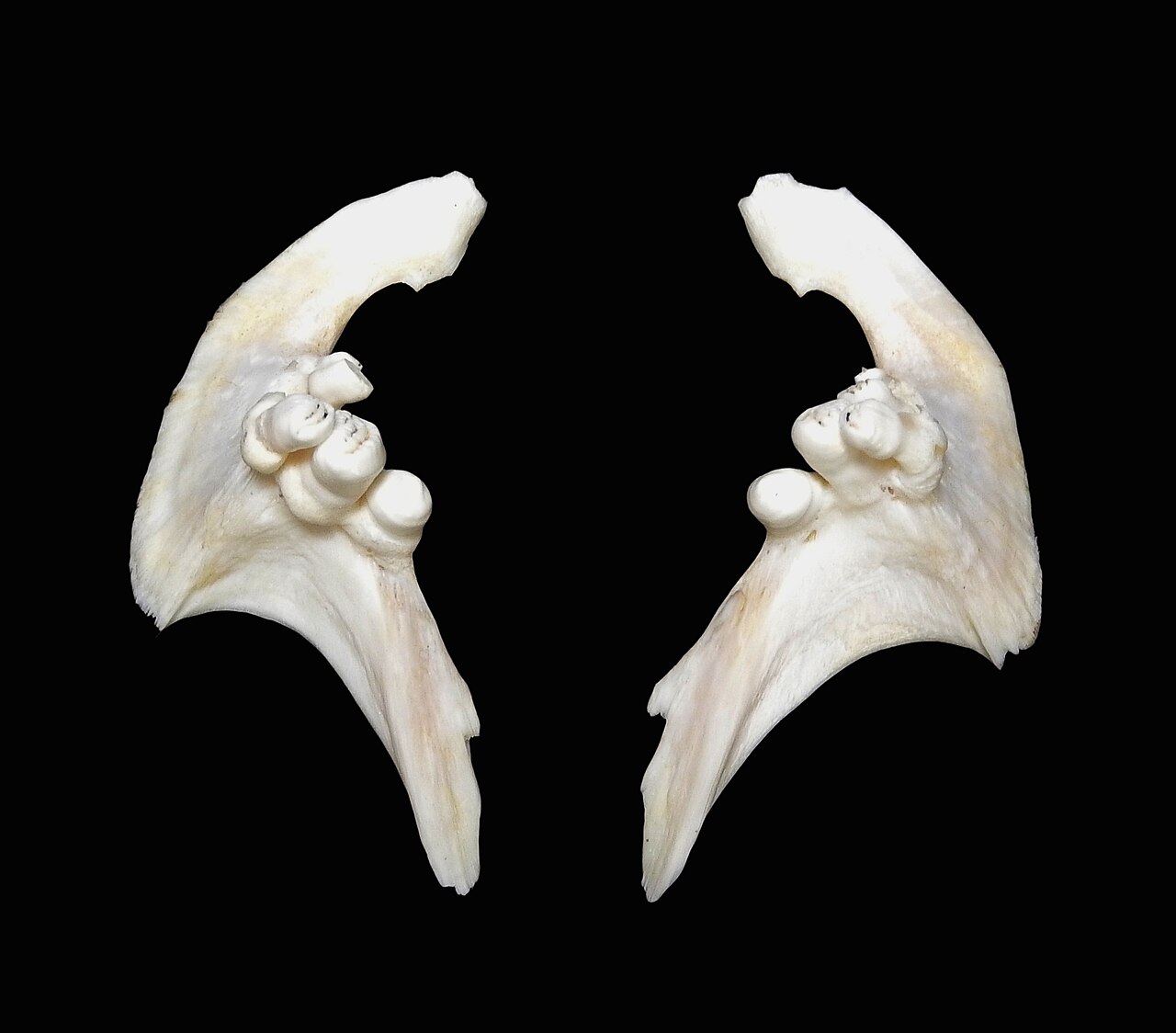
Fish pharyngeal teeth are specialised dental structures in the throat of cypriniform fishes. Their distinctive rows and crown shapes can aid archaeological identification. They also preserve another kind of human history: detailed studies of selected Late Mesolithic burials demonstrate that pharyngeal teeth were sometimes used as garment ornaments. A scientifically strong lesson distinguishes the anatomy, the object and the archaeological context before deciding whether a tooth was food refuse, transported sediment or personal adornment.
This reference combines diagnostic anatomy, regional taxonomy, replacement and wear, genuine research at Vlasac, and a transparent fictional Alder Reach worked example. The featured photograph is a real modern common carp pharyngeal apparatus from a zoological collection, not an excavated Mesolithic object. The chapter index and research checklist let readers locate the relevant process without assuming all carp-like teeth mean the same thing.
For the underlying evidence, see the 2010 cypriniform dentition survey, the 2012 Vlasac garment analysis and the 2014 Vlasac binding-residue study.


1. The first object is a fish tooth, not a cultural story
Pharyngeal teeth sit deeper in the throat of many fishes, including familiar members of the carp lineage. They may be recovered from lake mud, flood deposits, food-processing areas and ancient burials. Their morphology can inform zoological identification, and in well-documented contexts their alteration and arrangement can illuminate how people used animal materials. Yet a tooth by itself is not an individual fish, a meal, a fishing technology or an ornament. Each of those interpretations requires separate evidence linking the physical object to its source and later history.
Start a class with an isolated molar-like tooth and ask for three statements of increasing strength: what anatomical category is observed, what fish lineage might have produced it, and what prehistoric people may have done with it. Students must name the additional supporting observations required for every step. This approach produces useful archaeological reasoning before a compelling cultural narrative hardens into an untested assumption.
2. Understand the throat apparatus in Cypriniformes
Cypriniform fishes generally lack conventional oral-jaw teeth and develop teeth on the fifth ceratobranchial, a skeletal element of the rear gill-arch apparatus. Their pharyngeal teeth are not merely hidden duplicates of a mammal’s molars: they are part of a specialised arrangement of feeding surfaces. A tooth-bearing lower pharyngeal bone preserves position and row relationships that a detached crown often loses. Recognising the source anatomy protects the analyst from confusing a loose fish tooth with a mammalian tooth or an indeterminate mineral object.
Use a genuine modern common-carp paired pharyngeal-bone photograph to identify the left and right structures, individual tooth bases and grinding surfaces. Ask students which taxonomic characters remain visible after the elements separate. They should draw what survives rather than reconstruct a complete apparatus from imagination. The source photo demonstrates modern anatomy, not an excavated specimen from Vlasac or the fictional counting exercises.
3. Dental formulae describe arrangements, not arbitrary totals
The number of pharyngeal tooth rows and their positions differ among cypriniform taxa. A dental formula records that spatial arrangement, sometimes including left-right differences. The 2010 evolutionary study surveyed diverse cypriniform fishes with microtomography and documented patterns ranging from single rows to more complex arrangements. It also found multiple evolutionary changes in tooth rows, a useful warning that one simplified ancestral formula cannot identify every modern or fossil member of the group.
Present a complete tooth-bearing reference bone beside a detached worn crown. The complete example can support observation of how teeth are arranged; the crown alone normally cannot. Students should state whether a formula is observed from preserved positions, derived from a reliable reference after identification, or simply unknown. Only the first two can be responsibly reported, and even then the inferential step needs disclosure.
4. Distinguish crown, root, tooth-bearing bone and fragment
One archaeological bag can contain attached teeth, isolated crowns, bases with broken necks and larger pieces of pharyngeal bone. These are not equivalent counting units. An attached tooth recorded separately from its parent bone may be double counted, while one crown fractured into several pieces can inflate a fragment total. Condition and articulation also affect taxonomic information: a tooth with its original base may reveal more position than an isolated polished crown of identical external dimensions.
Create separate recording categories for complete paired bones, individual pharyngeal bones, fragments with attached teeth, complete detached teeth and indeterminate pieces. Keep a separate field for the number of attached crowns without automatically adding those crowns to the total of physical objects. The course’s quantitative work later uses mutually exclusive object counts precisely to avoid confusing pieces with fishes.
5. Taxonomic shape categories and their limits
Cypriniform pharyngeal teeth can be spoon-shaped, compressed, spatulate, saw-like or molariform, depending on lineage and tooth position. Such terminology organises observable anatomy, but broad morphotypes occur in more than one taxon and can be altered by wear. A rounded grinding surface may be compatible with several feeding strategies, so a tooth-shape word should not silently become a species name or a measured prehistoric diet. Reference collections must establish which features actually discriminate among the local candidate fishes.
Students should describe the maximum crown width, root condition, apex, occlusal ridges and any margin damage without attributing one function prematurely. They then compare multiple specimens of known species rather than memorising a single common-carp photograph. If the archaeological tooth lacks important diagnostic details, a family- or lineage-level identification may be the strongest defensible published result.
6. The 2010 dentition survey as a calibration lesson
The PLOS ONE study on cypriniform dentition showed why an evolutionary framework matters. Its research associated dental characters with phylogeny using modern anatomical data and warned that diet relationships were not sufficiently understood to conclude that every tooth shape has one simple feeding meaning. This makes it a particularly good reading for students who assume morphology instantly reveals ecology. Tooth rows, developmental relationships and comparative lineage sampling need to be considered together.
Assign a critique in which students separate directly measured dental shapes from evolutionary reconstructions. Ask which results involve modern observed teeth, which involve phylogenetic models, and which remain open questions about feeding. A fossil tooth can be compared with the reference observations without importing all higher-level evolutionary claims as if they were directly preserved in an excavation.
7. Local reference fauna before species identity
Identification depends on which fish could plausibly have contributed to the studied catchment, which collections have been examined and how regional taxonomy is defined. The 2022 Greater Zab River study compared pharyngeal bones and teeth of seven cyprinid or related species represented by 152 fish and measured several morphological characters. Its findings are useful in that geographical context, but a key designed for northern Iraq cannot automatically separate fishes in every European or Southeast Asian river.
Give learners a hypothetical archaeological site and ask them to prepare a candidate-fauna list from credible regional references. They must also consider imported fish as a possibility in trading settlements. When reference material covers only a subset of plausible fishes, the classification should retain an explicit unknown category rather than force every crown into the nearest familiar photograph.
8. Three-dimensional crown analysis: a tool, not an oracle
Micro-computed tomography can reveal crown and root geometry that ordinary photographs may hide, especially when a tooth has complex grinding surfaces. Work on Capoeta pharyngeal dentition has used three-dimensional shape comparisons to investigate systematic relationships. Nevertheless, missing enamel, deformed roots and limited modern taxon coverage can make a scanned fossil ambiguous. More pixels or a higher-resolution model cannot replace diagnostic anatomy that was destroyed before burial.
Students should identify one specific shape question that merits three-dimensional imaging, such as whether two worn surfaces preserve different relief when seen from the side. They then decide whether the expected information gain justifies specialist access or handling of a fragile object. Technology choice follows the inferential problem; it should not be used merely to make a paper look more impressive.
9. Wear during fish life versus wear in sediment
A crown can be altered through food processing during the animal’s lifetime. After death, water abrasion, mineral particles, trampling and curatorial handling can produce superficially similar polish, scratches or chipped edges. Surface wear must therefore be described by anatomical location, direction, associated fractures and preservation history rather than labelled a feeding trace on first inspection. A polished tooth may be genuinely worn, but its cause is a separate question from the observation.
Ask students to compare documented modern feeding-wear references with experimentally abraded or tumbled controls. Their report should say where a striation occurs and whether it crosses a break rather than merely note that the tooth looks smooth. Where observations cannot discriminate biological from taphonomic wear, that ambiguity is a useful research finding and should remain visible.
10. Tooth replacement makes a census especially difficult
Cypriniform fishes can replace pharyngeal teeth, and many teeth are present in one apparatus. Consequently, isolated crowns can enter a deposit without each representing a newly caught fish. The number of loose teeth is filtered further by head processing, predator activity, sediment deposition and sieving. A large count of hard teeth may reflect their differential survival when thinner head bones have decayed, rather than a corresponding abundance of one kind of fish in the living community.
Students examine a tray with attached teeth on paired bones and an additional group of loose crowns. They should list the observations that might constrain minimum individual numbers, while acknowledging uncertainty about replacement and duplication. Dividing the raw count by a textbook number of teeth per carp would ignore both life history and taphonomic processes.
11. Site formation: the same tooth can follow different routes
A fish tooth in river gravel could be transported naturally. One in household rubbish might result from preparation or consumption of fish, while a patterned group in a burial could document deliberate object selection. The fish itself might also have arrived as preserved trade food from beyond the immediate catchment. Context can change which interpretations are plausible without changing the tooth’s anatomy. The investigation needs sediment fabric, associated bones, spatial distribution and archaeological chronology.
Give three fictional contexts containing the same tooth morphotype and require a separate formation hypothesis for each. The learner should propose what could discriminate flood deposition from managed refuse and ornament use. The best conclusion is not a universal meaning for a fish tooth, but a context-specific account with explicit reasons.
12. Why Vlasac ornaments transformed this research field
At Vlasac in the Danube Gorges, researchers investigated fish pharyngeal teeth found in Late Mesolithic burials. Earlier descriptions sometimes treated the ornaments as objects scattered across the deceased. Detailed study of placement and wear showed that selected teeth could function as sewn or otherwise attached garment adornments. The transition from the description ‘teeth in a burial’ to an argument about clothing required a preserved spatial pattern and technological comparisons, not simply an attractive choice of material.
A class should make two diagrams: an archaeological plan showing tooth positions relative to the skeleton, and a hypothetical garment reconstruction. They must connect each part of the reconstruction to an observed distribution or use-wear pattern. If a portion of the burial had been disturbed, the strength of the inference should change. The evidence does not automatically establish the same garment design at every Mesolithic site.
13. What the 2012 Vlasac work directly supported
Cristiani and Borić examined ornaments from two Late Mesolithic burials at Vlasac, combining contextual records with technological, experimental and microscopic use-wear analysis. The observed tooth and gastropod distributions were compatible with ornamented garments rather than simply loose deposits. Research described both modified and unmodified carp-family teeth. The specific burial evidence was important because it linked individual objects to their deposition positions instead of treating a large undifferentiated collection as a decorative style.
Students should read the methods as carefully as the paper’s title. They identify where tooth positions, modified roots, wear marks and comparisons contribute independent support. Ask which observations would be lost if excavation records showed only a box of teeth with no precise provenance. Archaeological confidence comes from that lost or preserved context, not from the familiarity of the ornament form.
14. The 2014 Vlasac study: 288 actual ornaments
The subsequent study by Cristiani, Živaljević and Borić investigated 288 cyprinid pharyngeal tooth appliqués from Late Mesolithic Burial 42a at Vlasac. The team combined wear, taphonomy and residue analysis with modern experiments and ethnographic comparison. Its findings supported attachment by sinew fibres wrapped around tooth necks, alongside evidence of an organic binding compound mixed with red ochre. These details are specific researched evidence from an excavated burial—not numbers generated by the fictional Alder Reach exercises below.
Students create an evidence table with columns for morphological marks, fibres or chemical residues, body placement and comparative experimentation. They should identify which interpretations require multiple columns to agree. The paper is a model of triangulation: no single dark residue or shiny neck alone would justify a detailed claim about ancient fastening methods.
15. Sinew, adhesive and ochre have different evidentiary roles
An organic fibre near a tooth neck can be compatible with thread-like fastening; an adhesive residue may suggest binding; coloured mineral particles can be associated with pigment or burial sediment. These are different observations with different possible contamination routes. The 2014 Vlasac interpretation combined their location and characteristics with use-wear and contextual evidence. Reporting all three merely as ‘ancient glue’ would erase the differences that make the reconstruction scientifically meaningful.
Ask students to annotate a fictional close-up showing a fibre trapped below a mineral crust. How would they check whether the fibre sits in an original binding position, whether the mineral was introduced with soil, and whether conservation adhesive was used later? This lesson encourages a causal explanation of attachment instead of a list of impressive laboratory materials.
16. A tooth does not need a drilled hole to be attached
Some organic ornaments were attached using an existing neck or root shape, modified base or a binding method that did not require conventional drilling. This means the absence of an obvious perforation cannot, by itself, prove an archaeological tooth was unused. Conversely, a natural constriction does not automatically establish it as a bead. Wear location, binding material, repeated orientation and spatial pattern together can make a suspension hypothesis stronger.
Provide students with a tooth bearing clear drilled modification, one with a narrow natural neck and traces of wear, and one with no documented wear. They must assess the support for different attachment methods rather than classify every object into a simple worn/not-worn dichotomy. The lesson is about diagnostic processes, not whether an object resembles modern jewellery.
17. Burial layout can strengthen or weaken a garment hypothesis
A cluster of teeth over a torso or beneath a skeleton may be consistent with garment adornment, but body decomposition, deliberate offering, secondary burial and later disturbance can modify placement. Object orientation, repetition, association with other adornments and excavation notes help evaluate alternative interpretations. At Vlasac, attention to consistent positioning was crucial to the garment reconstruction. A tooth found in a grave with no spatial documentation supports a weaker claim.
Ask students to compare two burial plans: one with teeth forming a repeated line and another with teeth mixed in disturbed fill. They should state why the first provides more contextual support and which further observations are needed in each case. Scientific caution respects the original mortuary context and does not turn every burial object’s presence into proof of what was worn.
18. Residue contamination and conservation history
Fine particles and films may originate from prehistoric manufacture, burial chemistry, excavation, storage or modern conservation treatments. Museum adhesives and fibres can complicate ancient-residue studies, and a result on one tooth may not represent every tooth in the burial. Provenance and handling records therefore belong beside microscopy and chemical observations. The absence of a visible modern intervention is not proof that contamination never occurred.
Students prepare a chain-of-custody worksheet for a tooth excavated decades ago. They trace cleaning methods, adhesives, previous mounting, sample transfers and microscopy. If a polymeric film is detected near the neck, the class should ask whether its distribution matches a plausible prehistoric fastening method and whether relevant conservation materials can be excluded. These are testable questions, not formalities.
19. Other Danube-to-Dnipro comparisons raise hypotheses, not certainties
Research from the Danube region and the Dnipro burial traditions has documented pharyngeal-tooth ornaments or broadly comparable practices. The 2022 Vasylivka II study reviewed tooth-ornament evidence alongside other grave goods and chronology. Similar use of an available biological material can motivate questions about exchange, shared technique or movement of ideas, but does not uniquely demonstrate a migration path. Site dates, artefact production and individual provenance need independent evaluation.
Give students two maps with ornament finds and rough chronological ranges. They must identify whether the contexts overlap in time and what differences in construction or material source may matter. Then they propose at least two competing social explanations before claiming a connection. Similarity is a datum; interaction is a hypothesis.
20. Use zooarchaeological quantification with the right denominator
Counts of loose teeth, tooth-bearing bones and other fish remains are useful when the observation categories are explicit and mutually exclusive. The number of identified specimens is not the number of individual fish or human meals. Tooth replacement, multiple teeth per fish, breakage and selective survival complicate the translation. Processed sediment mass or volume adds another denominator that helps compare recovery when laboratory methods are compatible.
Students should separate a catalogue’s physical-piece totals from anatomical-tooth totals and possible individual estimates. A tooth attached to a bone must not silently appear as two independent physical finds. Reports that expose such units are easier to compare than those offering a lone impressive number labelled ‘carp.’
21. Alder Reach: invented counts for sediment comparison
At the entirely fictional Alder Reach site, older context A yields 42 complete loose pharyngeal teeth and 18 larger tooth-bearing fragments from three kilograms of sorted sediment. Younger context B yields 25 complete loose teeth and 35 larger tooth-bearing fragments from six kilograms. Under a stated rule that counts these as mutually exclusive physical objects, both contexts yield sixty. Their simple rates, however, are twenty and ten objects per kilogram respectively.
The arithmetic is useful but not a prehistoric population estimate. The two archaeological contexts may differ in how much time they represent, what kind of material entered them, tooth replacement, preservation and screening. A proper comparison would ask whether those effects can be made sufficiently compatible to interpret the rate difference. Students should present raw counts and processed mass in the same table.
Alder Reach: entirely fictional sediment counts
| Toy context | Loose teeth | Tooth-bearing fragments | Total physical objects | Sediment mass | Objects/kg |
|---|---|---|---|---|---|
| Older A | 42 | 18 | 60 | 3 kg | 20 |
| Younger B | 25 | 35 | 60 | 6 kg | 10 |
22. Alder Reach: a different fictional ornament study
Imagine a separate simulated burial group with twenty-four tooth-shaped objects inspected for possible neck wear. Fourteen have clear wear under one teaching coding rule, six are ambiguous and four have no detected relevant trace. The observed definite-wear share is fourteen divided by twenty-four, approximately 58.3 percent. If all six ambiguous cases later met the criterion, the highest supported share under that rule would be twenty out of twenty-four, approximately 83.3 percent.
These figures are deliberately invented and have no statistical or archaeological connection to the 288 Vlasac ornaments. They train distinction between a measured classification proportion and a cultural interpretation. Even a high wear share requires corroboration from use context, residues and differential preservation before reconstructing clothing. Students must label what was observed, what remains conditional and what evidence would allow a stronger inference.
Separate fictional wear and ambiguity exercise
| Wear category | Toy count | Share of 24 |
|---|---|---|
| Clearly modified near neck | 14 | 58.3% |
| Ambiguous | 6 | 25.0% |
| No relevant feature seen | 4 | 16.7% |
23. Condition-based exclusions can change the denominator
Suppose the twenty-four fictional tooth objects include eight whose necks are too damaged for reliable wear assessment. If the fourteen clear cases fall among sixteen scorable objects, fourteen divided by sixteen is 87.5 percent of that subset, not of the whole assemblage. This does not replace the honest fourteen-out-of-twenty-four raw statement. Both fractions may be relevant but must be named precisely, with the exclusion criteria preserved.
Ask students to prepare a data table showing total objects, scorable objects, unscorable objects and clearly modified objects. They should then decide what each proportion says and whether ambiguity correlates with deposit type. Reporting only the flattering fraction among surviving specimens can produce a distorted impression of use.
24. Taxonomic evidence and cultural evidence are not interchangeable
A tooth identified to the genus Rutilus supports a biological-source claim at that rank. It does not independently establish whether the fish was obtained locally, transported as food, or selected for ornament production. Similarly, archaeological evidence of use as an appliqué does not prove a detailed diet for the source fish. Distinct kinds of evidence can enrich an object biography when their causal relationships are specified, but should not be used to substitute for each other.
Students should construct an inference map with two branches: biological origin and archaeological use. They connect the branches only at facts that genuinely bear on both, such as the tooth’s original anatomy or geographically constrained source fauna. A well-organised report makes the resulting cultural hypothesis stronger by showing which scientific observations support it.
25. The same material can move between food and ornament systems
Teeth can be recovered during fish processing and selected for later craft use. An ornament could then be worn, repaired, transferred and buried long after the fish was caught. Such a sequence produces several opportunities for handling wear, residues and movement. It is therefore misleading to infer the date of fish capture from the burial date of the ornament or the number of caught fish from the number of teeth decorating a garment.
Have students draw a hypothetical history from river capture to fish processing, tooth selection, attachment, wear and eventual burial. At each stage they should predict one possible archaeological trace and state which stages might remain invisible. This exercise develops a richer object biography without pretending that every event can be reconstructed from one crown.
26. Protect sensitive burial evidence and rare dental material
Human burial assemblages often have collection restrictions, cultural responsibilities and specialist conservation needs. Analytical sampling that damages a unique tooth or residue should be justified by a clear research question, evaluated against non-destructive approaches, and authorised by appropriate stewards. Even routine photography or publication may need sensitivity to context. Preservation of the original evidence is part of scientific reliability, especially when future methods could test interpretations that remain uncertain now.
Students should write a stewardship decision explaining specimen significance, documentation, likely information gain, possible contamination, consent or access conditions, and retained material. A research plan that chooses not to consume a vulnerable object can meet the highest professional standard when the expected analytical gain is weak.
27. Design a reproducible identification and use-wear dataset
A research-grade catalogue stores the context and recovery method, object ID, anatomical source, taxonomic rank, tooth position if known, crown dimensions, completeness, abrasion, intentional-modification indicators, microscopic wear, residue observations, conservation history and interpretation confidence. Raw measurements should remain distinct from classifications and subsequent historical conclusions. If a new reference key changes an identification, the earlier determination and reason for revision should remain documented.
Give one student only a polished graph and another the source catalogue. The reviewer should be able to reconstruct every numerator and denominator, identify ambiguous pieces and trace each claim back to a specimen or external reference. That is the practical test of reproducibility and why it matters more than a confident narrative tone.
28. When a claim should remain unresolved
Some specimens will be identifiable only as cyprinid-like tooth fragments. Others will be too abraded to separate feeding from post-depositional wear, or too poorly provenanced to distinguish an ornament from naturally dispersed teeth. A responsible report should preserve these as unresolved cases rather than forcing a complete explanation. The research still advances when it identifies which missing evidence most limits the answer.
Finish with an archaeological case in which one tooth has a plausible natural neck but no visible residue or contextual pattern. Students should write a concise finding that states what is secure, which hypotheses remain open, and what targeted follow-up could distinguish them. This is better science than a definitive ornamental label supported only by visual resemblance.
29. A conclusion from proof rather than resemblance
The genuine Vlasac investigations justify a site-specific account of pharyngeal-tooth adornment because the researchers combined detailed placement, wear, comparison and residues. The fictional Alder Reach exercises justify only a comparison of recorded dental objects and a separate classroom demonstration of how modification categories affect percentages. These examples are not interchangeable. One is published archaeological analysis; the other is arithmetic and reasoning practice.
The gold standard is a learner who can describe the fish anatomy correctly, choose defensible taxonomic precision, understand why tooth counts cannot become fish counts, test possible ornament function with independent evidence, and respect the source context and collection ethics. When a larger cultural story is warranted, every step should remain independently checkable.
Twenty-five original research and field decision exercises
These fictional audits test different types of identification, contextual, statistical and conservation error. They are teaching scenarios, not new excavated discoveries or data from Vlasac.
1. The crown from an unknown position
A worn tooth lies alone on a slide. Students record dimensions and surface characters, then explain why a complete row formula cannot be reconstructed without the corresponding bone. They should specify what features would support a broader lineage and where specialist comparison might help. An uncertainty note is an intended research output, not a failed identification.
2. A perfect photograph but wrong taxon range
A regional species list omits fishes plausibly brought into a market by traders. The analyst nonetheless selects the nearest matching local carp. Students identify reference bias and propose comparing additional collections and trade evidence. The final classification should reflect missing candidates rather than confident overfitting to an incomplete reference set.
3. Ten teeth are not ten fishes
A sediment sample contains ten isolated crowns with no preserved pharyngeal bones. Students discuss multiple teeth per fish, replacement, transport and breakage, and refuse to equate the raw count with fish abundance. They can still report ten identifiable physical objects using a transparent counting rule.
4. The worn occlusal face
One crown is highly polished where it would have met food during life. The report calls it a prehistoric garment bead. Students separate functional feeding wear, burial abrasion and attachment wear by location, orientation and context. The best explanation identifies which microscopic tests would make the competing causes distinguishable.
5. A late crack becomes manufacturing damage
The tooth broke during excavation or conservation, but the break is interpreted as a deliberate notch. Learners request photographs taken before cleaning and compare fracture surfaces and surrounding wear. A convincing ancient manufacturing interpretation needs evidence that the modification predates the modern handling record.
6. A naturally constricted neck
A fish tooth possesses a narrow base without a drilled hole. Students examine why it could potentially be fastened with thread, but why the physical possibility does not establish historical use. They propose repetitive wear or fibre residue tests and seek spatial patterns in the original burial context.
7. The unmodified Vlasac teeth
A student assumes that the phrase unmodified means archaeologists found no evidence of clothing attachment. Peers explain that unperforated or otherwise visibly unmodified teeth can still carry binding wear and residues. They cite the actual Vlasac study rather than guessing which objects were used.
8. Sinew or soil fibre?
A thin filament sits near a tooth neck. Students identify possible animal-derived binding, intrusive plant fibres and later conservation material. They design a provenance audit and compare wear patterns before calling the filament an original Mesolithic thread.
9. Ochre alone is not glue
Red mineral particles are detected on a tooth and the paper declares a prehistoric adhesive recipe. Learners distinguish pigment, sedimentary colouring and an organic compound, and identify why the combination and location of multiple residues matter in the actual Vlasac interpretation.
10. Burial line or scattering?
Teeth occur as a narrow patterned row under a skeleton. Students consider attachment, deliberate offering and post-depositional movement. They analyse object orientation and spatial recording quality before accepting a garment reconstruction. A disturbed grave would support a weaker claim than an intact recorded arrangement.
11. The false fish count in Alder Reach
Older context A has sixty tooth or bone objects from three kilograms, while younger B has sixty from six. Students calculate twenty and ten objects per kilogram and explain why neither rate measures living carp. They retain processed mass, mesh and formation conditions in the report.
12. The 58.3 percent case
Fourteen of twenty-four fictional teeth have clear neck-area alteration. Students calculate 58.3 percent, then explain why the rate does not identify a specific binding material or prove that the objects were all used on clothing. Interpretation requires evidence beyond classification.
13. Ambiguity widens a range
Six of twenty-four wear observations are uncertain. Students calculate the minimum definite category and the maximum possible category if all six later qualify. They should state both rates with their denominators and reject claims that the maximum is the actual historical outcome.
14. Excluding damaged evidence
A reviewer reports only fourteen clear modifications among sixteen scorable teeth and omits eight unscorable pieces. Students compare 87.5 percent of scorable objects with 58.3 percent of all objects. They explain how sample selection changes the statement and why both totals must remain available.
15. The coarse-sieve null
Tiny tooth fragments are not recovered from a hand-collected deposit. Learners describe method-specific non-detection rather than claiming carp were absent from the ancient river. They propose systematic comparable fine screening and a sediment-mass record.
16. Two names for one specimen
A tooth attached to a bone is also entered as a separate loose find. Students create unique physical-object identifiers and repair the double counting. Separate anatomical descriptions can remain in the record without being added as additional recovered objects.
17. A long-distance resemblance
A fish-tooth ornament resembles one from another river basin. Students distinguish shared technique, trade, exchange of ideas and human movement as rival hypotheses. They identify chronological and contextual data needed to argue for contact without asserting migration from resemblance alone.
18. A tooth placed with other ornaments
One tooth is found beside marine gastropod beads in a burial. Students explain why mixed object assemblages may support adornment while leaving manufacture, origin and precise garment design uncertain. The answer must refer to the find’s own context, not universalising from Vlasac.
19. A modern reference is not an excavation photo
The CC0 photograph of common carp bones is displayed under a fictional excavation caption. Learners correct the attribution and distinguish modern comparative anatomy from archaeological evidence. Scientific illustrations should never fabricate a source location or historical date for dramatic presentation.
20. A broad species identification
A broken crown lacks diagnostic details needed to choose between two related genera. Students record an appropriate higher-rank label, list alternatives and explain whether further 3D imaging could materially improve identification. Not every unresolved tooth needs destructive testing.
21. The migration headline
A manuscript infers a precise travel route of a Mesolithic individual from one decorative tooth. Peer reviewers propose independent dating, isotopic or archaeological mobility data where permitted. Similar cultural material is informative but cannot substitute for personal biographical evidence.
22. The contact chronology mismatch
Two sites use comparable tooth ornaments but their dates may differ substantially. Students plot actual chronological ranges and examine whether overlap is secure. They should explain how traditions can be reused or rediscovered and avoid presenting uncertain time as a definite simultaneous network.
23. The residue-preservation reversal
A burial has abundant visible neck polish but few surviving binding residues. Students discuss material decay, sediment chemistry and later cleaning before concluding that fibre binding was absent. Negative residue evidence is conditional on detection and preservation.
24. The ethics gate
A unique human-burial tooth is proposed for destructive 3D preparation or chemical analysis with no specific research gain. Learners evaluate consultation, permissions, less destructive imaging and sample stewardship. A decision to preserve the object may be the scientifically strongest outcome.
25. The final peer-review paragraph
Students receive a fictional conclusion claiming carp population collapse and widespread clothing ornament use from a tooth concentration difference. They preserve raw counts and modify the hypothesis to account for tooth replacement, recovery, site formation and independent use-wear. The revised prose should remain informative without manufacturing history.
Advanced interpretation and reproducibility clinics
1. Taxonomic character matrix
Learners compare at least three reference crowns with known tooth positions, then list ridge type, compression, occlusal profile, base condition and diagnostic uncertainty. A fossil matching only broad characters should remain broadly identified. The product is a transparent key with explicit limits, not a collection of photographs accompanied by confident labels.
2. Blind wear audit
Two students classify the same anonymised tooth images before discussion, scoring attachment-like polish, feeding wear, abrasion and uncertainty. They compare disagreement by anatomical location and refine the coding rules. A second blind reading checks repeatability, while ambiguous cases remain part of the published result rather than being silently resolved to fit an ornament hypothesis.
3. From biological source to social biography
Students draw a chain from fish capture through jaw removal, tooth selection, possible modification, fastening, garment use, repair, burial and recovery. They assign potential observations to each step and explicitly state which transitions could leave no trace. This reveals why a culturally meaningful object can still have an incomplete historical biography.
4. Source and date mismatch
An ornament is excavated from a securely dated grave, but its manufacture and earlier use dates are unknown. Learners distinguish deposition date, object use period and fish acquisition, then evaluate how heirloom or exchange hypotheses alter the chronology. Their reports should not force these events into one calendar date.
5. Material and residue controls
A tooth bears red particles and a fibre near the neck. Students seek reference blanks, surrounding sediment controls, conservation history, microscopy and compound-specific analysis before adopting a prehistoric binding explanation. They should explain which observation contributes to attachment, which to colouring and which remains unresolved.
6. Archaeological site-context comparison
Teams compare an intact burial, a mixed occupation midden and river gravel with similar tooth morphotypes. They propose three distinct research questions and choose the observation most informative for each. An animal-species identification can be equally valid across contexts while the strength of an ornament or diet claim changes markedly.
7. Numerical audit
Using the invented Alder Reach counts, students compute objects per kilogram, clear-wear percentage among all objects and clear-wear percentage among scorable objects. They then explain why the three rates are different variables, not competing answers to one question. The submission must retain both raw numbers and the explicitly fictional nature of the dataset.
8. Non-destructive imaging choice
A damaged crown might benefit from a better oblique-light photograph, a microscope surface map or volumetric imaging. Students must identify the specific missing character and the least intrusive method capable of revealing it. A technology list alone is not a research design; expected information gain and collection constraints guide the choice.
9. Regionally valid reference library
A class builds a specimen-reference catalogue for its hypothetical catchment, recording modern fish taxa, anatomical position, taxonomic revisions and known gaps. It identifies which candidates could be imported and how trade changes the relevant source pool. Where the comparison library is incomplete, a qualified identification remains preferable to guessing.
10. The false certainty detector
Every learner highlights the words proves, must, uniquely, exactly and always in a draft. For each they either supply matching independent evidence or revise the claim. The objective is not vague caution: retain clear, meaningful observations while removing unsupported biological and cultural precision.
11. Stewardship log
Students produce a form for accession number, excavation context, photo scale, cleaning history, prior adhesive use, sampling permission, amount consumed and retained material. Another learner should be able to audit the case without personal explanations from the original analyst. This builds scientific and ethical reproducibility.
12. A final multi-evidence decision
Learners receive one anatomical classification, one tooth-wear record, one residue observation and one burial plan. They build a claim ladder, acknowledging which observations are independent and where shared assumptions could cause false agreement. The final paragraph is a conditional but useful reconstruction of what a person may have done with the object.
Suggested teaching sequence
- Session 1: anatomical location, paired pharyngeal bones, crown morphology, row formulas and reference limitations; students label genuine modern images.
- Session 2: the difference between biological wear, sediment abrasion and deliberate attachment; blind-classify fictional tooth images and report uncertainty.
- Session 3: read the actual 2012 and 2014 Vlasac studies, separating object placement, sinew binding, red-ochre compounds, experimental comparisons and cultural interpretation.
- Session 4: carry out Alder Reach’s explicitly invented calculations, audit scorable versus total denominators, compare alternative site histories and prepare an ethical research report.
Gold Standard assessment rubric
| Criterion | Meets standard | Unsupported shortcut |
|---|---|---|
| Anatomical identification | Tooth and associated throat bone described, diagnostic view and taxonomic rank justified | Generic worn object named as a carp species |
| Quantification | Physical-object units, tooth attachment and sediment denominators stated | Each tooth called a whole fish |
| Wear and residues | Location, reference materials, contamination and handling tested | Any polished neck or red particle called clothing evidence |
| Mesolithic interpretation | Provenance, repeated wear, actual burial placement and research chronology connected | Every grave tooth called an appliqué |
| Regional connection | Dates, technology and independent sources assessed | Similar ornament shape proves a migration route |
| Reproducibility and ethics | Uncertainties, raw photos, coding rules and steward permissions preserved | Unsupported confident narrative or destructive sampling |
Frequently asked questions
Where are cyprinid pharyngeal teeth found?
They are attached to bones in the throat apparatus rather than conventional oral-jaw positions.
Can an isolated pharyngeal crown reveal a species?
Sometimes, but wear, tooth position and reference coverage limit how narrow a taxonomic identification can be.
What is a dental formula?
A description of tooth row and position pattern; its full form usually cannot be observed from one detached crown.
Does one tooth represent one fish?
No. A fish has multiple teeth and may replace them, and fragments can duplicate recovered counts.
Can a molar-shaped tooth tell us exactly what a fish ate?
No. Form and wear constrain functional hypotheses but cannot uniquely reconstruct an individual’s ancient diet.
Were fish pharyngeal teeth used as clothing ornaments?
Yes. Detailed research on particular Vlasac Late Mesolithic burials documented evidence of use as garment appliqués.
What did the 2014 Vlasac research add?
It studied 288 tooth ornaments and used microscopy, residues and experimental comparison to investigate sinew attachment and binding compounds associated with red ochre.
Must a tooth have a drilled hole to have been worn?
Not necessarily; natural necks, binding and other attachment methods are possible, but context and use evidence matter.
Are the Alder Reach sample values historical findings?
No. Every Alder Reach count and calculated percentage is fictional classroom data and separate from real archaeological studies.
Does tooth ornament similarity establish human migration?
Not by itself. Chronological, archaeological and independent mobility evidence is required for such a strong claim.
Research sources and connected eduKate teaching guides
- Evolutionary Trends of the Pharyngeal Dentition in Cypriniformes, PLOS ONE (2010)
- Capoeta pharyngeal dentition: three-dimensional shape and taxonomic analysis
- Seven Greater Zab cyprinid species and 152 fish: anatomical comparison (2022)
- Cristiani and Borić (2012), Late Mesolithic garment embroidery at Vlasac
- Cristiani, Živaljević and Borić (2014), residues and tooth suspension at Vlasac
- Vasylivka II comparative tooth ornaments, Open Archaeology (2022)
- Modern common carp pharyngeal bones, MAKY.OREL, CC0
- Teaching Archaeological Fish Vertebra Analysis
- Teaching Archaeological Fish Scale Analysis
- Teaching Archaeological Fish Fin Ray and Spine Analysis
- Teaching Archaeological Otolith Analysis
- Teaching Zooarchaeology
- The Gold Standard of Archaeology
- The Gold Standard master hub
The gold standard of teaching archaeological fish pharyngeal tooth analysis is a student who can describe the actual throat dentition, distinguish counted physical objects from animals, interpret wear and residues with independent controls, and propose a cultural history only as strongly as the specimen provenance and comparisons justify.