
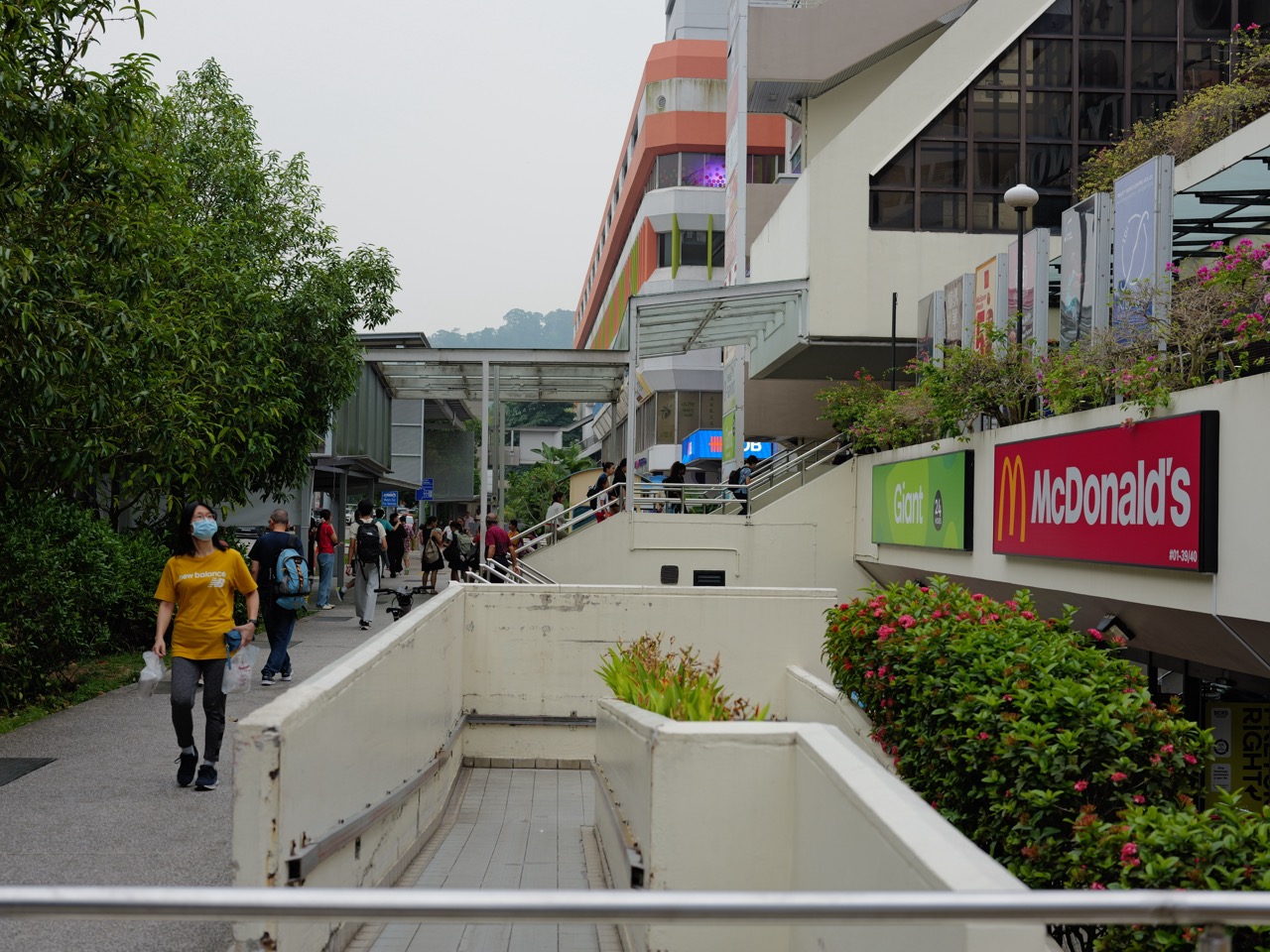
Ask for directions in Singapore: from a landmark to the correct entrance
“Excuse me, how do I get to the nearest MRT station?” and “Which exit should I take?” are useful questions when you are exploring Singapore. You may hear shorter local replies such as “Opposite the block” or “Can, walk straight.” What matters is understanding the actual route, not copying an accent. Start by confirming your destination and the first safe landmark.
This guide teaches 20 practical Singapore direction words and expressions across English, Simplified Chinese, Hindi and Russian. All four editions share the same numbered entries, so you can switch directly to the matching explanation when a word is unfamiliar. Some terms are ordinary English; MRT, HDB block and void deck bring in local context. We explain what people may say, how to ask again and when to consult signs or an official map.
Street conditions, construction and station exits can change. The dialogues use fictional destinations and do not claim a specific walking time, accessible route or currently open entrance. For a real journey, check current signs and map information. For crossing a road, use appropriate pedestrian crossing facilities and obey the pedestrian signal even if someone suggests a shorter route.
English · 简体中文 · हिन्दी · Русский
The twenty terms at a glance · Twenty words: meanings, examples and important distinctions · Five route decisions to make before setting off · Ten conversations for asking and checking directions · Practice for five minutes, then test your understanding · Ten frequently asked questions about finding your way · Official sources and wording notes · Continue through everyday Singapore
The twenty terms at a glance
| No. | Singapore expression | Meaning in this situation |
|---|---|---|
| 1 | Excuse me, how do I get to…? | Start a polite request and name your destination. |
| 2 | Nearest MRT station | Ask about the closest rail station rather than a particular train route. |
| 3 | Station exit A / B | A labelled pedestrian exit from an MRT station. |
| 4 | Bus stop | A specific place where a bus boards and alights passengers. |
| 5 | Bus interchange | A larger hub for multiple public bus services. |
| 6 | HDB block / Blk | A public-housing block number used in addresses and directions. |
| 7 | Six-digit postal code | The postcode associated with a Singapore address. |
| 8 | Void deck | An open communal area at ground level in many HDB blocks. |
| 9 | Landmark | A recognisable feature used to orient a route. |
| 10 | Opposite / across the road | On the other side from the reference point. |
| 11 | Beside / next to | Immediately adjacent to another known place. |
| 12 | Go straight | Continue in the same direction until the next instruction. |
| 13 | Turn left | Change direction to the left at a specified point. |
| 14 | Turn right | Change direction to the right at a specified point. |
| 15 | Traffic-light crossing | A signalised crossing where pedestrians obey the pedestrian lights. |
| 16 | Overhead bridge | A pedestrian bridge that goes above a road. |
| 17 | Underpass | A pedestrian passage that passes below a road or another route. |
| 18 | Sheltered walkway / covered linkway | A walkway offering some protection from rain or sun. |
| 19 | Lift / step-free route | An accessible route without a need to use steps. |
| 20 | Can you show me on the map? | A polite way to confirm a place when spoken directions are unclear. |
Do not confuse a station exit, an address and a bus-stop code.
Twenty words: meanings, examples and important distinctions
1. Excuse me, how do I get to…?
Meaning: Start a polite request and name your destination.. Say it: “Excuse me, how do I get to the community library?”
Important distinction: A clear request names a place rather than assuming the listener knows your plan. Say where you are standing if the destination is far away.
Read the other languages: 简体中文 01 · हिन्दी 01 · Русский 01
2. Nearest MRT station
Meaning: Ask about the closest rail station rather than a particular train route.. Say it: “Which is the nearest MRT station from here?”
Important distinction: Nearest describes location, not necessarily the simplest journey or accessible entrance. Check the station name and the route you can use.
Read the other languages: 简体中文 02 · हिन्दी 02 · Русский 02
3. Station exit A / B
Meaning: A labelled pedestrian exit from an MRT station.. Say it: “Should I take Exit A or Exit B?”
Important distinction: Letters identify station exits, not bus routes or platforms. Follow the station’s actual wayfinding signs and recheck if you change station.
Read the other languages: 简体中文 03 · हिन्दी 03 · Русский 03
4. Bus stop
Meaning: A specific place where a bus boards and alights passengers.. Say it: “Where is the bus stop for this service?”
Important distinction: A nearby stop may serve the wrong direction. Ask for the specific service and side of the road; five-digit stop codes can help.
Read the other languages: 简体中文 04 · हिन्दी 04 · Русский 04
5. Bus interchange
Meaning: A larger hub for multiple public bus services.. Say it: “Is the bus interchange near the MRT station?”
Important distinction: Do not confuse an interchange with a single roadside stop. Some names overlap, so verify the entrance and the boarding point.
Read the other languages: 简体中文 05 · हिन्दी 05 · Русский 05
6. HDB block / Blk
Meaning: A public-housing block number used in addresses and directions.. Say it: “Is Block 120 on this side of the road?”
Important distinction: A block number alone may recur across neighbourhoods. Ask for the street and full postal address; fictional Block 120 here identifies no actual house.
Read the other languages: 简体中文 06 · हिन्दी 06 · Русский 06
7. Six-digit postal code
Meaning: The postcode associated with a Singapore address.. Say it: “Could you send me the six-digit postal code?”
Important distinction: A postal code is not the same as a bus-stop code or a block number. Use it together with the building name to verify a place on OneMap.
Read the other languages: 简体中文 07 · हिन्दी 07 · Русский 07
8. Void deck
Meaning: An open communal area at ground level in many HDB blocks.. Say it: “Is the meeting point at the void deck?”
Important distinction: Do not assume every building has one or that a void deck is a private apartment entrance. Ask which side of the block to meet.
Read the other languages: 简体中文 08 · हिन्दी 08 · Русский 08
9. Landmark
Meaning: A recognisable feature used to orient a route.. Say it: “What landmark should I look for?”
Important distinction: A familiar shop or sign can close or move. Pair a landmark with a road name or official sign instead of relying on one memory.
Read the other languages: 简体中文 09 · हिन्दी 09 · Русский 09
10. Opposite / across the road
Meaning: On the other side from the reference point.. Say it: “Is the clinic opposite the bus stop?”
Important distinction: Opposite does not specify where it is safe to cross. Identify the designated crossing first rather than walking straight into traffic.
Read the other languages: 简体中文 10 · हिन्दी 10 · Русский 10
11. Beside / next to
Meaning: Immediately adjacent to another known place.. Say it: “Is the entrance beside the pharmacy?”
Important distinction: Beside can refer to the building, its entrance or a different side. Ask which doorway or side is intended when there are multiple entrances.
Read the other languages: 简体中文 11 · हिन्दी 11 · Русский 11
12. Go straight
Meaning: Continue in the same direction until the next instruction.. Say it: “Go straight until the next junction?”
Important distinction: Ask where the straight segment ends. The instruction does not mean ignoring traffic lights or crossing unsafe roads.
Read the other languages: 简体中文 12 · हिन्दी 12 · Русский 12
13. Turn left
Meaning: Change direction to the left at a specified point.. Say it: “Turn left after the traffic light?”
Important distinction: The important part is where to turn: before or after a junction changes the route. Repeat the landmark and turn together.
Read the other languages: 简体中文 13 · हिन्दी 13 · Русский 13
14. Turn right
Meaning: Change direction to the right at a specified point.. Say it: “Should I turn right at the second junction?”
Important distinction: Count junctions carefully and check the side you should be on. If unsure, ask for a visible sign rather than guessing the “second” corner.
Read the other languages: 简体中文 14 · हिन्दी 14 · Русский 14
15. Traffic-light crossing
Meaning: A signalised crossing where pedestrians obey the pedestrian lights.. Say it: “Where is the traffic-light crossing?”
Important distinction: Wait for the steady green pedestrian signal before starting. Do not begin on a flashing green man or red man; watch the road too.
Read the other languages: 简体中文 15 · हिन्दी 15 · Русский 15
16. Overhead bridge
Meaning: A pedestrian bridge that goes above a road.. Say it: “Do I need to use the overhead bridge?”
Important distinction: An overhead bridge differs from an underpass. Some bridges have stairs or lifts; verify the specific crossing if step-free access matters.
Read the other languages: 简体中文 16 · हिन्दी 16 · Русский 16
17. Underpass
Meaning: A pedestrian passage that passes below a road or another route.. Say it: “Is there an underpass near the station?”
Important distinction: An underpass may have more than one entrance. Check which side emerges near the destination and whether a lift or ramp is available.
Read the other languages: 简体中文 17 · हिन्दी 17 · Русский 17
18. Sheltered walkway / covered linkway
Meaning: A walkway offering some protection from rain or sun.. Say it: “Is there a sheltered walkway from the station?”
Important distinction: Covered does not promise that every metre is sheltered or step-free. Ask where the covering starts and ends, especially in rain.
Read the other languages: 简体中文 18 · हिन्दी 18 · Русский 18
19. Lift / step-free route
Meaning: An accessible route without a need to use steps.. Say it: “Could you show me a step-free route, please?”
Important distinction: Do not assume the nearest stairwell is suitable. Check where the lift opens and whether it is currently available; no personal explanation is required.
Read the other languages: 简体中文 19 · हिन्दी 19 · Русский 19
20. Can you show me on the map?
Meaning: A polite way to confirm a place when spoken directions are unclear.. Say it: “Sorry, could you show me on the map?”
Important distinction: This is a request for clarification, not a failure. Use an official map to verify the final location and thank the person even if they cannot help.
Read the other languages: 简体中文 20 · हिन्दी 20 · Русский 20
Five route decisions to make before setting off
Identify the destination, not merely the neighbourhood
A neighbourhood name can cover many streets, blocks and entrances. Ask for the exact building, shop or meeting point before accepting directions. A six-digit postal code or a clearly written building name often removes ambiguity. Compare the address with OneMap or the current official signage. An example address in this guide is fictional and is not a route instruction.
A good question identifies both the destination and your starting point: “I am outside the station entrance. Is the library across the road from here?” If the person cannot see where you are standing, ask them to mark a map rather than inventing a landmark.
Separate a station exit from a bus stop
A station exit such as Exit A is a pedestrian way out of a specific MRT station. It is not the same thing as a bus stop or bus interchange. A bus stop is one boarding point, often identifiable by a five-digit stop code; an interchange is a larger hub with multiple services. Read the sign and name the facility before you cross a street.
Two transport services can share a name while their entrances are in different places. If you are changing modes, say exactly what you need: “I am coming out of Exit B. Which side is the bus stop for this service?”
Treat a block number as a local landmark, not the whole address
In many HDB neighbourhoods people use block numbers when giving directions. “Blk 120” may be easy for residents to recognise, but the street and town still matter because numbers can recur in different places. A void deck is a ground-level communal space in some public-housing blocks; it is not automatically the private lobby of the person you are visiting.
Ask for the exact block and the appropriate entrance. Respect residents’ privacy and avoid photographing door numbers or people as you look around. If you are delivering something, agree on a legitimate public handover point with the intended recipient.
Plan a safe crossing rather than a straight line
A shop that looks “opposite” may still require a pedestrian crossing, an overhead bridge or an underpass. “Go straight” describes a direction, not permission to cross a road wherever you happen to stand. Obey current signals; do not begin crossing when the green man is flashing or when the red man is showing.
Singapore Police advise pedestrians to use proper crossing facilities and remain attentive. If the recommended bridge or underpass is inconvenient, ask for another safe route. A map line is not evidence of a legal or suitable crossing.
Ask for the route you can actually use
A person using a wheelchair, stroller or luggage may need a step-free route rather than the fastest staircase. Ask about lifts and any current closures. Not every overhead bridge or short walkway has the same accessibility features. A sheltered walkway may provide cover for only part of the trip.
Say “Could you show me a step-free route, please?” or “Does this lift reach the exit?” You need not disclose a private medical reason. Compare the reply with current signs, and ask again if the suggested route is unsuitable.
Ten conversations for asking and checking directions
Illustrative conversation only: no real location, fare or walking duration is asserted.
1. From a station entrance
At the entrance a visitor wants a nearby building, but the helper first checks which station exit they used.
Visitor: “Excuse me, how do I get to the library?” Local: “Which MRT exit are you at?” Visitor: “Exit B. Can you show the library on my map?”
Why this exchange helps: Identify both the destination and the present exit before interpreting a route.
2. Do not confuse a bus stop with an interchange
One person is looking for a bus service; the local checks whether the traveller needs a roadside stop or the interchange.
Visitor: “Is the bus interchange across the road?” Local: “The bus stop is opposite. The interchange is farther away.” Visitor: “I need the bus stop for my service. Where should I cross?”
Why this exchange helps: Name the intended boarding point and ask for a safe crossing instead of following the nearest bus sign blindly.
3. Finding an HDB block
A visitor has a block number but not enough address information.
Visitor: “Is this Block 120?” Local: “There are many blocks. What street or postal code do you have?” Visitor: “I will check the full address and ask again. Thank you.”
Why this exchange helps: A block number without the street can be ambiguous. Checking the complete address is better than assuming the nearest matching number.
4. Using a familiar landmark
The visitor hears “beside the shop” and asks which entrance the speaker has in mind.
Local: “The entrance is beside the pharmacy.” Visitor: “The pharmacy has two doors. Which side?” Local: “Use the entrance facing the pedestrian walkway.”
Why this exchange helps: Repeat the particular entrance or side, rather than treating a landmark as an exact door number.
5. A turn at the junction
The visitor checks whether the instruction says to turn before or after the traffic lights.
Local: “Walk straight and turn left at the traffic light.” Visitor: “At the traffic light, not before it, correct?” Local: “Correct. Then follow the sign to the station.”
Why this exchange helps: The correct landmark can matter more than simply memorising left. Repeat the point of turning.
6. Crossing at a safe place
A shop looks close, but it is on the other side of the road.
Visitor: “The shop is opposite. Can I cross here?” Local: “Please use the pedestrian crossing at the traffic light.” Visitor: “Understood. I will go to the crossing.”
Why this exchange helps: Opposite is a location description, not an instruction to cross wherever you stand. Obey the signal.
7. Above or below the road
The traveller sees both a bridge and an underground passage.
Visitor: “Do you mean the overhead bridge or the underpass?” Local: “The underpass, below the road.” Visitor: “Which exit from the underpass is nearest the clinic?”
Why this exchange helps: Above and below are different routes. The underpass may have several exits, so confirm the correct one.
8. A sheltered route during rain
A visitor asks if the route remains sheltered all the way to the building.
Visitor: “Is there a sheltered walkway?” Local: “Part of the route is covered, but not the last section.” Visitor: “Thanks. Where does the covered part end?”
Why this exchange helps: The word sheltered may refer to only part of a route. Ask which part, especially if rain matters.
9. Finding a step-free route
Someone carrying a stroller needs to avoid a staircase.
Visitor: “I need a step-free route. Where is the lift?” Local: “There is a lift beside the other station entrance.” Visitor: “Does that lift reach the street level I need?”
Why this exchange helps: Ask for accessibility features without disclosing private reasons. Verify the lift reaches the relevant level.
10. When you missed a direction
Noise makes the visitor uncertain about the first instruction.
Local: “Turn right after the second junction.” Visitor: “Sorry, I missed that. Could you show me on the map?” Local: “Yes. This is the junction I mean.”
Why this exchange helps: Politely acknowledging uncertainty is safer than pretending to understand. A map helps verify the turn.
Five worked examples: common direction mistakes
The wrong exit can add a whole unnecessary detour
A station may have multiple pedestrian exits serving different roads or buildings. Before leaving the paid area, check the station map and confirm the letter of the exit closest to your destination. “Which exit is closer to the library entrance?” is more useful than “Which exit is best?” because you have defined the destination. If a staff member says an exit is closed, use the replacement they indicate rather than relying on a saved old screenshot.
A block number is not the same as a six-digit postcode
Imagine a visitor is sent “Blk 120” without a street. They may find another block with the same number elsewhere in Singapore. Ask “Could you send the street name and postal code?” and check that the map result matches the intended neighbourhood. The six-digit postcode relates to the address, whereas a five-digit bus-stop code relates to a stop. Mixing them can produce a perfectly plausible search result in the wrong place.
An opposite-side landmark still requires a crossing
Suppose a friend says the supermarket is “just opposite.” You see the sign across a busy road, but there is no crossing directly in front of you. Ask “Where is the nearest pedestrian crossing?” rather than stepping into traffic. At signalised crossings, wait for the steady green pedestrian signal; do not begin when it is flashing. The shorter geometric distance may not be the safe walking route.
A covered linkway can end before the destination
On a rainy afternoon, “There is a sheltered walkway” is helpful but incomplete. Ask “Is it covered all the way, or only to the bus stop?” A respondent may correctly say the route is sheltered while meaning only its first section. Identifying the end of the shelter lets you prepare without asking strangers to predict weather or promising a completely dry journey.
Accessibility is about the full chain of movements
Someone with a stroller might manage a station lift but still encounter a staircase near the last junction. Ask “Is there a step-free route from this exit to the entrance?” rather than stopping after confirmation of one lift. The answer should consider the entire route and any current closures. If a local cannot confirm, thank them and consult current transport signage or the relevant operator.
Practice for five minutes, then test your understanding
Choose a destination and rehearse this sequence aloud. First, say exactly where you are. Next, ask for the building or station exit. Third, repeat the first turn and the side of the road. Fourth, ask where to cross safely. Fifth, explain a step-free requirement if relevant. Finally, open OneMap or the current sign and verify the route before leaving. Successful communication means arriving at the right place safely, not using the highest number of local expressions.
Quick recall and answer
1. Does “Exit B” mean Bus Stop B? No. MRT exit lettering and bus-stop identification are different systems; identify the facility first.
2. Can “opposite” mean I may cross in a straight line? No. It describes relative position, not a safe crossing. Use an appropriate crossing facility.
3. Do two places called “Blk 120” have to be the same building? No. Ask for the street, town or complete postal address.
4. What is the difference between an overhead bridge and an underpass? The first crosses above a road; the second passes below it.
5. Does sheltered walkway guarantee the entire route is covered? No. Confirm the part of the journey that is actually sheltered.
6. What should you do if a route requires stairs you cannot use? Ask for a step-free alternative and verify the available lift or accessible route.
A phrase is useful when it tells the listener exactly what you need. Repeat the destination, route feature or crossing when the first answer is uncertain.
Ten frequently asked questions about finding your way
1. Must I speak Singlish to ask for directions?
No. Plain English, a written destination and a map work well. Recognising expressions such as “opposite” or “can” is useful, but performing a local accent is unnecessary.
2. Are all twenty words Singapore-specific?
No. Left, right, landmark and underpass are ordinary English. MRT, HDB block and void deck are particularly relevant to local navigation.
3. Is a station exit the same as the nearest bus stop?
No. A rail exit is a pedestrian exit. A bus stop is a boarding location with its own name or code. Check both before following directions.
4. Does a six-digit postal code identify a bus stop?
No. Singapore postal codes are used for addresses; bus-stop codes are a separate identification system. Do not swap one for the other.
5. May I start crossing when the green man flashes?
No. Singapore Police advice is not to start crossing on a flashing green man; wait for a safe crossing phase and obey the signal.
6. Is the shortest route always the best route?
No. Road crossings, construction, accessibility and personal safety can make another route more suitable.
7. What exactly is a void deck?
It is a ground-level open communal area found in many HDB public-housing blocks, not a description of every lobby or a private home entrance.
8. Will every overhead bridge have a lift?
Do not assume that. Singapore continues accessibility upgrades, but a specific bridge and its current lift operation must be checked.
9. Where can I search a building name or postal code?
Singapore Land Authority’s OneMap lets users search addresses, postal codes and building names. Check the location matches the one you need.
10. What if I do not understand the reply?
Say “Sorry, could you show me on the map?” or repeat the first direction for confirmation. A polite correction is better than pretending to understand.
Official sources and wording notes
Language note: Singapore speakers may use ordinary English, local terms and shortened phrases. You do not need to speak in an exaggerated Singlish accent. Keep the answer concrete and considerate.
Singapore Land Authority — OneMap: national map and address search · OneMap — search addresses, postcodes and buildings · Land Transport Authority — public transport wayfinding · Land Transport Authority — Bus Services and stop codes · Singapore Police Force — pedestrian road-safety tips · Ministry of Transport — inclusive transport infrastructure · National Heritage Board — Toa Payoh heritage, HDB blocks and community spaces
Continue through everyday Singapore
Related Singapore vocabulary lessons: Taking the MRT · Riding a Public Bus · Taking a Taxi or Ride-Hail · Shopping at a Mall · Meeting an Uncle or Auntie · At a Kopitiam · eduKate Vocabulary Hub.
English · 简体中文 · हिन्दी · Русский
A useful Singapore direction is more than “left” or “right.” It identifies a precise place, points to a recognisable landmark, chooses a safe way to cross and checks that the route works for the person travelling. Learn one new local term, then practise confirming the first step. That is enough to make the next journey easier.
From Directions to Hotel Check-In
Once you reach the correct hotel entrance, the next task is to confirm the reservation, room type, check-in time and any card hold. Read Top 20 Vocabulary Singapore | Checking Into a Hotel. English · 简体中文 · हिन्दी · Русский