
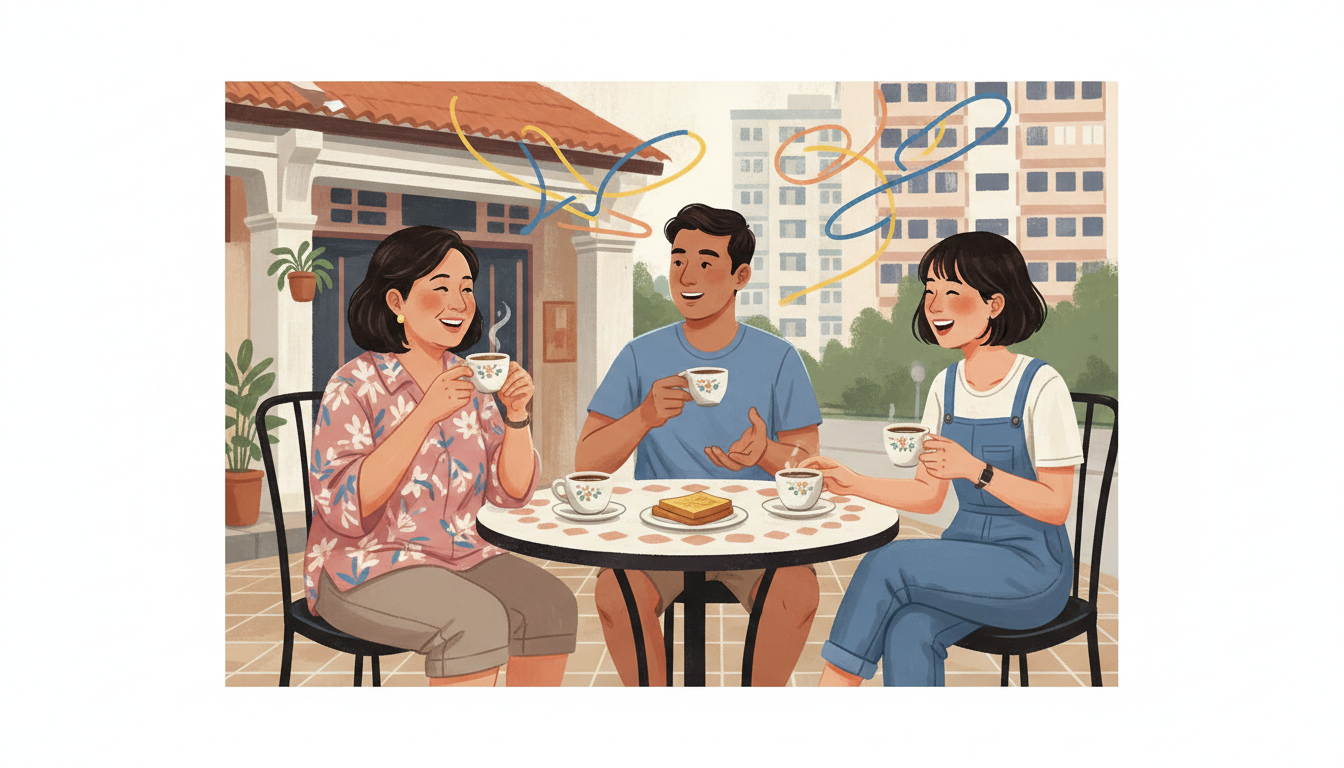
If you meet an older neighbour, a food-stall owner or someone you recognise from the estate, you might hear “Good morning, Uncle!” or “Morning, Auntie!” In Singapore, those words can be friendly forms of address even when the people are not relatives. But there is no rule that everyone must accept them. A safe beginning is “Good morning. Excuse me, could I ask you something?” and, once you know the person, follow the form of address they prefer.
The first conversation can be short: “Makan already?” means roughly “Have you eaten?” in casual speech. “Can?” asks whether something can be done; “Can” may answer yes. “Paiseh” softens a small embarrassment, while “jio me next time” is a relaxed request to be included. Use one expression in a meaningful sentence, not a string of unfamiliar slang. Singapore Tourism Board’s guide to local lingo and the HSBC Singapore Singlish guide offer examples of the language visitors may hear.
This guide is for tourists, people visiting family, new residents and anyone who wants to make everyday Singapore interactions easier. It teaches the 20 expressions in the exact same sequence as the Simplified Chinese, Hindi and Russian editions; every word has a direct link to its matching explanation in the other languages. The goal is to communicate well, not to perform a caricature of local speech.
Use polite English as your default. Make space for personal preferences, especially when someone works at a busy counter, is travelling with children or does not want small talk. For a quick food-specific ordering conversation, see the connected At a Kopitiam guide. This chapter instead specialises in forms of address, rapport and saying the right thing at the right moment.
Speak naturally and respectfully with a neighbour, stallholder or familiar face in Singapore. Twenty expressions, their limits, and real conversations in context.
Read this entry in: English · 简体中文 · हिन्दी · Русский

What does Uncle or Auntie mean in Singapore?
In everyday Singapore speech, Uncle and Auntie/Aunty can be familiar ways to address someone senior or known through neighbourhood life, not only a literal family relationship. Singapore Global Network’s account of everyday habits includes calling people “Uncle and Aunty” genuinely, and stories of market life frequently show the terms in use. This is a description of a social habit, not a command to address every stranger that way.
The two words are not interchangeable with a name, an official title or a professional relationship. A stallholder may welcome “Uncle”; a service professional may prefer Ms Tan; a younger neighbour may dislike being called Auntie. The respectful choice is the one that respects the other person, including by dropping the familiar title if it does not fit. Equally, not all Singapore residents speak Singlish or use the same expressions.
The best beginner sequence is: begin clearly, ask one relevant question, listen, respond, and end with thanks. For example: “Excuse me, is this lift going down?” — “Can, can.” — “Thank you!” That small exchange can be more successful than twenty expressions delivered without context.
The 20 expressions at a glance
| Expression | Everyday function | A sentence to say |
|---|---|---|
| 1. Uncle | A familiar way some Singaporeans address an older man who is not a relative. It can communicate warmth at a market, neighbourhood shop … | Excuse me, Uncle, is the seat free? |
| 2. Auntie / Aunty | A common familiar form of address for an older woman, including some neighbours and hawkers. Both spellings occur, and children may be … | Morning, Auntie! How are you today? |
| 3. Excuse me | The safest opening when you want attention without assuming familiarity. It helps at an MRT exit, coffee counter or lift lobby, particu… | Excuse me, could I ask you something? |
| 4. Good morning | A natural neutral greeting in the first part of the day, suitable for neighbours, shop staff and acquaintances. English is commonly use… | Good morning! Hope your day is going well. |
| 5. Makan already? | Literally a casual “Have you eaten?” combining Malay makan, to eat, with colloquial English already. In informal conversations it can b… | Makan already, Auntie? |
| 6. How are you? | A straightforward check-in that works without local slang. Tone and relationship determine whether it opens a long conversation or simp… | How are you doing today? |
| 7. Can? / Can. | In conversational Singapore English, “can?” may check whether something is possible and “can” can mean “yes, that is possible”. You may… | Is this seat free, can? — Can. |
| 8. Paiseh | A Hokkien-derived everyday expression often conveying embarrassment, awkwardness or an informal apology. It can soften a small social m… | Paiseh, I think I took the wrong queue. |
| 9. Lah | A recognisable Singapore English sentence-final particle whose effect depends on pitch and relationship. It can express reassurance, em… | No hurry lah, take your time. |
| 10. Wah! | A short exclamation of surprise, admiration or amazement. You may hear it when food arrives or somebody tells an unexpected story. The … | Wah, that smells good! |
| 11. Alamak! | A familiar exclamation meaning roughly “Oh no!” when a small problem or surprise occurs. It has long circulated in regional Malay-influ… | Alamak, I left my umbrella at home! |
| 12. Shiok | A lively expression of intense enjoyment or satisfaction, particularly after good food, a refreshing drink or a pleasant experience. It… | That laksa was shiok! |
| 13. Jio | An informal word meaning to invite or include someone in an activity, often in the phrase “jio me”. Friends may use it when arranging m… | Next time you go to the market, jio me! |
| 14. Bo jio | A playful “Why didn’t you invite me?” often used among friends who already joke together. It draws attention to being left out, sometim… | You all went for kopi? Bo jio! |
| 15. Long time no see | A friendly greeting when two people really have not met for some time. It can start a short neighbourhood catch-up about the market or … | Uncle, long time no see! How have you been? |
| 16. Got or not? | A very concise conversational question about availability or existence; in more formal English, “Is there a lift in this block?” or “Do… | This block got a lift, or not? |
| 17. Can help me? | A compact request you may hear or use informally. In friendly local exchanges, leaving out “you” can still be understood, but a clearer… | Excuse me, can help me find this bus stop? |
| 18. No need, thank you | A kind way to decline extra food, an offer to pay, help or another serving without rejecting the person. It keeps the relationship warm… | No need, thank you — I can carry it. |
| 19. Take care | A warm farewell that expresses good wishes without promising to meet again. It suits a neighbour you have just chatted with or someone … | Take care, Auntie. Have a good evening! |
| 20. See you around | A light farewell when you might cross paths again in the same market, estate or neighbourhood. It does not commit either person to an a… | Thanks for the directions. See you around! |
Practise speaking, not just recognising vocabulary · Six worked conversations you might have in Singapore · Frequently asked questions about meeting Singapore locals
The 20 expressions in five everyday situations
Meeting someone respectfully
The first four entries help you begin without guessing how close you are to someone. The familiar title is optional; an opening such as Excuse me or Good morning remains useful even when you do not know a person’s preferred language, culture or name. Be attentive to how someone responds before adding more conversation.
1. Uncle
Say this in English or Singlish: Excuse me, Uncle, is the seat free? (UN-kul)
Meaning and local context: A familiar way some Singaporeans address an older man who is not a relative. It can communicate warmth at a market, neighbourhood shop or food stall, especially when the person uses that style himself. The word also refers to an actual relative, so context decides which meaning applies.
When to be careful: Do not assume a stranger wants to be classified by age. Use “Excuse me” or a preferred name if the person seems uncomfortable; in professional contexts use their stated title or name.
Try it in a real situation: Greet a stallholder politely, then ask one clear question rather than calling out “Uncle!” repeatedly.
Read this entry in: English · 简体中文 · हिन्दी · Русский
2. Auntie / Aunty
Say this in English or Singlish: Morning, Auntie! How are you today? (AAN-tee)
Meaning and local context: A common familiar form of address for an older woman, including some neighbours and hawkers. Both spellings occur, and children may be taught it as a respectful social address. It is not necessarily a family relationship.
When to be careful: Preferences differ: a younger-looking person, colleague or stranger may not welcome the label. Follow how a person introduces herself; avoid stereotyped remarks about age.
Try it in a real situation: Try a greeting that works without the title: “Good morning. May I ask a question?”
Read this entry in: English · 简体中文 · हिन्दी · Русский
3. Excuse me
Say this in English or Singlish: Excuse me, could I ask you something? (ik-SKYOOZ mee)
Meaning and local context: The safest opening when you want attention without assuming familiarity. It helps at an MRT exit, coffee counter or lift lobby, particularly if the other person is occupied. Use it before your request rather than interrupting loudly.
When to be careful: “Excuse me” is an invitation to listen, not permission to insist; allow a refusal if the person is busy. Avoid touching strangers to get attention.
Try it in a real situation: Ask a neighbour for directions in one sentence, then give the person room to respond.
Read this entry in: English · 简体中文 · हिन्दी · Русский
4. Good morning
Say this in English or Singlish: Good morning! Hope your day is going well. (good MOR-ning)
Meaning and local context: A natural neutral greeting in the first part of the day, suitable for neighbours, shop staff and acquaintances. English is commonly useful across Singapore communities, so you need not know the person’s mother tongue to be polite.
When to be careful: Do not turn a greeting into a long interview if the other person is hurrying to work. A smile and a short greeting are enough.
Try it in a real situation: Say it once in a friendly tone, then pause to see whether the person wants to chat.
Read this entry in: English · 简体中文 · हिन्दी · Русский
Checking in without being intrusive
Food and daily routine often provide low-pressure conversation topics, but they should not become an interrogation. In these next four expressions, the important skill is separating a light check-in from a literal offer of food or a guaranteed agreement. Use ordinary complete English when the stakes are high.
5. Makan already?
Say this in English or Singlish: Makan already, Auntie? (MAH-kahn aw-RED-ee)
Meaning and local context: Literally a casual “Have you eaten?” combining Malay makan, to eat, with colloquial English already. In informal conversations it can be a warm way to check in. It does not always mean that food is being offered.
When to be careful: Never assume every Singaporean uses it, or that somebody who hears it wants to discuss what they ate. With a new acquaintance, “How’s your day?” may be easier.
Try it in a real situation: Reply briefly with “Yes, just had lunch, thanks” or “Not yet, later.”
Read this entry in: English · 简体中文 · हिन्दी · Русский
6. How are you?
Say this in English or Singlish: How are you doing today? (how are YOO)
Meaning and local context: A straightforward check-in that works without local slang. Tone and relationship determine whether it opens a long conversation or simply deserves “Fine, thank you.” You can ask it after a greeting, not before someone can stop what they are doing.
When to be careful: If a person replies briefly, do not demand private medical, financial or family details. Respect that Singaporeans, like anyone else, differ in sociability.
Try it in a real situation: Make the question lighter: “How’s your morning going?” Then listen for a short answer.
Read this entry in: English · 简体中文 · हिन्दी · Русский
7. Can? / Can.
Say this in English or Singlish: Is this seat free, can? — Can. (kan)
Meaning and local context: In conversational Singapore English, “can?” may check whether something is possible and “can” can mean “yes, that is possible”. You may also hear “can or not?” or “can already”. Clear standard English works just as well.
When to be careful: “Can” is context-dependent. A yes to one request does not promise an unrelated favour. Repeat important dates, prices or arrangements in plain language.
Try it in a real situation: Ask “Could I sit here?” and recognise that “Can” is an affirmative reply.
Read this entry in: English · 简体中文 · हिन्दी · Русский
8. Paiseh
Say this in English or Singlish: Paiseh, I think I took the wrong queue. (PIE-seh)
Meaning and local context: A Hokkien-derived everyday expression often conveying embarrassment, awkwardness or an informal apology. It can soften a small social mistake, such as blocking a path or getting a name wrong. It can also describe feeling shy about accepting a treat.
When to be careful: It is not an all-purpose substitute for a serious apology. If you inconvenience someone, say clearly what happened and how you will fix it.
Try it in a real situation: Say “Sorry, I misunderstood; I’ll move over” after using paiseh in a small mistake.
Read this entry in: English · 简体中文 · हिन्दी · Русский
Sounding friendly without overdoing Singlish
Small particles and exclamations carry feeling and rhythm. They can be welcoming when used naturally, but can also sound impatient when copied without the tone and relationship that give them meaning. Listening first is a more respectful route to understanding Singlish than performing an accent.
9. Lah
Say this in English or Singlish: No hurry lah, take your time. (lah)
Meaning and local context: A recognisable Singapore English sentence-final particle whose effect depends on pitch and relationship. It can express reassurance, emphasis or a familiar attitude rather than a fixed English meaning. Understanding it matters more than copying it.
When to be careful: A misplaced lah can sound impatient, dismissive or mocking. Visitors do not need to add lah to every sentence to sound friendly.
Try it in a real situation: Try both versions aloud: “No hurry, take your time” and “No hurry lah”; notice the tone, not just the spelling.
Read this entry in: English · 简体中文 · हिन्दी · Русский
10. Wah!
Say this in English or Singlish: Wah, that smells good! (wah)
Meaning and local context: A short exclamation of surprise, admiration or amazement. You may hear it when food arrives or somebody tells an unexpected story. The voice and situation distinguish a delighted “wow” from shock or concern.
When to be careful: Avoid loudly commenting on a stranger’s body, clothing, age or spending. Praise the food or helpful action instead of making personal assumptions.
Try it in a real situation: React to a dish with “Wah, looks delicious!” and wait for the other person’s reply.
Read this entry in: English · 简体中文 · हिन्दी · Русский
11. Alamak!
Say this in English or Singlish: Alamak, I left my umbrella at home! (ah-LAH-mahk)
Meaning and local context: A familiar exclamation meaning roughly “Oh no!” when a small problem or surprise occurs. It has long circulated in regional Malay-influenced speech and is recognised in Singapore English. It often signals a minor mishap, not a formal complaint.
When to be careful: It should not be used to ridicule somebody else’s difficulty. In an emergency, state the problem directly instead of relying on a playful expression.
Try it in a real situation: Say what went wrong and what you will do next: “Alamak, wrong stop. I’ll check the map.”
Read this entry in: English · 简体中文 · हिन्दी · Русский
12. Shiok
Say this in English or Singlish: That laksa was shiok! (shee-OK)
Meaning and local context: A lively expression of intense enjoyment or satisfaction, particularly after good food, a refreshing drink or a pleasant experience. It is an adjective-like reaction in informal Singapore speech. Listen to context rather than translating it as only “delicious”.
When to be careful: This word is for a feeling or experience, not a universal rating of a vendor’s hygiene, ingredients or quality. Never use it to make insensitive remarks about a person.
Try it in a real situation: Describe a specific positive experience: “The cold lime juice was shiok after the walk.”
Read this entry in: English · 简体中文 · हिन्दी · Русский
Invitations and neighbourly familiarity
Invitations are about choice. Jio and bo jio are often heard among friends, but they do not entitle anyone to another person’s free time. The boundary between playful teasing and unwanted pressure is different in every relationship. Keep the invitation open and make declining easy.
13. Jio
Say this in English or Singlish: Next time you go to the market, jio me! (jee-OH)
Meaning and local context: An informal word meaning to invite or include someone in an activity, often in the phrase “jio me”. Friends may use it when arranging makan, sports or an outing. It signals friendly inclusion rather than an obligation.
When to be careful: Do not demand an invitation from somebody you hardly know. A more neutral choice is “Let me know if you’re going again.”
Try it in a real situation: Invite a friend: “We’re going for lunch on Saturday. Want to come?”
Read this entry in: English · 简体中文 · हिन्दी · Русский
14. Bo jio
Say this in English or Singlish: You all went for kopi? Bo jio! (boh jee-OH)
Meaning and local context: A playful “Why didn’t you invite me?” often used among friends who already joke together. It draws attention to being left out, sometimes in mock protest. It is useful to recognise even if you rarely say it.
When to be careful: It can sound accusatory or entitled with a new acquaintance or colleague. If inclusion matters, ask gently about the next plan rather than blaming somebody.
Try it in a real situation: Respond to a friend with “Next time we’ll ask you” and move on without creating pressure.
Read this entry in: English · 简体中文 · हिन्दी · Русский
15. Long time no see
Say this in English or Singlish: Uncle, long time no see! How have you been? (long time no SEE)
Meaning and local context: A friendly greeting when two people really have not met for some time. It can start a short neighbourhood catch-up about the market or an old routine. The phrase is common international English, not uniquely Singlish.
When to be careful: Do not say it to a stranger you have never met. You need an actual past connection; avoid pretending familiarity to gain favour.
Try it in a real situation: Add a light topic: “Long time no see! Still visiting this market?”
Read this entry in: English · 简体中文 · हिन्दी · Русский
16. Got or not?
Say this in English or Singlish: This block got a lift, or not? (got aw not)
Meaning and local context: A very concise conversational question about availability or existence; in more formal English, “Is there a lift in this block?” or “Do you have it?” Word order and the intended object matter.
When to be careful: Avoid using compressed questions when safety or accessibility is important; ask a clear question and confirm the answer. Also don’t assume a neighbour knows every building facility.
Try it in a real situation: Ask “Is there a lift at this entrance?” and follow the person’s direction before moving.
Read this entry in: English · 简体中文 · हिन्दी · Русский
Getting help and ending on a good note
These final terms help in practical neighbourhood life: locating a lift, asking for a little assistance, declining graciously and leaving a conversation well. A successful exchange does not require perfect slang. It requires a clear request, a proportionate response and appreciation for the other person’s time.
17. Can help me?
Say this in English or Singlish: Excuse me, can help me find this bus stop? (kan help mee)
Meaning and local context: A compact request you may hear or use informally. In friendly local exchanges, leaving out “you” can still be understood, but a clearer polite version is “Could you please help me find this bus stop?”
When to be careful: No stranger is required to help. Share only the information needed for your request, and accept “sorry, I’m not sure” without argument.
Try it in a real situation: Show a written destination and say “Thank you anyway” if the person cannot help.
Read this entry in: English · 简体中文 · हिन्दी · Русский
18. No need, thank you
Say this in English or Singlish: No need, thank you — I can carry it. (noh need thank yoo)
Meaning and local context: A kind way to decline extra food, an offer to pay, help or another serving without rejecting the person. It keeps the relationship warm when you do not want to accept the offered thing.
When to be careful: “No need!” by itself may sound abrupt. Add thanks or an explanation, especially when a host has taken trouble to help.
Try it in a real situation: Decline once kindly, then acknowledge the thought: “No need, thank you. That’s very kind.”
Read this entry in: English · 简体中文 · हिन्दी · Русский
19. Take care
Say this in English or Singlish: Take care, Auntie. Have a good evening! (tayk kair)
Meaning and local context: A warm farewell that expresses good wishes without promising to meet again. It suits a neighbour you have just chatted with or someone who has helped you. It is ordinary English that fits Singapore social life.
When to be careful: Do not impose a hug, handshake or personal familiarity. A wave or brief smile may be enough; different people have different comfort levels.
Try it in a real situation: Close a conversation positively before leaving rather than simply turning away.
Read this entry in: English · 简体中文 · हिन्दी · Русский
20. See you around
Say this in English or Singlish: Thanks for the directions. See you around! (see yoo uh-ROUND)
Meaning and local context: A light farewell when you might cross paths again in the same market, estate or neighbourhood. It does not commit either person to an appointment and is useful for casual acquaintances.
When to be careful: If you genuinely need to meet at a certain time, arrange the details explicitly; “see you around” is not a confirmed plan.
Try it in a real situation: Use it at a familiar neighbourhood shop, but choose “Thank you, goodbye” for a one-off encounter.
Read this entry in: English · 简体中文 · हिन्दी · Русский
What makes a friendly encounter genuinely respectful?
Do not assume an older person wants small talk, help or a seat offered, and do not assume that someone younger should be called Auntie. Ask rather than decide on their behalf. If a person gives a name, that name is more reliable than guessing from appearance.
Listen for conversational register. A market regular and a front-desk executive may use different levels of formality. The same person can switch among Standard English, Singlish and other languages depending on who is present and what is being discussed.
Keep questions bounded. Food and the weather can be easy opening topics, but private health matters, family finances, immigration status and political or religious assumptions do not belong in a first two-minute encounter. A short answer should be allowed to remain short.
Treat a refusal as complete. “No need, thank you” is sufficient for a declined offer, and “Sorry, I’m not sure” is sufficient when someone cannot give directions. A warm goodbye does not turn a stranger into an on-call guide.
Respect real access needs. If asking about lifts, step-free routes or building entrances, use full sentences, check signs and official information when the answer matters. Friendly advice is useful, but it is not a guarantee of accessibility or safety.
Learn local speech without mimicry. Pronunciation hints here are approximate: Singapore contains different accents, languages and personal styles. You can be understood, considerate and welcome while speaking entirely in straightforward English.
Six worked conversations you might have in Singapore
These are model exchanges rather than recordings of actual individuals. They show how to make a request and leave the other person free to choose how much conversation to have. The lines that visitors can say are in everyday English; explanatory notes tell you why each exchange works.
1. A familiar shopkeeper who may prefer a different title
Visitor: Good morning. Excuse me, is the shop open yet?
Shopkeeper: Yes, we just opened. Call me Mr Lim.
Visitor: Thank you, Mr Lim. I’ll come back after breakfast.
The first line is neutral; the shopkeeper’s reply supplies both useful information and a name. Reusing Mr Lim shows respect for the person’s own choice. There is no need to insist on “Uncle” just because you have learned the local word. If a person instead smiles and welcomes Auntie or Uncle, you may follow that preference. Remember that the practical goal is to find out whether the shop is open, not to prove knowledge of Singlish.
2. Finding a lift without taking too much of someone’s time
Visitor: Excuse me, can you help me find the lift at this entrance?
Neighbour: I think it is around that corner, but I’m not sure.
Visitor: No problem. Thanks anyway; I’ll check the signs.
Notice the neighbour’s uncertainty. A helpful guess is not verified accessibility information. The visitor accepts the limits of the reply and checks the signs instead of pressing the neighbour for certainty. If step-free access matters, a complete request, signage and current official information are preferable to relying on “got or not?” alone. Pausing to let a hurried neighbour continue their day is part of polite communication.
3. A light “Makan already?” conversation
Neighbour: Morning! Makan already?
Visitor: Yes, just had kaya toast, thanks. How about you?
Neighbour: Not yet. I’m heading to the kopitiam now.
Visitor: Enjoy your breakfast!
Here the question functions as friendly small talk, not a promise of a meal or a request for a complete food diary. A brief reply plus a return question is enough. The neighbour’s next answer supplies a natural place to end the interaction. You can also simply say “Yes, thanks” if you do not feel like chatting. This approach keeps an ordinary Singapore expression from becoming a forced ritual.
4. Making a small mistake and repairing it
Visitor: Paiseh, I think I joined the wrong queue.
Customer: The queue for drinks is over there.
Visitor: Thanks for telling me. Sorry to block the way.
Customer: No problem.
Paiseh communicates mild embarrassment, but the real repair is to move, apologise for blocking the path and thank the person. Saying paiseh does not give you priority or an excuse to cut across others. If the mistake caused genuine harm, you need a more explicit apology and appropriate action. A listener who never uses paiseh will still understand “Sorry, wrong queue” perfectly well.
5. Friends inviting each other, without pressure
Friend A: We went for noodles yesterday.
Friend B: Bo jio! Next time jio me lah.
Friend A: Sure, next Saturday we may go again. Want me to message you?
Friend B: Can! If I’m free, I’ll join.
The friends know one another and share a joking style; bo jio is playful here, not an accusation. The invitation is still open rather than forced. “May go” does not confirm a reservation or a definite Saturday plan; if meeting really matters, follow up with a time and place. With a new colleague, simply ask “Let me know next time” instead of performing an angry-sounding bo jio.
6. A warm but ordinary goodbye
Visitor: Wah, the noodles were shiok. Thank you for the recommendation!
Neighbour: Glad you enjoyed them.
Visitor: Take care. See you around!
Neighbour: You too, bye!
Praise a real experience rather than flattering someone just to gain a favour. “Shiok” communicates enjoyment, not a guarantee about food safety or quality. “Take care” is kind, while “see you around” does not impose a future appointment. The person may be a local acquaintance rather than a close friend; a short farewell keeps the right degree of warmth. You can say “Thank you and goodbye” instead if you prefer clear standard English.
Practise speaking, not just recognising vocabulary
A five-minute routine is enough to move from reading to doing. First cover the explanations and identify five expressions. Then say one complete request for a seat, a direction or a friendly greeting. Finally replace a risky assumption with a clear alternative: use Excuse me instead of an unwanted familiar title, or a full question instead of an ambiguous Can.
Walk through a first meeting: observe if the person is available, begin with Good morning or Excuse me, ask one question and accept the answer. If a familiar title is welcome, use it naturally; if not, leave it out. This method is simple enough to remember while travelling and flexible enough for different social situations.
When speaking to a familiar elder or hawker, a short positive observation about a stall, garden or neighbourhood event can open friendly small talk. Avoid assuming that every person shares the same family practices, religion, first language or willingness to discuss personal matters. Ask open but bounded questions and let the person choose how much to share.
Keep one repair phrase ready: “Sorry, I misunderstood. Let me ask again.” It solves more real misunderstandings than imitating a whole sentence of slang. If you cannot understand, ask the person to repeat slowly or show the destination in writing. Communication is cooperative: both people can adapt.
A small invitation also needs clarity. “Jio me next time” suggests interest, while “Bo jio!” may only be playful teasing between close friends. Neither is a confirmed appointment. When a meeting matters, explicitly confirm where, when and whether everyone is free.
Check your understanding: ten little decisions
- A new adult neighbour gives you her name. Do you keep calling her Auntie?
- An older stranger looks busy. What is a gentle opener?
- A neighbour asks “Makan already?” Are they offering to buy you food?
- Someone says “Can” about a seat. Does that confirm a restaurant booking?
- You joined the wrong queue. What matters after “Paiseh”?
- Do you need to put lah at the end of every sentence?
- You enjoyed a drink. What can shiok express?
- A close friend jokes “Bo jio!” What response can work?
- A neighbour says “I’m not sure” about a lift. Is the route verified?
- What does “See you around” promise?
Why those answers work
- No. Use the name she gave, unless she welcomes Auntie.
- “Excuse me” followed by one brief question, or do not interrupt.
- Not necessarily; it can simply be a friendly check-in.
- No. It answers the particular seat request, not unrelated arrangements.
- Move to the correct place, apologise and thank the person.
- No. Use plain English unless you understand the tone.
- Your strong satisfaction, not verified food-safety quality.
- “Next time we’ll ask you” or a friendly future invitation.
- No. Check signage and reliable access information.
- No fixed appointment. Arrange time and place separately if needed.
A model meeting in a Singapore neighbourhood
The rain had just stopped when I reached the neighbourhood market. A familiar vegetable seller was arranging bundles of greens beside her stall. “Good morning,” I said, leaving space for her to finish serving the customer ahead of me. She looked up and smiled. “Morning!” After the queue cleared, I asked, “Excuse me, could you tell me whether the lift near the other entrance is working?” She paused and pointed toward the next block. “I’m not sure about that one. The other lift is there.”
“Thank you. That helps,” I said. Then I noticed the fish-ball noodles steaming at the neighbouring stall. “Wah, that smells good.” She laughed and told me which stall she liked. I did not ask her to stop working or pretend that we were close friends. Before leaving I said, “Take care. See you around.” The next time I came to the market, I could begin with the same simple greeting and let our familiarity grow naturally.
This scene is illustrative, not a description of a specific person, market or verified lift status. The useful pattern is permission to speak → one clear question → appreciation → an easy farewell.
Frequently asked questions about meeting Singapore locals
1. Is it rude to call someone Uncle or Auntie in Singapore?
Not automatically. In familiar neighbourhood settings, Uncle and Auntie/Aunty may be respectful, affectionate forms of address for someone older, without claiming a family relationship. But a title that is warm to one person can be unwanted to another. A visitor should watch the response and adopt the person’s name or preferred title if offered. At a hotel reception, clinic counter or business meeting, a neutral “Excuse me” is usually the safer opening.
2. Can I call every older Singaporean Uncle or Auntie?
No. Age, nationality and appearance do not determine a person’s preference. Some communities and generations use familiar kinship terms frequently, others less so. Not every Singaporean speaks Singlish, and not every person you meet wants a social conversation. Use a friendly tone, listen to how the person introduces themselves, and switch immediately if a title seems unwelcome.
3. Does “Makan already?” mean I am being invited to eat?
Usually not by itself. It is commonly understood as a casual “Have you eaten?” or a light check-in. If someone is inviting you, they will normally supply a clearer suggestion, such as “Want to have lunch with us?” You can reply briefly: “Yes, thanks, I ate already,” or “Not yet, later.” Neither answer commits you to a meal.
4. What does “can” mean in Singapore conversation?
Depending on context, “Can?” can ask whether something is possible, and “Can” can answer yes. The shortened style saves words, but you should not infer details that were never discussed. If a local says “Can” when you ask whether a seat is free, that does not tell you whether payment, a booking or another arrangement has been confirmed. Use full sentences for consequential matters.
5. Should a visitor say “lah” in every sentence?
No. Lah is a meaningful sentence-final particle with changes in tone and interpersonal effect. Used badly, it can sound impatient, sarcastic or like an imitation of someone’s identity. A polite English sentence without lah is fully appropriate. Listen before attempting the particle and use it only when you understand the social relationship and tone.
6. Are jio and bo jio interchangeable?
No. Jio refers to inviting or including someone, as in “jio me next time.” Bo jio is often a teasing complaint that a friend did not include you. The second expression assumes a level of familiarity that may not exist with colleagues, clients or new neighbours. If unsure, choose the straightforward “Let me know if you are going again.”
7. How do I speak to a stranger who looks busy?
Start with “Excuse me,” ask one limited, relevant question and allow a refusal. If the person is on the phone, carrying heavy items or looking after children, look for a staff member or information sign instead. You can say “Thank you anyway” if they are unable to help. Personal boundaries are part of good communication, not a rejection of you.
8. What if I pronounce Singlish differently from a local?
That is normal. The pronunciation cues here are approximations, not one official accent, and everyday speakers vary. State the complete request in plain English, show a destination or written phrase, and confirm the answer when necessary. Understanding and respectful listening matter far more than producing the most authentic-sounding lah or paiseh.
Sources and further Singapore reading
- Singapore Tourism Board — About Singapore and local lingo
- HSBC Singapore — A Beginner’s Guide to Singlish
- Singapore Global Network — 60 Things That Make Me Feel Singaporean
- Singapore Global Network — An Expat on Being an Insider-Outsider
- eduKateSG — Top 100 Singapore Vocabulary Day 19: Singlish
- eduKateSG — The Full Singapore Dictionary | Singlish
- eduKateSG — Vocabulary Hub
Continue through Singapore everyday conversation
- At a Kopitiam — earlier scenario
- Top 100 Singapore Vocabulary — Singlish
- The Full Singapore Dictionary | Singlish
- eduKateSG Vocabulary Hub
Start with one sentence that suits the person and place. A visitor who listens, smiles, checks meaning and says thank you already has the foundations of a good conversation in Singapore.
Read this entry in: English · 简体中文 · हिन्दी · Русский
Next conversation: Shopping at a Wet Market
After learning how to greet an Uncle or Auntie, practise the next everyday exchange at a Singapore wet market. Find the vegetable stall, ask whether an item is available, confirm how much it costs per bunch or kilogram, and ask for safe packing. The 20-word shopping guide explains pasar, ikan, ayam, taugeh, kang kong and PayNow with full conversations. Next conversation: Shopping at a Wet Market.
\nContinue: At a Hawker Centre
\nNext, learn the words visitors need when sharing tables, queuing, ordering hawker food, checking ingredients and returning trays. Read Top 20 Vocabulary Singapore | At a Hawker Centre. English · 简体中文 · हिन्दी · Русский
\n\nContinue: At a Wet Market
\nNext, learn how to buy fresh vegetables, fish and seafood at a Singapore pasar. Practise market prices, half-kilo orders, food preparation, safe separate packaging and payment. Top 20 Vocabulary Singapore | At a Wet Market. English · 简体中文 · हिन्दी · Русский
\nContinue: Shopping in a Neighbourhood Shop
Learn how to ask about stock, shop promotions, package sizes, NETS or PayNow payment, and receipts in the next practical Singapore vocabulary lesson. Top 20 Vocabulary Singapore | Shopping in a Neighbourhood Shop. English · 简体中文 · हिन्दी · Русский
Next in the Singapore vocabulary series: Shopping at a Mall
Now practise finding a store, asking for sizes, checking promotions and understanding the final bill. Top 20 Vocabulary Singapore | Shopping at a Mall. English · 简体中文 · हिन्दी · Русский
Continue: Sizes, Exchanges and Returns
Learn how to ask for a size, clarify return policies and describe faults. Top 20 Vocabulary Singapore | Asking About Sizes, Exchanges and Returns. English · 简体中文 · हिन्दी · Русский
Continue: Buying Groceries
Use new vocabulary to find supermarket aisles, compare quantities and read food labels. Top 20 Vocabulary Singapore | Buying Groceries. English · 简体中文 · हिन्दी · Русский
Next: Taking the MRT in Singapore
Continue with station codes, platforms, transfers, exits, payment and asking for assistance on Singapore’s MRT. Top 20 Vocabulary Singapore | Taking the MRT. English · 简体中文 · हिन्दी · Русский
Next: Meeting Local Neighbours
Continue from friendly forms of address to introducing yourself, understanding HDB shared spaces, meeting people at community activities and keeping good neighbourly boundaries. Top 20 Vocabulary Singapore | Meeting Local Neighbours. English · 简体中文 · हिन्दी · Русский
Continue: Visiting a Local Home
Once you can greet your neighbours, practise confirming a home invitation, finding the correct unit, asking about shoes, food and gifts, and thanking your host before leaving. Top 20 Vocabulary Singapore | Visiting a Local Home. English · 简体中文 · हिन्दी · Русский
Continue learning: Riding a Public Bus
Learn to confirm bus stop codes, service numbers and directions, request accessibility help, and tap in and out with the same card or device. Top 20 Vocabulary Singapore | Riding a Public Bus. English · 简体中文 · हिन्दी · Русский