
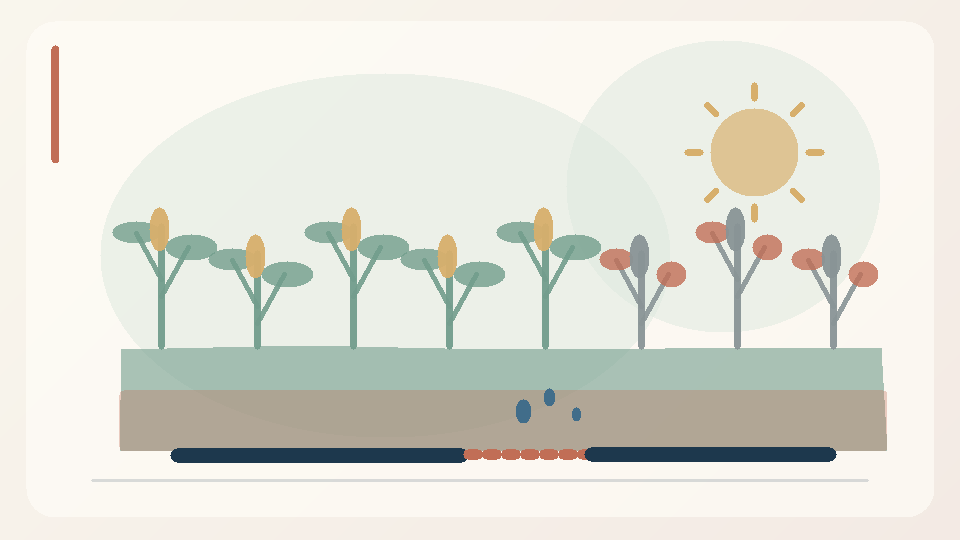
Did you know? A crop can fail even when a farm has good seeds, enough fertiliser and a strong market. Soil structure, water timing, crop health and the cost of inputs must work together before an agricultural season produces a dependable result.
Quick answer: Agricultural systems fail when soil degradation, drought, flooding, disease, unsuitable crop choices or weak input and market links prevent sustainable production. The last bad harvest may be visible, but the underlying problem can develop over many years.
This practical guide explains land degradation, irrigation risks, pests, farm economics and crop resilience, including the FAO’s 2025 research on reduced yields. It is written to help readers distinguish poor field conditions from failures after harvest.
Trace the chain: productive land → soil and water → suitable inputs and skills → healthy plants or animals → harvest → safe storage and market access.
Choose your reading route
- The quick answer: why agriculture can fail
- A farm is a biological and economic system
- What the FAO’s 2025 land-degradation research found
- Why soil is more than brown material beneath plants
- Erosion removes more than visible dirt
- When water arrives at the wrong time
- Groundwater can conceal a long-term problem
- Salt can turn irrigated land into less productive land
- Why fertiliser cannot fix every yield problem
- Seeds, genetics and local adaptation
- Pests and crop disease turn biological networks against production
- Livestock systems have their own failure pathways
- Energy failures can stop irrigation and cold storage
- When the price of inputs rises faster than crop income
- Why a good harvest can still become wasted food
- Crop concentration creates a shared dependency
- Why climate adaptation must match the crop and place
- Case study in principle: land degradation and recovery
- A fictional farm: strong rainfall, weak soil
- A second fictional farm: excellent crops, no viable market
- What a farm-risk checklist should cover
- How to tell whether agricultural repair has worked
- Frequently asked questions
The quick answer: why agriculture can fail
Did you know? A field may look green and healthy early in the season yet produce a disappointing harvest because its soil structure, available water or crop health changed at the wrong time. Agriculture is not simply placing seeds in the ground and waiting.
Agricultural production depends on land, soil organisms, nutrients, water, weather, suitable plant or animal genetics, equipment, labour, inputs, finance and market access. A weakness in one resource can undermine all the effort invested in the others.
Quick answer: agricultural systems fail when their biological, environmental or operational conditions cannot reliably support safe and sustainable production. Causes include soil degradation, drought, flooding, pests, diseases, unsuitable crop choices, poor management and broken input or market connections. A single bad harvest is not necessarily permanent system collapse. Diagnosis must identify the crop, location, season, main constraint and options for recovery.
A farm is a biological and economic system
Imagine a grower planting vegetables. The plants need appropriate sunlight, temperature, water, minerals and biological conditions. The grower also needs seeds, tools, suitable timing, trained labour and a buyer who can receive the produce in usable condition.
A technically productive field can still be an unviable business if farm-gate prices remain below sustainable costs. Conversely, strong market demand cannot make plants grow without the water or growing conditions they require. Farming combines a living system with practical institutions and financial decisions.
The complete journey is land and resources → inputs → planting and care → crop or animal health → harvest → safe handling → market and livelihood. Each handoff matters. The useful outcome is not the number of hectares planted but sustained, appropriate production and the wellbeing of people who depend on it.
What the FAO’s 2025 land-degradation research found
The FAO State of Food and Agriculture 2025 examines human-induced land degradation and its effects on agricultural yields across different types of farms. It identifies land degradation as a significant constraint on production and rural livelihoods.
In its 3 November 2025 release, FAO estimated that about 1.7 billion people live in areas where crop yields are at least 10% lower because of human-induced land degradation. This is an estimate of affected populations and yield impacts under the report’s methods, not a claim that 1.7 billion people own damaged farmland or face the same loss.
The report also explores how landholding scale changes available solutions. A smallholder without reliable credit may need different support from a large farm with mechanisation and irrigation. Restoration requires sound evidence and policies matched to local realities rather than a single method applied everywhere.
Why soil is more than brown material beneath plants
Healthy agricultural soil is a physical, chemical and biological environment. Its structure affects the movement of water and air. Organic matter and organisms contribute to nutrient cycling and other functions. Different crops need different conditions, and the underlying soil type also matters.
Soil can deteriorate through erosion, salinity, compaction, loss of organic matter or other changes. These processes do not all respond to the same intervention. A field with poor drainage may need a different approach from one losing topsoil to wind or water.
The correct investigation begins with observations and appropriate testing. Is water entering and leaving the root zone? Are nutrients available in usable forms? Are soils compacted or eroding? Simply adding fertiliser cannot rebuild every damaged soil function. Fertility, structure and biological activity must be evaluated together.
Erosion removes more than visible dirt
Wind and water can transport soil particles away from a field. Some erosion is part of natural landscapes, but accelerated erosion associated with unsuitable land management can damage agricultural capability.
Loss of topsoil may reduce nutrient-rich material and affect infiltration or root growth. The consequences vary with soil, slope, rainfall and cultivation. Eroded sediment may also reach streams or reservoirs, creating problems beyond the farm boundary.
Possible responses include maintaining appropriate ground cover, managing slopes and controlling runoff where conditions warrant. FAO’s 2025 report discusses sustainable land-management practices that can help avoid or reverse degradation in suitable settings. What works depends on local agronomy, farmer resources and careful monitoring. The objective is maintaining productive land, not simply preventing any soil particle from moving under all conditions.
When water arrives at the wrong time
A crop needs water in quantities and patterns appropriate to its growth stage and local conditions. Rainfall can be abundant over a year yet poorly timed for a particular harvest. Dry weather during a sensitive growth phase may reduce yield even if rain arrives later.
Waterlogging can also harm roots by reducing suitable oxygen conditions. Floods may damage plants, equipment and access routes. Thus both scarcity and excess can create failures, and a region can experience drought and flooding at different points within one agricultural year.
Irrigation helps where feasible, but it depends on reliable water resources, suitable design, energy and maintenance. Water supply decisions also affect downstream users and ecosystems. A resilient agricultural plan evaluates both agronomic needs and the limits of the wider watershed. Read Why Water Systems Fail for connected infrastructure pressures.
Groundwater can conceal a long-term problem
A farmer may obtain reliable irrigation from a groundwater source during a dry season. But if withdrawals exceed sustainable replenishment under the local conditions, water levels can fall over time. Pumping may become more expensive, and some sources may eventually become unsuitable or inaccessible.
Groundwater behaviour depends on geology, aquifer characteristics, recharge and interactions with rivers or ecosystems. A short observation period may not reveal slow depletion. Good planning therefore needs monitoring over appropriate timescales.
It would be misleading to declare all groundwater irrigation harmful or sustainable without context. Managed groundwater can be valuable for food production and drought resilience. The actual question is whether withdrawals, quality and environmental needs are compatible with long-term use. A short-term successful harvest should not come at the hidden expense of future farms and communities.
Salt can turn irrigated land into less productive land
Irrigation water may contain dissolved salts. Under particular soil, drainage and climate conditions, water can leave salts accumulating in the root zone. Some crops are more sensitive than others, and saline conditions can reduce their ability to take up water and grow.
Poor drainage can intensify the problem. An attempt to improve yields through more irrigation may worsen long-term conditions if the underlying water and salt balance is not managed appropriately.
Effective remedies depend on the source water, soil, crop tolerance and feasible drainage. Not every field needs the same treatment, and some heavily affected sites face difficult economic constraints. The lesson is that an input such as irrigation is not automatically beneficial without regard to its cumulative effects. Agriculture succeeds through maintaining the full resource balance, not one season’s volume of water delivered.
Why fertiliser cannot fix every yield problem
Plants need suitable nutrients, but nutrients are only one part of their growing conditions. A crop facing water stress, poor root growth or disease may not respond to additional fertiliser as expected.
Excessive or poorly timed nutrient application can also waste money or cause environmental harm. The correct form and amount depend on crop requirements, soil conditions and local management. A higher input bill does not prove a more productive farm.
Soil testing and agronomic advice can help distinguish nutrient deficiency from other constraints. A responsible strategy aims to provide needed nutrients while protecting soil and water quality. The broader systems lesson is simple: improving an input that is not currently the bottleneck may produce little benefit while leaving the actual failure uncorrected.
Seeds, genetics and local adaptation
Different varieties of a crop have different characteristics, including maturation timing, susceptibility to particular diseases and suitability for different environmental conditions. A variety performing well in one region may not deliver the same result elsewhere.
Farmers may also face difficulty obtaining reliable, appropriate seeds at the correct time. Quality and supply-chain constraints can affect germination, planning and harvests. Selecting a high-yielding variety cannot compensate for a mismatch between its needs and the local climate or soil.
Resilient farming combines appropriate crop selection with sound management and suitable input quality. New varieties can offer important benefits but need evaluation for the actual production environment. A seed advertisement is not the same as locally verified performance over relevant seasons and conditions.
Pests and crop disease turn biological networks against production
Farms operate within ecosystems. Insects, fungi, bacteria, viruses and other organisms can affect crops or livestock, sometimes reducing output substantially. The consequences depend on the host, environment, management and timing of the outbreak.
A pest outbreak may become more damaging when crops lack diversity or when conditions favour rapid spread, though not every diverse farm avoids serious problems. A disease can also move through planting material or other supply pathways.
Sound protection involves appropriate monitoring, prevention, resistant varieties where suitable and legally approved management methods guided by qualified expertise. Simply applying more chemicals indiscriminately can create health, environmental or resistance concerns. The correct approach identifies the organism and its biology before choosing control measures. This is one reason agricultural failure is a scientific diagnosis, not a reflexive instruction to use more inputs.
Livestock systems have their own failure pathways
Animal agriculture depends on feed, water, appropriate housing, veterinary care, biosecurity, environmental conditions and welfare. Disease outbreaks, heat stress, unavailable feed or weak management can affect animal health and production.
A farm may appear successful based on animal numbers while facing hidden welfare, disease or cost pressures. Transport and market conditions also affect whether the output can be delivered safely.
The response varies by species, production system and local regulations. Qualified animal-health professionals should guide diagnosis and disease controls. As with crops, one intervention rarely repairs every weakness. A healthy livestock operation requires both suitable biological conditions and practical systems for monitoring, feed supply, sanitation and accountability.
Energy failures can stop irrigation and cold storage
Pumps, processing equipment and refrigerated storage can depend on electricity or fuel. A power outage may interrupt irrigation schedules, delay food handling or compromise the condition of perishable products even when the harvest itself was healthy.
Backup arrangements help only when adequately designed, maintained and supplied. An emergency generator cannot replace unavailable parts or guarantee that spoiled food becomes safe again when cooling resumes.
Farming resilience should map the infrastructure supporting critical operations, including power, water and communications. The appropriate alternative depends on the farm and product. Read Why Power Grids Collapse for a broader infrastructure example. Agricultural success depends partly on systems outside the farm gate.
When the price of inputs rises faster than crop income
A farm may produce a good harvest but lose money because seed, fertiliser, fuel, labour or financing costs increased. Higher output does not automatically mean higher income.
Some farmers must buy inputs months before selling their harvest. Borrowing and price uncertainty can therefore affect which crops they plant or how much land they cultivate. A market price that appears attractive today may be different when the harvest is ready.
This creates economic failure distinct from the biological failure of crops. Policy analysis must distinguish yield from profitability and household welfare. Better access to trustworthy market information, appropriate finance and realistic risk management can help, but solutions depend on local conditions. A farm that cannot sustain the next production cycle is not healthy merely because the last harvest was large.
Why a good harvest can still become wasted food
Harvested produce often requires drying, grading, suitable packaging, storage and transport. Without timely handling, perishable crops may lose value or become unusable. Grain also needs storage conditions appropriate to its characteristics and risks.
A rural road closure can leave growers with marketable produce that cannot reach buyers. A refrigeration problem can undermine the quality of goods that were harvested successfully. These losses differ from inadequate crop yield but can have similar consequences for farm income.
The whole system should be evaluated from planting to actual buyer receipt. For the downstream failure pathway, see Why Food Systems Fail. The useful measure is not only kilograms picked but safe, usable and economically valuable output reaching the next stage.
Crop concentration creates a shared dependency
Specialising in one crop can make farming efficient by allowing focused equipment, expertise and supply contracts. However, it also increases exposure to risks that affect the chosen crop or its market.
An outbreak targeting that species, a change in purchase demand or an input shortage can affect a large share of farm income at once. Diversification may reduce some risks but also introduce new costs and management challenges.
The relevant decision is not whether every farm must grow many crops. It is whether the enterprise understands its exposures and has suitable alternatives or protections. These may include different planting times, market relationships, financial planning or crop choices, subject to local feasibility. Resilience involves a risk portfolio rather than a universal farming style.
Why climate adaptation must match the crop and place
Changing temperatures, rainfall patterns and weather extremes can affect agricultural suitability and yields. But the effects differ by crop, growth stage, geography and available resources. A technique useful in one watershed may be inappropriate in another.
Adaptation options can include monitoring, suitable crop varieties, improved water management, soil protection and adjustments to production schedules. Their benefits require local evidence and realistic assessment of costs.
No adaptation technique guarantees success under every extreme event. Farming also has environmental consequences, so improvements should consider resource conservation and the broader landscape. Sound policy connects climate information with what growers can actually do, including the financing and skills needed to act.
Case study in principle: land degradation and recovery
FAO’s 2025 analysis estimates that restoring a share of degraded existing cropland could recover important production potential. Its public release models that reversing 10% of human-induced degradation on existing croplands could restore enough production to feed an additional 154 million people annually under the report’s assumptions.
This is a scenario estimate, not a guarantee that planting one cover crop would produce exactly that outcome everywhere. Implementation depends on land conditions, available resources, land rights, incentives and management over time.
The value of the finding is that preventing degradation and rebuilding productive soil can be economically and socially meaningful. Land restoration is not only a conservation goal; it can protect future food production and rural livelihoods. Evaluating a programme requires comparing relevant soil and yield outcomes before and after appropriately designed interventions.
A fictional farm: strong rainfall, weak soil
Imagine a fictional farm receiving plentiful seasonal rain. Farmers add fertiliser and plant an appropriate seed variety, but years of soil compaction and runoff have reduced infiltration. Heavy rainfall flows across the surface instead of supplying roots effectively.
Yields disappoint despite apparently adequate total rain and expensive inputs. Blaming the seed alone misses the underlying physical condition.
The appropriate investigation would examine soil structure, drainage, nutrient conditions and the timing of rainfall. A locally suitable soil-management plan may improve future outcomes. This case is invented to teach causal diagnosis: agricultural failure often comes from interactions among resources rather than one missing ingredient.
A second fictional farm: excellent crops, no viable market
Imagine a grower producing high-quality vegetables. A major transport corridor closes during harvest, and an alternative buyer is far away. Produce accumulates, suitable storage is limited and the farm cannot sell enough of the crop before quality declines.
The agronomy succeeded, yet the economic system failed. The immediate fix is not more fertiliser or irrigation. It might involve safe storage, alternative markets or transport access where feasible.
This example shows why agricultural success must include the pathway to market. The farmer’s effort and knowledge are real even when the final commercial outcome disappoints. A useful response traces the actual bottleneck and protects livelihoods instead of presuming low income proves poor farming.
What a farm-risk checklist should cover
Begin with the intended product, the local production calendar and essential resources. Identify soil condition, water, weather exposure, seed and animal health, suitable inputs, equipment, workforce and finance. Distinguish what is within the farm’s control from shared external dependencies.
Next estimate the consequences of realistic interruptions: one week without irrigation, an unavailable seed shipment, a major pest problem or delayed transport at harvest. The severity depends on timing and product.
Finally assign observable warning signs and sensible actions. A measured decline in water availability should lead to a defined assessment, not a vague instruction to worry. Risk planning becomes useful when it tells the farmer which uncertainty matters most and what options genuinely exist.
How to tell whether agricultural repair has worked
A new irrigation system, training course or soil-management scheme is an input. The outcome should be measured through usable production, resource condition, income stability and effects on people and ecosystems.
One successful growing season may be encouraging but not prove long-term resilience. Some improvements take time, and unusual weather can affect results. Monitoring should use appropriate comparisons and record uncertainty.
The best repair improves the farm’s ability to sustain productive capability under realistic variability. It should avoid shifting hidden damage to neighbouring communities or future seasons. A resilient farm is not one that never faces difficulty; it is one that can understand, adapt to and recover from important pressures.
Frequently asked questions
Why can a farm fail even when it receives enough rain?
Water timing, soil infiltration, drainage, nutrients and crop health matter. Total seasonal rainfall alone does not establish that plants received suitable water conditions at critical stages.
What is land degradation?
It is deterioration in land condition or productive and ecological functions through processes such as erosion, salinity, compaction or other change. Causes and remedies vary by location.
What did FAO report in 2025?
FAO estimated that roughly 1.7 billion people live where yields are at least 10% lower because of human-induced land degradation, using its particular analytical framework.
Can fertiliser solve every low-yield problem?
No. Water stress, soil structure, disease, salinity and unsuitable crop conditions can constrain growth independently of nutrient supply.
Why can irrigation cause long-term problems?
Under unsuitable drainage and water conditions, salts may accumulate or groundwater withdrawals may become unsustainable. Outcomes depend on local hydrology, soils and management.
Is crop diversity always better?
Diversification can reduce some exposures but involves costs and agronomic trade-offs. A farm should choose an appropriate risk strategy for its crops, markets and conditions.
How do pests and diseases harm production?
They can damage plants or animals, reduce yields and quality, and require costly control. Proper identification and context-specific management are essential.
Why can a high-yield harvest still be unprofitable?
Input prices, finance, labour, transport, storage and the sale price affect profitability. Yield is a biological outcome; income depends on the wider economic chain.
What is agricultural resilience?
The capacity to maintain or recover essential productive functions under credible stresses, including weather, resource, biological and market disruptions.
How should students analyse crop failure?
Identify the crop, place and season. Map soil, water, inputs, biological conditions and market access. Test which factor limited the outcome instead of assuming one universal cause.
Primary sources and further reading
The FAO State of Food and Agriculture 2025 examines land degradation across farm scales. Its 3 November 2025 release explains the 1.7 billion affected-population estimate and a scenario for restoring degraded cropland. These figures are dated estimates, not individual farm diagnoses.
Related guides: Why Food Systems Fail | Harvest Shocks, Prices and Waste; Why Ecosystems Collapse | Biodiversity Loss, Tipping Points and Recovery; Why Water Systems Fail | Leaks, Drought and Unsafe Supply; Why Supply Chains Break | Bottlenecks, Dependencies and Delays.
Final thought: A thriving farm is a dependable relationship among land, water, biology, skills and livelihoods. Repair begins by discovering which relationship has stopped working and why.