
Small Group Tutorials
Here to help students catch up, keep up, and move ahead. Book a consultation here.
Project Type: Secondary Mathematics Tuition
-
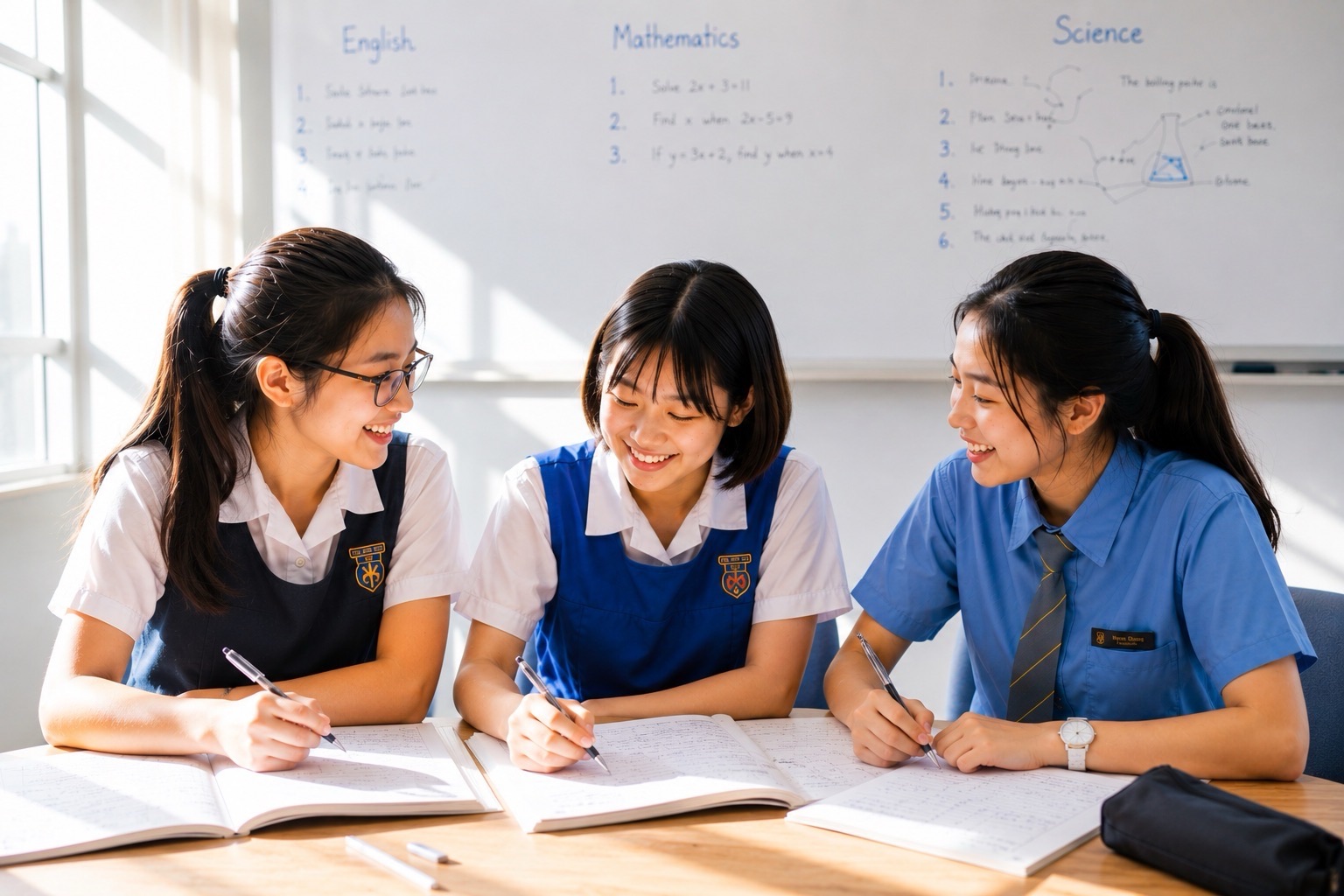
Mathematics Tuition Sengkang | Small Groups of 3 Students
Mathematics Tuition for Sengkang students in small groups of up to three. Build strong foundations, problem-solving skills and exam confidence for Primary, PSLE, Secondary, E-Math and A-Math. Mathematics Tuition Sengkang | Small Groups of 3 Students Parents searching for Mathematics Tuition in Sengkang are often trying to solve more than one visible problem. Their child…
-

Bukit Timah Mathematics Capability Atlas
The content describes the Bukit Timah Mathematics tuition program for students from Primary 1 to Secondary 4. It emphasizes a capability-transfer approach to mathematics, highlighting skills essential for real-world applications. The program aims to diagnose and repair learning gaps while fostering independence through small-group tuition, integrating broader educational contexts like Singapore's operational systems.
-
Secondary Mathematics Tuition | Buona Vista — 3 Pax Small Groups Tuition
eduKateSG offers tailored Secondary Mathematics tuition for Buona Vista families, focusing on small 3-pax classes. The program develops students' understanding through targeted instruction, fostering mathematical reasoning and independence. The curriculum adapts to individual needs across various levels, ensuring effective preparation for school assessments and examinations while enhancing confidence in mathematical skills.
-
Secondary Mathematics Tuition | Ghim Moh — 3 Pax Small Groups | What Happens in Secondary Small Groups Tuition
eduKateSG offers tailored Secondary Mathematics tuition for Ghim Moh students in small groups of three. With structured lessons for Secondary 1 to 4, students receive individualized support to develop a solid understanding of Mathematical concepts. The focus is on foundational skills, algebra fluency, and examination readiness to foster confidence and independence in problem-solving.
-

Secondary Mathematics Tuition | Toh Tuck — 3 Pax Small Groups | What Happens in Secondary Small Groups Tuition
eduKateSG offers specialized Secondary Mathematics tuition in small 3-pax groups, focusing on resolving individual learning gaps and fostering independence. With a tailored approach, tutors observe and address each student's unique challenges, ensuring progression through structured lessons and continuous assessment. The goal is to build a strong mathematical foundation and enhance examination performance.
-
Secondary Mathematics Tuition | Woodlands — 3-Pax Small Groups | What Happens in Secondary Small Groups Tuition
eduKateSG offers small-group Secondary Mathematics tuition for students in Woodlands, focusing on understanding concepts rather than merely completing worksheets. With a maximum of three students per class, lessons emphasize personalized guidance, foundational repairs, and preparation for assessments. This tailored approach nurtures confidence, accuracy, and independent problem-solving skills across all secondary levels.
-
Secondary Mathematics Tuition | Dover — 3 Pax Small Groups | What Happens in Secondary Small Groups Tuition
eduKateSG offers specialized Secondary Mathematics tuition for Dover students in small 3-pax groups. Each 1.5-hour lesson emphasizes understanding, guided practice, and targeted preparation for assessments. This approach addresses various learning pathways, ensuring students build a strong mathematical foundation while adapting to increasing school demands and ultimately improving performance and confidence in mathematics.
-
Secondary Mathematics Tuition | Sembawang — 3 Pax Small Groups | What Happens in Secondary Small Groups Tuition
eduKateSG offers specialized Secondary Mathematics tuition in Sembawang for students in small groups of three. The program emphasizes individualized learning to address each student's unique challenges and strengthen their mathematical foundations. Lessons focus on concept mastery, error correction, and building confidence for school assessments and examinations, tailored to meet diverse learning needs across different secondary…
-
Secondary Mathematics Tuition | Tiong Bahru — 3-Pax Small Groups | What Happens in Secondary Small Groups Tuition
Secondary Mathematics becomes easier when the student’s thinking becomes visible. Not only the final answer. The working before it. The line where a negative sign disappears. The moment the student chooses the wrong formula. The hesitation before an algebraic expression. The skipped step that makes the next three steps unreliable. At eduKateSG, our Secondary Mathematics…
-
Secondary Mathematics Tuition | Seletar — 3 Pax Small Groups | What Happens in Secondary Small Groups Tuition
eduKateSG offers specialized secondary mathematics tuition in Punggol for Seletar students, focusing on small classes of three. The program emphasizes foundational understanding in algebra and various mathematical concepts, tailored to individual student needs. It aims to diagnose weaknesses, promote independent problem-solving, and enhance examination performance through structured lessons and personalized attention.
-
Secondary Mathematics Tuition | Holland Village — 3 Pax Small Groups | What Happens in Secondary Small Groups Tuition
eduKateSG offers premium small-group Secondary Mathematics tuition for students in Holland Village. With classes of three, the program emphasizes understanding concepts, repairing foundational gaps, and enhancing independent problem-solving skills from Secondary 1 to 4. The approach fosters confidence and clarity in recognizing mathematical principles, aiding students in achieving academic success.
-
Secondary Mathematics Tuition | Thomson — 3 Pax Small Groups | What Happens in Secondary Small Groups Tuition
eduKateSG offers small-group Secondary Mathematics tuition, focusing on personalized learning for Thomson students. Lessons emphasize understanding concepts, correcting mistakes, and preparing for assessments in a calm environment. With only three students per class, tutors can closely monitor progress, helping learners build confidence and mastery of increasingly complex mathematical concepts.
Secondary Mathematics Tuition by eduKateSG is a Singapore tuition branch that explains Secondary Mathematics as a system of number, algebra, geometry, graphs, measurement, statistics, probability, reasoning, modelling, examination control and mathematical confidence.
This project studies Secondary Mathematics not only as formulas, worksheets, school tests or examination practice, but as the full reasoning system a teenager uses to understand relationships, manipulate symbols, read graphs, solve problems, interpret data and communicate mathematical thinking clearly.
In Primary Mathematics, many students learn through arithmetic, models, fractions, ratio, percentage and problem-solving heuristics.
In Secondary Mathematics, the machinery changes.
Numbers become algebra.
Word problems become equations.
Shapes become geometry.
Patterns become graphs.
Data becomes interpretation.
Methods become arguments.
Working becomes evidence.
The student is no longer just finding the answer.
The student must show a controlled route to the answer.
Across the Secondary Mathematics Tuition articles, eduKateSG explores how students move from Secondary 1 to Secondary 4, from Primary-style problem-solving into algebraic thinking, from arithmetic confidence into symbolic control, from simple diagrams into geometry, from tables into graphs, from topic practice into full-paper strategy, and from school Mathematics into national examination readiness.
Secondary Mathematics is rarely just one topic problem.
It is a layered process involving arithmetic fluency, number sense, algebraic manipulation, equations, inequalities, expansion, factorisation, graphs, functions, coordinate geometry, angles, similarity, congruence, trigonometry, mensuration, statistics, probability, vectors, transformations, problem-solving, modelling, working accuracy, time management and emotional control under examination pressure.
A student may appear to struggle with algebra, but the real gap may be weak arithmetic.
A student may appear to struggle with graphs, but the real gap may be poor understanding of relationships.
A student may appear to struggle with geometry, but the real gap may be weak visual reasoning.
A student may appear careless, but the real gap may be poor working discipline.
A student may appear slow, but the real gap may be weak method selection.
This means Secondary Mathematics tuition must begin with diagnosis.
Not every Mathematics mistake is the same mistake. Some students do not understand the concept. Some understand the concept but cannot start the question. Some know the method but choose the wrong route. Some can solve routine questions but collapse when the context changes. Some copy numbers wrongly. Some skip working. Some lose algebraic control. Some do not know how to check whether the answer makes sense.
Good Secondary Mathematics tuition helps parents and students see the difference.
It should not simply add more questions.
It should make the mathematical route clearer.
At eduKateSG, we help students catch up, keep up and move ahead by identifying where the real Mathematics gap is before more practice becomes more repetition. A student improves when weak foundations are rebuilt, when methods are explained clearly, when repeated errors are compressed, and when better working habits are trained until they become stable.
This project also studies the Secondary 1 transition.
Secondary 1 Mathematics is not simply Primary 7 Mathematics. Students enter a new mathematical environment where algebra, negative numbers, equations, geometry, graphs and proportional reasoning begin to matter more. The child who relied mainly on arithmetic speed may suddenly meet symbolic work that feels unfamiliar.
This is where many students first realise that Mathematics has changed language.
The question no longer asks only, “Can you calculate?”
It begins to ask, “Can you represent the unknown?”
Secondary 2 is the consolidation year.
This is where algebra, graphs and geometry start to carry more weight. Students must strengthen manipulation, understand linear relationships, read diagrams accurately, work with angles, manage mensuration, interpret data and build enough confidence before the upper-secondary jump.
Secondary 2 is also a route-check year.
Some students are preparing for G2 Mathematics.
Some students are preparing for G3 Mathematics.
Some students are preparing for Additional Mathematics readiness.
Some students are trying to recover foundations before Secondary 3 makes the load heavier.
The year matters because weak habits harden if they are not corrected early.
Secondary 3 is the upper-secondary jump.
Mathematics becomes more connected. Algebra, graphs, geometry, trigonometry, statistics, probability and application questions begin to speak to one another. The student must learn to hold more than one idea at a time. It is no longer enough to know a topic in isolation. The student must learn how topics combine under exam conditions.
Secondary 3 is where the examination clock starts.
A weak Secondary 3 foundation makes Secondary 4 stressful.
A strong Secondary 3 foundation makes Secondary 4 manageable.
The difference is not talent alone.
The difference is structure, correction and time.
Secondary 4 is the final conversion year.
This is where years of learning must become marks. Students must practise full papers, manage timing, recognise question types, select methods quickly, avoid repeated traps, show working clearly, recover from difficult questions and protect accuracy from the first page to the last page.
Secondary 4 Mathematics tuition must therefore train both understanding and examination control.
The student needs to know the topic.
But the student also needs to know what to do when the question looks unfamiliar.
This is where many marks leak.
Not because the student knows nothing.
But because the student cannot control enough parts of the mathematical system at once.
Secondary Mathematics Tuition by eduKateSG also studies the algebra problem.
Algebra is the spine of Secondary Mathematics.
It carries equations.
It carries graphs.
It carries word problems.
It carries proportional reasoning.
It carries functions.
It carries trigonometry.
It carries Additional Mathematics readiness.
A student who has weak algebra may struggle everywhere, even when the visible topic is not called algebra.
This is why algebra cannot be treated as one chapter to survive. It must become a working language. Students must understand symbols, terms, coefficients, brackets, expansion, factorisation, substitution, simplification and equation-solving as part of one connected system.
Algebra is not decoration.
Algebra is control over the unknown.
Graphs are another major jump.
In Primary Mathematics, students may read simple charts and tables. In Secondary Mathematics, graphs become a way to show relationships. A line can show rate. A curve can show change. A gradient can show steepness. An intercept can show meaning. A point of intersection can show a solution.
Graphs punish students who only memorise.
They reward students who understand relationships.
Geometry adds another pressure.
Geometry is not just recognising shapes. It is the discipline of seeing structure. Students must track angles, parallel lines, congruence, similarity, circles, triangles, polygons and spatial relationships. They must know when to use a theorem, how to justify a step and how to preserve logic in the working.
Many students lose geometry marks not because they cannot see the diagram, but because they cannot explain the reason.
Secondary Mathematics is full of this problem.
The student may know.
But the working does not prove that the student knows.
In Mathematics, working is not paperwork.
Working is the argument.
This project also studies the problem-solving and modelling load.
Secondary Mathematics increasingly asks students to interpret real-world contexts, translate information into mathematical form, select relevant methods, solve the problem and interpret the answer back in context. This is where students who only memorise question templates begin to struggle.
A real-world problem may involve units, scale, percentage, rate, graphs, estimation, probability, diagrams or hidden assumptions.
The student must slow the problem down.
What is given?
What is asked?
What is changing?
What is fixed?
What is the relationship?
Which method fits?
What does the answer mean?
This is why eduKateSG treats Secondary Mathematics as a route-recognition problem before it becomes a speed problem.
Speed without understanding is fragile.
Practice without correction is repetition.
Memorisation without route control breaks under pressure.
Secondary Mathematics Tuition by eduKateSG also studies the parent’s problem.
Parents often see marks, careless mistakes, failed tests, unfinished papers and blank workings first. But they may not see the hidden machinery underneath. A child may be losing marks because of weak arithmetic, poor algebra control, poor graph interpretation, weak geometry reasoning, fragile trigonometry, poor unit handling, slow method selection, careless notation, weak checking habits or examination anxiety.
These problems may look similar from the outside.
They are not similar on the inside.
This is why eduKateSG treats Secondary Mathematics as a diagnosis problem before it becomes a practice problem.
More practice helps only when the correction is clear.
Doing more papers does not help if the student keeps losing marks through the same algebra mistake.
Doing more worksheets does not help if the student does not know why the method works.
Doing more timed practice does not help if the student has no route when the question changes.
Good Mathematics tuition repairs the method.
It repairs the thinking.
It repairs the working habit.
It repairs the confidence to begin.
Secondary Mathematics is also a pathway subject in Singapore.
Under Full Subject-Based Banding, students may offer subjects at different subject levels as they progress through secondary school. Mathematics can sit at different levels for different students, with different demands, different pacing and different future pathways.
This makes parent clarity important.
A student doing G2 Mathematics may need stronger foundation repair and confidence.
A student doing G3 Mathematics may need sharper exam control and route recognition.
A student preparing for Additional Mathematics may need stronger algebra, graph and trigonometry readiness.
A Secondary 4 student may need full-paper strategy and error compression.
The correct support depends on where the student is, what the school demands, and what future route the family is preparing for.
Secondary Mathematics Tuition by eduKateSG connects Mathematics learning to our wider EducationOS, MathOS, TuitionOS, ParentOS and CivilisationOS framework. Mathematics is not only an examination subject. It is one of the systems civilisation uses to measure, model, compare, optimise, build, predict, analyse risk, design technology and reason under constraint.
When a student gains control of Mathematics, the student gains more than marks.
The student gains a clearer way to think.
This does not mean every student will love Mathematics immediately.
Many students fear it first.
They fear algebra.
They fear graphs.
They fear geometry.
They fear trigonometry.
They fear long word problems.
They fear full papers.
They fear not knowing how to start.
They fear seeing a question that does not look like the one they practised.
The solution is not panic.
The solution is structure.
We rebuild foundations carefully.
We strengthen algebra as a working language.
We teach students how graphs show relationships.
We train geometry through reasons, not guessing.
We help students read questions properly.
We teach them how to select methods.
We correct repeated mistakes before they become permanent.
We train students to show working clearly.
We prepare students to face full papers with better timing, accuracy and recovery.
Secondary Mathematics tuition should repair confusion.
It should repair weak foundations.
It should repair poor algebra control.
It should repair repeated careless mistakes.
It should repair weak graph understanding.
It should repair poor geometry reasoning.
It should repair panic when questions look unfamiliar.
It should repair the belief that Mathematics improvement is random.
Mathematics can be taught clearly. Algebra can be strengthened. Graphs can be understood. Geometry can be reasoned. Trigonometry can be organised. Statistics can be interpreted. Probability can be trained. Working habits can be improved. Examination confidence can be built.
Secondary Mathematics Tuition by eduKateSG is a long-form Singapore tuition knowledge branch for parents and students who want to understand how Secondary Mathematics works, why students struggle, where marks leak, how foundations are rebuilt, how Secondary 1 prepares for Secondary 2, how Secondary 3 prepares for Secondary 4, how G2 and G3 demands differ, and why route recognition matters before pressure takes over.
This branch is for families who want Mathematics tuition that sees the student properly.
Not just the marks.
Not just the careless mistake.
Not just the failed test.
Not just the next worksheet.
But the real mathematical system underneath.
Secondary Mathematics Tuition by eduKateSG explains Mathematics as a system of number, algebra, geometry, graphs, measurement, statistics, probability, modelling, reasoning, working accuracy, examination control, parent clarity, student confidence and long-term mathematical repair.