
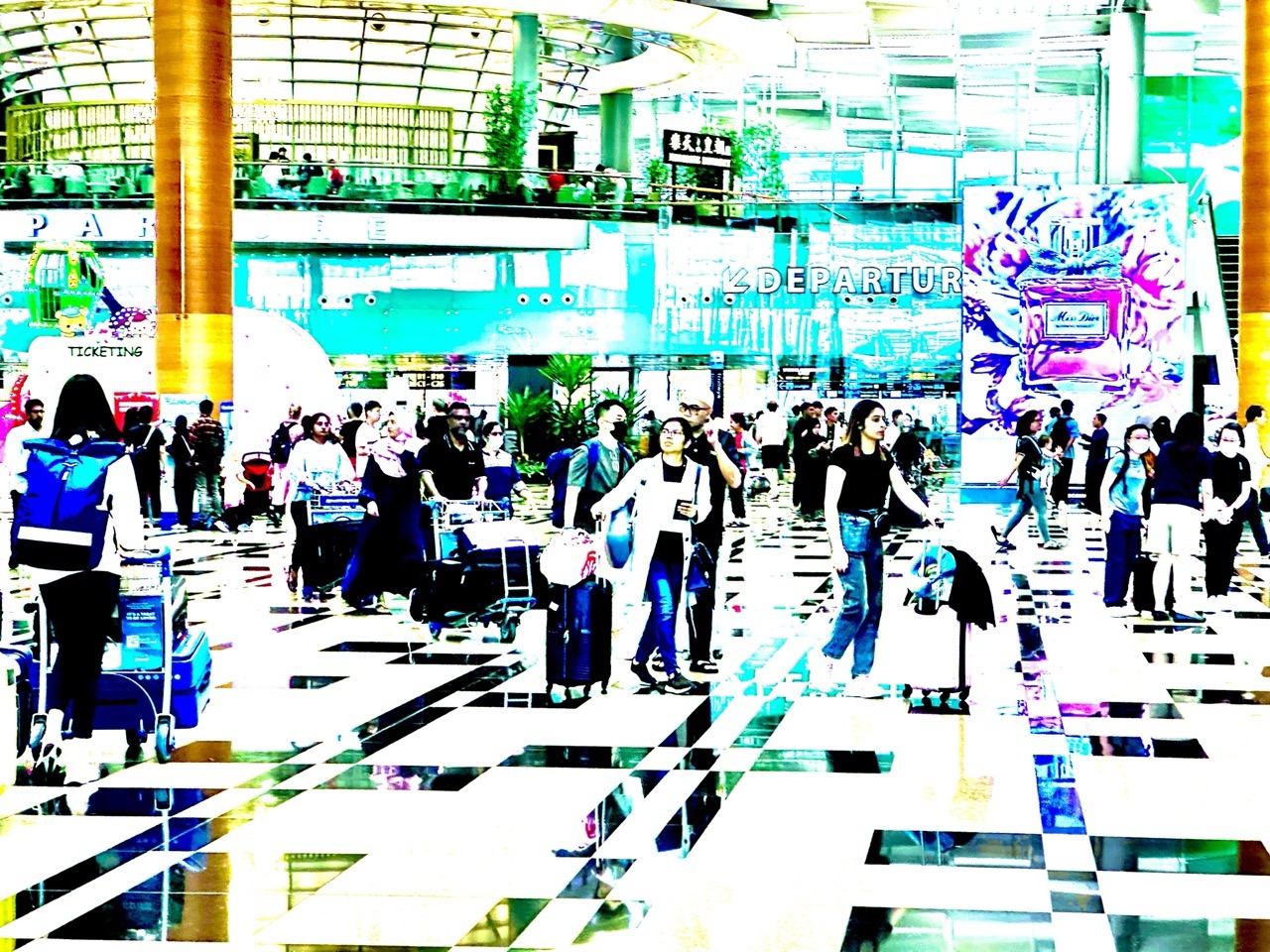
Changi Airport in one minute: which terminal, which zone, which route?
Landing at Changi Airport or departing from Singapore? The useful first questions are “Which terminal?”, “Is Jewel in the public area?”, “Which gate is my flight using?” and “Where is the MRT or taxi pick-up?” This guide answers those questions with 20 practical Singapore airport words and complete sample conversations. The names T1–T4, Jewel, Skytrain, SG Arrival Card and MRT are the vocabulary you will see on signs; plain English questions help you put those names to work.
This is not a challenge to sound more Singlish than the staff. In an airport, clarity matters: identify the flight number, distinguish public area from transit area and ask for a repeat when a direction affects your boarding or immigration. “Can or not?” may be familiar informal English in Singapore, but “Am I allowed to enter Singapore for this connection?” is the safer question when you need an official answer.
Facilities, airline arrangements, entry requirements and flight timings can change. The examples below are for learning, not real-time flight or legal advice. Verify your itinerary with the airline, current directions with Changi Airport and entry requirements with ICA. The 20 entries keep exactly the same numbering in English, Simplified Chinese, Hindi and Russian.
English · 简体中文 · हिन्दी · Русский
20 airport words at a glance · Twenty words explained for real airport situations · Five parts of a Changi Airport journey · Ten conversations to practise · Five-minute retrieval practice and a model journey · Ten questions visitors ask at Changi · Official sources and what they establish
20 airport words at a glance
The twenty names below are not all Singlish. Some are official airport terms; others are Singapore-specific place names. You can speak in ordinary English and still understand the local sign.
| No. | Term | What this helps you ask |
|---|---|---|
| 1 | Terminal / T1, T2, T3, T4 | T1 to T4 are terminal designations. Each contains specific airline services and passenger areas. |
| 2 | Arrival Hall | The arrivals hall is the public arrival-side area where travellers emerge after the appropriate entry and baggage steps. |
| 3 | Departure Hall | The departures hall is where passengers prepare to leave, find check-in services and proceed towards travel formalities. |
| 4 | Public area / landside | Public area or landside means a part of the airport outside its restricted departure transit zone, subject to normal access rules. |
| 5 | Transit area / airside | A restricted area used by eligible passengers moving through the airport without entering the public landside zone. |
| 6 | Jewel Changi Airport | Jewel is the well-known shopping and leisure complex at Changi, connected directly to T1 arrivals and linked to T2 and T3 on foot. |
| 7 | Skytrain | Skytrain is Changi’s complimentary inter-terminal people-mover connecting T1, T2 and T3 in public and transit areas. |
| 8 | Terminal 4 shuttle bus | A complimentary bus connection to T4, which is separate from the Skytrain network. |
| 9 | Flight information / status board | A digital display or official app entry showing the latest available flight schedule, terminal and status. |
| 10 | Self-service kiosk / bag drop | A kiosk may issue boarding documents or baggage labels, while bag drop accepts checked bags from eligible passengers. |
| 11 | Boarding pass | A document or accepted digital credential used for boarding, with flight and passenger details. |
| 12 | Boarding gate | A designated exit point through which passengers board a particular flight. |
| 13 | Boarding time / departure time | Boarding time is when boarding starts or a stated boarding deadline; departure time is the flight’s scheduled departure. |
| 14 | Immigration clearance | Formal entry or exit checks at the immigration checkpoint, conducted by authorised officers. |
| 15 | SG Arrival Card / SGAC | A required electronic arrival and health declaration for most travellers entering Singapore, subject to specified exceptions. |
| 16 | Baggage claim / carousel | The arrivals area and moving belt where checked bags from an arriving flight are delivered. |
| 17 | Missing baggage / lost and found | A missing checked bag is a baggage-handling matter; an item lost elsewhere on airport premises may follow a different lost-property process. |
| 18 | Connecting flight / transfer | A connecting flight continues your journey after you change aircraft or flight. Transfer refers to moving to the next service. |
| 19 | MRT / airport train | MRT is Singapore’s mass rapid transit rail system. Changi Airport MRT station links directly with T2 and T3. |
| 20 | Taxi stand / ride-hailing pick-up | A taxi stand serves licensed taxis; a ride-hailing pick-up point is the designated place for an app-booked vehicle. |
Choose the question you need to answer
Terminal and public / transit areas
Jewel, Skytrain and T4 shuttle
Arrival card, immigration and baggage
Twenty words explained for real airport situations
Read the example aloud, then ask a partner to change one detail—terminal, gate, service or destination. This builds usable vocabulary rather than a fixed script.
1. Terminal / T1, T2, T3, T4
Meaning: T1 to T4 are terminal designations. Each contains specific airline services and passenger areas.
Say it: “Is my flight departing from T2 or T3?”
Why it matters: Your airline, flight number and travel date matter more than which terminal that airline used last year. Recheck before travelling and after a schedule change. Be careful: Do not assume a connection between every pair of terminals is on the Skytrain. T4 transfers use shuttle buses in the relevant areas.
简体中文 01 · हिन्दी 01 · Русский 01
2. Arrival Hall
Meaning: The arrivals hall is the public arrival-side area where travellers emerge after the appropriate entry and baggage steps.
Say it: “Where is the Arrival Hall after baggage collection?”
Why it matters: If meeting a person, distinguish the arrivals hall from a specific pick-up door. Drivers may be directed to another level or designated collection area. Be careful: Do not tell someone to meet you at baggage claim unless they are allowed into that restricted area. Choose a public meeting point.
简体中文 02 · हिन्दी 02 · Русский 02
3. Departure Hall
Meaning: The departures hall is where passengers prepare to leave, find check-in services and proceed towards travel formalities.
Say it: “Please drop me at the Departure Hall for my terminal.”
Why it matters: Ask where your airline’s check-in row is; one terminal can have multiple rows or service points. Allow time for documents and baggage. Be careful: A car drop-off point is not automatically your boarding gate. The trip inside the terminal has several separate steps.
简体中文 03 · हिन्दी 03 · Русский 03
4. Public area / landside
Meaning: Public area or landside means a part of the airport outside its restricted departure transit zone, subject to normal access rules.
Say it: “Is this attraction in the public area?”
Why it matters: Jewel is in this public area. A transit passenger who wants to visit may need to enter Singapore through immigration and later return for a flight. Be careful: Being physically near a terminal attraction does not mean you can see it from airside. Check eligibility, documents and time first.
简体中文 04 · हिन्दी 04 · Русский 04
5. Transit area / airside
Meaning: A restricted area used by eligible passengers moving through the airport without entering the public landside zone.
Say it: “Can I remain in the transit area for my connection?”
Why it matters: Transfer arrangements depend on the itinerary, airline, checked baggage and onward boarding pass. Ask the airline if bags will be checked through and whether immigration is required. Be careful: Do not assume that a connecting ticket always lets you stay airside or use the transit shuttle to T4; check through-check eligibility.
简体中文 05 · हिन्दी 05 · Русский 05
6. Jewel Changi Airport
Meaning: Jewel is the well-known shopping and leisure complex at Changi, connected directly to T1 arrivals and linked to T2 and T3 on foot.
Say it: “I want to see Jewel. Do I need to clear immigration?”
Why it matters: It sits in the public landside area. Transit passengers must clear arrival immigration to visit, assuming they are eligible to enter Singapore. Be careful: Do not say “I’ll just take the Skytrain into Jewel”: a train passes through the complex but has no station inside it.
简体中文 06 · हिन्दी 06 · Русский 06
7. Skytrain
Meaning: Skytrain is Changi’s complimentary inter-terminal people-mover connecting T1, T2 and T3 in public and transit areas.
Say it: “Where can I take the Skytrain to Terminal 3?”
Why it matters: Follow the sign for the appropriate public or transit station. The service has operating hours; walking links are another option between T1–T3 where accessible. Be careful: It does not directly carry you to T4 or stop inside Jewel. Confirm disruptions and operating hours on the current airport page.
简体中文 07 · हिन्दी 07 · Русский 07
8. Terminal 4 shuttle bus
Meaning: A complimentary bus connection to T4, which is separate from the Skytrain network.
Say it: “Where is the free shuttle bus to Terminal 4?”
Why it matters: Public and transit shuttles operate from different boarding locations and may have different eligibility. Follow signs for your current zone and terminal. Be careful: If you are airside and not through-checked, do not assume you can use an airside T4 transfer. Ask your airline before moving.
简体中文 08 · हिन्दी 08 · Русский 08
9. Flight information / status board
Meaning: A digital display or official app entry showing the latest available flight schedule, terminal and status.
Say it: “Has the gate or departure time changed on the flight board?”
Why it matters: Check the flight number, date and destination together. A delayed flight may still require you to monitor updates and airline instructions. Be careful: A photograph of yesterday’s board is not live information. Treat airline and official airport updates as the basis for current decisions.
简体中文 09 · हिन्दी 09 · Русский 09
10. Self-service kiosk / bag drop
Meaning: A kiosk may issue boarding documents or baggage labels, while bag drop accepts checked bags from eligible passengers.
Say it: “Can I use the kiosk and bag drop for this flight?”
Why it matters: Use depends on airline, booking, baggage and document requirements. A staff member can direct you if a passport check or assisted service is necessary. Be careful: Printing a label is not proof the bag has been accepted. Follow the system’s confirmation and keep the baggage receipt.
简体中文 10 · हिन्दी 10 · Русский 10
11. Boarding pass
Meaning: A document or accepted digital credential used for boarding, with flight and passenger details.
Say it: “Is this my boarding pass for the next flight?”
Why it matters: Check the name, flight, travel date and displayed gate or time. On a connection, ask whether you already have the onward boarding pass. Be careful: It is not the same as an itinerary screenshot, visa, SG Arrival Card or baggage receipt. Each document serves a different function.
简体中文 11 · हिन्दी 11 · Русский 11
12. Boarding gate
Meaning: A designated exit point through which passengers board a particular flight.
Say it: “Which gate is boarding my flight now?”
Why it matters: Find the gate using the latest flight display rather than an earlier screenshot or printed itinerary alone. Gates can change. Be careful: Gate and terminal are not the same information. A gate may be some distance from your current lounge or shop.
简体中文 12 · हिन्दी 12 · Русский 12
13. Boarding time / departure time
Meaning: Boarding time is when boarding starts or a stated boarding deadline; departure time is the flight’s scheduled departure.
Say it: “Is that the boarding time or the flight departure time?”
Why it matters: They are not interchangeable. Airlines may require travellers at the gate before boarding closes, regardless of departure delays. Be careful: Ask “When must I be at the gate?” rather than using the printed flight time to decide when to leave a café.
简体中文 13 · हिन्दी 13 · Русский 13
14. Immigration clearance
Meaning: Formal entry or exit checks at the immigration checkpoint, conducted by authorised officers.
Say it: “Do I need to clear immigration for this part of my journey?”
Why it matters: A transit passenger leaving the restricted zone for Jewel must enter Singapore through the appropriate checkpoint. Requirements depend on nationality, documents and itinerary. Be careful: A boarding pass, a visa and an arrival card have different purposes; do not present one as a substitute for another or improvise answers to an officer.
简体中文 14 · हिन्दी 14 · Русский 14
15. SG Arrival Card / SGAC
Meaning: A required electronic arrival and health declaration for most travellers entering Singapore, subject to specified exceptions.
Say it: “Where is the official, free SG Arrival Card service?”
Why it matters: ICA says the SGAC is not a visa and submission is free via official channels, within three days including the arrival date. Passengers staying in transit without immigration clearance are exempt. Be careful: Do not pay an unofficial arrival-card website or assume submitting the form gives permission to enter Singapore.
简体中文 15 · हिन्दी 15 · Русский 15
16. Baggage claim / carousel
Meaning: The arrivals area and moving belt where checked bags from an arriving flight are delivered.
Say it: “Which baggage carousel is showing my flight?”
Why it matters: Match the current belt display with your flight. Use your baggage tag to identify the bag, especially when several similar suitcases arrive. Be careful: Belt numbers can change. Do not collect a similar-looking bag simply because the colour matches yours.
简体中文 16 · हिन्दी 16 · Русский 16
17. Missing baggage / lost and found
Meaning: A missing checked bag is a baggage-handling matter; an item lost elsewhere on airport premises may follow a different lost-property process.
Say it: “My checked bag has not arrived. Which airline desk should I visit?”
Why it matters: For a checked bag that does not arrive, contact your airline or its baggage handling desk before leaving, and keep your tag and reference. Be careful: Do not assume the general airport lost-property team and your airline’s baggage team handle the same case. Give precise facts and ask for a report number.
简体中文 17 · हिन्दी 17 · Русский 17
18. Connecting flight / transfer
Meaning: A connecting flight continues your journey after you change aircraft or flight. Transfer refers to moving to the next service.
Say it: “Is my checked baggage going through to my final destination?”
Why it matters: Ask your airline for the onward gate, terminal, boarding pass and whether luggage is checked through. The answer depends on the booking and airline arrangement. Be careful: Do not assume you must collect every bag or that you must never collect one. The actual itinerary determines whether immigration or re-check-in is required.
简体中文 18 · हिन्दी 18 · Русский 18
19. MRT / airport train
Meaning: MRT is Singapore’s mass rapid transit rail system. Changi Airport MRT station links directly with T2 and T3.
Say it: “Where is the MRT station for the train to the city?”
Why it matters: To reach many city destinations, passengers transfer at Tanah Merah or Expo according to the line. Check the actual destination and last-train information. Be careful: The airport train is not the free Skytrain between terminals. Paying for MRT is different from using a terminal shuttle.
简体中文 19 · हिन्दी 19 · Русский 19
20. Taxi stand / ride-hailing pick-up
Meaning: A taxi stand serves licensed taxis; a ride-hailing pick-up point is the designated place for an app-booked vehicle.
Say it: “Which pick-up point should I tell my driver?”
Why it matters: The correct location depends on your terminal and vehicle type. Confirm the app’s pin, terminal, level and door before leaving the arrivals hall. Be careful: Do not assume an arrival door is also the permitted place for a booked car or that every kerbside is a legal waiting area.
简体中文 20 · हिन्दी 20 · Русский 20
Five parts of a Changi Airport journey
1. Find the correct place
Begin with the airline and flight number, then identify the terminal, Arrival or Departure Hall and exact level. If someone is collecting you, agree on a public meeting place and repeat the door. If you are changing terminals, first ask whether you are currently in the public area or transit area.
2. Separate the three airport transport systems
The Skytrain links T1–T3; T4 uses free shuttle buses with different arrangements for public and transit passengers. The MRT takes you into Singapore rather than merely across terminals. A taxi rank and a ride-hailing collection area may be different again. Check the signs for the service you actually want.
3. Before a flight, check each separate step
Check-in, bag drop, immigration, boarding pass, gate and boarding time are six separate pieces of the departure process. An airline can change a gate, and a flight delay does not necessarily remove a boarding deadline. Consult the live flight display and your airline before moving away from your gate.
4. On arrival, distinguish documents, baggage and transport
ICA’s SGAC is a free arrival declaration, not a visa. Follow the rules that apply to your travel and check whether you are exempt. After the appropriate clearance, find the correct baggage belt; if a checked bag never arrives, report it through the airline’s baggage channel before proceeding to a taxi or MRT.
5. Practise the repair question
If you did not understand an announcement, try “Sorry, could you repeat the terminal, please?” or show the flight number on your booking. Clarifying is not rude. It prevents a much more serious error than speaking formal rather than local English.
Ten conversations to practise
These are invented practice conversations; no real flight, gate, policy or staff member is being quoted. Swap roles and practise responding when the next answer is not the one you expected.
1. Confirm the terminal
Traveller: “I am flying on this flight. Which terminal should I go to?” Staff member: “Please check the flight number on the departure board. The current terminal is shown there.” Traveller: “Thank you. I will verify the terminal before leaving.”
What this teaches: The answer directs the traveller to a current source, not a memorised airline-terminal pairing. A screen or flight number is more useful than an unsupported guess.
2. Arrivals are not departures
Traveller: “Is this the Arrival Hall or the Departure Hall?” Staff member: “This is arrivals. Departures are on another level. Please follow the signs.” Traveller: “Could you point me to the correct lift?”
What this teaches: A single airport building can contain multiple floors and purposes. Asking for a lift also helps identify a clear route.
3. Going from T3 to T4
Traveller: “Can I take the Skytrain directly to T4?” Staff member: “No. For Terminal 4, please follow the signs for the appropriate shuttle bus.” Traveller: “I am in transit. Can you show me the eligible transit route?”
What this teaches: Skytrain and T4 shuttle are not the same service. The last line matters because airside transfers depend on the traveller’s itinerary.
4. Wanting to visit Jewel
Traveller: “Is Jewel in the transit area?” Staff member: “Jewel is in the public area. Transit passengers must clear immigration to visit.” Traveller: “I will check whether I can enter Singapore and have enough time.”
What this teaches: Knowing the building name is not enough; entering Singapore is a separate immigration question. Do not treat an airport attraction as freely accessible from every side.
5. Check-in and bag drop
Traveller: “I checked in online. Do I still need to visit bag drop?” Staff member: “If you have checked baggage, ask your airline which bag-drop service applies.” Traveller: “I will check the baggage acceptance and keep my tag.”
What this teaches: Online check-in and acceptance of checked baggage are distinct events. Printed tags alone do not confirm acceptance.
6. Checking boarding time
Traveller: “The ticket says 18:00. Is that departure or boarding time?” Staff member: “Check your boarding pass and the latest gate announcement for boarding instructions.” Traveller: “I will confirm when I must be at the gate.”
What this teaches: The example clock time is invented. Do not use an aircraft departure time as a boarding deadline.
7. Connecting flight and checked bags
Traveller: “Is my baggage checked through to my final destination?” Staff member: “Your airline must confirm that. Show the itinerary and baggage receipt.” Traveller: “And do I need a new boarding pass for my next flight?”
What this teaches: The next step is determined by the airline and booking, not a universal rule about transit passengers. Keep the baggage tag accessible.
8. SG Arrival Card question
Traveller: “Does the SG Arrival Card replace my visa?” Staff member: “No. ICA says it is a free arrival declaration, not a visa.” Traveller: “I will read the official ICA entry requirements.”
What this teaches: SGAC filing and eligibility to enter are separate. Pure transit without immigration clearance is one specified SGAC exemption.
9. Checked bag missing
Traveller: “My checked bag did not appear on the baggage belt.” Staff member: “Please contact your airline baggage service and show the baggage tag.” Traveller: “Can I have a report or reference number?”
What this teaches: The traveller describes a checked-baggage problem and asks for a traceable report rather than using an unrelated airport lost-property procedure.
10. Getting from the airport to the city
Traveller: “Where is the MRT? Or is there a taxi stand nearby?” Staff member: “Please follow the signs. An app-booked car may use a different pick-up point.” Traveller: “I will confirm the terminal, level and door with my driver.”
What this teaches: The MRT, taxi queue and ride-hailing collection location serve different purposes. Their availability and precise points must be confirmed for the actual terminal.
Five-minute retrieval practice and a model journey
First minute: name your terminal, your flight number and whether you are arriving or departing. Second minute: explain the difference between Skytrain and the T4 shuttle. Third minute: practise asking about Jewel without claiming that transit passengers may enter Singapore. Fourth minute: ask where the right baggage belt is and what to do if a bag is missing. Fifth minute: choose MRT, taxi or a ride-hailing pick-up and request the actual departure point.
Example of a complete arrival, written as a fictional visitor’s account: “I checked my terminal on the official flight board. After the required entry steps, I went to the baggage claim and matched my bag tag. I asked whether the MRT station or taxi stand was more convenient for my destination. I sent my friend the terminal and exact meeting point rather than writing only ‘I’m at Changi’. Nothing in this example tells another traveller what their individual immigration permission is.”
Ask yourself: (1) Does Skytrain serve T4? (2) Is Jewel airside? (3) Does SGAC replace a visa? (4) Do you need a separate baggage report when a checked bag never arrives? (5) Are MRT and the free Skytrain one service? Explain each answer rather than memorising yes or no.
Answers: (1) No, use the appropriate free T4 shuttle. (2) No, Jewel is public/landside. (3) No, official ICA submission is free and separate from visa requirements. (4) Report the missing checked bag through your airline’s baggage channel. (5) No, MRT takes passengers into the wider Singapore network while Skytrain links airport terminals.
Ten questions visitors ask at Changi
1. Is Jewel inside the transit area?
No. Jewel is landside, in the public area. Eligible transit passengers must pass through immigration to visit.
2. Can the Skytrain take me straight to T4?
No. The Skytrain links T1, T2 and T3. T4 has a separate free shuttle arrangement.
3. Is there a Skytrain station inside Jewel?
No. A Skytrain route passes through the complex but does not stop there.
4. Is the SG Arrival Card a visa?
No. The declaration is free through ICA channels and does not replace any necessary visa.
5. Must everyone transiting submit SGAC?
No. Travellers transferring without seeking immigration clearance are an express exception; review ICA requirements for your own journey.
6. Can a baggage tag prove a suitcase was accepted?
Not on its own. Complete the airline’s bag-drop process and retain the issued confirmation or baggage receipt.
7. Are boarding time and departure time identical?
No. Ask when you need to be at the gate and check your airline’s latest instructions.
8. What if my baggage is missing?
Contact the relevant airline baggage service and keep identification, baggage tag and report number.
9. Does the MRT go directly into all terminals?
Changi Airport MRT station directly connects with T2 and T3. Use appropriate airport links for other terminals.
10. Can I meet my ride-hailing driver at any kerb?
No. Use the approved terminal-specific collection point and match the location in your booking.
Official sources and what they establish
Official references for this guide (checked 22 October 2026). These establish the cited airport and entry distinctions; they do not confirm a specific reader’s flight or permission to travel.
Changi Airport — Transfers between terminals and Jewel
Immigration & Checkpoints Authority — SG Arrival Card
Changi Airport — Live flight information
Changi Airport — Leaving the airport
Changi Airport — Flight, airline, baggage and lost-property help
Jewel Changi Airport — Getting to Jewel
Changi Airport — Baggage arrival information
Continue the Singapore vocabulary journey
Asking for Directions · Taking a Taxi or Ride-Hail · Riding a Public Bus · Taking the MRT · Shopping at a Mall · At a Kopitiam
eduKate Singapore — Vocabulary Learning Hub · Singapore Visitor Vocabulary Master Guide
English · 简体中文 · हिन्दी · Русский
Before a real flight, verify the terminal, gate, boarding time, entry documents and transport pickup again. The best first visit is not an accent performance; it is a clear, respectful exchange followed by the right action.
Continue: Checking Into a Hotel
After the airport, use these 20 hotel check-in expressions to confirm a reservation, room arrangement, identification details, deposit and final bill. Top 20 Vocabulary Singapore | Checking Into a Hotel. English · 简体中文 · हिन्दी · Русский