
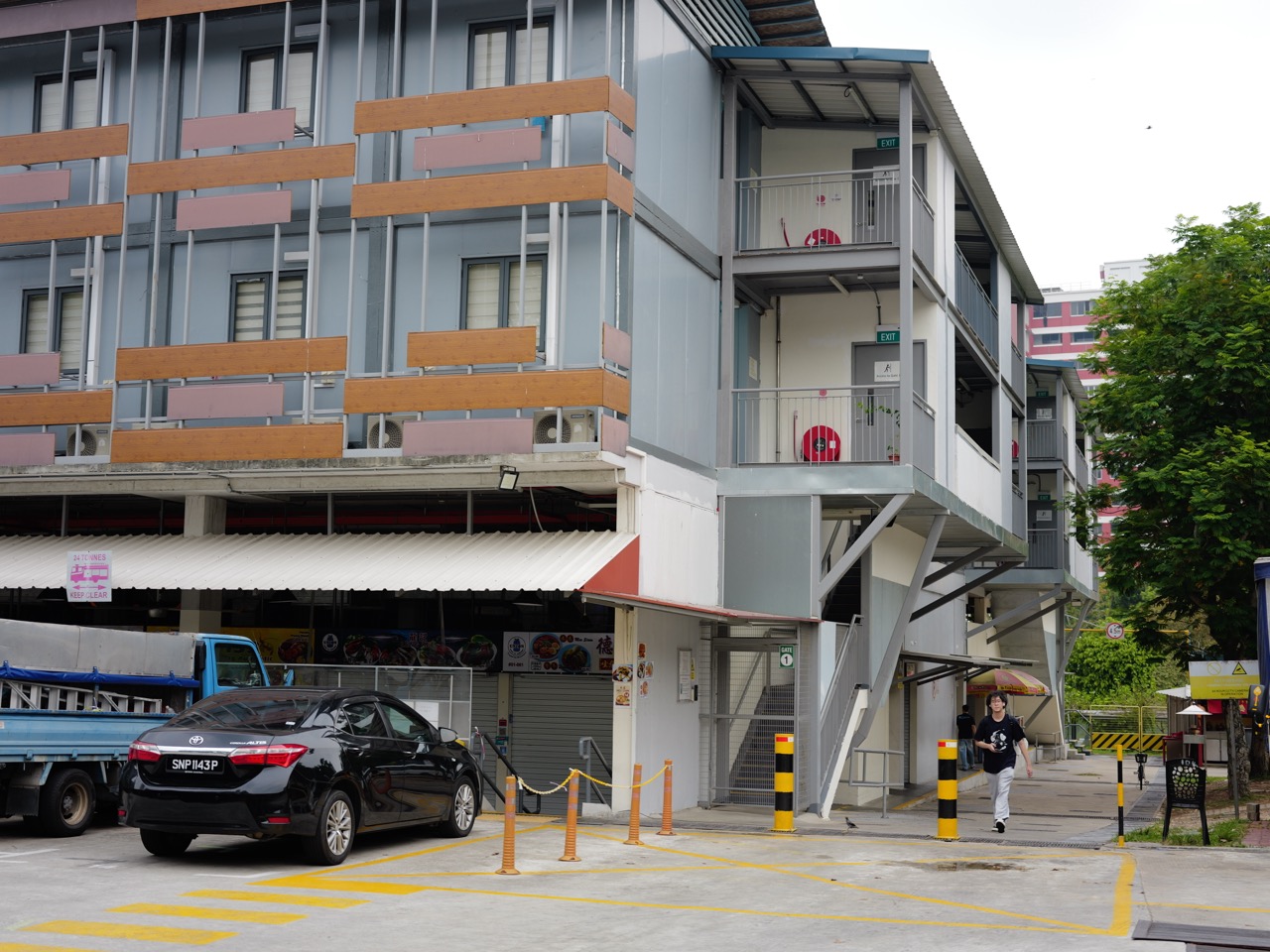
Quick list: the 20 terms you can use at a wet market
A Singapore wet market is a place to buy ingredients such as vegetables, fish, meat and fruit, not primarily a place to sit down for a cooked meal. To buy one bunch of kangkong and half a kilogram of prawns, start with a clear request: “Excuse me, one bunch of kangkong and half a kilo of prawns, please. How much altogether?” You can use plain English with local food names; speaking Singlish perfectly is not necessary.
The most useful twenty terms here include pasar (market), sayur (vegetables), ikan (fish), udang (prawns), potong (cut) and “Can PayNow?” (does this stall accept the payment method?). Some are Malay words or Chinese-influenced local names, while others are ordinary English requests. They serve different jobs: locating a market, naming food, choosing an amount, requesting preparation and paying correctly.
A crucial difference from our hawker-centre lesson is the food itself. At a hawker centre, you often buy cooked dishes for eating. At a wet market, you usually carry raw ingredients home. The Singapore Food Agency’s guidance asks shoppers to pay attention to freshness, proper chilling and separation of raw meat or seafood from ready-to-eat food. This guide makes those needs part of the language practice, not an afterthought.
Begin with one purchase, then use the numbered glossary, realistic conversations and a five-minute self-check to build confidence. Markets differ in pricing units, availability, opening hours and payment acceptance; nothing here promises a fixed price or a particular stall service.
Other language editions: 简体中文 · हिन्दी · Русский.

Jump to a section
- Quick list: the 20 terms you can use at a wet market
- Four useful routes through the market
- The twenty words explained in context
- Buying food safely and clearly
- Ten market conversations to rehearse
- Practice these questions
- Frequently asked questions
- Official sources and cultural references
- Continue the Singapore everyday vocabulary series
Quick list: the 20 terms you can use at a wet market
| # | Spoken phrase | Meaning |
|---|---|---|
| 1 | Pasar | Market. In Singapore, pasar is used for a neighbourhood market, commonly where people buy fresh produce. |
| 2 | Pasar pagi | Morning market; pagi means morning in Malay. |
| 3 | Wet market | A market selling fresh vegetables, fruit, meat, seafood and other groceries. |
| 4 | Uncle | Sometimes a friendly form of address for an older man, including a vendor who is not your relative. |
| 5 | Auntie | Sometimes a familiar, respectful-sounding way to address an older woman, including a stallholder. |
| 6 | Berapa? | How much? Berapa harga ini? means “How much is this?” in Malay. |
| 7 | How much per kilo? | A direct question asking for the price of one kilogram, not necessarily the amount you will buy. |
| 8 | Half kilo | Half a kilogram, equivalent to 500 grams. |
| 9 | Ikat / one bunch | Ikat means a tied bundle in Malay; “one bunch” is the clear English buying phrase. |
| 10 | Sayur | Vegetables, in Malay; a familiar term in multilingual food contexts. |
| 11 | Kangkong | Water spinach, a leafy green vegetable commonly used in Southeast Asian cooking. |
| 12 | Tau geh | Bean sprouts, often mung bean sprouts used in local dishes. |
| 13 | Ikan | Fish. Ikan is a Malay word commonly encountered in food names. |
| 14 | Udang | Prawns or shrimp. A common Malay food word. |
| 15 | Sotong | Squid, a seafood item and frequent Malay-influenced food name. |
| 16 | Potong | Cut. Potong is Malay; boleh potong? asks whether something can be cut. |
| 17 | Clean the fish | Ask the fishmonger to prepare the fish, usually by removing scales and internal organs, depending on the service. |
| 18 | Separate bag | A request to keep raw meat or seafood in a different package from vegetables and ready-to-eat foods. |
| 19 | Bungkus / dabao | Bungkus means wrap or pack in Malay; dabao is common Singapore speech for packing food to take away. |
| 20 | Can PayNow? | A compact local question asking whether the stall accepts PayNow transfer or a supported PayNow/SGQR code. |
Four useful routes through the market
1. Where you are and whom you are speaking to
Start by finding the correct row. Pasar and wet market describe the place, while Uncle and Auntie may be familiar forms of address. A neutral greeting is always safe. Notice that the market selling raw ingredients may sit in the same complex as a cooked-food hawker centre.
2. Prices, weights and a clear order
Point to the intended item and ask whether the price refers to a kilogram, one piece, one packet or a bunch. State your quantity before weighing. If you do not understand the total, ask again before the vendor cuts, cleans or bags it.
3. Names for vegetables and seafood
Food words cross languages in Singapore. Sayur describes vegetables; kangkong and tau geh are more specific. Ikan, udang and sotong help identify fish, prawns and squid. Knowing one local name does not establish freshness or whether something is safe to eat raw.
4. Preparation, packaging and payment
Ask for cutting or cleaning before assuming the service is available. Keep raw fish or meat separate from other purchases. When paying, check the accepted method and amount, especially with QR codes. These ordinary habits matter more than fashionable slang.
The twenty words explained in context
These pronunciation hints are approximate, not an official phonetic standard. Local languages and accents vary; the written names and a clear English explanation are reliable fallbacks.
1. Where you are and whom you are speaking to
01. Pasar
Meaning: Market. In Singapore, pasar is used for a neighbourhood market, commonly where people buy fresh produce. Source and context: Malay — market. Approximate pronunciation: PAH-sar.
Say this to the stallholder: “Is this the pasar?” — “Is this the market?”
Why this expression matters: This is a place word, not the name of one specific building. Some markets share a complex with cooked-food stalls, so ask whether you need the market floor or the food centre. The National Library Board describes pasar and its Chinese rendering 巴刹 as part of Singapore’s market history.
Avoid a misunderstanding: Use it to find your way, not as a claim that every Singaporean market is identical.
Switch to this same term in another language: 简体中文 · हिन्दी · Русский.
02. Pasar pagi
Meaning: Morning market; pagi means morning in Malay. Source and context: Malay — morning market. Approximate pronunciation: PAH-sar PAH-gee.
Say this to the stallholder: “Is the pasar pagi still open?” — “Is the morning market open today?”
Why this expression matters: An expression for a market that operates in the morning, not a guarantee of fixed opening hours. The similarly named pasar malam refers to a night market, often with a different mix of goods. Check the specific market before travelling, especially when it is undergoing cleaning or renovation.
Avoid a misunderstanding: Never infer opening hours from the phrase alone.
Switch to this same term in another language: 简体中文 · हिन्दी · Русский.
03. Wet market
Meaning: A market selling fresh vegetables, fruit, meat, seafood and other groceries. Source and context: Singapore English — fresh-food market. Approximate pronunciation: wet MAR-kit.
Say this to the stallholder: “Where is the wet market entrance?” — “I’m looking for the fresh-food market.”
Why this expression matters: The word wet historically describes markets where water and cleaning are common, but modern Singapore markets can be bright and comparatively dry. A wet market is not automatically a wildlife market, nor is it the same as a cooked-food hawker centre. The National Library Board documents the term’s changing usage.
Avoid a misunderstanding: Do not assume everything sold at a wet market is ready to eat.
Switch to this same term in another language: 简体中文 · हिन्दी · Русский.
04. Uncle
Meaning: Sometimes a friendly form of address for an older man, including a vendor who is not your relative. Source and context: Singapore English — familiar address. Approximate pronunciation: UN-kul.
Say this to the stallholder: “Uncle, how much is this?” — “Excuse me, how much are these tomatoes?”
Why this expression matters: Uncle is contextual. Some vendors like the familiarity; other people prefer Sir, hello, or simply excuse me. Use the expression only when it seems welcome, and never assume that an older appearance makes someone comfortable with the label.
Avoid a misunderstanding: Politeness matters more than imitating a local accent.
Switch to this same term in another language: 简体中文 · हिन्दी · Русский.
05. Auntie
Meaning: Sometimes a familiar, respectful-sounding way to address an older woman, including a stallholder. Source and context: Singapore English — familiar address. Approximate pronunciation: AHN-tee.
Say this to the stallholder: “Auntie, do you have kangkong?” — “Excuse me, do you have water spinach?”
Why this expression matters: As with Uncle, it is not a universal honorific. If you are unsure whether the person is comfortable, simply say excuse me and ask the question. Avoid beginning with a demand or speaking over another customer’s order.
Avoid a misunderstanding: A neutral greeting is always a workable alternative.
Switch to this same term in another language: 简体中文 · हिन्दी · Русский.
2. Prices, weights and a clear order
06. Berapa?
Meaning: How much? Berapa harga ini? means “How much is this?” in Malay. Source and context: Malay — how much?. Approximate pronunciation: buh-RAH-pah.
Say this to the stallholder: “Berapa harga ini?” — “How much is this?”
Why this expression matters: It is useful if a Malay-speaking vendor welcomes the language, but multilingual Singapore does not require every vendor to use Malay. Point to the item and ask in plain English when unsure. Confirm whether the answer refers to one piece, one bunch or one kilogram.
Avoid a misunderstanding: Confirm the price unit instead of guessing it from a short answer.
Switch to this same term in another language: 简体中文 · हिन्दी · Русский.
07. How much per kilo?
Meaning: A direct question asking for the price of one kilogram, not necessarily the amount you will buy. Source and context: Plain English — price unit. Approximate pronunciation: how much per KEE-lo.
Say this to the stallholder: “How much per kilo for the prawns?” — “Is the price for one kilo or one packet?”
Why this expression matters: Some vegetables and seafood are priced per weight, while particular fish, bunches, eggs or packaged foods may be priced per piece or per packet. Ask before the vendor weighs or prepares food. Price tags and display practices vary; a polite clarification prevents disagreements.
Avoid a misunderstanding: Do not infer a current price from any example in this guide.
Switch to this same term in another language: 简体中文 · हिन्दी · Русский.
08. Half kilo
Meaning: Half a kilogram, equivalent to 500 grams. Source and context: Market English — 500 grams. Approximate pronunciation: haaf a KEE-lo.
Say this to the stallholder: “Half a kilo of prawns, please.” — “About 500 grams, please. Is that possible?”
Why this expression matters: Say the quantity before it is weighed: “Half a kilo, please.” The final amount can vary slightly around your requested weight, so ask to confirm the scale reading and total price. Do not assume the vendor can split every prepacked product.
Avoid a misunderstanding: Quantity and price are two separate things: confirm both.
Switch to this same term in another language: 简体中文 · हिन्दी · Русский.
09. Ikat / one bunch
Meaning: Ikat means a tied bundle in Malay; “one bunch” is the clear English buying phrase. Source and context: Malay — tied bundle. Approximate pronunciation: EE-kat / one bunch.
Say this to the stallholder: “One bunch of spinach, please.” — “Is this one bunch or two?”
Why this expression matters: A bunch is not a standard weight. Leafy greens may be tied in bundles of different sizes, and some sellers price by weight instead. Point to the specific bundle you want; if comparison matters, ask about weight rather than pretending all bunches are equivalent.
Avoid a misunderstanding: Use a visual reference when the bundle size is unclear.
Switch to this same term in another language: 简体中文 · हिन्दी · Русский.
10. Sayur
Meaning: Vegetables, in Malay; a familiar term in multilingual food contexts. Source and context: Malay — vegetables. Approximate pronunciation: sah-YOOR.
Say this to the stallholder: “Do you have fresh sayur today?” — “Which vegetables are suitable for soup?”
Why this expression matters: It is a category, not the name of one particular vegetable. You still need to identify spinach, cabbage or another item. If the stallholder does not understand your pronunciation, show a picture or ask in English. Sayur can also appear in names of cooked dishes, where preparation is different.
Avoid a misunderstanding: Do not treat the language category as a guarantee about recipes or ingredients.
Switch to this same term in another language: 简体中文 · हिन्दी · Русский.
3. Names for vegetables and seafood
11. Kangkong
Meaning: Water spinach, a leafy green vegetable commonly used in Southeast Asian cooking. Source and context: Regional food term — water spinach. Approximate pronunciation: KAHNG-kong.
Say this to the stallholder: “One bunch of kangkong, please.” — “Is this kangkong? One bunch, please.”
Why this expression matters: Different English names can refer to it, including water spinach and morning glory. At the market, the actual bunch is a better reference than a translated name. Ask whether it is sold in a bunch and wash vegetables appropriately before use at home.
Avoid a misunderstanding: Plant names in different languages are not always one-to-one; confirm the actual vegetable.
Switch to this same term in another language: 简体中文 · हिन्दी · Русский.
12. Tau geh
Meaning: Bean sprouts, often mung bean sprouts used in local dishes. Source and context: Hokkien-influenced local term — bean sprouts. Approximate pronunciation: tau geh (often tau-GEH).
Say this to the stallholder: “Do you have tau geh?” — “I need a small packet of bean sprouts.”
Why this expression matters: The spelling may appear as taugeh, tau geh or bean sprouts. Ask for the amount you need and check condition, not merely the word on a label. Keep chilled produce appropriately and wash it before cooking; vulnerable diners should follow safe-food advice for raw sprouts.
Avoid a misunderstanding: Use bean sprouts as the clear English fallback when the local term is unfamiliar.
Switch to this same term in another language: 简体中文 · हिन्दी · Русский.
13. Ikan
Meaning: Fish. Ikan is a Malay word commonly encountered in food names. Source and context: Malay — fish. Approximate pronunciation: EE-kahn.
Say this to the stallholder: “Ikan, please. Can you clean it?” — “What fish is this, and is the price per kilogram?”
Why this expression matters: The word does not tell you the species, size, freshness, preparation or whether a fish is sold by piece or weight. Ask what fish it is and state whether you want it whole or cut. Never interpret the word ikan as proof that raw fish is suitable to eat uncooked.
Avoid a misunderstanding: For raw consumption, use an explicitly suitable product and follow SFA advice.
Switch to this same term in another language: 简体中文 · हिन्दी · Русский.
14. Udang
Meaning: Prawns or shrimp. A common Malay food word. Source and context: Malay — prawns/shrimp. Approximate pronunciation: OO-dahng.
Say this to the stallholder: “Half a kilo of udang, please.” — “Are these prawns sold with the heads on?”
Why this expression matters: Prawn size and type can affect price. Ask whether the amount includes shells and heads, and whether cleaning is offered. If someone in your group has a shellfish allergy, identify the actual ingredient and cross-contact risks with the vendor; simply recognising udang is not enough.
Avoid a misunderstanding: Agree on the product and total before any requested cleaning or packing.
Switch to this same term in another language: 简体中文 · हिन्दी · Русский.
15. Sotong
Meaning: Squid, a seafood item and frequent Malay-influenced food name. Source and context: Malay — squid. Approximate pronunciation: SOH-tong.
Say this to the stallholder: “Do you have sotong today?” — “Can you clean the squid for cooking?”
Why this expression matters: Ask for a squid suitable for your intended recipe and whether the vendor can clean it. Some prepared food terms use sotong but may refer to a cooked dish rather than raw seafood for sale. Store and cook raw seafood safely; ordinary wet-market squid is not automatically suitable for uncooked consumption.
Avoid a misunderstanding: Do not assume cleaning or preparation is included in the listed price.
Switch to this same term in another language: 简体中文 · हिन्दी · Русский.
4. Preparation, packaging and payment
16. Potong
Meaning: Cut. Potong is Malay; boleh potong? asks whether something can be cut. Source and context: Malay — cut. Approximate pronunciation: POH-tong.
Say this to the stallholder: “Boleh potong? Can you cut it?” — “Could you cut it into smaller cooking pieces?”
Why this expression matters: Point to the exact item and specify how you want it prepared: into two parts, slices or cooking pieces. A vendor may not offer the service or may charge for preparation. Do not grab a knife or cross the stall’s working area to demonstrate.
Avoid a misunderstanding: Ask before buying when the cut is essential to your recipe.
Switch to this same term in another language: 简体中文 · हिन्दी · Русский.
17. Clean the fish
Meaning: Ask the fishmonger to prepare the fish, usually by removing scales and internal organs, depending on the service. Source and context: Plain English — preparation request. Approximate pronunciation: clean the fish.
Say this to the stallholder: “Could you clean the fish for me?” — “Please remove the scales and insides, but keep the head.”
Why this expression matters: “Clean” can mean different things to different stalls. Say whether you need descaling, gutting, or cutting, and ask what will be left with the fish. Preparing a fish at the stall is not the same as making it ready-to-eat raw; cook and handle it appropriately at home.
Avoid a misunderstanding: Specify what ‘clean’ means for your dish; do not mistake it for disinfection.
Switch to this same term in another language: 简体中文 · हिन्दी · Русский.
18. Separate bag
Meaning: A request to keep raw meat or seafood in a different package from vegetables and ready-to-eat foods. Source and context: Plain English — hygiene request. Approximate pronunciation: SEP-uh-rit bag.
Say this to the stallholder: “Please pack the raw fish separately.” — “Can you put the fish and vegetables in different bags?”
Why this expression matters: This is a practical food-safety habit, not a Singlish particle. The Singapore Food Agency warns that raw-food juices can contaminate other foods. Keep sealed raw items separate during transport, use an insulated bag for chilled groceries, and refrigerate promptly at home.
Avoid a misunderstanding: Separate packaging is important even if the vendor has already cleaned the fish.
Switch to this same term in another language: 简体中文 · हिन्दी · Русский.
19. Bungkus / dabao
Meaning: Bungkus means wrap or pack in Malay; dabao is common Singapore speech for packing food to take away. Source and context: Malay / Chinese-influenced local terms — pack to take away. Approximate pronunciation: BOONG-koos / DAH-bow.
Say this to the stallholder: “Can you bungkus this, please?” — “Please pack the vegetables separately from the seafood.”
Why this expression matters: At a wet market, most goods will be taken home, so “Can you pack it separately?” is often more precise than merely saying dabao. At a cooked-food stall, dabao contrasts clearly with “having here.” Use the word that fits the vendor and item instead of treating both as mandatory slang.
Avoid a misunderstanding: Do not assume one bag is hygienic for every mix of groceries.
Switch to this same term in another language: 简体中文 · हिन्दी · Русский.
20. Can PayNow?
Meaning: A compact local question asking whether the stall accepts PayNow transfer or a supported PayNow/SGQR code. Source and context: Singapore English — payment check. Approximate pronunciation: can PAY-now.
Say this to the stallholder: “Can PayNow, or cash only?” — “Do you take cash? My app may not support this QR.”
Why this expression matters: PayNow is a Singapore payment network, not a promise that a visitor’s foreign wallet or card can scan every QR code. Ask what the stall accepts and check the logos on its SGQR label. Before confirming a transfer, verify the displayed recipient and amount. Have an alternative payment method if your app is incompatible.
Avoid a misunderstanding: Never send a transfer without verifying the intended recipient and exact total.
Switch to this same term in another language: 简体中文 · हिन्दी · Русский.
Buying food safely and clearly
1. Plan the visit around the specific market, not a generic timetable
A wet market may share a building with a food centre, but the counters and operating patterns differ. NEA publishes market and hawker-centre information, including cleaning and works closures. Before setting off, check the particular market or stall rather than assuming every pasar opens or closes at the same time. Weekends and mornings can feel busier in many markets, so allow time to browse without blocking the walkway.
2. Check the price unit before inviting preparation
A displayed $ amount alone does not explain whether it covers a kilogram, one piece, a packet or a bunch. Point to the item, say the quantity and ask for the total. For fish or meat, agree on the cut and whether preparation changes the price before the vendor works on it. Friendly bargaining is not an obligation and aggressive bargaining is rarely useful; being clear about a budget is more courteous.
3. Fresh-looking is a clue, not a laboratory test
SFA advises buyers to check that fish look shiny and bright, eggs are not cracked, and vegetables are not shrivelled or mouldy. At the same time, appearance alone cannot guarantee a product is safe; proper chilling, trustworthy sourcing and prompt refrigeration matter. Do not buy chilled meat or seafood that is being displayed warm. If a dietary requirement is important, ask specific questions rather than inferring from the food name.
4. Separate raw and ready-to-eat items as you shop
Buy perishables towards the end of your trip when possible, carry an insulated bag and go home without unnecessary delays. Seal raw poultry, fish and meat separately from fruit or prepared food. At home, keep raw products covered on a low refrigerator shelf so juices cannot drip onto other items. SFA discourages washing raw meat because splashing can spread bacteria onto surrounding surfaces; cook food thoroughly and clean utensils.
5. Food labels and religious needs require exact checking
For a shellfish allergy, recognise that udang means prawns, but also ask about handling and contact with other seafood. For halal-certified food, a vendor’s statement is not a substitute for checking a current applicable MUIS certificate and the specific item; certification of one outlet or product does not automatically describe every stall around it. A market is a mix of independent businesses.
6. Payment is the final part of the conversation
If the stall accepts cash, pay the amount agreed. If a PayNow or SGQR label is displayed, check which payment schemes it actually supports and whether your banking app works with them. The Association of Banks in Singapore explains that consumers should check the receiving party before transferring. A tourist’s foreign e-wallet or card is not automatically a PayNow payment method. Ask rather than assuming.
Singapore Food Agency: buying and handling food · NEA market and cleaning information · PayNow payment information.
Ten market conversations to rehearse
1. Find the right entrance
Visitor: “Excuse me, is the wet market downstairs?”
Local: “Yes, the cooked-food stalls are upstairs.”
Visitor: “Thank you. I’m going to the vegetable stalls.”
The first task is locating the correct part of the building. Do not assume the market and the cooked-food centre have one counter or the same opening hours.
2. Greet the vegetable seller
Visitor: “Excuse me, Auntie, do you have kangkong?”
Seller: “Yes, this one.”
Visitor: “One bunch, please. How much?”
The local word helps identify the vegetable, but the neutral opening does most of the polite work. If the person dislikes Auntie, switch to “Excuse me” without making the encounter awkward.
3. Confirm price per unit
Visitor: “How much per kilo?”
Seller: “This one is by the bunch.”
Visitor: “Oh, understood. I’ll take one bunch.”
The vendor has changed the unit of sale, not contradicted your mathematics. Repeat the unit back before paying and compare like with like.
4. Buy 500 grams of prawns
Visitor: “Half a kilo of prawns, please.”
Seller: “About 500 grams, okay?”
Visitor: “Yes. What is the total?”
Half a kilogram is 500 grams, but the exact weighed amount may vary slightly. The buyer checks the total rather than relying on an imagined universal market price.
5. Ask about fish preparation
Visitor: “What fish is this? Can you clean it for me?”
Seller: “Do you want it cut?”
Visitor: “Yes, small pieces, please. Keep the head.”
“Clean” alone is ambiguous. This dialogue specifies both the desired cuts and the part to retain. Whether the service is included should be clarified before proceeding.
6. Use a Malay word without insisting
Visitor: “Berapa harga ini?”
Seller: “Sorry?”
Visitor: “How much is this fish, please?”
A Malay phrase may not be understood by every person. The right response is to switch helpfully to ordinary English, not repeat the unfamiliar phrase louder.
7. Choose between squid and prawns
Visitor: “Do you have sotong, or only udang?”
Seller: “Both, over here.”
Visitor: “I’ll take the squid. Can you clean it?”
Using local food names narrows your choice, but it does not answer how the seafood has been stored or whether cleaning is offered. Check those matters separately.
8. Pack raw foods separately
Visitor: “Can you put the raw fish in a separate bag?”
Seller: “Okay.”
Visitor: “Thank you. I have vegetables in this other bag.”
This is an uncomplicated safety request. SFA advises separating raw meat and seafood from ready-to-eat food to reduce contamination from juices and handling.
9. Check a specific dietary need
Visitor: “I need halal-certified meat. Is this stall certified?”
Seller: “Please check our certificate.”
Visitor: “Thank you. I’ll verify the current details.”
Do not infer certification from a friendly answer, the market’s name or a product’s appearance. A visitor with a strict requirement can check the current MUIS certificate where applicable and clarify the exact product and handling.
10. Ask about payment, then thank
Visitor: “Can PayNow, or cash only?”
Seller: “Cash is okay.”
Visitor: “I’ll pay cash. Thank you, have a good day.”
Availability of a QR code is not identical to compatibility with a particular foreign app. Ask early, check any supported logo, and verify any payment amount and recipient before sending money.
A five-minute retrieval exercise and a full market plan
- A stall displays a number but no unit. What should you ask?
- You want 500 grams of prawns. Which phrase works?
- You need water spinach, not bean sprouts. Which two terms distinguish them?
- A seller does not understand Berapa? How do you recover?
- You have raw fish and ready-to-eat bread. What is the packaging request?
- A QR code is displayed but your foreign payment app fails. What should you do?
Check your answers
- Ask “Is that per kilo, per bunch or per piece?” before agreeing to buy.
- Say “Half a kilo of prawns, please,” then confirm the weighed amount and total price.
- Kangkong refers to water spinach; tau geh refers to bean sprouts.
- Say “Sorry, how much is this, please?” and point to the item.
- Ask for the raw fish in a separate, secure bag; keep it cold and refrigerate promptly.
- Ask “Cash okay?” or another accepted option; do not send money without confirming the recipient.
Model market visit
At the vegetable stall, I greeted the seller and asked for one bunch of kangkong. I checked whether the vegetables were sold by bunch or weight. Next I bought about half a kilogram of prawns and asked for the total after weighing. I requested a separate bag for the seafood and carried the chilled food home in an insulated bag. At the payment counter, I confirmed whether my app supported the displayed QR code before paying. The useful local words helped me identify products, but the ordinary English questions prevented misunderstandings.
Frequently asked questions
1. What is a wet market in Singapore?
It is a market where people buy vegetables, fruit, fish, meat and other groceries, often for home cooking. Some are in complexes that also have cooked-food hawker stalls. “Wet market” does not automatically mean a market selling wildlife.
2. Does pasar mean the same thing as pasar malam?
No. Pasar is a Malay word for market; pasar pagi refers to a morning market, while pasar malam means night market. A night market may have cooked snacks, clothing or other goods and is not automatically a wet market.
3. Do I need to use Singlish when buying groceries?
No. Polite and clear English is effective, and many vendors understand additional local languages. Learn useful food names but avoid imitating a particular ethnic accent or assuming everyone speaks the same language.
4. How do I ask whether the price is per kilogram?
Say “How much per kilo?” and point at the exact food. Check whether other items are sold by piece, packet or bunch. A displayed number alone is not a complete price without a unit.
5. Is half a kilo 500 grams?
Yes. Half a kilogram equals 500 grams. At a stall the weighed amount may differ slightly, so confirm both the indicated weight and the total price before accepting the purchase.
6. Can I ask a vendor to cut and clean a fish?
You can ask, but do not assume every stall offers that service. Explain whether you want scales or innards removed, how large the pieces should be and what parts to keep. Ask about any extra charge in advance.
7. Can I eat fish bought at a wet market raw?
Do not assume so. SFA says fish intended for raw consumption requires appropriate sourcing and handling; ordinary fish for cooking should not be treated as ready-to-eat raw fish. When uncertain, cook it thoroughly.
8. Should raw fish and vegetables be carried in the same bag?
Use separate, secure packaging so raw juices do not contaminate other foods. Keep chilled purchases cold using an insulated bag where possible, and refrigerate them promptly after returning home, following SFA guidance.
9. Can a visitor pay with PayNow or a QR code?
Only if that stall accepts a compatible payment method and the visitor has an app that supports it. An SGQR label can show several schemes. Ask first, inspect the logos, check recipient and amount, and have another payment option.
10. How do I verify halal certification if I need it?
Ask about the specific product and outlet. MUIS maintains certification resources; when the outlet claims to be certified, check a current certificate or the current online details and confirm that the establishment and address match. Do not assume all market stalls are certified.
Official sources and cultural references
- NLB BiblioAsia — Singapore’s changing wet markets
- NEA — Managing markets and hawker centres
- SFA — Food safety tips when buying and handling groceries
- SFA — Ready-to-eat raw fish advice
- ABS — PayNow and QR payments
- MUIS — Halal guidance
- MUIS — How to check a current halal certificate
Continue the Singapore everyday vocabulary series
Top 100 Singapore Vocabulary Words | Touring and Visiting · eduKateSG Vocabulary Learning Hub.
Other language editions: 简体中文 · हिन्दी · Русский
The best first visit is not a vocabulary performance
Singapore’s wet markets are living neighbourhood workplaces. The person behind the counter may be moving quickly, weighing several purchases and speaking different languages with different customers. A short clear order—item, quantity, preparation, price and payment—is respectful of their work. If there is a misunderstanding, repeat your meaning in simpler words and ask for confirmation.
Once you can identify a vegetable, request a weight, clarify a preparation and carry home raw food safely, you have gained something more useful than a memorised catchphrase: the ability to participate in an ordinary Singapore shopping trip with confidence.
Next: Shopping in a Neighbourhood Shop
After buying ingredients at a wet market, learn how to ask for everyday supplies at Singapore’s neighbourhood provision shops. Practise checking stock, selecting the right packet or piece, confirming a price, and choosing the payment method the shop accepts. Top 20 Vocabulary Singapore | Shopping in a Neighbourhood Shop. English · 简体中文 · हिन्दी · Русский
Next in the Singapore vocabulary series: Shopping at a Mall
Now practise finding a store, asking for sizes, checking promotions and understanding the final bill. Top 20 Vocabulary Singapore | Shopping at a Mall. English · 简体中文 · हिन्दी · Русский
Next: Sizes, Exchanges and Returns
Carry your visitor vocabulary into a clothing or goods shop with precise questions about sizes, returns and defects. Top 20 Vocabulary Singapore | Asking About Sizes, Exchanges and Returns. English · 简体中文 · हिन्दी · Русский
Continue: Buying Groceries
Compare a wet-market visit with supermarkets: packaging, unit prices, food labels and checkout. Top 20 Vocabulary Singapore | Buying Groceries. English · 简体中文 · हिन्दी · Русский
Next: Taking the MRT in Singapore
Learn station codes, platforms, train directions, transfers, exits and fare payment. Top 20 Vocabulary Singapore | Taking the MRT. English · 简体中文 · हिन्दी · Русский
Continue: Riding a Public Bus
Learn Singapore bus stop codes, route directions, boarding and alighting, payment taps and accessible travel language. Top 20 Vocabulary Singapore | Riding a Public Bus. English · 简体中文 · हिन्दी · Русский