
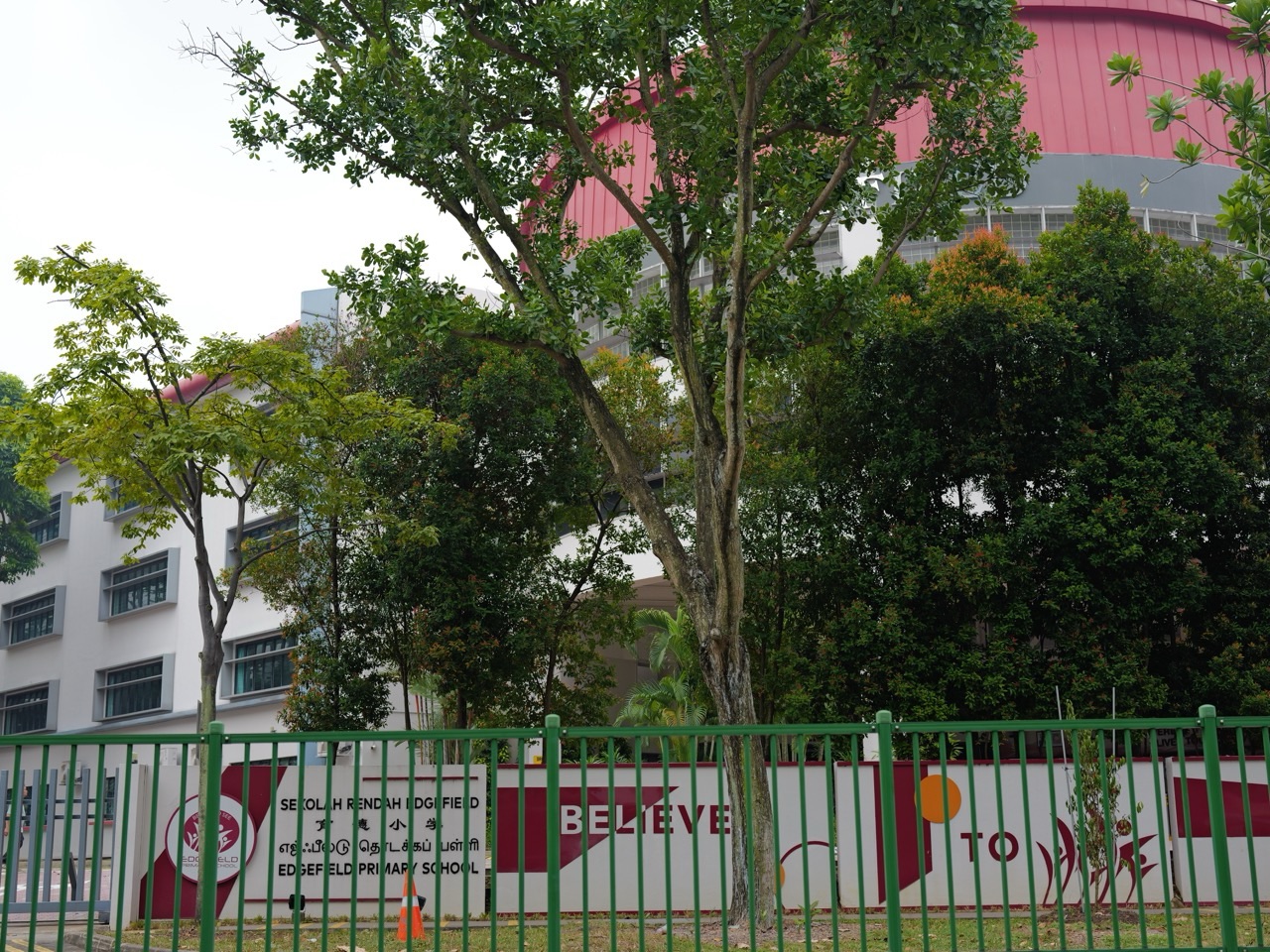
Edgefield Primary School is at 41 Edgefield Plains in Punggol. Its current STEM Innovator Programme gives families a concrete way to investigate school fit: pupils encounter sustainability problems and use design thinking to consider possible solutions.
Did you know that a question about wasted food can contain both a Mathematics problem and a design problem? Before proposing a solution, a child needs to know what was observed, how much was involved and why it might be happening. That makes the reasoning more interesting than simply repeating “save the environment”.
The new photograph shows Edgefield Primary’s exterior through the trees and boundary fencing. This guide connects the photographed school with current official information, questions for parents and a small investigation families can try without creating a large extra workload.
Photograph: Exterior and school building at Edgefield Primary School in Punggol, Singapore. Photo: eduKate.
Find the part your family needs
Start with the school’s published approach, check the daily routine, or go straight to the questions for your next visit.
Understand the school · Check the journey · Plan your next questions
Contents
1–3 · School, place and learning
1. What the STEM Innovator Programme includes
4–6 · Questions, support and next steps
4. Questions for an Edgefield Primary visit
| At a glance | Details |
|---|---|
| Institution | Edgefield Primary School |
| Stage | Primary education |
| Location | 41 Edgefield Plains, Singapore 828869 |
| Focus in this guide | STEM learning through food and energy questions |
The school’s current STEM page identifies the STEM Innovator Programme as its ALP. It describes Primary 4 work on food sustainability and Primary 5 work on energy conservation, using activities such as audits, generating ideas and proposing or prototyping solutions.
The page also distinguishes a mainstream pathway from an additional innovation track for selected learners. Ask how participation works for the relevant level and which opportunities are part of the ordinary school experience.
The practical value to investigate is the connection between evidence and action. A child who proposes a solution should be able to say what problem it addresses and how they might tell whether it worked. That is a useful question in many subjects.
The photograph provides an exterior view; the entrance and collection arrangements should be confirmed directly. Edgefield Primary and Edgefield Secondary are separate institutions with different addresses. A shared name should not be treated as evidence of an admission pathway between them.
Edgefield Primary’s contact page confirms 41 Edgefield Plains. Be careful not to substitute Edgedale Plains when planning the route or briefing another caregiver.
Try the journey at the pace your child can maintain. Include road crossings, the approach to the gate and the return trip. Ask where the child will eat, rest and organise the next day’s work. These practical details shape how manageable an otherwise attractive school option feels.
Here is an optional eduKate home activity. With an adult, identify one room where a light is sometimes left on after everyone leaves. Make a simple observation over a few agreed occasions; there is no need to touch electrical fittings or investigate appliances.
Ask the child to separate what they saw from what they assume. “The room was empty and the light was on” is an observation. “Nobody cares about saving energy” is an unsupported conclusion about people.
Choose a gentle reminder near the exit or agree on a routine. Check later whether the habit changed. An older child can keep a count and explain the limitations of the observation. A younger child can draw the reminder and explain its purpose.
Do not convert the activity into an invented electricity-savings figure. Without the relevant power, duration and usage information, a precise cost claim would not be justified. The immediate learning goal is a fair observation and a thoughtful response.
Ask how the school helps pupils define a problem before building a solution. How do teachers introduce measurement or recording when the underlying Mathematics is still developing? What kinds of feedback help pupils improve their first attempt?
Ask how group responsibilities are assigned and how quieter learners participate. For any additional programme, clarify eligibility and selection rather than assuming that every child will receive the same experience.
Then cover ordinary arrangements: support for new pupils, student care, dismissal and communication with teachers. Use MOE’s current registration information to plan admission for the intended year.
The companion Edgefield Primary school-choice guide can help you organise the family comparison. Current programme and operational questions should go back to the school.
In the Mathematics continuity discussion, eduKate considers how earlier capabilities support later tasks. An audit depends on understanding what is being counted, keeping categories consistent and comparing like with like.
The vocabulary hub can support words such as observation, quantity, conserve, solution and limitation. Use a child’s own investigation as the example. A carefully explained limitation is often a sign of better thinking, rather than a weaker answer.
If a child enjoys projects but struggles with written schoolwork, investigate the gap precisely. The need may be reading, organisation, calculation or explanation. Enjoyment is useful information; it does not tell us by itself which skill requires teaching.
Edgefield Primary’s published sustainability programme is worth exploring when your child is curious about how things work and how everyday problems might be improved. Also ask how the school supports children who are interested but need help getting started.
After a visit, compare the actual route, the available support and the child’s response. Give each a place in your notes. A good programme cannot answer a transport question, and a convenient location cannot answer every learning question.
Your next step can be one school enquiry and one short home observation. Keep the work small enough that the child remains the thinker, with the adult providing support rather than supplying the entire solution.
Official sources and further checks
Checked on 10 October 2026. Programmes, operational arrangements and admission requirements can change; use the school or university’s current information for the relevant intake. This is an independent eduKate guide, not an official school publication or an endorsement by the institution.
Explore the photographed Punggol school series
This series covers the institutions in these photographs. For wider local context, continue to the existing Punggol schools and education overview.
Primary schools · Secondary schools · University
Edgefield Primary School — you are here
For a specific learning concern, bring recent schoolwork and the weekly timetable to an eduKate parent–student consultation. Begin with the child’s starting point and consider a suitable 3-pax arrangement where support is needed.