
Yusof Ishak Secondary School is at 8 Sumang Walk in Punggol. Its current S4TEM@YI Applied Learning Programme connects STEM with sustainable and smart-city questions, giving parents a specific area to explore when comparing schools in Punggol.
Did you know that a smart-city idea can begin with a very ordinary question, such as what information is needed before deciding when to water a plant? The interesting part is the relationship between a need, an observation and an action. Technology becomes useful when that relationship is understood.
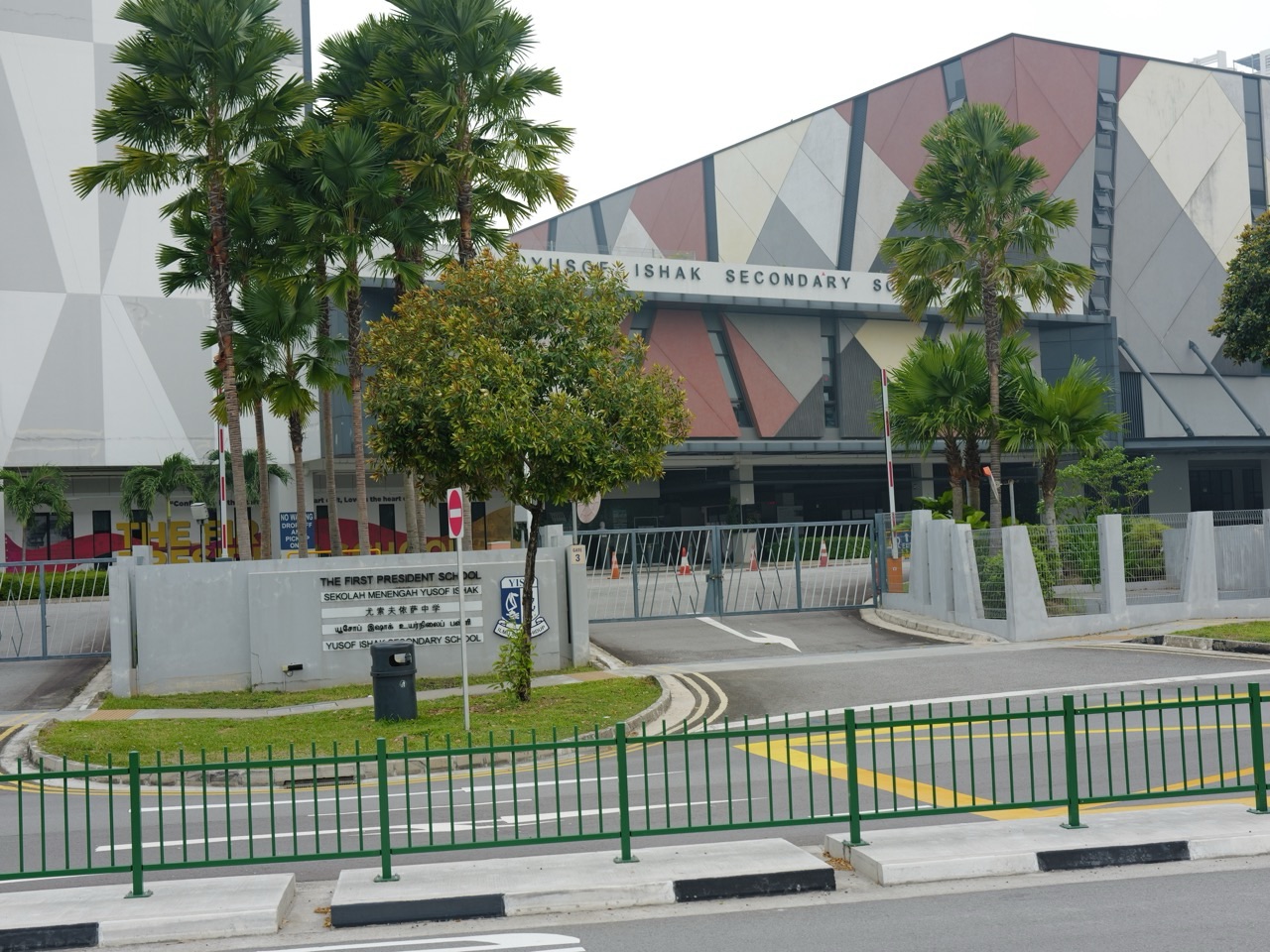
The photograph shows the school’s entrance and distinctive geometric façade. This guide connects the visible campus with verified programme information, the family’s daily route and practical ways to support careful reasoning.
Photograph: Main entrance to Yusof Ishak Secondary School in Punggol, Singapore. Photo: eduKate.
Find the part your family needs
Start with the school’s published approach, check the daily routine, or go straight to the questions for your next visit.
Understand the school · Check the journey · Plan your next questions
Contents
1–3 · School, place and learning
1. What the official STEM programme describes
4–6 · Questions, support and next steps
4. Questions that help a family assess fit
| At a glance | Details |
|---|---|
| Institution | Yusof Ishak Secondary School |
| Stage | Secondary education |
| Location | 8 Sumang Walk, Singapore 828676 |
| Focus in this guide | STEM, sustainability and smart-city questions |
The school’s official ALP page names S4TEM@YI and describes learning opportunities involving sustainability, coding, urban farming and related STEM experiences. It also discusses interdisciplinary work and opportunities to deepen interests through relevant co-curricular activities.
The page records examples from different years. Ask which experiences apply to the intended cohort instead of assuming that an earlier competition, partnership activity or workshop will recur in the same form.
Our practical interpretation is to investigate whether students learn to connect evidence with decisions. A device can collect a reading, but the student still needs to understand the quantity, its limitations and what action would be reasonable.
The photograph clearly identifies the entrance and the patterned exterior. It does not show every gate or establish student arrival and visitor access arrangements.
The school’s contact page confirms 8 Sumang Walk and lists Soo Teck and Sumang among its LRT references. Plan the full route from your actual home, including the final walk and the return journey after CCA.
Include the teenager in the planning. Ask where they would wait under the agreed arrangement and how they would communicate a delay. A sustainable routine supports both academic work and participation in the broader school experience.
Here is an original eduKate discussion activity. Imagine that a plant-watering system receives one soil-moisture reading. Should it always water immediately when the reading is low? Ask the student what else they would want to know.
They might ask whether the reading is accurate, whether the plant needs that amount of water, or whether the sensor is positioned appropriately. The exercise is about identifying missing information, not building a device or prescribing plant care.
Give a simple hypothetical data set: readings of 4, 5, 4, 19 and 5 on the same scale. Ask what should be checked before concluding that conditions changed dramatically. The value 19 could reflect a real change or a measurement problem; the numbers alone do not settle the cause.
Then ask for a short explanation with two parts: what the data show and what remains uncertain. This habit is useful when reading Science results, interpreting graphs or evaluating a claim online. It is a home example, not a stated Yusof Ishak lesson.
Ask how all students encounter the STEM programme and how a learner can explore an interest without prior specialist experience. What is the balance between hands-on activity, subject explanation and reflection?
Ask how teachers support a student who enjoys practical work but struggles with Mathematics or written expression. Which school support routes are available, and how should the family communicate an emerging concern?
Confirm current subject provision and requirements directly. Refer to MOE’s Full SBB information for subject-level context and SEAB’s SEC information for the framework introduced from 2027. Programme interest does not replace cohort-specific academic planning.
Read the existing Yusof Ishak school-fit article with your own questions beside you. The eduKatePunggol local guide offers a further neighbourhood-focused route.
For foundational work, the Secondary 1 Mathematics transition guide helps frame the move from arithmetic to relationships and symbols. A student interested in technology still benefits from understanding scales, units, fractions and algebra.
The vocabulary hub can support precise words such as reliable, variable, interpret and limitation. Ask the student to explain the hypothetical sensor reading without claiming more than the evidence permits.
Where a difficulty is persistent, bring actual schoolwork to a teacher discussion or an eduKate consultation. The useful plan identifies the missing connection and checks whether targeted teaching makes the current task more manageable.
A STEM emphasis can invite exploration without requiring a teenager to commit to engineering or computing now. A useful school experience should help the student discover what they enjoy and what sustained work in that area involves.
After visiting, ask what interested them, what looked demanding and what support they would want. Compare their answers with the school’s explanation and your practical route check.
Make the next step concrete. Confirm one subject question, test the commute or review one piece of schoolwork together. The aim is a clearer picture of how this student could learn and participate across an ordinary week.
Official sources and further checks
Checked on 10 October 2026. Programmes, operational arrangements and admission requirements can change; use the school or university’s current information for the relevant intake. This is an independent eduKate guide, not an official school publication or an endorsement by the institution.
Yusof Ishak Secondary location
Explore the photographed Punggol school series
This series covers the institutions in these photographs. For wider local context, continue to the existing Punggol schools and education overview.
Primary schools · Secondary schools · University
Yusof Ishak Secondary School — you are here
For a specific learning concern, bring recent schoolwork and the weekly timetable to an eduKate parent–student consultation. Begin with the child’s starting point and consider a suitable 3-pax arrangement where support is needed.