
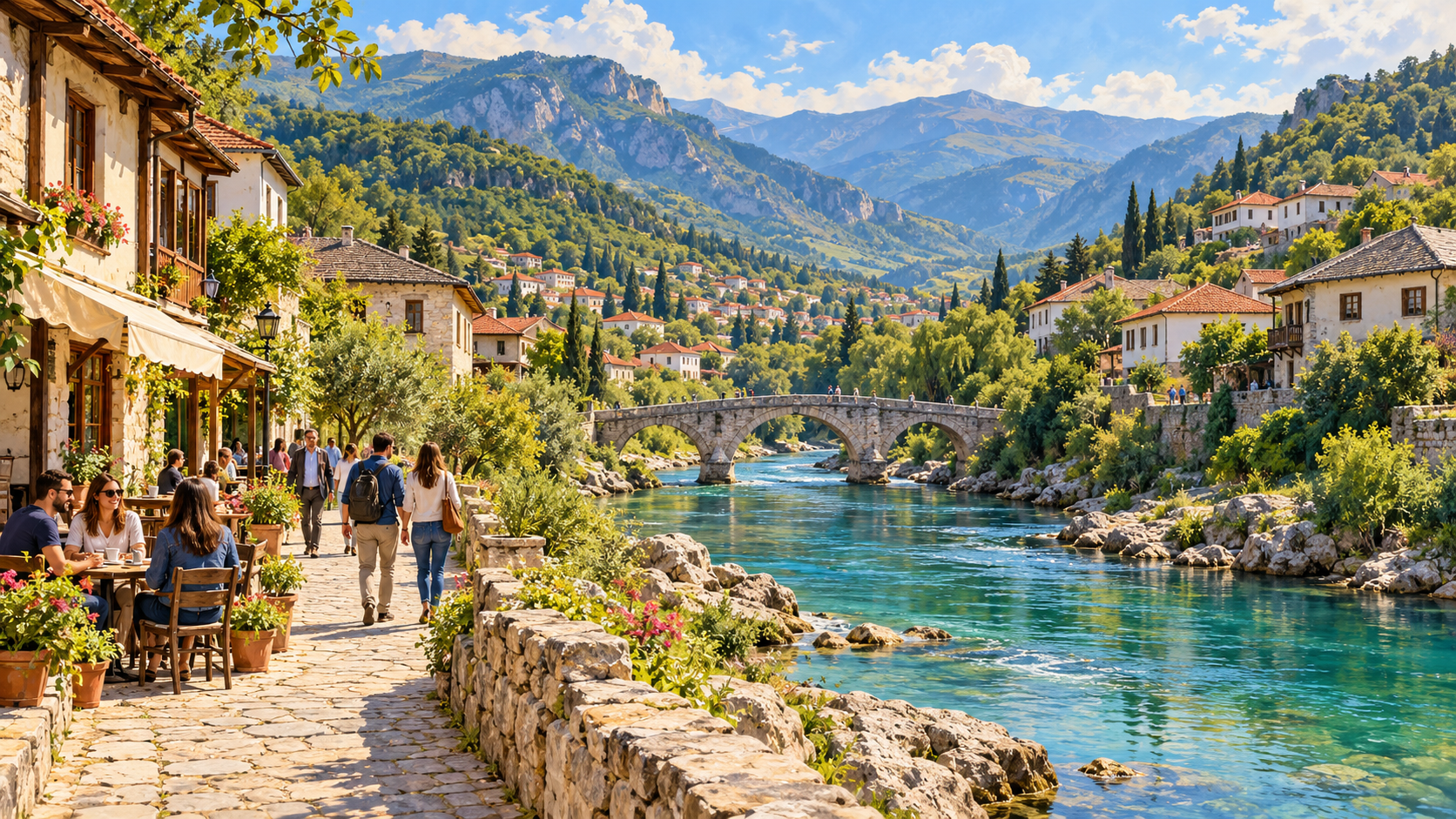
Bosnia and Herzegovina Children Vocabulary | Words for Character and Nation Building introduces 20 age-appropriate English words through a careful study of people, places, skills and social responsibilities. What can a rebuilt bridge, a medieval carved stone, a hand-embroidered blue pattern and a traditional city song teach a child? Bosnia and Herzegovina offers carefully sourced examples about historical change, cultural memory, giving makers credit and repairing everyday disagreements through words and actions.
Written for international children roughly eight to twelve years old, with adult guidance for sensitive history. This is not a national history syllabus, political position on past or present disputes, religious instruction or an invitation to perform heritage without consent. The fictional classroom scenes do not report actual people’s experience of war.
Source-supported country context: UNESCO lists the Old Bridge Area of Mostar, recording the destruction of the bridge in 1993 and its later reconstruction; the multinational Stećci Medieval Tombstone Graveyards property covers Bosnia and Herzegovina and three neighbours. Zmijanje embroidery was inscribed as intangible heritage in 2014, and Sevdalinka traditional urban folk song in 2024. These sources show that rebuilt structures, regional material culture and living performance traditions require distinct vocabulary and careful treatment of their bearers.
What character and nation building means here: Character and nation building in this educational series means historical honesty, respect for different families and communities, accurate attribution, meaningful listening and actions that help trust. The word reconciliation is treated as a demanding social process, not a claim that rebuilding a bridge automatically resolved every injury.
Quick answer: what children will learn
| Learning component | How a child uses it | What to avoid |
|---|---|---|
| Twenty explained English words | Define a word, reject a non-example and make a meaningful sentence | Repeating impressive words without knowing what they mean |
| Four detailed country-based chapters | Connect a real fact with its specific people, setting and evidence | Treating one heritage example as every resident’s experience |
| Fictional story and six worked checks | Find an unsupported claim, repair it and explain why | Pretending a classroom story is a real historical source |
| A seven-day learning sequence | Speak, read, practise, write and transfer the words | Assigning children legal, political or dangerous duties |
Choose a section: 20-word bank · four chapters · fictional story · six answered checks · seven-day plan · parent and teacher guidance · questions · sources and related guides.
20 children’s English vocabulary words and model sentences
The definitions include what each term does not mean. This makes the word useful in real explanations instead of as decoration. All sentences are editorial teaching examples, not accounts of real children.
1. Mostar: rebuilding a bridge and explaining reconciliation carefully
| Word | Meaning and distinction | Original child-friendly example |
|---|---|---|
| Stari Most | The named Old Bridge of Mostar; not every stone bridge in Bosnia and Herzegovina. | The class located Stari Most over the Neretva River. |
| reconstruction | Rebuilding a damaged or destroyed structure using evidence and design decisions; not pretending no loss occurred. | The bridge’s reconstruction followed its destruction in 1993. |
| restoration | Careful work to repair or recover valued historic fabric; not always identical to complete reconstruction. | The museum distinguished restoration of buildings from rebuilding the bridge. |
| reconciliation | The difficult process of repairing relationships after harm; not merely declaring a problem solved. | The bridge is a symbol of reconciliation, but people still have to build trust. |
| coexistence | People or traditions living alongside one another, with differences that need not disappear. | A city can support coexistence without requiring everyone to agree. |
2. Stećci: medieval monuments and evidence across four countries
| Word | Meaning and distinction | Original child-friendly example |
|---|---|---|
| stećak | A medieval regional tombstone, singular of stećci; not any roadside stone. | The label identified a stećak in a protected graveyard. |
| inscription | Words cut or written on a surface; not every decorative mark is writing. | An inscription can provide clues about a medieval person. |
| motif | A recurring decorative form or idea; not proof one meaning applies at every site. | The pupil described a carved motif without inventing its symbolism. |
| chronology | The order of events in time, not a list of dates chosen at random. | The class arranged the graveyard examples in chronology. |
| transboundary | Extending across an international border, rather than belonging solely to one modern state. | The UNESCO stećci property is transboundary. |
3. Zmijanje: hand embroidery, practitioners and skilled transmission
| Word | Meaning and distinction | Original child-friendly example |
|---|---|---|
| Zmijanje | A region whose named hand-embroidery technique is associated with villages near Banja Luka; not a blanket term for all Balkan textiles. | The exhibition credited the Zmijanje embroidery tradition. |
| embroidery | Decorative needlework using thread on fabric; not simply a printed design. | The deep-blue embroidery showed careful stitching. |
| craftsmanship | Skilled making developed through practice and judgement; more than a colourful result. | The textile’s stitching showed craftsmanship. |
| transmission | Passing knowledge and skills among people and generations; not just storing a finished object. | Workshops can support transmission of an embroidery technique. |
| attribution | Naming makers and sources rather than claiming another person’s work as one’s own. | Attribution made the museum caption fairer to its practitioners. |
4. Sevdalinka: urban music, emotion and respectful dialogue
| Word | Meaning and distinction | Original child-friendly example |
|---|---|---|
| Sevdalinka | A traditional urban folk song genre from Bosnia and Herzegovina recognised by UNESCO; not any song sung there. | The class listened to a credited Sevdalinka recording. |
| oral tradition | Stories or practices transmitted through spoken or performed forms; not necessarily written down first. | An oral tradition can be learned by listening to experienced performers. |
| interpretation | A particular explanation or performance of material; not the only possible perspective. | The singer’s interpretation differed from another recording. |
| dialogue | A two-way exchange in which people listen and respond, rather than deliver separate speeches. | The group used dialogue to revise a misleading caption. |
| accountability | Being prepared to explain actions, acknowledge harm and correct mistakes; not just saying sorry without change. | The pupils showed accountability by updating the exhibition label. |
Four learning chapters: knowledge, evidence and meaningful action
Each reading chapter links five words with one country-specific fact and a safe, transferable exercise. An example is not proof that an entire country’s people think alike. The chapter’s final correction gives children a model for honest revision.
1. Stari Most is a reconstructed bridge and a symbol, not proof that conflict disappeared
Focus vocabulary: Stari Most · reconstruction · restoration · reconciliation · coexistence.
Stari Most, the Old Bridge of Mostar, is famous for its graceful arch across the Neretva River. UNESCO describes a town that developed through Ottoman and later Austro-Hungarian periods, and a bridge that became one of the city’s defining landmarks. During the conflict of the 1990s, the historic bridge was destroyed in 1993. International cooperation and local work supported its later reconstruction. Children can learn that a rebuilt landmark reflects research, skilled work and public decisions, but should not be told that the loss never happened.
Reconstruction differs from restoration. Reconstruction often means making a replacement for a lost structure using available historical evidence and suitable methods. Restoration may concern repairing surviving features and buildings. In the Old Bridge area both kinds of heritage work matter. A present photograph shows the bridge standing, but does not prove that every stone is from the original structure. A responsible caption explains that the original was destroyed and the crossing was rebuilt, rather than calling it ‘unchanged for five hundred years’.
UNESCO describes the reconstructed bridge and city as symbols of reconciliation and international cooperation. A symbol can encourage people to think about difficult relationships, but it does not prove that every person in Mostar has reconciled or that the effects of conflict have disappeared. Reconciliation is a social process requiring acknowledgement of harm, safety, justice, cooperation and time. The word should not be used to pressure a child who has suffered into forgiving before they are ready. A landmark’s intended message and people’s real experiences are different things.
Coexistence describes different communities or traditions living alongside one another. UNESCO connects the historic Old City with architectural influences from different cultural worlds. That diversity makes the place historically interesting, but it should not be simplified into ‘everyone always lived without tension’. A town can include people with different languages, religions and customs; the existence of varied architecture alone cannot establish that every period was fair. Children can learn to describe this complexity gently without treating current classmates as representatives of past conflict.
For a classroom diagram, draw the original bridge in one panel, the period after destruction in another and the reconstructed crossing in the final panel. Each caption should state what source supports the image. If the child invents a character walking across the bridge, that character must be clearly labelled fictional. Do not put imagined dialogue in the mouth of someone who experienced the war and present it as testimony. Sensitive history needs truthful, age-appropriate explanation rather than dramatic invention.
Ask which practical jobs people may have undertaken to rebuild a bridge: historical study, engineering, stonework, documentation and careful coordination. Students do not need to carry out those jobs. Their safe equivalent is to repair a mistaken classroom drawing or reconsider a harsh comment after listening to another student. The scale is different, and we should not pretend a small argument is equal to war. What transfers is the habit of taking evidence seriously and making a real correction rather than denying a problem.
Two sample labels reveal the difference: ‘The bridge has stood unchanged since the sixteenth century’ is misleading. ‘Stari Most was destroyed in 1993 and reconstructed, becoming a symbol of reconciliation and cooperation’ is supported by UNESCO. The better sentence contains difficulty and repair in the same account. That is precisely why it is more educationally valuable than an attractive but inaccurate caption.
A final question asks whether rebuilding a bridge and rebuilding trust are identical. They are not. One is an identifiable project with physical structures and a completion date; the other is a continuing human task. Teaching that difference allows children to appreciate a symbol without asking them to pretend that the work of living together is finished.
Check and repair the meaning: Misleading: ‘Stari Most has remained untouched for centuries and its reconstruction proves everyone has reconciled.’ Repair: ‘The original was destroyed in 1993; the rebuilt bridge symbolises reconciliation but does not measure every person’s experience.’
Safe transfer activity: Create a three-stage timeline labelled original, destruction and reconstruction. Write a separate sentence explaining why a symbol cannot prove a whole city’s relationships are repaired.
2. Stećci belong to a regional medieval heritage across four modern states
Focus vocabulary: stećak · inscription · motif · chronology · transboundary.
UNESCO inscribed the Stećci Medieval Tombstone Graveyards as a World Heritage property shared by Bosnia and Herzegovina, Croatia, Montenegro and Serbia. A single tombstone is a stećak; the plural is stećci. These are distinctive medieval stone grave markers found at cemeteries across the region. UNESCO’s listing combines 28 component sites in four present-day countries. It is therefore inaccurate to describe every protected stećak as exclusively belonging to one modern state or to say that every old stone in the Balkans is a stećak.
Many examples show carved motifs and some bear inscriptions. An inscription contains writing, while a motif may be a design or figure without words. Not every carving has a single, universally accepted symbolic meaning. A child looking at a photograph can identify a visible pattern, but should not automatically decide it proves the religious beliefs or occupation of the person buried there. Interpretation requires the particular monument, its location, comparative sources and specialist knowledge.
Chronology is the order of events. UNESCO dates the stećci tradition broadly from the twelfth to sixteenth centuries, with particularly intensive production in some intervening centuries. That range does not mean all the stones were produced in the same decade. A protected cemetery might contain monuments from different periods. Children should recognise that a long-lived cultural practice can change over time even when some design features continue. A single photograph cannot assign precise dates to all the stones shown.
The word transboundary applies because the inscription crosses current international borders. The physical graveyards do not move whenever political lines change. A child should also avoid projecting today’s national identities back onto every individual buried in medieval times. History can be connected with present places without assuming that people in a distant period used all the same political or ethnic categories that are familiar today.
UNESCO describes the tombstones as a record of regional medieval art and funerary customs. It also notes that cemeteries may be in rows and that the stones feature differing decorative styles and inscriptions. Respect for these places means treating them as burial grounds, not as a supply of stones for craft projects. Learners must not climb on, scrape, move, trace or attempt to restore protected markers. Safe exercises use authorised photographs, diagrams and careful text instead of interfering with historic or sacred places.
Imagine a class creates a four-country map. One pupil wants to colour all stećci sites the colour of Bosnia and Herzegovina because the project title names that country. Another checks UNESCO and adds Croatia, Montenegro and Serbia. This correction does not diminish the Bosnian heritage connection; it accurately describes a regional practice. The pupil can learn that shared culture may connect communities across borders while the individual sites have specific locations and responsibilities.
A strong caption might read: ‘Stećci are medieval tombstones found across several Balkan countries, with varied carved motifs and some written inscriptions. UNESCO protects selected sites in four countries’. A weaker caption says: ‘Every stećak looks the same and tells us exactly what its owner believed’. The first uses evidence and limit words; the second invents uniformity where the source documents variation.
For a paper-only task, students can draw three fictional stone shapes with different patterns and write that they are invented illustrations. They should not call them authentic historical replicas. The teacher then asks what kind of evidence an archaeologist might need to identify a real stećak’s age or original context. In this way art supports historical thinking without pretending to replace archaeology.
Learning the words inscription, motif and chronology strengthens ordinary reading too. When a child reads a museum label, they can distinguish what is directly visible from the conclusions a curator has drawn, and ask whether a date refers to one object or the wider tradition. That careful habit can transfer to any place, far beyond the historic stone graveyards of Bosnia and Herzegovina.
Check and repair the meaning: Misleading: ‘Stećci are identical stones made in one century and belong only to Bosnia and Herzegovina.’ Repair: ‘UNESCO describes varied medieval monuments across four modern states and a long history of production.’
Safe transfer activity: Label a fictional three-stone paper exhibition. Use inscription, motif and chronology in distinct roles, and indicate which claims require an archaeological source.
3. Zmijanje embroidery shows how a small skilled tradition carries many kinds of memory
Focus vocabulary: Zmijanje · embroidery · craftsmanship · transmission · attribution.
UNESCO inscribed Zmijanje embroidery on its intangible-heritage list in 2014. The practice is associated with Zmijanje villages near Banja Luka in Bosnia and Herzegovina. UNESCO describes decorative handwork using deep-blue thread and improvisational geometrical patterns on traditional garments and household items. Calling the style ‘any blue printed fabric in Bosnia’ would confuse a living community practice with an appearance. The method, makers and context are part of the heritage element.
Embroidery uses needle and thread to create decoration on fabric. The term is not interchangeable with weaving a cloth from scratch or printing a picture on it. Craftsmanship includes experienced choices about thread, placement, pattern, tension and overall composition. A finished photograph may show the surface but cannot record every decision the maker took. Young readers should not assume they know a garment’s exact age, maker or personal history unless the museum or practitioner supplies that information.
UNESCO notes that the practice has historically been particularly associated with women in the Zmijanje area and can include collective sessions in which practitioners work, sing and converse. This illustrates that craft can be a social activity as well as a finished object. It does not mean every woman in Bosnia and Herzegovina makes this embroidery or that no other person can appreciate it. A description of past practice is different from a rule forcing contemporary children into a particular role.
Transmission takes place through observation, guided practice and sharing knowledge across generations. UNESCO describes how embroiderers vary patterns using both inherited elements and individual creativity. The technique can endure while makers adapt designs. That is why ‘traditional’ is not automatically the same as ‘unchanging’. A child can learn to recognise variation without deciding one unknown pattern is more authentic merely because it looks older.
The National Museum of Bosnia and Herzegovina provides a documented example of shirt sleeves embroidered with deep-blue thread in this technique. The museum’s object label includes location, period and material details. That is an excellent model for attribution: the caption tells readers what is known about the object and where that knowledge came from. It does not invent a first-person diary from the maker. When a creator’s name is unknown, one should say ‘maker not recorded’ rather than add a plausible-sounding fictional name.
The embroidery’s emotional value matters too. UNESCO discusses its place in identity and the memories of displaced communities. A textile may be associated with home or family even when it is no longer worn every day. Children should not ask people to relive painful experiences as a compulsory project or use another person’s story for dramatic effect. An age-appropriate lesson can say that handmade items sometimes help people remember important relationships and places, while personal accounts are shared only voluntarily and with permission.
For a class activity, use a safe paper grid and blue pencil to create an original geometric pattern. Label it a learning exercise inspired by the idea of repeated shapes, not a traditional Zmijanje embroidery sample. If a textile practitioner agrees to speak, learners can ask respectful questions about how training works and what designs mean. They should not demand to record private work or copy a particular family’s patterns without consent.
A good comparison might ask students to distinguish three sentences: ‘The pattern is blue’ is an observation; ‘UNESCO describes deep-blue thread as characteristic of Zmijanje embroidery’ is a source-supported general statement; ‘This exact shirt was sewn by a particular person on a precise date’ would need an object record. Each sentence serves a different purpose, and the difference is worth practising.
Finish with a 100-word caption using Zmijanje, embroidery, craftsmanship, transmission and attribution. A precise child writer credits living practitioners, explains the technique, and identifies what remains unknown about a selected museum object. Character is visible in the refusal to erase the people behind beautiful material culture.
Check and repair the meaning: Misleading: ‘All blue cloth in Bosnia is Zmijanje embroidery and the art is identical in every household.’ Repair: ‘It is a distinctive, practised regional embroidery technique with skilled makers and changing pattern variations.’
Safe transfer activity: Create a paper pattern with original geometric designs. Label it as your own, compare it with the museum’s documented object description and write what you cannot know from its photograph.
4. Sevdalinka demonstrates that cultural emotion and careful dialogue can coexist
Focus vocabulary: Sevdalinka · oral tradition · interpretation · dialogue · accountability.
UNESCO inscribed Sevdalinka, traditional urban folk song from Bosnia and Herzegovina in 2024. It describes a song tradition closely connected with urban communities, emotional expression and the passing on of musical knowledge. A learner may hear a recording and notice a reflective melody. That response is legitimate, but it does not prove what every listener feels or mean that every song from Bosnia and Herzegovina is Sevdalinka. A musical genre has particular features and histories that require explanation from the source and practising musicians.
An oral tradition includes stories, songs and other knowledge that people pass on through performance and memory. Recordings, notation and books can support it, but a living tradition also depends on performers, listeners and opportunities to learn. UNESCO’s entry documents its social role and transmission practices. Children should not imagine that the written words of one song exhaust the ways a performance can communicate emotion or meaning.
Interpretation has two useful senses here: the explanation a listener gives and the artistic shaping a performer brings to a piece. A singer may choose phrasing or timing that affects how a song is heard, while two listeners can hear different details. Those differences do not remove the need for factual accuracy about the performer, composer when known, genre and recording source. ‘This song makes me feel thoughtful’ is a personal statement. ‘This recording was performed in a particular year’ is a factual claim needing verification.
Music can support dialogue when people listen to one another rather than speak over one another. A pupil might ask why a classmate hears a melody differently and receive an answer grounded in personal experience. That can deepen understanding without asking the class to agree on one emotion. A cultural discussion should not turn a child into a spokesperson for every person of the same background. Asking for individual consent and listening to voluntary responses is more respectful.
Accountability is important if a class uses a recording. The group should check who performed it, whether the recording can legally be shared, and which description the source supports. Copying song lyrics or full recordings into a school page without permission can violate rights. The educational task is to describe the tradition in original words and cite the official UNESCO entry, not reproduce copyrighted material. If the source metadata is incomplete, write ‘performer not identified’ rather than fabricate an attribution.
There is also a lesson in avoiding cultural stereotypes. Sevdalinka may be associated with nostalgia, longing or other emotions, but those broad associations do not mean every person in the country experiences life as sad. UNESCO recognises a particular urban music tradition, not a psychological description of the nation’s population. A writer should use terms such as ‘performers’, ‘practitioners’ or ‘some listeners’ where those are accurate, rather than claims beginning ‘all Bosnians’.
For a transfer activity, invent a short English dialogue between classmates deciding which factual caption to use for a listening exhibition. One pupil wants to write ‘Everybody feels exactly the same emotion’. Another asks what the recording can really establish. They revise it to say that music can invite emotional responses which vary among listeners. The pupils’ imagined words are fictional, not part of the tradition itself.
After listening to a properly attributed short audio sample if licensing permits, the class could describe rhythm, instrument timbre or an emotional impression without claiming authenticity for a made-up performance. Where no permitted recording is available, a teacher can use the UNESCO description alone. The language lesson still works because the task is to distinguish a verified cultural fact from an individual interpretation.
Students can end with a small editorial report: ‘Our first caption claimed …; UNESCO supports …; we changed …’. This sentence frame turns accountability into an observable practice. It shows how children can learn about living culture without erasing disagreement, appropriating another person’s work or reducing complex people to a single feeling.
Check and repair the meaning: Misleading: ‘Sevdalinka is every song in Bosnia and all residents must feel nostalgic when hearing it.’ Repair: ‘It is a particular urban folk song tradition, and responses and personal experience vary.’
Safe transfer activity: Prepare a two-paragraph exhibition note: first describe UNESCO’s documented tradition, then describe a hypothetical listener’s reaction and label it as an opinion, not a national fact.
Fictional story: children show the habit of checking
At a fictional children’s history fair, Hana labels Stari Most as ‘unchanged since 1566’. Her class checks UNESCO and adds the destruction in 1993 and the later reconstruction. Emir draws a map of stećci monuments only in Bosnia and Herzegovina, then adds Croatia, Montenegro and Serbia after reading the UNESCO inscription. Lejla calls every blue printed cloth ‘Zmijanje embroidery’, but a museum source helps her describe its specific handwork and makers. Finally, a listening stand claims every Bosnian resident loves the same Sevdalinka song. A visitor asks for evidence, so the group explains the tradition and avoids guessing what everybody feels. The pupils and school event are invented, while the heritage facts are drawn from the cited sources.
Four reading questions
- 1. What factual error was hidden by ‘unchanged since 1566’?
- 2. Which countries belong on the stećci heritage map?
- 3. Why did Lejla need to credit the specific embroidery technique and its makers?
- 4. How did the class separate a cultural tradition from a claim about every listener?
Support each answer with a particular correction from the story. If the learner offers a general slogan, ask which fact or action supports it. The characters are invented; the historical, geographical and heritage statements should be checked against the sources below.
Six knowledge checks with worked answers
Check 1: Does the present Old Bridge of Mostar prove it was never destroyed?
Worked answer: No. The original bridge was destroyed in 1993 and reconstructed later.
Reasoning practice: Explain why this term matches the evidence and why a tempting alternative would change the meaning. Then write one original sentence using the word in a different classroom, family or community situation.
Check 2: Does a reconstructed monument automatically prove all conflict effects are resolved?
Worked answer: No. Reconciliation is a continuing human process; a bridge can be a symbol but not a complete measure.
Reasoning practice: Explain why this term matches the evidence and why a tempting alternative would change the meaning. Then write one original sentence using the word in a different classroom, family or community situation.
Check 3: Which four modern countries share the stećci World Heritage inscription?
Worked answer: Bosnia and Herzegovina, Croatia, Montenegro and Serbia.
Reasoning practice: Explain why this term matches the evidence and why a tempting alternative would change the meaning. Then write one original sentence using the word in a different classroom, family or community situation.
Check 4: What characteristic colour does UNESCO associate with Zmijanje embroidery?
Worked answer: Deep blue thread, often arranged in geometric designs.
Reasoning practice: Explain why this term matches the evidence and why a tempting alternative would change the meaning. Then write one original sentence using the word in a different classroom, family or community situation.
Check 5: When was Sevdalinka inscribed by UNESCO as intangible heritage?
Worked answer: In 2024.
Reasoning practice: Explain why this term matches the evidence and why a tempting alternative would change the meaning. Then write one original sentence using the word in a different classroom, family or community situation.
Check 6: A listening poster misstates an artist’s identity and a pupil corrects it. What quality is shown?
Worked answer: Accountability supported by proper attribution and evidence.
Reasoning practice: Explain why this term matches the evidence and why a tempting alternative would change the meaning. Then write one original sentence using the word in a different classroom, family or community situation.
Seven-day vocabulary practice: notice, retrieve and transfer
| Session | What learners do | Evidence of understanding |
|---|---|---|
| Day 1 — Notice | Read the first five words. Explain their meanings without copying, and identify one non-example. | A precise definition in original words |
| Day 2 — Speak | Use the second five words in two supervised school or home scenarios. | Clear spoken sentences and an appropriate contrast |
| Day 3 — Source | With an adult, read a short accessible excerpt from one primary source linked below. | One verified fact and one open question |
| Day 4 — Compare | Study words 11–15 and sort claims into observed, sourced, fictional or uncertain. | The child does not invent names, dates or traditions |
| Day 5 — Decide | Study words 16–20. Use one small imaginary group problem to choose an appropriate action. | A clearly named, age-appropriate responsibility |
| Day 6 — Write | Write 80–120 words using at least three terms accurately. | Meaningful original writing with traceable facts |
| Day 7 — Transfer | Use three general-purpose terms for a different place, neighbourhood or school situation. | Accurate transfer without copying stereotypes |
How parents can check learning without creating exam pressure
Ask for a definition in the child’s own words, a sentence where the word would be wrong and a sentence where the child has used it well. Record each as ‘not yet’, ‘with guidance’ or ‘independently’. Repeat the retrieval a few days later. A meaningful correction is evidence of progress; a long recitation without comprehension is not.
For paragraph writing, check that the subject and verb are clear, the term fits the specific context, country facts are attributed, model stories are labelled as fiction and any safe action is within the learner’s abilities. Avoid giving extra credit merely for large words. Precise language should help a reader understand a place, not disguise gaps in knowledge.
Guidance for teachers: character without stereotypes or slogans
- Use source-supported country examples. An institution’s description can establish a specific fact; it cannot tell us what every resident believes.
- Distinguish community heritage and national identity. Traditions can be shared across borders, and living practitioners deserve credit.
- Describe hard history honestly and gently. Do not present coercion as voluntary work, or invent stories about identifiable victims.
- Keep cultural, religious and political agency with people. Children should not be required to perform a ceremony, endorse a government or take a side in adult disputes.
- Keep potentially hazardous work with qualified adults. Archaeology, conservation fieldwork, monument repair and public infrastructure require appropriate authority.
- Check access and comprehension rather than good intentions alone. A welcome sign may remain difficult to read or understand.
- Reward evidence-based corrections. A narrower accurate sentence is a stronger contribution than a confident inaccurate claim.
- Practise in manageable amounts. Five connected words at a time, revisited across speaking and writing, support meaningful use.
Frequently asked questions
Was the Stari Most bridge in Mostar never damaged?
No. It was destroyed during the conflict in 1993 and later reconstructed; UNESCO calls it a symbol of reconciliation and cooperation.
Do medieval stećci belong only to Bosnia and Herzegovina?
No. UNESCO recognises selected graveyards in four countries: Bosnia and Herzegovina, Croatia, Montenegro and Serbia.
Is Zmijanje embroidery the name of every decorative textile in the region?
No. It is a particular regional technique traditionally associated with deep-blue thread and the practitioners of Zmijanje villages.
What is Sevdalinka and when did UNESCO recognise it?
A traditional urban folk song genre in Bosnia and Herzegovina, inscribed in 2024.
Primary sources, country articles and major learning hubs
The country-specific facts and links below were checked against named official and specialist sources on 23 October 2026. All imagined classrooms, pupil names, original model sentences and assessment tasks are editorial teaching material; they are not official national syllabuses or eyewitness reports.
- UNESCO World Heritage | Old Bridge Area of Mostar
- UNESCO | Creating reconciliation: Mostar Bridge
- UNESCO World Heritage | Stećci Medieval Tombstone Graveyards
- UNESCO Intangible Heritage | Zmijanje embroidery
- National Museum of Bosnia and Herzegovina | Zmijanje embroidery object
- UNESCO Intangible Heritage | Sevdalinka, traditional urban folk song
- UNICEF | Convention on the Rights of the Child
Continue learning about this country
- Everything About Bosnia and Herzegovina
- How Bosnia and Herzegovina Works
- How Education System of Bosnia and Herzegovina Works
- Top 100 Zmijanje Embroidery Vocabulary Words
A–K Children Vocabulary series — nearby country pages
Afghanistan Children Vocabulary · Albania Children Vocabulary · Algeria Children Vocabulary · Andorra Children Vocabulary · Angola Children Vocabulary · Antigua and Barbuda Children Vocabulary · Argentina Children Vocabulary · Armenia Children Vocabulary · Australia Children Vocabulary · Austria Children Vocabulary · Azerbaijan Children Vocabulary · Bahamas Children Vocabulary · Bahrain Children Vocabulary · Bangladesh Children Vocabulary · Barbados Children Vocabulary · Belarus Children Vocabulary · Belgium Children Vocabulary · Belize Children Vocabulary · Benin Children Vocabulary · Bhutan Children Vocabulary · Bolivia Children Vocabulary · Bosnia and Herzegovina (this article) · Botswana Children Vocabulary · Brazil Children Vocabulary
Return to eduKateSG’s vocabulary ecosystem
- Vocabulary Learning Hub
- Vocabulary by Age and Purpose
- How Countries Work | A–Z
- World Travel and Country Vocabulary Index
A child finishing the Bosnia and Herzegovina guide should be able to name twenty words accurately, distinguish historical evidence from invention, respect people and cultural knowledge, and complete one small responsibility honestly. This is how vocabulary can support character: by making explanations and actions more thoughtful.