
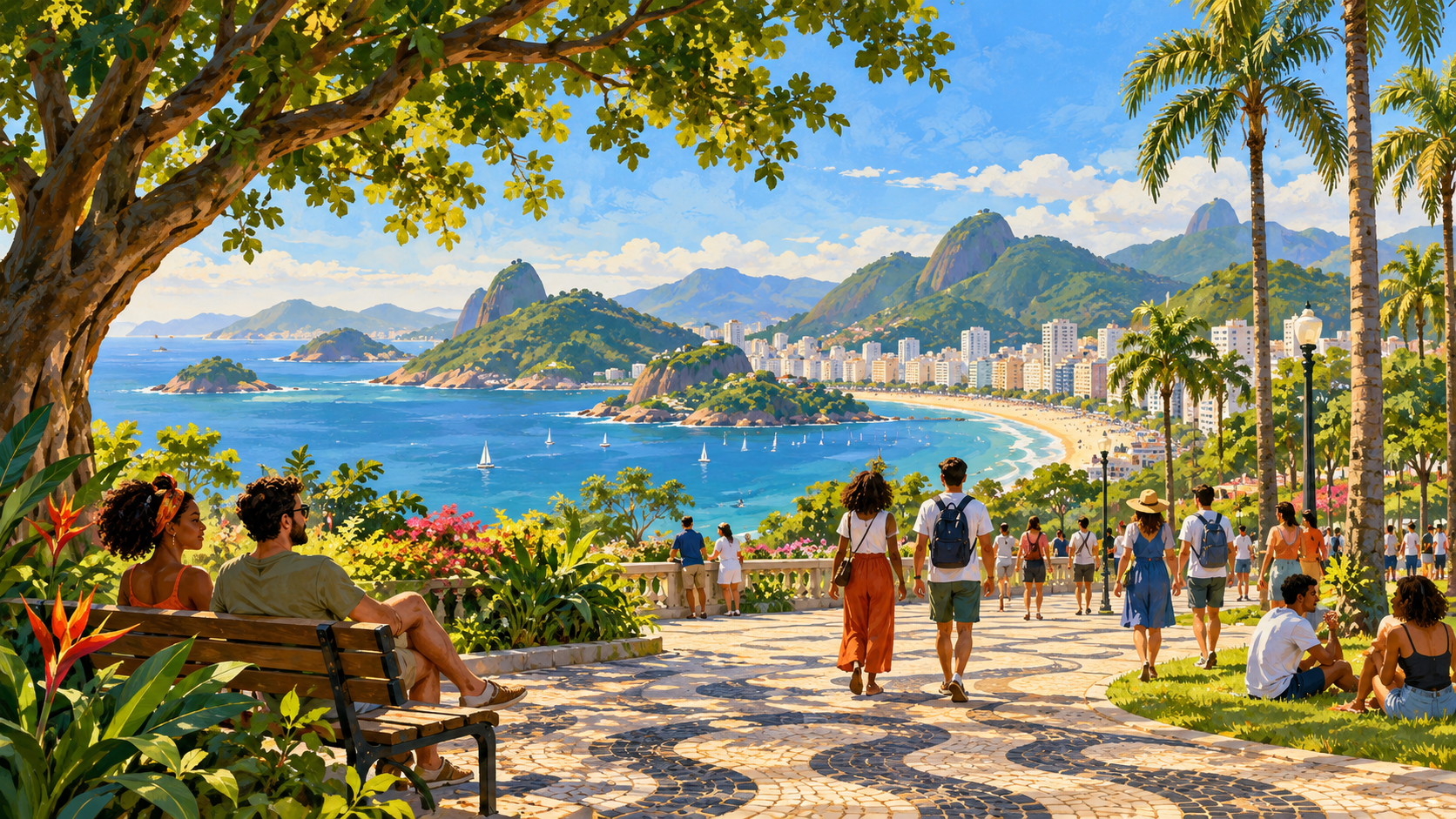
Brazil Children Vocabulary | Words for Character and Nation Building gives international children 20 age-appropriate English words and connected reading about heritage, nature, community and careful action. How does a planned capital become a place people actually use, how can a group performance depend on disciplined listening, and why does a lush forest need careful scientific monitoring? Brazil provides examples through Brasília, capoeira, Atlantic Forest conservation and the plurality of language and song traditions.
For international children roughly ages eight to twelve learning English. It is not a Brazilian school syllabus, political campaign, capoeira movement tutorial or permission to enter a protected forest. The examples name specific practitioners and places rather than assuming that everyone in Brazil shares the same experiences, beliefs or cultural forms.
Documented country context: UNESCO recognises Brasília as a modernist planned capital, built from 1956 to 1960 and listed in 1987; the capoeira circle as an Afro-Brazilian practice inscribed in 2014; and the Atlantic Forest South-East Reserves as a large system of 25 protected areas. UNESCO also recognises Samba de Roda of the Recôncavo of Bahia, while Brazil’s statistics institute IBGE documents substantial Indigenous-language diversity. Together these sources teach that a city plan, community skill, ecological system and living language are different kinds of evidence about national life.
What nation building means in this guide: In this series, nation building means learning accurate public language, acknowledging cultural practitioners, testing whether people can actually use a shared place and taking small responsible actions. It does not mean children must endorse a government or behave as though a recognised tradition describes every Brazilian.
Quick answer: how this vocabulary article helps children
| What the guide contains | Learning task | What not to do |
|---|---|---|
| 20 terms with meanings and model sentences | Explain and use each word with a contrasting non-example | Use a complex word solely to sound impressive |
| Four sourced reading chapters | Connect a claim, its limits and a safe action | Apply one community’s practice to an entire population |
| Fictional school story plus six explained answers | Identify a misleading statement, check a source and repair it | Treat imaginary stories as eyewitness reports |
| One week of short study activities | Read, speak, compare, write and reuse meanings | Make children carry professional or governmental duties |
Jump to the 20 words · four chapters · story · worked checks · 7-day plan · adult guidance · questions · sources and hubs.
20 children’s vocabulary words: clear definitions and useful examples
The middle column distinguishes the meaning from a common error. The final sentences are editorial English-learning examples, not real quotations or news reports. Culture-specific terms are presented only with their documented community context.
1. Brasília: planned design and the reality of accessible places
| Word | Meaning and important distinction | Model sentence |
|---|---|---|
| Brasília | Brazil’s purpose-built modern capital, not the name of every large city in the country. | The pupils placed Brasília in the Federal District. |
| urban planning | Designing and managing the arrangement of places and services in a city; not simply sketching pretty buildings. | Urban planning connects streets, homes and public places. |
| axis | A principal line or organising direction in a layout; not necessarily a physical wall. | The model city showed two main axes. |
| public space | An area used or shared by people under relevant rules; not unrestricted private property. | The square was discussed as a public space. |
| accessibility | The ability of different people to use a place or message effectively; not just having an entrance. | The design’s accessibility improved with readable signs. |
2. Capoeira: disciplined cultural practice and respectful learning
| Word | Meaning and important distinction | Model sentence |
|---|---|---|
| capoeira | An Afro-Brazilian cultural practice combining movement, music and interactive play within community traditions; not simply gymnastics. | The class read UNESCO’s explanation of capoeira. |
| roda | A circle or gathering in which particular Brazilian cultural performances take place; not any random ring of people. | The capoeira roda has roles for players and musicians. |
| berimbau | A single-string musical bow associated with capoeira; not a name for every drum. | The caption identified the berimbau as an instrument. |
| master | An experienced practitioner who teaches and maintains cultural knowledge; not anyone who wins one game. | A capoeira master transmits skills and group conduct. |
| discipline | Developed self-control and adherence to appropriate practice rules, not mindless obedience. | Discipline includes knowing when not to attempt a dangerous movement. |
3. Atlantic Forest: habitat diversity and evidence-based conservation
| Word | Meaning and important distinction | Model sentence |
|---|---|---|
| Atlantic Forest | A Brazilian biome with forests and diverse habitats, not simply a synonym for the Amazon. | The map located protected Atlantic Forest areas in south-east Brazil. |
| biodiversity | The variety of living organisms and ecosystems within an area; not one large count of a single species. | The report described biodiversity across varied habitats. |
| endemic | Naturally occurring in a particular geographical area and found nowhere else in the wild; not merely rare. | An endemic species may need special habitat protection. |
| fragmentation | The breaking of a habitat into separated pieces; not automatically the same as natural seasonal change. | Roads can contribute to habitat fragmentation. |
| conservation | Informed protection and management of environments or species; not collecting wildlife as a souvenir. | Conservation depends on repeated monitoring and suitable rules. |
4. Languages and Samba de Roda: belonging without cultural stereotypes
| Word | Meaning and important distinction | Model sentence |
|---|---|---|
| Portuguese | Brazil’s official language; not proof it is the only language spoken by every resident. | The student learned that Portuguese has official status. |
| Indigenous language | A language associated with an Indigenous people, not a dialect automatically inferior to an official language. | The report recognised Brazilian Indigenous-language diversity. |
| Samba de Roda | A participatory Afro-Brazilian music, dance and poetry tradition of the Recôncavo of Bahia; not every Brazilian samba performance. | UNESCO identifies Samba de Roda as a specific regional tradition. |
| attribution | Naming the creators, performers and sources of cultural work; not using another person’s work anonymously. | The programme included attribution for the recording. |
| inclusion | Making genuine participation possible for people with different needs and backgrounds; not only saying welcome. | The group practised inclusion by checking its audience could read the notice. |
Four learning chapters: a source, a word and a practical judgement
Each chapter links five related vocabulary terms to a country-specific source. Read for the distinction between what is observed, what the source supports and what is still unknown. Then complete the child-safe transfer task.
1. Brasília proves that a plan and a lived city are not identical things
Five terms in focus: Brasília · urban planning · axis · public space · accessibility.
UNESCO lists Brasília as a World Heritage property because of its influential twentieth-century city design. Built as Brazil’s modern capital beginning in the 1950s, it is associated with urban planner Lúcio Costa and architect Oscar Niemeyer. The plan combines major circulation and monumental axes, distinct administrative areas and residential neighbourhood concepts. The word urban planning explains why an entire city is more than a collection of attractive individual buildings. Roads, services, spaces and the relationships among them all matter.
An axis is a useful organising line in a plan or diagram. Brasília’s design is often interpreted visually in relation to two crossing main directions, with the monumental axis and a curved transportation-residential axis. A child looking at an aerial image may enjoy its shape, but should not assume that the appearance proves every street is easy to cross or every resident can reach every service. A geometric plan describes intention and arrangement; practical use requires separate evidence.
A public space is a place people may share under its rules and purposes. An architectural drawing can show a large square, but cannot establish whether it feels safe at night, has readable signs, meets access needs or is comfortable in different weather. These are questions about actual experience and management. Children’s vocabulary should distinguish a planner’s proposed design from outcomes experienced by residents. Admiring an innovative building does not require pretending the city has no practical challenges.
Accessibility makes the contrast concrete. Suppose a fictional class builds a model capital with beautiful wide avenues but forgets where pedestrians could cross and how someone with mobility needs would use the route. The model looks symmetrical, yet important users have been ignored. A safer and more inclusive classroom revision might add clear crossings, step-free access in the imagined layout and signs readable at suitable heights. The students should not claim the redesigned paper model proves Brasília itself lacks these facilities; the scenario is invented for learning.
UNESCO describes modernist buildings, planned districts and the vision of harmonising urban form. The World Heritage listing is about particular cultural and architectural values. It is not a certificate saying every aspect of the city’s government or services is perfect. A pupil who reads that Brasília is a capital with significant public buildings should not use that claim to describe the living conditions of all Brazilians. The country includes many other cities, rural areas and communities with very different daily experiences.
Ask the class to prepare two kinds of sentence. A historical fact: ‘Brasília was planned and built as Brazil’s capital in the middle of the twentieth century’. A design description: ‘Its layout uses organising axes and districts’. A judgement about actual accessibility would require current evidence about specific streets, buildings and people. The first two can be connected to UNESCO; the third is not established simply by looking at the plan.
Students can make an original model neighbourhood with a library, school, garden and bus stop, then use string to mark possible routes. They can test whether a younger learner can understand the map legend and whether the route instructions name a clear starting point. The activity is a lesson in planning language and user needs, not a real traffic engineering proposal or an accurate map of Brasília.
A final debate can ask: ‘If a city looks beautiful from the sky, does everybody living there automatically have equal access to services?’ The answer is no. Accessibility must be assessed with relevant people and evidence. The word makes a civic idea concrete without asking children to hold a political opinion about the city’s planners. They learn to describe intentions, built objects and measured outcomes as different things.
Precision check: Misleading: ‘Brasília’s impressive plan proves every resident has equal access and that all Brazilian cities look alike.’ Repair: ‘Its UNESCO significance concerns modernist planning, while real access requires place-specific evidence.’
Practice and transfer: Draw a fictional planned town with two axes and four shared facilities. Ask a partner to follow a route and note what design change would make the map more accessible.
2. A capoeira roda is trained cultural interaction, not an acrobatics challenge
Five terms in focus: capoeira · roda · berimbau · master · discipline.
UNESCO inscribed the capoeira circle on its intangible-heritage list in 2014. It describes an Afro-Brazilian cultural practice with elements of fight, dance, music and interactive play. The roda is the circle of participants, and two practitioners move within it while others sing, clap and play instruments. A child might see a dramatic handstand and assume capoeira is only gymnastics. That misses the timing, musical knowledge, communication, community history and codes of conduct that UNESCO considers central to the practice.
The berimbau is a distinctive single-string musical bow used within capoeira. Its sound helps shape rhythm and timing, but a photograph of the instrument is not enough to teach its playing technique. UNESCO also describes different roles, including the master, other experienced participants and learners. A master transmits skills and guides group conduct. The title refers to cultivated expertise within a tradition, not simply the person who performed the most spectacular move in one round.
Discipline is often misunderstood as staying silent or obeying every instruction without thought. In this context it includes learning methods, understanding codes of behaviour, listening carefully, controlling movement and recognising safety. Experienced capoeira practice can be physically demanding and carries risk. Young children should not attempt flips, strikes, balance moves or improvised sparring after reading this article. Any practical training requires qualified adult instruction and suitable safety arrangements. A vocabulary exercise is not a movement tutorial.
UNESCO’s description links capoeira with the memory of resistance to historical oppression and the ability of a circle to foster mutual respect. This should be discussed honestly. Afro-Brazilian traditions have histories shaped by African-descended communities and unequal social conditions; a school should not erase those people and call the practice a game invented for tourists. At the same time, a short description cannot provide every practitioner family’s full historical experience. A source-grounded caption can acknowledge a history of resistance without inventing personal testimony.
Consider a fictional class writing a poster. One line reads, ‘Brazil’s children all practise capoeira and anyone can teach it without training’. That statement is not supported by UNESCO. A stronger version says that UNESCO recognises a specific Afro-Brazilian practice, sustained by masters and groups who learn its movement, music and conduct. The corrected sentence does not deny its wide cultural significance; it avoids presenting a valued example as a compulsory national activity.
For a safe classroom transfer activity, create a seated call-and-response reading exercise about vocabulary: one pupil gives a word, another uses it in an original sentence, and the group listens and checks the meaning. Explain that this is an English learning game and not a capoeira roda, demonstration or ceremonial performance. It illustrates how coordinated listening and discipline can improve shared activity without appropriating the exact movement or music of the practice.
If using a recording or image in a school article, attribution will be important even though it appears in a later word group. Identify the source, performers and permissions where known. Public availability on a video platform does not mean a recording may be copied into a new site without rights or consent. The work and cultural context of practitioners deserve credit.
Another useful reflection asks whether the most skilled participant is the one who takes the biggest risk. The answer is not necessarily. A trained practitioner may display judgement by choosing appropriate movements, timing and communication, and by protecting other people. For children, understanding what not to attempt is a form of disciplined learning. Confidence is not proof of competence or permission.
End with three connected sentences: ‘The roda is a group circle. The master helps transmit knowledge. The discipline of capoeira includes music, movement and respectful conduct’. Each sentence identifies a feature that UNESCO describes. Together they give more insight than a poster dominated by one photograph of an acrobatic move.
Precision check: Misleading: ‘Capoeira is merely acrobatics and children can safely copy it from a short video.’ Repair: ‘It is a complex Afro-Brazilian tradition involving music, trained movement, social learning and conduct under experienced guidance.’
Practice and transfer: Describe a credited capoeira recording in your own English words without reproducing moves. Make a separate seated listening game clearly labelled as an original classroom activity.
3. The Atlantic Forest is a complex biome, not just another name for the Amazon
Five terms in focus: Atlantic Forest · biodiversity · endemic · fragmentation · conservation.
Brazil contains many ecosystems. UNESCO’s Atlantic Forest South-East Reserves property includes 25 protected areas in the states of Paraná and São Paulo. This is not the Amazon rainforest, and the word Atlantic Forest should not be used as though it were interchangeable with every wooded place in the country. UNESCO describes an exceptionally varied landscape from mountains and dense forests to estuaries, coastal islands and wetlands. A photograph of a single green hillside does not represent all those habitats.
Biodiversity concerns the variety of species and ecological relationships. Some parts of the forest hold rare animals and plants, including species that are endemic, meaning their natural wild range is limited to a particular geographical area. A species can be endemic without being abundant or guaranteed to be seen. One striking wildlife photograph does not measure a population, and the absence of an animal from a class picture does not prove it is absent from the forest.
UNESCO identifies fragmentation as a major concern for the Atlantic Forest. When a habitat is split into isolated pieces, animals and plants may have less opportunity to move, disperse or maintain ecological connections. That does not mean every road automatically destroys an entire ecosystem, or that children can decide environmental policy from an aerial photo. The effects require ecological measurements, spatial context and careful decisions by responsible authorities. The word is valuable because it describes a process that may matter even if some green forest remains visible.
Conservation means informed work to protect ecosystems, species and processes. UNESCO discusses the importance of corridors and buffer zones so that protected areas are not considered separate islands of safety within a wider damaged landscape. A protected boundary on a map does not prove all threats disappear at that line. The wider surrounding land and connected waterways also influence ecological outcomes. This is a reason to consider systems and repeated monitoring rather than declaring victory when one reserve is named.
Ask pupils to compare three fictional maps. The first has one large connected forest; the second shows the same total number of small green blocks separated by roads; the third adds green links between some blocks. Without claiming to calculate actual biodiversity from a simple diagram, students can discuss why connections could matter. They should label the scenarios invented. The activity helps explain fragmentation but is not a replacement for research on the real Atlantic Forest.
UNESCO also lists specific rare or threatened species in this region. A child might be tempted to make an animal-counting challenge on a real hike. That is inappropriate without qualified adult guidance, local access rules and safety planning. Wildlife should not be approached, fed or collected for school credit. The safe classroom role is to read and accurately explain the conservation information and understand that professional monitoring supports decisions. A child who notices a misleading poster can correct it rather than taking unnecessary field risks.
The distinction between ‘green’ and ‘healthy ecosystem’ is important. A garden may look green after heavy watering but still have problems; similarly, a forest’s appearance does not by itself reveal soil conditions, species interactions or protection effectiveness. Good scientific language uses specific claims supported by observations. An article can admire a forest without asserting that its ecological future is guaranteed by scenic beauty.
A paragraph about the country should avoid saying ‘Brazil is just the Amazon’. Brazil includes Atlantic Forest, Cerrado, Caatinga, Pantanal and other biomes, each with different conditions and histories. UNESCO’s Atlantic Forest entry gives one detailed example, not an exhaustive account of Brazil’s nature. Children who understand that distinction can write richer geography descriptions without reducing a vast country to one image.
Finally, ask students to use the words Atlantic Forest, endemic, fragmentation, biodiversity and conservation in a four-sentence explanation. One sentence names the region, one describes a scientific concept, one states a limit of the available evidence, and one identifies a safe supervised classroom contribution. That is more educationally valuable than a vague instruction to ‘save every animal’.
Precision check: Misleading: ‘All Brazilian forests are Amazon rainforest and a green photo proves biodiversity is safe.’ Repair: ‘The Atlantic Forest is a distinct biome whose endemic species and fragmentation need evidence-based conservation.’
Practice and transfer: Draw two fictional forest maps: one connected, one fragmented. Explain a possible ecological effect without claiming to know the real population of any protected species.
4. Brazil’s many languages and Samba de Roda illustrate different ways to belong
Five terms in focus: Portuguese · Indigenous language · Samba de Roda · attribution · inclusion.
Portuguese is Brazil’s official language, but that legal status does not mean every person uses Portuguese as their only home language. Brazil’s statistics institute IBGE documents substantial diversity among Indigenous languages, including its 2022 Census research. Indigenous languages have their own structures, speakers and community knowledge; they are not inherently inferior to an official language. A child should not guess which language another child speaks from appearance or surname. The respectful question is what explanation or language support helps the person understand a particular task.
The UNESCO-recognised Samba de Roda of the Recôncavo of Bahia offers another example of diversity. It is an Afro-Brazilian tradition associated with a particular region of Bahia, involving music, dance and poetry. UNESCO links its history to African-descended communities and contact with Portuguese influences. That does not mean every person in Brazil practises the same form of samba, nor that every contemporary samba event is the specific Recôncavo tradition. A named heritage entry has a context and particular practitioners who should not disappear behind a generic national label.
Samba de Roda includes group participation and the transmission of knowledge through people who know its songs, movements and social settings. UNESCO discusses pressures on the tradition, including changes in music practices and a shortage of makers for some associated instruments. These challenges do not mean it has already vanished, nor that one outside school performance can replace community practice. Children can learn why living art needs opportunities to teach and practise without claiming they have acquired full authority after watching a clip.
Attribution is the habit of crediting the performer, craftsperson, musician, source and appropriate community when known. If a school uses a piece of music, a photograph or a poem, it should observe copyright and other permissions. A public streaming clip is not a licence to reproduce lyrics or recordings freely. If the artist is not identified in the material, an honest label should say so rather than invent a name. This is one way to treat artistic and Indigenous knowledge with dignity.
Inclusion concerns practical ability to participate. Imagine an English-language school exhibit explaining Brazil. The organisers include a difficult word such as ‘endemic’ but no definition. A learner with less English experience struggles to follow the meaning. The group might add a plain-language caption, clear diagram or spoken explanation. It should not assume that the child is less intelligent because the language is unfamiliar. Likewise, having a sign in Portuguese does not prove every visitor can understand it. Effective communication requires checking with the intended audience.
IBGE’s language statistics illustrate why ‘one nation, one language, one culture’ is inaccurate. A census is a structured way of collecting information at a given time; its results need to be read with attention to population, age groups and categories. A pupil should not turn a national count into a claim that every individual speaks a particular tongue. Language knowledge can change across generations and places. A child’s role is to read the official source carefully and avoid reducing many distinct Indigenous peoples to one single community.
The article can also distinguish belonging from compulsory performance. A person can live in Brazil, appreciate a regional art tradition and choose not to dance. A child may learn Portuguese and a family language without being required to abandon either. Shared national institutions do not erase different histories. The word inclusion is useful precisely because it asks whether actual people can take part without surrendering their identity or being forced to represent a stereotype.
A safe classroom exercise is to compose a short original call-and-response about borrowing books in English, rather than imitating a protected cultural song. Label it an invented language-learning activity and explain why it is not Samba de Roda. If a teacher has a licensed, correctly attributed recording, pupils can compare its documented description with their personal reaction while recognising that an opinion is not proof of the performer’s intent.
End with three different sentence types. A legal statement: ‘Portuguese has official status in Brazil’. A source-supported cultural statement: ‘UNESCO recognises Samba de Roda from the Recôncavo of Bahia’. A practical action: ‘Our class added a clearer definition so younger readers could understand the display’. The first two require authoritative information, and the third requires checking what the class actually did. Keeping these categories separate makes children more responsible communicators.
The character lesson is not to call every Brazilian the same kind of singer, speaker or citizen. It is to recognise communities’ knowledge, credit living makers, respect language differences and make public explanations more usable. Those habits make vocabulary useful wherever children learn.
Precision check: Misleading: ‘Portuguese is official, so Brazil has no other languages, and every Brazilian practises the same Samba de Roda.’ Repair: ‘Brazil contains substantial Indigenous-language diversity, and Samba de Roda is a particular Afro-Brazilian regional tradition.’
Practice and transfer: Write a museum note with one verified fact about Samba de Roda, one verified observation from IBGE on language diversity and a practical suggestion to help different visitors understand the exhibit.
Fictional story: practise evidence-based correction
At a fictional international classroom, Clara draws Brasília as a perfect symmetrical city and claims its plan guarantees every resident can reach every public service. Her friend asks for evidence about access, so she revises the caption. João watches a capoeira video and proposes unsafe acrobatics for the class; the teacher instead gives a seated vocabulary listening game and explains the need for trained instruction. Marina labels the Atlantic Forest as the Amazon and corrects her map after checking UNESCO’s protected-area listing. Finally, Ana writes that Portuguese is the only language anyone speaks in Brazil and that all children practise Samba de Roda. The group reads IBGE and UNESCO, credits regional practitioners and adds a simpler English explanation. The pupils and events are entirely imaginary; source-based facts are referenced below.
Four questions to discuss
- 1. What did Clara assume about real public access from a city plan?
- 2. Why did João’s capoeira exercise need a safer replacement?
- 3. Which geographical distinction corrected Marina’s forest map?
- 4. How did Ana’s revised language and culture labels become more inclusive and accurate?
Ask the learner to point to the particular line of the fictional story that explains an answer, and to the actual source for any real cultural or scientific fact. A fictional character cannot establish the historical experience of real people.
Six short checks with worked answers
Check 1: Is Brasília a naturally grown medieval capital or a modern planned city?
Worked answer: It is a planned capital associated with urban design from the 1950s and listed by UNESCO.
How to reason: Identify the specific information in the question, choose the accurate term, rule out one plausible error and use the word again in an original sentence about a different safe situation.
Check 2: Does a beautiful city plan prove every person has equal access to services?
Worked answer: No. Accessibility needs its own evidence about users and conditions.
How to reason: Identify the specific information in the question, choose the accurate term, rule out one plausible error and use the word again in an original sentence about a different safe situation.
Check 3: Is capoeira only an acrobatics trick anyone should copy from a video?
Worked answer: No. It is a trained Afro-Brazilian cultural practice involving music, movement and codes of conduct.
How to reason: Identify the specific information in the question, choose the accurate term, rule out one plausible error and use the word again in an original sentence about a different safe situation.
Check 4: Is Atlantic Forest another name for all of the Amazon rainforest?
Worked answer: No. It is a distinct Brazilian biome with its own ecosystems and conservation needs.
How to reason: Identify the specific information in the question, choose the accurate term, rule out one plausible error and use the word again in an original sentence about a different safe situation.
Check 5: What does endemic mean for a wild species?
Worked answer: It naturally occurs within a particular geographical area, not everywhere.
How to reason: Identify the specific information in the question, choose the accurate term, rule out one plausible error and use the word again in an original sentence about a different safe situation.
Check 6: Does official Portuguese mean Brazil has no Indigenous languages?
Worked answer: No. Brazil’s IBGE documents many Indigenous languages in use.
How to reason: Identify the specific information in the question, choose the accurate term, rule out one plausible error and use the word again in an original sentence about a different safe situation.
Seven days to turn twenty words into active vocabulary
| Day | Learning task | Evidence of mastery |
|---|---|---|
| Day 1 — Notice | Learn words 1–5 and explain each meaning without copying the text. | One correct example and one non-example |
| Day 2 — Speak | Use words 6–10 in two ordinary spoken situations, with a partner listening. | A complete sentence with correct meaning |
| Day 3 — Read | With an adult, read a short appropriate paragraph from an authoritative link below. | One supported claim and one further question |
| Day 4 — Compare | Study words 11–15 and sort four statements into observation, sourced fact, fiction and inference. | The learner can explain the boundaries |
| Day 5 — Decide | Study words 16–20 in a safe imaginary classroom decision. | One realistic action and a way to check its result |
| Day 6 — Write | Write 80–120 original words using at least three vocabulary terms. | Clear prose with correctly limited claims |
| Day 7 — Transfer | Use three general words in a new school, family or country example. | Transfer of meaning without stereotypes |
Checking progress without confusing memorisation with understanding
A child who understands a word should be able to define it independently, reject a tempting but wrong example and use it correctly in a fresh situation. Adults may record these abilities as ‘not yet’, ‘with help’ and ‘independently’, then repeat the check after several days. Correcting an earlier error is progress, not a failure.
For a writing activity, check five essentials: clear subject and verb, appropriate vocabulary, proper source attribution, an honest boundary on what is known, and a safe and realistic action when one is described. A precise short explanation is stronger than a long paragraph of national praise.
Notes for parents and teachers: teach character as an action
- Choose real sources for real claims. UNESCO or an official statistical agency can establish a specific fact; a classroom simulation cannot establish a country’s conditions.
- Differentiate people, culture, country and government. Children should not be asked to support a political authority or speak for everyone with a national label.
- Name heritage bearers. Living traditions are sustained by particular people and can change or cross borders without losing significance.
- Discuss difficult history with dignity. Acknowledge exploitation or oppression honestly but without sensational stories, invented victim voices or graphic imagery.
- Keep risky work with qualified adults. Wild-animal observation, dangerous sports, protected-area access and infrastructure management are not children’s assignments.
- Check real inclusion. A beautiful display or welcome sentence does not prove that different readers can participate.
- Welcome correction and dialogue. The best group often improves when a quiet source-checker notices a misleading claim.
- Practise five connected words at a time. Revisit them through reading, paraphrasing, original writing and safe practical models.
Frequently asked questions
What makes Brasília important to architecture and urban history?
UNESCO recognises its twentieth-century modernist planning and distinctive urban layout; that does not automatically measure every resident’s accessibility.
Is capoeira an ordinary physical-education warm-up?
No. It is a cultural practice with trained movements, music and social codes; young learners should not attempt risky moves without qualified instruction.
Is the Atlantic Forest the same as the Amazon?
No. It is a different Brazilian biome; UNESCO protects important Atlantic Forest sites in Paraná and São Paulo.
Does every Brazilian speak only Portuguese and practise Samba de Roda?
No. Portuguese is official, but IBGE documents Indigenous-language diversity, and Samba de Roda is a distinct regional heritage tradition.
Official references, companion country articles and hubs
Country facts were checked with the named institutional sources on 23 October 2026. The example sentences, invented pupils, fictional dialogues and learning activities are original editorial materials—not national curricula, eyewitness accounts or current safety advice. Local rules and conditions must be checked with relevant authorities.
- UNESCO World Heritage | Brasília
- UNESCO Committee Decision | Capoeira circle inscription
- UNESCO World Heritage | Atlantic Forest South-East Reserves
- UNESCO Intangible Heritage | Samba de Roda of the Recôncavo of Bahia
- Brazilian Institute of Geography and Statistics (IBGE) | Indigenous languages
- UNICEF | Convention on the Rights of the Child
More country learning on eduKateSG
- Everything About Brazil
- How Brazil Works
- Understanding the Education System of Brazil
- Top 100 Music Vocabulary Words | Brazil
A–K Children Vocabulary country series
Afghanistan Children Vocabulary · Albania Children Vocabulary · Algeria Children Vocabulary · Andorra Children Vocabulary · Angola Children Vocabulary · Antigua and Barbuda Children Vocabulary · Argentina Children Vocabulary · Armenia Children Vocabulary · Australia Children Vocabulary · Austria Children Vocabulary · Azerbaijan Children Vocabulary · Bahamas Children Vocabulary · Bahrain Children Vocabulary · Bangladesh Children Vocabulary · Barbados Children Vocabulary · Belarus Children Vocabulary · Belgium Children Vocabulary · Belize Children Vocabulary · Benin Children Vocabulary · Bhutan Children Vocabulary · Bolivia Children Vocabulary · Bosnia and Herzegovina Children Vocabulary · Botswana Children Vocabulary · Brazil (this guide)
Return to the main vocabulary hubs
- Vocabulary Learning Hub
- Vocabulary by Age and Purpose
- How Countries Work | A–Z
- World Travel and Country Vocabulary Index
A child who completes this Brazil guide should be able to describe facts without stereotypes, give credit for people’s knowledge, recognise the limits of a photograph or claim, and explain one safe contribution they can make. Vocabulary supports character when it helps us understand before we speak and act.