
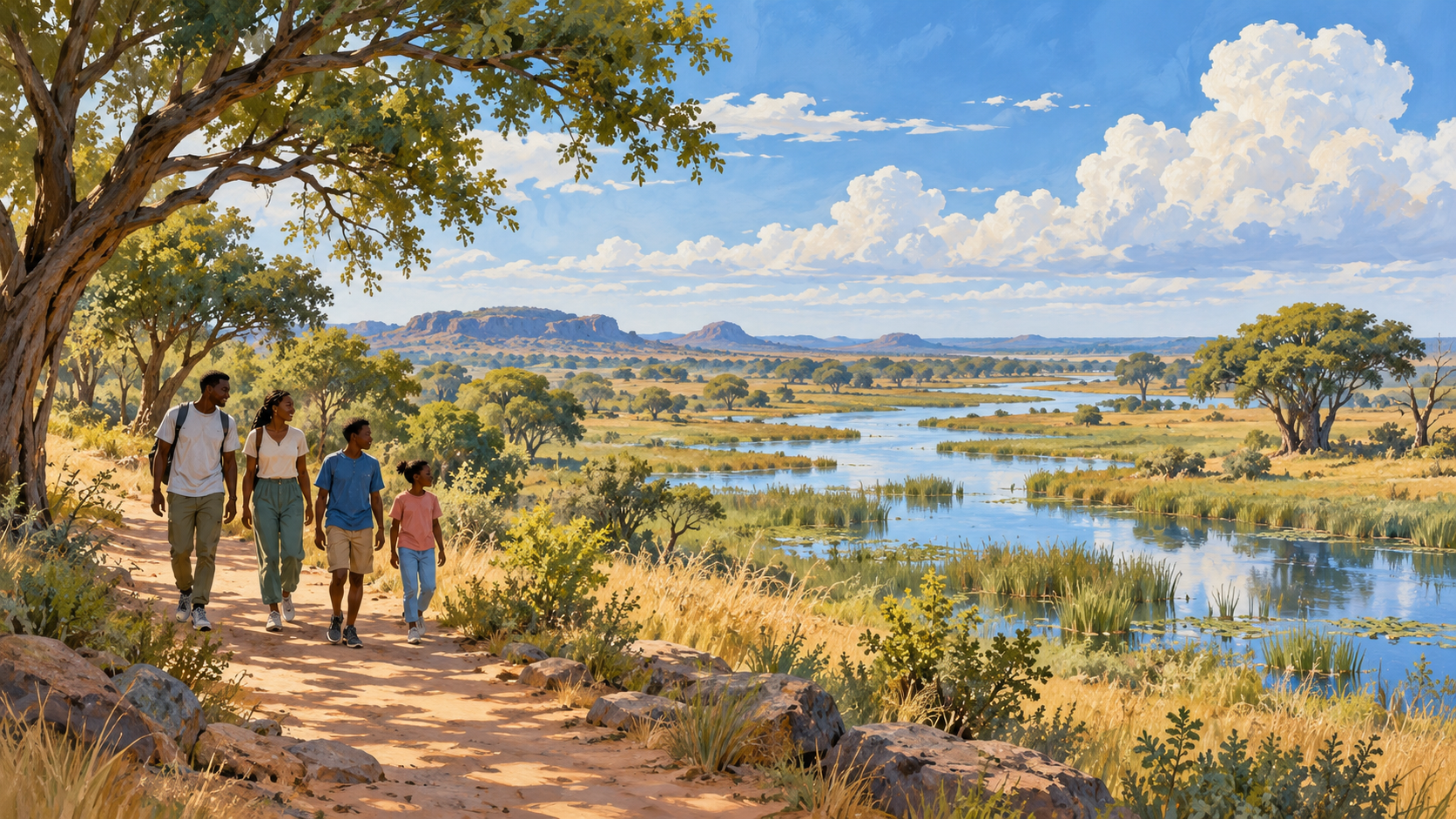
Botswana Children Vocabulary | Words for Character and Nation Building gives international children 20 age-appropriate English words and connected reading about heritage, nature, community and careful action. Why does water spread across a desert during a dry season, why are ancient paintings evidence rather than complete stories, and how can a community keep a song tradition alive? Botswana offers age-appropriate examples of ecological thinking, cultural respect and accountability that help children use English vocabulary beyond memorised definitions.
An independent English vocabulary guide for international children roughly eight to twelve, parents and educators. It is not Botswana’s official school syllabus, a wildlife-travel guide, permission to enter sacred or protected places, or a claim that every citizen has the same cultural traditions. Classroom pupils and stories are invented, and hazardous fieldwork belongs to trained adults.
Documented country context: UNESCO’s Okavango Delta World Heritage description explains an inland delta whose annual flood arrives during the region’s dry season, sustaining varied wetlands and wildlife. The Tsodilo World Heritage property documents thousands of rock paintings and long sequences of human activity. UNESCO’s 2017 inscription of Dikopelo folk music of Bakgatla ba Kgafela in Kgatleng District is on the List of Intangible Cultural Heritage in Need of Urgent Safeguarding. These examples combine environmental processes, archaeological evidence and living community knowledge without treating them as interchangeable.
What nation building means in this guide: Character and nation building here means using accurate observations, respecting the holders of cultural knowledge, considering people’s rights and needs in conservation and carrying out safe school-scale commitments. It does not require political loyalty or assign adult wildlife-management work to a child.
Quick answer: how this vocabulary article helps children
| What the guide contains | Learning task | What not to do |
|---|---|---|
| 20 terms with meanings and model sentences | Explain and use each word with a contrasting non-example | Use a complex word solely to sound impressive |
| Four sourced reading chapters | Connect a claim, its limits and a safe action | Apply one community’s practice to an entire population |
| Fictional school story plus six explained answers | Identify a misleading statement, check a source and repair it | Treat imaginary stories as eyewitness reports |
| One week of short study activities | Read, speak, compare, write and reuse meanings | Make children carry professional or governmental duties |
Jump to the 20 words · four chapters · story · worked checks · 7-day plan · adult guidance · questions · sources and hubs.
20 children’s vocabulary words: clear definitions and useful examples
The middle column distinguishes the meaning from a common error. The final sentences are editorial English-learning examples, not real quotations or news reports. Culture-specific terms are presented only with their documented community context.
1. Okavango: seasonal water and how an inland delta works
| Word | Meaning and important distinction | Model sentence |
|---|---|---|
| Okavango Delta | A large inland wetland system in Botswana where river water spreads into marshes and plains; not a coastal river mouth. | The map showed the Okavango Delta away from the sea. |
| inland delta | A spreading river-water system that does not directly empty into an ocean; not the same as every coastal delta. | The learner distinguished an inland delta from a marine estuary. |
| seasonal flood | Water spreading over land in a recurring period of the year; not necessarily a sudden damaging disaster. | The seasonal flood brings water to Okavango habitats. |
| wetland | Land that remains waterlogged or flooded for some or all of the year; not simply a muddy road. | The wetland diagram showed pools and marsh plants. |
| ecological process | A recurring interaction affecting organisms and their environment, rather than one isolated animal sighting. | Flooding is linked with an ecological process sustaining habitats. |
2. Tsodilo: rock art, archaeology and the limits of inference
| Word | Meaning and important distinction | Model sentence |
|---|---|---|
| Tsodilo | A World Heritage rock-art landscape in north-west Botswana; not a generic name for all ancient paintings. | The class studied UNESCO’s Tsodilo site description. |
| rock art | Painted or engraved marks made on rock in human history; not necessarily a modern decoration. | Tsodilo contains important rock art. |
| archaeology | Investigation of human history through material remains and context; not inventing a story from one photo. | Archaeology gives evidence about earlier human occupation. |
| chronology | The order of events across time; not proof everything in one place happened at once. | The class arranged the site history in chronology. |
| inference | A reasoned idea drawn from evidence, not a fact seen directly. | Her inference about the painting was marked as tentative. |
3. Dikopelo: living choral knowledge and respectful transmission
| Word | Meaning and important distinction | Model sentence |
|---|---|---|
| Dikopelo | A communal choral song-and-dance tradition of Bakgatla ba Kgafela in Botswana; not every popular song in the country. | UNESCO lists Dikopelo as requiring urgent safeguarding. |
| choir | A group of people singing together; not automatically a group accompanied by instruments. | The Dikopelo choir practised coordinated singing. |
| choreography | A planned pattern of dance or movement; not just unorganised walking. | The description explained the choir’s choreography. |
| heritage bearer | A person or group that practises and transmits a cultural tradition; not simply a spectator. | The programme credited the tradition’s heritage bearers. |
| safeguarding | Supporting the continued practice and transmission of living heritage; not freezing people in the past. | Teaching can contribute to safeguarding when communities guide it. |
4. Stewardship: fair decisions, community voices and accountability
| Word | Meaning and important distinction | Model sentence |
|---|---|---|
| stewardship | Responsible care for shared natural or cultural resources; not a licence to handle protected wildlife. | The class described stewardship as following site rules. |
| consultation | Seeking affected people’s views and seriously considering them before action; not one question followed by ignoring every answer. | Consultation helped the team revise its information board. |
| livelihood | The means by which a person or family sustains life, such as work or resources; not a synonym for wealth. | Conservation decisions can affect local livelihoods. |
| fairness | Just treatment that considers different needs and barriers, not simply giving everyone identical help. | Fairness meant making the instructions understandable to all learners. |
| accountability | Explaining decisions and verifiable results, including mistakes or work not completed. | The team showed accountability by reporting the unfinished map. |
Four learning chapters: a source, a word and a practical judgement
Each chapter links five related vocabulary terms to a country-specific source. Read for the distinction between what is observed, what the source supports and what is still unknown. Then complete the child-safe transfer task.
1. The Okavango teaches children that a dry season and a flood can overlap
Five terms in focus: Okavango Delta · inland delta · seasonal flood · wetland · ecological process.
UNESCO describes the Okavango Delta in north-west Botswana as an outstanding inland delta, a system in which water spreads through marshes and floodplains without reaching the sea. This makes it different from the familiar textbook image of a river emptying into an ocean. The river’s water comes from a catchment that extends upstream into Angola and Namibia, while the UNESCO-listed wetland itself lies in Botswana. Those geographical distinctions matter; a river basin can connect places across borders while the protected property has a defined location.
One of Okavango’s remarkable features is the timing of its seasonal flood. UNESCO explains that the flood reaches the delta during the local dry season. A child might assume that water can spread only while rain is falling on the same spot. River water can take time to travel from the upstream catchment, so local seasons and distant rainfall do not always match neatly. This is a lesson about systems, not a contradiction. Seasonal flooding can transform otherwise dry depressions into vibrant wetlands that support plants and animals.
An ecological process is an interaction or change involving organisms and the environment. In the delta, water patterns influence plants, feeding areas and wildlife movement. A flood is not merely scenery for a photograph. UNESCO describes the interdependence of hydrological, climatic and biological processes, meaning water, climate and living organisms affect one another. The word ‘process’ reminds children to consider what happens over time, not only what a picture shows at one moment.
Imagine two photographs taken at different seasons from the same fictional location. The first shows dry grass; the second shows water and birds. A pupil writes ‘Someone destroyed the land and created a lake’. That is not supported by the pair of images. It is more reasonable to ask whether seasonal water movement explains the difference, and then look for dated hydrological observations. The pictures alone cannot confirm exact causes, water sources, levels or future behaviour. A scientific description should identify what is visible, what a credible source explains and what remains uncertain.
Wild animals such as elephants, buffalo, antelopes and large predators are associated with the protected delta. A list of species tells us about the ecosystem, but not that every visitor will see them, nor that one sighting measures their populations. These animals can be dangerous, and young learners should not be assigned to approach them, camp in the wetlands or take boats through channels as part of vocabulary work. A safe lesson stays with maps, illustrations, trustworthy reports and adult-led classroom research.
UNESCO also notes the importance of the Okavango River Basin Water Commission, which involves cooperation over the wider river system. A water decision upstream can matter to downstream habitats. The idea of coordination across places is understandable to children, but the actual management is a matter for governments, communities, hydrologists and conservation specialists. Students can recognise different responsibilities without pretending their own model map is a management plan.
Use a fictional classroom water-cycle model drawn on paper: a highland source, a river, an inland fan and seasonal wet areas. Add arrows showing water movement and labels for where plants or animals might respond. Make clear that the picture is a simplified illustration, not a real-world flood prediction for Botswana. Ask learners whether changing one part of a system could affect another. The task develops cause-and-effect vocabulary while keeping historical and scientific claims within their sources.
The final check is a contrast between ‘Okavango floods in the rainy season because it is raining at the delta’ and ‘The delta receives a seasonal flood that can arrive during its dry season after water has travelled from upstream’. The latter is the source-grounded explanation. Learning to repair the first sentence teaches children that real-world systems sometimes behave differently from an easy assumption.
Precision check: Misleading: ‘Because the delta floods, it must always be raining there at that time.’ Repair: ‘Okavango’s annual flood pulse arrives during the local dry season after water moves through the upstream basin.’
Practice and transfer: Draw a fictional inland delta with a seasonal flood arrow. Write one sentence explaining why a local dry season does not automatically mean zero incoming river water.
2. Tsodilo rock paintings require evidence and respect for living communities
Five terms in focus: Tsodilo · rock art · archaeology · chronology · inference.
UNESCO lists Tsodilo in north-west Botswana as a World Heritage property important for archaeology, rock art and continuing cultural traditions. Its description refers to thousands of paintings and carvings, along with archaeological evidence of human activity extending over an exceptionally long period. That does not mean every painted animal or human form is the same age. A location that has been significant across many centuries can contain traces produced during very different periods by different people.
Archaeology depends on evidence in context. Researchers study rock surfaces, shelters, deposits and material remains to understand past human activity. A photograph might allow a student to see a painted outline, but not to assign its exact year of creation. The site’s full chronology is a sequence studied using more than one kind of evidence. A long archaeological record is not a single event; it reflects numerous phases of use and change. A child should resist the temptation to label every image ‘prehistoric’ as though that supplies a precise date.
Inference is an interpretation drawn from evidence. Imagine a rock painting of an animal. Observation: an outline resembles a particular animal. Source-based statement: UNESCO identifies animal paintings as part of the site’s significant art. Tentative inference: perhaps the animal held significance to its makers. Unsupported leap: ‘I know exactly what the artist dreamed that night’. The final claim is invented. Even when scholars propose meanings based on culture and context, a pupil should not turn a plausible interpretation into a universal fact.
UNESCO discusses how Tsodilo continues to matter to communities living around the hills, including spiritual and cultural relationships with the site. That is not permission for outsiders to enter every place, copy private practices or treat living cultural beliefs as a curiosity. A visitor can describe that people attach meaning to a place without being required to share those beliefs. Equally, a child should not decide that the local communities’ interpretations are irrelevant merely because they do not look like modern archaeological charts. Respectful research listens to knowledgeable people and carefully distinguishes forms of evidence and cultural meaning.
Rock art can be fragile. Damage to a painted or engraved surface may be permanent. Children should never be asked to touch paintings, chalk outlines, scrub rocks, make unauthorized rubbings or collect artefacts from a protected property. Heritage management belongs to trained staff and relevant local authorities. In the classroom, pupils can use correctly credited reproductions and create their own drawings on paper. The drawing should be labelled an original exercise, not a replica of a sacred panel or proof of a particular ancient meaning.
Sometimes a museum display uses a dramatic image and a short sentence such as ‘The secrets of the ancients are solved’. That is attractive wording but poor history. Good educational writing makes the evidence visible. When a source explains that the paintings span a wide period, the caption should use a phrase such as ‘the exact age of a particular image requires specialist evidence’. A student who admits uncertainty is not failing to understand; they are showing that the word inference has a real role.
Try giving pupils three labels for a fictional painting: ‘shows a red animal outline’, ‘was part of a long-lived rock-art tradition’, and ‘proves every inhabitant had the same belief’. They should classify the first as observation, the second as a claim that needs source support, and the third as an unsupported generalisation. If a credible source documents a specific tradition, the learner can name its community and limits without applying it automatically to all Botswana residents.
Another useful comparison is between Tsodilo and an ordinary class noticeboard. Both can contain material from different times. One cannot assume every message was made on the same day because they share a wall; dates and context matter. This analogy is simple, but it teaches the logic of chronology without suggesting the significance of a school noticeboard is equal to a protected heritage site.
End with a respectful museum-caption exercise. Ask children to use the words Tsodilo, rock art, archaeology, chronology and inference in an accurate paragraph. Require at least one source and one unanswered question. They should credit the World Heritage description and avoid pretending to speak for the people whose traditions continue to connect with the hills.
Precision check: Misleading: ‘All Tsodilo paintings were created at one time, and each tells us the artist’s exact belief.’ Repair: ‘The site preserves material from multiple periods; interpretations of particular paintings require evidence and cultural context.’
Practice and transfer: Study a credited reproduction of Tsodilo rock art. Write one observation, one fact confirmed by UNESCO, and one clearly tentative inference that would need further study.
3. Dikopelo’s community choirs show why safeguarding needs people, not just recordings
Five terms in focus: Dikopelo · choir · choreography · heritage bearer · safeguarding.
UNESCO inscribed Dikopelo folk music of Bakgatla ba Kgafela in Kgatleng District in 2017 on the List of Intangible Cultural Heritage in Need of Urgent Safeguarding. This is a particular Botswanan community tradition, not the name of every song in Botswana. UNESCO describes groups that sing in a choir and move in planned patterns, with little or no musical-instrument accompaniment. The practice includes organised singing, dancing and social participation, rather than a solo performance that can be fully understood from one still photograph.
Choreography describes organised movement. A group may move in a repeated pattern in relation to another group, requiring attention and coordination. A child can understand the English word through a classroom stepping game, but should not claim that an invented game reproduces authentic Dikopelo choreography. The specific performance’s methods, occasions and meanings belong to the heritage bearers who practise it and understand its local social context. The appropriate educational distinction is between learning a general word and learning a community’s entire living art.
UNESCO explains that Dikopelo used to be more closely connected with farming communities and that changing lifestyles and livelihoods affected opportunities to practise. Some groups moved towards village settings, while modern entertainment and social changes reduced the number of experienced practitioners. This history does not mean the community forgot or abandoned its music. The entry specifically records people’s commitment to keeping the practice meaningful. A responsible description should not dramatise the issue as ‘the last song has disappeared’ when the listing documents continuing practice.
Safeguarding means supporting the future life of an element whose continuation may be at risk. A recording is useful documentation, but it cannot by itself teach the exact movement, timing, social relationships and personal judgement required. Young practitioners need suitable opportunities to learn from experienced people and participate in ways the community considers appropriate. UNESCO identifies elders as important sources of skill and guidance. Their role should not be erased by treating a recording platform as the sole owner of the knowledge.
What does ‘in need of urgent safeguarding’ mean? It is a UNESCO heritage-list category concerned with viability and threats, not a judgement that a tradition is inferior or unimportant. Nor does it mean children should rush to organise performances without consent. Adults, practitioners and institutions must make the relevant decisions. International pupils can begin by understanding that cultural skills are sustained by living people and that changes in work and settlement patterns may make teaching more difficult.
For a safe class exercise, create an original two-line choral exchange about an ordinary school topic, such as keeping library books in order. Divide pupils into groups and ask them to listen for timing and clarity. State that this is an invented English speaking task, not an authentic Dikopelo performance. Students should avoid copying a particular community’s song, costume or ceremonial meaning from unlicensed online material. If a teacher uses a verified recording, credit the performers and check permission for reuse.
Children can compare two imagined exhibit captions. The first says ‘Botswana has one national choir that everyone joins and nobody knows its music anymore’. The second says ‘UNESCO documents Dikopelo as a specific communal choral tradition of Bakgatla ba Kgafela, now supported by safeguarding efforts’. The second names the community and does not exaggerate either disappearance or universal participation. A pupil who can explain the difference demonstrates both vocabulary understanding and respect for people.
Another question asks who contributes to a cultural tradition. A lead singer may be visible, but experienced teachers, organisers, costume makers, younger learners and those who arrange suitable practice can all matter. The exact roles should be based on the source, not an invented list of people who must be present at every Dikopelo performance. Cultural transmission is practical and collaborative; it needs opportunities, not merely applause.
Finally, have each student write a short note explaining the relationship among choir, choreography, heritage bearer and safeguarding. A strong answer says that the group practises music and movement together, knowledgeable people transmit skills, and safeguarding seeks to support continuing practice. It avoids treating a particular Botswanan community as a performance supplied for outsiders’ entertainment.
Precision check: Misleading: ‘Dikopelo is a musical-instrument orchestra performed by everyone in Botswana, and urgent safeguarding means it has already vanished.’ Repair: ‘It is a specific communal vocal and choreographic tradition practised by Bakgatla ba Kgafela, with efforts to support its continuity.’
Practice and transfer: Create an original two-line English choir exercise on paper and with supervised voices. Mark it a class exercise, not Dikopelo, and write a caption crediting the real practitioners described by UNESCO.
4. Environmental care is fairer when the people affected can take part
Five terms in focus: stewardship · consultation · livelihood · fairness · accountability.
The Okavango’s World Heritage status recognises ecological value, but the landscape also connects with people who have long relationships with land and water. UNESCO’s management discussion identifies Indigenous communities and other residents, along with conservation authorities and tourism operators, as important stakeholders. Stewardship therefore cannot mean that outsiders simply decide what is best from a distant photograph. Responsible care uses ecological evidence and considers rights, needs and the people affected by decisions.
Consultation is more than asking one convenient person a question and then claiming that all communities agreed. It involves engaging appropriate affected voices, considering what they say and reporting the process honestly. UNESCO explicitly discusses the importance of including Indigenous inhabitants of the delta region in communication about World Heritage management and respecting their views. That is a powerful example for children learning the difference between ‘we informed people’ and ‘we listened to people who would be affected’. The class should not claim to have conducted real consultations on behalf of the reserve.
A livelihood is the means by which people obtain what they need to live, including work and resource use. Some conservation decisions may affect access to land, fisheries, tourism benefits or other opportunities. That does not prove every resident has the same livelihood or that environmental goals and human wellbeing must always conflict. A thoughtful reader asks what evidence exists for a particular choice, whose needs are affected and whether responsible authorities have considered alternatives. Children can learn this logic without prescribing national wildlife policy.
Fairness includes recognising different barriers. A public information meeting held at an inaccessible venue may be announced as ‘open to all’ while still excluding some residents in practice. A translated leaflet may help only when its instructions remain accurate and intended readers can understand it. A classroom can model this with a fictional exhibit opening: the organisers notice that smaller pupils cannot see a tall notice and change the placement, then test whether the text is readable. The principle transfers to public participation, though the classroom task is much simpler than real governance.
Accountability means explaining a decision and checking what happened afterwards. If a group promises to produce three clearly labelled wildlife signs and makes only two, the report should say two. An honest record should also distinguish a sign that has been designed from one that has actually been installed with permission. Announcing that ‘everyone is now safe’ because a poster was printed is an unsupported leap. Accurate reporting allows adults to know what remains to be done and prevents an appearance of success from hiding practical gaps.
Consider an invented proposal to move a path away from a sensitive wetland area. A child might assume the only question is whether wildlife benefits. A mature discussion also asks who uses the path, whether alternatives exist, how access and safety will be managed and which authority has the power to decide. A proper answer may require ecology, community knowledge and legal guidance. It is acceptable for children to say ‘We cannot determine that from this exercise’ instead of selecting a simplistic winner.
Another useful comparison is between one photograph and a long-term report. A photograph of a large herd can show animals present at one time. It cannot establish species trends, the quality of all habitats or the fairness of management decisions. The terms biodiversity, livelihood and consultation need different kinds of evidence. A strong reader knows when not to extend a narrow observation into a claim about every community in Botswana.
For a transferable classroom task, hold a mock decision about the location of a school reading display. Give participants different legitimate needs: a wheelchair user who requires passage, a child who needs quiet and an organiser concerned about space. Do not assign disabilities to real classmates without consent or ask a pupil to speak for a group they do not represent. Instead, use fictional roles and let students explain how they can test a compromise. The goal is respectful consideration, not performance or pity.
At the end, pupils should prepare a short report using all five focus words: they cared for a shared resource, consulted fictional affected people, considered their different needs, and honestly reported the outcome. This is an age-appropriate meaning of community building. It avoids two extremes: pretending that children must solve national conservation and telling them that their everyday actions have no value.
Precision check: Misleading: ‘A beautiful wildlife park means local people’s rights and livelihoods no longer need consideration.’ Repair: ‘Effective stewardship uses ecological evidence and fair consultation with people affected by management.’
Practice and transfer: Run a fictional class notice-board consultation. Record three views, one reasonable change, and an honest explanation of what the group has and has not completed.
Fictional story: practise evidence-based correction
At a fictional children’s science-and-culture fair in Botswana, Neo labels the Okavango a coastal delta and assumes its flood must arrive during local rain. Her partner checks UNESCO and explains the inland flood arriving in the dry season. Dineo writes that every Tsodilo painting was made by one person in one year, then revises the claim after learning about the site’s long chronology. Kagiso prepares a choir video and calls it authentic Dikopelo even though it is his own class exercise; he changes the caption and credits the Bakgatla ba Kgafela tradition. Finally, the group designs a wetland sign without asking anyone if it can be read. They improve the layout after receiving feedback and report the exact changes. Every character and school activity is invented; country facts are grounded in the cited sources.
Four questions to discuss
- 1. How is the Okavango’s flooding different from the simple assumption about local rain?
- 2. Why can’t Dineo infer one date and artist for all Tsodilo paintings?
- 3. What did Kagiso need to change about the claim that his class exercise was authentic Dikopelo?
- 4. How did the group use consultation and accountability rather than merely declaring success?
Ask the learner to point to the particular line of the fictional story that explains an answer, and to the actual source for any real cultural or scientific fact. A fictional character cannot establish the historical experience of real people.
Six short checks with worked answers
Check 1: Does the Okavango Delta empty into an ocean?
Worked answer: No. It is a major inland delta in Botswana.
How to reason: Identify the specific information in the question, choose the accurate term, rule out one plausible error and use the word again in an original sentence about a different safe situation.
Check 2: Why can the Okavango flood when its local region is in a dry season?
Worked answer: Water travels from the upstream catchment and arrives seasonally after a delay.
How to reason: Identify the specific information in the question, choose the accurate term, rule out one plausible error and use the word again in an original sentence about a different safe situation.
Check 3: Does the Tsodilo site record human activity from only one century?
Worked answer: No. It contains archaeological and rock-art evidence spanning very long periods.
How to reason: Identify the specific information in the question, choose the accurate term, rule out one plausible error and use the word again in an original sentence about a different safe situation.
Check 4: What makes Dikopelo different from an instrumental orchestra?
Worked answer: UNESCO describes organised communal singing and choreography without accompanying instruments.
How to reason: Identify the specific information in the question, choose the accurate term, rule out one plausible error and use the word again in an original sentence about a different safe situation.
Check 5: Does urgent safeguarding mean Dikopelo no longer exists?
Worked answer: No. It is still practised, but continuity faces recognised challenges.
How to reason: Identify the specific information in the question, choose the accurate term, rule out one plausible error and use the word again in an original sentence about a different safe situation.
Check 6: What does good consultation require beyond sending an announcement?
Worked answer: Appropriate affected people should have a genuine opportunity to express views that are considered.
How to reason: Identify the specific information in the question, choose the accurate term, rule out one plausible error and use the word again in an original sentence about a different safe situation.
Seven days to turn twenty words into active vocabulary
| Day | Learning task | Evidence of mastery |
|---|---|---|
| Day 1 — Notice | Learn words 1–5 and explain each meaning without copying the text. | One correct example and one non-example |
| Day 2 — Speak | Use words 6–10 in two ordinary spoken situations, with a partner listening. | A complete sentence with correct meaning |
| Day 3 — Read | With an adult, read a short appropriate paragraph from an authoritative link below. | One supported claim and one further question |
| Day 4 — Compare | Study words 11–15 and sort four statements into observation, sourced fact, fiction and inference. | The learner can explain the boundaries |
| Day 5 — Decide | Study words 16–20 in a safe imaginary classroom decision. | One realistic action and a way to check its result |
| Day 6 — Write | Write 80–120 original words using at least three vocabulary terms. | Clear prose with correctly limited claims |
| Day 7 — Transfer | Use three general words in a new school, family or country example. | Transfer of meaning without stereotypes |
Checking progress without confusing memorisation with understanding
A child who understands a word should be able to define it independently, reject a tempting but wrong example and use it correctly in a fresh situation. Adults may record these abilities as ‘not yet’, ‘with help’ and ‘independently’, then repeat the check after several days. Correcting an earlier error is progress, not a failure.
For a writing activity, check five essentials: clear subject and verb, appropriate vocabulary, proper source attribution, an honest boundary on what is known, and a safe and realistic action when one is described. A precise short explanation is stronger than a long paragraph of national praise.
Notes for parents and teachers: teach character as an action
- Choose real sources for real claims. UNESCO or an official statistical agency can establish a specific fact; a classroom simulation cannot establish a country’s conditions.
- Differentiate people, culture, country and government. Children should not be asked to support a political authority or speak for everyone with a national label.
- Name heritage bearers. Living traditions are sustained by particular people and can change or cross borders without losing significance.
- Discuss difficult history with dignity. Acknowledge exploitation or oppression honestly but without sensational stories, invented victim voices or graphic imagery.
- Keep risky work with qualified adults. Wild-animal observation, dangerous sports, protected-area access and infrastructure management are not children’s assignments.
- Check real inclusion. A beautiful display or welcome sentence does not prove that different readers can participate.
- Welcome correction and dialogue. The best group often improves when a quiet source-checker notices a misleading claim.
- Practise five connected words at a time. Revisit them through reading, paraphrasing, original writing and safe practical models.
Frequently asked questions
Why is the Okavango called an inland delta?
Its river spreads into a wetland system in Botswana rather than flowing out directly to the sea.
What makes Tsodilo important to archaeology?
UNESCO documents thousands of rock-art works, material remains and long histories of human activity.
What is Dikopelo and why is it on an urgent safeguarding list?
A communal vocal and dance tradition of Bakgatla ba Kgafela; UNESCO identifies social changes that threaten opportunities to transmit it.
Can children take part in real wildlife monitoring simply after learning these words?
Not independently. Protected-area monitoring and dangerous wildlife encounters require trained adults. Students can learn safely from credible scientific information.
Official references, companion country articles and hubs
Country facts were checked with the named institutional sources on 23 October 2026. The example sentences, invented pupils, fictional dialogues and learning activities are original editorial materials—not national curricula, eyewitness accounts or current safety advice. Local rules and conditions must be checked with relevant authorities.
- UNESCO World Heritage | Okavango Delta
- UNESCO World Heritage | Tsodilo
- UNESCO Intangible Heritage | Dikopelo folk music (2017)
- UNESCO | Botswana intangible-heritage listings
- UNICEF | Convention on the Rights of the Child
More country learning on eduKateSG
- Everything About Botswana
- How Botswana Works
- Understanding the Education System of Botswana
- Top 100 Basketry Vocabulary Words | Botswana
- Top 100 Salt Pan Ecology Vocabulary Words | Botswana
A–K Children Vocabulary country series
Afghanistan Children Vocabulary · Albania Children Vocabulary · Algeria Children Vocabulary · Andorra Children Vocabulary · Angola Children Vocabulary · Antigua and Barbuda Children Vocabulary · Argentina Children Vocabulary · Armenia Children Vocabulary · Australia Children Vocabulary · Austria Children Vocabulary · Azerbaijan Children Vocabulary · Bahamas Children Vocabulary · Bahrain Children Vocabulary · Bangladesh Children Vocabulary · Barbados Children Vocabulary · Belarus Children Vocabulary · Belgium Children Vocabulary · Belize Children Vocabulary · Benin Children Vocabulary · Bhutan Children Vocabulary · Bolivia Children Vocabulary · Bosnia and Herzegovina Children Vocabulary · Botswana (this guide) · Brazil Children Vocabulary
Return to the main vocabulary hubs
- Vocabulary Learning Hub
- Vocabulary by Age and Purpose
- How Countries Work | A–Z
- World Travel and Country Vocabulary Index
A child who completes this Botswana guide should be able to describe facts without stereotypes, give credit for people’s knowledge, recognise the limits of a photograph or claim, and explain one safe contribution they can make. Vocabulary supports character when it helps us understand before we speak and act.