
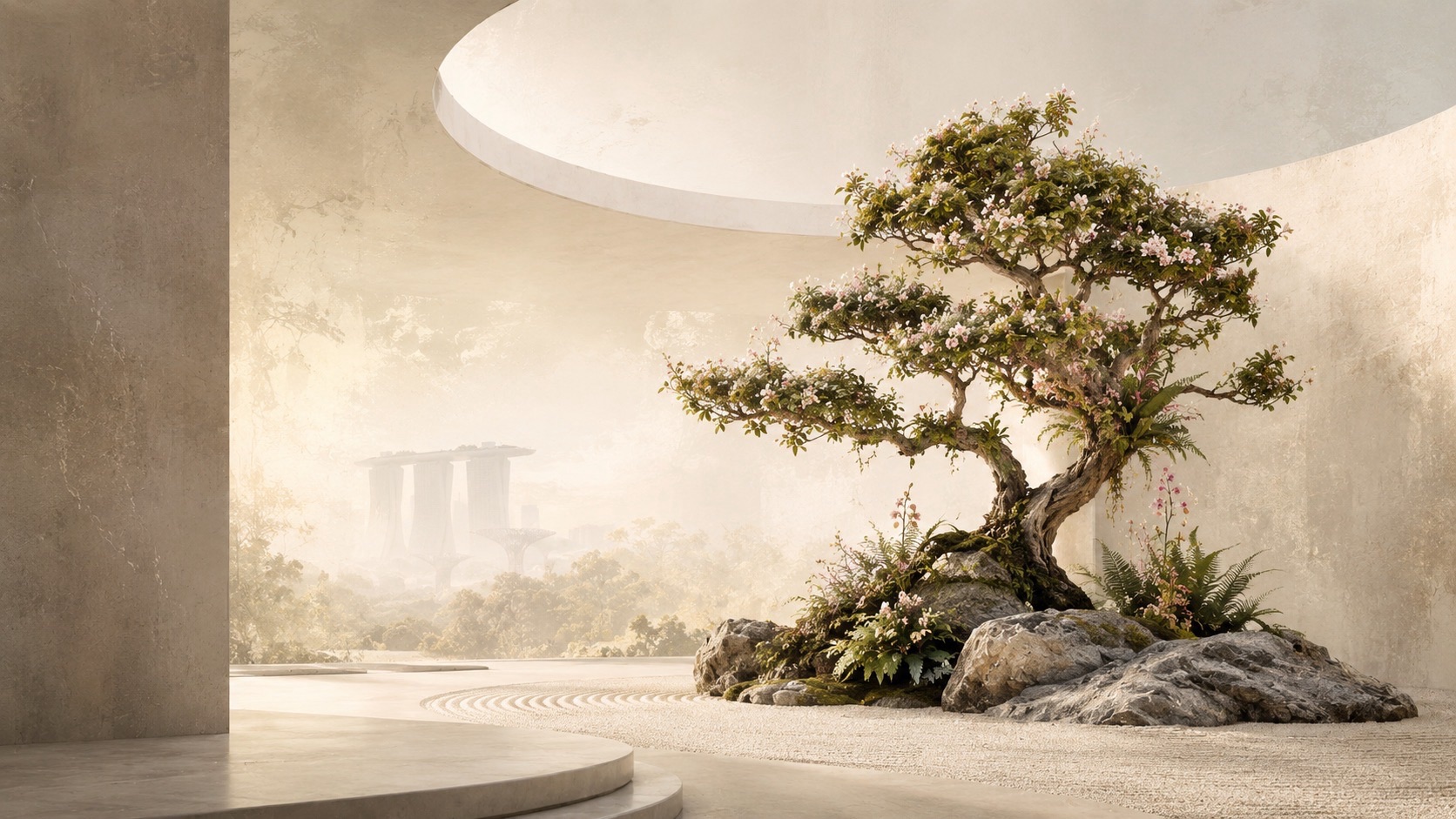
Luxury air is one of the least visible forms of abundance. People searching for indoor air quality, luxury ventilation, fresh air in homes, air purification, humidity control and healthy luxury interiors are often asking the same deeper question: why can one room feel immediately fresh, calm and comfortable while another feels stale even when both look beautiful?
Did you know? Air may be the most important material in a room because it fills nearly all the space that furniture does not. We breathe it, smell it, heat it, cool it, filter it, humidify it, dehumidify it and move through it constantly. Luxury air begins when the atmosphere itself is designed well enough that nobody has to think about it. The room simply feels fresh, quiet, comfortable and alive.
This is the air chapter of The Art of Luxury | What Is Luxury?, following The Art of Luxury | Gardens.
Gardens shape the air outside.
Architecture shapes the air inside.
Did You Know? Fresh Air Is Not the Same as Cold Air
A room can be cold and still feel stale.
A room can be warm and feel fresh.
Freshness depends on more than temperature.
Air movement matters.
Ventilation matters.
Humidity matters.
Odour matters.
Filtration matters.
Luxury climate design treats all of these as one system rather than asking the thermostat to solve everything.
The Air Equation
A useful way to think about luxury air is:
Luxury Air = Freshness + Temperature + Humidity + Movement + Filtration + Quiet + Scent Restraint
Freshness keeps rooms from feeling stale.
Temperature creates thermal comfort.
Humidity changes how the body and materials experience a space.
Movement prevents air from feeling dead.
Filtration removes unwanted particles from circulated air.
Quiet keeps ventilation from becoming background machinery.
Scent restraint prevents atmosphere from becoming perfume overload.
Ventilation Is the Invisible Doorway
Rooms need exchange.
People breathe.
Cooking produces odours and moisture.
Bathrooms create humidity.
Materials release smells.
Closed rooms accumulate yesterday.
Ventilation lets a building renew itself.
Luxury ventilation succeeds when exchange happens without drafts, noise or constant user intervention.
That is The Art of Luxury | Effortlessness applied to atmosphere.
The Open Window Is Still a Luxury Technology
Sometimes the most sophisticated ventilation device is a window that opens well.
Fresh morning air enters.
Heat escapes.
Rain can be heard.
Garden scent drifts in.
The room becomes connected to weather.
But this works only when outside conditions are suitable.
Luxury means having options: natural ventilation when the world outside is pleasant, controlled ventilation when it is not.
Read The Art of Luxury | Freedom and Autonomy.
Air Movement Changes Perceived Comfort
A still room can feel warmer than a gently moving one.
This is why fans can create comfort without always requiring colder air.
Ceiling fans.
Cross-ventilation.
Courtyard breezes.
Openings aligned with prevailing air movement.
Luxury comfort sometimes comes from moving air intelligently rather than forcing temperature lower.
Continue with The Art of Luxury | Comfort Is Engineered.
Humidity Is the Hidden Mood of a Room
Humidity changes how air feels.
It also changes how materials behave.
Timber moves.
Leather responds.
Textiles can feel different.
Condensation can appear on cool surfaces.
Luxury climate control therefore protects both people and objects.
Air is part of The Art of Luxury | Stewardship.
Materials Live Inside the Air
Furniture does not experience a room separately from its atmosphere.
Timber responds to moisture.
Metals react with surrounding conditions.
Textiles absorb odours.
Paper and artworks can be sensitive to environmental change.
Air is therefore part of material care.
A beautiful interior can deteriorate if atmosphere is treated as an afterthought.
Explore The Art of Luxury | Luxury Materials.
Air Can Make Craftsmanship Last Longer
A carefully made object deserves an appropriate environment.
Stable conditions reduce stress on some materials.
Good storage reduces exposure.
Ventilation reduces trapped moisture in suitable spaces.
Filtration can reduce unwanted dust reaching delicate surfaces.
Luxury stewardship therefore extends beyond polishing and repair.
It includes the invisible environment surrounding the object.
Read The Art of Luxury | Craftsmanship.
Scent Is Air with Memory Attached
Smell can identify a place before the eye does.
Rain on stone.
Timber in an old room.
Tea.
Flowers.
Sea air.
A garden after rain.
Scent can become part of memory because atmosphere is experienced emotionally as well as physically.
That is why air connects naturally with The Art of Luxury | Memory and Meaning.
Luxury Scent Requires Restraint
A beautiful scent at low intensity can enrich atmosphere.
Too much can dominate the room.
Luxury scent should not announce itself before every other sense has a chance.
The goal is not to perfume space until all places smell alike.
The goal is to let atmosphere support the place.
This is why restraint matters.
Read The Art of Luxury | Restraint.
The Best Air Has Almost No Story
When air is bad, people notice immediately.
Too warm.
Too humid.
Too dry.
Stale.
Drafty.
Over-perfumed.
Noisy ventilation.
When air is excellent, it often disappears from attention.
That invisibility is a mark of successful design.
Luxury air is the atmosphere nobody has to complain about.
Quiet Ventilation Is a Form of Acoustic Luxury
Mechanical systems can solve one comfort problem and create another.
A room may be cool but noisy.
Fresh but drafty.
Filtered but mechanically intrusive.
Luxury systems move enough air without constantly reminding people that machines are operating.
Air quality and acoustic quality should reinforce one another.
Continue with The Art of Luxury | Silence Is Luxury.
Air Conditioning Is Really Atmosphere Engineering
Cooling is only part of the job.
Air has to move.
Heat has to be removed.
Moisture may need management.
Filters need maintenance.
Controls must be intuitive.
The equipment must fit architecture.
The system should respond to occupancy and activity rather than force every room into one climate.
True climate luxury is personalised atmosphere.
Read The Art of Luxury | Personalisation.
Fresh Air and Privacy Can Conflict
Opening a window can invite more than breeze.
Noise.
Views inward.
Street odours.
Dust.
Heat.
Rain.
Luxury architecture solves this conflict through courtyards, screens, landscaping, setbacks, controlled ventilation and careful opening design.
The goal is breathable privacy.
Explore The Art of Luxury | Privacy Is the New Luxury.
Gardens Can Become Air Infrastructure
Trees create shade.
Leaves move air visibly.
Planting can soften hot surfaces.
Courtyards can help create sheltered microclimates.
Fragrant plants can add subtle seasonal scent.
Landscape and atmosphere are linked.
A garden is not just something outside the building.
It can help shape what the building feels like inside.
Read The Art of Luxury | Gardens.
Water Changes Air Too
Air and water constantly interact.
Evaporation can cool surfaces and air under suitable conditions.
Rain changes temperature and scent.
Sea air carries moisture and salt.
Hot baths increase local humidity.
Pools require ventilation strategies indoors.
Luxury environmental design understands atmosphere as a system rather than treating air and water separately.
Continue with The Art of Luxury | Water.
Air Makes Seasonality Physical
You can sometimes feel the season before you see it.
Cooler morning air.
Humidity before rain.
Dryness.
Wind direction.
Flowering scents.
Sea breeze.
Atmosphere carries the calendar into the body.
That is why The Art of Luxury | Seasonality is also an air story.
Air Is a Security and Resilience System
Buildings need to remain habitable when outside conditions change.
Smoke.
Heat.
Humidity.
Pollution events.
Mechanical failure.
Luxury resilience may include filtration, zoning, backup power, operable windows or alternative ventilation strategies depending on context.
The point is not fear.
It is continuity.
Read The Art of Luxury | Security and Safety.
Hotels Reveal the Difference Between Temperature and Atmosphere
A hotel room can be technically cool and still feel wrong.
The air may be too dry.
The fan may be noisy.
The room may smell strongly of cleaning products.
The window may not open.
The bathroom humidity may linger.
Luxury hospitality understands atmosphere as part of service.
The guest should not have to become a building engineer to feel comfortable.
Read The Art of Luxury | Service Is the Invisible Luxury.
Travel Changes When You Notice Air
Mountain air.
Sea breeze.
Dry desert evenings.
Humid tropical mornings.
Cold winter streets.
A garden after rain.
Atmosphere is part of place.
Luxury travel becomes richer when visitors notice how a destination feels on the skin and in the lungs, not only how it looks in photographs.
This is The Art of Luxury | Attention Is the Rarest Luxury applied to climate.
Singapore: Air in a Hot, Humid Tropical City
Singapore makes air design especially interesting because outdoor conditions are often warm and humid.
Shade matters.
Air movement matters.
Covered walkways matter.
Courtyards matter.
Air-conditioning matters.
So does the transition between indoor and outdoor space.
Tropical luxury is not simply colder interiors.
It is an intelligent gradient between sun, shade, breeze and conditioned air.
Monaco: Sea Air, Terraces and Mediterranean Atmosphere
Monaco offers a different relationship with air.
Terraces open toward the Mediterranean.
Sea breezes meet steep urban topography.
Salt air interacts with buildings, metals and mechanical systems.
Indoor-outdoor living can feel extraordinary when weather is mild.
The luxury lies in access to atmosphere while still having control when conditions change.
Explore Crazy Rich Monaco | Monaco Real Estate, Property Prices and the Scarcity Economy.
China: Air, 空气 and 通风
For bilingual English–Chinese readers, several words help describe atmospheric luxury precisely.
空气 means air.
新鲜空气 means fresh air.
通风 means ventilation.
空气流动 means air movement.
湿度 means humidity.
过滤 means filtration.
气味 means smell or odour.
清新 means fresh or refreshing.
The vocabulary reminds us that “air” is not one thing. It is temperature, movement, moisture, scent and cleanliness experienced together.
English–Chinese Air Vocabulary | 空气、通风与湿度词汇
- air — 空气
- fresh air — 新鲜空气
- ventilation — 通风
- airflow — 气流 / 空气流动
- humidity — 湿度
- filtration — 过滤
- air quality — 空气质量
- draft — 穿堂风 / 冷风感
- odour — 气味
- scent — 香气 / 气味
- dehumidification — 除湿
- air-conditioning — 空调
- cross-ventilation — 对流通风
- fresh — 清新的
- stale air — 闷浊空气 / 不新鲜的空气
Visit and Touring Vocabulary | Rooms, Climate and Fresh Air · 房间、气候与新鲜空气
1. Can the window be opened? · 窗户可以打开吗?
Useful in hotels and apartments. 中文:窗户可以打开吗?
2. Is there good ventilation? · 这里通风好吗?
A useful room question. 中文:这里通风好吗?
3. Can we make the room cooler? · 可以把房间调凉一点吗?
Useful when adjusting comfort. 中文:可以把房间调凉一点吗?
4. Can we reduce the air-conditioning? · 可以把空调调弱一点吗?
Useful when the room feels too cold or drafty. 中文:可以把空调调弱一点吗?
5. Is the room humid? · 房间里湿度高吗?
Useful in tropical climates. 中文:房间里湿度高吗?
6. Is there an air purifier? · 有空气净化设备吗?
Useful where filtration matters. 中文:有空气净化设备吗?
7. Could we have a room without strong fragrance? · 可以安排一个没有浓烈香味的房间吗?
Useful for scent-sensitive travellers. 中文:可以安排一个没有浓烈香味的房间吗?
8. Where can we get some fresh air? · 哪里可以呼吸一点新鲜空气?
Useful in dense cities and large buildings. 中文:哪里可以呼吸一点新鲜空气?
9. Is there a terrace or balcony? · 有露台或阳台吗?
Useful for indoor-outdoor living. 中文:有露台或阳台吗?
10. Is there a sea breeze in the evening? · 晚上有海风吗?
Useful for coastal destinations. 中文:晚上有海风吗?
11. Does the garden smell different after rain? · 下雨后花园的气味会不同吗?
A beautiful sensory-travel question. 中文:下雨后花园的气味会不同吗?
12. The air feels very fresh here. · 这里的空气感觉很清新。
A simple compliment for gardens, mountains and coastal stays. 中文:这里的空气感觉很清新。
Continue with the Top 100 Vocabulary for Visiting and Touring | World City Directory.
How to Notice Luxury Air Without Spending More
- Open windows when outdoor conditions are pleasant and safe.
- Notice which rooms feel stale and which feel naturally fresh.
- Use fans and airflow before assuming colder air is always necessary.
- Keep filters and ventilation systems maintained.
- Avoid overwhelming rooms with unnecessary fragrance.
- Notice how humidity changes materials and comfort.
- Spend time in gardens, waterfronts and shaded outdoor spaces.
- Ask whether a room needs colder air, fresher air or simply more air movement.
Luxury atmosphere often begins with better observation before it begins with more equipment.
What Students Can Learn from Luxury Air
Physics
Air movement, pressure, heat transfer and evaporation help explain ventilation and thermal comfort.
Chemistry
Air contains gases, moisture, particles and odour compounds that change how environments are experienced.
Architecture
Windows, courtyards, vents, shading and room planning determine how air and heat move through buildings.
Engineering
Mechanical ventilation and climate-control systems balance temperature, humidity, filtration, noise, maintenance and energy use.
Geography
Climate determines whether natural ventilation, heating, cooling or humidity management becomes most important.
Character
Air teaches attention because an invisible environment can still strongly shape comfort, memory and place.
Frequently Asked Questions
Why is fresh air a luxury?
Fresh air becomes luxurious when buildings provide comfortable temperature, appropriate humidity, good ventilation, quiet operation and control without demanding constant attention.
Is cold air the same as fresh air?
No. Temperature and freshness are different. A room can be cool but stale if air exchange and ventilation are poor.
Why does humidity matter?
Humidity affects perceived comfort, condensation and how some materials respond to the indoor environment.
Why is quiet ventilation luxurious?
Because mechanical systems should improve comfort without creating distracting background noise.
Can scent be part of luxury interiors?
Yes, but restraint matters. Scent can support memory and atmosphere, while excessive fragrance can dominate the experience.
Why do gardens affect how buildings feel?
Gardens can create shade, visual calm, seasonal scent and sheltered outdoor microclimates that influence nearby indoor-outdoor spaces.
Why do materials need climate control?
Some materials respond to temperature and moisture, so environmental stability can help preserve furniture, textiles, art and finishes.
Can open windows replace mechanical ventilation?
Sometimes natural ventilation is highly effective, but suitability depends on climate, noise, privacy, outdoor air conditions and building design.
Why can a room smell stale?
Stale odours can arise when air exchange is limited and moisture, cooking smells, furnishings or other sources accumulate in an enclosed space.
What is the simplest rule of luxury air?
Design the atmosphere so well that people notice the room, the view and the experience before they ever notice the ventilation system.
Helpful Reading Across the eduKate Knowledge Graph
- The Art of Luxury | What Is Luxury?
- The Art of Luxury | Gardens
- The Art of Luxury | Water
- The Art of Luxury | Comfort Is Engineered
- The Art of Luxury | Silence Is Luxury
- The Art of Luxury | Privacy Is the New Luxury
- The Art of Luxury | Stewardship
- The Art of Luxury | Seasonality
- The Art of Luxury | Attention Is the Rarest Luxury
- Top 100 Vocabulary for Visiting and Touring | World City Directory
The Art of Luxury Is Designing What Nobody Can See
Fresh morning air.
A quiet breeze.
Stable humidity.
A room without stale odour.
A terrace open to the evening.
A garden after rain.
Did you know? Luxury air may be one of the purest forms of invisible design because when it is excellent, nothing seems to happen. You simply feel comfortable enough to forget the atmosphere is being managed at all.
Return to The Art of Luxury | What Is Luxury?
Series navigation: The Art of Luxury | Complete Series Directory · Luxury | World Directory · Crazy Rich World