
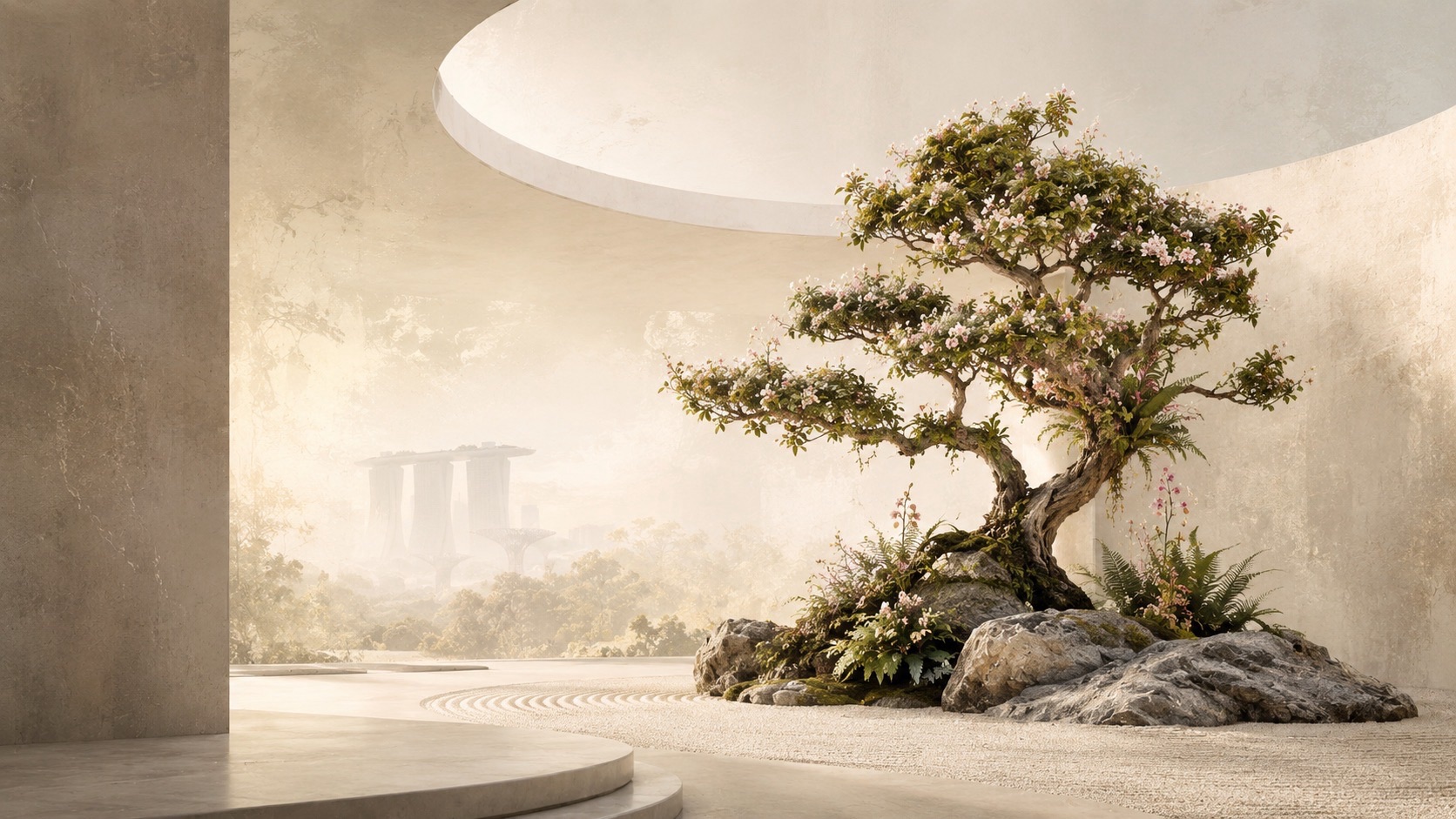
Luxury gardens are not simply collections of expensive plants. They are designed relationships among land, light, water, time, privacy, climate, movement and care. People searching for luxury garden design, landscape architecture, private gardens, Japanese gardens, botanical gardens and estate landscaping are often asking the same deeper question: why can a garden feel more luxurious than another room?
Did you know? A mature garden is one of the few luxuries that cannot be delivered instantly. Trees need years. Soil improves slowly. Shade develops. Views are edited by growth. Water systems settle into the landscape. Moss, bark and stone age. A garden is luxury made from time that remains alive. You do not merely own it. You enter a changing system whose best version may arrive long after the original designer has left.
This is the garden chapter of The Art of Luxury | What Is Luxury?, following The Art of Luxury | Water.
Water gives gardens movement.
Light gives them time.
Plants give them change.
Did You Know? A Garden Is Architecture That Keeps Growing
A building is designed, constructed and then maintained.
A garden is designed, planted, grown, pruned, replanted and continually reinterpreted.
Its walls may be hedges.
Its ceiling may be tree canopy.
Its corridors may be paths.
Its rooms may be clearings.
Its artwork may flower once a year.
Landscape architecture is architecture whose materials are partly alive.
The Garden Equation
A useful way to think about luxury gardens is:
Luxury Garden = Space + Time + Climate + Water + Light + Stewardship + Restraint
Space allows plants to mature.
Time creates scale and character.
Climate decides what can thrive.
Water sustains life.
Light shapes growth and atmosphere.
Stewardship keeps the system healthy.
Restraint prevents the garden from becoming visual noise.
The First Luxury of a Garden Is Land
Gardens require something dense cities make scarce.
Unbuilt space.
A lawn could have been another room.
A courtyard could have been more floor area.
A grove could have been parking.
A terrace garden could have been mechanical space.
When valuable land is deliberately left partly open for plants, shade and breathing room, space itself becomes a luxury.
Read The Art of Luxury | Space Is the New Luxury.
Mature Trees Are Time You Cannot Manufacture
A large tree can be purchased and transplanted.
But true maturity is difficult to fake.
Branch structure.
Root adaptation.
Bark.
Canopy depth.
Shade patterns.
Relationship with surrounding soil and architecture.
A mature tree is accumulated time made biological.
That is why old gardens can feel more luxurious than newly completed ones even when the new construction cost more.
Continue with The Art of Luxury | Patience.
Shade Is One of the Garden’s Greatest Luxuries
In hot climates, shade changes what space can do.
A path becomes walkable.
A terrace becomes usable.
A bench becomes inviting.
A façade receives less direct sun.
Plants create microclimates that architecture alone would have to engineer mechanically.
Luxury shade is comfort grown rather than installed.
Read The Art of Luxury | Comfort Is Engineered.
A Garden Creates Privacy Without Always Creating Walls
Planting can edit visibility.
A hedge blocks direct sightlines.
Bamboo filters a boundary.
A grove creates visual depth.
Climbers soften architecture.
A courtyard turns the view inward.
Landscape can create privacy while feeling less defensive than a solid barrier.
That is where gardens meet The Art of Luxury | Privacy Is the New Luxury.
Gardens Are Designed with Views, Not Just Plants
A good garden edits the eye.
Hide the service road.
Frame the mountain.
Reveal the water slowly.
Borrow a distant tree into the composition.
Use a wall to make one flowering branch more important.
Luxury landscape design is often less about adding objects and more about controlling what is seen, when it is seen and from where.
That is spatial connoisseurship.
Read The Art of Luxury | Taste and Connoisseurship.
Borrowed Scenery Makes a Garden Larger Than Its Boundary
A garden does not have to own every view it uses.
A distant hill.
A neighbouring tree canopy.
A temple roof.
A skyline.
A body of water.
Framed carefully, these become part of the garden experience.
This idea teaches a larger luxury principle:
Access can sometimes create more value than ownership.
Continue with The Art of Luxury | Access Over Ownership.
Water Makes Gardens Move
A pond reflects.
A stream guides.
A fountain sounds.
A rill leads the eye.
Rain changes every surface.
Water introduces motion into a composition otherwise built largely from slow-growing forms.
It also attracts insects, birds and other life.
A garden with water becomes a small ecosystem as well as an aesthetic object.
Read The Art of Luxury | Water.
Light Makes the Garden Change by the Hour
Morning light reveals one side.
Noon compresses shadows.
Late afternoon lengthens them.
Leaves become translucent when backlit.
Water reflects sky.
Wet stone darkens after rain.
The same garden creates multiple experiences because light keeps rewriting it.
Explore The Art of Luxury | Light.
Seasonality Makes Gardens Impossible to Finish
A garden is never really finished.
Flowers come and go.
Fruit appears.
Leaves change.
Rainfall shifts.
Birds arrive and leave.
Growth changes proportions.
Luxury gardening does not try to freeze one perfect photograph forever.
It designs for change.
Continue with The Art of Luxury | Seasonality.
Imperfection Makes Gardens Feel Alive
A perfectly symmetrical planting plan will eventually meet biology.
One tree grows faster.
One branch leans.
One plant flowers early.
Storms remove limbs.
Moss appears.
Luxury gardens often become more beautiful as strict geometry softens into mature variation.
That is controlled surrender.
Read The Art of Luxury | Imperfection.
Soil Is the Invisible Luxury Material
Visitors notice flowers.
Gardeners notice soil.
Drainage.
Structure.
Organic matter.
Moisture retention.
Roots.
Microbial life.
A garden can look expensive for one season and fail if the invisible substrate was neglected.
Luxury gardens begin below the surface.
Plant Selection Is Climate Intelligence
The rarest plant is not automatically the best plant.
Does it suit the climate?
Will it survive the soil?
How much water does it need?
Will roots damage structures?
Will the canopy eventually block a view?
Luxury landscape design chooses plants for future behaviour, not only first-day appearance.
Good taste includes ecological fit.
A Garden Can Be Expensive and Still Feel Wrong
Too many specimen plants.
Too many colours.
Too many materials.
Too many ornaments.
Too many competing focal points.
Luxury landscape often improves through editing.
Repeat one tree species.
Leave breathing room.
Frame one view.
Let one old tree dominate.
Restraint allows nature to become legible.
Read The Art of Luxury | Restraint.
Gardens Create Silence Without Becoming Empty
Leaves move.
Birds call.
Water runs.
Wind changes.
A garden is not silent in the acoustic sense.
Yet it can feel quieter because the sounds are less demanding than traffic, alarms or conversation.
Nature gives attention somewhere gentle to rest.
Continue with The Art of Luxury | Silence Is Luxury.
Gardens Are Slow Service Systems
A beautiful garden looks effortless.
It is not.
Irrigation is checked.
Pruning is timed.
Soil is improved.
Pests are monitored.
Leaves are managed.
Paths are repaired.
Plants are replaced.
The garden feels peaceful because someone is continually doing work elsewhere.
That is The Art of Luxury | Effortlessness in biological form.
Pruning Is the Art of Subtraction
Growth alone does not create a good garden.
Some branches must be removed.
Some views must be opened.
Some plants must be moved.
Some abundance must be edited.
Pruning is one of luxury gardening’s deepest metaphors.
Care is not always adding.
Sometimes care is deciding what should no longer remain.
Bonsai Compresses Landscape into Time and Attention
Bonsai is not simply a small tree.
It is a long relationship among plant, container, pruning, wiring, watering, season and judgement.
Its luxury does not come from scale.
It comes from sustained attention.
Years can be embodied in an object small enough to carry.
See Crazy Rich Japan | Saitama Luxury Travel: 500-Year Bonsai, Royal Suites and Living Art.
Japanese Gardens Show the Luxury of Editing Nature
Japanese garden traditions can use stone, moss, water, gravel, pines, bridges, lanterns and borrowed scenery with extraordinary restraint.
The goal is not necessarily to imitate untouched wilderness.
It is often to compose nature so attention slows down.
A turn in the path hides the next view.
A stone suggests a mountain.
Raked gravel can imply water.
A small space becomes mentally larger through suggestion.
Explore Crazy Rich Monaco | Japanese Garden, Zen Landscape and the Quiet-City Economy.
Chinese Classical Gardens Make Landscape into Literature
Chinese garden traditions can combine architecture, rock, water, planting, framed views, inscriptions and sequence.
A wall may contain a moon gate.
A window may act like a picture frame.
A rock can suggest a mountain landscape.
A pond can make the sky part of the composition.
Walking becomes reading.
The visitor encounters one visual sentence after another.
Explore Crazy Rich Suzhou | Private Islands, Classical Gardens, Lake Villas and Jiangnan Luxury.
A Garden Can Be a Family Legacy
A tree planted by one generation may shade another.
A path may become associated with childhood.
A flowering season can become family ritual.
A gardener’s decisions can outlive the gardener.
Gardens are unusual heirlooms because they cannot simply be placed in storage.
They must remain alive.
Legacy therefore depends on continuous care.
Read The Art of Luxury | Legacy and The Art of Luxury | Stewardship.
The Luxury Garden Must Survive Climate
A garden that requires endless emergency intervention is not necessarily luxurious.
Good landscape design anticipates reality.
Heat.
Cold.
Wind.
Rain.
Drought.
Salt air.
Storms.
Luxury means enough ecological intelligence that the garden can remain beautiful without fighting its climate every day.
Water Use Determines Whether a Garden’s Abundance Is Responsible
Lushness can be appropriate in one climate and wasteful in another.
Responsible landscape design asks:
How much irrigation is required?
Can rainwater be managed better?
Can soil retain more moisture?
Can shade reduce evaporation?
Can planting reflect local conditions?
The most convincing luxury garden makes abundance feel intelligent rather than careless.
Singapore: The Garden City as Civilisation-Level Luxury
Singapore is especially interesting because greenery is not confined to private estates.
Roads, parks, reservoirs, housing estates, business districts, schools and major attractions all participate in a broader urban landscape system.
In a dense tropical city, greenery can create shade, soften infrastructure, manage water, support biodiversity and provide visual relief.
This turns landscape into shared luxury.
People do not need to own a private estate to experience designed nature.
Explore Crazy Rich Singapore | Gardens by the Bay and the Horticultural Attraction Economy.
Monaco: Gardens Where Land Is Extremely Scarce
Monaco makes garden space especially interesting because land is scarce and highly valued.
Every planted terrace competes with built area.
Every public garden creates breathing room inside urban compression.
Landscape here becomes a deliberate refusal to build every possible square metre.
That is why quiet green spaces can feel disproportionately luxurious.
They offer shade, silence, privacy and psychological distance inside one of the world’s most spatially constrained luxury environments.
Explore Crazy Rich Monaco | Japanese Garden, Zen Landscape and the Quiet-City Economy.
China: Gardens, 园林 and 借景
For bilingual English–Chinese readers, garden vocabulary reveals an entire design philosophy.
花园 means garden.
园林 refers more broadly to garden and landscape design traditions.
景观 means landscape.
借景 means borrowed scenery — using a view beyond the immediate garden as part of the composition.
假山 means artificial or ornamental rockery.
水景 means waterscape or water feature.
庭院 means courtyard.
The term 借景 captures a sophisticated luxury principle: not everything valuable must be owned to become part of your experience.
English–Chinese Garden Vocabulary | 花园、园林与景观词汇
- garden — 花园
- landscape garden — 园林
- landscape — 景观
- courtyard — 庭院
- borrowed scenery — 借景
- rockery — 假山 / 山石景观
- water feature — 水景
- shade — 阴凉 / 遮荫
- canopy — 树冠
- hedge — 树篱
- path — 小径
- pruning — 修剪
- irrigation — 灌溉
- soil — 土壤
- seasonal planting — 季节性种植
Visit and Touring Vocabulary | Gardens, Parks and Landscape Design · 花园、公园与景观设计
1. When is the garden most beautiful? · 花园什么时候最美?
Useful for seasonal visits. 中文:花园什么时候最美?
2. Which plants are native here? · 哪些植物是本地原生的?
Useful for understanding climate and ecology. 中文:哪些植物是本地原生的?
3. How old is this tree? · 这棵树有多少年了?
A wonderful question in mature gardens. 中文:这棵树有多少年了?
4. Is this borrowed scenery? · 这是借景吗?
Useful in Chinese and Japanese garden traditions. 中文:这是借景吗?
5. Where is the quietest part of the garden? · 花园里最安静的地方在哪里?
Useful for slow touring. 中文:花园里最安静的地方在哪里?
6. When does this flower bloom? · 这种花什么时候开?
Useful for seasonal planning. 中文:这种花什么时候开?
7. Is there a shaded walking route? · 有比较阴凉的步行路线吗?
Especially useful in tropical climates. 中文:有比较阴凉的步行路线吗?
8. How is the garden watered? · 这个花园是怎样灌溉的?
A practical landscape-design question. 中文:这个花园是怎样灌溉的?
9. Is this garden designed to change with the seasons? · 这个花园会随着季节变化吗?
Useful for understanding planting strategy. 中文:这个花园会随着季节变化吗?
10. What view is this path leading us toward? · 这条小径是引导我们看什么景色?
A strong landscape-composition question. 中文:这条小径是引导我们看什么景色?
11. Who maintains the garden? · 谁负责维护这个花园?
Useful for understanding stewardship. 中文:谁负责维护这个花园?
12. I like how the garden reveals itself slowly. · 我喜欢这个花园慢慢展开的感觉。
A lovely compliment for layered landscape design. 中文:我喜欢这个花园慢慢展开的感觉。
Continue with the Top 100 Vocabulary for Visiting and Touring | World City Directory.
How to Notice Garden Luxury Without Owning a Garden
- Visit the same public garden in different seasons.
- Notice where shade falls at different times of day.
- Learn the names of a few common local trees.
- Watch how paths reveal and hide views.
- Notice how water changes sound and temperature.
- Look for places where distant scenery becomes part of the composition.
- Compare a newly planted landscape with a mature one.
- Ask what invisible maintenance keeps the garden feeling effortless.
You do not need to own landscape to become literate in it.
What Students Can Learn from Luxury Gardens
Biology
Plants respond to light, water, soil, temperature, pests and competition, making gardens living laboratories.
Geography
Climate and local ecology determine which landscapes are sustainable and which require intensive intervention.
Architecture
Gardens extend rooms outdoors through paths, thresholds, courtyards, framed views and sequences.
Engineering
Drainage, irrigation, retaining structures, soil preparation and lighting all support apparently natural landscapes.
Art
Landscape design uses composition, contrast, rhythm, texture, scale and negative space just like other visual arts.
Character
Gardens teach patience because their most important results may take years to appear.
Frequently Asked Questions
Why are gardens luxurious?
Gardens require land, time, skilled maintenance, water, ecological knowledge and long-term care while providing privacy, shade, beauty and changing seasonal experiences.
Why do mature gardens feel more luxurious?
Mature trees, established soil, layered planting and developed canopy contain years that cannot be reproduced instantly.
What is borrowed scenery?
Borrowed scenery is the design technique of incorporating a distant view outside the immediate garden boundary into the visual composition.
Why is shade important in luxury gardens?
Shade improves outdoor comfort, protects some materials and plants, reduces heat and makes more of the garden usable through the day.
Why does soil matter so much?
Soil controls root health, drainage, water retention and nutrient availability, making it one of the garden’s most important invisible systems.
Are rare plants always more luxurious?
No. A rare plant that struggles in the climate may be less convincing than a well-chosen plant that thrives, matures beautifully and supports the landscape.
Why do gardens require so much maintenance?
Because living materials keep growing and responding to climate, water, pests and competition. The garden remains dynamic rather than finished.
Can gardens create privacy?
Yes. Hedges, trees, courtyards, layered planting and landform can filter views and create separation without relying only on solid walls.
Can public gardens be a form of luxury?
Yes. Public gardens convert land, horticultural expertise and long-term maintenance into shared access to shade, beauty, biodiversity and calm.
What is the simplest rule of luxury garden design?
Design for what the garden will become, not merely how it looks on planting day.
Helpful Reading Across the eduKate Knowledge Graph
- The Art of Luxury | What Is Luxury?
- The Art of Luxury | Water
- The Art of Luxury | Light
- The Art of Luxury | Seasonality
- The Art of Luxury | Patience
- The Art of Luxury | Space Is the New Luxury
- The Art of Luxury | Stewardship
- Crazy Rich Singapore | Gardens by the Bay and the Horticultural Attraction Economy
- Crazy Rich Monaco | Japanese Garden, Zen Landscape and the Quiet-City Economy
- Top 100 Vocabulary for Visiting and Touring | World City Directory
The Art of Luxury Is Planting for a Future You Cannot Fully Control
A tree grows.
A path disappears into shade.
A pond reflects a different sky.
A flower arrives once a year.
A garden changes while remaining itself.
Did you know? A luxury garden may be one of the purest forms of stewardship because its beauty depends on accepting that you are not designing a finished object. You are beginning a relationship with time, climate and life.
Return to The Art of Luxury | What Is Luxury?
Series navigation: The Art of Luxury | Complete Series Directory · Luxury | World Directory · Crazy Rich World