
Did you know that a shopping centre does not need to be the newest or flashiest building to play an important role in a neighbourhood? Bukit Timah Plaza shows how everyday usefulness can matter as much as spectacle.
At 1 Jalan Anak Bukit, Bukit Timah Plaza became part of the late-1970s idea of bringing comprehensive retail services to residential districts beyond the city centre. Its story is connected to the apartments of Sherwood Towers, nearby roads and the shopping habits of generations of households.
The quick answer: Bukit Timah Plaza works as a suburban mixed-use centre. Shops, essential services and residential homes occupy a connected development. Visitors may come for groceries, practical errands or classes, while residents benefit from a concentration of services close to home. The centre’s continuing function is different from the heritage history of the nearby former Beauty World market.
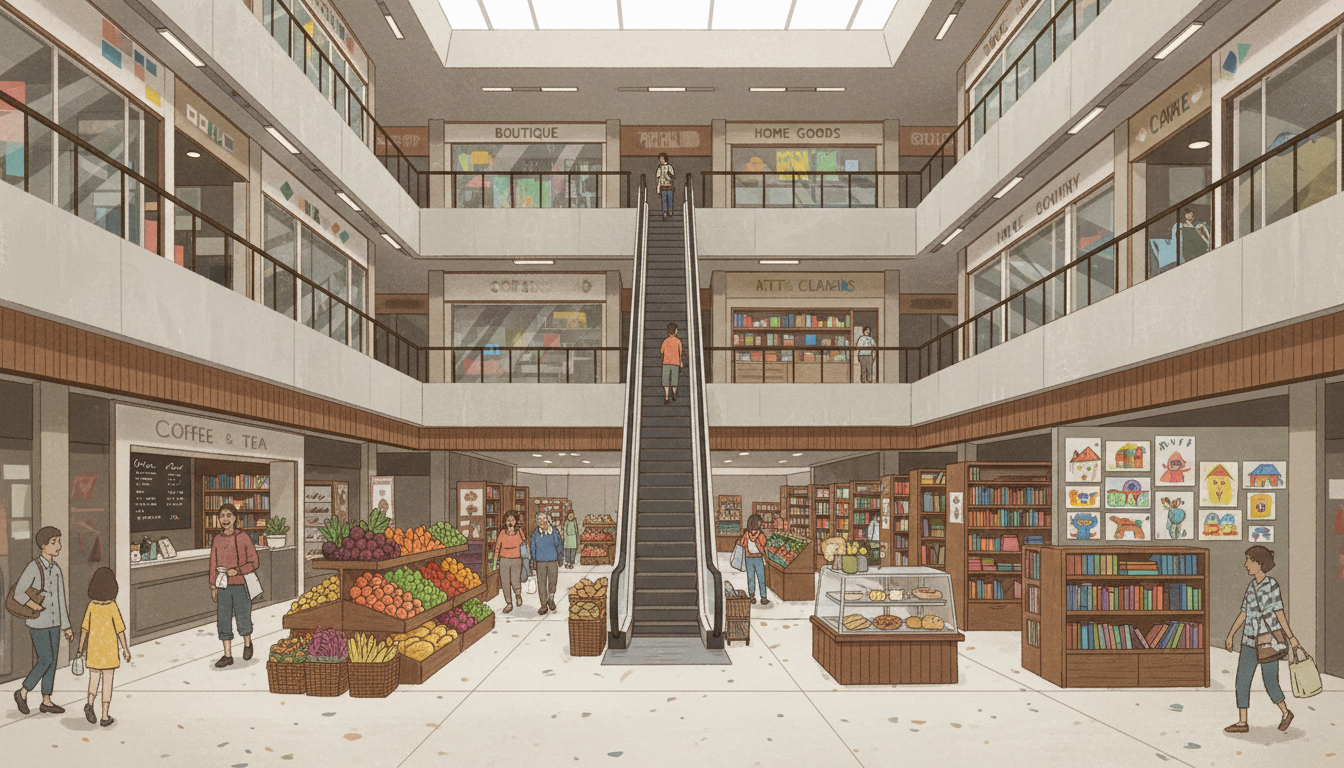
Featured image is an original editorial illustration of a neighbourhood shopping mall, not a photograph of Bukit Timah Plaza or its current tenant directory.
Quick navigation: Why did Singapore build big shopping centres outside town? · What makes Bukit Timah Plaza a mixed-use development? · How does a neighbourhood mall differ from a destination mall? · Why do location and road access matter so much? · How can small specialist shops compete with larger malls? · What is the role of the apartments above? · How can families read the mall as a piece of urban history? · What should visitors check in 2026?
1. Why did Singapore build big shopping centres outside town?
Today it seems normal to have supermarkets and retail centres near residential districts. In the 1970s, the idea of a sizeable ‘one-stop’ shopping centre outside the city core was relatively new.
According to Singapore Graphic Archives, Bukit Timah Plaza was one of the early developments described as a regional shopping centre, intended to serve growing residential areas. Contemporary design records note an opening in November 1978; other property descriptions place its overall completion around 1979.
This difference between a retail opening date and completion reporting does not change the main point: the development belongs to the late-1970s wave of suburban retail rather than the much later MRT era.
The goal was simple: residents would no longer need to go into central Singapore for every shopping trip. Everyday commerce could follow where people lived.
2. What makes Bukit Timah Plaza a mixed-use development?
A mixed-use building combines different functions on or above a connected site. Bukit Timah Plaza has a multi-level retail podium, and the residential component is known as Sherwood Towers.
CBRE described the development in a 2025 property release as consisting of a four-storey retail block with two residential apartment blocks containing 269 units. Retail tenants and individual unit ownership arrangements may change, but the broad physical organisation is enduring.
Why does that layout make sense? Homes create repeat demand for daily essentials. Shops and services help residents without requiring a long journey. Shared location creates convenience, although it also introduces practical questions about deliveries, access, noise and traffic.
The value of mixed use is not that every resident buys everything downstairs. It is that a variety of needs can be met within a fairly compact area.
3. How does a neighbourhood mall differ from a destination mall?
Some large malls depend on entertainment, major fashion launches or visitors travelling across Singapore. A neighbourhood mall can remain useful with a different business mix: supermarkets, food, clinics, education services and small specialist retailers.
Commercial marketing materials from 2025 described Bukit Timah Plaza as having a large FairPrice Finest supermarket alongside other retail and food uses. Specific tenants are subject to change, so an old directory should not be treated as a guaranteed list of shops open in October 2026.
Everyday services encourage repeat visits. A family may stop by several times a week to shop, buy something practical or attend a scheduled appointment. Such routines can create a different kind of commercial stability from a mall built around occasional high-spending trips.
4. Why do location and road access matter so much?
Bukit Timah Plaza sits near the junction of Upper Bukit Timah Road and Jalan Anak Bukit, not far from Beauty World MRT on the Downtown Line. Major roads and public transport make it reachable from nearby homes and schools.
However, being close on a map does not always mean a short or convenient walking journey. A pedestrian needs actual crossings, suitable pavements and the right building entrance. Someone arriving with a stroller or in a wheelchair may need a different path from a person who uses stairs.
Good retail access therefore involves the entire trip: transport, walking, crossing, wayfinding, carpark or drop-off, and how easily one can reach the desired unit inside.
5. How can small specialist shops compete with larger malls?
Small retailers rarely win solely by offering more space than a national chain. They can remain relevant through specialised knowledge, convenience, repeated relationships and practical services that people need close to home.
A repair service, tuition centre or specialist retailer may draw a different visitor from a grocery shop, yet both benefit when several useful destinations sit in one complex. People can combine errands or build familiar routines.
Of course, not every small business survives. Rents, competing online services, customer patterns and changing demographics influence results. It would be inaccurate to claim all shops are thriving simply because the building has existed for decades.
The broader economic insight is that retail success depends on matching a real local need, not merely on the age or appearance of a shopping centre.
6. What is the role of the apartments above?
Sherwood Towers illustrates a planning approach that links housing directly with commerce. Residents have services very close by, while retailers have a nearby customer base, though many shoppers also arrive from elsewhere.
Mixed-use sites still require management: lifts, shared access, fire safety, waste collection and rules separating residential privacy from public shopping activity. These behind-the-scenes systems are part of why the development works.
Students can think of it as a network of functions: housing provides demand; retail supplies goods and services; transport brings additional visitors; maintenance keeps shared spaces usable. None of these works fully in isolation.
7. How can families read the mall as a piece of urban history?
A visit does not have to be a shopping spree. Try an observation exercise using public areas and an up-to-date directory. Categorise businesses by purpose: groceries, food, education, healthcare, personal services and discretionary purchases.
Next, ask which businesses help people meet needs every week and which are used less frequently. Look at where the lifts, escalators and external links direct foot traffic. Why might a supermarket draw customers to a particular floor?
Finally, compare the late-1970s suburban retail idea with the neighbourhood’s newer MRT connections and redevelopment proposals. Buildings from different periods can keep performing useful roles together.
8. What should visitors check in 2026?
One final point matters: do not confuse Bukit Timah Plaza with Bukit Timah Shopping Centre, a separate older commercial building at 170 Upper Bukit Timah Road, or with Beauty World Centre, which has its own postwar market history.
These buildings share a neighbourhood, but not an identical origin or function. Understanding those distinctions is how we move from memorising landmarks to seeing how Bukit Timah actually works.
- Address: Bukit Timah Plaza is at 1 Jalan Anak Bukit, separate from Bukit Timah Shopping Centre and Beauty World Centre.
- Business directory: confirm whether a specific shop, clinic or service is currently operating before making a special trip.
- Opening hours: an individual store’s schedule may differ from the surrounding mall.
- Transport: check the actual walking route from Beauty World MRT or relevant bus stops.
- Accessibility: use current lift and entrance guidance for the destination unit.
Frequently asked questions
When did Bukit Timah Plaza open?
Historical design records place its retail opening in November 1978, while some commercial property sources describe overall completion in 1979.
Is Bukit Timah Plaza the same as Beauty World Centre?
No. They are separate developments with different histories and locations. The original Beauty World market was also a different site from the modern Beauty World Centre.
What is Sherwood Towers?
Sherwood Towers is the residential component of the Bukit Timah Plaza mixed-use development, described by CBRE as two apartment blocks with 269 units.
Why are there schools and learning services near Bukit Timah Plaza?
Schools and households in the surrounding districts create demand for a variety of practical services, including education-related businesses. Actual tenant availability should be checked individually.
Official references and further reading
Use the original sources for current opening arrangements, policy decisions and planned transport milestones. Future targets can change.
- Singapore Graphic Archives: Bukit Timah Plaza and November 1978 opening
- CBRE Singapore: Bukit Timah Plaza mixed-use development details, 2025
- NHB: Bukit Timah Heritage Trail (background on Beauty World and local commerce)
- LTA: Downtown Line and Beauty World station context
More guides in the How Bukit Timah Works series
- How Bukit Timah Works | Why Granite, Quarries and Hills Shaped the Area
- How Bukit Timah Works | How the Rainforest Survives Inside Singapore
- How Bukit Timah Works | How the Rail Corridor Connects History and Nature
- How Bukit Timah Works | Why Schools and MRT Stations Follow the Main Road
- How Bukit Timah Works | Why Floods Happen and How the 2026 Canal Upgrade Helps
- How Bukit Timah Works | How Beauty World Grew from a Market into a Town Centre
- How Bukit Timah Works | How Kampongs, Temples and Fuyong Estate Shaped the Neighbourhood
- How Bukit Timah Works | Why Bukit Timah Was Crucial in World War II
- How Bukit Timah Works | How Dairy Farm Became a Nature Park
- How Bukit Timah Works | Why Hawkers Moved to an Interim Market
- How Bukit Timah Works | How the Former Fire Station Became a Community Hub
- How Bukit Timah Works | Why Singapore Botanic Gardens Is UNESCO Heritage
- How Bukit Timah Works | How Hume MRT Connects Homes, History and the Rail Corridor
- How Bukit Timah Works | How Rifle Range Nature Park Restores a Quarry and Protects Wildlife
- How Bukit Timah Works | How Turf City Is Becoming a New Housing Estate
- How Bukit Timah Works | Why Bukit Timah Plaza Still Serves the Neighbourhood (this guide)